Filed with Countries · Related: 60.23 History · 60.3.1 - Foreign Policy
Tags:
Timeline: The Kurds’ Long Struggle With Statelessness
The relationship between the Kurdish people and Western powers, particularly the United States, is often described by historians as a “bittersweet bond.” While the Kurds have been among the most reliable and effective partners for Western strategic interests in the Middle East, they have also been repeatedly abandoned when those same interests shifted toward maintaining relationships with regional state powers like Turkey, Iraq, or Iran.
Map of Kurdish settlement across borders
These are Izady’s geographic reconstructions and estimates, not a uniform census series or maps of political allegiance. Dates and classifications belong to each image; religious affiliation does not establish support for a government or armed group.
Kurdish distribution across the region
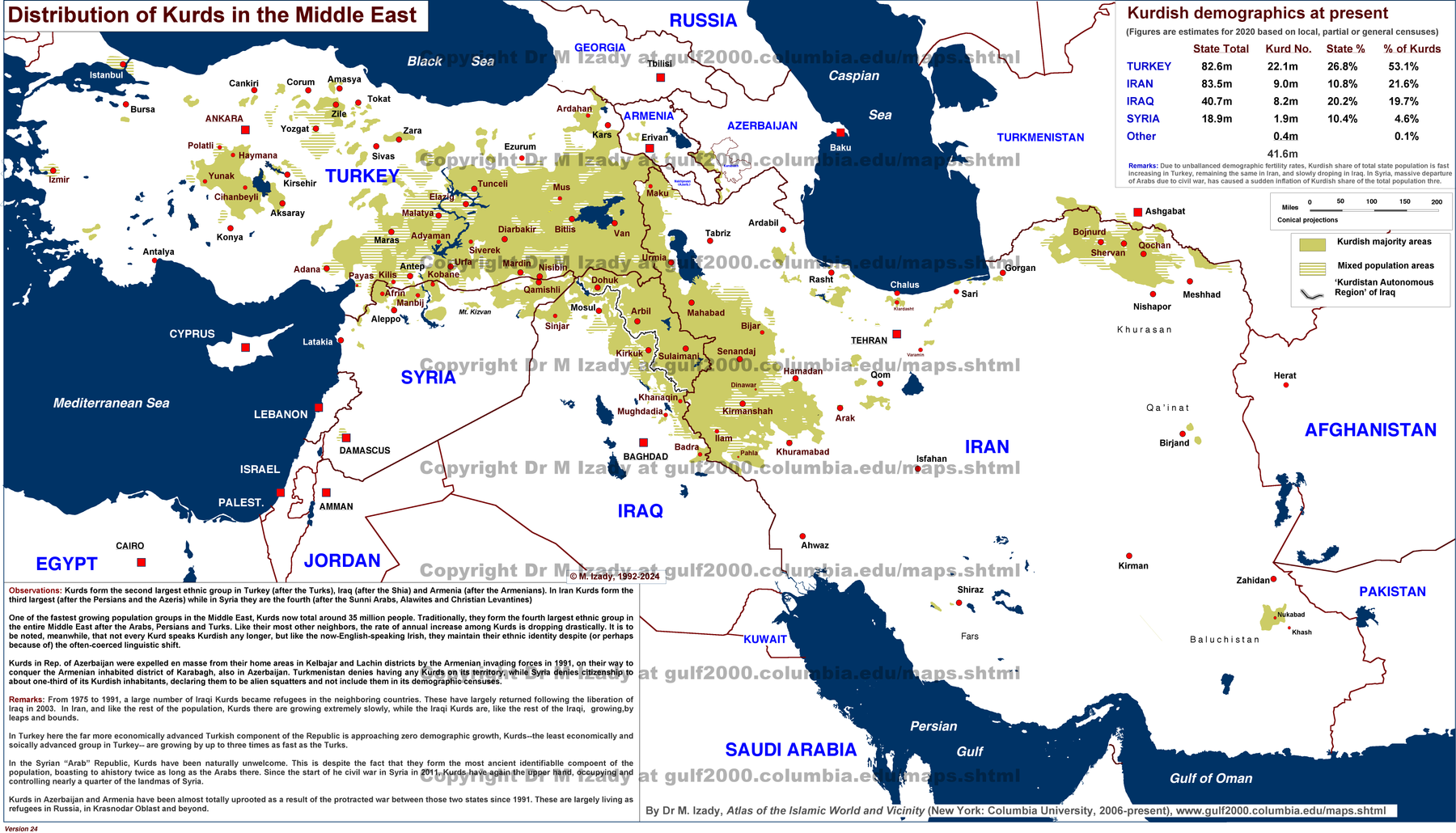
Locate Kurdish settlement across Turkey, Iraq, Iran, and Syria before reading the episodes of autonomy, outside support, and abandonment. The map’s population estimates belong to its own reference period; settlement areas are not agreed national borders.
Map source: Dr. Michael Izady, Gulf/2000, Columbia University. Original map · Collection. Personal reference use; copyright remains with the author.

Source and interpretation: Gulf2000 map collection.
Part I: Instances of Kurdish Help to the West
The Kurds have frequently served as the primary “boots on the ground” for Western military objectives, providing local intelligence, regional stability, and elite fighting forces.
1. The Cold War Counter-Balance (1960s–1970s)
During the Cold War, the U.S. and Israel used Iraqi Kurds to destabilize the Ba’athist government in Baghdad, which was leaning toward the Soviet Union. The Kurdish Peshmerga (meaning “those who face death”) conducted a massive insurgency that tied down the Iraqi military, preventing them from fully aligning with Soviet regional goals or effectively threatening U.S. allies like the Shah of Iran.
2. The “Second Front” in the Iraq War (2003)
When the U.S. invaded Iraq in 2003, Turkey refused to allow American troops to use its territory to open a northern front. The Kurds stepped in, providing the necessary infrastructure and thousands of Peshmerga fighters to secure northern Iraq. They were instrumental in:
- Capturing the major cities of Kirkuk and Mosul.
- Providing high-level intelligence that led to the capture of Saddam Hussein.
- Serving as the only stable, pro-Western region in Iraq during the post-invasion insurgency.
3. The Vanguard Against ISIS (2014–2019)
The most significant instance of assistance occurred during the rise of the Islamic State.
- In Iraq: The Peshmerga held a 1,000-kilometer front line when the Iraqi national army collapsed, protecting ethnic minorities (such as the Yazidis) and assisting the U.S.-led coalition in the liberation of Mosul.
- In Syria: The Syrian Democratic Forces (SDF), a Kurdish-led militia, became the primary ground partner for the U.S. They suffered over 11,000 casualties while retaking nearly a third of Syria from ISIS, including the capital, Raqqa, and the final stronghold in Baghouz.
Part II: The History of Broken Promises
The “betrayal of the Kurds” is a recurring theme in 20th and 21st-century diplomacy, usually occurring when Western states prioritize their relationships with recognized sovereign nations over the aspirations of the stateless Kurds.
1. The Post-WWI Division (1920–1923)
Following the collapse of the Ottoman Empire, Western powers initially promised the Kurds a path to statehood.
- The Promise: The Treaty of Sèvres (1920) explicitly provided for an autonomous Kurdish state and a future referendum for independence.
- The Betrayal: Fearing the rise of the Soviet Union and wanting to appease the new Turkish Republic under Atatürk, the West signed the Treaty of Lausanne (1923). This treaty completely ignored Kurdish aspirations, dividing their ancestral lands between Turkey, Iraq (British Mandate), Syria (French Mandate), and Iran.
2. The Algiers Agreement (1975)
In the early 1970s, the CIA and Henry Kissinger funneled millions in aid to Iraqi Kurds to keep Saddam Hussein occupied.
- The Promise: Implicit guarantees of continued support for Kurdish autonomy in exchange for their rebellion.
- The Betrayal: In 1975, the Shah of Iran and Saddam Hussein signed the Algiers Agreement, settling their border disputes. Immediately, the U.S. cut off all aid to the Kurds. When the Kurds pleaded for help as Saddam’s forces began a slaughter, Kissinger famously remarked: “Covert action should not be confused with missionary work.”
3. The 1991 Uprising
After the Gulf War, President George H.W. Bush publicly encouraged Iraqis to rise up and overthrow Saddam Hussein.
- The Promise: The Kurds interpreted this as a promise of American military backing.
- The Betrayal: When the Kurds and Shia rose up, the U.S. military stood by as Saddam used his remaining helicopter gunships to crush the rebellion. While the U.S. eventually established a “No-Fly Zone” (Operation Provide Comfort) after a massive refugee crisis, the initial abandonment led to thousands of deaths and a humanitarian catastrophe.
4. The Withdrawal from Northern Syria (2019)
After five years of fighting alongside the Kurds against ISIS, the U.S. made a sudden policy shift.
- The Promise: U.S. officials had repeatedly assured the SDF that they would remain in Northern Syria to ensure stability and protect them from Turkish aggression.
- The Betrayal: In October 2019, following a phone call with Turkish President Erdoğan, the Trump administration abruptly ordered U.S. troops to withdraw from the border “safe zones.” This green-lit a Turkish military incursion into Kurdish-held territory, forcing the Kurds—who were still guarding thousands of ISIS prisoners for the West—to turn to Russia and the Assad regime for protection.
Summary Table: Kurdish-Western Relations
| Era | Kurdish Contribution | Western Promise | Outcome |
|---|---|---|---|
| 1920s | Helped dismantle Ottoman influence. | Independent Kurdistan (Treaty of Sèvres). | Divided between 4 states (Treaty of Lausanne). |
| 1970s | Proxy war against Soviet-aligned Iraq. | Continued military support/autonomy. | Abandoned for a border deal (Algiers Accord). |
| 1991 | Massive uprising against Saddam. | Support for regime change. | Abandoned to Saddam’s air force; later “No-Fly Zone.” |
| 2014-19 | Defeated the ISIS Caliphate. | Security guarantees & “partnership.” | Sudden U.S. withdrawal; Turkish invasion. |