The U.S.’s entanglement with the Arab world began in the early 1800s with American naval battles against the Barbary pirates off the coast of North Africa. The Al Thani family, which now rules Qatar, was just a minor tribe over most of the past two centuries, dwarfed by the Al Saud family in modern-day Saudi Arabia, the Al Khalifa clan in today’s Bahrain, and the Al Nahyan family in Abu Dhabi.
As recently as the 1980s, diplomats and businessmen described Doha as a barren place with stifling heat. The economy was fueled largely by pearl farming. The Al Thanis promoted a conservative brand of Islam that left its women covered and the country largely dry of alcohol. From a distance, the only discernible building on Doha’s waterfront promenade was the pyramid-shaped Sheraton hotel.
“I mean, sleepy doesn’t really do it justice,” Sir John Jenkins, a former British diplomat focused on the Middle East, told The Free Press about his visits then. “There was nothing going on.”
Qatar’s economic fortunes soared when American and European energy giants, such as ExxonMobil and ConocoPhillips, developed the technology to exploit what turned out to be one of the largest natural gas reserves in the world. Qatar began exporting liquefied natural gas to Asia in 1997. Per-capita gross domestic product is now $121,610, among the highest in the world, compared with $89,110 in the U.S., according to the International Monetary Fund.
Money gave the Al Thanis an opportunity to follow the same playbook long used by Persian Gulf rulers: seeking a foreign patron to guarantee their security. Instead of the Ottoman Empire and Great Britain, Qatar turned toward Washington.
In the early 2000s, Qatar successfully wooed the U.S. away from the air base in Saudi Arabia, where it had been for more than a decade after Saddam Hussein invaded Kuwait in 1990. Qatar poured more than $1 billion into the runways, barracks, and hangars of Al Udeid. The facility can house thousands of American troops and is also a regional base for the UK’s Royal Air Force. How Qatar Bought America - by Frannie Block and Jay Solomon
filters: and: - file.ext == "md" - 'file.hasLink("Qatar")' - '!file("Qatar").links.contains(file.asLink())'views: - type: table name: Notes not linked from the hub order: - file.name - file.folder - Category - Genre - up - related sort: - property: file.name direction: ASC
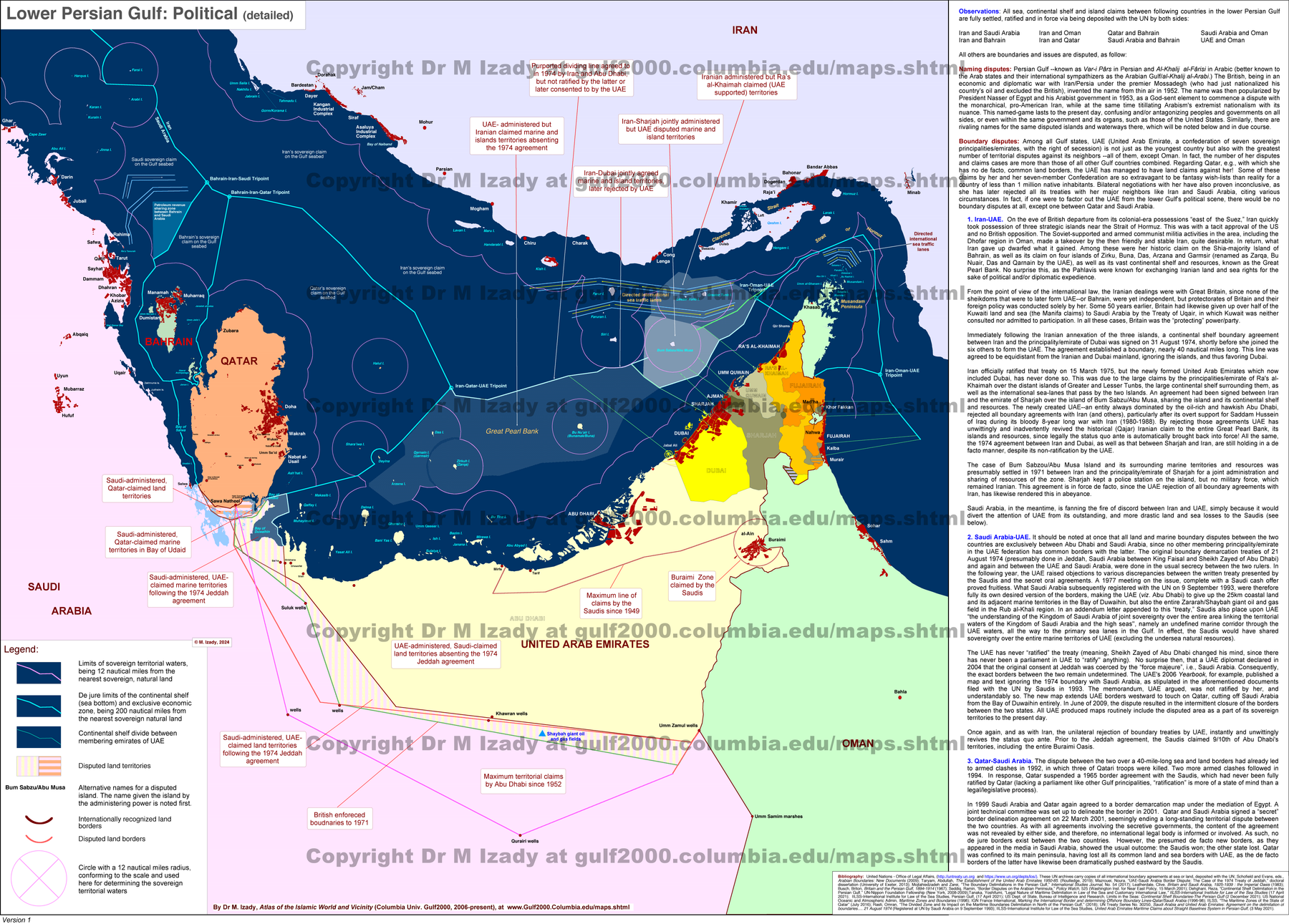
Map for Qatar’s Gulf setting
A geographic reference for Qatar, Bahrain, the UAE, and the Iranian coast. Maritime lines, disputed islands, and interpretive notes represent the author’s depiction and do not by themselves settle sovereignty disputes.
Qatar and the lower Persian Gulf
Locate the peninsula, neighboring states, ports, and maritime geography. This supplements the history and diplomacy material; it is not a map of British control around 1900.
Map source: Dr. Michael Izady, Gulf/2000, Columbia University. Original map · Collection. Personal reference use; copyright remains with the author.