Zibaldone 2024–2025 journal
Journal connection: A country-focused page on Saudi Arabia.
Source boundary: These are captured journal materials; the integration does not independently verify every clipped claim, quotation, or figure.
PDF++ pages: p. 231 (file not included in this release)
Embedded preview:
Zibaldone 2024-2025.pdf (file not included in this release)
Open the complete Zibaldone page index
U.S. Military Bases
No, the United States does not maintain military forces in Saudi Arabia primarily because of Israel. The main reasons for the U.S. military presence in Saudi Arabia have historically been strategic, economic, and regional security-related—focused on the Persian Gulf, oil flow stability, and countering regional threats, particularly Iraq and Iran.
✅ Historical and Strategic Reasons for U.S. Forces in Saudi Arabia
1. Protection Against Iraq (Gulf War & Aftermath)
-
In 1990, Saddam Hussein’s Iraq invaded Kuwait. Saudi Arabia, fearing invasion, invited U.S. forces to defend its territory.
-
This led to Operation Desert Shield and then Desert Storm (1991), which expelled Iraq from Kuwait.
-
U.S. troops remained in Saudi Arabia after the war to:
- Enforce the no-fly zones over Iraq.
- Maintain quick-reaction capabilities in case of renewed aggression.
- Serve as a forward base for U.S. operations in the region.
2. Regional Stability and Oil Security
-
Saudi Arabia sits atop the world’s largest proven oil reserves. The U.S. strategic interest has long been to ensure:
- Uninterrupted access to Persian Gulf oil (for global market stability, not just U.S. consumption).
- Free navigation in the Strait of Hormuz, a vital shipping route.
-
A U.S. military presence deters Iranian aggression and provides rapid response capabilities.
3. Containment of Iran
- After the 1979 Iranian Revolution and subsequent hostility between the U.S. and Iran, the Persian Gulf became a focal point of U.S. containment strategy.
- U.S. bases in Saudi Arabia, and later in Qatar, Bahrain, and Kuwait, were key to monitoring and deterring Iranian influence and military operations.
❌ Israel Is Not the Primary Reason
- Israel has its own powerful military and receives direct U.S. military aid (about $3.8 billion annually), but it does not require U.S. troops to defend it on its soil or from Saudi Arabia.
- The U.S.-Saudi military alliance is independent of Israel, and often separate in logic. In fact, for most of the 20th century, Saudi Arabia was openly hostile to Israel and had no diplomatic relations until the Abraham Accords era.
- In the 1990s and 2000s, the U.S. was often balancing its Israeli and Arab alliances, rather than aligning them.
🔄 2003 Withdrawal and Repositioning
- After the 9/11 attacks (which were partly motivated by U.S. troop presence in Saudi Arabia), the U.S. withdrew most of its forces from Saudi bases in 2003.
- The U.S. shifted its regional operations to bases in Qatar (Al Udeid) and Bahrain (home to the U.S. Navy’s Fifth Fleet).
- However, small numbers of U.S. troops returned to Saudi Arabia in 2019, amid heightened tensions with Iran following attacks on Saudi oil infrastructure.
✅ Conclusion
The U.S. maintains forces in Saudi Arabia primarily to project power in the Gulf, protect oil routes, and deter regional threats—particularly from Iran and formerly Iraq—not because of Israel. The U.S.-Israel alliance is strategically important, but it is not the driving factor behind American bases in Saudi Arabia.
Would you like a timeline of major U.S. troop deployments in the Gulf for further context?
Maps for Saudi origins and regional security
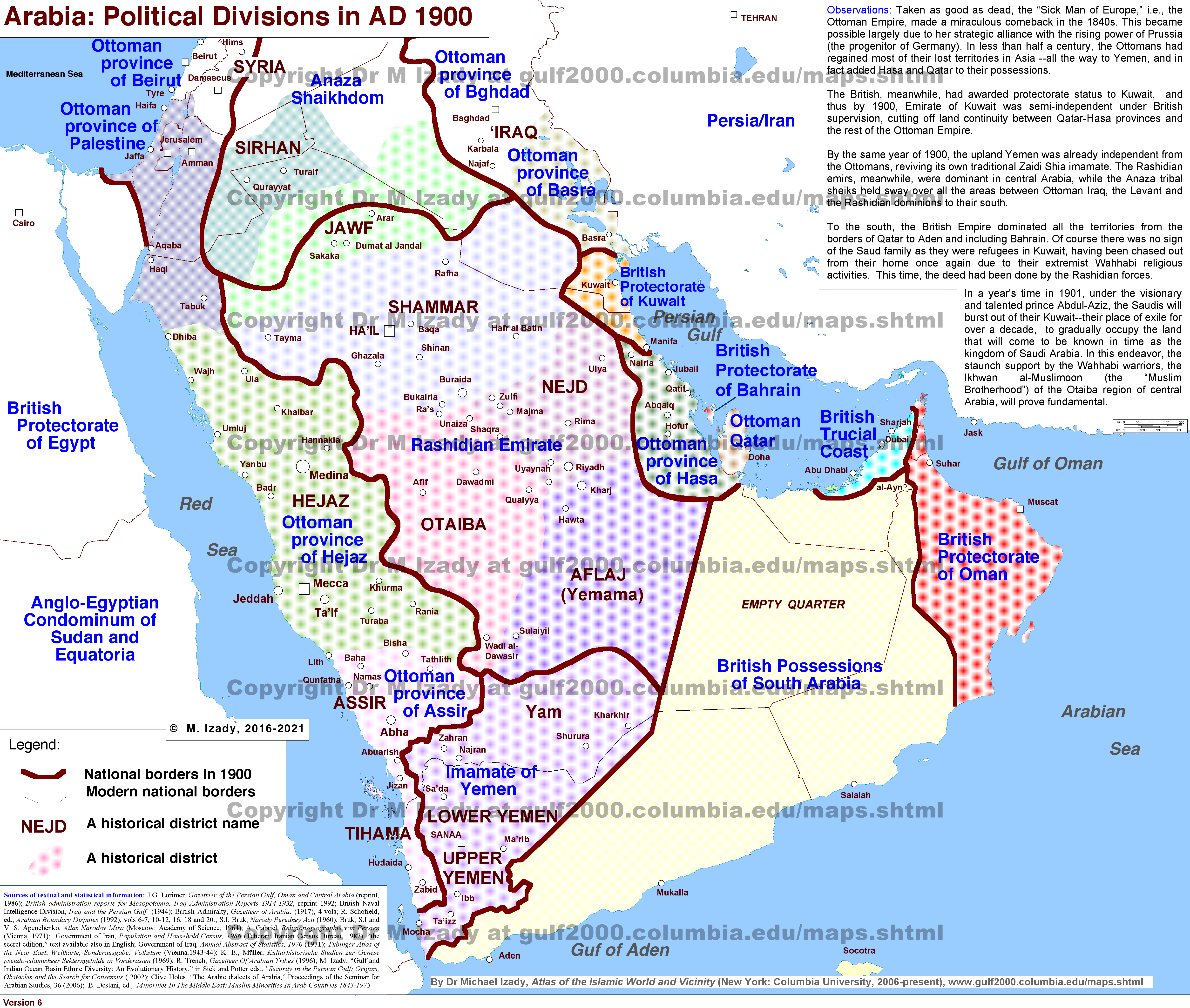
Modern reconstructions of historical political geography. Distinguish formal sovereignty, military occupation, protectorate relationships, and direct administration. In 1900 Egypt was British-occupied but remained nominally Ottoman; Britain declared its formal protectorate in 1914. Hatching should not be read as identical government arrangements everywhere. Modern boundary lines are orientation aids.
Arabia before Saudi unification, 1900
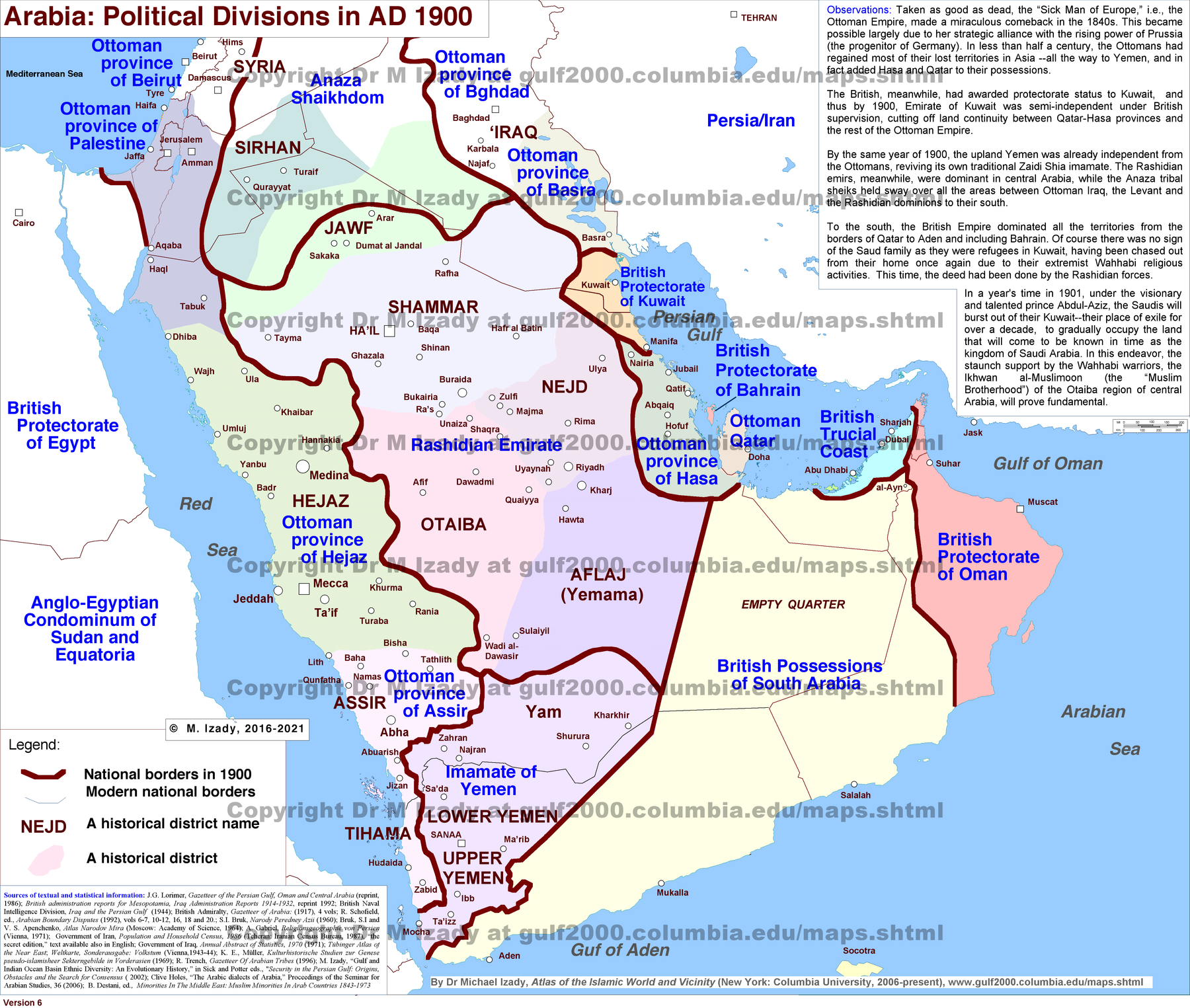
Locate the Rashidi emirate, Ottoman provinces, British Gulf relationships, and southern Arabian possessions before Ibn Saud’s conquests. The map labels Egypt a British protectorate in 1900; read that label as effective British control, since formal protectorate status began in 1914.
Map source: Dr. Michael Izady, Gulf/2000, Columbia University. Original map · Collection. Personal reference use; copyright remains with the author.
Saudi expansion, 1902–1934
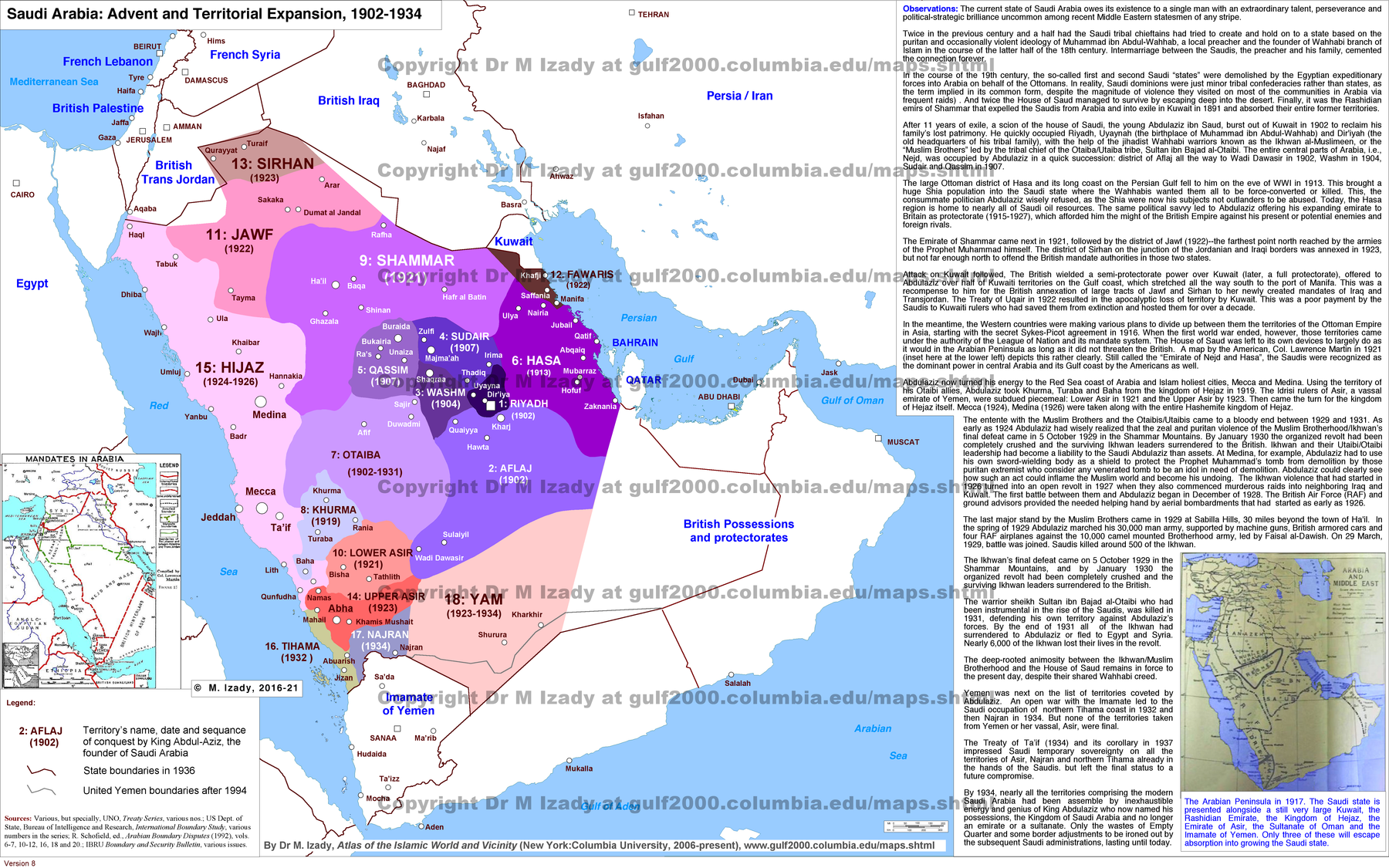
Follow the dated territorial expansion from the Saudi return to Riyadh through the formation and consolidation of the kingdom. A historical expansion map, not a current border-dispute determination.
Map source: Dr. Michael Izady, Gulf/2000, Columbia University. Original map · Collection. Personal reference use; copyright remains with the author.

U.S. facilities in the region, mid-2024
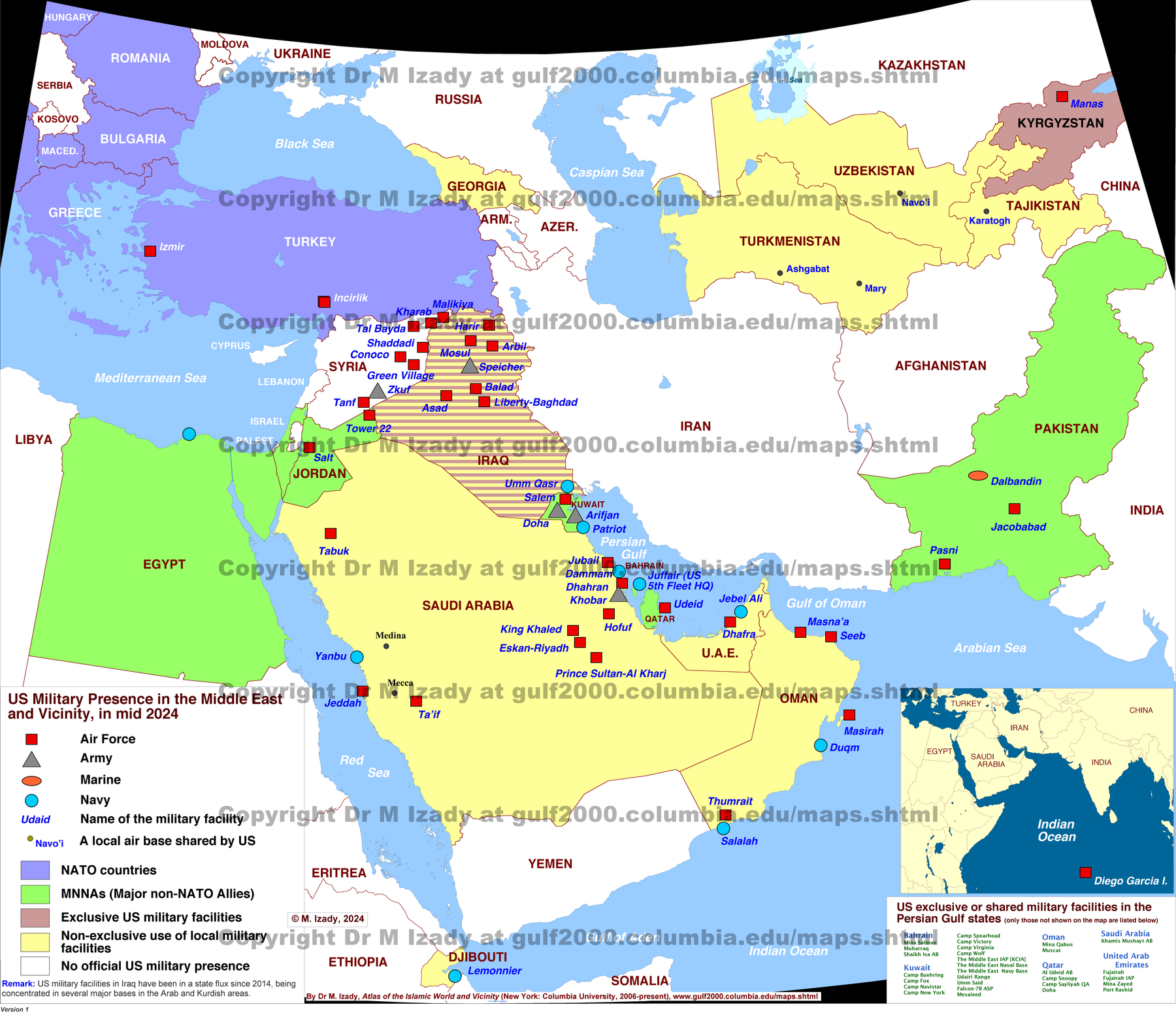
A mid-2024 snapshot for the existing discussion of U.S. basing and regional security. It includes shared facilities and other kinds of military access; it is not a current inventory or proof of why each facility exists.
Map source: Dr. Michael Izady, Gulf/2000, Columbia University. Original map · Collection. Personal reference use; copyright remains with the author.

Source and interpretation: Gulf2000 map collection.