Ottoman rule, reform, violence, and World War I
Book companion: The Cauldron — complete supplied-PDF notes develops the regional chronology, with page-linked argument summaries and retrieval questions. Compare the author’s book and interview as two presentations of his account; agreement between them is not independent corroboration.
Watch: 3:12–12:24
Ottoman wartime geography, 1916
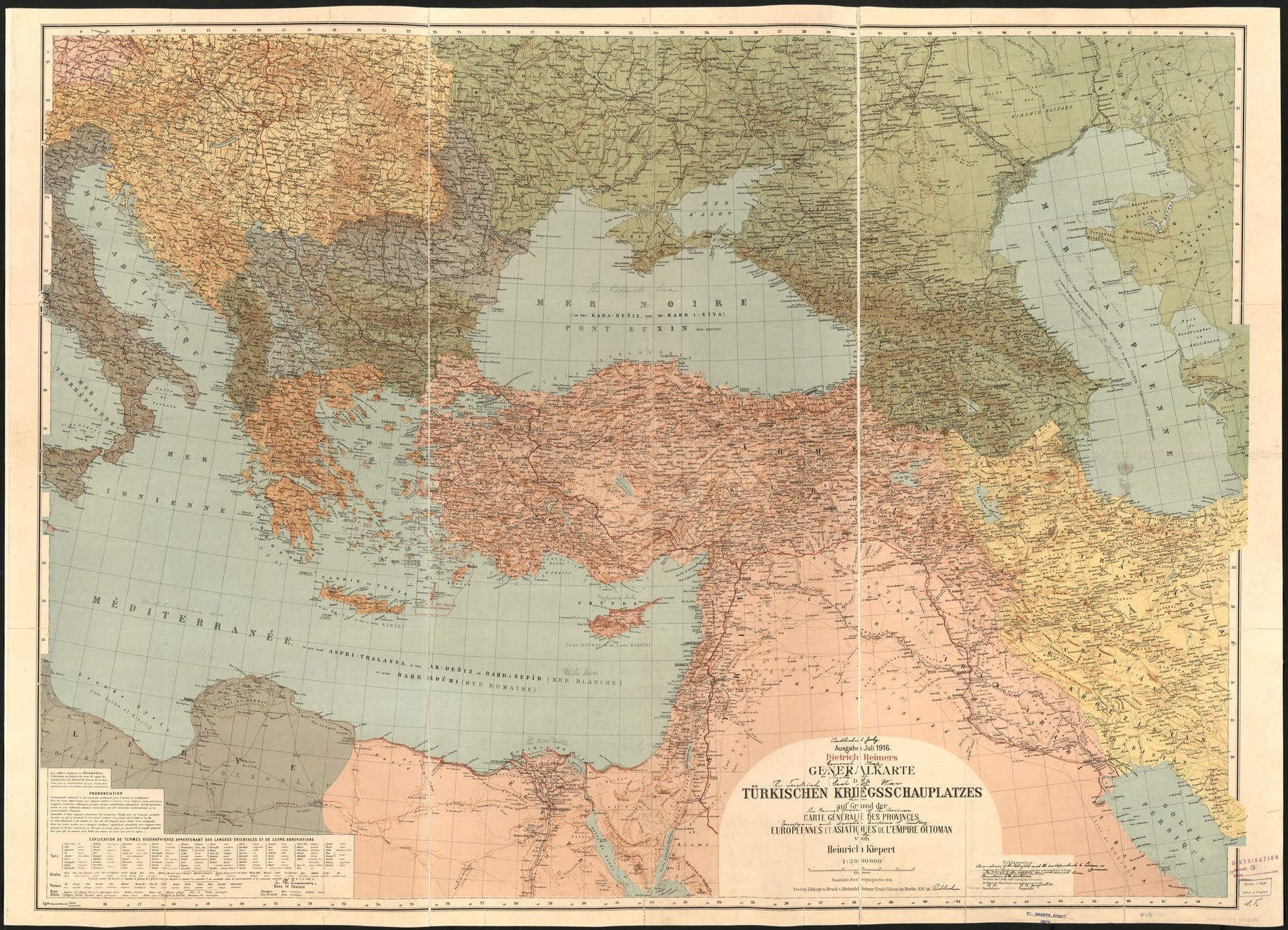
Source: Library of Congress, item 2013593013, Generalkarte des Türkischen Kriegsschauplatzes, July 1916, drawing on Heinrich Kiepert’s earlier cartography. Historic map, not a present-day boundary reference. The scan includes older geographic conventions and representations of imperial territory; do not infer effective control from color alone.
Viewing guide for 3:12–18:55: locate Constantinople/Istanbul, Anatolia, the Levant, and Mesopotamia. Trace how a region that now crosses several states could be discussed as one imperial strategic space. Zoom the original for place names.
Supplementary maps for the Ottoman opening
Modern reconstructions of historical political geography. Distinguish formal sovereignty, military occupation, protectorate relationships, and direct administration. In 1900 Egypt was British-occupied but remained nominally Ottoman; Britain declared its formal protectorate in 1914. Hatching should not be read as identical government arrangements everywhere. Modern boundary lines are orientation aids.
The regional powers around 1900
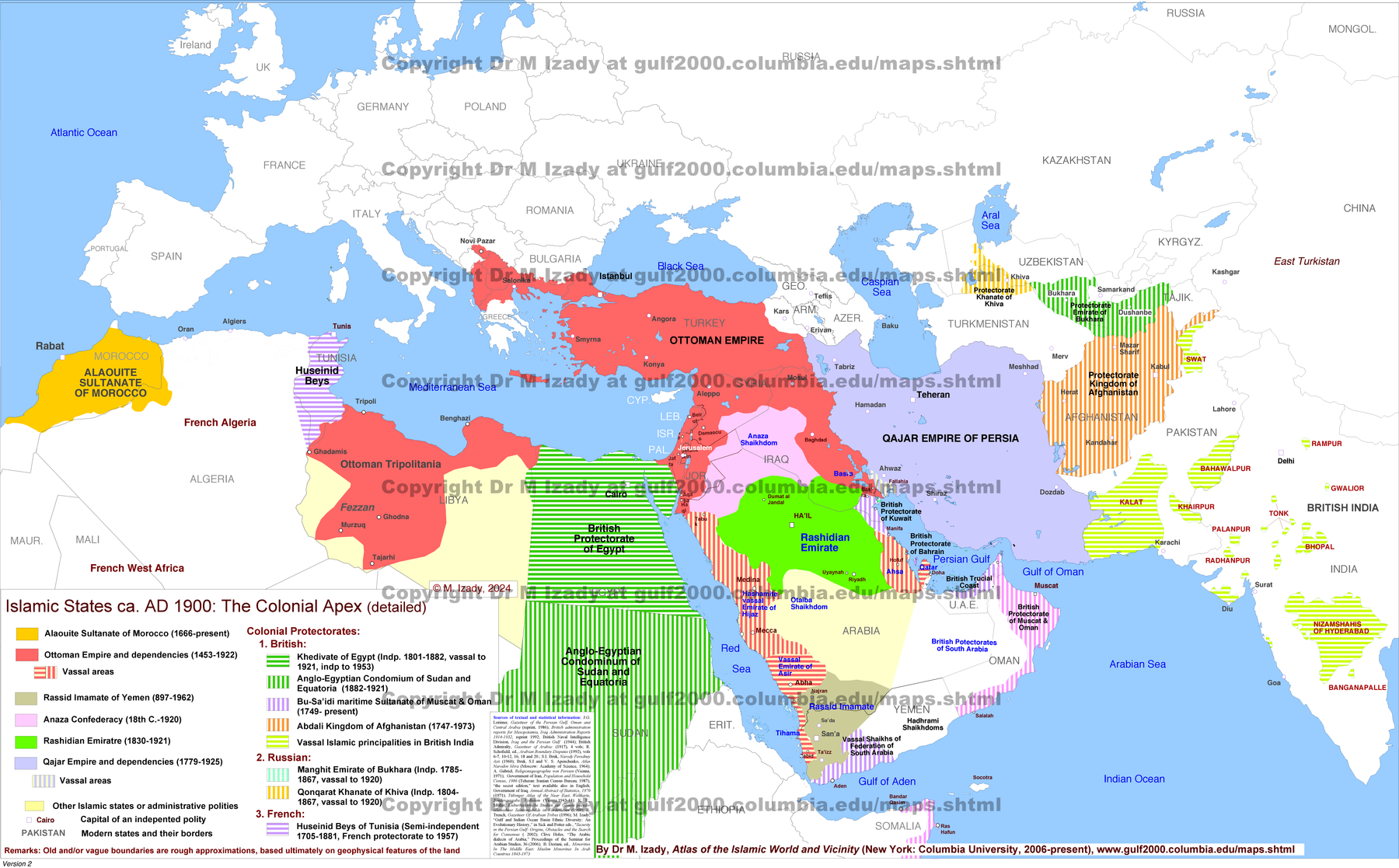
Use alongside the existing 1916 wartime map to orient the earlier circa-1900 political setting. The reconstruction adds colonial dependencies and independent states but does not replace the original wartime source.
Map source: Dr. Michael Izady, Gulf/2000, Columbia University. Original map · Collection. Personal reference use; copyright remains with the author.

Christian communities before the First World War
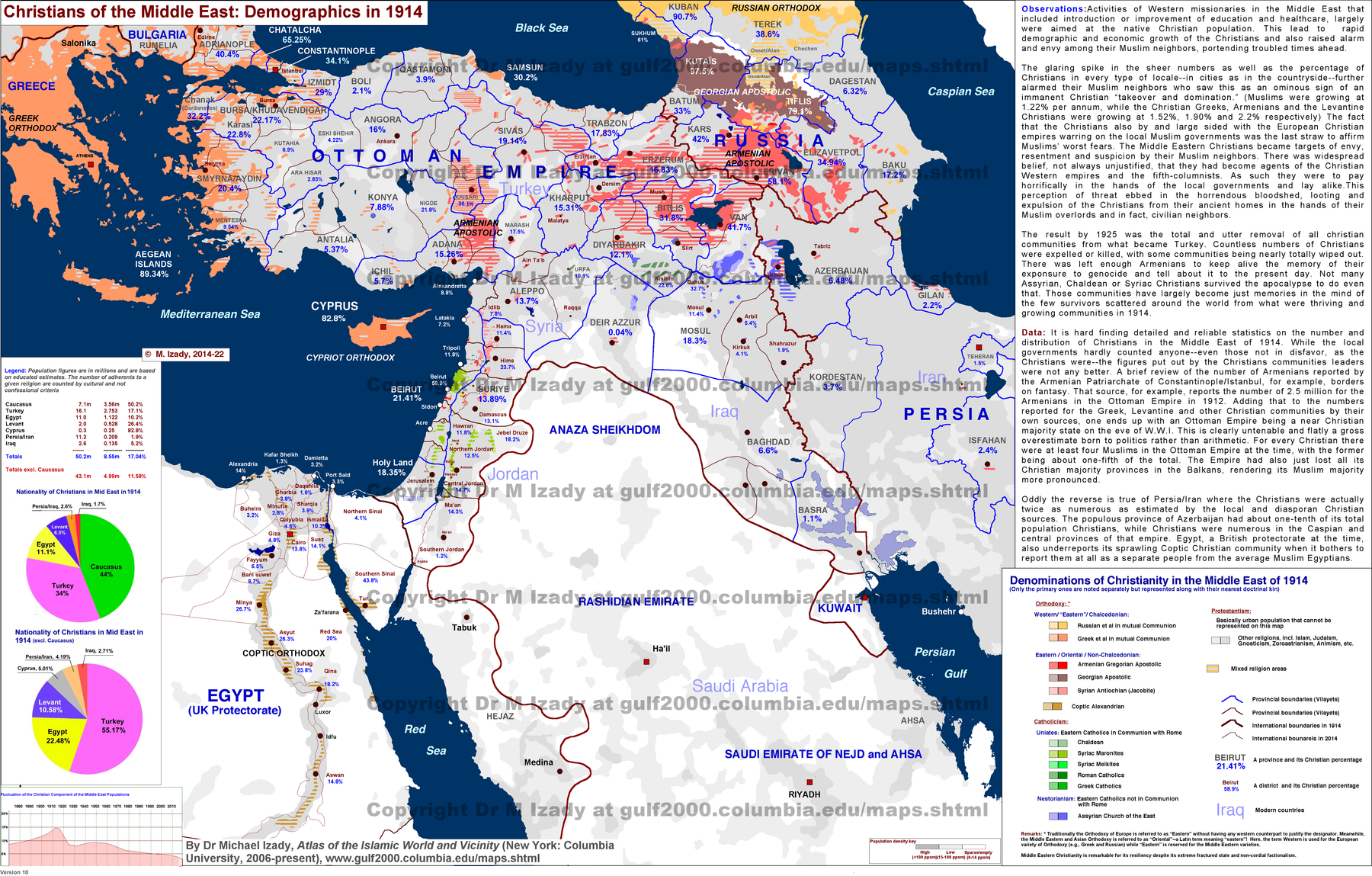
A demographic reference for the opening discussion of Ottoman religious diversity and wartime violence. The map’s estimates and causal explanations are Izady’s, not an independently verified statistical finding of this note.
Map source: Dr. Michael Izady, Gulf/2000, Columbia University. Original map · Collection. Personal reference use; copyright remains with the author.

Source and interpretation: Gulf2000 map collection.
The discussion
The account: Montefiore challenges nostalgia for Ottoman tolerance by moving from the Tanzimat reforms to nineteenth-century communal violence and the wartime rule of the Three Pashas. He emphasizes the Armenian genocide and other catastrophes affecting Christian populations. He also insists that the Ottoman war effort was stronger than its “sick man” reputation suggests: Gallipoli and Kut complicate a story of effortless Allied victory.
Arab nationalism appears here as a challenge developing inside an empire, not as a collection of already independent nation-states. The Hashemite revolt enters the story alongside the continued service of many Arabs in the Ottoman army.
Context check: the USHMM overview of the Armenian genocide supports the central account of systematic destruction. Its estimate has a stated range and period; do not convert the interview’s rounded figure into a universally agreed exact total. His labels for the late Ottoman regime and explanations for changing communal relations remain interpretations to examine.
Timeline
- 1839 onward — Tanzimat reform period, discussed as an attempt to reorganize Ottoman rule (4:20).
- 1860 — Damascus violence discussed in the wider context of communal conflict (4:50).
- 1914–1918 — Ottoman participation in World War I; military struggle and imperial collapse (6:11–15:59).
- 1915–1916 — Armenian genocide; independently contextualized by USHMM (6:49; 12:25).
Visual guide
flowchart LR
    A["Ottoman imperial order"] --> B["Reform and communal conflict"]
    B --> C["World War I"]
    C --> D["Genocide and mass displacement"]
    C --> E["Military struggle and imperial collapse"]
People and terms
| Name or term | Study reminder |
|---|---|
| Ottoman Empire / Turkey | Related histories, but not interchangeable political entities |
| Sultan / caliph | Political-dynastic ruler / claim to religious leadership; the interview stresses their overlap in late Ottoman rule |
| Tanzimat | Nineteenth-century Ottoman reform era |
| Three Pashas | Enver, Talât, and Cemal; wartime Ottoman leadership discussed here |
Additional sources
- What supports the Armenian genocide account? USHMM overview and in-depth discussion. Museum historical syntheses with a route into the documentary evidence; preserve each estimate’s scope.
Wartime promises and the making of Turkey
Watch: 12:25–18:55
Sykes–Picot: the proposed settlement
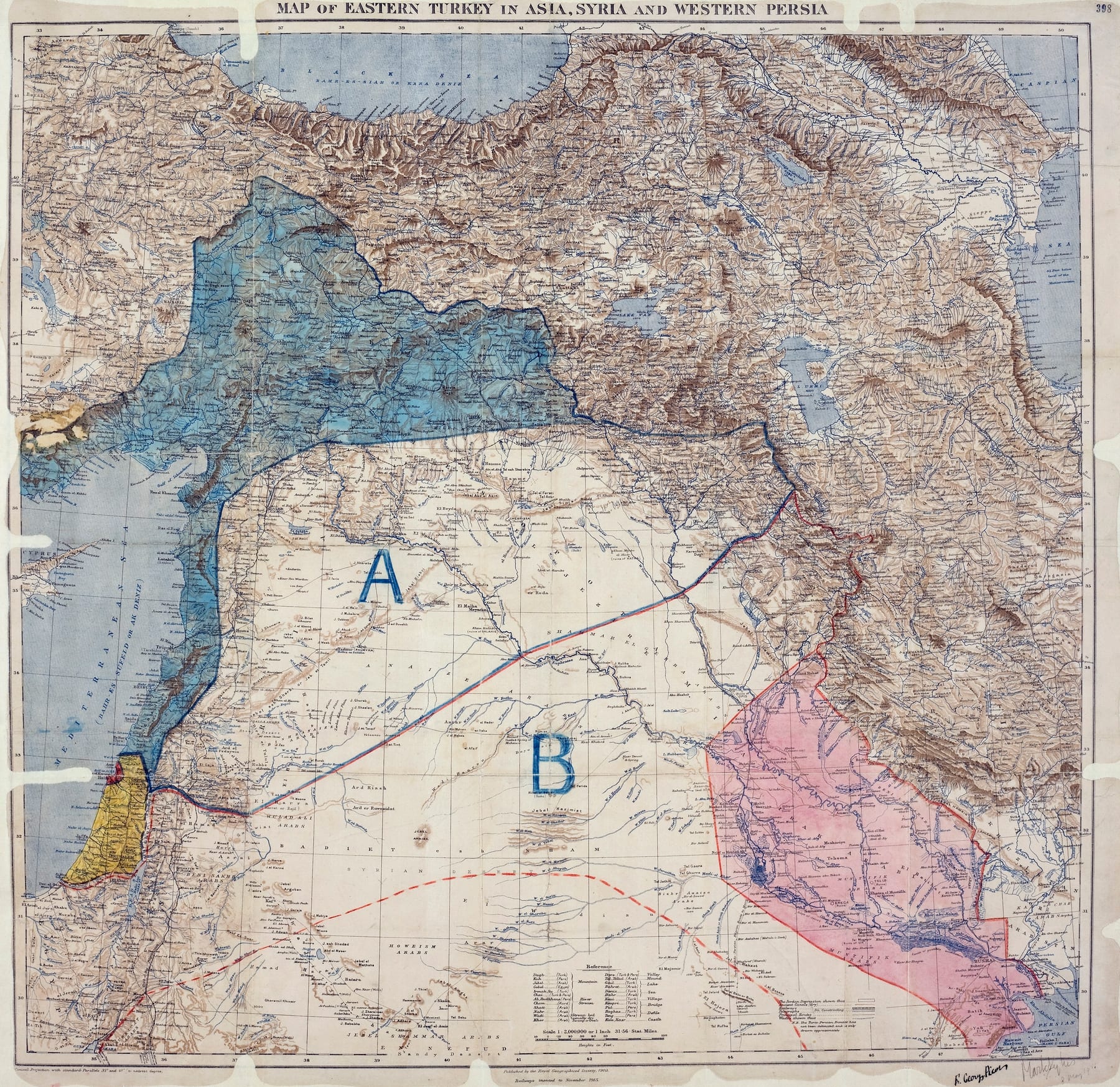
Source and credit: Royal Geographical Society base map; annotations by Mark Sykes and François Georges-Picot, signed 8 May 1916; UK National Archives MPK1/426, via Wikimedia Commons file record. The file record identifies the work as public domain. The signed-map date and the diplomatic agreement’s date are not the same thing.

Viewing guide for 13:24–18:55 and 42:51–49:45: distinguish the colored direct-control areas from the A/B influence areas and the proposed arrangement around Palestine. Compare the document’s language with the map in the agreement text. Do not read the colored zones as the final borders of Syria, Iraq, Jordan, or Israel.
The discussion
The account: Britain, France, Russia, and other powers considered overlapping claims while trying to defeat the Ottomans. Montefiore argues that Sykes–Picot has become a catch-all explanation for boundaries that were actually shaped by later negotiations, revolutions, and military outcomes. Russia’s revolution and Turkish nationalist victories changed what could be implemented.
Mustafa Kemal’s resistance then overturns the proposed settlement of Anatolia. Montefiore connects the defeat of Greek forces, the Lausanne settlement, and population displacement to the emergence of the Turkish republic. His comparison with Israel is about violent state formation; it does not establish equivalence in causes, legal arrangements, or responsibility.
Context check: the Lausanne population-exchange convention explicitly made an exchange compulsory and defined categories largely by religion, with named exceptions. “Swap” is therefore inadequate if it suggests a voluntary exchange. Separate Sèvres, 1920, from Lausanne, 1923 and from the republic’s proclamation.
Timeline
- 1916 — Sykes–Picot agreement; Hashemite Arab Revolt (13:24; 45:33).
- 1920 — San Remo and Sèvres belong to the postwar settlement process, not the original 1916 bargain (15:24 onward).
- 30 January 1923 — Compulsory Greek–Turkish population-exchange convention (17:49–18:39).
- 24 July 1923 — Lausanne peace settlement; do not confuse this with Sèvres (17:49 onward).
Visual guide
flowchart LR
    A["1916: wartime bargaining"] --> B["1920: proposed postwar settlement"]
    B --> C["Turkish nationalist military resistance"]
    C --> D["1923: exchange convention and Lausanne settlement"]
    D --> E["New Turkish state and forced population movement"]
People and terms
| Name or term | Study reminder |
|---|---|
| Mustafa Kemal / Atatürk | Turkish nationalist leader associated with the republic’s creation |
Qualifications for this section
Sykes–Picot explains the modern map, 13:24–18:55
Retain: Wartime imperial bargaining is essential context. Qualify: The proposed 1916 settlement and the later arrangements are not identical.
Additional sources
- What was actually promised in 1916? Sykes–Picot agreement, Yale Avalon. Primary diplomatic text in a university-hosted transcription. Compare its zones and conditions with the Sykes–Picot map in this section.
- Was the Greek–Turkish exchange voluntary? 1923 exchange convention. Read Articles 1–3 and note its compulsory categories and exceptions. Official Turkish-hosted treaty text, not endorsement of every modern governmental interpretation.
Turkey today and the Muslim Brotherhood detour
Watch: 20:30–29:37 · Skip the preceding sponsor segment.
The discussion
The account: Montefiore interprets Erdoğan’s regional ambitions as neo-Ottomanism: an attempt to draw political influence from Turkey’s imperial past, military capacity, and relationships with Islamist movements. This leads to a compressed history of the Muslim Brotherhood, the Egyptian monarchy’s elite, Nasser’s repression, Morsi’s presidency, and Hamas’s origins.
What to learn: separate three levels: a movement’s genealogy, a government’s diplomatic or material support for it, and operational control over particular actions. Relationships among Turkey, Qatar, Hamas, and Iran do not become identical merely because the interview discusses them together. Sunni/Shiʿi difference also does not prevent strategic cooperation.
Caution: the claims about contemporary Syria, Turkish intentions, and a particular ceasefire are the interview’s contemporary analysis. They have not been verified as the situation on the date of this note. A prediction or causal judgment is not established simply by calling it neo-Ottomanism.
Timeline
- Late 1920s — The interview locates the Muslim Brotherhood’s origins in modern Egypt.
- Later Egyptian politics — The account moves through Nasser’s repression and Morsi’s presidency.
- Contemporary discussion — Montefiore interprets Turkish relationships with Islamist movements through a neo-Ottoman lens.
Visual guide
flowchart TD
    A["Ottoman imperial history"] -. "political memory and rhetoric" .-> B["Neo-Ottomanism: Montefiore's interpretation"]
    C["Muslim Brotherhood"] -. "historical genealogy" .-> D["Hamas"]
    E["Turkey and Qatar"] -. "relationships discussed in the interview" .-> D
    F["Iran"] -. "separate strategic relationship" .-> D
The dotted relationships summarize the interview’s interpretation; they do not establish operational control.
Additional sources
- Iran and the Axis of Resistance — compare different kinds of regional relationships.
What a mandate was
Watch: 29:41–34:21
The discussion
The account: the hosts ask what “mandate” means. Montefiore answers that British and French imperial administration was repackaged in the language of preparation for self-government. He connects this to Wilsonian self-determination and the difficulty of reconciling it with imperial bargains.
Context check: “empire under another name” is a political interpretation. The Palestine Mandate’s text supplies the actual obligations: administration, institutions, the Jewish national home, and protections for inhabitants. Article 25 permits differentiated application east of the Jordan. Read this rather than treating a colorful summary as the complete legal instrument.
An administrative unit’s creation does not mean its inhabitants or regional identities were invented at that moment. Conversely, an ancient geographic name does not prove continuous sovereignty by a modern state.
Timeline
- 1922–1923 — Palestine Mandate approved in 1922 and effective in 1923 (29:41–34:21).
Visual guide
flowchart LR
    A["Wartime imperial bargains"] --> B["Mandate framework"]
    B --> C["British administration"]
    B --> D["Jewish national home obligations"]
    B --> E["Protections for inhabitants"]
    B --> F["Article 25: differentiated application east of Jordan"]
People and terms
| Name or term | Study reminder |
|---|---|
| Mandate | Internationally framed administration after World War I; examine the specific instrument |
Qualifications for this section
Mandates were simply empire, 29:41–31:57
Retain: Imperial power shaped their administration. Qualify: The actual legal instrument and specific obligations still matter.
Additional sources
- What obligations did Britain hold? Palestine Mandate. Begin with the preamble and Articles 2, 4, 6, and 25. Compare the formal terms with the interview’s empire analogy.
- Mandate and legal basis — compare the documentary obligations.
Jewish attachment and modern political Zionism
Watch: 34:25–36:29, then 37:53–42:50 · Sponsor break between them.
The discussion
The account: asked how Jews came to be in the region, Montefiore moves back to Judea, exile, the Temple, Roman rule, and dispersed Jewish communities. His distinction is between an old religious and historical attachment to a homeland and the modern political organizations that sought to act on it. He emphasizes the diversity of Jewish communities, including those from Middle Eastern and North African societies.
He then explains Allied support for a national home through a combination of biblical familiarity, attitudes toward Jewish persecution, and wartime politics. His account rejects the notion that a single British whim explains the movement or its international recognition.
Context check: Balfour’s 1917 declaration supports a Jewish national home in Palestine and also protects the civil and religious rights of non-Jewish communities and the status of Jews elsewhere. It does not itself establish a sovereign Jewish state. Ancient attachment and modern nationalist institutions should remain distinct analytical categories.
Source limit: Jerusalem’s population near 1780 and some other rounded population totals remain unverified in this note.
Timeline
- Earlier history — The interview recalls Judea, the Temple, Roman rule, exile, and dispersed communities; these are not a single modern political program.
- Modern nationalist period — Organized political Zionism develops projects for autonomy, settlement, and statehood.
- 2 November 1917 — Balfour Declaration (41:32 onward).
Visual guide
flowchart LR
    A["Historical and religious attachment"] --> B["Modern political organization"]
    B --> C["Autonomy or shared arrangements"]
    B --> D["National statehood"]
    E["1917 Balfour Declaration"] --> F["National home in Palestine plus stated protections"]
People and terms
| Name or term | Study reminder |
|---|---|
| National home / sovereign state | Not interchangeable terms in the 1917 declaration |
Additional sources
- What did Balfour promise—and protect? Balfour Declaration, Yale Avalon. Read the whole short declaration rather than a single clause.
- British Library: the Balfour Declaration archive record — identifies the 2 November 1917 letter as folio 3; catalogue provenance rather than a substitute for reading the text.
- Zionism — historical attachment and modern political programs.
The Hashemites and the new regional kingdoms
Watch: 42:51–49:45
Map guide: follow the Hejaz, Syria, Mesopotamia, and the territory east of the Jordan. This is the 1916 proposal, not a map of the kingdoms that later emerged. Source and legend: the wartime-settlement section.
The discussion
The account: Hussein of Mecca and his sons sought British backing for extensive Arab rule. Montefiore presents their negotiations as ambitious bargaining amid deliberately ambiguous British commitments, rather than a simple transaction between equal parties with an agreed map.
The brothers’ stories then diverge. Faisal’s Syrian kingship collides with French power, after which Britain supports him in Iraq; Abdullah’s position becomes the basis of Transjordan. Resistance to mandate rule in Iraq and Syria exposes the gulf between a settlement drawn by outside powers and one accepted locally.
What to learn: keep the Hashemites separate from the House of Saud, and separate dynastic ambition from the full range of Arab national aspirations. The rulers’ names and family relationships explain a great deal, but do not exhaust the politics of the populations they governed. “It was all created in one stroke” is less useful than a sequence of bargaining, military action, institution-building, and resistance.
Timeline
- 1916 — Sykes–Picot agreement; Hashemite Arab Revolt (13:24; 45:33).
- December 1917 — British capture of Jerusalem (45:55–46:24).
- Postwar settlement — Faisal’s Syrian kingship is displaced by French power; his path then leads to Iraq. Abdullah’s path leads to Transjordan.
Visual guide
flowchart TD
    A["Hussein of Mecca: Hashemite dynasty"] --> B["Faisal"]
    A --> C["Abdullah"]
    B --> D["Syria: kingship and French intervention"]
    D --> E["Iraq: British-backed kingship"]
    C --> F["Transjordan"]
    G["House of Saud: a different dynasty"]
People and terms
| Name or term | Study reminder |
|---|---|
| Hashemites | Hussein of Mecca’s dynasty; Faisal and Abdullah take different paths |
| House of Saud | A different ruling family; do not merge it with the Hashemites |
Additional sources
- What was actually promised in 1916? Sykes–Picot agreement, Yale Avalon. Primary diplomatic text in a university-hosted transcription. Compare its zones and conditions with the Sykes–Picot map in this section.
Settlement, 1929 violence, and the approach of revolt
Watch: 49:46–52:47
The discussion
The account: Montefiore describes Jewish farming settlements and land purchase, then turns to the 1929 violence, particularly Hebron and Safed. His causal sequence links fear concerning sacred sites, communal violence, the rise of Hitler, increased immigration, and the intensification of conflict in the 1930s.
What to learn: land purchase and conflict are not mutually exclusive categories. Ask who owned a parcel, who lived or worked on it, which institutions controlled immigration, and what political future each community expected. Violence against longstanding Jewish communities also complicates a narrative focused exclusively on new immigrants.
Caution: the detailed atrocity allegations in this passage, and its comparison to October 7, are reported here as interview claims, not independently authenticated event-by-event findings. Do not copy graphic details as settled facts without checking contemporary evidence. An analogy can be emotionally forceful while leaving important differences unexplored.
Source limit: The specific graphic atrocity allegations concerning 1929 are not independently settled here.
Timeline
- 1929 — Violence in Mandatory Palestine, including Hebron and Safed (51:05 onward).
- After 1929 — The interview connects intensified fear, the rise of Hitler, and increased immigration to the approach of revolt.
Visual guide
flowchart LR
    A["Land ownership and purchase"] --> D["Ask separate questions"]
    B["Residents and cultivators"] --> D
    C["Immigration and political authority"] --> D
    D --> E["What happened in each place?"]
Additional sources
- What did Jerusalem’s social life look like from within? “A Flâneur’s Jerusalem,” Jerusalem Quarterly. Review discussing Wasif Jawhariyyeh’s memoirs, The Storyteller of Jerusalem. The review is contextual reading, not a substitute for inspecting the memoir passage cited in the interview.
- Timeline and history — regional chronology and related event notes.
Amin al-Husayni, revolt, and collaboration with Nazi Germany
Watch: 54:07–62:59
The discussion
The account: Montefiore attributes major influence to British decisions that enhanced Amin al-Husayni’s religious, financial, and political authority. He contrasts the Husayni and Nashashibi networks, then follows the 1936–39 revolt, British repression, al-Husayni’s flight, the 1941 Iraqi crisis, and his wartime activity in Berlin.
He treats al-Husayni’s Nazi alliance as a disastrous political choice and as evidence that anti-British nationalism alone does not explain his antisemitism. The narrative also describes violence within Palestinian Arab politics, not only between Arabs and Jews.
Context check: USHMM’s chronology documents al-Husayni’s meeting with Hitler on 28 November 1941 and his Axis collaboration. This supports a serious account of collaboration, but not the different claim that he originated Nazi genocide. USHMM explicitly rejects that distortion. Nor should one leader’s conduct be transferred to every Palestinian Arab.
Timeline
- 1936–1939 — Palestinian Arab revolt; repression and political fragmentation (57:42 onward).
- 28 November 1941 — Al-Husayni’s meeting with Hitler (61:13 onward).
Visual guide
flowchart LR
    A["Religious and political authority in Palestine"] --> B["1936–1939 revolt and repression"]
    B --> C["Flight and wartime activity abroad"]
    C --> D["1941 meeting with Hitler and Axis collaboration"]
    D --> E["One leader's record: not collective responsibility"]
People and terms
| Name or term | Study reminder |
|---|---|
| Amin al-Husayni | Mufti of Jerusalem and political leader discussed as an Axis collaborator |
Additional sources
- What was al-Husayni’s Nazi relationship? USHMM key dates. Read with the museum’s correction of the claim that he instigated the Holocaust.
The 1939 turn and the problem of compromise
Watch: 63:20–67:24
The discussion
The account: Montefiore describes Britain’s move away from partition toward a proposed independent Palestine with safeguards for its communities. He portrays al-Husayni’s rejection as another lost opportunity, then distinguishes groups willing to negotiate a lasting settlement from those accepting a transitional arrangement or rejecting Jewish sovereignty altogether.
What to learn: identify the offer’s date, its exact terms, who could accept it, and what security guarantees existed. The description “a state was offered” does not settle whether a proposal provided satisfactory sovereignty, representation, immigration rules, or minority protection. Montefiore’s judgments about what would have happened under a different ruler are counterfactuals, not documented outcomes.
Read next: the documentary history in the Anglo-American Committee’s Appendix IV helps distinguish successive British proposals. Do not collapse the 1937 partition proposal and the 1939 policy into one offer.
Timeline
- 1937 / 1939 — Partition proposal / subsequent British policy reversal—different proposals (57:50; 63:23 onward).
Visual guide
flowchart LR
    A["1937: partition proposal"] --> B["1939: different British policy"]
    B --> C["Read the proposed institutions and safeguards"]
    C --> D["Separate documented terms from imagined outcomes"]
Additional sources
- How did British proposals change? Anglo-American Committee of Inquiry, Appendix IV. An official retrospective account, useful for distinguishing policies rather than collapsing them into repeated identical offers.
- UN Special Committee on Palestine, 1947 report — contemporary official retrospective on the changing proposals and the 1939 policy; compare its account with the earlier documents.
Different Zionisms and different political Islams
Watch: 67:25–70:18, then 71:20–75:25
The discussion
The account: the hosts ask whether Jews had always sought an exclusively Jewish sovereign state. Montefiore emphasizes a range of ideas: autonomy in a larger polity, binational or shared arrangements, farming communities, and nationalist statehood. The discussion then broadens into his contrast between accommodating traditions within Islam and modern revolutionary or exclusionary movements.
He presents modern Islamism as an ideological response to modern circumstances, not an unchanged survival of the seventh century. He also notes revivalist precedents. The useful question is what is inherited, what is newly organized, and which institutions turn belief into political power.
Caution: descriptions of what the “vast majority” of Zionists wanted require period-specific evidence, not just examples of individual thinkers. Likewise, a binary between “moderate” and “extreme” Islam can conceal substantial differences within each category. The transcript’s 1820s reference near 74:43 is inconsistent with its earlier late-1920s account of the Brotherhood; preserve it as a transcription/spoken-date uncertainty rather than silently rewriting the source.
Timeline
- Earlier attachments and traditions — The interview distinguishes religious attachment and inherited practices from modern political organizations.
- Modern political projects — Zionist programs and Islamist movements develop competing goals and institutions.
- Source-date uncertainty — The transcript’s “1820s” reference near 74:43 conflicts with its earlier late-1920s account; it is not used as an established date.
Visual guide
flowchart TD
    A["Zionist political proposals"] --> B["Autonomy in a larger polity"]
    A --> C["Binational or shared arrangements"]
    A --> D["Sovereign statehood"]
    E["Political Islam"] --> F["Different movements, institutions, and aims"]
Additional sources
- What did Balfour promise—and protect? Balfour Declaration, Yale Avalon. Read the whole short declaration rather than a single clause.
- What obligations did Britain hold? Palestine Mandate. Begin with the preamble and Articles 2, 4, 6, and 25. Compare the formal terms with the interview’s empire analogy.
India, the United Nations, and the partition proposal
Watch: 75:27–86:43
1947 proposal and 1949 armistice outcome
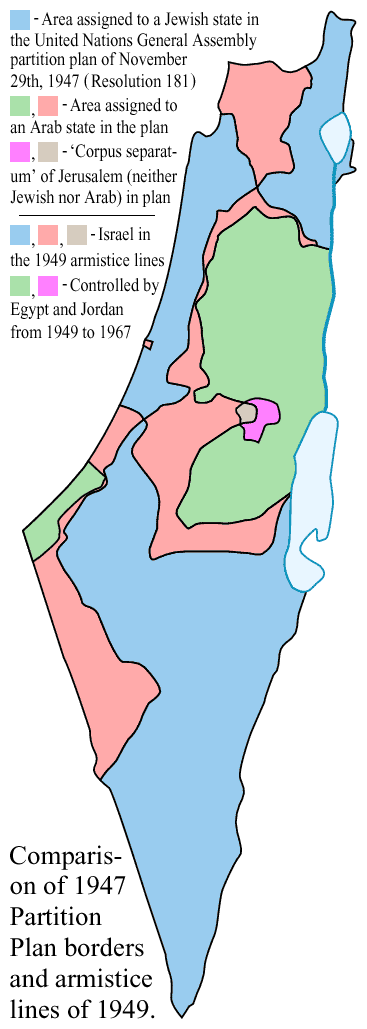
Source and credit: AnonMoos, 2005, Commons file and full legend, released into the public domain by its creator. This is a later explanatory reconstruction, not the original UN map. It simplifies demilitarized zones, Latrun, and Jerusalem’s boundary details. Read alongside the UN’s official historical-map record and Resolution 181.

Viewing guide for 80:23–106:06: blue marks proposed Jewish-state territory within the armistice lines; green and pink both mark territory proposed for the Arab state, with different postwar outcomes; the Jerusalem colors distinguish the proposed international zone from later control. Check the legend before drawing conclusions.
Ask three separate questions: What was proposed in 1947? Who controlled the territory after the war? What happened to the people living there? This image addresses the first two, not the third. Armistice lines are not automatically final agreed international borders.
The discussion
The account: Montefiore compares the difficult British withdrawals from India and Palestine. He uses the Indian partition’s violence to illustrate the danger of believing a new boundary will neatly separate mixed populations. Britain’s referral of Palestine to the UN then leads to the 1947 plan, which he criticizes as geographically fragmented and difficult to defend.
He argues that Abdullah’s dealings with Jewish leaders offered another possible path, while the hosts highlight mutually reinforcing radicalization: violence by one side strengthens those on the other side who oppose compromise.
Context check: Resolution 181 recommended Arab and Jewish states with economic union and a special international regime for Jerusalem. It did not reserve Jerusalem as a permanent British possession. Its administrative design and the failure to implement it are distinct questions. Montefiore’s claim that a different Abdullah settlement would have solved the entire conflict is an untestable counterfactual, not a fact established by the negotiations.
Timeline
- British withdrawal — The India comparison concerns mixed populations and violent partition; it does not establish that the two cases were identical.
- 29 November 1947 — UN General Assembly Resolution 181 recommends partition with economic union (80:23 onward).
Visual guide
flowchart TD
    A["UN Resolution 181: recommendation"] --> B["Arab state"]
    A --> C["Jewish state"]
    A --> D["Special international regime for Jerusalem"]
    B --- E["Economic union in the proposal"]
    C --- E
Qualifications for this section
Jerusalem was kept by Britain under the UN plan, around 81:14
Retain: Jerusalem’s status was a separate problem. Qualify: Resolution 181 proposed an international regime, not permanent British possession.An Abdullah arrangement would have solved the entire conflict, 83:20–87:27
Retain: Alternative negotiations existed. Qualify: Their eventual success cannot be established as a fact.
Additional sources
- What did the UN actually propose? Resolution 181. Focus on termination of the Mandate, economic union, minority safeguards, and Jerusalem’s international regime. Proposal is not implementation.
Civil war and the first refugee movements
Watch: 86:45–95:06
The discussion
The account: Montefiore emphasizes Jewish insecurity during the civil-war phase, rivalry among Arab forces, and the lack of confidence that a Jewish state would survive. He then discusses Palestinian Arabs leaving before Israel’s declaration, naming fear, community breakdown, expectations of return, and particular memoirs or recollections.
Essential distinction: the date of departure does not by itself identify its cause. A person leaving before 14 May 1948 could still be responding to an attack, an expulsion, fear of atrocities, loss of services, or a collapsing local defense. The absence of a face-to-face expulsion order does not establish that flight was freely chosen or unrelated to military action.
Chronology check: a US diplomatic telegram dated 13 April 1948 already describes the 9 April Deir Yassin attack and its political impact. That alone defeats a blanket inference that pre-independence flight occurred before such military violence. Its early casualty count is a contemporary report, not a final verified total.
Source limit: The original text of the Richard Falk article named in the interview was not inspected; Montefiore’s characterization remains a source lead, not a verified quotation.
Timeline
- Late 1947–May 1948 — Civil-war phase before Israel’s declaration and neighboring regular armies’ intervention (86:45 onward).
- 10 March 1948 — Plan Dalet finalized—before independence (Discussed out of sequence near 100:23).
- 9 April 1948 — Deir Yassin attack—before independence (Discussed out of sequence near 95:46).
Visual guide
flowchart TD
    A["Departure before 14 May 1948"] --> B["Establish the cause in that locality"]
    B --> C["Attack or expulsion"]
    B --> D["Fear and expectations of return"]
    B --> E["Collapse of defense, services, or community"]
    C --> F["Timing alone cannot choose among explanations"]
    D --> F
    E --> F
People and terms
| Name or term | Study reminder |
|---|---|
| Haganah / Irgun / Lehi | Distinct Jewish armed organizations; not interchangeable names |
| Arab Liberation Army / Arab Legion | Distinct organizations; the latter associated with Transjordan |
| Nakba | Palestinian catastrophe, centrally involving displacement and loss in the 1948 war |
Qualifications for this section
Pre-May flight preceded Israeli offensives or expulsions, 91:40–94:05
Retain: Many Palestinians became refugees before Israel’s declaration. Qualify: Timing alone cannot distinguish fear, military attack, expulsion, or collapse; the blanket claim is untenable.
Additional sources
- What did contemporaries report before independence? Wasson’s telegram, 13 April 1948. A contemporary US primary record of the Deir Yassin attack and its consequences. Use it for the dated report, not as a final casualty investigation.
- What did Jerusalem’s social life look like from within? “A Flâneur’s Jerusalem,” Jerusalem Quarterly. Review discussing Wasif Jawhariyyeh’s memoirs, The Storyteller of Jerusalem. The review is contextual reading, not a substitute for inspecting the memoir passage cited in the interview.
- Nakba — differentiate causes of displacement by locality and phase.
Independence, interstate war, expulsions, and the postwar map
Watch: 95:10–106:53
Map guide: compare the proposed partition with the armistice outcome, then locate the West Bank, Gaza, and Jerusalem. The image does not measure displacement or land ownership. Source and full legend: the UN-partition section.
The discussion
The account: the discussion moves from Israel’s declaration and Arab intervention to command rivalry, Israeli military recovery, Plan Dalet, and the expulsions from Lydda and Ramle. Montefiore explicitly condemns those expulsions while explaining the strategic aims he believes motivated them. He also describes the removal of Jews from areas captured by Arab forces, Jordanian control of the West Bank and East Jerusalem, and Egyptian control of Gaza.
He accepts substantial British responsibility for a withdrawal without an effective transition, while rejecting an explanation that makes Britain the only actor. His account then jumps briefly to 1967 rather than giving a detailed treatment of the intervening period.
Critical correction: Plan Dalet was finalized 10 March 1948, not first conceived as a post-invasion counteroffensive. Its translated text contains territorial and military objectives and provisions concerning villages. Whether it constituted an overarching expulsion blueprint remains an interpretive controversy; its date does not. Security explanations and condemnations of expulsions can coexist, but neither should replace investigation of specific places and orders.
Timeline
- 10 March 1948 — Plan Dalet finalized—before independence (Discussed out of sequence near 100:23).
- 9 April 1948 — Deir Yassin attack—before independence (Discussed out of sequence near 95:46).
- 14–15 May 1948 — Israeli declaration, end of the Mandate, interstate intervention (95:10 onward).
- July 1948 — Lydda and Ramle expulsions discussed as a central example of forced displacement (101:51 onward).
- 1949 — Armistice arrangements; Israel, Jordan, and Egypt control different territories (103:38–105:40).
- 1967 — War changes control of the West Bank and Gaza; only briefly covered here (105:40 onward).
Visual guide
flowchart LR
    A["March: Plan Dalet"] --> B["April: Deir Yassin"]
    B --> C["May: declaration, Mandate ends, interstate intervention"]
    C --> D["July: Lydda and Ramle expulsions"]
    D --> E["1949: armistice arrangements"]
Qualifications for this section
Plan Dalet follows the interstate invasion, around 99:04–101:29
Retain: It must be studied in its military and territorial context. Qualify: The plan was finalized in March, before independence; its broader purpose remains disputed.All invading Arab states were only 18 months old, 97:48–99:04
Retain: Many current state forms were products of the post-Ottoman era. Qualify: Sovereignty dates differed; this is rhetorical compression, not a usable country-by-country chronology.
Additional sources
- What did Plan Dalet say? March 1948 text, Jewish Virtual Library. Translation of a primary military document, reproduced with editorial framing. Compare the introduction and village-operation clauses. Walid Khalidi’s differently framed edition with the translated text is a further-reading lead; full PDF retrieval was blocked during preparation. The opposed framing is not two independent original plans.
- What did the UN actually propose? Resolution 181. Focus on termination of the Mandate, economic union, minority safeguards, and Jerusalem’s international regime. Proposal is not implementation.
- What did contemporaries report before independence? Wasson’s telegram, 13 April 1948. A contemporary US primary record of the Deir Yassin attack and its consequences. Use it for the dated report, not as a final casualty investigation.
The Pahlavis and the road toward Iran’s revolution
Watch: 106:54–116:51
The Pahlavi ruler and Iranian geography
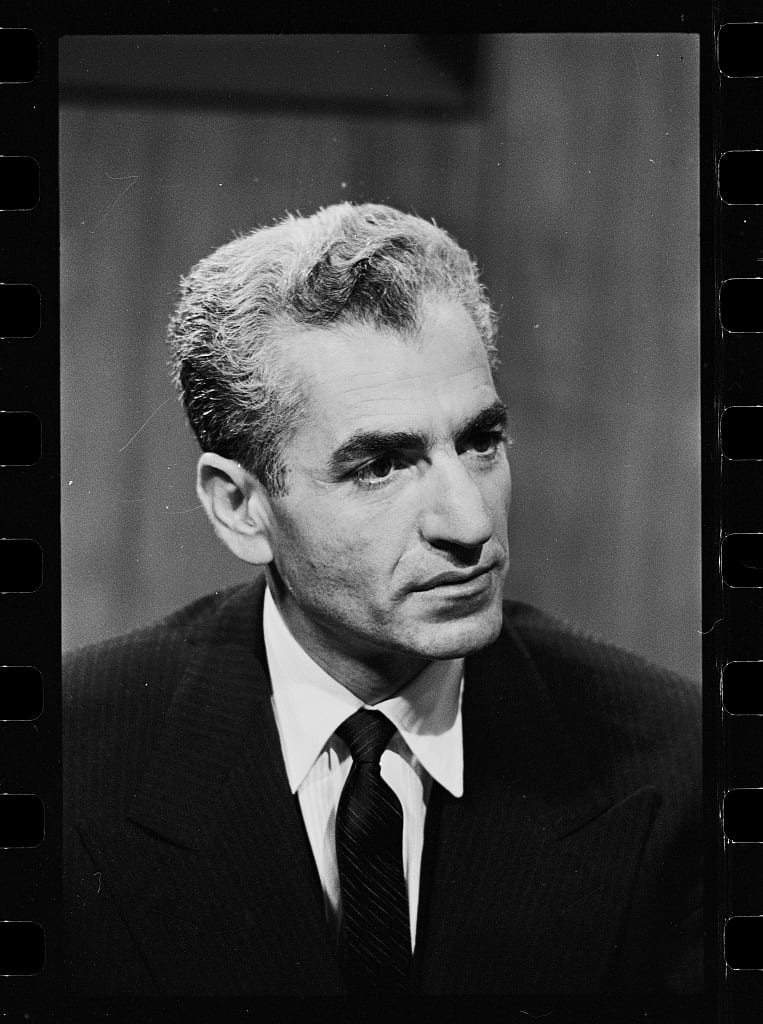
Image: Mohammad Reza Shah Pahlavi, photographed by Marion S. Trikosko on 12 April 1962. This is the son, not Reza Shah. Library of Congress record and credit; no known restrictions on publication.
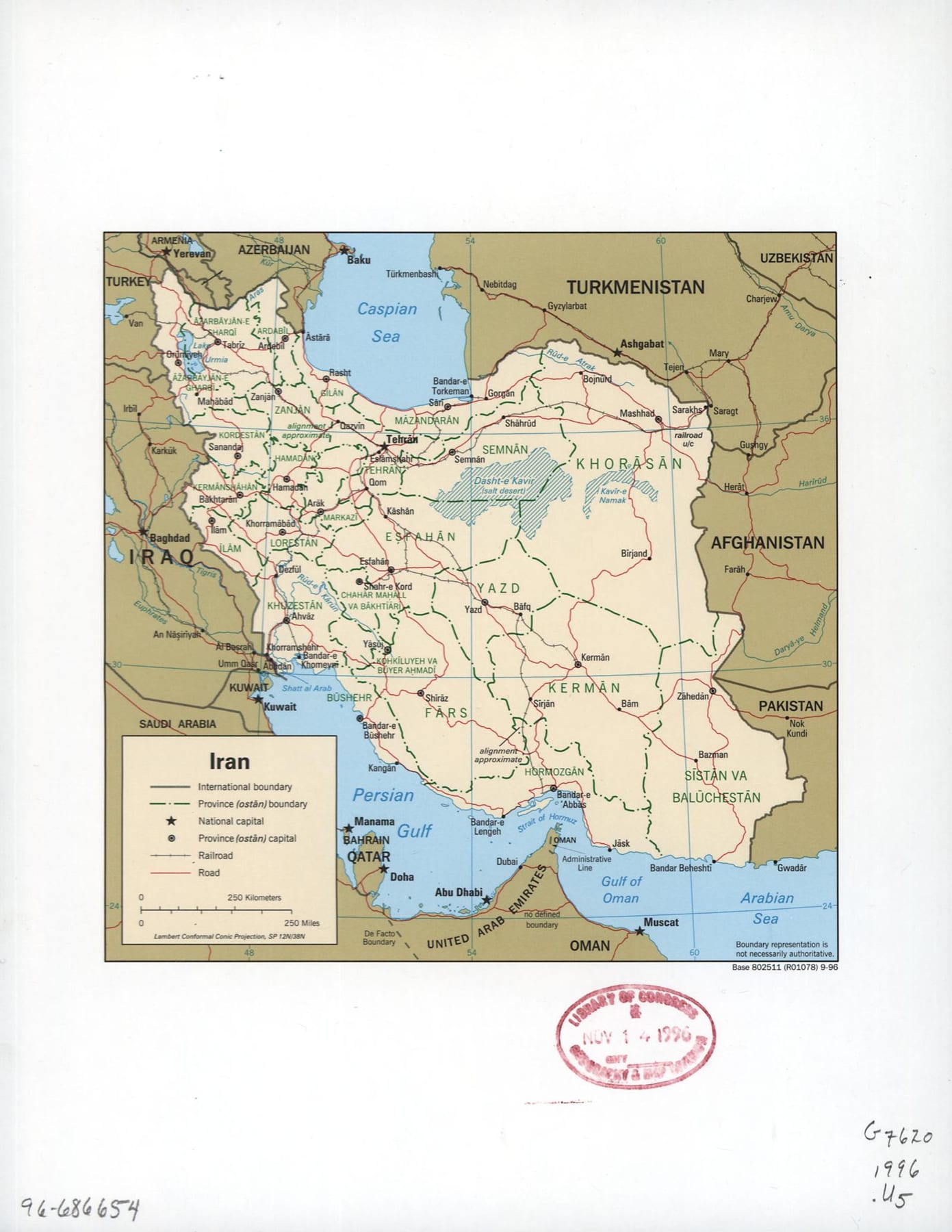
Map: CIA, Iran, September 1996; Library of Congress, Geography and Map Division. Use it to locate Tehran, Qom, the Iraqi border, and the Persian Gulf. It is a later geographic reference, not a map of political control in 1941, 1953, or 1979. Original map and zoom.
The discussion
The account: Montefiore starts with Reza Shah’s rise, moves to the 1941 Anglo-Soviet invasion and Mohammad Reza Shah’s accession, then describes modernization alongside concentrated power. His explanation for the later collapse combines political exclusion, corruption, uneven development, urban migration, the ruler’s illness, and his inability to manage the opposition.
Important addition: this interview compresses past 1953, when Mosaddegh was overthrown. Eisenhower’s diary, reproduced in the US diplomatic record, acknowledges American covert involvement. Mark Gasiorowski’s Iranica article explains the British and American operation alongside Iranian political actors. That episode matters to arguments about legitimacy and foreign intervention; modernization alone cannot stand in for the Shah’s political history.
Timeline
- Before 1941 — Reza Shah’s rise and centralization precede his son’s reign.
- 1941 — Anglo-Soviet invasion; Mohammad Reza Shah succeeds Reza Shah.
- 1953 — Mosaddegh overthrown; important supplementary context missing from the compressed Iran sequence (Supplement to 106:54 onward).
- Later Pahlavi rule — Modernization accompanies concentrated power, political exclusion, and growing opposition.
Visual guide
flowchart LR
    A["Reza Shah"] --> B["1941: Mohammad Reza Shah"]
    B --> C["1953: overthrow of Mosaddegh"]
    C --> D["Modernization alongside autocracy"]
    D --> E["Legitimacy crisis and opposition"]
People and terms
| Name or term | Study reminder |
|---|---|
| Reza Shah / Mohammad Reza Shah | Father / son; do not merge the two Pahlavi reigns |
Additional sources
- What is missing from the Iran narrative if 1953 disappears? Eisenhower’s diary in FRUS and Gasiorowski’s scholarly Iranica article. Read the first for official acknowledgment and the second for a wider causal narrative.
- CIA’s 1996 Iran map, Library of Congress — geographic reference, with date and map legend.
- Mohammad Reza Shah portrait record — photograph identity, date, creator, and rights.
How Khomeini turned a broad revolution into clerical supremacy
Watch: 116:52–128:33
The discussion
The account: Montefiore emphasizes Khomeini’s political skill and the ambiguity that allowed different opponents of the Shah to rally around him. Liberals, Marxists, religious activists, and other groups could agree about removing the monarchy while expecting different successors. Once the Shah left, parallel revolutionary institutions and coercive organizations undermined rivals.
He connects this consolidation to the doctrine of the guardianship of the jurist, the constitutional supremacy of a religious leader, repression of former allies, and the radicalizing effect of the Iran–Iraq War. His praise of political effectiveness is explanatory, not approval of the resulting repression.
Read with: Iranica’s Khomeini biography. For study, distinguish the coalition that enabled revolution from the institutions that won afterward. The interview’s numerical comparison between deaths under the Shah and a January 2026 crackdown is not verified here; it combines different periods and possible definitions. Keep it out of the settled-fact timeline.
Source limit: The asserted official admission of 6,000 deaths and the larger 42,000 estimate require source provenance, compatible definitions, and dates before use in a comparison.
Timeline
- 1978–1979 — Revolutionary crisis, Shah’s departure, Khomeini’s return, and new regime (112:44–127:57).
- 1980–1988 — Iran–Iraq War, discussed as a major influence on the Islamic Republic (125:38 onward).
- 1989 — Khamenei succeeds Khomeini (128:18 onward).
Visual guide
flowchart LR
    A["Broad opposition to the Shah"] --> B["Revolutionary victory"]
    B --> C["Competing expectations for the new regime"]
    C --> D["Parallel institutions and coercive organizations"]
    D --> E["Clerical supremacy and exclusion of rivals"]
    F["Iran–Iraq War"] --> E
People and terms
| Name or term | Study reminder |
|---|---|
| Khomeini / Khamenei | Revolutionary founder / successor; similar names, different people |
| Velayat-e faqih | Guardianship of the jurist; central to the interview’s explanation of clerical supremacy |
Additional sources
- How did Khomeini acquire power? Iranica, Khomeini’s life. A substantive scholarly interpretation, not a neutral primary transcript; compare its chronology and emphasis with Montefiore’s.
- Iran: A Country Study, Library of Congress — supplementary historical account; Figure 4 maps the initial Iraqi attack in September–November 1980. This is an older reference, not a current Iran briefing.
Iran’s regional network and the limits of the empire metaphor
Watch: 128:35–134:24
Geography guide: locate Iran beside Iraq and the Gulf, then Bandar Abbas and the narrow passage into the Gulf of Oman. Use this 1996 map for geographic orientation; it does not show current alliances, military deployments, or control. Library of Congress map record.
The discussion
The account: Montefiore interprets Iran’s partnerships and support for armed organizations as a system of forward defense: influence outside Iran, pressure on opponents, and the ability to fight without making Iranian territory the main battlefield. He argues that the 2003 removal of Saddam Hussein weakened a regional counterweight and opened opportunities for Iran.
He discusses Iraq, Syria, Hezbollah, Hamas, and Palestinian Islamic Jihad, then connects this to nuclear ambitions, decentralized defense, the Strait of Hormuz, and assumptions about American political endurance. These are his explanations of strategy and intent, not all independently demonstrated operational facts.
What to learn: distinguish patronage, alliance, financial support, coordination, and command. The expression “informal empire” can summarize a pattern but risks erasing local agency. The claim that a government seeks an apocalyptic war is stronger than the claim that it plans to survive a war; keep rhetoric, deterrence, capability, and intention separate.
Source limit: Present-day leadership changes, the status of Hormuz, current military rankings, and claims about particular recent ceasefires are not treated here as a live October 2026 briefing.
Timeline
- 2003 onward — Montefiore connects the Iraq invasion to opportunities for Iranian influence (129:40 onward).
Visual guide
flowchart TD
    A["Iranian state strategy, as interpreted by Montefiore"] -.-> B["Support, partnerships, and forward defense"]
    B -.-> C["Different regional organizations"]
    C --> D["Local leadership and interests"]
    C --> E["Varying degrees of coordination"]
    C --> F["Do not assume one uniform chain of command"]
The dotted relationships summarize the interview’s interpretation; they do not establish operational control.
People and terms
| Name or term | Study reminder |
|---|---|
| Axis of Resistance | A label for a network; not evidence of one undifferentiated chain of command |
Qualifications for this section
Iran’s partners form an empire, 129:09 onward
Retain: Networks and forward defense are important analytical ideas. Qualify: Support and influence do not prove uniform control or shared objectives.
Additional sources
- Iran and the Axis of Resistance — compare the interview’s strategic interpretation with the note’s evidence.
Poetry and the region beyond its wars
Watch: 134:48–136:15
The discussion
The account: asked what deserves more attention, Montefiore answers with Arabic poetry and explains his use of Arabic, Persian, and Hebrew literature to convey lived experience. He singles out the pre-Islamic suspended odes. The closing argument is methodological: a history of governments and violence can lose the texture of the people’s lives.
Try this: use the Poetry Foundation’s Imru al-Qays page to find a translation of “The Suspended Ode.” Note the translator. The similarly named Frederick Seidel Mu’allaqa is explicitly a modern tribute, not a straightforward translation of the ancient poem. No poem is reproduced here.
Timeline
- Pre-Islamic Arabia — The suspended odes belong to a literary tradition predating Islam.
- Later regional traditions — Arabic, Persian, and Hebrew writing supply perspectives beyond wars and governments.
- Modern reading — Distinguish translations of an ancient poem from later works inspired by it.
Visual guide
flowchart LR
    A["Arabic, Persian, and Hebrew literature"] --> B["Individual experience and cultural memory"]
    B --> C["A regional history beyond rulers and wars"]
Additional sources
- Where to begin with the suspended odes? Imru al-Qays, Poetry Foundation. Follow the translation and credit its translator; distinguish an ancient poem in translation from a modern tribute inspired by it.
- Mentioned book: Publisher record for The Cauldron. This identifies the book; the book’s full text and its source notes were not used as evidence here.
Source record
Unaltered supplied transcript (file not included in this release); timestamped 0:02–136:43. Timestamps are transcript locators, not audio-verified. Section summaries and diagrams paraphrase the interview; supplementary context is identified locally. Private conversations, intentions, and anecdotes remain attributed claims unless supported by the linked records. Existing documentary checks date to 15 October 2026; maps, images, and section organization updated 16 October 2026.