Why this matters
The Israel–Hamas war is not a two-party border dispute — it is one front of a regional war waged by Iran through proxies whose stated goal is Israel’s elimination. This reframes the whole conflict: Israel is fighting a multi-front defensive war, which is central to the genocide rebuttal and to explaining Oct 7’s timing and purpose.
Failed coordination and regional domino claims
Coleman Hughes / Elliot Kaufman — source-audited argument, 5 October 2026
Shared Iranian support does not establish one command for every operation. Captured-planning reporting describes Hamas seeking participation; UNIFIL independently records October 8 cross-border fire, not Iranian orders for October 7. UNIFIL observation · Support, coordination and orders
Weakened allies contributed to Assad’s vulnerability alongside Syrian, Russian, Turkish and rebel factors. Reuters multicausal account · Regional attribution
A permanent reversal remains a forecast. Nuclear-site damage is not verified elimination. Sequence and limits
Evidence-First Framework
The “Axis of Resistance” is a useful label for a real Iran-centered network, but it should not imply that every member is an identical proxy receiving an order for every operation. The relationship varies across funding, weapons, training, doctrine, intelligence, strategic coordination, and local autonomy.
| Layer | Evidence to collect | Caution |
|---|---|---|
| Ideology | Velayat-e Faqih - Governance of the Jurist, charters, speeches, clerical allegiance | Shared doctrine does not prove operational command in a specific attack. |
| Material support | Arms interdictions, sanctions designations, financial records, official admissions | Sponsorship can be substantial without eliminating local interests. |
| Coordination | Meeting records, communications, synchronized operations, intelligence assessments | Timing alone can suggest coordination but does not establish its degree. |
| Local politics | Elections, welfare institutions, territorial control, domestic constituencies | Hezbollah, Hamas, the Houthis, and Iraqi militias operate in different societies. |
Iran’s nuclear program is related but analytically separate. The evidence and legal framework belong in Iran Nuclear Program - Evidence and Timeline, not as an assumed proof of intent inside every proxy-war argument.
The regime should also be distinguished from Iranian society. Historical formation, repression, and the limits of polling under authoritarian conditions are mapped in Iran - Regime, Society and Historical Timeline.
🕌 The Ideological Root — 1979
- Iran’s 1979 Islamic Revolution installed a theocracy whose founding ideology treats Israel (“the Little Satan”) and the US (“the Great Satan”) as enemies to be destroyed. “Death to Israel” is a state slogan, not rhetoric.
- While decrying “Western imperialism,” the regime built its own imperial network across the region. → On Democracies and Death Cults
- This is religious/ideological, predating any specific Israeli policy — the same point as Radicalization: the hostility is doctrinal, not reactive.
🕸️ The Proxy Network (“Axis of Resistance”)
Iran funds, arms, and directs a ring of proxies to fight Israel without direct attribution:
| Proxy | Base | Role |
|---|---|---|
| Hamas | Gaza | Oct 7 massacre; rockets |
| Palestinian Islamic Jihad (PIJ) | Gaza | Rockets; most militant, wholly Iran-aligned |
| Hezbollah | Lebanon | Large Iranian-supplied arsenal before the 2024 war; opened a northern front on 8 October 2023; capabilities were badly degraded but not eliminated |
| Houthis | Yemen | Attacks on Israel & Red Sea shipping |
| Shia militias | Iraq & Syria | Drone/rocket attacks on Israel and US forces |
- After Oct 7, these fronts activated in coordination, and Iran struck Israel directly (April & October 2024) — the first state-on-state attacks. → 2023-2024 October 7th Massacre + War
Hezbollah — independent agency, Iranian support, and Lebanese costs
Hezbollah’s Iranian support is well documented, but “proxy” should not erase its Lebanese leadership, constituency, institutions, or responsibility for its own decisions. The strongest case against an exclusively defensive account is cumulative:
- Hezbollah opened the northern front on 8 October 2023, firing in stated support of Hamas. This does not make every later Israeli action proportionate, but it matters to conflict initiation and displacement on both sides.
- Iran supplied money, weapons, training, and sophisticated systems; Syria historically provided a transit corridor. Iran support does not prove Tehran issued the tactical order for every launch.
- Hezbollah intervened extensively for Bashar al-Assad in Syria, conduct not reducible to defending Lebanon from Israel.
- The Hezbollah-led opposition used armed force in Beirut and elsewhere in May 2008. Human Rights Watch reported at least 65 killed and 200 wounded.
- Human Rights Watch found deliberate or indiscriminate Hezbollah rocket attacks on Israeli civilian areas in 2006. It also documented some firing or weapons storage in populated areas, while finding those practices not widespread in the cases it studied and only a handful of possible intentional-shielding incidents.
Sources and calibration: CRS, Lebanese Hezbollah · HRW on May 2008 violence · HRW, Civilians under Assault · HRW, Why They Died.
November 2024 cessation of hostilities
The U.S.–French-announced arrangement, effective 27 November 2024, embedded reciprocal obligations:
| Lebanon’s side | Israel’s side |
|---|---|
| Prevent Hezbollah and other armed groups from attacking Israel; authorize the LAF to dismantle unauthorized sites and infrastructure and confiscate unauthorized arms, beginning south of the Litani; move toward the disarmament of non-state armed groups under UNSCR 1701 and predecessor resolutions. | Cease offensive military action against Lebanese targets and withdraw forces south of the Blue Line in parallel with LAF deployment. |
Primary text: Security Council document S/2024/870.
What happened after the agreement
The UN Secretary-General’s April 2025 report records genuine movement and unresolved violations:
- By the end of March, the Lebanese Armed Forces had deployed to towns and villages south of the Litani except areas where Israeli forces remained.
- Israel withdrew from population centers but retained five positions and two buffer zones; the report also condemned continuing occupation at Ghajar, Israeli overflights, and strikes as violations of Lebanese sovereignty.
- Israel alleged repeated attempts to transfer cash and weapons to Hezbollah; Iran denied the smuggling allegations. These are party claims, not an independent UN finding of each transfer.
- Hezbollah secretary-general Naim Qassem said the organization had restored capabilities at every level and insisted its leadership would decide when and how to use “resistance” arms. This is direct evidence that Hezbollah did not understand the arrangement as full organizational disarmament.
- The LAF’s deployment and seizures show that the Lebanese state was not wholly passive, but the disarmament provisions remained incomplete.
Source: UN Secretary-General report S/2025/254.
Defensible 1701 argument
Hezbollah’s continued independent arsenal and stated restoration of capacity are real threats to Lebanese sovereignty and the ceasefire architecture. Israel also retained positions and conducted strikes and overflights. Resolution 1701 is strongest as a bilateral compliance framework, not a warrant to count only the other side’s violations.
Debate-ready response
“Hezbollah is not just a passive shield for Lebanon. It chose to open fire on October 8, receives extensive Iranian support, fought for Assad, used arms inside Lebanese politics, and has launched unlawful attacks on civilians. After the 2024 ceasefire its leader openly maintained Hezbollah’s independent decision over its weapons. But the same agreement required Israeli withdrawal and an end to offensive operations, so Israeli violations remain part of the record and Hezbollah’s conduct does not legalize disproportionate retaliation.”
Full history (1920-2026, including the 2025 disarmament decisions and the 2026 war) → Lebanon, Israel & Hezbollah - A Century of Conflict (1920-2026)
Related: LonerBox - Antisemitism, Hamas, US Leverage and Gaza Debate Panel · Hassan Nasrallah · Nasrallah Speeches and Interviews (1986–2006) · International Law & Aid Organizations
⚖️ The Debate Payoff
- “Israel is the aggressor / expansionist” → Israel is responding to a coordinated multi-front assault it did not start. → argument map §15
- “Why can’t Israel just stop fighting?” → Because the adversary’s goal is elimination, not a border. → Haviv Rettig Gur on Breaking Points
- “It’s about the occupation” → Iran had no territorial dispute with Israel; its enmity is ideological and predates 1967. → Occupation
- The money trail → Iran also funds Western protest movements and campus activism. → Protesters · Qatar
Maps for Syria’s social geography
These are Izady’s geographic reconstructions and estimates, not a uniform census series or maps of political allegiance. Dates and classifications belong to each image; religious affiliation does not establish support for a government or armed group. These images are historical social-geography references, not maps of the Axis of Resistance or current territorial control.
Syria’s religious geography in 2010
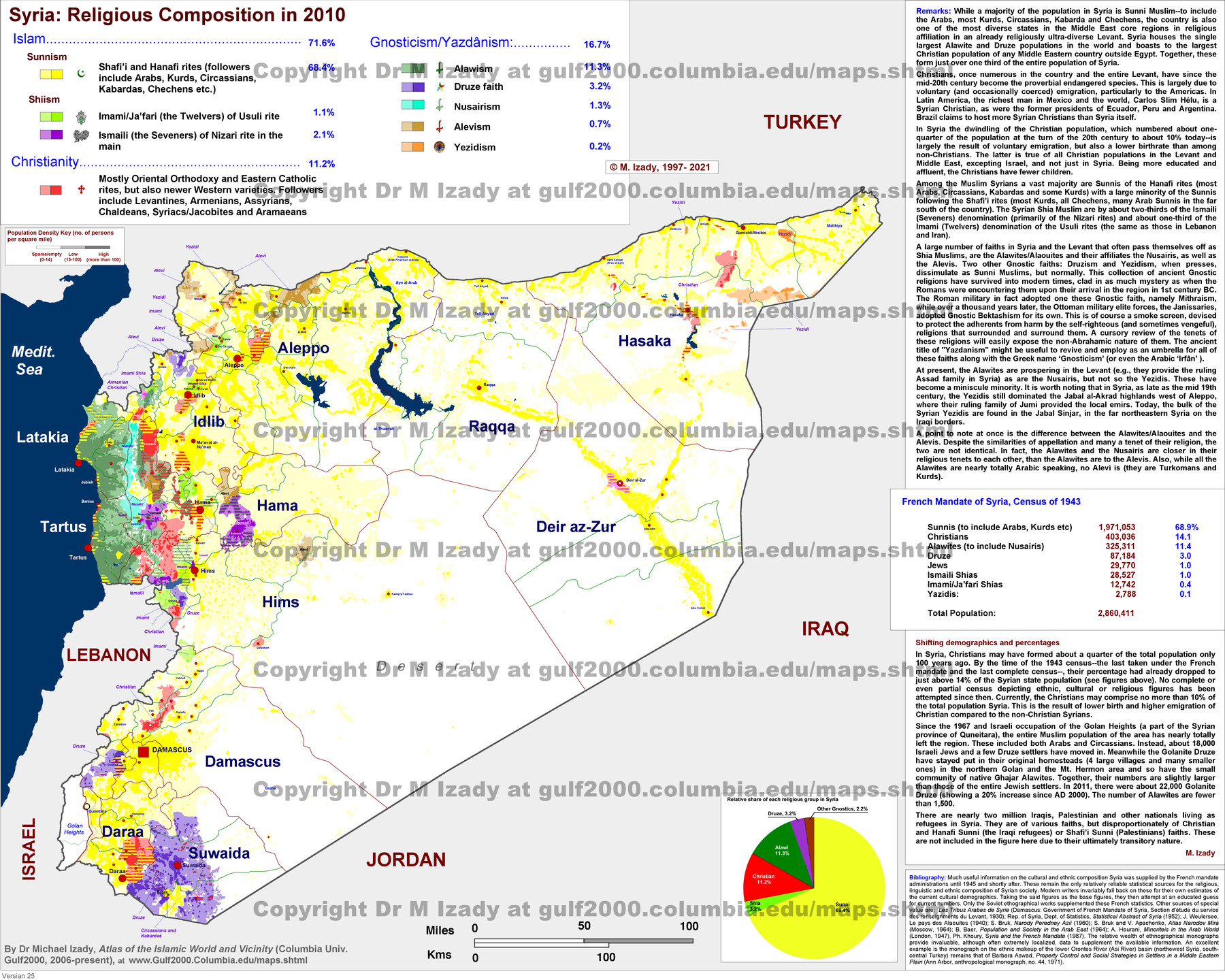
A prewar 2010 reference for the communities around Syria’s principal cities and regions. The legend uses Izady’s contested classification of some religious groups; community location does not establish loyalty to Assad, Iran, or an armed faction.
Map source: Dr. Michael Izady, Gulf/2000, Columbia University. Original map · Collection. Personal reference use; copyright remains with the author.

Syria’s estimated demographic shift, 2010–mid-2018
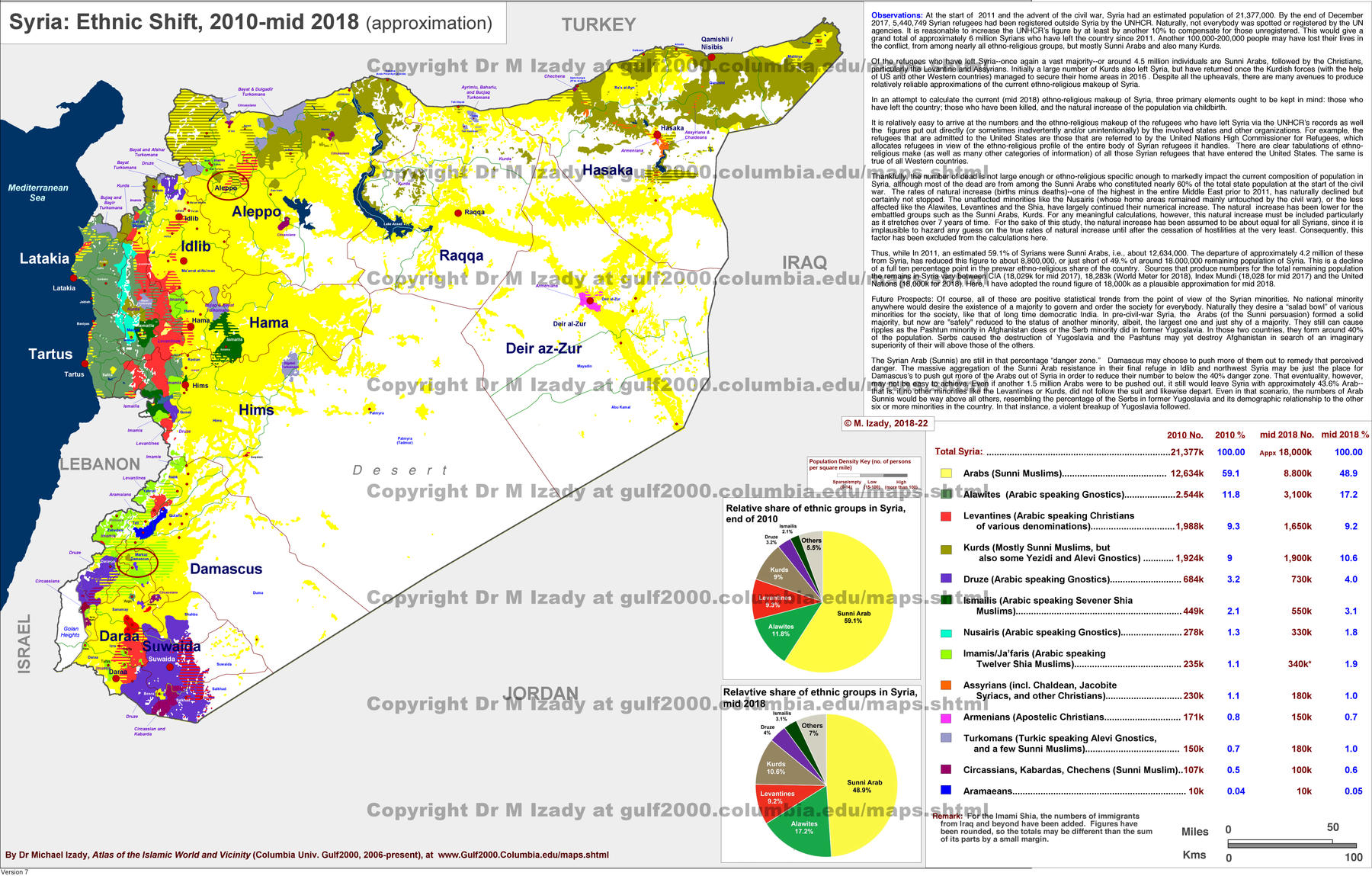
The image explicitly describes an approximate shift from 2010 to mid-2018. Use it to frame questions about displacement and changing settlement patterns, not as a current map or an independent estimate of responsibility for displacement.
Map source: Dr. Michael Izady, Gulf/2000, Columbia University. Original map · Collection. Personal reference use; copyright remains with the author.
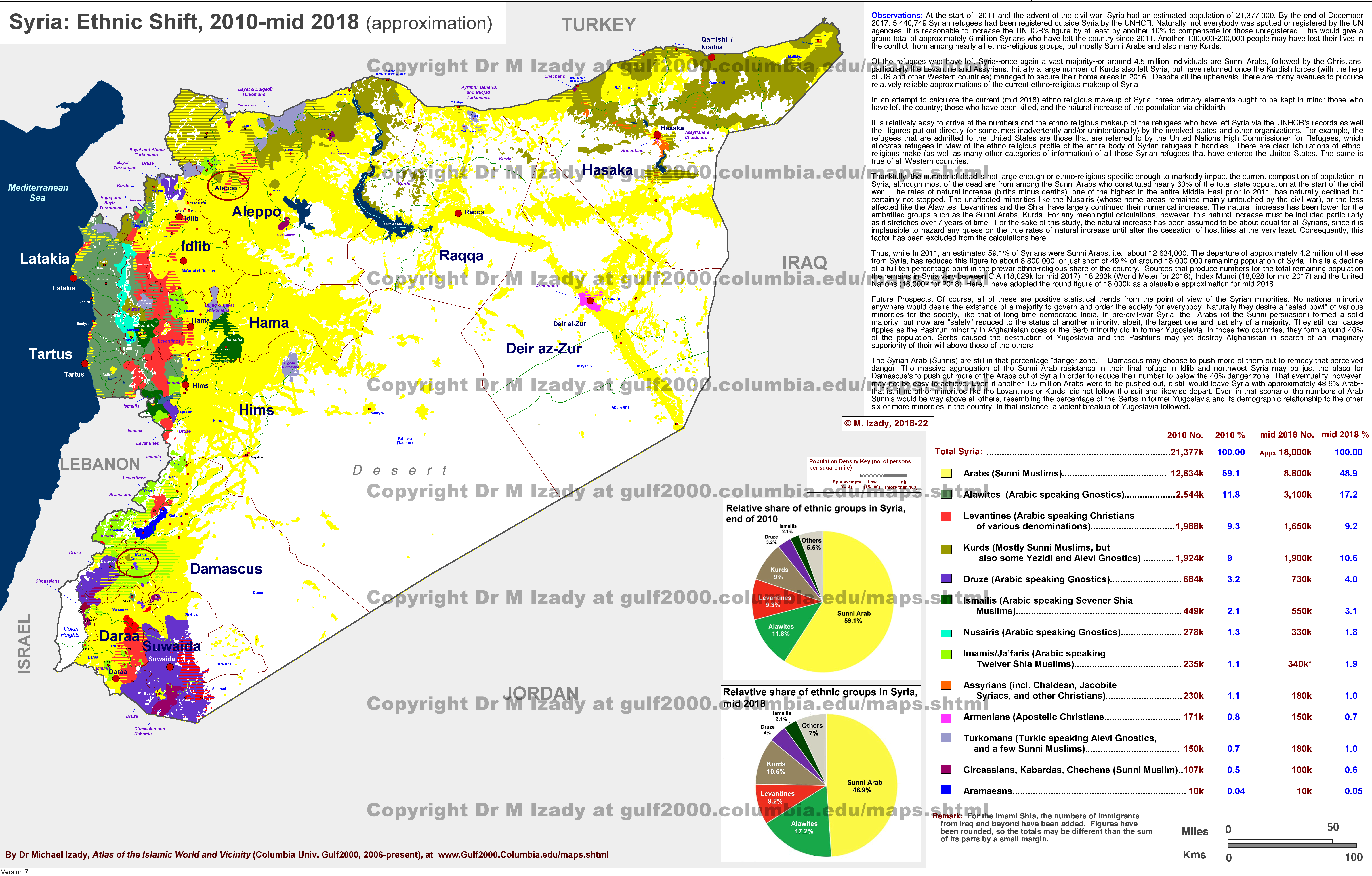
Source and interpretation: Gulf2000 map collection.
🔗 See Also
- Hamas · Hamas Leadership · Sinwar
- International Law & Aid Organizations · Polls
- On Democracies and Death Cults — Iran’s regional imperialism & sponsorship of proxies
- Velayat-e Faqih - Governance of the Jurist · Iran Nuclear Program - Evidence and Timeline · Nasrallah Speeches and Interviews (1986–2006)
- Lebanon, Israel & Hezbollah - A Century of Conflict (1920-2026) — Lebanon, Israel, and Hezbollah across a century