Pinker’s Chapter 6 supplement — an “Islamic exception” in share, not a demonstrated religious cause
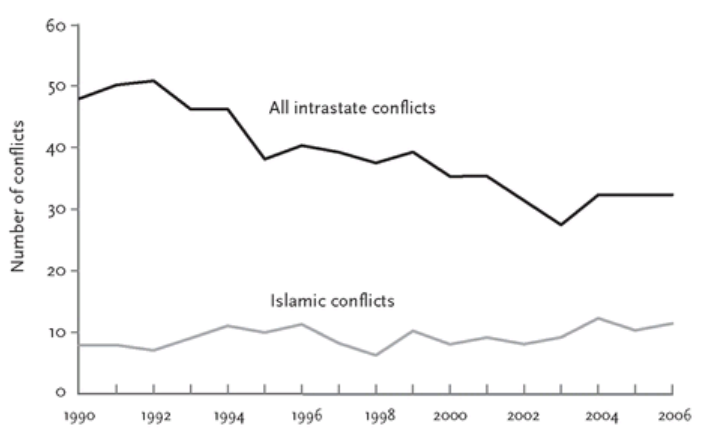
Figure 6-12 shows that conflicts involving a Muslim-majority country or Islamic opposition movement stayed roughly level from 1990–2006 while other intrastate conflicts fell. Pinker also reports later declines in support for al-Qaeda, suicide bombing, and attacks on civilians, plus a shift among 102 Muslim organizations from violent endorsement toward protest and elections. The coding does not show that Islam caused every conflict, and the trend window is historical rather than current. → Figure 6-12 · attitude change
Figure 6-12 — Conflicts coded “Islamic” and all intrastate conflicts, 1990–2006. “Islamic” means a Muslim-majority country, an Islamic opposition movement, or both; the graph does not isolate theology from regime type, state weakness, foreign intervention, geography, or insurgency. The category’s share rose because the comparison series declined, not because the Islamic-conflict count surged. Pinker’s Gallup and organizational evidence further treats Muslim opinion and tactics as heterogeneous and changeable. All of this is a 2011 source argument using data mostly ending in 2006–2010, not a current country ranking or a description of Muslims as a single civilization. Chapter 6 synthesis · Pinker’s adverse case and its scope, PDF pp. 506–510 (file not included in this release) · Denominator and Gallup interpretation, PDF pp. 511–513 (file not included in this release) · Figure 6-12, PDF p. 512 (file not included in this release) · Organizational change and 2011 forecast, PDF pp. 513–514 (file not included in this release)
Terrorism
Killings for Islam
Islam: The Politically Incorrect Truth
Evidence-audited debates
- September 11 Attacks - Origins, Plot, and Aftermath — a sourced history of al-Qaeda’s origins, the plot and four flights, the policy/ideology distinction, 2001 warnings, and claims to correct in a retrospective interview; distinguishes the perpetrators from Muslims generally and notes documented post-9/11 anti-Muslim hate crimes.
- The West Is Right to Be Suspicious of Islam - Jonathan Sacerdoti (Oxford Union, 2026) — distinguishes the documented Islamist threat from the unsupported move to collective suspicion; includes current UK/EU threat evidence and a claim-by-claim transcript audit.
- The 1991 Muslim Brotherhood Explanatory Memorandum - Provenance, Meaning, and Limits — nonviolent Islamism, historical U.S. networks, Hamas-support litigation, and the limits of inference from an internal proposal.
War
Islam Caliphates, Conquering, Colonizing
Islam Invasion of India
GENOCIDE OF ZARATUSHTIS by Islam in Iran (file not included in this release)
Killings for Islam