⬅️ Back to 60.11 Religion · Hubs: ✝️ Christianity · 🏛️ Christian Nationalism · Religion in Politics · Database: Books base (file not included in this release)
Source and reading notes
📄 Supplied text → Jesus and John Wayne (PDF) (file not included in this release)
🟨 Reader notebook → original HTML export (file not included in this release) · 82 imported highlights and 7 answered annotations
🧭 Detailed notes → Introduction · begin with Chapter 1
Every section note links its claims to the relevant physical PDF pages and maps the chapter to the complete span of Du Mez’s endnotes.
Handwritten Notebook Pages
Source
Open Jesus and John Wayne notebook pages — start at notebook p. 210 (file not included in this release).
Distilled Knowledge
From source to usable thought
The PDF, imported highlights, and chapter notes remain the complete source dossier. The notes below promote only the most reusable ideas into the wider vault, then carry them into an argument map, a provisional position, and a writing brief.
Reusable concepts
- Militant Christian Masculinity — Du Mez’s central concept, its mechanism, evidence, limits, and competing Christian models.
- The Protector Archetype in Religious Politics — the broader threat–protector–moral permission structure, separated from this single historical case.
- Consumer Networks as Ideological Institutions — how publishers, retailers, media, conferences, ministries, and audiences can create practical ideological authority without a central command.
Claims and argument
- 60 Knowledge/60.3 Politics/Religion & Politics/Gender Traditionalism Alone Does Not Explain White Evangelical Politics — uses Black Protestant Christianity as a control-case challenge to any monocausal patriarchy explanation.
- Militant Masculinity and Evangelical Support for Trump — separates cultural compatibility, strategic voting, moral permission, positive identification, and measured electoral causation.
Position and writing
- 30 Rhetoric/Politics/My Assessment of Jesus and John Wayne — a provisional position card distinguishing what the evidence strongly supports, partially supports, and does not establish.
- 80 Blog & Writing/Politics/Why Trump Was Not Simply a Betrayal of Evangelical Family Values — an article brief with thesis, outline, steelman, evidence chain, research gaps, and drafting checklist.
Visual Study Sheets
Whole-Book Argument Map
People and Ideas Timeline
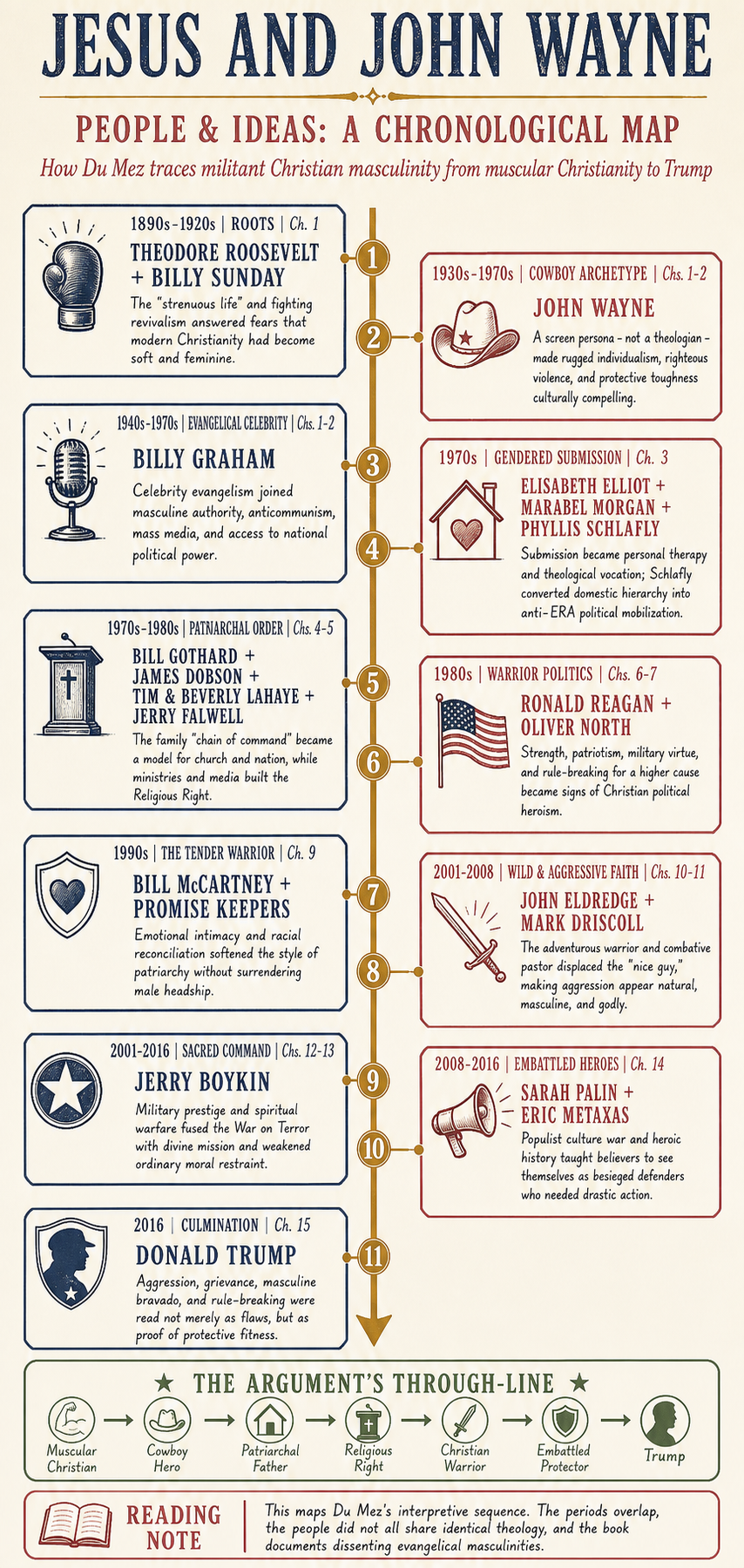
Description
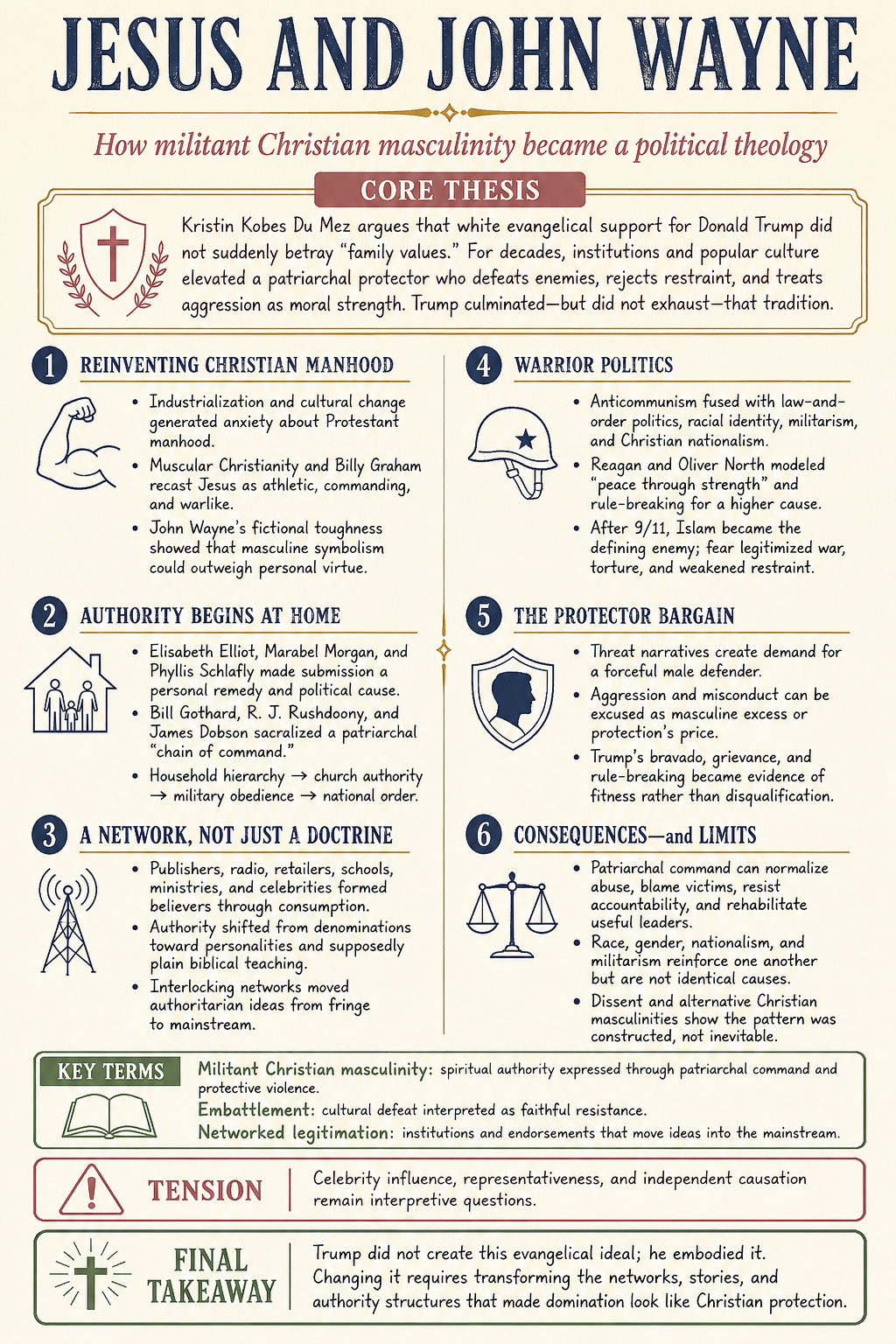
Kristin Kobes Du Mez presents a cultural history of white American evangelical masculinity from the early Cold War through Donald Trump. She argues that evangelical support for aggressive political leaders is best understood through a long institutional and consumer history that fused patriarchal authority, heroic violence, Christian nationalism, racial identity, sexual order, and fear of cultural decline.
Core Argument
Trump was not an inexplicable exception to evangelical “family values.” He became a fitting representative of values that had been cultivated for decades: a protector who projects strength, defeats enemies, ignores political correctness, and treats restraint as weakness. Churches, ministries, political organizations, publishers, retailers, military networks, celebrity pastors, and family authorities collectively made militant Christian masculinity part of ordinary evangelical identity.
Du Mez does not claim all evangelicals accepted this ideology or that the outcome was inevitable. The history contains dissent, alternative Christian masculinities, institutional variation, and reversals. Her argument concerns the dominant cultural pattern and the networks that made it politically powerful, especially within white conservative evangelicalism.
Chapter Guide
- Introduction — Trump as culmination; militant masculinity as a cultural and political theology.
- Chapter 1: Saddling Up — muscular Christianity, Cold War evangelical institutions, Billy Graham, and the cowboy ideal.
- Chapter 2: John Wayne Will Save Your Ass — civil rights, Vietnam, Nixon, law and order, John Wayne, and Jack Hyles.
- Chapter 3: God’s Gift to Man — Elisabeth Elliot, Marabel Morgan, Phyllis Schlafly, sexuality, submission, and the ERA.
- Chapter 4: Discipline and Command — Bill Gothard, R. J. Rushdoony, James Dobson, punishment, family hierarchy, and political order.
- Chapter 5: Slaves and Soldiers — the LaHayes, Jerry Falwell, Jimmy Carter, race, sexuality, and the emergence of the Religious Right.
- Chapter 6: Going for the Jugular — Reagan, the Southern Baptist takeover, militarism, and Iran-Contra.
- Chapter 7: The Greatest American Hero — Oliver North, televangelist scandal, military evangelization, and redemptive warrior celebrity.
- Chapter 8: War for the Soul — the Clinton era, culture war, selective moral judgment, and conservative media.
- Chapter 9: Tender Warriors — Promise Keepers, servant leadership, complementarianism, race reconciliation, and purity culture.
- Chapter 10: No More Christian Nice Guy — John Eldredge, post-9/11 aggression, the Iraq War, and the rejection of a gentle Jesus.
- Chapter 11: Holy Balls — fight-club religion, homeschool patriarchy, Mark Driscoll, New Calvinism, and the collapse of the fringe-mainstream boundary.
- Chapter 12: Pilgrim’s Progress in Camo — Colorado Springs, evangelical influence in the military, and soldiers as spiritual authorities.
- Chapter 13: Why We Want to Kill You — Islamophobia, fraudulent “ex-terrorists,” Jerry Boykin, torture, and fear as a source of power.
- Chapter 14: Spiritual Badasses — Obama-era embattlement, Sarah Palin, Eric Metaxas, Duck Dynasty, and warrior moral authority.
- Chapter 15: A New High Priest — the 2016 election and Trump as the culmination of militant Christian masculinity.
- Chapter 16: Evangelical Mulligans—A History — abuse, victim blaming, institutional protection, and the cost of unchecked patriarchal power.
- Conclusion — guns, borders, markets, race, global export, resistance, and the historical possibility of unmaking the system.
Recurring Mechanisms
- Masculine threat and protection: Communities are taught to perceive danger, then grant authority to men who promise forceful defense.
- Patriarchal chain of command: Family, church, military, and nation mirror one another as hierarchies in which obedience becomes a spiritual virtue.
- Consumer formation: Books, radio, toys, conferences, film, retail, and celebrity culture transmit political theology without requiring formal doctrinal agreement.
- Militarized Christian nationalism: God-and-country identity treats American force as redemptive and national criticism as disloyal or impious.
- Networked legitimation: Publishers, ministries, schools, conferences, endorsements, and friendships move ideas and leaders between fringe and mainstream.
- Selective moral accounting: Aggression and sexual misconduct can be reframed as masculine excess, forgivable imperfection, or the cost of an effective protector.
Evidence and Interpretation Boundary
How to use these notes
These chapter notes summarize Du Mez’s argument and evidentiary choices; they do not treat every causal inference or classification as settled fact. Her documented events, quotations, polling, institutional connections, and publication history support a strong cultural-history case. Broader claims—such as how representative a celebrity was of ordinary believers, how much gender ideology independently caused a political behavior, or where “mainstream” ends and “fringe” begins—remain interpretive questions. The chapter notes preserve dissenting evangelicals and alternative explanations where the book supplies them.
Cross-Vault Connections
- Christian Nationalism — competing definitions, defenses, and criticisms of Christian political dominance.
- America a Christian Nation? — founding-era and constitutional claims behind God-and-country identity.
- Religion in Politics — public reason, pluralism, religious freedom, and the use of religious authority in law.
- The Dark Side of Christian History · Authority Abusers- Breaking Free from Spiritual Abuse · Toxic Faith — comparison points for institutional power and spiritual abuse.
- Islamophobia · Terrorism, Violence & War — the post-9/11 enemy construction examined in Chapters 12–13.
Review and Retention
Closed-Book Recall
- The book’s thesis in one sentence:
- The three most important mechanisms:
- The strongest chapter-level evidence:
- The most important counterexample or qualification:
- What remains uncertain:
Retrieval Questions
- How does Du Mez connect family advice and masculinity media to national politics?
- Why is John Wayne more important as a cultural symbol than as a historical person in this argument?
- Which institutions carried militant masculinity across generations?
- How do race, gender, and Christian nationalism interact without becoming identical explanations?
- What would falsify or substantially weaken the book’s thesis?
Reader Highlights and Answered Annotations
Import provenance and limits
Imported from the supplied Kindle Notebook HTML on 2026-09-04: 82 yellow highlights and 7 reader annotations, covering the Introduction through Chapter 6 only. Highlight wording is Du Mez’s text; blocks labeled Reader annotation are the reader’s questions; blocks labeled Research response are later analysis and are not part of the book. Kindle page numbers are linked to the corresponding local PDF page using the six-page front-matter offset.
Introduction
Reader highlight — p. 1 · loc. 56 (file not included in this release)
42 percent of white evangelicals supported Trump—more than any other candidate.
Reader highlight — p. 3 · loc. 85 (file not included in this release)
But evangelical support for Trump was no aberration, nor was it merely a pragmatic choice. It was, rather, the culmination of evangelicals’ embrace of militant masculinity, an ideology that enshrines patriarchal authority and condones the callous display of power, at home and abroad. By the time Trump arrived proclaiming himself their savior, conservative white evangelicals had already traded a faith that privileges humility and elevates “the least of these” for one that derides gentleness as the province of wusses. Rather than turning the other cheek, they’d resolved to defend their faith and their nation, secure in the knowledge that the ends justify the means. Having replaced the Jesus of the Gospels with a vengeful warrior Christ, it’s no wonder many came to think of Trump in the same way. In 2016, many observers were stunned at evangelicals’ apparent betrayal of their own values. In reality, evangelicals did not cast their vote despite their beliefs, but because of them.
Reader highlight — p. 3 · loc. 93 (file not included in this release)
Survey data reveal the stark contours of the contemporary evangelical worldview. More than any other religious demographic in America, white evangelical Protestants support preemptive war, condone the use of torture, and favor the death penalty. They are more likely than members of other faith groups to own a gun, to believe citizens should be allowed to carry guns in most places, and to feel safer with a firearm around. White evangelicals are more opposed to immigration reform and have more negative views of immigrants than any other religious demographic; two-thirds support Trump’s border wall. Sixty-eight percent of white evangelical Protestants—more than any other demographic—do not think that the United States has a responsibility to accept refugees. More than half of white evangelical Protestants think a majority nonwhite US population would be a negative development. White evangelicals are considerably more likely than others to believe that Islam encourages violence, to refuse to see Islam as “part of mainstream American society,” and to perceive “natural conflict between Islam and democracy.” At the same time, white evangelicals believe that Christians in America face more discrimination than Muslims. White evangelicals are significantly more authoritarian than other religious groups, and they express confidence in their religious leaders at much higher rates than do members of other faiths.
Reader highlight — p. 4 · loc. 104 (file not included in this release)
the belief that America is God’s chosen nation and must be defended as such—serves as a powerful predictor of intolerance toward immigrants, racial minorities, and non-Christians.
Reader annotation — p. 4 · loc. 105 (file not included in this release)
Are these actually connected? Are they just conservative? Correlation not causation?
Research response
Connected, but the evidence is not a clean demonstration of causation. The book is drawing on more than an uncontrolled comparison between evangelicals and everyone else. Whitehead, Perry, and Baker found Christian-nationalist identification predicted a Trump vote even after controls for political identity, economic dissatisfaction, sexism, anti-Black prejudice, and anti-Muslim and anti-immigrant attitudes (study and DOI). Related research found associations with judgments about police treatment of Black Americans even after controlling for political and religious characteristics (Perry, Whitehead, and Davis). That makes “they are merely measuring conservatism” too dismissive.
It still does not prove that Christian nationalism independently causes every listed attitude. These are observational survey models: party identity, racial threat, authoritarian disposition, media environment, and Christian nationalism may influence one another, and some survey items may partly encode conservative politics in the measure itself. Du Mez’s contribution is a proposed historical mechanism—institutions joined patriarchal protection, white Christian nationhood, militarism, and perceived threat over time—not an experiment isolating one causal variable. Best verdict: a robust conditional association plus a plausible historical mechanism, not settled one-way causation.
Reader highlight — p. 6 · loc. 145 (file not included in this release)
For conservative white evangelicals, the “good news” of the Christian gospel has become inextricably linked to a staunch commitment to patriarchal authority, gender difference, and Christian nationalism, and all of these are intertwined with white racial identity.
Reader highlight — p. 11 · loc. 220 (file not included in this release)
Antecedents can be found in nineteenth-century southern evangelicalism and in early-twentieth-century “muscular Christianity,” but it was in the 1940s and 1950s that a potent mix of patriarchal “gender traditionalism,” militarism, and Christian nationalism coalesced to form the basis of a revitalized evangelical identity. With Billy Graham at the vanguard, evangelicals believed that they had a special role to play in keeping America Christian, American families strong, and the nation secure. The assertion of masculine power would accomplish all these goals.
Reader highlight — p. 12 · loc. 233 (file not included in this release)
desegregation also heightened the long-standing imagined threat to white womanhood, and to the power of white men to police social and sexual boundaries. The reassertion of white patriarchy was central to the new “family values” politics, and by the end of the 1970s, the defense of patriarchal power had emerged as an evangelical distinctive.
Reader annotation — p. 12 · loc. 235 (file not included in this release)
What is this purposeful ignorance of Black conservative patriarchal views?
Research response
This is a fair control-case challenge, but “purposeful ignorance” attributes intent that the passage does not establish. Black Protestant communities have often contained conservative sexual ethics, male-provider expectations, and patriarchal institutions. Pew, for example, finds that Black congregations emphasize men’s financial and community roles more than women’s, while also finding that overwhelming majorities of Black Americans support women serving as senior religious leaders (Pew’s Black religion and gender study).
The comparison actually improves the analysis. Black and white evangelicals can share high religiosity and some conservative theology while diverging sharply in partisanship and judgments about race, government, immigration, and Trump; Pew explains why it normally analyzes them separately (methodological explanation). Therefore patriarchy by itself cannot explain white evangelical Republican politics. Du Mez’s narrower claim concerns a historically specific bundle: patriarchal protection joined to white racial order, Christian nationalism, militarism, consumer networks, and conservative partisanship. Her white-evangelical scope is legitimate, but the book would be analytically stronger if it used Black conservative Christianity more explicitly as a comparison that separates shared gender traditionalism from the racial-nationalist political package.
Reader highlight — p. 12 · loc. 240 (file not included in this release)
come, militant masculinity
Reader highlight — p. 13 · loc. 246 (file not included in this release)
In 2001, when terrorists struck the United States, evangelicals again had an actual battle to fight. Yet even then, evangelical militancy was fueled by fraudulent tales of the Islamic threat, tales that were promoted by evangelicals themselves.
Reader annotation — p. 13 · loc. 248 (file not included in this release)
fraudulent tales right after she talks about 9/11 in the previous sentence
Research response
She is not calling the September 11 attacks fraudulent. The sentence distinguishes the real attack from false or embellished stories later used to portray Islam and Muslims generally as an undifferentiated civilizational enemy. Chapter 13 identifies the intended examples: Ergun and Emir Caner’s invented or embellished “former jihadist” biography and the unsupported “ex-terrorist” accounts circulated by Walid Shoebat, Zachariah Anani, and Kamal Saleem. Churches, publishers, broadcasters, colleges, and sometimes military audiences continued presenting these speakers as experts after serious credibility problems emerged. See the Caner evidence and the ex-terrorist circuit. A clearer sentence would have said: “After the real attack, evangelical militancy was also amplified by fraudulent tales purporting to describe Islam as a whole.”
Reader highlight — p. 13 · loc. 259 (file not included in this release)
Generations of evangelicals learned to be afraid of communists, feminists, liberals, secular humanists, “the homosexuals,” the United Nations, the government, Muslims, and immigrants—and they were primed to respond to those fears by looking to a strong man to rescue them from danger, a man who embodied a God-given, testosterone-driven masculinity.
Chapter 1: Saddling Up
Reader highlight — p. 15 · loc. 281 (file not included in this release)
the “feminization” of Victorian Christianity, which privileged gentility, restraint, and an emotive response to the gospel message.
Reader highlight — p. 16 · loc. 290 (file not included in this release)
Immigrants from southern and eastern Europe began arriving at the nation’s shores, and “new women” started going to college, entering the professions, riding bicycles, wearing bloomers, and having fewer babies.
Reader annotation — p. 16 · loc. 291 (file not included in this release)
fact check
Research response
Substantially accurate, but compressed into a symbolic list. The late nineteenth and early twentieth centuries brought a major immigration wave from southern and eastern Europe; women’s higher-education enrollment and entry into professions rose; and the “New Woman” became a recognizable cultural type. The Library of Congress describes her as independent, often well educated, and more publicly active (Gibson Girl/New Woman exhibit). It also documents the 1890s bicycle boom, women’s cycling, and clothing debates involving bloomers (Library of Congress bicycle guide). Federal historical education statistics confirm rising female participation in higher education (NCES historical portrait), and Census historical analysis shows fertility declined across the nineteenth century (Census fertility study).
Two qualifications matter. Women and immigrants had not suddenly appeared; their numbers, visibility, national origins, and social independence were changing. And bloomers were controversial and never normal dress for most women. Du Mez is accurately listing the changes that contemporary commentators bundled into a perceived crisis of white Protestant manhood, not describing every American woman.
Reader highlight — p. 16 · loc. 294 (file not included in this release)
No one advanced this new American masculinity with more gusto than Theodore Roosevelt.
Reader highlight — p. 16 · loc. 302 (file not included in this release)
In this way, the new American imperialism was framed as a conservative effort to restore American manhood. 2
Reader annotation — p. 16 · loc. 303 (file not included in this release)
how are these connected
Research response
The connection is partly actors’ own rhetoric and partly Du Mez’s historical interpretation. After the continental frontier was declared closed, overseas war and empire offered elite white men a new arena for displaying vigor, risk, conquest, racial tutelage, and national mastery. Theodore Roosevelt made the link unusually explicit: his “strenuous life” opposed anti-imperialism and warned that an easy, isolated nation would lose the “manly and adventurous qualities” necessary for survival. The Library of Congress preserves the speech collection (primary-source record), and the Theodore Roosevelt Presidential Library explains that the 1899 address directly answered opponents of overseas expansion (speech context).
Thus imperial expansion was represented as a cure for feared softness: foreign struggle would regenerate both individual men and the national body. This supports Du Mez’s claim that imperialism was framed as restored manhood. It does not establish masculinity anxiety as the sole or primary cause of American empire; commercial interests, strategy, naval power, party politics, and racial ideology remain independent explanations.
Reader highlight — p. 17 · loc. 311 (file not included in this release)
1910s, Christian men set out to “re-masculinize” American Christianity.
Reader highlight — p. 19 · loc. 353 (file not included in this release)
patriotism was no virtue; a Christian’s loyalty belonged to God’s kingdom, not to the nation.
Reader highlight — p. 19 · loc. 357 (file not included in this release)
When the war came to a close, no amount of patriotism could obscure the fact that it had been fought at great cost, and with little apparent gain.
Reader annotation — p. 20 · loc. 358 (file not included in this release)
what???
Research response
This is describing postwar disillusionment, not claiming that victory produced literally no consequences or benefits. World War I killed more than 116,000 Americans in service and millions globally (National WWI Museum/Smithsonian material). The peace did not produce the durable moral reconstruction many liberal Protestants had promised: the Versailles settlement became associated with punitive terms and unstable compromises; the United States rejected the treaty and never joined Wilson’s League of Nations; and public confidence in the settlement declined (U.S. Office of the Historian). “Little apparent gain” is therefore a period judgment about the gap between redemptive-war rhetoric and the postwar order—not a balanced inventory of every geopolitical result.
Reader highlight — p. 21 · loc. 379 (file not included in this release)
Authors like Sinclair Lewis and H. L. Mencken made a sport of ridiculing the retrograde muscular Christianity of fundamentalists
Reader highlight — p. 22 · loc. 408 (file not included in this release)
Billy Graham’s
Reader highlight — p. 23 · loc. 421 (file not included in this release)
incumbent upon Graham to prove that Christianity was wholly compatible with red-blooded masculinity.
Reader highlight — p. 24 · loc. 435 (file not included in this release)
Through the 1940s and into the 1950s, most evangelicals saw the military as a place of moral corruption for young men. Contrary to later myths about “the good war” and “the greatest generation,” the military was known as an institution where drunkenness, vulgarity, gambling, and sexual disease abounded.
Reader highlight — p. 27 · loc. 475 (file not included in this release)
Some believed Christ’s atonement had nullified any “curse” placed on Eve in the Book of Genesis, opening the way to egalitarian gender roles; in the late nineteenth and early twentieth centuries, evangelicals in this tradition had been enthusiastic proponents of women’s rights.
Reader highlight — p. 28 · loc. 501 (file not included in this release)
myth of the American cowboy had
Reader highlight — p. 31 · loc. 549 (file not included in this release)
Reminiscent of the days of Theodore Roosevelt, Cold War Americans once again found themselves trading isolationism for a new imperialism—this time expanding the free market at home and abroad. Combining resurgent nationalism with moral exceptionalism, Americans divided the world into good guys and bad guys, and the Western offered a morality tale perfectly suited to the moment, one in which the rugged hero resorted to violence to save the day. 34
Chapter 2: John Wayne Will Save Your Ass
Reader highlight — p. 33 · loc. 570 (file not included in this release)
evangelical partisanship can only be understood in terms of a broader realignment that transformed partisan politics from the 1950s to the 1980s, a realignment that evangelicals themselves helped bring about. At the heart of this realignment were attitudes toward civil rights, the war in Vietnam, and “family values.” For conservatives, a defense of white patriarchy emerged as a unifying thread across this range of issues; for conservative evangelicals, a defense of white patriarchy would move to the center of their coalescing cultural and political identity.
Reader highlight — p. 35 · loc. 608 (file not included in this release)
The defense of Christian America required more than spiritual resources alone. Eisenhower presided over the vast expansion of America’s military-industrial complex, and in his farewell address, he made the connection explicit: a strong military would keep Americans free to worship their God.
Reader highlight — p. 36 · loc. 618 (file not included in this release)
(The nuclear family structured around a male breadwinner was in fact of recent invention, arising in the 1920s and peaking in the 1950s and 1960s; before then, multigenerational families relying on multiple contributors to the family economy had been the norm.)
Reader annotation — p. 36 · loc. 620 (file not included in this release)
fact check
Research response
The claim is directionally right about the breadwinner–homemaker model but too categorical about the nuclear family itself. Parent-and-child households existed long before the 1920s, and historians dispute how universally extended families ever shared one roof. What became newly dominant was a particular industrial arrangement: the husband earned a wage outside the home, the wife specialized in unpaid domestic work, children ceased to be major economic contributors, young couples established independent households, and postwar wages and housing made the ideal unusually attainable.
Historical demographer Steven Ruggles traces the transition from family economies involving household heads, children, servants, and intergenerational coresidence toward male wage labor and later female wage labor; he also shows that intergenerational coresidence was once a normal life-course phase rather than a universal permanent household form (Ruggles, Demography; coresidence study). The most precise restatement is: the culturally dominant, economically feasible male-breadwinner nuclear-household ideal emerged through nineteenth-century industrialization, became widespread in the early twentieth century, and reached an exceptional high point in the 1950s–60s. Calling the nuclear family itself a 1920s invention overstates the evidence.
Reader highlight — p. 37 · loc. 636 (file not included in this release)
It is easily forgotten, but some evangelicals—especially those who would come to constitute the “evangelical Left”—were vocal supporters of civil rights.
Reader highlight — p. 38 · loc. 657 (file not included in this release)
Understanding this ambivalence toward civil rights within white evangelicalism is key to understanding the role that race would play within evangelical politics more generally. By backing away from their support for civil rights, evangelicals like Graham ended up giving cover to more extremist sentiments within the insurgent Religious Right. Today some historians place race at the very heart of evangelical politics, pointing to the fact that evangelical opposition to government-mandated integration predated anti-abortion activism by several years.
Reader highlight — p. 39 · loc. 669 (file not included in this release)
many southern evangelicals and fundamentalists who persisted in their unreconstructed views of race would find common cause with more “tolerant” evangelicals on issues like social welfare policy and “law and order” politics that would carry clear racial undertones.
Reader highlight — p. 43 · loc. 735 (file not included in this release)
Opponents tarred him a warmonger and an extremist, to which Goldwater famously retorted: “Extremism in the defense of liberty is no vice. And … moderation in the pursuit of justice is no virtue!”
Reader highlight — p. 45 · loc. 767 (file not included in this release)
With Graham’s assistance, Nixon had worked to identify himself with born-again Christianity.
Reader highlight — p. 47 · loc. 810 (file not included in this release)
Evangelicals had long rejected rock ’n’ roll, which they associated with drug culture and youthful rebellion, but by offering a Christian version of popular music, Explo ’72 helped pave the way for what would become a thriving Christian contemporary music industry.
Reader highlight — p. 48 · loc. 819 (file not included in this release)
THE ANTIWAR LEFT, though often disparaged by evangelicals, was in fact animated in part by religious faith. Mainline clergy vociferously condemned American war crimes and called into question the morality of the war and that of American soldiers.
Reader highlight — p. 50 · loc. 853 (file not included in this release)
The Vietnam War was pivotal to the formation of an emerging evangelical identity. For many Americans who came of age in the 1960s and 1970s, Vietnam demolished myths of American greatness and goodness. American power came to be viewed with suspicion, if not revulsion, and a pervasive antimilitarism took hold.
Reader highlight — p. 52 · loc. 890 (file not included in this release)
The failure of American soldiers to defeat a ragtag enemy testified to serious problems of American manhood, and no group felt this crisis more keenly than American evangelicals.
Reader highlight — p. 53 · loc. 900 (file not included in this release)
Teaching boys how to be good losers left you with a generation of young men who didn’t want to fight for their country and were instead “willing to let the strongest nation on earth bow down in shame before a little nation like North Vietnam.”
Reader highlight — p. 53 · loc. 907 (file not included in this release)
Hyles prefigured a style of militant masculinity that other evangelical pastors would perfect.
Reader highlight — p. 53 · loc. 913 (file not included in this release)
Parents in his church took his advice to heart; one woman recalled receiving more than three hundred lashes from a leather belt, and Hyles advised the girl’s parents how to avoid arrest after authorities were notified.
Reader highlight — p. 54 · loc. 921 (file not included in this release)
an evangelical could be defined as anyone who liked Billy Graham, by the 1970s a conservative might well be defined as anyone who loved John Wayne.
Reader highlight — p. 56 · loc. 944 (file not included in this release)
the war effort, ridiculing as “soft” those who didn’t enlist. One critic labeled Wayne “the most important man in America,” given the role his films played in driving American engagement in Vietnam.
Reader highlight — p. 56 · loc. 959 (file not included in this release)
All of Wayne’s greatest hits involved valiant white men battling (and usually subduing) nonwhite populations—the Japanese, Native Americans, or Mexicans.
Reader highlight — p. 59 · loc. 1004 (file not included in this release)
Instrumental to their efforts to reclaim power, this rhetoric of fear would continue to bolster the role of the heroic masculine protector.
Chapter 3: God’s Gift to Man
Reader highlight — p. 60 · loc. 1012 (file not included in this release)
MARABEL MORGAN’S
Reader highlight — p. 62 · loc. 1051 (file not included in this release)
In fact, she promised women a sizable return on their investment: “If you’re stingy in bed, he’ll be stingy with you.” Give him what he wants, and he’ll give back to you.
Reader highlight — p. 65 · loc. 1095 (file not included in this release)
The very notion of hierarchy came from the Bible, Elliot contended. In short, equality was “not a Christian ideal.” A hierarchical order of submission and rule descended “from the nature of God Himself.” God the Father exercised “just and legitimate authority”; the Son exhibited “willing and joyful submission.” Within the trinitarian God, then, existed “the elements of rule, submission, and union.” Due to a hatred of authority, however, “the blueprint has been lost.”
Reader highlight — p. 65 · loc. 1102 (file not included in this release)
“The more womanly you are, the more manly your husband will want to be.” 9
Reader highlight — p. 67 · loc. 1136 (file not included in this release)
In light of this God-given difference, “Judeo-Christian” society had developed laws and customs requiring men to carry out their duties to protect and provide for women. Women’s rights, then—their rights to have babies and to be protected—were achieved through the family structure and ensured through men’s chivalry. Tragically, “‘ equal rights’ fanatics” threatened to undo all this. All of a sudden, “aggressive females” were everywhere “yapping” about how mistreated they were, equating marriage to slavery, suggesting that housework was “menial and degrading, and—perish the thought—that women are discriminated against.” This was “the fraud of the century.”
Reader highlight — p. 69 · loc. 1160 (file not included in this release)
Like Billy Graham and other evangelical lodestars, Schlafly moved fluidly between family matters and national security. She linked gender equality to communism (in Russia, a woman was “obliged to put her baby in a state-operated nursery or kindergarten” and abortions were “available for the asking”) and fretted that the ERA would force women into military service. She couldn’t imagine “why any woman would support such a ridiculous and un-American proposal as this.”
Reader highlight — p. 71 · loc. 1199 (file not included in this release)
A state legislator, too, made the connection plainly: “I ain’t going to have my wife be in the bathroom with some big, black buck!” 21
Reader highlight — p. 71 · loc. 1209 (file not included in this release)
A WITTY, BRILLIANT WOMAN, Schlafly infuriated feminists. When she spoke in public, she liked to thank her husband for allowing her to do so just to get a rise out of any “women’s libbers” who might be present.
Reader highlight — p. 72 · loc. 1220 (file not included in this release)
Almost singlehandedly, Schlafly sabotaged the ratification of the ERA. In doing so, she also helped put gender at the center of an emerging evangelical political identity.
Reader highlight — p. 73 · loc. 1228 (file not included in this release)
It’s hard to overstate Schlafly’s significance in marshalling the forces of the Religious Right. Years before James Dobson or Jerry Falwell entered the political fray, Phyllis Schlafly helped unify white Christians around a rigid and deeply conservative vision of family and nation. Although her star faded by the end of the century, it wasn’t because her influence had waned. By that time, her ideas had come to define the Republican Party, and much of American evangelicalism. If she seemed superfluous, it was only because what she was saying had become the lingua franca among American conservatives.
Chapter 4: Discipline and Command
Reader highlight — p. 74 · loc. 1244 (file not included in this release)
BILL GOTHARD
Reader highlight — p. 76 · loc. 1265 (file not included in this release)
Like Rushdoony, Gothard believed that most problems could be solved by submitting to the proper authorities in each domain of life. To this end, he advanced the idea of a divinely ordained “chain of command” similar to that of the military. In the family, the father was the ultimate authority. A wife owed her husband total submission, requiring approval for even the smallest household decisions, and children owed parents absolute obedience in both action and attitude. The church was also part of the proper functioning of society, and church leaders were to wield absolute, God-given authority over members. Government, too, administered divinely sanctioned authority, with national leaders exercising authority over local officials, who in turn exercised authority over citizens. Proper authority structured business as well; the employer wielded God-given authority over employees. In this way, proponents of “biblical law” married “traditional” gender roles to unrestrained, free-market capitalism. It was a match made in heaven.
Reader highlight — p. 76 · loc. 1275 (file not included in this release)
For both Gothard and Rushdoony, this order found expression in the authoritarian rule of men. Men who forsook their duty to impose order abdicated their masculinity, allowing women to usurp their power, and Rushdoony eagerly awaited the day when “once independent and feministic women” would be humbled and “seek the protection and safety of a man.”
Reader highlight — p. 78 · loc. 1310 (file not included in this release)
IN 1970, AN AS-OF-YET LITTLE-KNOWN child psychologist named James Dobson published a small book, Dare to Discipline.
Reader highlight — p. 79 · loc. 1321 (file not included in this release)
Dobson saw children as naturally sinful creatures, inclined toward defiance and rebellion.
Reader highlight — p. 81 · loc. 1351 (file not included in this release)
In 1973, Dobson resigned from the American Psychological Association after it removed homosexuality from its list of mental disorders.
Reader highlight — p. 81 · loc. 1354 (file not included in this release)
With two children of his own, however, Dobson feared making the mistakes of his own absentee father, and so he decided to retire from the speaking circuit—but not before agreeing to record one of his final talks. Produced by a Christian publisher and marketed to evangelical churches, his seven-part video series was compatible with the first VCRs. One segment of the series addressing distant fathers was packaged separately as a one-hour television special, Where’s Dad?, and Dobson sent a representative around the country to solicit donations from evangelical businessmen to fund its airing in local markets. This distribution model worked spectacularly well. By the early 1980s an estimated one hundred million people around the world had viewed the special.
Reader highlight — p. 81 · loc. 1364 (file not included in this release)
The postwar years had been marked by economic gains that made it possible for many men to serve as sole breadwinners for their families. The global economic restructuring beginning in the 1970s, however, resulted in a decline of American manufacturing jobs and stagnation of male wages. The breadwinner economy had always been as much myth as reality, but by the 1970s, this aspirational ideal was becoming increasingly difficult to attain, even among members of the white middle class.
Reader highlight — p. 82 · loc. 1376 (file not included in this release)
In 1972, the same year Congress overwhelmingly approved the ERA, they also passed Title IX as part of the Education Amendments Act, prohibiting sex discrimination in federally funded schools. In 1973, the Supreme Court established women’s constitutional right to an abortion in Roe v. Wade. Together with the growing power of the feminist movement, this series of events appeared to evangelicals to be a coordinated assault on traditional, God-ordained gender roles.
Reader highlight — p. 83 · loc. 1385 (file not included in this release)
“Men derive self-esteem by being respected; women feel worthy when they are loved.” Five years later, in his book Straight Talk to Men and Their Wives, he expanded on this theme. Echoing Marabel Morgan, he explained that because of a man’s fragile ego and “enormous need to be respected,” together with a woman’s vulnerability and need to be loved, it was “a mistake to tamper with the time-honored relationship of husband as loving protector and wife as recipient of that protection.”
Reader highlight — p. 83 · loc. 1394 (file not included in this release)
But by the end of the 1970s, Dobson had turned his attention to men. He blamed feminists for calling into question “everything traditionally masculine” and for tampering with the “time-honored roles of protector and protected.” Most perniciously, they had denigrated masculine leadership as “macho,” leaving men in confusion and the nation in peril. The media, too, had colluded with feminists to portray “the macho man” as an anachronism. The demeaning portrayal of men in popular sitcoms was part of a “concerted attack on ‘maleness.’” All this left men in a state of confusion over their role: “Will he march off to defend his homeland in times of war, or will his wife be the one to fight on foreign soil? Should he wear jewelry and satin shoes or carry a purse? Alas, is there anything that marks him as different from his female counterpart?”
Reader highlight — p. 84 · loc. 1407 (file not included in this release)
“If this be macho, sexist, chauvinist, and stereotypical, then I’m guilty as charged.” With evident pleasure, he added: “Please address all hate mail to my secretary, who has a special file prepared for it.” 18
Reader highlight — p. 86 · loc. 1447 (file not included in this release)
Cognitive linguist George Lakoff has proposed that competing metaphors of the family constitute a key divide in modern society. Morality is imagined through metaphor, and family metaphors reside at the core of contemporary political worldviews; whereas liberals favor a nurturing parent model, conservatives embrace a strict father metaphor. At the center of Dobson’s worldview—and that of many conservative evangelicals—was the strict enforcement of patriarchal authority.
Reader highlight — p. 86 · loc. 1451 (file not included in this release)
For both Dobson and Gothard, the problems of the modern family, and of society writ large, could be traced to the erosion of patriarchal power. Within both separatist and “respectable” wings of modern evangelicalism, then, a shared defense of patriarchy contributed to an emerging cultural identity, and to a growing commitment to political activism. Over time, this alliance would begin to dictate the boundaries of evangelicalism itself.
Chapter 5: Slaves and Soldiers
Reader highlight — p. 91 · loc. 1512 (file not included in this release)
In satisfying their husbands sexually, wives played a critical role in propping up men’s egos, which in turn bolstered them for leadership. If a husband lacked confidence, his wife should “make aggressive love to him … dress provocatively and use her feminine charm to seduce him” to help him “bounce back.”
Reader highlight — p. 91 · loc. 1517 (file not included in this release)
The problem was that many Christian wives were failures in the bedroom. And here the LaHayes confronted a conundrum. What happens when you believe that men have voracious sexual appetites, that their very ability to lead their families and their nation is linked to the satisfaction of those appetites, but wives have been taught from childhood that their sexuality must be restrained, controlled, suppressed? What happens when good Christian wives have little sexual knowledge and little apparent desire? When they are filled with guilt and an overbearing sense of modesty? Obviously, this led to conflict in the bedroom, and the LaHayes offered a solution.
Reader highlight — p. 95 · loc. 1576 (file not included in this release)
LaHaye established himself as one of the most influential evangelicals of the late twentieth century, a status he shared with another key player in the rise of the Christian Right, the Reverend Jerry Falwell.
Reader highlight — p. 95 · loc. 1579 (file not included in this release)
JERRY FALWELL ECHOED and amplified themes articulated by Schlafly, Dobson, and the LaHayes.
Reader highlight — p. 95 · loc. 1581 (file not included in this release)
brazen militancy—and militarism.
Reader highlight — p. 96 · loc. 1593 (file not included in this release)
Falwell fashioned a Christianity that was well suited to this local context—one that was anticommunist, pro-segregationist, and infused throughout with a militant masculinity. Building a religious empire in Lynchburg, Falwell then exported this politicized faith across the nation through his radio and television ministries.
Reader highlight — p. 97 · loc. 1611 (file not included in this release)
Signs of this decay abounded: “welfarism,” “income-transfer programs,” divorce, abortion, homosexuality, “secular humanism” in public schools, federally funded day care, and the Domestic Violence Prevention and Treatment Act. The
Reader highlight — p. 97 · loc. 1617 (file not included in this release)
Falwell offered solutions to the grim situation the country found itself in: free enterprise (as “clearly outlined in the Book of Proverbs”), patriotism, turning to God instead of government, and taking a firm stand against the ERA, feminism, and “the homosexual revolution.” Defending the family was the linchpin of Falwell’s ideology. God had created families for a purpose: families were central to procreation, and, properly structured around patriarchal authority, families were also God’s mechanism for controlling and “containing” the earth.
Reader highlight — p. 97 · loc. 1625 (file not included in this release)
Falwell insisted that Christianity sanctioned military aggression. The Book of Romans stated plainly that God granted government officials “the right to bear the sword.” Moreover, “a political leader, as a minister of God, is a revenger to execute wrath upon those who do evil.” The US government, then, had every right “to use its armaments to bring wrath upon those who would do evil by hurting other people.” Good citizens submit to their governments and honor those in authority over them; in turn, government officials—“ ministers of God”—ensure the safety of their citizens by “being a terror to evildoers within and without the nation.” Ultimately, American security depended on its men: “We need in America today powerful, dynamic, and godly leadership.”
Reader highlight — p. 99 · loc. 1648 (file not included in this release)
As Falwell battled for the rights of (white) families and in defense of the nation, he employed explicitly militaristic language. In 1981, journalist Frances FitzGerald introduced Falwell to the American public in a lengthy New Yorker profile. Falwell was “fighting a holy war,” a war to resist feminism, abortion on demand, government intervention in the family, the abandonment of Taiwan, IRS interference in Christian schools, children’s rights, and “rampant homosexuality”—the very things that had corrupted the nation’s morals and blunted its ability to resist communism. According to Falwell, this war was between those who loved Jesus and those who hated him, and those who loved Jesus should expect to be reviled by others.
Reader highlight — p. 100 · loc. 1678 (file not included in this release)
When it came to marshaling grassroots forces, conservatives had the upper hand. They’d been building networks and refining policy positions for over a decade, and they knew what they were up against. Nationally funded childcare, the ERA, Roe v. Wade, the Domestic Violence Prevention and Treatment Act, feminism, and gay rights—each of these flashpoints had mobilized a “pro-family” movement and fine-tuned conservative Christian talking points.
Chapter 6: Going for the Jugular
Reader highlight — p. 103 · loc. 1720 (file not included in this release)
True, Reagan’s religious credentials left something to be desired. Although raised Presbyterian, his church attendance was sporadic. There was also the matter of his divorce.
Reader highlight — p. 105 · loc. 1749 (file not included in this release)
Reagan specialized in playing the role of the stern, authoritarian father. Only a month before the Kent State shootings in the spring of 1970, his response to student unrest was blunt: “If it takes a bloodbath, let’s get it over with. No more appeasement.” He ran as a tough-on-crime candidate, and for conservatives, “tough on crime” generally connoted only certain types of crime: “street crime,” or the threat of black men. Domestic violence, sexual assault, and child abuse didn’t register.
Reader highlight — p. 110 · loc. 1832 (file not included in this release)
Once in office, however, Reagan’s loyalty to the Religious Right wasn’t what its members had hoped for. They’d expected Reagan to do away with abortion, bring back prayer in schools, and usher in a spiritual and moral renewal. They also expected some plum assignments in the new administration. On all these counts they were disappointed. Reagan did not prioritize the domestic family values agenda he had championed during the campaign, abortion rights remained the law of the land, and there was little evidence of moral revival. When Reagan failed to back Bob Jones University in the IRS’s civil rights case against them, Bob Jones III denounced him as a “traitor to God’s people.” Falwell, too, was disenchanted. A year in, he griped that he had expected more “with one of our ‘own’ in the White House.” 19
Reader highlight — p. 113 · loc. 1888 (file not included in this release)
PERHAPS NO EPISODE better reveals the connections between the Reagan administration and the leadership of the Christian Right than the Nicaraguan Contra War.