Primary learning process
Start with My Learning Process for a manageable book, topic, or philosopher workflow and a reusable custom-plan request. The notes below are supporting methods and specialist references.
Zibaldone 2024–2025 journal
Journal connection: Learning systems, reading workflows, knowledge capture, study design, and productivity boards.
Source boundary: These are captured journal materials; the integration does not independently verify every clipped claim, quotation, or figure.
PDF++ pages: p. 33 (file not included in this release) · p. 56 (file not included in this release) · p. 67 (file not included in this release) · p. 68 (file not included in this release) · p. 69 (file not included in this release) · p. 70 (file not included in this release) · p. 71 (file not included in this release) · p. 72 (file not included in this release) · p. 73 (file not included in this release) · p. 81 (file not included in this release)
p. 82 (file not included in this release) · p. 234 (file not included in this release) · p. 237 (file not included in this release) · p. 290 (file not included in this release) · p. 345 (file not included in this release) · p. 346 (file not included in this release) · p. 391 (file not included in this release)
Embedded preview:
Zibaldone 2024-2025.pdf (file not included in this release)
Open the complete Zibaldone page index
⬅️ Back to 60.12 Self-Improvement · Database: Learning base (file not included in this release) · Cross: Curriculum & Study Path (MOC) · Anki Collection
Optional advanced method for contested topics: Adversarial Debate Prep - A Learning Method
The full loop for learning a contested topic: build the opponent’s case first (half your prep), steelman it, map it as a C→R→O→RR tree, brief the evidence so each block answers an argument, then spar against an AI playing four different opponent personas until the tree stops breaking. Includes the spacing schedule, the four sparring failure modes and their fixes, and an honest list of the method’s limits.
Templates: Debate Project - Master · Debate Project - REF Note · AI Sparring Session · Worked examples: Genocide Debate - Master · Secular Democracy vs Theocracy
Vault cross-reference — the precondition this folder assumes
Everything indexed here is technique: how to read a book, retrieval practice, the Feynman effect, method of loci, essay-writing as thinking. All of it presupposes a capacity that three books in the library address directly and that nothing in this folder currently links to:
- Deep Work - Cal Newport — the claim that sustained concentration is now both rarer and more valuable, and is a trainable capacity rather than a personality trait. Without it, Active Learning and Reading Hard Books have nothing to run on.
- Digital Minimalism - Choosing a Focused Life in a Noisy World — the subtractive half. Newport’s argument is that attention has to be defended before it can be deployed.
- Building a Second Brain — the capture-and-retrieval layer, which is what your In Obsidian and My FULL Obsidian Zettelkasten Workflow in 10 minutes notes are actually implementing.
There’s also a Stoic prerequisite worth naming: Discipline Is Destiny and Procrastination are about the willingness to begin, which no learning technique supplies. Technique fails on motivation far more often than on method.
⚠️ Note: the library currently holds two Deep Work notes — Deep Work and Deep Work - Cal Newport. Worth merging.
How to learn faster, read better, remember longer, and think by writing. Organized as a pipeline: method → reading → memory → writing → tools → curricula.
The two framing ideas
“It is better to read a little and ponder a lot than to read a lot and ponder a little.” — Denis Parsons Burkitt → Reading quotes
“Your system is optimized for understanding at the moment of reading, not for retrieval later… highlights and summaries create recognition fluency: ‘I understand this when I see it.’ Recall requires you to repeatedly reconstruct the idea without looking.” → Memory Retrieval Techniques
Method — how learning actually works
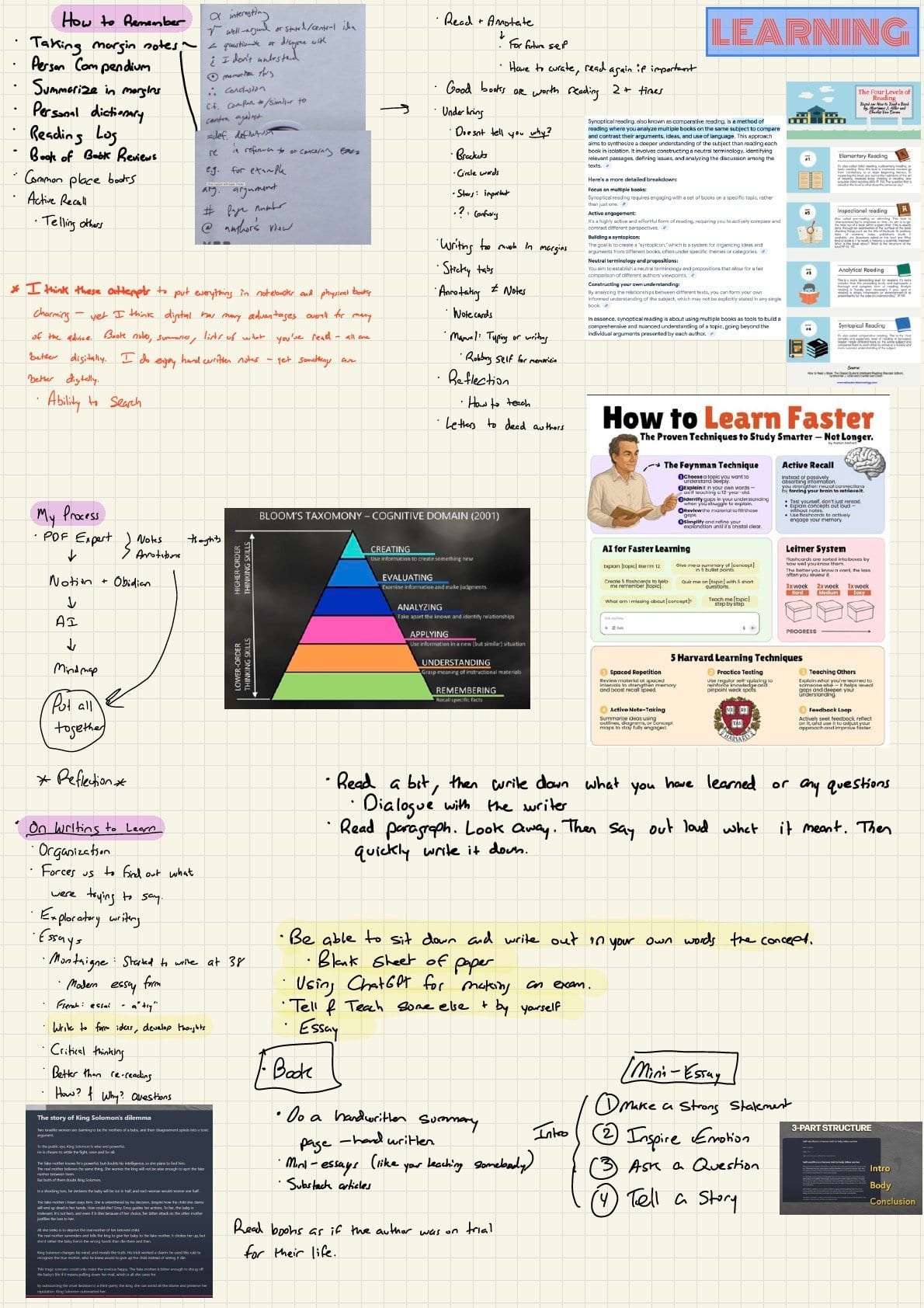
- Active Learning — the foundation: retrieval, elaboration, spacing, interleaving, application, metacognition
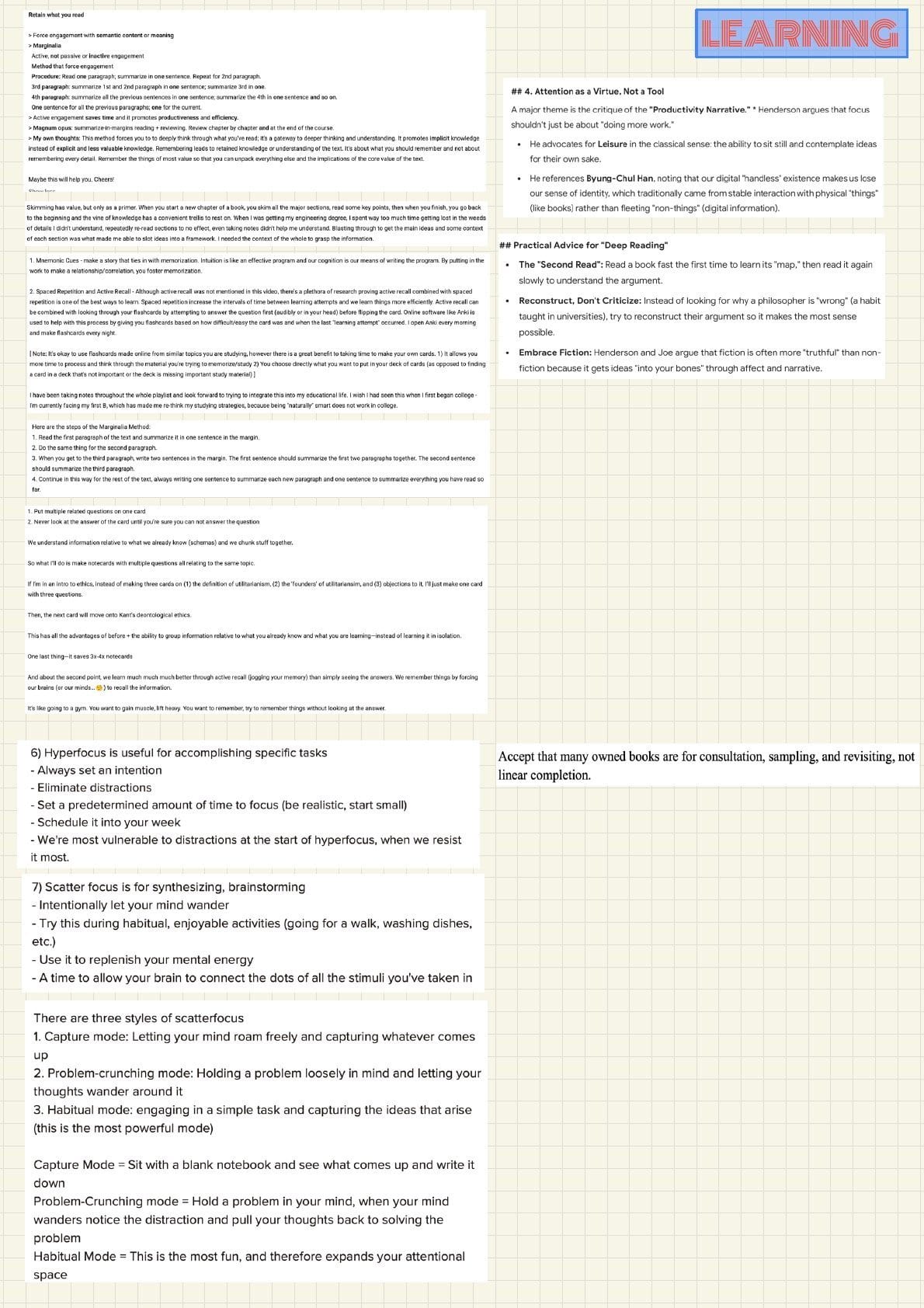
- How to Study Like a Philosophy PhD Student - ParkNotes — source analysis and upgraded workflow: marginal cues → subject compendium → seminar correction → recall → output
- How To Learn So Fast It’s Almost Unfair — the 3C Protocol: Compress → Compile → Consolidate (learn-test loops + sleep)
- Feynman Effect — if you can’t explain it simply, you don’t understand it
- Best Way to Learn Large Subject — the research-backed “Accordion × Spiral” approach for huge subjects
- Lean Learning · How to Practice from ChatGPT · AI Prompts — deliberate practice, AI as tutor
- Learning Checklist: extended learning-and-writing reference (3C system and Gawande/Harding/De Botton craft); use My Learning Process for the default sequence.
- Cross-vault → I studied 2000+ hours on focus training - here's what actually works vs. what's BS · Cognitive Biases and Information Evaluation
📖 Embed — what the research says about learning a huge subject
What the research says is the most effective way to learn a huge subject
Modern learning research is pretty consistent on a few principles that matter more than the exact book order:
Link to original
- Build a “spine,” then revisit in widening loops (spiral learning). You learn complex domains best when you return to the same big ideas multiple times, each pass adding nuance and connections (rather than trying to “finish” one era perfectly before moving on). simplypsychology.org+1
- Use retrieval practice, not just reading. Testing yourself (free recall, short prompts, “explain X without looking,” mini-essays) beats rereading for long-term retention. PubMed+2Psychnet+2
- Space and interleave. Spacing review over time and mixing related topics/eras improves durable learning and discrimination (e.g., comparing Reconstruction to the 1960s civil-rights era, or WWII mobilization to Cold War state-building). uweb.cas.usf.edu+3PubMed+3Oxford Research Encyclopedia+3
- Use “advance organizers” and mapping. A one-page framework before a unit (key questions, actors, institutions, timelines) improves meaningful learning and retention.
The Reading System
-
Goodnotes reading and review workflow — choose a companion, recall sheet, timeline, or visual map for the current reading problem
-
How to Read a Book - Mortimer J Adler Charles Van Doren — the classic: inspectional → analytical → syntopical
-
Process to Read a Book — the personal workflow: pre-read, micro-retrieval, blind recall, the “Adler pass,” depth lanes
-
Book Marking System — the margin-mark vocabulary
-
Reading Hard Books — levels, dense vs. light structure, goal-based selective reading
-
Cross-vault → 7 Stoic reading tips · The Well-Educated Mind - A Guide to the Classical Education You Never Had · Reading quotes
Memory
- Memory Retrieval Techniques — retrieval practice, spaced repetition, notes-as-questions
- Method of Loci — the memory palace
- Anki Collection — the live flashcard decks (Books · Logic · Philosophy · Political Philosophy · Economics · Business · Vocab…)
- Cross-vault → How To Train Yourself To Have An Exceptional Memory
- Books: Unlimited Memory · The Memory Book
Writing & Notes
- I’m begging you to write essays — Montaigne’s essai: writing as the test of understanding
- How to Use Writing to Improve Your Thinking — Atul Gawande — the 40 Rule, the discipline of writing, narrative strategy
- How to take notes · Note taking · Cornell Notes
- Cross-vault → Writing to Learn - William Zinsser · Essay Writing · Writing Pipeline
Speaking
- How to Speak — Patrick Winston’s classic lecture
- Cross-vault → Speaking · Articulation · Communication
Obsidian & Tools
- My FULL Obsidian Zettelkasten Workflow in 10 minutes — fleeting → reference → literature → permanent notes
- In Obsidian — lecture-note method
- Building a Second Brain — capture/organize/distill/express
- Learning base (file not included in this release) — the database view
Curricula & Reading Lists
- Reading Lists — the reading-program hub: active plan, warehouses, audits, and the expansion tracks buried inside them
- Curriculum & Study Path (MOC) — the philosophy study path hub · Enlightenment Curriculum
- The Complete English Literature Reading List — the canon, genre by genre
- Reading List 2027 — Improved Accordion Edition — active 2027 master plan · 2026 Reading List · 2026_Reading_List_Revised_Mastery_Edition · Reading List 2027 · Reading List 2027 — Goodreads Gap Audit
- Best Way to Learn Large Subject — how to sequence any of the above
Related books elsewhere in the vault
Learning & skill books (in 60.12 Self-Improvement/Books)
How to Read a Book - Mortimer J Adler Charles Van Doren · Building a Second Brain · Unlimited Memory · The Memory Book · Power Reading - The Best, Fastest, Easiest, Most Effective Course on Speedreading and Comprehension Ever Developed! · Hacking Your Education · The Talent Code - Greatness Isn't Born. It's Grown. Here's How · Talent Is Overrated · Mastery - The Keys to Success and Long-Term Fulfillment · Deep Work - Cal Newport
Working notes
- Share your knowledge.
- Build a community/network
- Bring People together
- Dinner parties with discussions
- Brain parties
- Two Invaluable Skills: Writing & Programming
Handwritten Notebook Pages
Source
- Open Recall notebook pages — start at notebook p. 19 (file not included in this release)
- Open Learning notebook pages — start at notebook p. 50 (file not included in this release)
- Open Learning notebook pages — start at notebook p. 152 (file not included in this release)
Handwritten Notebook Topics
- Dyslexia — reading, learning, diagnosis, and compensation
Filed captures and working notes — October 2026
Memory, reading and study practices
- Generation Effect — preserved working note or source capture
Auto-index
Base index
Learning.base (file not included in this release)