Filed with 60.21 Psychology · Related: 60.12 Self-Improvement · Ethics & Metaethics (MOC)
Core claim
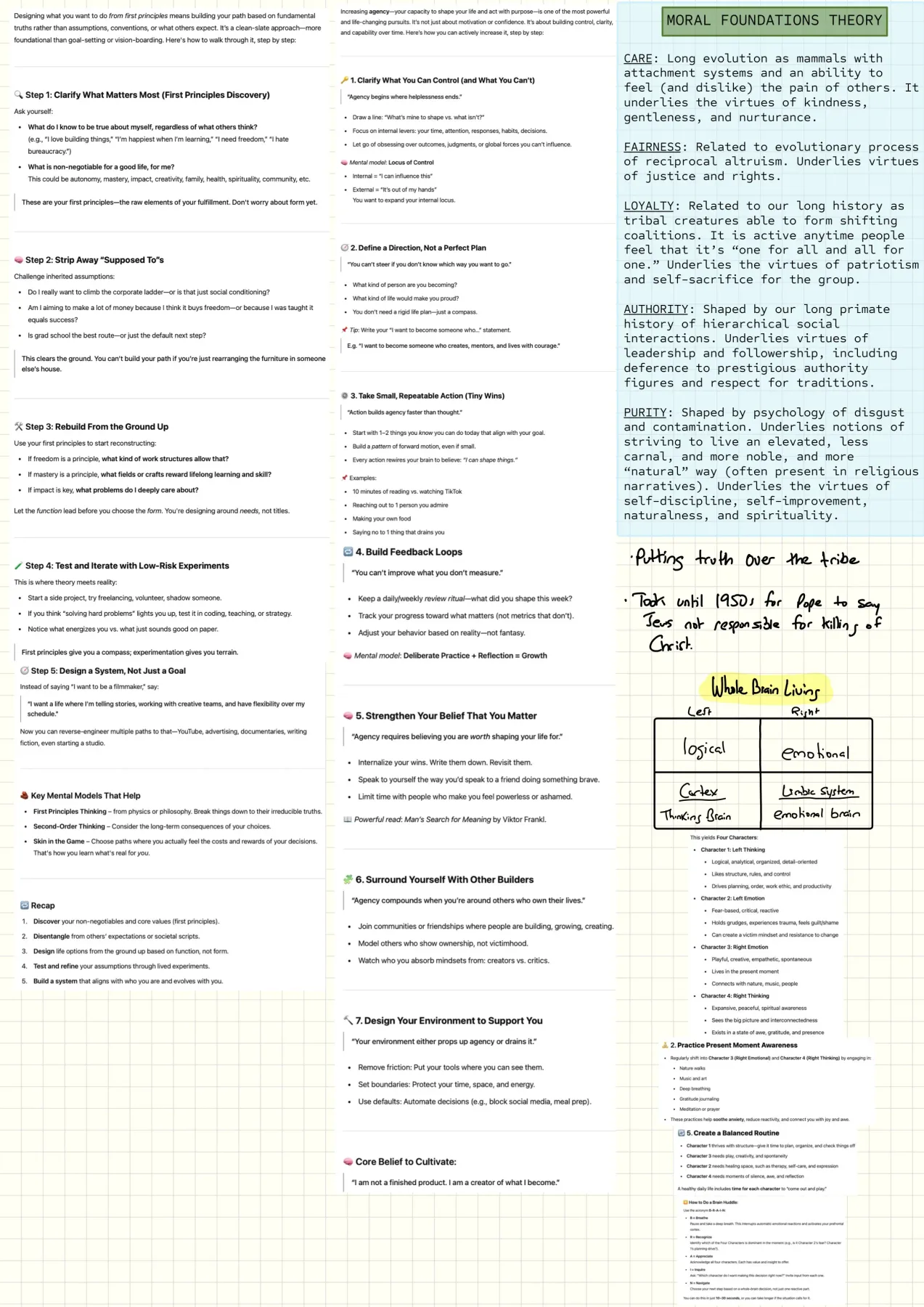
Moral Foundations Theory proposes that moral judgment is built from a limited set of evolved learning preparednesses, not from one universal rule or an unconstrained blank slate. Cultures develop those shared capacities into different moral matrices by teaching people which contemporary acts, persons, and institutions should trigger care, fairness, loyalty, authority, or sanctity. The framework is therefore an account of moral salience and variation. It does not by itself establish that a judgment is true, a norm is legitimate, or an evolutionary reconstruction is correct.
The Righteous Mind, Chapter 9 — from shared plans to binding foundations
Haidt proposes shared intentionality as the bridge from individual social intelligence to a moral matrix. People can represent a common task, know that partners share it, divide roles, notice obstruction or unequal spoils, and judge conduct against the joint plan. Norms, institutions, symbols, and sacred objects then make that common representation portable across larger groups. On this account, Loyalty, Authority, and Sanctity are not merely arbitrary restraints: they can help mark membership, coordinate roles, suppress free riding, and protect a common project.
The origin story is disputed. Haidt’s four exhibits—major evolutionary transitions, Tomasello’s chimp–toddler comparisons, gene–culture coevolution, and fast-selection studies—make multilevel selection plausible to him, but he calls the chapter an argument for retrial and identifies himself as a nonexpert in the underlying literatures. A cooperative function does not validate a particular loyalty, hierarchy, taboo, punishment, or exclusion. Use the model to ask what a norm coordinates and who pays its costs; use facts, rights, reciprocity, proportionality, voice, exit, and consequences to judge it. permanent concept note · Chapter 9 source and figure audit · shared intentionality, PDF pp. 236–238 (file not included in this release) · four-exhibit synthesis, PDF pp. 251–252 (file not included in this release)
The five-foundation first draft
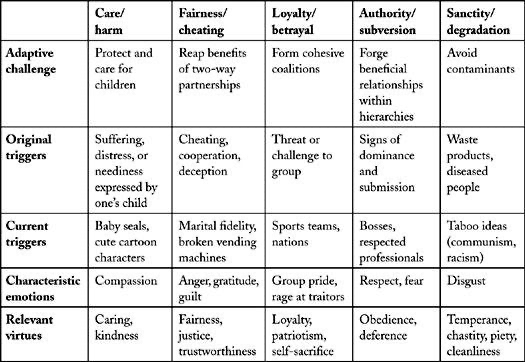
Figure 6.2 — Haidt and Craig Joseph’s five-foundation first draft. Each column connects a proposed adaptive challenge to original and current triggers, characteristic emotions, and culturally valued virtues. It is a theory diagram rather than a direct measurement result. Figure 6.2, PDF p. 152 (file not included in this release)
| Foundation | Proposed adaptive challenge | Original-trigger examples | Current-trigger examples in Haidt’s table | Emotions and virtues |
|---|---|---|---|---|
| Care/harm | Protect vulnerable children | suffering, distress, or need in a child | baby seals, cute cartoon characters | compassion; caring and kindness |
| Fairness/cheating | Benefit from two-way partnerships | cooperation, deception, or cheating | marital fidelity, broken vending machines | anger, gratitude, guilt; fairness, justice, trustworthiness |
| Loyalty/betrayal | Form cohesive coalitions | threat or challenge to the group | sports teams and nations | group pride, rage at traitors; loyalty, patriotism, self-sacrifice |
| Authority/subversion | Build beneficial relations within hierarchies | signs of dominance and submission | bosses and respected professionals | respect, fear; obedience and deference |
| Sanctity/degradation | Avoid contaminants | waste products and diseased people | taboo ideas as well as physical contaminants | disgust; temperance, chastity, piety, cleanliness |
Liberty/oppression is not part of the Chapter 6 table. Haidt says it will be added in Chapter 8. The exact names, number, and organization of foundations changed during the theory’s development, so this image should not be mistaken for a final or settled taxonomy. Five proposed foundations and the deferred sixth, PDF pp. 152–153 (file not included in this release)
Original and current triggers
- An original trigger is the recurrent kind of social or survival problem that a proposed system was selected or prepared to process.
- A current trigger is anything that activates that system now, including culturally learned, expanded, contracted, mistaken, or strategically engineered targets.
Haidt’s analogies make the distinction concrete. A preparedness to detect snakes can be activated by a curved stick, and a hover fly’s yellow-and-black markings can exploit a bird’s wasp-avoidance response. Moral cultures can likewise retarget intuitions far faster than genes change. Concern can expand toward animal suffering; disgust can contract around formerly condemned sexual conduct; a nation, sports team, or political party can be made to carry coalitional meaning. Modules and original versus current triggers, PDF pp. 150–151 (file not included in this release)
This helps explain sincere disagreement without settling it. Corporal punishment can be represented as Care/harm by someone who sees injury and domination, but as Authority/subversion by someone who sees legitimate discipline. The classification identifies what each observer perceives as morally salient. It cannot decide whether the punishment works, the authority is legitimate, or rights constrain the practice. Cultural retargeting and spanking, PDF p. 151 (file not included in this release)
Modules, innateness, and culture
Haidt uses “module” broadly: a functionally specialized information-processing system or set of systems, not necessarily one localized brain spot. “Innate” therefore need not mean a complete fixed behavior present at birth. It can mean organized in advance of experience so that some patterns are noticed and learned more readily than others. Culture then supplies stories, institutions, exemplars, prohibitions, and practices that develop this preparedness into a local moral repertoire.
The claim is neither genetic determinism nor unlimited construction. Shared preparedness constrains the recipes that cultures can build, while learning can greatly alter which present-day objects activate a foundation and how the resulting response is interpreted. Evolution, culture, and modules, PDF pp. 149–151 (file not included in this release)
Chapter 7 field guide: proposed origins, political uses, and failure modes
Chapter 7 develops each column of the first-draft table into a separate hypothesis. The useful unit is not a slogan such as “conservatives value loyalty.” It is a chain that can be questioned at every link:
proposed adaptive problem → prepared attention → culturally learned current trigger → intuitive appraisal → virtue or vice language → political claim
| Foundation | Proposed original problem | What it notices now | Chapter 7 political contrast | Characteristic failure mode |
|---|---|---|---|---|
| Care/harm | protecting costly, vulnerable children | need, suffering, injury, cuteness, victimhood | universalist concern for distant victims versus care for members who sacrificed for the group | paternalism, selective victimhood, manipulated sentiment |
| Fairness/cheating | gaining from repeated cooperation without exploitation | reciprocity, contribution, free riding, desert, unequal shares | equality and exploitation versus proportionality and earned reward | erasing unequal starting points or erasing agency and contribution |
| Loyalty/betrayal | forming and maintaining coalitions | team membership, sacrifice, solidarity, defection, treachery | patriotism and national unity versus suspicion of nationalism and dissent from foreign policy | treating criticism as treason and outsiders as morally negligible |
| Authority/subversion | navigating and benefiting from hierarchy | rank, role, deference, disobedience, institutional stability | legitimate order and tradition versus insubordination and suspicion of hierarchy | confusing legitimacy with survival, obedience, or coercive power |
| Sanctity/degradation | avoiding toxic food, pathogens, and parasites | contamination, bodily meaning, purity, elevation, desecration, sacred value | sanctity of life, marriage, and chastity; also natural purity and cleansing rhetoric on the spiritual left | converting disgust into proof, stigmatizing people as contaminants, blocking all tradeoff |
Care and attachment, PDF pp. 158–163 (file not included in this release) · Fairness and reciprocity, PDF pp. 162–165 (file not included in this release) · Loyalty and coalitions, PDF pp. 166–170 (file not included in this release) · Authority and legitimate asymmetry, PDF pp. 170–174 (file not included in this release) · Sanctity and degradation, PDF pp. 175–183 (file not included in this release)
Care is broader than kinship, but not automatically impartial
Haidt connects Care to attachment and the long dependence of human children. Figure 7.2 shows his son Max treating a stuffed monkey as a dependent; Figure 7.3 uses a threatened baby seal to show how infantile appearance and perceived vulnerability can recruit the same concern. Political actors therefore compete to make their constituency legible as the innocent victim. Care’s expansion is morally powerful, but it can remain local, become universal, or be selectively withheld. A care response establishes perceived vulnerability, not the truth of the causal story or the best remedy. Attachment and expanded Care triggers, PDF pp. 159–163 (file not included in this release)
Fairness contains at least two distributive grammars
The original problem is reciprocal cooperation: reward trustworthy partners, remember cheats, and resist exploitation. Contemporary politics can translate that concern into equality—the powerful take too much and owe a fairer share—or proportionality—reward should track effort and contribution. The Occupy and Tea Party signs in Figure 7.5 show how both movements claimed fairness while accusing different actors of cheating. The distinction diagnoses disagreement; it does not decide which baseline, contribution measure, or distribution is just. The endnote also limits the chapter’s game-theory shorthand: tit-for-tat is not uniquely optimal once error and misperception enter the model. Reciprocity and political fairness, PDF pp. 163–165 (file not included in this release) · Strategy qualification, endnote 15, PDF p. 390 (file not included in this release)
Loyalty and Authority must be separated from total obedience
Robbers Cave shows that groups can create names, territory, leaders, and norms before meeting a rival, then intensify those identities through competition. This makes loyalty a source of cooperation as well as a route to raids, traitor hatred, and moral exclusion. Haidt’s Authority account adds a necessary distinction: legitimate hierarchy is not merely superior force. In Alan Fiske’s Authority Ranking, subordinates defer while superiors owe protection, order, justice, and responsibility downward. A hierarchy can therefore be assessed by whether those reciprocal duties, accountability, voice, and exit actually exist. Haidt’s own endnote acknowledges system-justification theory as an alternative explanation for subordinate support. Robbers Cave and Loyalty, PDF pp. 166–169 (file not included in this release) · Authority Ranking, PDF pp. 172–174 (file not included in this release) · Authority alternatives, endnote 35, PDF p. 391 (file not included in this release)
Sanctity makes nonfungible value possible—and prejudice easy
Haidt connects Sanctity to the omnivore’s dilemma and pathogen avoidance, then traces a cultural expansion from contamination to bodies, places, symbols, principles, and communities treated as elevated or untouchable. The Meiwes–Brandes case and Leon Kass’s defense of repugnance show why harm-and-consent language can feel incomplete when an act is perceived as degrading human life itself. But disgust is evidence that an appraisal occurred, not proof that its target is dangerous or wrong. The same system can protect life, mourning, and sacred commitments or encode caste, racism, homophobia, disability stigma, and xenophobia. Meiwes, consent, and degradation, PDF pp. 175–177 (file not included in this release) · Disgust and the behavioral immune system, PDF pp. 177–180 (file not included in this release) · Biomedical sanctity and repugnance, PDF pp. 182–183 (file not included in this release)
Chapter 7 source audit — the political map is descriptive and provisional
Haidt ends Chapter 7 by proposing that the left relies primarily on Care and Fairness while the right recruits all five foundations. The chapter’s photographs, signs, family scenes, thought prompts, and selected studies make that hypothesis legible; they do not yet measure its size, universality, or current validity. The survey comparison comes next in Chapter 8.
“Uses more foundations” is not equivalent to “is more moral.” A broader palette may help a coalition communicate with more voters, while also creating additional routes for exclusion and coercion. Treat the framework as a map of perceived moral relevance. Test every current trigger against facts, reciprocity, proportionality, rights, consequences, legitimacy, minority standing, and less coercive alternatives. Five-foundation recap and political hypothesis, PDF pp. 183–184 (file not included in this release) · Chapter 7 source audit
Chapter 8 evidence audit: measurement changes the model
Chapter 8 supplies the source-era evidence behind the partisan shorthand and then revises two rows of the theory. The first fifteen-item MFQ drew about 1,600 voluntary Project Implicit respondents in one week. A later, revised MFQ on YourMorals produced the same broad crossing pattern among about 132,000 self-selected visitors by 2011: Care and Fairness averaged higher on the left and declined modestly toward the right, while Loyalty, Authority, and Sanctity rose toward the right. The samples are large but not representative; the questionnaires differ; ideology is self-described; group distributions overlap; and no causal direction follows from the correlation. First MFQ and Project Implicit sample, PDF pp. 188–190 (file not included in this release) · YourMorals pattern, PDF pp. 192–193 (file not included in this release)
Henrich, Chapter 6 — kinship predicts a different MFQ axis than left versus right
Henrich reuses a much larger online MFQ pool—285,792 respondents from 206 countries—to ask a different question. Higher origin-country kinship intensity is associated with greater in-group loyalty and deference to authority and with lower relative emphasis on universal fairness and care. He also reports a within-host-country comparison of 26,657 immigrants: respondents whose origin groups had more intensive historical kinship retained more loyalty-oriented and less universalistic profiles. This suggests that moral-foundation scores may reflect long-lived institutions and cultural transmission, not only present political ideology.
The evidence does not convert the MFQ into a civilizational ranker. The online sample is self-selected, the KII is a reconstructed historical proxy, country averages conceal wide overlap, and the findings remain observational. Nor does “universalism” equal moral correctness or “loyalty” equal corruption. The result is best used to generate institutional hypotheses about why foundations are weighted differently, followed by the same independent audit of facts, rights, reciprocity, proportionality, consequences, voice, and outsider standing used throughout this note. universalism and kinship, Figure 6.7, PDF pp. 216–217 (file not included in this release) · MFQ and immigrant analyses, PDF pp. 217–219 (file not included in this release) · measurement qualifications, PDF pp. 553–558 (file not included in this release) · Chapter 6 source audit
The revision matters as much as the graph. Economic-conservative readers objected that the original Fairness scale operationalized equality while neglecting proportionality, contribution, and free riding. Haidt accepts the criticism, makes proportionality central to Fairness, and relocates much egalitarian concern toward Care plus a new Liberty/oppression candidate. Liberty is not mere preference satisfaction. Its proposed core is resistance to domination: reactance against bullying or arbitrary constraint and the coalition of subordinates against would-be tyrants. Haidt presents it as a provisional sixth foundation, not a closed discovery; honesty, ownership, and waste or inefficiency remained alternative candidates. Fairness criticism and revision, PDF pp. 201–204 (file not included in this release) · Liberty and reverse dominance, PDF pp. 203–209 (file not included in this release) · Provisional status and alternatives, Chapter 8 endnote 25, PDF p. 398 (file not included in this release)
| Foundation after Chapter 8 | Refined concern | Source-era political emphasis in Haidt’s account | Audit question |
|---|---|---|---|
| Care/harm | suffering, vulnerability, protection | more heavily weighted on the left, but present across the spectrum | Is the victim framing factually complete and reciprocally applied? |
| Liberty/oppression | domination, bullying, reactance, tyranny | left: vulnerable groups dominated by power; right/libertarian: government coercion | Who has power, what constraint is arbitrary, and can the remedy become a new dominator? |
| Fairness/cheating | reciprocity, contribution, proportionality, free riding | left often joins fairness to equality; right emphasizes desert and contribution | Which baseline, contribution measure, responsibility, and allowance for unequal starting points? |
| Loyalty/betrayal | coalition, sacrifice, solidarity, defection | stronger average relevance on the right in the MFQ | Does solidarity preserve dissent and the moral standing of outsiders? |
| Authority/subversion | legitimate rank, order, reciprocal role duty | stronger average relevance on the right | Is authority accountable and protective, with voice, appeal, and exit? |
| Sanctity/degradation | contamination, bodily meaning, sacred value | stronger average relevance on the right, with spiritual-left uses | Does sacredness protect a good or convert disgust and identity into unreviewable coercion? |
Haidt’s Fehr–Gächter example clarifies the revised Fairness row. In a four-player public-goods game, average contributions declined when free riding could not be sanctioned, then rose when players could pay one token to remove three from another participant. The experiment shows one mechanism by which costly punishment can stabilize conditional cooperation. It does not establish that a real-world accused free rider is guilty, that the baseline is just, or that a sanction is proportionate. The claim that equality may itself be a basic relational motive also remains open in the endnotes. Public-goods game, PDF pp. 212–215 (file not included in this release) · Fairness alternatives and punishment qualifications, Chapter 8 endnotes, PDF pp. 399–400 (file not included in this release)
Chapter 8 source audit — “three versus six” is not a moral league table
Haidt concludes that liberals emphasize Care, Liberty, and Fairness; social conservatives distribute attention more evenly across all six; and libertarians make Liberty dominant while scoring low on the binding foundations. This is an interpretation of voluntary, source-era group averages and political rhetoric. It is not an individual classifier, a representative estimate, a timeless map of parties or cultures, or evidence that a six-foundation judgment is wiser than a three-foundation one.
Use repertoire breadth as a translation prompt: which good or danger has another coalition noticed that I have missed? Then return to facts, causal evidence, rights, reciprocity, proportionality, consequences, legitimacy, minority standing, voice, exit, and less coercive alternatives. Three, six, and libertarian profiles, PDF pp. 216–218 (file not included in this release) · Chapter 8 source and figure audit
Chapter 12: matrices as coalition stories, not personality verdicts
Chapter 12 turns the foundations from survey dimensions into three schematic political stories. The center of each image is a coalition’s identity and sacred value; line thickness represents Haidt’s interpretation of relative moral emphasis. The figures are not individual scores, measured effect sizes, current party platforms, or claims that everyone inside a coalition shares one mind.
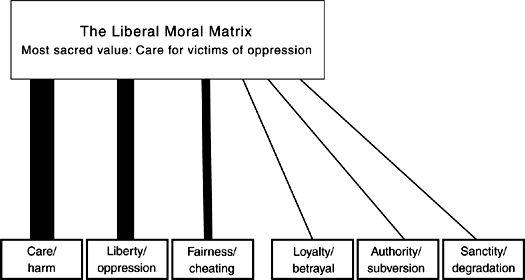
Figure 12.2 — Haidt’s American liberal matrix. Care for victims of oppression occupies the sacred center; Liberty and equality-oriented Fairness also carry much of the argument. Figure 12.2, PDF p. 334 (file not included in this release)
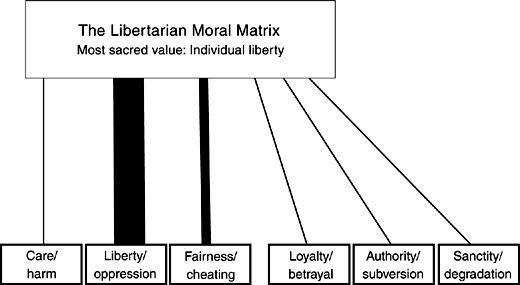
Figure 12.3 — Haidt’s American libertarian matrix. Liberty dominates, while the source-era YourMorals averages place libertarians near liberals on low Loyalty, Authority, and Sanctity and lower than both major coalitions on Care. The comparison involved about 12,000 self-selected libertarians, not a representative population sample. Figure 12.3 and sample context, PDF pp. 338–340 (file not included in this release)
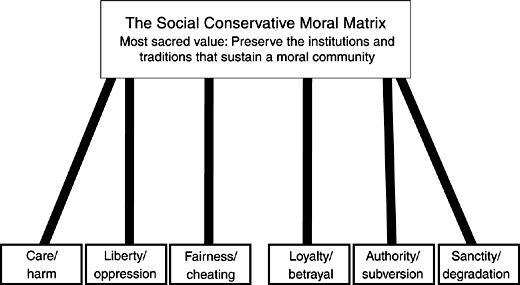
Figure 12.4 — Haidt’s American social-conservative matrix. All six connections are relatively strong, and institutions and traditions that sustain a moral community occupy the sacred center. Breadth does not establish wisdom or goodness: a wider palette can notice more cooperative functions and rationalize more forms of exclusion or domination. Figure 12.4, PDF pp. 343–344 (file not included in this release)
Translation protocol — follow the sacredness, then audit the claim
Ask which victim, liberty, contribution rule, group, authority, sacred object, or institution is treated as nonfungible. Reconstruct the feared catastrophe and the positive good in language an advocate would accept. Then separate moral salience from factual accuracy, causal mechanism, legal legitimacy, distribution, rights, external costs, and feasible alternatives.
Haidt’s source-era imitation study found that more than 2,000 voluntary YourMorals participants differed in how accurately they predicted a “typical” liberal’s or conservative’s MFQ responses; very liberal participants made the largest errors when estimating conservative Care and Fairness. That result concerns one self-selected sample, stereotypes, and one questionnaire. It does not show that conservatives are generally more empathic, intelligent, or correct. Use the exercise to discover a missing moral premise, not to rank people. Partisan-imitation study, PDF pp. 323–324 (file not included in this release) · Study baselines, Chapter 12 endnote 32, PDF p. 428 (file not included in this release) · Chapter 12 audit
Conclusion: the moral toolbox is not a permission slip
Haidt’s final moral-taste lesson is a warning against building every human community from one foundation. That is a claim about explanatory and political incompleteness, not a rule that all six foundations must always be honored or balanced. A single value can sometimes override others, an institution can invoke a genuine concern illegitimately, and a monistic normative theory can still recognize several psychological motives.
His appeal to Isaiah Berlin supplies the needed distinction. Pluralism can treat several values as real and sometimes conflicting while preserving criticism; relativism makes validity framework-dependent. Moral Foundations Theory establishes neither view. It maps reported salience and proposed psychological mechanisms. Facts, rights, reciprocity, proportionality, consequences, standing, and an explicit normative theory must still decide the case. → pluralism, monism, and relativism audit · Moral toolbox and Berlin, PDF p. 353 (file not included in this release) · Conclusion audit
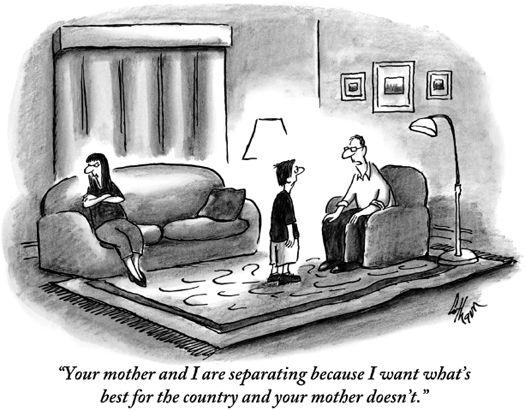
Figure 13.1 — Frank Cotham’s cartoon of Manichaean politics. The father explains a separation by saying he wants what is best for the country and the mother does not. Haidt uses the joke to expose a moral-matrix failure: disagreement is interpreted as proof that the rival lacks good purpose. It is rhetorical illustration, not evidence of equal responsibility or equal validity. Figure 13.1, PDF p. 355 (file not included in this release)
Theory history and revision
The taxonomy was explicitly provisional. Haidt and Joseph’s 2004 article began with four foundations and mentioned group loyalty as a candidate; terminology changed between 2005 and 2009; the book uses the 2010 names, then Chapter 8 adds Liberty/oppression and reconstructs Fairness after critics expose an equality bias in the instrument. Haidt also describes each foundation as a coordinated set of possible modules rather than a single organ or emotion. Moral Foundations Theory is best treated as a revisable research program whose measures, boundaries, cross-cultural generality, and alternatives require ongoing comparison. Early theory history and module sets, endnotes 34–37, PDF pp. 387–388 (file not included in this release) · Chapter 8 reconstruction, PDF pp. 201–209 (file not included in this release)
Evidence and interpretation boundaries
- A useful metaphor is not a receptor count. The taste analogy explains how common capacities and cultural cuisines could coexist; it does not establish exactly five or six foundations.
- Recurrence is not proof of adaptation. Cross-cultural virtue lists are clues. They do not reveal ancestral selection directly or validate a “just-so story” about any favored trait.
- Prepared learning is not a fixed script. A proposed predisposition can be developmentally open and culturally redirected.
- Description is not endorsement. Showing that loyalty, authority, or sanctity motivates people does not legitimate nationalism, hierarchy, purity policing, or the conduct defended in their names.
- Salience is not correctness. A foundation can explain why an act feels cruel, disloyal, insolent, or contaminating without deciding facts, proportionality, reciprocity, rights, or consequences.
- Plural psychology does not settle metaethics. Multiple human concerns can coexist with moral realism, constructivism, value pluralism, or a normative theory that ranks them under a higher principle.
- The first draft is not the last word. The book’s table predates later measures, revisions, replications, and criticism; it should be source-audited before use as a current scientific consensus.
- Large online samples are not population samples. Project Implicit and YourMorals support source-era pattern detection, not representative prevalence estimates.
- Instrument revision blocks naive comparison. Figures 8.1 and 8.2 use different MFQ versions, and the Fairness criticism shows why wording is substantive.
- Breadth is not moral superiority. A coalition can activate more foundations while being wrong about the facts or using loyalty, authority, sanctity, liberty, or punishment to rationalize coercion.
Source routes
- Full Chapter 6 argument, figures, and qualifications → The Righteous Mind, Chapter 6
- Full Chapter 7 foundation dossiers, figures, and political qualifications → The Righteous Mind, Chapter 7
- Chapter 8 measurement, theory revision, all seven figures, and evidence limits → The Righteous Mind, Chapter 8
- Chapter 12 coalition narratives, Figures 12.2–12.4, moral capital, and constructive-disagreement limits → The Righteous Mind, Chapter 12
- Cultural precursor → The ethics of autonomy, community, and divinity
- Judgment sequence rather than judgment content → The Social Intuitionist Model
- Normative firewall → Moral Psychology Does Not Settle Metaethics
Chapter 6 source audit — what the first-draft theory claims
Chapter 6 is the theory’s architectural hinge. Haidt and Joseph move from cross-cultural virtue lists to hypotheses about evolved learning preparedness, distinguish original from culturally mutable current triggers, and organize the first draft around Care, Fairness, Loyalty, Authority, and Sanctity. The theory can explain why different people map the same act onto different moral concerns, but it does not determine whose mapping is factually accurate or normatively justified.
The first-draft status matters: Liberty/oppression is deferred, names and counts changed during development, and the table itself contains no measurement validation or comparison with rival taxonomies. From virtue lists to modules, PDF pp. 148–151 (file not included in this release) · Figure 6.2 and five-foundation draft, PDF pp. 152–153 (file not included in this release) · Chapter 6 source audit
Chapter 1 is groundwork for Moral Foundations Theory, not the theory itself
Chapter 1 challenges the idea that morality is universally constructed from conscious reasoning about harm and fairness. Haidt contrasts Turiel’s harm-centered moral-conventional distinction with Shweder’s cross-cultural findings, then reports his own three-city study: 360 interviews varying city, social class, and age. He says the group differences in moralizing harmless disgust and disrespect remained—and grew—after respondents who consciously perceived harm were removed.
That result motivates the search for moral concerns beyond harm; it does not yet establish the later foundations taxonomy, prove that every taboo reflects an innate module, or justify the norms participants endorsed. Figure 1.1 belongs to Shweder’s earlier 600-interview study and illustrates disagreement in selected scenarios. Shweder and Haidt’s setup, PDF pp. 31–41 (file not included in this release) · Figure 1.1, PDF pp. 33–34 (file not included in this release) · Chapter 1 source audit
Chapter 5 supplies the cultural precursor, not the later foundations taxonomy
Before Haidt proposes innate moral foundations, Chapter 5 uses Richard Shweder’s reanalysis of 600 Orissa-Chicago interviews to distinguish three moral languages. Autonomy treats the person as an individual and emphasizes harm, rights, liberty, and justice. Community treats the person as a member of larger bodies and emphasizes duty, hierarchy, loyalty, respect, and reputation. Divinity treats embodied persons as capable of elevation or degradation and emphasizes sanctity, purity, sin, and self-command.
This precursor matters because a foundations survey can otherwise look like a list of political preferences rather than an attempt to explain different constructions of personhood. It also sets limits: the three ethics are descriptive ideal types, not mutually exclusive populations; WEIRD and non-WEIRD groups overlap; and identifying a moral concern does not validate conduct justified in its name. Chapter 6 begins the foundations theory proper. WEIRD sampling and Penn’s 73 percent result, PDF pp. 118–121 (file not included in this release) · The three ethics, PDF pp. 122–124 (file not included in this release) · Chapter 5 source audit · Permanent three-ethics note