⬅️ 60.21 Psychology · Belief map: Psychology of Belief (MOC) · Concepts: Cognitive Bias · Practice: Critical Thinking · Moral intuition: intuition first
Source and scope
- Video: Why Smart People Get Things Wrong — public 47-minute archive excerpt of Sam Harris’s live conversation with Daniel Kahneman at the Beacon Theatre.
- Original episode: Making Sense #150 — The Map of Misunderstanding, published March 12, 2019.
- Transcript status: organized synthesis of the supplied automatic transcript. Names and obvious transcription errors were silently corrected; timestamps remain approximate locators.
- Coverage boundary: the public excerpt ends with a membership notice at 47:03. The official episode description lists later topics—such as the experiencing versus remembering self—that are not present in the supplied excerpt and therefore are not summarized here.
Evidence boundary
This is a map of what Harris and Kahneman argue in the conversation, not a fresh replication audit of every study they mention. Specific experiments and generalizations below should be read as speaker-reported research claims unless an external source is linked. Kahneman repeatedly makes the replication crisis part of the conversation itself.
Executive synthesis
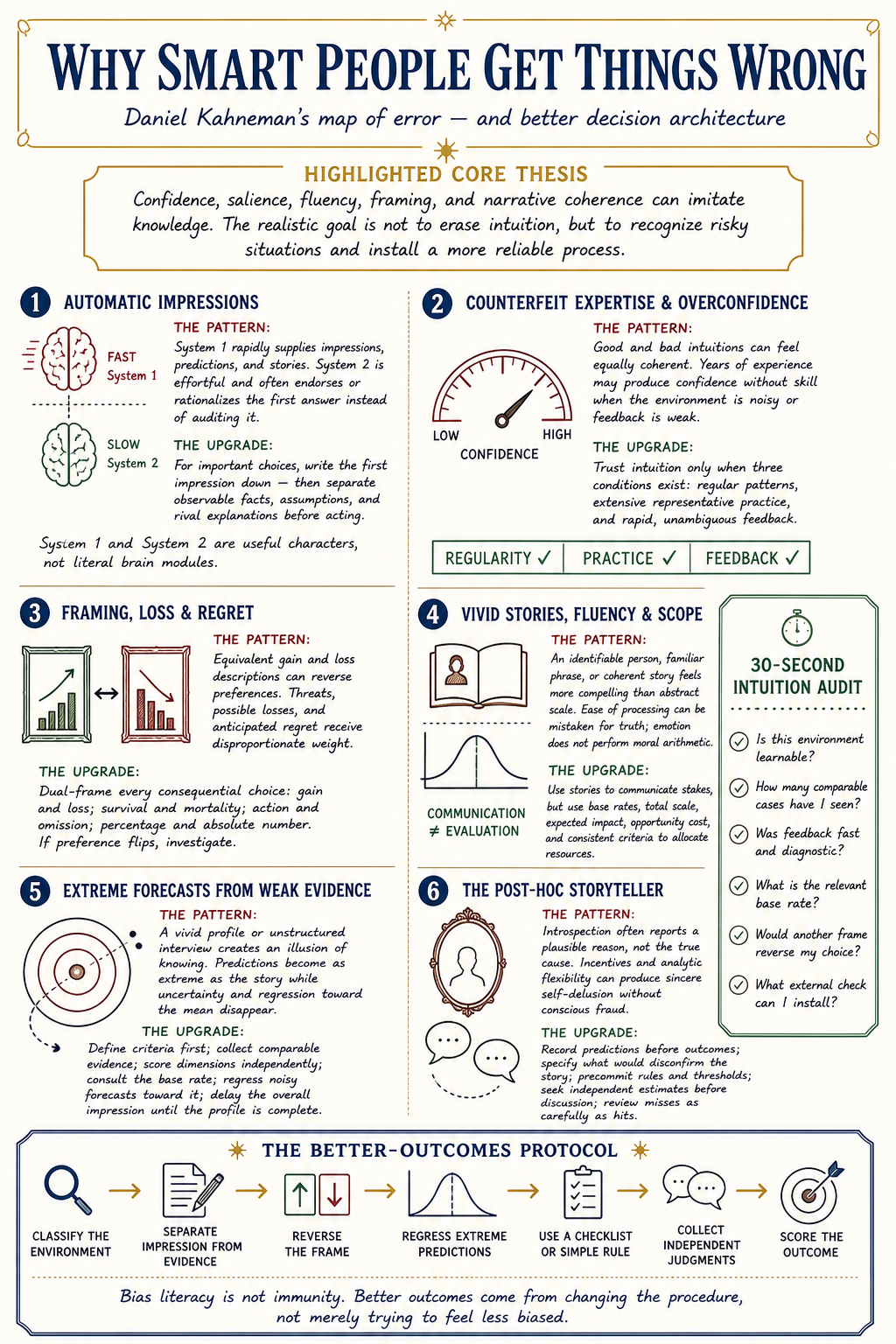
Intelligence does not protect people from systematic error because the mind’s default mode is not detached statistical analysis. It is rapid pattern recognition: ideas arrive automatically, vivid stories feel meaningful, confidence is generated internally, and reasons are often supplied after the judgment has already formed. Deliberate thought can calculate and check, but it does not automatically erase the first impression.
Kahneman’s most important practical conclusion is therefore institutional rather than inspirational. Knowing the names of biases rarely makes one’s intuitions reliably better. Improvement comes from recognizing high-risk situations and using an external equivalent of a ruler: base rates, structured comparisons, independent judgments, numerical models, checklists, explicit reframing, and decision rules that do not depend on how persuasive an impression feels.
The conversation’s deepest tension is that human motivation runs on stories while good policy often has to run on numbers. A single identifiable victim can move people more than a mass statistic; a face-to-face interview can outweigh a stronger record; and a gain frame can reverse the preference produced by an equivalent loss frame. Public reasoning must therefore use vivid narratives to make a problem emotionally legible while using disciplined quantitative procedures to decide what actually deserves resources.
The through-line
We get things wrong not merely because we lack information, but because confidence, salience, fluency, framing, and narrative coherence can imitate knowledge. The corrective is not to suppress intuition everywhere; it is to know when the environment has earned our intuition and when judgment must be handed to a more reliable process.
The argument in one map
- Most mental activity is automatic and unavailable to introspection.
- Automatic cognition creates expectations, recognizes patterns, and produces a feeling of coherence.
- That feeling can arise from real expertise or from weak evidence, vividness, repetition, framing, and self-serving interpretation.
- Because confidence is itself produced by this machinery, subjective certainty cannot reliably distinguish the two cases.
- Deliberate reasoning often rationalizes the intuition instead of independently testing it.
- Learning about bias does not reprogram the automatic system; even experts on error remain overconfident.
- Better judgment therefore requires diagnostic questions and external procedures that reduce the power of unearned impressions.
- At social scale, institutions must separate motivation and communication from measurement and allocation: stories can mobilize, but numbers should guide many policy choices.
1. The replication crisis: science is vulnerable to motivated self-deception
→ 5:49
Harris opens with the reproducibility crisis in psychology and the wider social sciences. Kahneman’s explanation is not primarily fraud. Research is expensive in money, time, career capital, and personal identity, so researchers understandably want a study to succeed. That desire creates room for unnoticed flexibility:
- measuring several outcomes and emphasizing the one that “worked”;
- making analytic choices after seeing the data;
- treating a surprising result as discovery rather than as a reason for stronger verification;
- publishing positive, novel findings more readily than null results.
Kahneman describes much of this as self-delusion. The researcher can follow familiar professional practices, feel honest, and still create a result that is unlikely to reproduce. This is precisely why good intentions are not enough: bias can operate before conscious dishonesty begins.
Transcript claim, not a verified rate
Harris mentions approximate replication rates and a project that reproduced 13 of 21 papers from Nature and Science. The important conceptual point is the selection mechanism, not the exact percentage: the more professionally rewarding a surprising positive result is, the more protection it needs against analytic flexibility and publication bias.
Implication
Science is valuable partly because its institutions can expose individual error. But when incentives, methods, and publication filters all lean in the same direction, researchers’ mistakes need not cancel out. A community can produce systematic error without a coordinated conspiracy.
2. System 1 and System 2 are useful characters, not literal little people
→ 8:40
Kahneman begins with a phenomenological difference:
| Mode | What it feels like | Example | Main strength | Main danger |
|---|---|---|---|---|
| System 1 | An answer or impression simply arrives | Recognizing that 2 + 2 = 4 | Fast pattern recognition; effortless use of learned regularities | Produces confident answers without revealing their source or reliability |
| System 2 | Attention and work are required | Multiplying 24 × 17 | Calculation, comparison, rule-following, inhibition | Effortful, limited, and often recruited to justify rather than audit an intuition |
The names are deliberately personified. Kahneman acknowledges that “systems” can sound like agents inside the head, which is theoretically misleading. Their value is explanatory: people remember characters with traits more readily than an abstract inventory of processes.
The distinction also only roughly maps onto consciousness. System 1 processes are usually unconscious; System 2 activity is often conscious. This is not offered as a complete theory of consciousness or as evidence that the brain contains two literal modules.
Why this matters
Most knowledge is not being consciously retrieved step by step. System 1 continuously predicts what should happen, notices surprise, interprets faces and language, and updates a working model of the world. Human functioning would be impossible without it. The problem is not that fast cognition is intrinsically bad; the problem is that the same feeling of immediate recognition accompanies both genuine expertise and compelling error.
3. When should intuition be trusted?
→ 12:28
Kahneman defines intuition as a judgment that arrives without conscious access to how it was produced. In collaboration with psychologist Gary Klein—an advocate of expert intuition—he arrived at three conditions under which intuitive expertise can become reliable:
- A sufficiently regular environment — stable patterns really exist to be learned.
- Enough exposure and practice — the person has encountered a large and representative range of cases.
- Rapid, informative feedback — the person learns soon enough whether the judgment was correct and why.
Chess is the clear example: the rules and configurations are regular, experts see enormous numbers of positions, and feedback is relatively quick. Their immediate candidate moves can become genuinely skilled recognition.
The counterfeit version
When those conditions are absent, intuitions do not disappear. Thoughts still arrive automatically and with confidence. A person can therefore acquire the feeling of expertise in a noisy environment where outcomes are delayed, ambiguous, rare, or never properly scored.
Intuition audit
Before trusting a strong impression, ask:
- Is this domain regular enough to learn?
- How many comparable cases have I actually seen?
- Did I receive fast, unambiguous feedback—or only a story about what happened?
- Have I recorded my misses as carefully as my hits?
This separates familiarity, status, and years in a role from the conditions that can produce real expertise. Long experience in a low-validity environment may simply provide more opportunities to rehearse an unsupported story.
4. Confidence is not a dependable measure of accuracy
→ 16:31
Confidence is psychologically important because it reports how strongly a proposition feels true. But that makes confidence a fact about the mind’s current state, not direct evidence about the world. Kahneman stresses that the correlation between confidence and accuracy is often weak.
This creates a built-in verification problem:
- A good intuition feels immediate and coherent.
- A bad intuition can feel exactly the same.
- The mind uses that shared feeling as evidence that the judgment is good.
- Explanations then make the judgment feel even more coherent.
Knowing this does not automatically change the feeling. Kahneman presents himself as the sobering case: decades spent studying cognitive error did not make his intuitions markedly better or remove his overconfidence.
What knowledge of bias can do
→ 18:45
The realistic gain is not permanent immunity but situation recognition. A visual illusion still looks wrong after it is explained, yet a person can remember not to trust the appearance and use a ruler. Cognitive debiasing works similarly:
- identify a class of situations where intuition is predictably unreliable;
- pause before converting confidence into action;
- use an external measurement, rule, comparison, or second opinion;
- design the choice environment so the check occurs automatically.
This fits the vault’s critical-thinking procedure: the value of the checklist is not that it makes the first impression vanish, but that it prevents the impression from being the only input.
Haidt, Chapter 4 — intelligence can strengthen the advocate without strengthening the judge
David Perkins asked people to generate reasons on both sides of social questions. In Haidt’s summary, IQ was the strongest predictor of argument production, but the increase appeared chiefly in my-side arguments, not in reasons for the opposing position. Comparing students at different educational levels also yielded little within-level evidence of growth, though the described design is cross-sectional and cannot establish that schooling never improves reasoning.
The result sharpens the “install the ruler” principle. Intelligence supplies more tools; it does not choose an impartial task for them. Use independent estimates, precommitted falsifiers, assigned opposition, and symmetric source standards before public commitment gives a clever person more material to defend. This is a source-dated book account, not a current effect-size or education-outcome review. Perkins study, PDF pp. 103–105 (file not included in this release) · Endnote 22, PDF p. 377 (file not included in this release) · Chapter 4 source audit
5. Framing can reverse preferences without changing the facts
→ 21:36
In the classic disease problem, the same expected outcomes are described in terms of lives saved or lives lost. People tend to become more risk-averse in the gain frame and more willing to gamble in the loss frame. The alternatives are extensionally equivalent, yet the language activates different intuitions.
The reason framing works is that the recipient usually sees only one formulation and does not spontaneously construct its equivalent. Presented with both, people may recognize the inconsistency but lose the clear feeling that made either choice seem obvious.
Moral significance
Harris asks whether a physician has an ethical duty to present survival and mortality statistics in a particular way. Kahneman’s answer is more destabilizing than a simple rule: once gain and loss language are stripped away, there may be no neutral intuition waiting underneath. Some moral judgments are not merely expressed through a frame; they are partly generated by it.
Practical correction
For consequential choices, require dual framing:
- survival and mortality;
- gains and losses;
- action and omission;
- absolute numbers and percentages;
- the immediate case and the relevant base rate.
If the preference changes when the description changes but the outcomes do not, the frame is carrying more of the decision than it should.
Related: framing effect · loss aversion
6. Stories move emotion; numbers must often govern allocation
→ 25:56
Harris describes Paul Slovic’s work on identifiable victims: one child’s story can provoke a stronger charitable response than the same child placed beside additional victims or a statistic describing hundreds of thousands in need. He also notes scope insensitivity—the willingness to contribute may not rise proportionately when the number of lives at stake increases dramatically.
Kahneman’s explanation is that System 1 represents an individual through an image and a story. As the scale expands, the image is diluted rather than multiplied. Emotion does not naturally perform moral arithmetic.
This yields two different functions:
| Function | What works psychologically | What good judgment requires |
|---|---|---|
| Motivating attention | A concrete person, image, and causal story | Honest representation without allowing the example to substitute for prevalence |
| Allocating resources | Intuition is weak at comparing large magnitudes | Numbers, expected impact, opportunity cost, base rates, and consistent criteria |
Kahneman does not conclude that policy should abandon emotion. He argues that policymakers must accept responsibility for numerical comparison, while public communication will often need individual stories to make the issue imaginable.
Communication is not evaluation
The story that best communicates a problem is not necessarily evidence that the problem is largest, most tractable, or most deserving of the next dollar.
This is a direct complement to the storytelling lesson in moral intuition: stories can outperform abstract facts in persuasion, but persuasion strength and decision quality are different variables.
7. Cognitive ease and the mind’s post-hoc storyteller
→ 29:16
Cognitive ease or fluency is the ease with which an idea is processed or retrieved. Fluency tends to feel pleasant and familiar; pleasant material can also feel more fluent. The important epistemic risk is that ease is experienced before its cause is diagnosed. Repetition, readability, familiarity, and coherence can therefore feel like truth without being truth.
Harris connects this to confabulation: people routinely generate explanations for their judgments while having little access to the processes that produced them. Kahneman agrees that retrospective storytelling is normal. A reason can be sincere, articulate, and causally wrong.
The post-hypnotic example makes the structure vivid: a person performs an action triggered by a suggestion, lacks access to the real trigger, and supplies an immediately plausible explanation. Ordinary cognition need not be that dramatic for the lesson to hold. Introspection often reports the best available story, not a transparent record of causes.
Diagnostic questions
- Did I predict this reason before I knew the outcome?
- What observation would distinguish my explanation from a plausible rival?
- Am I treating ease of recall as frequency or probability?
- Would the story still persuade me if it supported the opposite conclusion?
- What part of the explanation is observed, and what part is inferred?
8. Extreme predictions from weak evidence
→ 32:00
Kahneman identifies non-regressive prediction—making an extreme forecast from limited evidence—as a favorite cognitive error. The mind creates a coherent portrait and predicts an outcome as extreme as the impression, neglecting uncertainty, base rates, measurement error, and regression toward the mean.
The job-interview case
A face-to-face interview generates a vivid sense of knowing the candidate. Kahneman recalls experiencing this confidence while assessing candidates for officer training, even after outcome data showed that the interviews had little predictive value. The statistical correction did not erase the feeling of insight.
Adding an unstructured interview can make prediction worse when the interviewer also makes the final decision. The interview is immediate and memorable, so it receives more weight than less vivid but more diagnostic information.
Better hiring architecture
- define criteria before meeting the candidate;
- ask every candidate the same behaviorally anchored questions;
- score dimensions independently before forming an overall impression;
- review base rates and work samples before the interview narrative;
- delay the final synthesis until the structured evidence is visible;
- later score prediction quality rather than remembering only successful hires.
The wider rule is: when the evidence is noisy, predictions should be pulled toward the base rate rather than allowed to become as extreme as the story.
Related: regression to the mean · halo effect · overconfidence
9. Anticipated regret, loss aversion, and threats
→ 35:15
Regret is counterfactual: it concerns an outcome that could have happened but did not. Anticipated regret enters before the decision. A person imagines how it would feel to choose or omit an action and later discover that the alternative would have been better. Because the imagined loss is vivid, it can exert substantial influence in finance and other domains.
Kahneman connects loss aversion to a broader asymmetry between threats and opportunities. Threats often demand immediate action; many opportunities can be deferred. An evolutionary system that gives priority to possible danger can be adaptive while still producing distorted choices in modern settings.
Fairness and negative rights
→ 38:10
Kahneman reports a strong fairness intuition against inflicting a loss on someone, while the demand to share an unreceived gain is weaker. This helps explain why negative rights—protections against having something taken—can feel more compelling than claims on someone else’s new gains.
The same asymmetry creates political inconsistency:
- Viewed as a final distribution, large inequality may feel unfair.
- Viewed as a transition from the status quo, redistribution highlights concrete losses imposed on current holders.
Both intuitions can be strong even when they pull in different directions. Loss aversion helps explain the conflict; it does not by itself settle which moral principle is correct.
Description is not moral proof
An evolutionary or psychological explanation for an intuition does not establish that the intuition is ethically justified. It explains why a judgment is compelling, not whether it should govern policy.
10. Preventing misery versus promoting happiness
→ 39:27
Kahneman expresses skepticism toward treating the maximization of happiness as government’s central objective. Given the asymmetry between suffering and pleasure, he considers preventing misery a clearer and more important target than promoting happiness.
This is a normative proposal built from, but not logically entailed by, the psychology of loss. Its appeal is practical:
- severe misery is often more urgent and easier to identify than marginal increases in happiness;
- reducing extreme suffering may command broader agreement than defining the good life;
- avoiding imposed harm fits strong negative-rights intuitions.
The unresolved question is whether this should be a priority rule, a threshold, or a complete theory of welfare. The conversation does not supply that bridge.
11. Worry, distant risk, and the political problem of framing
→ 41:51
Worry can be useless rumination, but it can also provide the activation energy required for preventive action. The difficulty is that people struggle to worry proportionately about threats that are abstract, gradual, probabilistic, and distant.
Climate change is used as the example. Kahneman contrasts it with a future asteroid strike. Both may be temporally remote, but the asteroid supplies a single object, a visible trajectory, and a clear impact story. Climate risk is distributed across causes, places, time horizons, and uncertain pathways, which makes it harder for System 1 to represent.
The democratic tension
→ 45:19
Harris imagines decision-makers identifying important problems that fail to trigger adequate emotion and deliberately focusing public attention on them. Kahneman challenges the word “we.” Who decides which risks deserve attention, and on whose authority? Expert correction can slide into a paternalistic picture in which leaders treat citizens as incapable of understanding their own interests.
Kahneman then speculates that China’s political system may be more capable than Western democracies of implementing an effective response to climate change. This is explicitly framed as a guess in the conversation, not as an evidence-backed comparative conclusion.
The institutional dilemma
- Democratic responsiveness amplifies what citizens can vividly feel now.
- Long-range policy often requires acting on abstract models before consequences become vivid.
- Expert-led reframing may improve foresight but raises questions of legitimacy, manipulation, and accountability.
The transcript identifies the dilemma; it does not solve it.
What each speaker contributes
Daniel Kahneman
- A descriptive model of automatic and effortful cognition.
- Clear conditions for when expert intuition is likely to be valid.
- Pessimism about changing individual intuition merely through education.
- Emphasis on measurement, structured procedures, and policymaking as correctives.
- A repeated warning that coherent confidence can survive direct evidence of poor predictive performance.
Sam Harris
- Pushes the descriptive psychology toward moral and political consequences.
- Highlights the gap between emotional salience and the scale of suffering.
- Asks whether framing creates ethical duties for doctors, policymakers, and communicators.
- Presses on whether institutional design could produce large improvements even if individual cognition remains mostly unchanged.
Productive disagreement
Harris repeatedly searches for a path to collective improvement. Kahneman resists the idea that knowledge of bias will transform human nature. Their positions are not wholly opposed: Kahneman’s pessimism about internal change redirects hope toward external structure, while Harris’s questions reveal that the designers of those structures remain cognitively biased and politically accountable.
A practical decision protocol derived from the conversation
Step 1 — Classify the environment
- Is it stable enough for patterns to repeat?
- How many genuinely comparable cases exist?
- Is feedback fast, accurate, and attributable?
If any answer is weak, discount intuitive expertise.
Step 2 — Separate impression from evidence
Write down:
- the immediate judgment;
- the observable facts producing it;
- the story connecting those facts to the conclusion;
- the relevant base rate;
- at least one rival explanation.
Step 3 — Reverse the frame
Restate the choice as:
- gain and loss;
- survival and mortality;
- action and omission;
- percentage and absolute number;
- individual story and population statistic.
Treat a preference reversal as a prompt for further analysis, not as proof that either framing is correct.
Step 4 — Regress extreme predictions
The weaker and noisier the evidence, the closer the forecast should remain to the base rate. Do not let the vividness of the profile determine the extremity of the prediction.
Step 5 — Install the ruler
Choose a check that exists outside the feeling of confidence:
- structured scorecard;
- checklist;
- simple model or algorithm;
- independent estimate before group discussion;
- precommitted threshold;
- prospective prediction log;
- later outcome review.
Step 6 — Keep persuasion and allocation distinct
Use concrete stories to explain why a problem matters, but use consistent comparative criteria to decide how much attention or money it receives.
Step 7 — Audit the institution as well as the individual
Ask who chooses the metric, who selects the frame, what incentives reward surprising results, and how errors will be exposed. A procedure can reduce one bias while embedding another.
Strongest takeaways
- Bias is systematic, not random. Shared cognitive machinery can push groups in the same direction, so aggregation does not always cancel error.
- Intuition is learned recognition. Its validity depends more on the learning environment than on how expert the person feels.
- Confidence is not calibration. Certainty reports coherence inside the mind, not correspondence with reality.
- Bias literacy is not immunity. Knowing the label may help identify a dangerous situation without changing the first impression.
- Vividness distorts weight. Personal experience, interviews, and identifiable stories can overwhelm stronger but less vivid evidence.
- Frames create preferences. Equivalent descriptions can activate incompatible intuitions, including moral intuitions.
- External procedures are the realistic intervention. Better judgment often means changing how decisions are made rather than asking people to feel less biased.
- Policy needs a dual vocabulary. Stories make scale imaginable; numbers compare scale. Neither can safely replace the other.
Limits, open questions, and cautions
- System 1/System 2 is a pedagogical model. Kahneman explicitly presents the agent-like language as useful personification, not literal brain anatomy.
- Pessimism is not proof of impossibility. Kahneman’s personal failure to eliminate overconfidence does not establish that all training or debiasing interventions are ineffective.
- The transcript mixes evidence levels. It includes established concepts, informal recollections of studies, illustrative anecdotes, normative intuitions, and political speculation.
- Emotion is not merely noise. Stories can reveal stakes, values, and human experience that aggregate metrics omit. The error is allowing salience alone to set priority.
- Numbers also require framing. Metrics encode choices about denominator, time horizon, outcome, comparability, and moral value. Numerical procedure is a safeguard, not neutrality by definition.
- Institutional remedies create governance questions. Whoever designs the checklist, model, or public narrative can introduce incentives and frames of their own.
- The public excerpt is incomplete. Do not attribute the official episode’s untranscribed later topics to this note’s analysis.
Timestamped outline
| Time | Topic |
|---|---|
| 0:00 | Archive introduction and episode provenance |
| 5:49 | Replication crisis, incentives, and p-hacking |
| 8:40 | System 1 and System 2 |
| 12:28 | When intuition is reliable |
| 16:31 | Confidence versus accuracy |
| 18:45 | Why bias knowledge rarely changes intuition |
| 21:36 | Framing and the disease problem |
| 25:56 | Identifiable victims, scope, stories, and numbers |
| 29:16 | Cognitive ease and fluency |
| 30:01 | Confabulation and retrospective reasons |
| 32:00 | Non-regressive prediction and job interviews |
| 35:15 | Anticipated regret |
| 36:24 | Threats, opportunities, and loss aversion |
| 38:10 | Fairness, imposed losses, and negative rights |
| 39:27 | Preventing misery versus promoting happiness |
| 41:51 | Worry, motivation, and climate risk |
| 45:19 | Framing, democracy, expertise, and paternalism |
Further reading and vault connections
- Making Sense #150 — The Map of Misunderstanding — official episode page and original publication date.
- Daniel Kahneman, Thinking, Fast and Slow — the book-length presentation of the framework discussed here.
- Cognitive Bias — reference list for framing, loss aversion, halo effects, and overconfidence.
- Psychology of Belief (MOC) — the wider belief-formation and belief-revision map.
- Critical Thinking — procedures for forcing evidence, assumptions, alternative explanations, and implications into view.
- Regression to the mean — the statistical correction behind Kahneman’s warning about extreme forecasts from weak evidence.
- Moral intuition comes first — a complementary account of post-hoc reasoning and moral judgment.
- The Foundations of Morality - Intuition, Justification, and Infinite Regress — philosophical questions about whether and when intuitions can justify moral claims.
Handwritten Notebook Pages
Source
Open Why smart people get things wrong notebook pages — start at notebook p. 152 (file not included in this release).