Filed with 60.3.1 - Foreign Policy · Related: 60.13 Wars · Political Philosophy (MOC)
🧠 Main Ideas of Interventionism
Interventionism is a foreign policy doctrine that holds that a nation should actively engage in global affairs, particularly by using diplomatic, economic, or military power to shape world events in its national interest or to promote values like democracy, human rights, or global stability.
1. Active Global Engagement
- Belief that isolation breeds instability and that powerful nations have a responsibility to lead.
- Opposes neutrality in major conflicts or crises.
2. Promotion of Democracy and Human Rights
- Advocates say military or diplomatic interventions can spread freedom, prevent genocide, or topple tyrannies.
3. National Interest and Strategic Security
- Engagements (military bases, alliances, etc.) are seen as vital to securing economic, military, or geopolitical interests.
- Interventions are justified to contain threats (e.g., communism, terrorism).
4. Collective Security
- Support for international alliances like NATO or institutions like the UN to enforce global norms.
- Belief in multilateralism—nations working together to confront shared threats.
5. Responsibility to Protect (R2P)
- The idea that the international community has a moral obligation to intervene in humanitarian crises, even militarily, to prevent atrocities.
Pinker’s Chapter 6 supplement — peacekeeping is not the same intervention as regime-change war
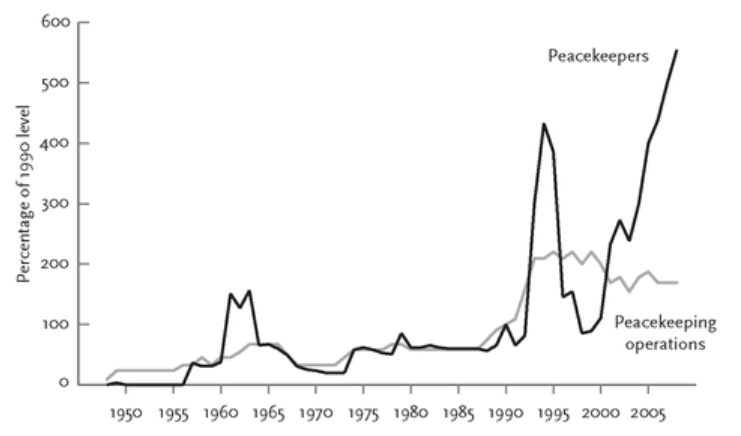
Pinker treats post-conflict peacekeeping as a specific, testable mechanism rather than evidence that every military intervention works. Virginia Page Fortna’s study of 115 civil-war cease-fires from 1944–1997, as Pinker reports it, found that the presence of a peacekeeping mission reduced the risk of renewed war by about 80 percent after modeling the fact that missions are often sent to difficult cases. The record still contains conspicuous failures, including Bosnia and Rwanda; an average effect does not guarantee success in any mission.
Figure 6-6 — Growth of peacekeeping operations and personnel, 1948–2008. Pinker’s proposed mechanisms are deterrence and tripwires, costly signals of good faith, monitoring and reassurance, policing of small provocations, identification of spoilers, demobilization and reintegration, and face-saving concessions through a neutral party. These functions differ from preventive invasion, occupation, or externally imposed regime change, so the finding should not be generalized to “interventionism” as a single policy. The evidence and figure are historical and end before the book’s 2011 publication. Chapter 6 synthesis · Settlements and the Fortna study, PDF pp. 441–442 (file not included in this release) · Figure 6-6 and peacekeeping mechanisms, PDF pp. 443–444 (file not included in this release)
🧑🏫 Philosophical and Political Roots
| Thinker / Tradition | Contribution |
|---|---|
| Immanuel Kant | Advocated for “perpetual peace” through a federation of liberal republics. |
| Woodrow Wilson | Idealist belief in making the world “safe for democracy.” |
| Hans Morgenthau | Realist who acknowledged that power must be used to preserve global order. |
| Francis Fukuyama | Argued for global democratic expansion after the Cold War (End of History thesis). |
| Neoconservatives | Advocated military intervention to spread democracy and protect U.S. interests. |
| Liberal Internationalists | Use diplomacy, aid, and multilateralism to pursue global stability and human rights. |
📅 Timeline of Interventionism
Pre-20th Century
- Limited U.S. interventionism (e.g., Monroe Doctrine as regional policing).
- European powers intervene globally through colonial empires.
World War I
- U.S. shifts from isolation to engagement under Woodrow Wilson.
- Idealism: war fought to “make the world safe for democracy.”
World War II
- Full-scale intervention in response to Axis threats.
- Post-war order structured by U.S. leadership: UN, IMF, NATO.
Cold War (1947–1991)
- Height of American interventionism: Korean War, Vietnam, coups, proxy wars.
- Containment doctrine aimed to stop the spread of communism.
Post–Cold War Era (1990s)
- Humanitarian interventions in Somalia, Bosnia, Kosovo.
- Belief in U.S. as global policeman rises.
Post-9/11 Era
- U.S. interventions in Afghanistan, Iraq, and drone strikes worldwide.
- Rise of neoconservative justification: spread democracy, defeat terror.
2010s–Present
- Backlash grows after long wars; shift toward restraint and strategic withdrawal.
- Ongoing debates over Ukraine, Syria, China, and U.S. role in global conflicts.
👤 Key Figures in Interventionism
| Name | Role / Belief |
|---|---|
| Woodrow Wilson | Architect of liberal internationalism; League of Nations. |
| Franklin D. Roosevelt | Guided U.S. into WWII and built postwar global institutions. |
| Harry Truman | Truman Doctrine: support free nations resisting communism. |
| Henry Kissinger | Realpolitik strategist; balanced intervention with diplomacy. |
| George W. Bush | Invaded Iraq and Afghanistan to defeat terror and spread democracy. |
| Hillary Clinton | Strong supporter of humanitarian and strategic interventions (e.g., Libya). |
| Barack Obama | Initially restrained, but intervened in Libya and expanded drone warfare. |
❗ Main Critiques of Interventionism
1. Unintended Consequences
- Interventions often create power vacuums, civil wars, or blowback (e.g., the Iraq War was a major enabling cause of ISIS, though neither intentional creation nor a sufficient cause by itself).
2. Imperialism in Disguise
- Critics argue it is a form of neo-imperialism, cloaked in rhetoric about democracy and freedom.
3. Cost in Lives and Resources
- Wars have cost trillions of dollars and led to massive civilian and military casualties.
4. Hypocrisy and Selectivity
- Critics point out that the West intervenes selectively, often ignoring atrocities in less strategic areas.
5. Loss of Credibility
- Failed interventions (e.g., Vietnam, Iraq, Libya) have damaged trust in Western leadership.
6. Undermining Sovereignty
- Interventions are seen as violations of national sovereignty and self-determination.
🔀 Variants and Related Movements
| Movement | Relation |
|---|---|
| Liberal Internationalism | Advocates for diplomacy and multilateral cooperation; emphasizes human rights. |
| Neoconservatism | Argues for U.S.-led military interventions to reshape the world order. |
| Responsibility to Protect (R2P) | UN-endorsed doctrine for military action to prevent genocide or mass atrocities. |
| Realism | Pragmatic intervention only when vital interests are at stake—not idealistic causes. |
| Peacekeeping (UN) | Limited, international military deployments to stabilize post-conflict zones. |