Project context
- Video: Why Did the Third World Learn to Cry Racism?
- Publication metadata: Published 2026-08-16; displayed duration
8:08; downloaded source duration487.361seconds. - Transcript source: YouTube automatic English captions, retrieved 2026-09-02 and checked against the source video on 2026-09-27.
- Research status: Full transcript, six preserved frames, Orania-history and energy audit, constitutional and municipal-status review, cultural-psychology audit, diversity-and-trust literature review, cross-cultural cooperation comparison, anti-racism chronology, and closing-quotation authentication completed 2026-09-27.
- Overall verdict: Mostly false or unsupported. The video starts from real facts—Orania is a growing Afrikaner cultural project with unusual local autonomy, self-provided services, solar generation, and restrictive residency norms—but changes or omits decisive context. The town inherited state-built infrastructure, remains connected to Eskom, and operates through a provisional legal accommodation inside South Africa. The video’s fear–shame–guilt hierarchy is a disputed missiological/anthropological classification rather than a validated scale of civilizational advancement. Research finds some modest, context-dependent associations between local ethnic diversity and trust, not an automatic transition to rule by force. The predator/prey analogy is not evidence about human populations, and the claim that non-Western people cannot comprehend moral language is contradicted by cross-cultural evidence of cooperation and by more than a century of African and Asian anti-racist political organization. The closing quotation is not Thomas Jefferson’s: it is an altered excerpt from Alexander Hamilton’s 1802 argument about immediate naturalization.
Evidence boundary
This audit does not decide whether Orania is desirable, whether cultural communities may legitimately seek autonomy, or what immigration level any country should choose. It tests the video’s factual premises and inferential bridges. Criticism by a politician is not government policy; a real headline is not a representative sample; and evidence that diversity can create coordination costs does not establish that heterogeneous societies necessarily lose moral regulation.
Executive verdict
The video could have made a defensible, narrower argument: Orania’s residents bought a deteriorating former government settlement, invested in it, built institutions around Afrikaans language and Afrikaner identity, supply many local services, and have rapidly expanded solar generation. Its unusual municipal position survived a 2000 court settlement, and some critics—especially the Economic Freedom Fighters—do call for ending its separate status. Those facts create legitimate questions about cultural self-determination, equal protection, private association, and the extent of local autonomy.
Instead, the narration turns that case into a theory about the mental and moral capacities of enormous human populations. It does so through five unsupported substitutions:
- Renovation becomes creation from nothing. Orania was built by the South African Department of Water Affairs in the 1960s for the Orange River Project, then abandoned and sold. Residents revived and expanded a deteriorated town; they did not create the original site, housing, and infrastructure from a barren plot without state antecedents.
- Energy resilience becomes off-grid independence. Orania has made genuine solar and battery investments. Its own public material nevertheless stated in 2023 that only about one-third of consumption was self-generated and that it was not yet free of load shedding; 2025–2026 notices describe a continuing Eskom connection and a special Eskom arrangement.
- A legal and political dispute becomes attempted taking. Orania lies geographically inside Thembelihle, retains municipal functions through a provisional settlement, and cooperates with several levels of government. EFF demands to abolish its status are real political speech. No evidence is offered that the South African state or “the rest of the country” is currently confiscating the town or demanding its residents’ possessions.
- A descriptive vocabulary becomes a hierarchy of peoples. Guilt, shame, fear, honor, law, reputation, and coercion all regulate conduct across societies. The three-culture scheme has a history in anthropology and Christian missiology, but review literature finds weak support for clean cultural categories. The video supplies no cross-national measure showing that guilt cultures are the most advanced, shame cultures require homogeneity, or fear cultures are the least prosperous.
- Political disagreement becomes animal predation. Humans are not distinct trophic species. Mapping unnamed peoples onto carnivores that cannot digest plants converts a political claim into an allegedly natural incapacity and then uses the analogy as if it had measured cognition. Cross-cultural experiments instead find variation in cooperation alongside widespread prosocial behavior, fairness, reciprocity, and moral rules.
The anti-racism claim is especially unsustainable. The African National Congress was founded in 1912 to defend African rights. Its 1955 Freedom Charter declared a multiracial democratic program. The 1955 Bandung communiqué—written by Asian and African states—condemned racial segregation, and the UN and UNESCO anti-discrimination record predates the modern welfare and diversity programs shown in the video. These movements exchanged concepts internationally, as political movements normally do, but that history cannot be reduced to outsiders teaching morally uncomprehending people a trick for obtaining benefits.
Debate-safe conclusion
Orania demonstrates that a disciplined cultural community can purchase, restore, govern, and partially power a town. It does not demonstrate that the surrounding population is incapable of creation, moral reasoning, or understanding discrimination. The video’s strongest Orania facts survive a careful audit; its civilizational hierarchy, automatic-diversity claim, predator analogy, population-level mind reading, welfare motive, and unnamed-coordinator implication do not.
Claim ledger
| Timestamp | Claim | Finding | Verdict |
|---|---|---|---|
| 0:00 | Orania is a lone, self-sufficient Afrikaner town in the Karoo. | It is an Afrikaner cultural settlement with private share-block ownership, an elected representative council, self-provided local services, and an unusual legal status. “Self-sufficient” is undefined and overstates continuing connections to South African law, markets, taxation, and Eskom. | Partly correct; overstated |
| 0:15 | Residents took a dilapidated plot and built the town through their own grit. | Residents bought and restored a deteriorating settlement, which is a genuine achievement. The Department of Water Affairs had created the town and its infrastructure in 1963 for the Orange River Project. | Real restoration; origin omitted |
| 0:27 | Orania used no government welfare or subsidies. | The town says it funds its own municipal services, but the video defines neither “welfare” nor “subsidy,” gives no audited fiscal account, and does not separate town finance from national benefits available to eligible South African residents. | Unsubstantiated absolute |
| 0:31 | Orania does not rely on South Africa’s power grid. | Orania has a solar farm and battery, but its own 2023 article said 33.3% of consumption was locally generated and it was not yet load-shedding-free. Later notices describe Eskom supply, tariffs, outages, and an Eskom agreement. | False as stated |
| 0:37 | The rest of South Africa inherited the country and “ruined it all.” | South Africa has serious crime, infrastructure, inequality, and governance problems. A total national judgment is undefined, supplies no comparison series, and treats a diverse country as one agent. | Rhetorical overgeneralization |
| 0:50 | Once Orania became successful, the remainder of the country wanted “a piece.” | Political criticism and EFF abolition demands are documented. The state has also negotiated, settled, and cooperated with Orania for decades. No nationwide or current state plan to take residents’ property is shown. | Criticism real; confiscation narrative unsupported |
| 1:00 | Apartheid criticism is merely hostility to freedom of association and a demand for goods. | Orania’s residency process, Afrikaner-only purpose, Christian values, Afrikaans language, and own-labor norm are documented; a debate about racial effect and equal protection is therefore not invented. Whether the arrangement is lawful or just is not resolved by calling every critic a taker. | Mischaracterizes the dispute |
| 1:36 | Western resources, laws, and customs are changed to accommodate people who should assimilate. | The migration-headline collage contains real or substantially real news stories, but it mixes countries, years, policy types, allegations, and temporary reception facilities. It does not establish a single Western rule or the motives of migrants as a class. | Selected examples / undefined thesis |
| 2:01 | Non-Western societies demand Western diversity and redistribution while remaining homogeneous and discriminatory. | “The Third World” includes thousands of institutions and positions. No representative data on attitudes, migration, transfers, or discrimination are supplied. | Sweeping ecological claim |
| 2:20 | Societies are regulated primarily by fear, shame, or guilt. | The categories have a real intellectual history, including Ruth Benedict’s guilt/shame distinction and later missiological fear–shame–guilt models. A review of the evidence finds that clean categorical division is poorly supported and that guilt and shame coexist. | Real schema; weak categorical validity |
| 2:36 | Western society is guilt-based, and such societies are exceptional. | Guilt can motivate prosocial behavior, but shame, reputation, law, coercion, and group identity also operate in Western societies. No measure or threshold classifies “the West” as a single type. | Oversimplified |
| 2:49 | Guilt-based society is possible only in advanced, religious, highly homogeneous groups. | No comparative study is cited. Guilt and conscience occur cross-culturally; religious and diverse societies use multiple sanctions. “Advanced” is undefined and makes the classification circular. | Unsupported |
| 3:03 | Most societies are shame-based, which still requires homogeneity. | Shame and reputation can matter in any community. The cited taxonomy does not establish an empirical requirement of ethnic homogeneity. | Unsupported necessity claim |
| 3:28 | Fear-based societies are the least advanced and least prosperous. | The video supplies no coding of societies, prosperity measure, temporal order, or causal design. Coercion can be more prominent where institutions are weak, but that does not validate a three-rung civilizational scale. | Unsupported hierarchy |
| 4:04 | When homogeneity is sufficiently broken, fear automatically takes charge. | A 2020 meta-analysis found a modest average negative association between ethnic diversity and trust, stronger at local scales, while emphasizing causal uncertainty and rejecting apocalyptic interpretations. Other reviews find mixed results and important roles for economic conditions, segregation, and contact. Nothing establishes automatic rule by force. | False deterministic inference |
| 4:29 | Human groups can be understood like herbivores and carnivores with incompatible nutritional adaptations. | The analogy names no population, trait, measure, or mechanism. Human communities are not different species or trophic niches; institutional behavior is learned, strategic, and changeable. | Category error / dehumanizing analogy |
| 5:04 | Some groups cannot learn productive self-provision; others rationally prefer taking. | No group, evidence, or test of inability is supplied. Cross-cultural behavioral experiments find that the canonical model of pure self-interest fails in every studied small-scale society and that cooperation varies with institutions and everyday interaction. | Unsupported collective-capacity claim |
| 6:04 | People outside guilt- or shame-based systems cannot comprehend moral language. | Research across 60 societies found positive moral valuation of seven cooperative behaviors throughout the sample, with explicit limitations on strength and conflict among values. Comprehension cannot be inferred from policy disagreement. | Contradicted by cross-cultural evidence |
| 6:48 | Non-Western people mimic “racism” like cats mimicking birds. | This is an analogy plus collective mind reading. It supplies no comprehension measure, interview evidence, representative sample, or alternative explanation. | Unsupported and dehumanizing |
| 7:04 | Racism claims produce resources, welfare, and preferential treatment; claimants do not understand why. | The displayed cases include actual adjudicated discrimination, an advocacy investigation, and contested positive-action policies. Valid, invalid, strategic, and mistaken claims must be evaluated individually. Benefits following some claims do not establish universal motive or incomprehension. | Anecdotes-to-motive fallacy |
| 7:23 | Non-Western histories are “often way worse,” so they have no right to judge Western history. | Historical comparison requires specified conduct, period, agents, and rule. Even grave wrongdoing by one society does not invalidate a person’s evidence about another; that is a tu quoque argument. | Undefined comparison / non sequitur |
| 7:45 | The complexity of anti-racist language makes it unlikely that non-Western people developed it themselves in a short time. | African and Asian anti-colonial and anti-racist organization long predates the examples shown: ANC (1912), multiracial Freedom Charter (1955), Bandung (1955), UDHR (1948), and UNESCO race statements (1950–1951). | Historically false premise |
| 7:58 | An unidentified actor taught this language and gained from doing so. | No actor, document, mechanism, payment, chronology, or falsifiable prediction is supplied. Ordinary political diffusion and independent responses to discrimination are available explanations. | Unfounded coordination implication |
| 8:00 visual | Thomas Jefferson warned that indiscriminately admitting foreigners’ rights was a “Trojan horse.” | The wording is from Alexander Hamilton’s 1802 Examination critique of Jefferson. The original says “the moment they put foot in our country” and “Grecian Horse,” and concerns immediate citizenship/naturalization, not entry alone. | Misattributed, altered, and decontextualized |
Orania: what is established
A purchased and restored town, not creation from a blank site
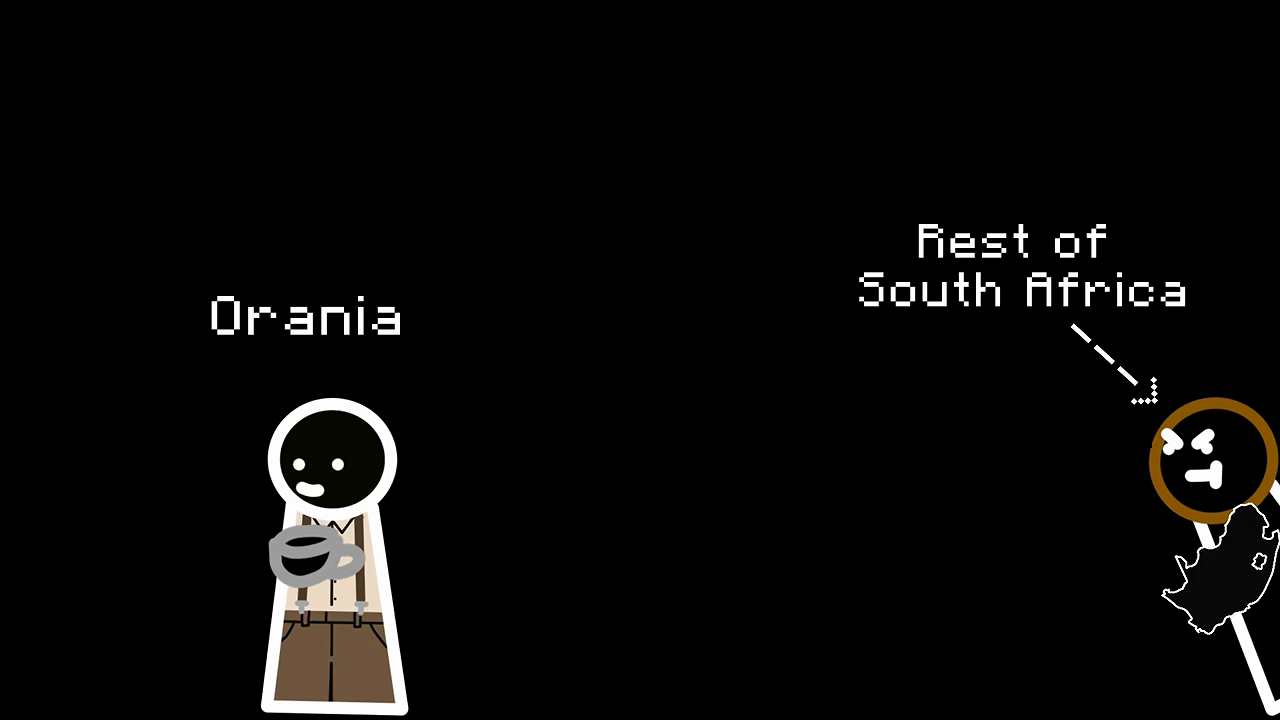
The narrow success story deserves credit. Orania’s residents purchased a neglected settlement, restored housing and services, expanded agriculture and businesses, and built institutions that attract new residents. The origin story nonetheless begins with the South African state. Orania’s own history calls it a former construction town for the Orange River water scheme that belonged to the Department of Water Affairs and was purchased in December 1990. A 2024 historical study similarly dates state development of the Vluytjeskraal township to 1963.
The accurate formulation is therefore:
state-built water-project town became deteriorated and was sold
                              ↓
Afrikaner settlers restored, governed, expanded, and invested in it
That is materially different from “a plot of land” transformed without inherited public infrastructure.
Energy resilience is real; grid independence is not
Orania’s solar investment is substantial. The overstatement is unusually easy to test because the town’s own sources describe the relationship:
- In 2023 the Orania Movement said local and private solar supplied
33.3%of town consumption and that Orania was not yet free of load shedding. - A 2025 newsletter described a “unique agreement” with Eskom and said the larger goal remained energy independence.
- A March 2026 town notice warned of a scheduled Eskom outage during which the town would temporarily depend on its solar farm and battery.
Solar and storage can protect the town during outages while it remains connected to and purchases power from Eskom. “Can island during some outages” and “does not rely on the national grid” are not equivalent.
Municipal autonomy is provisional and cooperative
Orania is not an independent state or an ordinary South African municipality. It lies within Thembelihle’s geographic boundaries but retains a representative council and local functions under a 2000 High Court settlement pending agreement on final status. A 2024 peer-reviewed legal/governance analysis describes Orania as a de facto local authority with its own fiscal base and services, operating through cooperative relationships with Thembelihle, the district, the Northern Cape, and national departments.
This record cuts both ways. It confirms meaningful local autonomy and supports residents’ claim that they provide their own municipal services. It also contradicts the video’s presentation of the South African state as simply preparing to force entry or seize the project. The most visible abolition demands come from the EFF, a political party. Criticism, a party platform, court litigation, negotiated status, and government policy must not be collapsed into one actor.
Cultural rights do not erase equality rules
The South African Constitution protects equality, association, language, culture, and cultural communities. Sections 30 and 31 say those cultural rights may not be exercised inconsistently with the Bill of Rights. Section 235 recognizes the notion of cultural self-determination within the Republic and subject to the Constitution.
freedom of association + cultural participation + self-determination
                              coexist with
equality + non-discrimination + constitutional limitations
Orania’s own materials describe a residency panel, Christian worldview, self-employment, Afrikaner labor, Afrikaans language, and community values. Whether particular decisions cross a legal line depends on facts and applicable law. The existence of competing constitutional principles is precisely why “freedom of association” does not end the inquiry.
The fear–shame–guilt framework
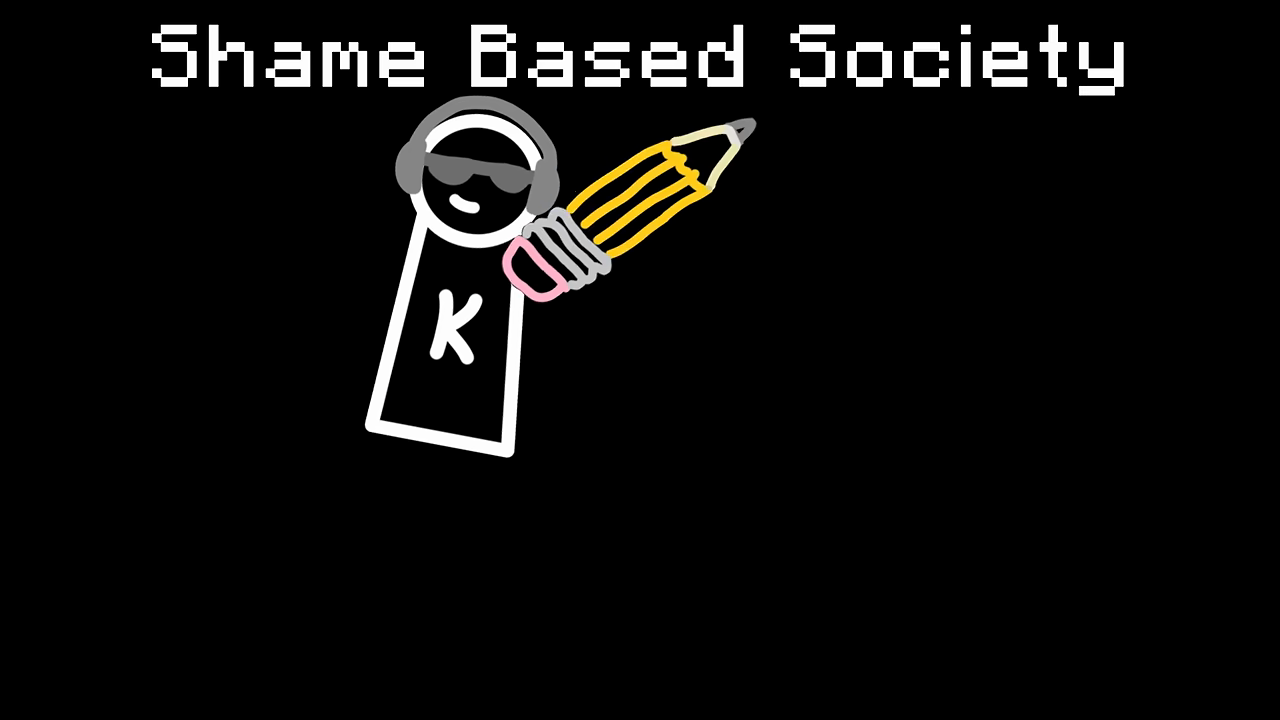

The classification is not invented by the video. Ruth Benedict’s 1946 discussion helped popularize the guilt/shame contrast. Eugene Nida and later Christian mission writers developed a three-way scheme; Roland Muller and Jayson Georges popularized fear–power, honor–shame, and guilt–innocence models for communicating the gospel across cultures.
That provenance matters because the video presents the model as settled comparative social science and then adds a civilizational ranking. Simon Cozens’s evidence review reaches a much narrower conclusion: the guilt/shame division is not clearly demarcated, critiques have undermined its categorical validity, and the empirical evidence for the tripartite scheme is limited. Psychological research more commonly treats guilt and shame as related self-conscious emotions that can coexist within individuals and groups, with effects that depend on appraisal and measurement.
The video’s added claims have separate evidentiary burdens:
| Added claim | What would be required | What is supplied |
|---|---|---|
| Guilt society requires advanced development | Independent development measure and temporal or causal design | An assertion |
| Guilt society requires religion | Comparative data distinguishing religion from institutions and education | An assertion |
| Guilt and shame require homogeneity | Defined diversity and emotion measures across comparable communities | An assertion |
| Fear society is least prosperous | Valid cultural classification and controls for conflict, state capacity, disease, geography, extraction, and history | No data |
| Diversity automatically installs fear | Longitudinal evidence of mechanism and exclusion of institutional alternatives | Animal analogy |
Labeling a society “fear-based” because it is poor or coercive and then using the label to explain why it is poor or coercive is circular.
Diversity, trust, and force
The strongest contrary evidence is not that diversity never creates strain. It sometimes does. Dinesen, Schaeffer, and Sønderskov’s review and meta-analysis of 1,001 estimates from 87 studies found a statistically significant but modest negative association between ethnic diversity and social trust, especially neighbor trust and local diversity. The authors also emphasize selection, measurement, context, and difficulty establishing causality. A broader cohesion review found mixed results across studies, and U.S. work has shown that residential stability and economic conditions can account for apparent diversity effects in some settings.
That evidence supports a conditional proposition:
under some local conditions, diversity may make trust-building harderIt does not support the video’s deterministic chain:
heterogeneity → moral language becomes incomprehensible → force automatically rulesInstitutions, equality before law, repeated interaction, common projects, economic security, segregation, and contact can mediate trust. Stable diverse democracies, organizations, firms, neighborhoods, and families are direct counterexamples to “automatic.”
Why the predator analogy cannot carry the argument
The carnivore/herbivore sequence is not a neutral illustration. It quietly changes the subject:
| Animal biology | Human political claim |
|---|---|
| Separate species may have obligatory diets fixed by anatomy and metabolism. | The video does not identify a human population with a measured biological incapacity for production or moral reasoning. |
| Predation transfers energy by killing prey. | Migration, taxation, discrimination claims, welfare, trade, and citizenship are distinct institutions with different rules and evidence. |
| A cat need not understand bird communication to exploit a sound. | Whether a person understands racism is an empirical question requiring language, belief, and behavior evidence. |
Cross-cultural evidence rejects the implied zero. Henrich and colleagues found that pure self-interest failed to describe behavior in every one of fifteen small-scale societies, while social organization and everyday cooperative payoffs explained part of the variation. Curry, Mullins, and Whitehouse coded ethnographies from sixty societies and found the studied cooperative behaviors positively moralized across regions, while carefully noting that they could not measure how strongly each value was held or how conflicts among values were resolved.
Human cooperation varies. The conclusion that some peoples are analogous to obligate carnivores is neither measured nor tested.
Anti-racism was not suddenly taught to a morally uncomprehending “Third World”
The closing coordination suggestion depends on a false compressed chronology:
| Date | Document or organization | What it shows |
|---|---|---|
| 1912 | African National Congress founded | Organized African defense of rights and freedoms predates modern DEI and welfare systems. |
| 1948 | Universal Declaration of Human Rights | Representatives from multiple regions articulated equal dignity and nondiscrimination by race or color. |
| 1950–1951 | UNESCO statements on race | International scientific and political attacks on racial hierarchy were publicly organized. |
| April 1955 | Bandung Conference | Asian and African states explicitly condemned racial segregation and discrimination, including in South Africa. |
| June 1955 | South African Freedom Charter | A locally organized movement declared that South Africa belonged to all who lived there, Black and White, with equal rights. |
| 1965 | International Convention on the Elimination of All Forms of Racial Discrimination | Antidiscrimination language became an international legal framework. |
Ideas circulated among colonized peoples, diasporas, churches, unions, socialist and liberal movements, scientists, and international institutions. That diffusion is documented. It is not evidence that people could not understand their own experiences or that one hidden teacher invented the language to obtain welfare.
What the displayed headlines actually show
Migration and asylum collage
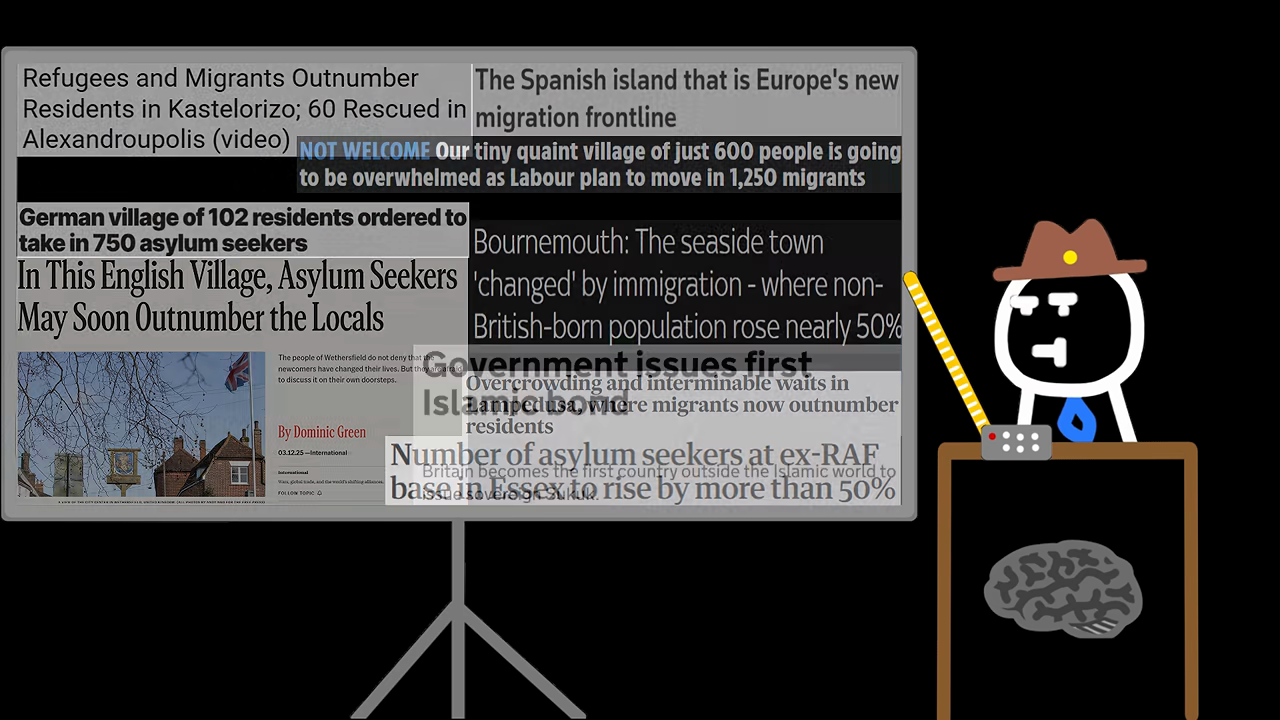
Several headlines are real. For example, a 2015 report concerned the German village of Sumte preparing to host hundreds of asylum seekers, while a 2025 Free Press article concerned a former air base near Wethersfield. The collage treats these as equivalent instances of Western people being forced to “share their homes,” although they involve different countries, dates, facilities, population figures, governments, and legal circumstances.
The evidentiary rule is simple: a headline can establish that an article existed. It cannot by itself establish representativeness, policy success or failure, demographic permanence, the attitudes of migrants, or a civilizational psychology.
Compensation and preference collage
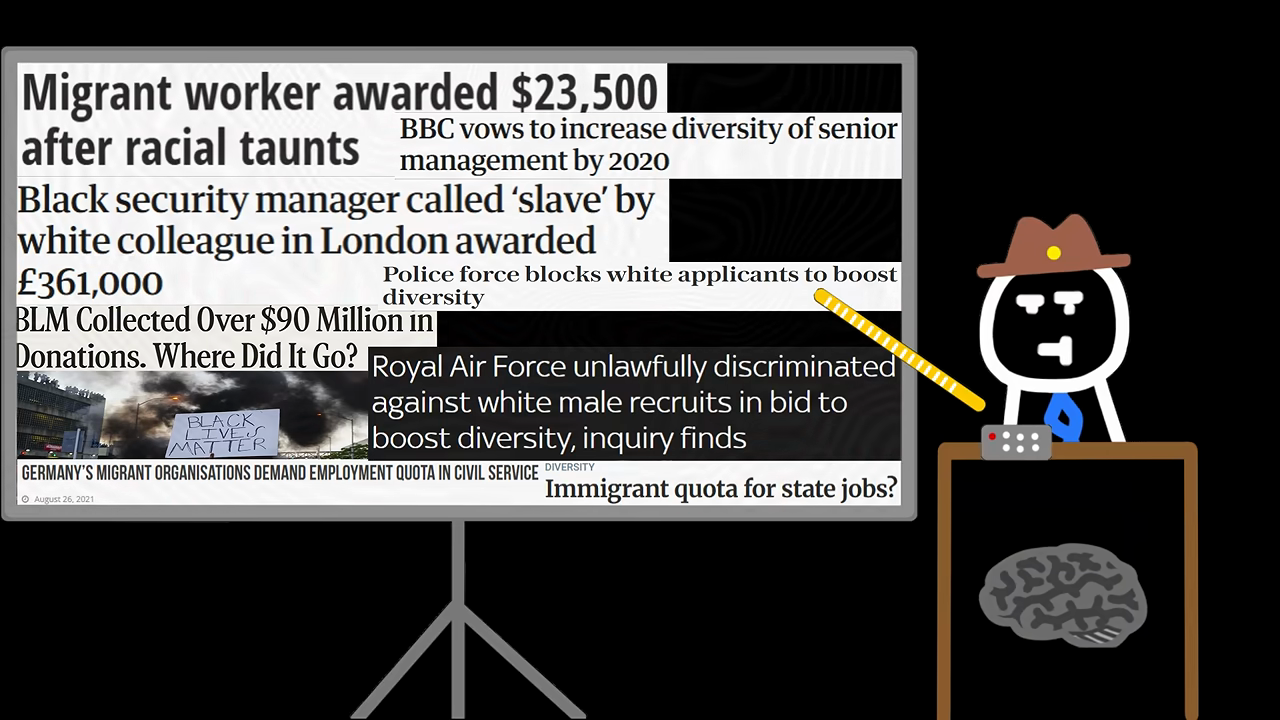
The board mixes unlike items:
- a Canadian human-rights award after a Saint Lucian worker was called a racial slur, fired, and repatriated;
- a UK employment award involving victimization, constructive dismissal, and documented race-based incidents;
- a critical investigation of Black Lives Matter finances;
- German civil-service quota advocacy;
- a contested West Yorkshire Police early-application policy; and
- general diversity announcements.
Some items may support criticism of a particular policy or organization. Others document remedies for specific misconduct. Combining them does not prove that claimants as a class are pretending not to understand racism. It is a selected-outcome-to-population-motive error.
The closing quotation is misattributed
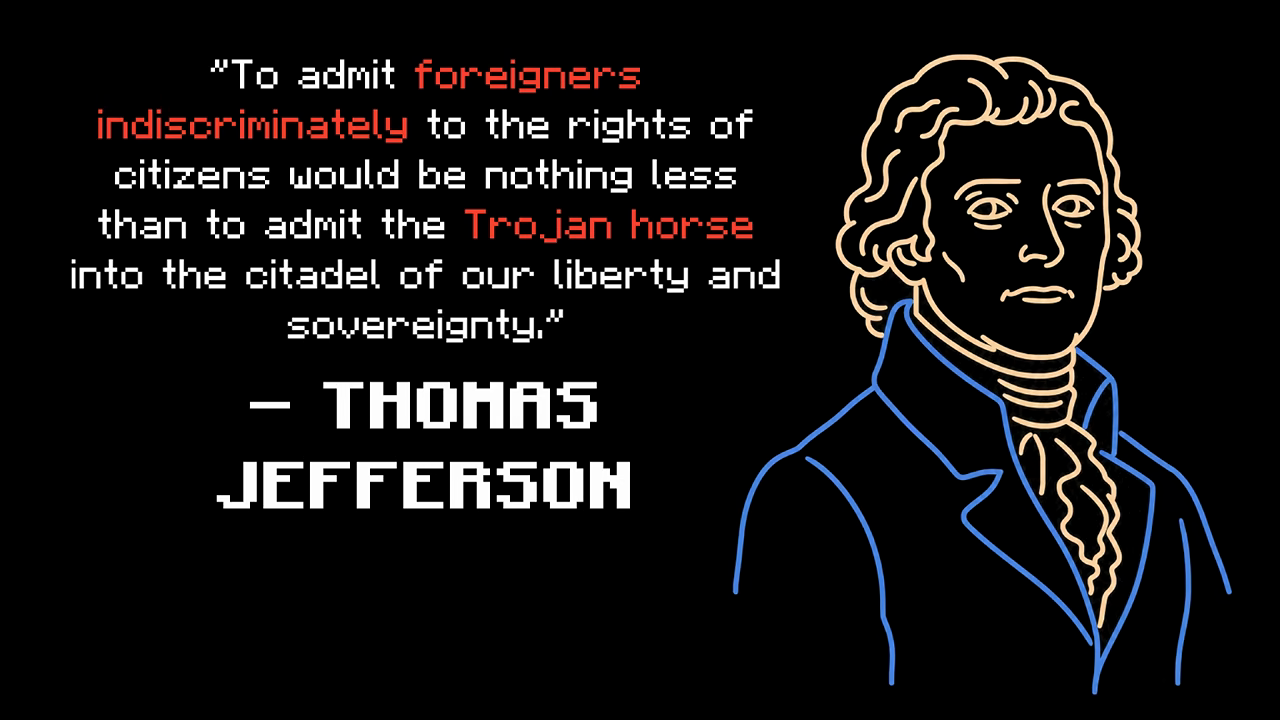
The visual attributes this to Thomas Jefferson:
“To admit foreigners indiscriminately to the rights of citizens would be nothing less than to admit the Trojan horse into the citadel of our liberty and sovereignty.”
The source is Alexander Hamilton, writing under the name Lucius Crassus in The Examination in January 1802 as a criticism of Jefferson’s message. The fuller sentence objects to giving foreigners the rights of citizens “the moment they put foot in our country” and says “Grecian Horse,” not “Trojan horse.” Hamilton immediately distinguished this position from a total ban on naturalization.
Three transformations therefore occur:
- Author inversion: Hamilton’s criticism of Jefferson is credited to Jefferson.
- Text alteration: “Grecian Horse” becomes “Trojan horse,” and the immediate-citizenship clause disappears.
- Scope change: a naturalization debate becomes a general warning about admitting foreigners.
This is not a minor label error; the altered attribution reverses the historical disagreement.
Causal and rhetorical structure
real Orania restoration, autonomy, and solar investment
                         ↓
public infrastructure and grid connection omitted
                         ↓
criticism recast as a demand to take residents' property
                         ↓
disputed fear–shame–guilt taxonomy made a hierarchy of peoples
                         ↓
diversity treated as automatic moral collapse
                         ↓
human groups mapped onto predator and prey species
                         ↓
selected headlines treated as proof of group motive
                         ↓
long anti-racist history compressed into sudden mimicry
                         ↓
an unidentified teacher/coordinator implied
The first premise can be true while every later arrow fails.
Source and provenance register
| Source | Role in this audit | Evidentiary use |
|---|---|---|
| Orania Movement history | Participant/official history | Confirms purchase of an abandoned state water-project town and Orania’s self-description. |
| Rossouw, “The Vluytjeskraaltownship” | Peer-reviewed history | Establishes Department of Water Affairs development beginning in 1963. |
| Orania Movement solar report | Participant source against interest | States 33.3% locally generated in 2023 and not yet load-shedding-free. |
| Orania 2025 Eskom newsletter and 2026 outage notice | Current participant records | Confirm continuing Eskom relationship and connection. |
| South African Constitution, Bill of Rights and index | Primary law | Equality, association, language, culture, cultural-community rights, and self-determination framework. |
| Van Staden, Orania as non-typical local government | Peer-reviewed legal/governance analysis | Provisional status, fiscal base, services, overlay zone, and cooperative government. |
| Cozens, “Shame Cultures, Fear Cultures, and Guilt Cultures” | Evidence review | Limited support and criticism of categorical shame/guilt/fear cultures. |
| Dinesen, Schaeffer, and Sønderskov 2020 | Narrative review and meta-analysis | Modest diversity–trust association, contextual variation, and causal limits. |
| Henrich et al. 2005 | Cross-cultural behavioral experiments | Variation and prosocial behavior across fifteen small-scale societies. |
| Curry, Mullins, and Whitehouse 2019 | Cross-cultural ethnographic study | Cooperative behaviors as plausible universal moral rules, with stated limits. |
| ANC history and Freedom Charter | Participant primary/historical archive | Organized rights claims from 1912 and explicit multiracial program in 1955. |
| Bandung communiqué | Primary diplomatic record | Asian-African condemnation of racial segregation and discrimination in 1955. |
| UDHR and UNESCO race history | Primary/institutional history | Long public development of international antidiscrimination language. |
| Hamilton quotation in the Congressional Record | Primary-text reproduction | Identifies Hamilton, the immediate-citizenship context, and “Grecian Horse.” |
| Monticello, “The Question of Immigration” | Jefferson institutional archive | Provides Jefferson’s broader and more welcoming citizenship context. |
Alternative explanations and disconfirming cases
- Orania’s order and growth may reflect resident selection, private ownership, small scale, shared norms, capital, screening, and administrative competence without establishing racial causation.
- Critics may object to racial effect, constitutional equality, history, or private municipal power without seeking personal goods.
- Migration disputes can concern capacity, legality, fairness, integration, labor, asylum duties, or local democratic consent; no single motive covers all participants.
- Antidiscrimination claims can be accurate, inaccurate, strategic, mistaken, or mixed. The existence of compensation creates incentives but cannot identify any particular claimant’s belief.
- Homogeneity can support bonding trust while also enabling exclusion, corruption, or conflict with outsiders. Diversity can impose coordination costs while also creating cross-cutting ties and broader markets.
- Western institutions use shame, reputation, and coercion; non-Western institutions use guilt, conscience, religion, contracts, and moral argument. Mixed regulation is the ordinary case.
What would change this verdict
- Audited Orania accounts defining and demonstrating the “no welfare” and “no subsidies” claims across town, residents, infrastructure, and national programs.
- Evidence that Orania had severed its Eskom connection at the video’s publication date.
- A specific government order or enacted policy requiring confiscation, transfer of ownership, or forced settlement in Orania.
- Valid cross-cultural measures showing that guilt, shame, and fear form mutually exclusive society types and predict development after plausible confounders.
- Longitudinal or quasi-experimental evidence that ethnic diversity necessarily produces coercive rule rather than a modest, contingent trust effect.
- Representative evidence measuring whether named populations understand racism language and use it principally for material gain.
- A named actor, mechanism, dated record, and independent corroboration for the closing coordination hypothesis.
Cross-video connections
- An Honest Review of Civil Rights — reuses the move from genuine legal conflict to group-level motive and “forced association.”
- Why Is Africa Like That — converts selected institutional and historical facts into a continent-wide psychology.
- Why Do Western Elites Fear European Bloodlines — moves from real political theory to unmeasured biological caste and coordination claims.
- Why Is Black America Like That — uses selected welfare and disparity facts to make a collective-character judgment.
- Basic Logic Cross-Video Claim Map > Homogeneity, moral cognition, and predation chain — project-level recurrence map.
Onscreen evidence and source provenance
Six consequential frames are preserved locally. The Orania, shame/fear, and predator graphics are creator-made argument frames, not external evidence. The two headline collages combine authentic and partially authenticated news items from unlike contexts; they do not document population-level motives. The Hamilton/Jefferson frame is directly falsified by the historical source. No direct upstream page containing the video’s complete Orania → cultural taxonomy → predator analogy → antiracism-mimicry chain was located, so provenance remains unresolved rather than assigned to a creator or intermediary.
Archived video description
Creator description captured from YouTube metadata on 2026-09-27
Over the last year the small Afrikaner town of Orania in South Africa’s Karoo has gone viral. With no government subsidies, no welfare, and even independence from the national power grid, its residents turned a barren plot into a safe, functioning community. The response from much of the rest of the country (and from voices across the West) has been to brand it a new form of apartheid and demand that the Afrikaners open it up or hand it over.
This video examines why the same people who insist the West must become diverse, redistribute its resources, and abandon freedom of association never apply those standards to their own societies. Why the language of “racism” and “discrimination” is used so selectively and effectively against the West. We look at the difference between guilt-based, shame-based, and fear-based societies, and why moral language that works inside a high-trust, homogeneous culture becomes a powerful tool once that homogeneity is broken. Using Orania as the concrete example, the video shows how the demand to share what others built is not primarily about justice, but about a simpler calculation: it is easier to take than to create.
Chapters:
0:00Introduction ·1:28An Odd Hypocrisy ·2:20Guilt & Shame Based Societies ·3:23Fear-Based Societies ·4:28Incentive To Take ·6:30Mimicry of Our Morals ·7:18Conclusion
Full transcript
Full transcript (YouTube automatic captions; lightly normalized)
Automatic captions can mishear names, numbers, and punctuation. The wording below is retained as evidence of what the video appears to say, not as authentication of every proper noun or statistic.
0:00 — Over the last year, the town known as Orania has been going viral. Orania, for those of you unaware, is a lone, self-sufficient town in the middle of the arid Karoo region in South Africa. It was settled by Afrikaners, that is the descendants of mainly Dutch settlers, with the goal of preserving their identity. In a country that’s been characterized by rampant crime, failing infrastructure, and overall decline, the Afrikaners of Orania were able to take a dilapidated plot of land with nothing else than their own grit, no government welfare, no subsidies, not even relying on a nation’s power grid, and build that up into a nice place for themselves and their families without having to rely or take from anyone else. So, naturally, the remainder of the country, which had the entire nation’s territory, natural resources, and advanced infrastructure, and ruined it all, and didn’t even care about Orania up until the Afrikaners made it into a nice place, have decided that they want a piece. They allege that
1:00 — the Afrikaners, by practicing their right to freedom of association, are actually a second form of apartheid, a town of racists for daring to try to preserve their unique identity and the fruits of their labor. They allege that they, as fellow South Africans, are entitled to Orania, and the Afrikaners must accommodate, or in other words, give them stuff. And if the Afrikaners refuse, the state ought to get involved and force them to. You see similar allegations all over the West. Arguments are made to justify why Westerners must associate with groups they otherwise wouldn’t want to. Why their resources, which they acquired through their own labor, must be shared with the Third World. Why their laws and customs must be changed to accommodate those who are supposed to be assimilating. But many have pointed out a strange irony. The people making these arguments and allegations against the West don’t hold their own nations to the same standards. The West must be diverse, but their
2:01 — homes remain homogeneous. The West must redistribute their resources, but their homes do not. The West cannot discriminate against them, but they can against us. So, what’s going on here? Is it just plain hypocrisy, or is there something more to it? That’s the question this video will explore, and if you enjoy it, consider subscribing. It helps the channel. Societies regulate human behavior on the basis of three negative emotions: fear, shame, and guilt. Westerners follow a guilt-based society. Social regulation is primarily based on the psychological pain of breaking one’s own principles, and only when that fails does law enforcement come in. While this is normal for the West, and many think it’s normal for the whole world, this is the exception, not the rule. Guilt-based societies are only possible in advanced, often religious, and highly homogeneous societies, so that the people’s individual principles are close enough for there to be an understanding. Most societies are shame-based, meaning regulation is
3:03 — primarily based on the pain of social ostracization if one goes against the clan’s values. Despite it being the most common, it still requires some advancement, and at minimum a homogeneous society, so that the same fans actually have power over the largest number of individuals. And lastly, the most primal form is fear. Fear-based societies are the least advanced and least conducive to a prosperous nation. But their advantage is that they work anywhere, regardless of circumstance. In fear-based societies, the only calculations are, “If I do X, then others will hurt me, so it’s not worth it.” And “If someone else does X against me, I will hurt them, so they won’t do it.” Such a straightforward system means you have no need for homogeneity. You can integrate whoever you want because values don’t matter. Only strength does. For obvious reasons, people don’t like the system. It’s inefficient and it’s might makes right. The issue is when you break
4:04 — homogeneity in a society so much to the point where aligned principles and clan values can’t enforce social order, fear is automatically in charge. You can moralize all you want, it doesn’t matter. When there are too many different peoples with competing values systems, it’s what you get. It’s the same reason we don’t waste our time trying to moralize carnivores versus herbivores in the wild. Herbivores put a lot of effort into be able to digest plants and create the necessary nutrients from it. It’s hard work requiring extensive specialization. A different animal, which is struggling to get the nutrients they want, could also maybe over many generations adapt to be able to produce those same nutrients as the herbivores. But that’s difficult. Wouldn’t it just be easier to just take the already processed nutrients forcefully? Is it immoral that some species have adapted to be carnivores? Is it immoral that some have adapted so much towards carnivory that they are actually fully unable to digest plants
5:04 — and have to prey on other animals to survive? When it comes to such situations, the question of morality [music] is irrelevant. The only question that matters is if it’s easier. Herbivores will be eaten by carnivores if they don’t have the means to defend themselves. The same is true for the plants that the herbivores eat. Because others already work hard to get something valuable, it’s simply more energy-efficient to take that than make it yourself. You can argue that if we were all photosynthesizing plant, we’d have the most energy-efficient situation as no energy would have to be lost in hunting or defending and everyone would be able to self-sustain. And that’s true, but also irrelevant. Some are simply not capable of learning to photosynthesize. Some are capable, but get far greater immediate rewards by not doing so. Naturally, this concept extends beyond just plants and animals. Whenever you make something desirable that’s hard to make, you’re incentivizing others to take it from you
6:04 — because it’s easier to take than to make it themselves. This is true for valuable craftsmanship, for architectural wonders, for hard to extract resources, and for civilization itself. And if they don’t share your personal principles, or they don’t follow your clan’s rulings, then they will act upon this principle. Not because they’re evil, at least not in the way we define it, but because it’s easier. You see, in fear-based situations, moral language doesn’t apply. It isn’t even comprehensible, which begs the video’s original question. If moral language doesn’t apply, why is it constantly used against the West in a hypocritical fashion? The answer is simple. Why do cats mimic the sounds of birds? The cat neither understands the sound they are making, nor do they understand the mechanism by which it gains the trust of birds. All they know is, by making those sounds, the birds lower their guard. Likewise, when they cry
7:04 — racism, discrimination, etc., they know they get resources, welfare, and preferential treatment by the authorities. They don’t really understand why. If anything, they probably think it’s stupid, but it works. So, there’s no reason not to. When Westerners who oppose this behavior try to lecture the Third World, demanding consistent standards, pointing out that they have no right to judge the West’s history, when their own are often way worse, it’s the same as a bird trying to teach a cat that the sounds they are mimicking are false statements. It’s pointless. The bird’s only concern should be to maintain its guard and make sure other birds don’t fall for it. That should be obvious. But there’s one other less apparent concern the bird must also consider. Given how complex its moral language and value system is, it’s unlikely the cat would have learned to exploit it on their own, especially in such a short time period. So that begs the uncomfortable question of who taught them?
8:04 — And what did they gain by doing so?