Project context
- Video: Why Do Western Elites Fear European Bloodlines?
- Published: July 26, 2026
- Duration: 8:18 displayed; downloaded media is 497.061 seconds
- Description: The video explicitly names the Italian School of Elitism, genetic assortative mating, noble lineages, elite circulation, the Industrial Revolution, dysgenics, welfare, immigration, and a proposed new caste system.
- Transcript source: YouTube automatic English captions, first retrieved 2026-09-02 and re-retrieved as
en-origWebVTT on 2026-09-27 - Media reviewed: 1280×720 video and creator-supplied metadata downloaded 2026-09-27
- Research status: Full transcript verified against the re-retrieved captions, central claims adjudicated, and four consequential frames preserved.
Evidence boundary
The transcript records the video’s claims; it is not evidence that those claims are true. The video names no empirical paper in the narration and supplies no source list. The research below therefore tests the strongest identifiable version of each claim against primary or scholarly sources without treating a plausible influence as a verified source.
Executive verdict
Overall assessment — mostly unsupported and materially misleading
The video starts from several defensible premises: organized minorities often exercise political power; Pareto wrote about elite circulation; cognitive ability and some personality traits are partly heritable within studied populations; people assort by education and other traits; long-run status persistence exists; some European elites did intermarry with wealthy commercial families; Indian population history records extensive endogamy; and the displayed Aristotle passage is substantially authentic. None of those findings demonstrates a distinct European “noble genetic line” bred to rule, unusually rapid European genetic elite turnover, a continent-wide dispersal of aristocratic governing traits during industrialization, a biologically interchangeable modern European population, welfare-caused dysgenic decline, immigration from “70 IQ demographics,” or a coordinated elite project to install a permanently loyal foreign caste.
The argument repeatedly substitutes one level of evidence for another: political theory becomes population genetics; individual heritability becomes hereditary caste; educational homogamy becomes selection for ruling capacity; genealogical descent becomes possession of advantageous alleles; surname persistence becomes genetic turnover; cross-sectional fertility differences become a welfare mechanism; country-level IQ estimates become individual migrant aptitude; and an authentic ancient quotation becomes evidence for a modern policy conspiracy. The closing intention claim is not merely unproved; the video supplies no named decision-maker, plan, documentary record, mechanism, counterfactual, or discriminating prediction by which it could be tested.
Bottom line by evidence layer
| Layer | Assessment |
|---|---|
| Classical elite theory | Partly accurate. Mosca’s organized-minority thesis and Pareto’s circulation-of-elites concept are real. The video’s biological extension is not part of the evidence establishing those theories. |
| Trait inheritance and mating | Narrow core true; inference unsupported. Intelligence is substantially heritable within populations, and assortative mating is documented. The evidence does not identify a multigenerational “noble” genotype for intellect, charisma, cunning, martial prowess, or governing competence. |
| European elite turnover | Unestablished and source-misrepresented. Gregory Clark’s surname work emphasizes unexpectedly slow, broadly similar long-run status mobility, including in Sweden—not uniquely aggressive European turnover. His method and interpretation are also debated. |
| Industrial Revolution | Mixed history, unsupported genetic conclusion. Industrialization changed occupational routes and admitted commercial/professional fortunes into elites, while landed elites also adapted and often remained powerful. No cited study shows mass diffusion of genetically selected ruling traits into “the common populace.” |
| Welfare and fertility | Selective fact, unsupported mechanism. Educational fertility gradients exist but vary by sex, cohort, country, parity, and policy setting. Family policies can raise or lower fertility at the margin. This does not establish that welfare transfers systematically suppress high-IQ births while subsidizing a genetically inferior population. |
| Immigration and caste | Measurement and ecological error. Migrant skills vary greatly by origin, selection route, language, education, and host country. Disputed national-IQ estimates cannot validly classify individual migrants. Indian endogamy is real population history; it does not validate fixed occupational aptitude or permanent political loyalty. |
| Elite intent | Unsupported. The video presents a motive story as an explanation without direct evidence of coordination or intent. |
Argument reconstructed
organized minorities govern complex societies
                     ↓
governing success requires heritable superior traits
                     ↓
elite assortative mating creates noble genetic lines
                     ↓
Europe cycles elites unusually quickly
                     ↓
industrialization disperses noble traits into ordinary Europeans
                     ↓
modern elites become genetically unimpressive and vulnerable
                     ↓
welfare lowers high-performing fertility while subsidizing low performers
                     ↓
immigration imports low-IQ biological castes
                     ↓
foreign dependence produces a permanently loyal underclass
                     ↓
Western elites can rule without native rivals
The dossier finds support for fragments at the first, third, and caste-endogamy steps. It does not find evidence for the arrows connecting them or for the final coordinated-intent conclusion.
Claim ledger
| Time | Video claim | Best evidence found | Assessment |
|---|---|---|---|
| 0:00–0:47 | In every complex society, an organized minority rules an unorganized majority because administration is specialized full-time work. | Mosca’s political-class theory centrally distinguishes a governing minority from the governed majority; later elite theory examines organization and power. | Substantially accurate as a classical theoretical claim, not a biological law. |
| 0:47–1:04 | Rulers must monopolize authority and resources or a rival organized minority will; this biologically destabilizes Western elites. | Elite competition and circulation are recognizable theoretical themes. No biological consequence follows without separate genetic evidence. | Mixed premise; unsupported biological bridge. |
| 1:07–1:39 | Elites possess greater intellect, charisma, cunning, martial prowess, and similar traits needed to rule; many are heritable. | Intelligence has substantial within-population heritability. Broad personality traits show partial heritability. The narrated bundle is undefined and “ruling ability” is not measured. | Overgeneralized. Heritability of some traits does not establish elite genetic superiority or a unitary governing phenotype. |
| 1:39–2:20 | Superior people pair with superior spouses and produce increasingly advantaged offspring, creating noble genetic lines “bred to rule.” | Educational and phenotypic assortative mating is real, but genetic similarity between spouses is much smaller than educational similarity and can reflect social sorting. | Unsupported. No lineage genotypes, trait measures, selection coefficients, or governing outcomes are supplied. |
| 2:20–2:40 | Mutation and “dysgenic elements” weaken noble bloodlines and allow new ones to challenge them. | Mutation continuously occurs, but most political turnover is not evidence of a lineage-level mutational cause. | Speculative and unfalsified. |
| 2:40–3:02 | Europeans historically had far higher elite turnover than other societies and therefore built unusually strong mobility mechanisms. | Clark’s Sweden paper finds elite surname persistence of roughly 0.7–0.8 and mobility similar to the UK and US, only a little higher than preindustrial Sweden. Cross-society comparisons depend heavily on measure and period. | Not established; Clark is used against the direction of his central result. |
| 3:02–3:28 | Revolutions are never masses versus elites; a new disenfranchised elite always uses the masses against an old elite. | Pareto/Mosca/Michels-inspired accounts often emphasize elite conflict and circulation. “Never” is an absolute claim that excludes popular organization, institutions, ideology, state breakdown, war, and material grievances. | Recognizable elite-theory lens, but overstated as a universal law. |
| 3:28–4:03 | Industrialization made business, mathematics, and marketing essential while court politics, social dynamics, and martial prowess became irrelevant. | Industrialization changed the economic and professional composition of elites, but landed and political elites often adapted, invested, intermarried, and retained power. | Partly plausible structural change; the trait substitution is reductive and unsourced. |
| 4:03–4:38 | More noble bloodlines were disenfranchised during the Industrial Revolution than at any other time; impoverished aristocrats commonly married business families or commoners. | Historians document elite adaptation, decline in some branches, new professional fortunes, and intermarriage. The comparative superlative and genetic consequence are not demonstrated. | Mixed historical core; unsupported scale and genetics. |
| 4:38–5:10 | Millennia-selected noble traits diffused into a substantial share of Europeans, explaining revolutions and the absence of biological castes. | Genealogical pedigree expansion makes shared ancestors common, but inheritance is recombined and genealogical descent does not imply retention of a coherent advantageous allele set. | Unsupported genetic inference and post hoc historical explanation. |
| 5:10–6:04 | Almost any Westerner may descend from a high-achieving lineage; current elites are unimpressive and perform tasks an average person could do if connected. | The first part is plausible genealogically over long time depths; the second is an undefined value judgment with no occupational-performance comparison. | Genealogical point plausible; competence claim not testable as stated. |
| 6:04–6:35 | A small ability gap between rulers and ruled causes overthrow; current elites hide behind politicians and finance. | Elite vulnerability has institutional, coercive, legitimacy, fiscal, military, and organizational determinants. No measure of the alleged ability gap is offered. | Unsupported causal narrative. |
| 6:35–7:06 | Welfare punishes middle-class savers and transfers their income to dependents, causing high-IQ, talented, hard-working people to have fewer children while encouraging dependents to reproduce. | Fertility varies with education, income, partnership, sex, parity, housing, work–family compatibility, and policy. OECD reviews find context-dependent policy effects; modern Swedish male data find a positive IQ–fertility relationship. | Selective and causally unsupported. Tax/benefit incidence is not a demonstrated genetic-selection mechanism. |
| 7:06–7:28 | Mass immigration inherently imports average masses rather than the best; people from “70 IQ demographics” rarely make good doctors or engineers. | Migrants are strongly selected by route and host-country policy. OECD skill gaps vary greatly and are partly language-related. National-IQ datasets contain severe sampling, imputation, and comparability problems. | Misleading ecological inference and demeaning individual classification. |
| 7:28–7:40 | Biological castes remain real and important outside the West. | Indian genomic research documents a historical shift toward endogamy and many founder events. It does not show fixed occupational merit, political docility, or a single pan-Indian biological hierarchy. | Real endogamy recast as unsupported essentialism. |
| 7:40–8:17 | Welfare plus immigration deliberately re-stratifies society: dependent foreigners become a perpetual loyal underclass, Europeans are displaced, and elites remove rival native bloodlines. | No named policy architect, documentary evidence, coordination mechanism, comparative design, or prediction distinguishes this theory from labor-demand, asylum, family-reunification, demographic, humanitarian, electoral, or administrative explanations. | Unsupported coordination and intent claim. |
Transcript and metadata verification
- The 2026-09-27
en-origWebVTT agrees with the transcript preserved below on all central claims. The paragraph timestamps below are navigation anchors rather than sentence-level timecodes. - Proper names are mostly absent from the narration. The visible slide at approximately 2:50 names Gregory Clark; the description names Pareto and Mosca; the closing frame names Aristotle.
- The captioned phrase is “70 IQ demographics.” The video provides no dataset, country list, migrant sample, score distribution, uncertainty interval, or occupational outcome model for it.
- The creator’s description frames the argument as one about “genetic assortative mating,” “noble lineages,” “modern dysgenics,” welfare, and immigration; the biological reading is therefore explicit rather than inferred only from imagery.
Italian elite theory: what survives the check
Gaetano Mosca did formulate a governing-minority thesis. A Treccani history of his work describes his “law of organized minorities” and quotes the distinction between the minority exercising public power and the governed majority. It also notes something the video omits: Mosca rejected crude positivist determinism based on race, climate, and similar variables and emphasized historical, cultural, psychosocial, and institutional analysis.
Pareto’s “circulation of elites” likewise concerns the rise, transformation, and decline of elites. It does not by itself say that political turnover measures biological replacement or that old and new elites are genetically differentiated. The video’s strongest defensible reading is therefore sociological: durable organizations concentrate power, elites compete, and elite composition changes. Its genetic narrative requires independent evidence that is never supplied.
The claim that revolutions are never popular struggles is stronger than the theory warrants. Elite sponsorship, factional conflict, and leadership are often important, but a universal claim must rule out causal roles for mass organization, ideology, fiscal crisis, military defeat, food prices, state capacity, and local institutions. The video presents none of those tests.
Assortative mating is not a noble-bloodline result
The audit distinguishes four propositions:
- People resemble their partners on education and some traits: well supported.
- Some of that resemblance has genetic correlates: supported in particular samples, but substantially smaller than educational resemblance and entangled with social sorting.
- Offspring inherit genetic and environmental advantages: broadly true, with direct genetics, genetic nurture, wealth, schooling, networks, geography, and status transmission all potentially involved.
- Aristocratic lineages accumulated a stable genotype for ruling: not established by the first three propositions.
Heritability describes variation in a specified population and environment; it is not a score for immutability, moral worth, or the genetic cause of a social rank. The video never defines “charisma,” “cunning,” “martial prowess,” or “ruling ability”; identifies variants; measures spouse phenotypes; compares noble and common lineages; or separates genes from wealth, titles, legal inheritance, schooling, patronage, marriage markets, and political exclusion.
Even the phrase “noble bloodline” conflates at least three different objects: a legal status, a genealogical pedigree, and a genetic lineage. Legal and genealogical continuity can be high while the particular alleles inherited from any remote ancestor become sparse and stochastic through recombination. A large share of Europeans can genealogically descend from medieval elites without possessing a coherent, elite-specific package of “ruling” alleles.
Clark, surnames, and European mobility
The visible “Europe’s Elite Turnover” slide cites surname and social-mobility research “such as Gregory Clark’s work.” Clark’s Sweden paper does not demonstrate the narration’s main point. Its abstract reports that conventional measures overstate mobility, that elite surnames persist for many generations, and that Sweden’s long-run rate is similar to the supposedly less mobile UK and US and only a little higher than in the preindustrial era.
The slide replies that Clark studied collectives rather than individuals and therefore “masks” turnover. That is an assertion, not a demonstrated correction. Surname-group persistence is precisely the method’s intended signal of multigenerational status transmission. Other scholars have criticized assumptions and estimates in Clark’s surname approach, which means neither Clark’s strong persistence result nor the video’s reversal should be treated as settled without measure-specific comparisons.
The further move—from status mobility to genetic elite turnover—has no measured bridge. Occupational entry, marriage, wealth loss, political reform, war, inheritance law, education, urbanization, and changing class categories can alter status without implying the rise or fall of a genetic lineage.
Industrialization and aristocratic intermarriage
The historical literature supports a more complicated picture than replacement followed by biological diffusion:
- industrialization expanded commercial, industrial, managerial, and professional routes to wealth and status;
- some aristocratic families declined, branches dropped out of elites, and some married new money;
- parts of the landed elite invested, adapted, entered business, or retained political and social power;
- Britain’s ruling elite could support industrial development for institutional, geopolitical, employment, and rent-related reasons;
- the timing and degree of mobility varied across countries, regions, occupations, and definitions of “elite.”
Those facts support elite recomposition, not the video’s claim that industrialization was history’s greatest disenfranchisement of noble bloodlines or that mathematical, marketing, and business genes replaced martial and courtly genes. Nor does the “age of revolutions” establish the proposed genetic cause; the chronology also contains state formation, fiscal crises, colonial wars, new political ideologies, communications changes, urbanization, and institutional conflict.
Fertility, welfare, and “dysgenics”
The video combines three different questions:
- whether education or measured cognitive ability correlates with fertility;
- whether taxes and benefits causally change births;
- whether any resulting change reduces population genetic value.
There is no single universal fertility gradient. Across European countries, lower-educated women often have higher period fertility, but some countries show U-shaped or weak gradients; patterns differ by parity and institutions. A Swedish register study found a positive intelligence–fertility relationship among men born 1951–1967. OECD reviews find that employment, housing, childcare, leave, cash benefits, and gendered work–family compatibility interact, with policy effects varying by design and national setting.
Even if a measured trait and completed fertility correlate in one population, “welfare caused dysgenics” still requires a causal design linking program exposure to births, a validated genetic measure, transmission across generations, and a net-population calculation that includes assortative mating, migration, mortality, education, and changing environments. The video supplies none of these. “Living off the state” and “work ethic” are also moral labels, not operational variables.
Immigration, national IQ, and the caste analogy
Migration is not a random draw from a country’s population. Work visas, student routes, asylum, family reunification, colonial ties, language, geography, income, network effects, and host-country rules produce very different selection profiles. OECD adult-skills research does find average migrant–native gaps in many participating countries, but emphasizes large cross-country and group variation and the role of assessment language. That evidence supports measuring real qualifications and integration barriers; it does not validate assigning an individual the alleged average IQ of a country or “demographic.”
The national-IQ source family reused elsewhere in the channel has extensive problems: unrepresentative samples, imputed countries, incomparable instruments and years, unclear exclusions, and ecological aggregation. A national mean—even if perfectly measured—would not determine whether a particular immigrant is a doctor, engineer, entrepreneur, caregiver, student, or low-skilled worker.
The Indian-caste slide has a factual anchor but an invalid use. Genomic studies show that widespread mixture in India was followed by stronger endogamy, leaving many group-specific founder events. That is evidence about mating history and medically important population structure. It does not establish a natural ranking of occupations, innate political loyalty, or that contemporary immigrants from an endogamous population form a permanent dependent caste abroad.
The Aristotle quotation
The closing quotation is substantially authentic. In Politics 5.1314a, Aristotle describes it as a mark of tyranny to prefer men of foreign extraction as guests and companions because citizens are hostile while strangers make no claim against the tyrant. The video’s graphic changes the cited English translation’s “hostile” to “rivals,” a small but meaningful shift toward the video’s thesis.
The surrounding passage is a catalog of tactics attributed to tyrants: humiliation, distrust, surveillance, division, impoverishment, and disabling collective action. Authenticity does not make the quotation empirical evidence that modern welfare and immigration policy was designed to reproduce the tactic. That application would need its own historical and documentary proof.
Onscreen evidence and source provenance
“Europe’s Elite Turnover” slide — approximately 2:50
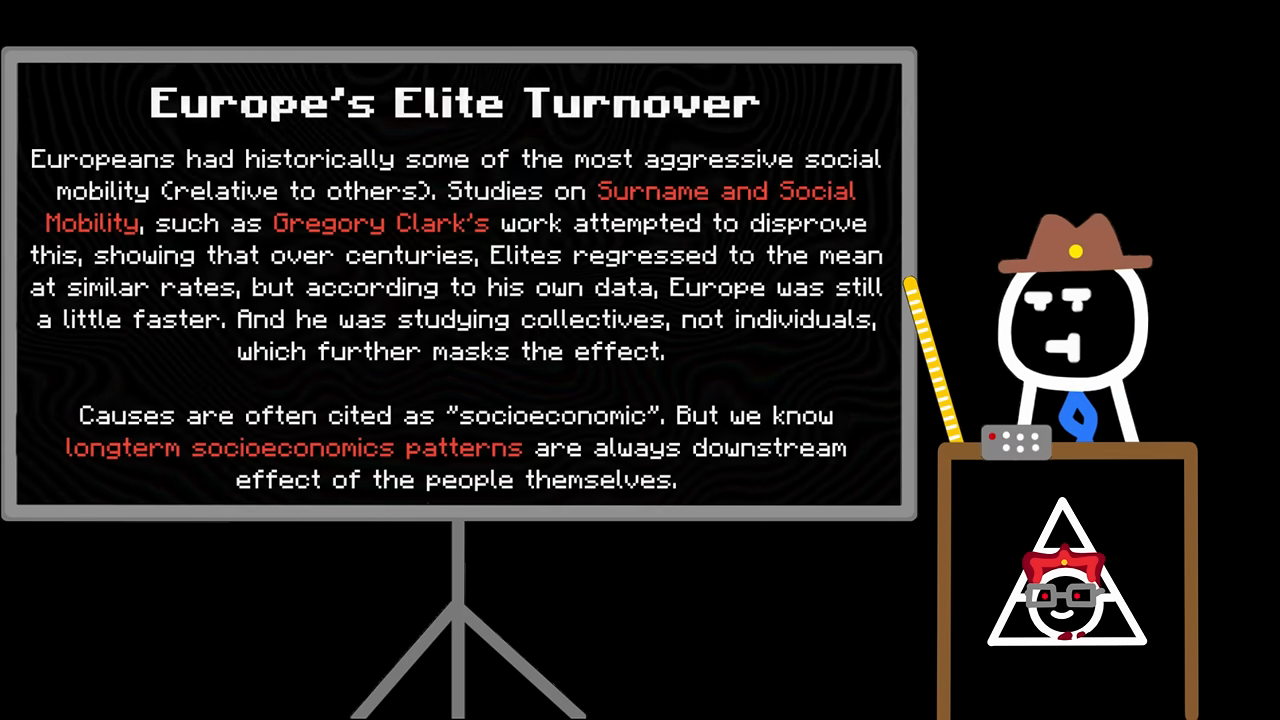
- Visible claim: Europe historically had unusually aggressive mobility; Clark tried to disprove this but allegedly still showed Europe “a little faster”; group-level surname methods allegedly mask individual turnover.
- Source status: Gregory Clark is named, but no title, table, country comparison, page, or estimate is given.
- Audit: Clark’s Sweden result emphasizes slow, persistent status and similarity to the UK/US. The slide’s continental conclusion and genetic interpretation do not follow.
Italian School revolution slide — approximately 3:02
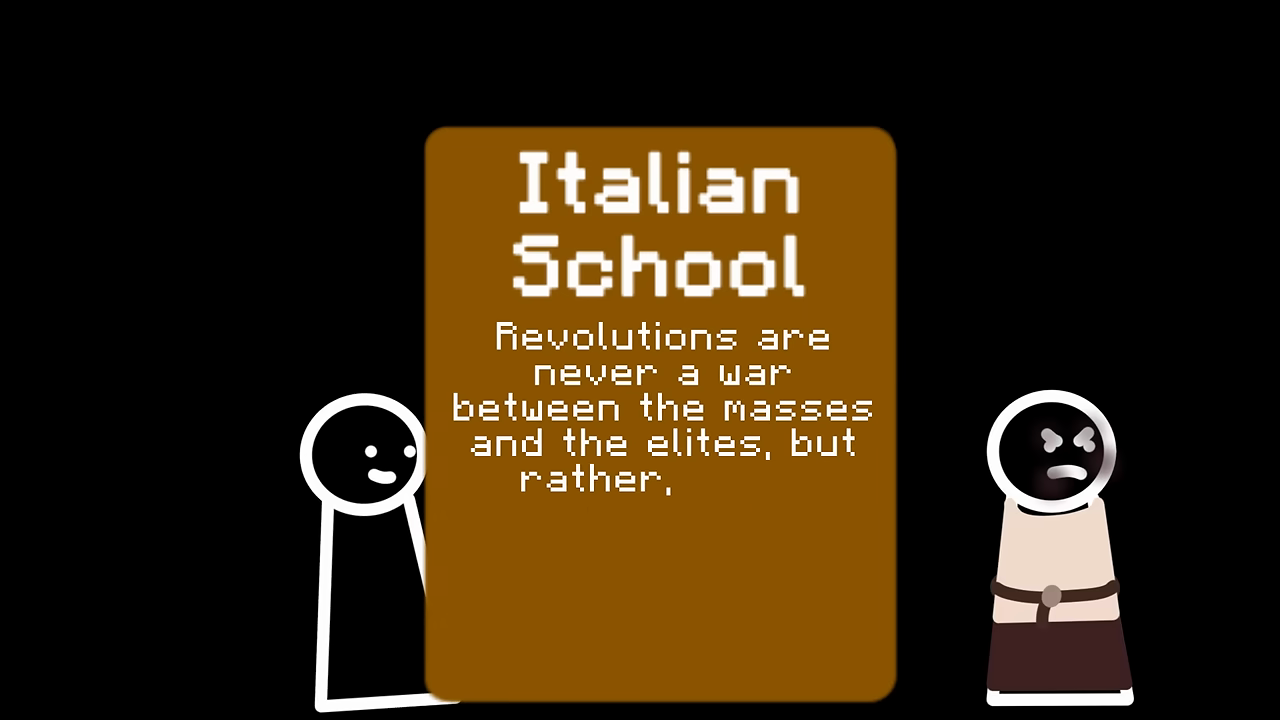
- Visible claim: revolutions are never masses against elites, but new disenfranchised elites using the masses against older elites.
- Source status: creator-made summary; no passage from Mosca, Pareto, or Michels is cited.
- Audit: recognizable as an elite-theory interpretation, but the absolute “never” and single-cause formulation exceed the identified theory.
Indian caste hierarchy — approximately 7:30
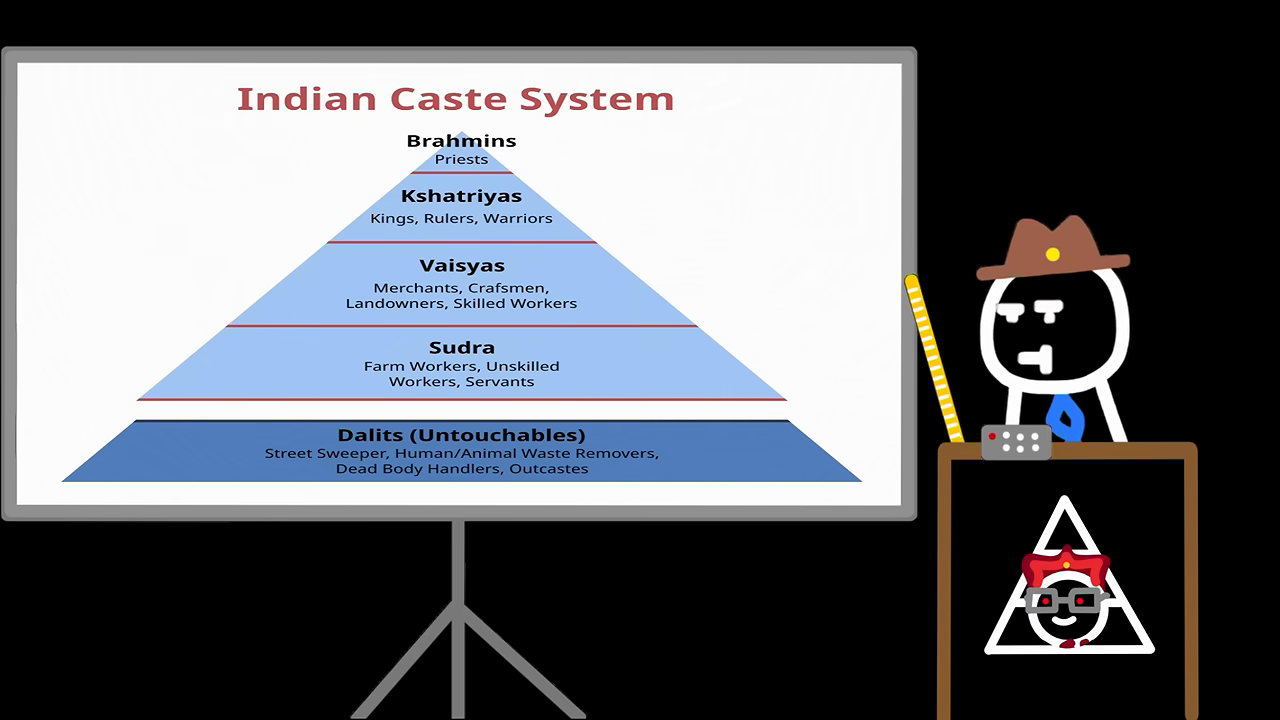
- Visible content: a generic five-level Brahmin/Kshatriya/Vaisya/Sudra/Dalit pyramid.
- Source status: no source or regional/historical qualification.
- Audit: visually compresses thousands of jatis, regional histories, legal categories, mobility, and political change into a single pan-Indian biological ladder. Genetic endogamy does not validate the ladder’s asserted aptitudes.
Aristotle quotation — approximately 8:08
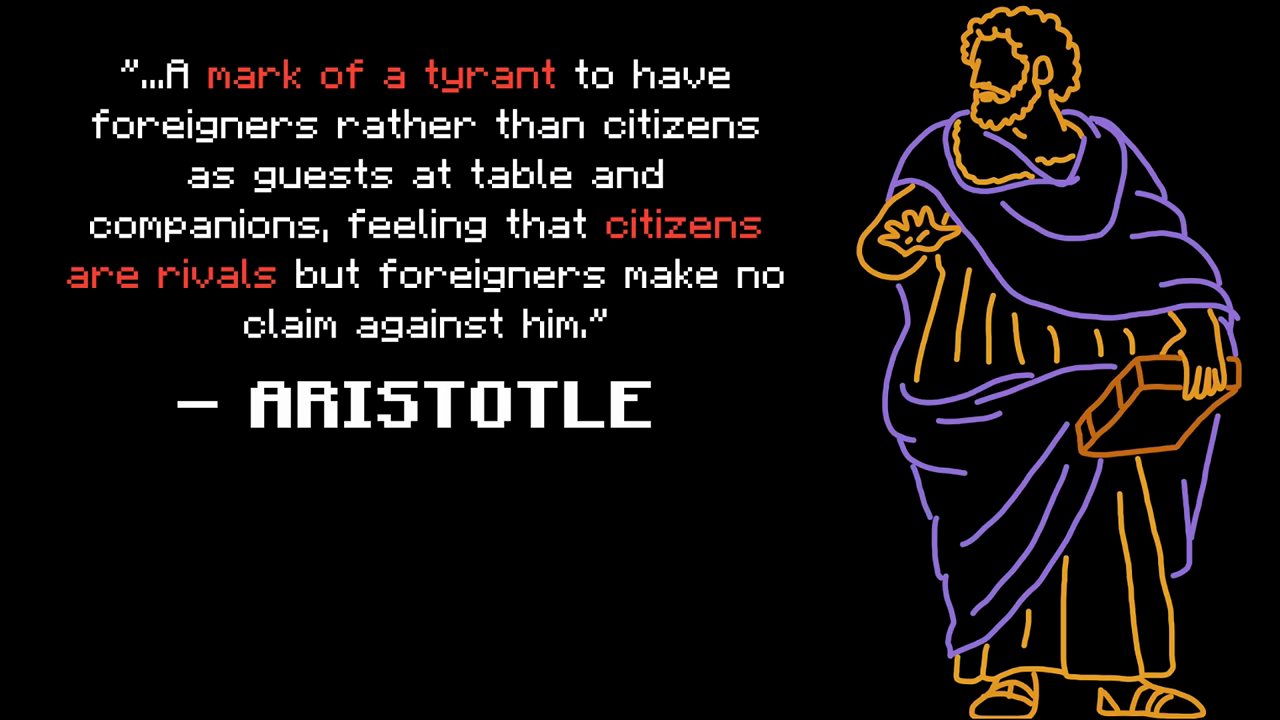
- Source status: author named; work and section omitted.
- Audit: substantially authentic to Politics 5.1314a, with “hostile” changed to “rivals.” It is contextual evidence about Aristotle’s theory of tyranny, not direct evidence of current elite intent.
Provenance findings
- Direct use verified: Aristotle’s Politics is directly quoted on screen, though without book/section and with one translated word altered.
- Probable intellectual lineage: the description’s Pareto/Mosca naming and the organized-minority/circulation framing clearly place the opening in the Italian elite-theory tradition.
- Direct mention, incomplete citation: Gregory Clark is named in a creator-written slide, but the exact work and comparison are omitted; the identified Sweden paper cuts against the slide’s main characterization.
- Verified cross-video recurrence: the video reuses the channel’s recurring moves from within-population heritability to group hierarchy, from aggregate IQ to individual worth, and from welfare association to a hereditarian causal conclusion.
- Open: no pre-video source containing the video’s complete elite bloodline → Industrial Revolution → welfare → immigration → caste chain was verified. The dossier therefore does not infer direct copying or creator identity.
Serious alternatives and disconfirming cases
The video would need to discriminate its account from ordinary, non-genetic explanations:
- elite continuity through property, law, schools, networks, marriage, inheritance, and institutional access;
- elite change through war, state breakdown, economic restructuring, democratization, education, professionalization, and organizational innovation;
- migration policy driven by employer demand, family rights, asylum obligations, colonial relationships, demographic aging, electoral incentives, or administrative drift;
- fertility shaped by partnership formation, delayed childbearing, housing, childcare, opportunity cost, gender norms, health, and work–family institutions;
- welfare programs that support child health and human capital or, depending on design, reduce or increase fertility at the margin;
- immigrants and descendants organizing politically, contesting governments, moving across classes, and exhibiting heterogeneous outcomes rather than permanent loyalty.
These are not automatically correct alternatives. They are competing explanations the video would have to measure before coordinated genetic caste-building becomes the best explanation.
What would change the verdict
The verdict would require revision if strong evidence showed:
- a preregistered or independently replicated comparison linking identified lineage genotypes—not titles or surnames—to governing performance across several societies;
- a valid historical dataset demonstrating exceptionally rapid European elite replacement and separating institutional mobility from genetic ancestry change;
- genomic evidence that industrial-era aristocratic intermarriage measurably dispersed a defined, validated governing-trait profile through European populations;
- credible quasi-experimental evidence that a specified welfare design changed fertility by measured cognitive genotype enough to alter population outcomes;
- representative migrant-level evidence connecting a specified selection route to the claimed ability distribution without national-mean imputation;
- direct documents, communications, consistent implementation, and discriminating predictions showing that identified Western decision-makers coordinated welfare and immigration to suppress rival European lineages and create a loyal caste.
Source register
Elite theory and circulation
- Treccani — Gaetano Mosca and the elitist paradigm — organized-minority thesis, historical method, and Mosca’s rejection of crude race/climate determinism.
- Gaetano Mosca, Elementi di scienza politica / English edition archive — primary-text anchor.
- “Rise and fall of elites: professionals as movers?” — scholarly discussion of Pareto and elite circulation.
Mobility and industrialization
- Gregory Clark, “What is the True Rate of Social Mobility in Sweden?” — slow elite-surname regression and similarity to UK/US mobility.
- Torche and Corvalan, “Estimating Intergenerational Mobility With Grouped Data” — critical assessment of surname-based mobility claims.
- Stone and Stone, An Open Elite? England 1540–1880 — historiography of English elite openness and mobility.
- Gulsunar, “To block or not: why the British ruling elite enabled the Industrial Revolution” — institutional and political motives of the British ruling elite.
- Brockliss and Smith, Male Professionals in Nineteenth-Century Britain — professional families, status change, and elite decline.
Genetics, mating, fertility, and caste
- Plomin and von Stumm, “The new genetics of intelligence” — intelligence heritability and polygenic architecture.
- Domingue et al., “Genetic and educational assortative mating among US adults” — documented but modest genetic similarity relative to educational similarity.
- Eilertsen et al., “Understanding indirect assortative mating” — distinctions among genetic homogamy, social homogamy, stratification, and indirect assortment.
- Greulich and Toulemon, educational fertility gradients in 28 European countries — cross-national and parity-specific variation.
- OECD, Fertility trends across the OECD: underlying drivers and the role for policy — context-dependent fertility drivers and policy effects.
- Kolk and Barclay, “Cognitive ability and fertility among Swedish men” — positive IQ–fertility relationship in the studied cohorts.
- Moorjani et al., “Genetic evidence for recent population mixture in India” — admixture followed by stronger endogamy; no occupational or loyalty hierarchy.
Immigration, national IQ, and quotation
- OECD, Skills on the Move — migrant skill distributions, language effects, and cross-country heterogeneity.
- Sear, national-IQ dataset critique — sample, imputation, and comparability problems.
- EHBEA statement and history concerning national-IQ datasets — methodological and ethical concerns.
- Aristotle, Politics 5.1314a — Perseus — primary passage and surrounding context.
Cross-video connections
- The Genetics Behind Unequal Societies — same heritability/population-structure → social hierarchy move.
- Racial Egalitarianism - All Arguments Ranked and Debunked — same within-group heritability → group-difference substitution.
- The IQ Debate We're Not Allowed To Have — national-IQ evidence and genetic-default framing.
- Why Is Black America Like That — welfare timing and association treated as proof of a hereditarian social mechanism.
- Why Is Africa Like That — national-IQ aggregation, biological-caste implications, and continent-level character inference.
- Why Did the Third World Learn to Cry Racism — next direct comparison for caste, immigration, homogeneity, elite coordination, and out-group loyalty.
- Elite/bloodline chain
Full transcript
Full transcript (YouTube automatic captions; lightly normalized)
Automatic captions can mishear names, numbers, and punctuation. The wording below is retained as evidence of what the video appears to say, not as authentication of every proper noun or statistic.
0:00 — Why are the masses, despite their vast numbers, so powerless against their ruling elite? The Italian school of elitism argues that in every complex society, an organized minority rules an unorganized majority. This is because of specialization. The act of ruling and administering a society is complex, necessary full-time work. As a result, the masses must delegate to a small minority who have the traits needed to fulfill this function. The issue is, this creates a natural monopoly. One the organized minority can leverage to guarantee their positions in power through their control of authority and resources. And in fact, they don’t have a choice. They have to leverage it because if they don’t, a rival organized minority will. But what I want to discuss in this video isn’t so much the school of elitism, but rather the biological consequences of these dynamics that are destabilizing the modern Western elite. Incentivizing them
1:01 — to turn against their own people and create a new caste system. And if you enjoyed the video, consider subscribing. It helps the channel. To be qualified to be an elite in a society, one must first have the traits that allow them to aid the organization and ruling of that society in the first place. Traits like greater intellect, charisma, cunning, martial prowess, among many more. And what’s interesting is many of these traits are heritable, meaning they can be passed down to offspring. And perhaps, just as important, these traits are desirable. What occurs naturally in society is that those with these great traits have more options for spouses and end up picking spouses that likewise have great traits. Their offspring, as a result, are likely to inherit them. These offspring then, with the advantages of their greater traits, will likely be more able to acquire resources, signal status, and themselves acquire similarly advantaged spouses. Whereas those of mediocre traits or are forced to settle for spouses of
2:01 — similarly lesser stock and produce unimpressive offspring. It’s this mechanism that creates noble lineages. If everything goes well over many generations, a distinct noble genetic line is created, producing individuals bred to rule. Of course, life happens and things don’t always go to plan. Sometimes dysgenic elements occur, promoting lesser traits. Sometimes the environment changes, making traits that used to be essential become obsolete. And sometimes simple mutation occurs, weakening or strengthening bloodlines randomly, allowing new bloodlines to arise to challenge the old. Europeans are particularly notorious for this, showing far higher elite turnover rate compared to other societies. As a result, noble bloodlines collapse more often and ordinary bloodlines elevate themselves more often. This forced Europe to have more mechanisms than most for social mobility, as Europeans had to cut off defective elites and elevate new elites faster to avoid revolutions.
3:02 — Because as the Italian school argues, revolutions are never a war between the masses and the elites, but rather a new disenfranchised elite that uses the masses as a tool to overthrow an older, weakened elite. Still, Europe was able to find an equilibrium, develop their noble bloodlines, and bring about stability. If anything, this actually helped Europeans advance as it forced them to tap into new talent and be less tolerant of decay. However, this balance was shattered with the Industrial Revolution. Remember what I said about environmental changes making traits that used to be essential obsolete? The reverse can also happen, turning traits that used to be okay-ish into essential ones. In the Industrial Revolution’s case, it turned business acumen, mathematical reasoning, and marketing into essential traits for ruling, whereas court politicking, social dynamics, and martial prowess became irrelevant. The Industrial Revolution was a period of time where the most number of noble bloodlines became
4:03 — disenfranchised in history. And as a result, the value they had in the spouse market declined sharply. It became common for impoverished aristocratic bloodlines to marry into upcoming business families, and that’s if they were lucky. Many ended up so disenfranchised they mixed with the common people. This caused an interesting result. Europe’s noble bloodlines, which had been a forged over millennia of aggressive competition, had now mixed into a substantial portion of the common populace. Europeans already had the pattern of new noble bloodlines arriving out of nowhere, but this magnified the issue many times over. Not only were more traits now capable of ascending someone aggressively into the elite, but now more noble traits were available to the general populace’s gene pool. While those traits alone were not enough to hold their predecessors in power, they were still great traits that could give a successor another shot at power. I’m oversimplifying a lot of history, but there’s a reason this
5:03 — became the age of revolutions and counterrevolutions. This leads us to today. Europeans have no real biological castes. Impressive individuals can emerge from almost anywhere and try to demand a higher lot in life. For the West, this is normal. But for the rest of the world, this is abnormal. Practically every Westerner you meet might be able to trace to some high-achieving lineage. While there is certainly no shortage of NPCs, the fact that our society treats being one as an insult, rather than just recognition of a lower strata, is telling. At the same time, our actual elites are very unimpressive. The gap between the ruler and the ruled is small. Being a financier, inflating money supplies, insider trading, bureaucracy. These are the skills of our elites that our society selects for. But none of these are actually hard to do. The average Joe can do them, provided he already has the established rare connections and the ability to scale. In other words, today’s elites don’t have to struggle, compete, or improve themselves. The
6:04 — perfect setup for dysgenics. History teaches us a simple lesson. When the gap between the ruled and rulers is small, the rulers are at risk of an overthrow. This makes Europeans as a people a threat to any would-be long-term elites. It’s why Western elites hide behind politicians and utilize power for anonymous means like finance, instead of simply declaring themselves kings. It’s effectively hiding, and it also explains the pattern of them promoting dysgenics in the general populace. The welfare system, for example, which aggressively punishes the middle-class savers and those who don’t want to be in debt or be a burden to society. The consequences of which are that high-performing individuals who are accustomed to a higher standard of living, usually those of higher IQs, talents, and work ethic, will refuse to have kids, saying they can’t afford them. Meanwhile, huge chunks of their paychecks are given as welfare to those living off the state, encouraging them to have kids at other people’s expense. Another example is
7:06 — mass immigration. Mass immigration, by its very nature, imports the masses. While we’re often told that such programs exist to poach the best of the best. In reality, the numbers speak for themselves. Average people from 70 IQ demographics rarely make a good doctors and engineers. While the West may have forgotten about the existence of biological castes, they remain a very real and important part of other societies. As such, the combination of the welfare state with mass immigration creates the fastest re-stratification of society possible. Regular European bloodlines pose a threat to the elite, but the average lower strata bloodline of a part of the world of biological castes, dependent on the government provided them by taking money from those Europeans, will never be a threat to them. The Western elite incentives point to the creation of a new caste system, one where foreigners will make up a perpetual loyal underclass. Europeans will be slowly squeezed out to accommodate them, and the elites
8:06 — themselves will remain in power without having to fear rival elites from their population for the first time in centuries.