Build out this research stub
The fuller writing-facing analysis is Gun Control - Position Card; Crime is a separate empirical lens. The image and “Fact check” reminder below are not yet a sourced argument for a specific gun policy.
Pinker’s Chapter 3 supplement — guns are part of the U.S. homicide gap, not the whole explanation
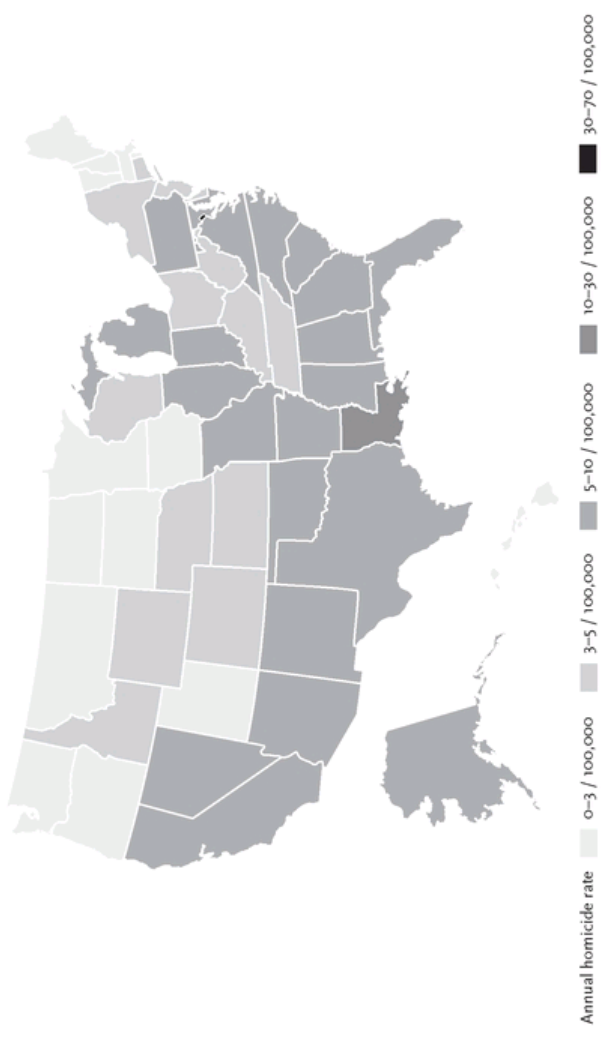
Pinker notes that the United States remained more homicidal than Western Europe even when he compared nonfirearm killings, which means the international gap cannot be reduced to weapon prevalence alone. He then disaggregates the country: the 2007 state map shows a low-homicide northern band and much higher rates across parts of the South and Southwest. He connects that geography to settlement history, uneven state reach, private enforcement, and regional honor cultures rather than to a single national “predisposition to violence.”
Figure 3-11 — state homicide rates in 2007. This is a historical snapshot, not a current policy scorecard. Subtracting firearm homicides does not estimate how gun availability changes lethality, substitution, suicide, defensive use, or the effect of any law; regional correlations also do not isolate culture from poverty, segregation, policing, demography, drug markets, or firearm access. The safe inference is limited: American lethal violence has multiple regional and institutional causes, so gun policy should not be asked to carry the entire causal explanation. Chapter 3 synthesis · The U.S.–England homicide gap and nonfirearm comparison, PDF pp. 144–145 (file not included in this release) · Regional framing and Figure 3-11, PDF pp. 145–147 (file not included in this release) · State reach and the southern honor-culture hypothesis, PDF pp. 152–157 (file not included in this release)

- Fact check