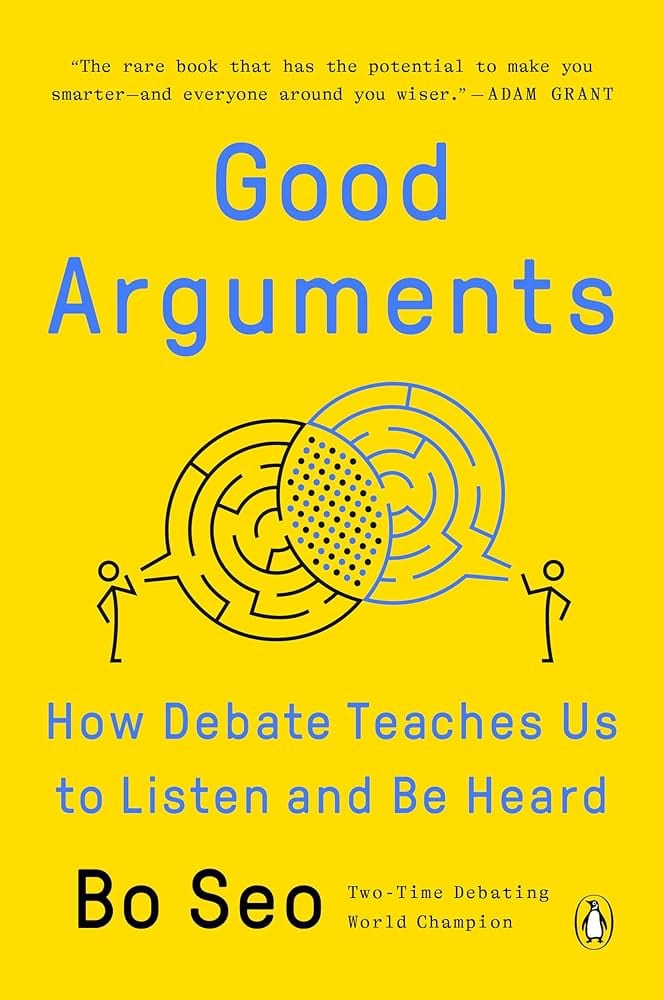

DESCRIPTION
At a time when every disagreement turns toxic, world champion debater Bo Seo reveals the timeless secrets of effective communication and persuasion. When Bo Seo was 8 years old, he and his family migrated from Korea to Australia. At the time, he did not speak English, and, unsurprisingly, struggled at school. But, then, in year five, something happened to change his life: he was introduced to debating. Immediately, he was hooked. It turned out, perhaps counterintuitively, that debating was the perfect activity for someone shy and unsure of himself. It became a way for Bo not only to find his voice, but to excel socially and academically. He went on to win world titles with the Australian schools and Harvard University teams. But debating isn”t just about winning or losing an argument: it”s about information gathering, truth finding, lucidity, organization, and persuasion. It”s about being able to engage with views you disagree with, without the argument turning toxic. Good Arguments shares insights from the strategy, structure and history of debating to teach readers how they might better communicate with friends, family and colleagues. Touching on everything from the radical politics of Malcom X to Artificial Intelligence, Seo proves beyond a shadow of a doubt that, far from being a source of conflict, good-faith debate can enrich our daily lives. Indeed, these good arguments are more important than ever at time when bad faith is all around, and our democracy seems so imperiled. ”From two-time world champion debater Bo Seo, a thoughtful, instructive and eloquent meditation on the art of debate and why its central pillars - fact-finding, reason, persuasion and listening to opponents - are so valuable in today”s alarming ecosystem of misinformation and extreme emotion. When Bo Seo”s family immigrated from South Korea to Australia, he was a shy, conflict-averse eight year old who worried about being an outsider, and in ''''''''Good Arguments,'''''''' he recounts how debate not only helped him to cross language lines, but also gave him confidence and a voice of his own” - Michiko Kakutani, former chief book critic for The New York Times. Review: ”From two-time world champion debater Bo Seo, a thoughtful, instructive and eloquent meditation on the art of debate and why its central pillars - fact-finding, reason, persuasion and listening to opponents - are so valuable in today”s alarming ecosystem of misinformation and extreme emotion. When Bo Seo”s family immigrated from South Korea to Australia, he was a shy, conflict-averse eight year old who worried about being an outsider, and in ''''''''Good Arguments,'''''''' he recounts how debate not only helped him to cross language lines, but also gave him confidence and a voice of his own” - Michiko Kakutani âe¢ former chief book critic for The New York Times âe¢ ”In a world increasingly rent by division within and between nations, Bo Seo”s lucid and humane search for ''''''''better ways to disagree'''''''' could not be more timely or valuable.” - Kevin Rudd, former Prime Minister of Australia and author of The Case for Courage ”This is not just the electrifying tale of how Bo Seo won two world debate championships. It”s also a user manual for our polarised world. I can”t think of a more vital resource for learning to sharpen your critical thinking, accelerate your rethinking, and hone your ability to open other people”s minds. Good Arguments is the rare book that has the potential to make you smarter-and everyone around you wiser.” - Adam Grant, #1 New York Times-bestselling author of Think Again and host of the podcast WorkLife ”Good Arguments is a book so timely and needed in this fraction-ing world we are living in. It assumes that a quarrel is something you first have with yourself, get it out of the way and start to respect and listen to the person across the room from you. Seo has written a book that forces us to think and then speak as the philosopher he knows is right on the tip of every tongue. This book is brilliant and a pleasure to read; in the end, he instructs us not to win but to convince and unexpectedly, it teaches how to persuade for words are deployed as weapons of love.” - Jamaica Kincaid, author of See Now Then, Mr. Potter, and The Autobiography of My Mother ”I adore this beautiful story of a young person”s journey from fear of conflict and altercation to embrace of wonderful disagreement and argument. In this touching memoir, debate is not a mere activity but a way of life that offers hope of a cure for a diseased society. Good Arguments is essential reading!” - Jeannie Suk Gersen, John H. Watson Jr. Professor of Law at Harvard Law School and author of A Light Inside ”I had lots of conversations about political and social issues with Bo Seo when he was a student at Harvard, and I never felt even, for a second, that he was being disputatious or even argumentative. On the contrary, they were delightfully agreeable. Now I understand why: it was because B
My Summary
Main Ideas, Takeaways & Similarities
Questions
I. What is the problem?
A. How is this problem formulated?
B. Why is this problem important?
C. What is the history of this problem?
D. Which prominent personalities have been interested in this problem?
II. What solutions to the problem are there?
A. What are the conclusions reached?
B. By what argument(s) is the conclusion reached?
C. What facts or assumptions serve as premises?
D. When a prominent personality offers a solution, does he also argue for or against other prominent personalities? Does he raise objections to alternative solutions? Does he consider objections to his own solutions?
III. Evaluation
A. What are the advantages and disadvantages of the alternative formulations to the problem?
B. Has the importance or history of the problem ever been misrepresented?
C. Are the solutions logically related to the premises?
D. Are the facts true? Are the assumptions acceptable? Are the objections answerable?
AI Summary
Highlights
My Summary
Main Ideas, Takeaways & Similarities
Questions
I. What is the problem?
A. How is this problem formulated?
B. Why is this problem important?
C. What is the 60 Knowledge/History/History of this problem?
D. Which prominent personalities have been interested in this problem?
II. What solutions to the problem are there?
A. What are the conclusions reached?
B. By what argument(s) is the conclusion reached?
C. What facts or assumptions serve as premises?
D. When a prominent personality offers a solution, does he also argue for or against Other prominent personalities? Does he raise objections to alternative solutions? Does he consider objections to his own solutions?
III. Evaluation
A. What are the advantages and disadvantages of the alternative formulations to the problem?
B. Has the importance or 60 Knowledge/History/History of the problem ever been misrepresented?
C. Are the solutions logically related to the premises?
D. Are the facts true? Are the assumptions acceptable? Are the objections answerable?
AI Summary
Chapter 1
Chapter 1 of Good Arguments by Bo Seo introduces the reader to the author’s personal journey into the world of debate and the foundational principles that underpin effective Argumentation. Here are the main points:
Personal Journey into Debate
- Transition to Middle School: Bo Seo describes his transition from elementary to middle School at Barker College in Sydney, Australia. He highlights the stark contrast between his previous School and Barker’s more structured environment.
- Joining the Debate Team: Despite initial challenges in adapting to the new School Culture, Seo was determined to join the debate team. He describes the audition process and his first experiences with competitive debate.
Key Concepts in Argumentation
- Importance of the Topic: The chapter emphasizes the significance of clearly defining the topic of a debate. The topic is the central point of disagreement and must be specific enough to allow for meaningful discussion.
- Types of Disagreements: Seo explains that disagreements can be categorized into three types:
- Factual Disagreements: These are about empirical claims regarding the way things are (e.g., “Lagos is a megacity”).
- Normative Disagreements: These involve subjective judgments about the world (e.g., “Lying is immoral”).
- Prescriptive Disagreements: These concern what actions should be taken (e.g., “The government should not impose limits on Freedom of speech”).
- Layered Nature of Arguments: Seo introduces the concept of topic analysis, which involves breaking down a topic to identify multiple layers of disagreement. This helps debaters understand the fundamental issues at stake and avoid talking past each Other.
Practical Application in Debates
- First Debate Experience: Seo recounts his first debate, where his team had to argue against prioritizing environmental sustainability over economic development in developing countries. Through topic analysis, they identified key areas of disagreement and formulated their Arguments.
- Handling Disagreements: The chapter discusses how effective debaters navigate disagreements by focusing on the core issues and seeking areas of compromise. This approach not only helps in winning debates but also in understanding and resolving real-life conflicts.
Broader Implications
- Debate as a Tool for Understanding: Seo reflects on how debate has helped him understand the world better by making disagreements clearer and more navigable. He draws parallels between debate and Other forms of discourse, such as political discussions and Media debates.
Overall, Chapter 1 of Good Arguments sets the stage for the book’s exploration of how debate techniques can improve our ability to listen, understand, and be heard in various aspects of life.
Chapter 2
Main Points
-
Introduction to Debating Context:
- The chapter begins with Bo Seo’s experience at the New South Wales state debating team trials. He describes the competitive atmosphere and the process of elimination that narrows down the participants to the FINAL team members.
-
Personal Background and Motivation:
- Seo shares his personal journey from Seoul to Sydney and how he developed a passion for debate as a tool for survival and self-expression. His ambition grew as he adapted to his new environment, striving for academic and extracurricular excellence.
-
Debate Preparation and Strategy:
-
Constructing a Good Argument:
- Seo explains the essential components of a good argument:
- Conclusion: The main point or claim.
- Main Claim: The Reason supporting the conclusion.
- Supporting Reasons and Evidence: Facts and information that bolster the main claim.
- Link: Connecting the main claim to the conclusion to show its importance.
- He emphasizes the need to meet two burdens of proof: truth (the claim must be factually correct) and importance (the claim must support the conclusion).
- Seo explains the essential components of a good argument:
-
60 Knowledge/60.12 Self-Improvement/Learning/Learning from Criticism:
-
Practical Application and Improvement:
- Seo describes his efforts to improve his debating skills by practicing the “four Ws” (What, Why, When, Who cares?) and writing numerous Arguments to refine his technique. This practice helped him perform better in debates and gain confidence.
-
Reflection on Argumentation and Persuasion:
- The chapter concludes with Seo reflecting on the broader implications of Argumentation. He realizes that effective Arguments not only require truth but also the ability to connect with and persuade the audience. He contrasts his approach with Debra’s, noting her skill in engaging the audience’s curiosity and making them co-authors of her ideas.
Conclusion
Chapter 2 of Good Arguments provides a detailed look at the mechanics of constructing a strong argument and the personal journey of developing debating skills. It underscores the importance of not just having the truth on one’s side but also the ability to communicate it effectively to persuade others.
Chapter 3
Main Points
-
Introduction to Rebuttal:
- The chapter begins with a vivid scene from a debate practice session in Istanbul, where Bruce, the coach, emphasizes the importance of rebuttal in debates. He stresses that the team is not contesting the Arguments effectively and introduces a method to challenge every point made by the opposition by thinking or saying “bullshit” and then finding reasons to refute it.
-
Personal Conflict Aversion:
- Bo Seo shares his personal 60 Knowledge/History/History of conflict aversion, stemming from childhood experiences in Seoul and his parents’ efforts to toughen him up through Tae Kwon Do. Despite excelling in competitive debate, he maintained a conflict-averse attitude in everyday life, valuing likability and avoiding altercations.
-
The Role of Rebuttal in Debate:
- Rebuttal is presented as essential not just for winning debates but for engaging with opponents’ Arguments genuinely. Bruce argues that direct rebuttal shows respect for the opponent and the audience, as it provides a chance for improvement and a fuller understanding of the issue at hand.
-
Techniques of Rebuttal:
- The chapter outlines the structure of a good rebuttal, which involves challenging the truth or importance of the opponent’s Arguments. Seo explains that an argument must prove both its main point and its relevance to the conclusion. Rebuttals can address factual inaccuracies, lack of evidence, or logical leaps.
-
The World Schools Debating Championships:
- The narrative shifts to the World Schools Debating Championships in Antalya, Turkey. Seo describes the intense preparation and the dynamics of the competition, highlighting the importance of rebuttal in their strategy. The Australian team, coached by Bruce, faces various international teams and learns to refine their rebuttal techniques.
-
The Power of Listening and Constructive Disagreement:
- Seo reflects on the value of listening and engaging with the strongest version of the opponent’s Arguments. This approach not only improves the quality of the debate but also fosters mutual respect and understanding. He contrasts this with the tendency to interrupt, which can undermine genuine persuasion and reinforce power dynamics.
-
The Grand FINAL and the Concept of Counterclaim:
- In the grand FINAL against the team from Eswatini, Seo emphasizes the importance of not just rebutting but also providing a positive counterclaim. This involves presenting an alternative vision or solution, which helps move the conversation forward constructively.
-
Broader Implications of Rebuttal and Opposition:
- The chapter concludes with reflections on the broader implications of rebuttal in both competitive debate and everyday life. Seo draws parallels between the concept of loyal opposition in Politics and the role of counterclaims in debates, suggesting that both aim to ground conflict in a desire for shared progress rather than destruction.
Key Takeaways
- Rebuttal as Respect: Effective rebuttal is not just about winning but about engaging with the opponent’s Arguments respectfully and thoroughly.
- Listening and Strengthening Opponent’s Arguments: Listening closely and addressing the strongest version of the opponent’s case leads to more meaningful and constructive debates.
- Counterclaims: Providing positive counterclaims in addition to rebuttals helps advance the discussion and offers a vision for improvement.
- Conflict Aversion vs. Engagement: Avoiding conflict can lead to superficial agreement and missed opportunities for genuine understanding and progress.
- Debate as a Microcosm: The principles of good debate, such as respectful rebuttal and constructive opposition, have broader applications in Politics and everyday interactions.
Chapter 4
Rhetoric: How to Move People
Chapter 4 of Good Arguments delves into the art of rhetoric, emphasizing its historical significance and practical application in persuasive communication. The chapter begins with a narrative about John Quincy Adams and his role in reviving rhetoric at Harvard University. Adams, despite his self-doubt about his speaking abilities, took on the mission to teach eloquence to future American leaders, believing that persuasive speaking was essential for a thriving republic.
Historical Context and Personal Reflections
The author recounts his personal journey with rhetoric, starting from his sixth-grade classroom where he first learned about the concept. This early exposure to rhetoric, combined with his experiences as an immigrant 60 Knowledge/60.12 Self-Improvement/Learning/Learning English, highlighted the importance of how one speaks in shaping perceptions and understanding.
Practical Exercises and Debate Training
The chapter describes various exercises used in debate training to eliminate distracting speech habits and improve clarity and effectiveness:
- Count: A speech exercise to count the number of times a speaker uses filler words.
- Restart: A technique where the speaker restarts their sentence every time they use a filler word.
- Penalty: An exercise where the speaker receives a penalty for each filler word used.
These exercises underscore the importance of clear and concise communication in debate.
College Debate and Rhetorical Techniques
At Harvard, the author joins the debate team and learns the importance of structured Argumentation and effective note-taking (flowing). The chapter highlights the difference between high School and college debate, emphasizing the increased pressure and the need for precise language.
Rules for Effective Communication
The author develops a set of rules to enhance rhetorical clarity:
- No abstract words: Use concrete terms instead of abstract ones.
- No confusing metaphors: Avoid mixing metaphors and use them sparingly.
- No excess qualification: Present the main point clearly before adding qualifications.
- No buried ledes: Start with the conclusion and provide supporting details.
- No thoughtless repetition: Avoid unnecessary repetition to maintain the audience’s attention.
Proportionality, Personality, and Panache
The chapter also discusses the importance of matching the tone of speech to the subject matter (proportionality), revealing personal journeys to build trust (personality), and crafting memorable lines that resonate with the audience (panache).
Modern Relevance of Rhetoric
Despite the decline of rhetoric in modern education and public discourse, the author argues for its continued relevance. Effective rhetoric can overcome apathy and cynicism by appealing to virtues like empathy and moral imagination.
Conclusion
Chapter 4 of Good Arguments illustrates the enduring power of rhetoric in shaping public discourse and personal communication. Through historical examples, personal anecdotes, and practical advice, the chapter provides a comprehensive guide to mastering the art of persuasive speaking.
Chapter 5
Overview
Chapter 5, titled “QUIET,” explores the dynamics of debate, focusing on when to engage in disagreements and the nature of competitive debate formats. The author, Bo Seo, reflects on his experiences in high School and university debate tournaments, particularly the practice known as “spreading” in policy debates and the contrasting styles of parliamentary debate.
Key Points
American High School Debate and “Spreading”
- Scale and Intensity: American high School debate tournaments are large-scale events involving thousands of competitors.
- Spreading: A technique in policy debate where speakers deliver Arguments at extremely high speeds (350-500 words per minute) to maximize the number of points made. This method is controversial due to its physical strain and potential to overwhelm rather than persuade.
- Historical Context: Spreading has been a dominant feature of policy debate for decades, with origins traced back to the University of Houston in the late 1960s. Efforts to counteract spreading include the creation of Lincoln-Douglas (L-D) and Public Forum debates, which emphasize persuasion to a lay audience.
Parliamentary Debate
- Format and Style: Parliamentary debate, or “parli,” values plain speaking and spontaneity. It draws inspiration from the English Parliament and emphasizes short, closed-book preparation.
- Cultural Roots: The format has historical roots in informal public gatherings and formal debate societies in Britain and the 60 Knowledge/60.14 Colonialism/60.6.1.3 Geographic Locations/United States.
World Universities Debating Championship (WUDC)
- Global Reach: WUDC attracts teams from around the world and sets trends in debate styles.
- Personal Experience: Seo describes his preparation and participation in the WUDC, emphasizing the intense focus and camaraderie among debaters.
Deciding When to Disagree
- RISA Framework: Seo develops a mental checklist to decide whether to engage in an argument, based on four conditions:
- Real: There is an actual difference of opinion.
- Important: The disagreement is significant enough to justify debate.
- Specific: The subject is specific enough to allow progress.
- Aligned: The goals of both sides are aligned.
Challenges in Debate
- Emotional and Physical Strain: Seo recounts the physical and emotional toll of intense debate preparation and competition.
- Handling Controversial Topics: The chapter discusses the importance of choosing debate topics carefully, ensuring they do not question the equal moral standing of persons or confer undue legitimacy on harmful ideas.
Reflection on Debate and Life
- Balancing Debate and Personal Life: Seo reflects on the need to balance debate with Other aspects of life, including friendships and personal well-being.
- 60 Knowledge/60.12 Self-Improvement/Learning/Learning from Debate: Despite its challenges, debate teaches valuable skills in preparation, listening, and sticking to the subject at hand.
Conclusion
Chapter 5 of Good Arguments provides a detailed look at the world of competitive debate, the techniques used, and the personal and ethical considerations involved in deciding when and how to engage in disagreements. It highlights the importance of thoughtful and respectful Argumentation, both in formal debate settings and everyday life.
Chapter 6
Self-Defense: How to Defeat a Bully
Chapter 6 of Good Arguments by Bo Seo delves into the nuances of dealing with bullies in debates, using historical anecdotes and philosophical 60 Knowledge/60.12 Self-Improvement/Insights to illustrate effective strategies. The chapter is divided into several sections, each focusing on different aspects of bad debating tactics and how to counter them.
Introduction: The Myth of Eris
The chapter opens with the myth of Eris, the goddess of strife, whose actions led to the Trojan War. This myth serves as a metaphor for how discord and bad Arguments can escalate conflicts.
Eristic Dialectic
The concept of eristic debate, which aims to win Arguments by any means rather than seeking the truth, is introduced. The chapter contrasts this with dialectic debate, which is truth-oriented. Socrates’ views on eristic debates are discussed, emphasizing that anyone can fall into bad debating practices.
Personal Experience with Debate
Bo Seo reflects on his own experiences with debate, particularly the 2016 U.S. presidential debates between Hillary Clinton and Donald Trump. He describes how Trump‘s bullying tactics disrupted the debate format and created a hostile atmosphere.
Schopenhauer’s Influence
Arthur Schopenhauer’s The Art of Always Being Right is discussed, highlighting his cynical view of Human Nature and debate. Schopenhauer’s work outlines various unscrupulous tactics used in debates, and Seo uses this to frame the discussion on how to counter such tactics.
Types of Bullies in Debate
The chapter categorizes bullies into four main types:
- The Dodger: Evades direct responses by pivoting to related but different topics.
- The Twister: Misrepresents the opponent’s arguments to create a straw man.
- The Wrangler: Focuses solely on rebuttals without presenting their own arguments.
- The Liar: Deliberately spreads falsehoods to mislead.
For each type, Seo provides strategies to counter their tactics, such as staying on course, correcting the record, pinning them to a position, and using the “plug and replace” method to refute lies.
Historical Example: The Kitchen Debate
The chapter recounts the famous “Kitchen Debate” between Richard Nixon and Nikita Khrushchev. Nixon’s strategies to handle Khrushchev’s bullying tactics—pretending it’s a debate, stopping and naming disruptive behavior, and deferring the round—are highlighted as effective methods to maintain the integrity of the debate.
Reflection on Debate and Democracy
Seo reflects on the role of debate in democracy, especially in the context of the 2016 U.S. presidential election. He expresses concern that the degradation of debate formats might lead People of IP to give up on the potential of good Arguments.
Philosophical Insights
The chapter concludes with philosophical 60 Knowledge/60.12 Self-Improvement/Insights, referencing Hesiod’s idea of two types of Eris: one that brings harmful strife and another that fosters healthy competition. This serves as a reminder that the goal is not to eliminate disagreement but to cultivate good disagreement.
Conclusion
Chapter 6 of Good Arguments provides a detailed examination of how to defend against bullies in debates. By understanding and countering various bad debating tactics, one can uphold the principles of good Argumentation and contribute to more constructive and truth-seeking discussions.
Chapter 7
Education and Malcolm Little’s Early Life
- Malcolm Little’s Transformation: The chapter begins by detailing Malcolm Little’s troubled early life, including the loss of his father, his mother’s nervous breakdown, and his involvement in minor crimes. Despite these challenges, Malcolm excelled academically and was elected class president at Mason Junior High School.
- Racism and Disillusionment: Malcolm’s aspirations to become a lawyer were crushed by his English teacher, Mr. Ostrowski, who advised him to pursue carpentry instead, citing racial prejudices. This incident led Malcolm to withdraw from School and eventually get involved in criminal activities, resulting in a ten-year Prison sentence.
Prison and the Influence of Debate
- Influence of Bimbi: In Prison, Malcolm met John Elton Bembry (“Bimbi”), whose eloquence and Knowledge inspired Malcolm to educate himself. Malcolm immersed himself in Reading and self-education at the Norfolk Prison Colony.
- Debate Society: Malcolm joined the Prison‘s debate society, which competed against local universities. This experience was transformative, providing him with an outlet for his views and honing his skills in public speaking and Argumentation.
Malcolm X and His Legacy
- Post-Prison Life: After his release, Malcolm adopted the name Malcolm X and became a prominent minister and activist. His debating skills were crucial in his advocacy for racial separatism and his critiques of nonviolence.
- Legacy of Debate: Malcolm credited his debating skills to his Prison days and the influence of Bimbi. The Norfolk debate society continued to thrive, achieving a remarkable record against college teams before going dormant in 1966 and being revived in 2016.
Debate as a Tool for Education
- Personal Experience: The author reflects on his own experiences with debate, emphasizing its role in teaching critical skills such as research, teamwork, logical reasoning, and public speaking. Debate also instills motivation and a desire to learn.
- Empirical Evidence: 60 Knowledge/60.3 Politics/60.3.9 - Social Issues/Trans/Studies, such as those on the Chicago Urban Debate League, show that debate can significantly improve educational outcomes for at-risk students. Efforts to expand access to debate have been successful in various regions, including Broward County, Florida.
Broader Implications of Debate
- Debate and Society: The author ponders whether debate serves merely as a personal advantage or if it has broader societal benefits. He concludes that debate teaches valuable lessons in humility, the possibility of being wrong, and the importance of continuous 60 Knowledge/60.12 Self-Improvement/Learning/Learning.
- Historical Context: The chapter also highlights the historical significance of debate in African American education, mentioning figures like James Farmer and Melvin Tolson, who used debate as a means of empowerment and resistance against racial oppression.
Final Reflections
- Coaching and Competitions: The author shares his experiences coaching debate teams, including the challenges and Rewards of preparing students for competitions. He emphasizes the importance of resilience and 60 Knowledge/60.12 Self-Improvement/Learning/Learning from losses.
- Future of Debate: The chapter concludes with reflections on the future of debate, particularly in the context of global education and the potential for debate to foster understanding and cooperation across cultural and ideological divides.
Chapter 8
Main Themes:
-
Personal Disagreements and Relationships:
- The chapter explores how personal relationships are often fraught with persistent and trivial disagreements, which can be more challenging to resolve than significant disputes.
- Seo describes his own experience moving back in with his parents and the ensuing conflicts over minor issues, highlighting how intimacy and low stakes can make disputes harder to manage.
-
The Nature of Arguments in Close Relationships:
- Seo introduces the concept of the “Dirty Dish Dispute,” where trivial matters escalate into significant Arguments due to the closeness of the relationship.
- He outlines the RISA checklist to explain why personal disagreements are particularly difficult:
- Unreal: Misunderstandings are common.
- Unimportant: Minor issues take on exaggerated importance.
- Unspecific: Disputes lack clear boundaries and can expand.
- Unaligned: Motivations for arguing can be complex and unrelated to the issue at hand.
-
The Role of Debate Techniques in Personal Disputes:
- Seo discusses how debate skills can sometimes be counterproductive in personal Arguments, as they may lead to accusations of insincerity or manipulation.
- He introduces the “Side Switch” technique from competitive debate, which involves considering the opponent’s perspective to improve understanding and empathy.
-
Empathy Through Structured Argument:
- The chapter emphasizes that empathy can be cultivated through structured actions like Side Switch, rather than relying solely on spontaneous emotional connections.
- This approach can help in seeing the world through another’s eyes and understanding the reasonableness of opposing views.
-
Debate and Personal Conviction:
- Seo reflects on the criticisms of competitive debate, particularly the idea that it undermines genuine conviction by training individuals to argue any side of an issue.
- He argues that debate can still foster strong, well-considered convictions by exposing individuals to diverse perspectives and rigorous Argumentation.
-
Application in Community and Personal Life:
- Seo recounts a contentious debate within his church community over same-sex marriage, illustrating how structured debate can help navigate complex and emotionally charged issues.
- He concludes that while debate is valuable, it must be balanced with Other forms of interaction, such as negotiation and reconciliation, to maintain healthy relationships.
Key Takeaways:
- Debate Techniques in Personal Relationships: While debate skills can enhance understanding, they must be used judiciously in personal relationships to avoid appearing insincere or confrontational.
- Empathy and Perspective-Taking: Structured techniques like Side Switch can help cultivate empathy and improve the quality of disagreements.
- Balancing Debate and Reconciliation: Effective disagreement involves not just winning Arguments but also maintaining relationships through empathy, negotiation, and compromise.
- Conviction Through Debate: Exposure to multiple viewpoints through debate can lead to more mature and well-considered convictions.
Overall, Chapter 8 of Good Arguments provides 60 Knowledge/60.12 Self-Improvement/Insights into managing personal disagreements by blending debate techniques with empathy and reconciliation, emphasizing the importance of maintaining relationships while engaging in constructive conflict.
The Side Switch Technique
The Side Switch technique is a method used in competitive debate to foster empathy and improve the quality of Arguments by requiring debaters to adopt and argue from the opposing viewpoint. Here are the main aspects and benefits of the Side Switch technique:
How It Works:
-
Preparation:
- Debaters take out a fresh sheet of paper and brainstorm the four best Arguments for the opposing side of the motion they are debating.
- They review their own Arguments from the perspective of an opponent, identifying the strongest possible objections to each claim.
- They imagine having won the debate from the opposing side and write out the reasons for their victory, including the mistakes made by their own side.
-
Implementation:
- This exercise is typically done in the last moments of preparation before a debate round.
- The goal is to set aside the certainty of one’s convictions and see things from another point of view to improve one’s chances of winning the debate.
Benefits:
-
Empathy and Understanding:
- By arguing from the opposing perspective, debaters experience what it is like to believe ideas that contradict their own. This helps them understand the subjective reasonableness of Other beliefs.
- This approach to empathy is achieved through structured actions rather than relying solely on spontaneous emotional connections[1][2].
-
Critical Thinking:
- The Side Switch technique helps debaters identify and address potential weaknesses in their Arguments, making them more robust.
- It encourages a deeper understanding of the issue at hand by considering multiple viewpoints.
-
Conflict Resolution:
- In personal relationships, this technique can help break negative patterns in disputes by fostering a more empathetic and open-minded approach to disagreements.
- It can be particularly useful in high-conflict situations where understanding the Other person’s perspective can lead to more constructive and less adversarial interactions[1][2].
Applications Beyond Debate:
- Negotiation and Mediation:
- The principles of the Side Switch technique can be applied in negotiation and mediation to understand the Other party’s position better and find common ground.
- Personal Disputes:
- In personal disagreements, such as those with family or friends, using the Side Switch technique can help individuals see the issue from the Other person’s perspective, leading to more empathetic and effective communication[1].
Challenges:
- Maintaining Empathy:
- While the technique can foster empathy, maintaining this perspective during prolonged disagreements can be challenging.
- The technique is most effective as a reset mechanism to disrupt negative patterns and encourage a more open-minded approach to conflict resolution[1].
In summary, the Side Switch technique is a valuable tool in both competitive debate and personal disputes, promoting empathy, critical thinking, and more constructive conflict resolution. It requires debaters to argue from the opposing viewpoint, helping them understand and address the other side’s arguments more effectively.
Chapter 9
Chapter Title: Technology
Main Points
1. The Evolution of Technology in Journalism:
- The chapter begins with the author’s experience as a journalist in Sydney, highlighting the challenges faced by the industry due to technological advancements. The decline of print advertising and the rise of online platforms have significantly impacted revenue streams for traditional media.
2. The Rise of AI in Debating:
- The author discusses IBM’s Project Debater, an AI system designed to engage in live debates with humans. The system’s debut in 2018 and subsequent performances are described, emphasizing its ability to process and present vast amounts of data quickly.
3. The 2019 Debate Event:
- The chapter details a debate held in February 2019 between Project Debater and Harish Natarajan, a skilled human debater. The motion was “That we should subsidize preschool.” Project Debater showcased its strength in marshalling evidence and presenting data, while Harish focused on practical realities and budgetary constraints.
4. The Outcome and Analysis:
- Harish Natarajan won the debate based on audience stance change, though Project Debater was recognized for enriching the audience’s knowledge. The author reflects on the different approaches taken by the debaters, noting that Harish’s ability to connect with the audience and address practical concerns was crucial.
5. The Broader Implications of AI in Debate:
- The chapter explores the potential and limitations of AI in debating. While Project Debater excelled in providing factual information, it struggled with the softer skills of persuasion, empathy, and connecting with the audience on a human level.
6. Online Platforms and Civil Discourse:
- The author examines the role of online platforms like Reddit’s Change My View (CMV) in fostering civil discourse. CMV’s rules and community guidelines are highlighted as effective in promoting constructive debates and changing views.
7. Audrey Tang’s Approach in Taiwan:
- The chapter introduces Audrey Tang, Taiwan’s digital minister, and her efforts to enhance government transparency and public participation through technology. Tang’s initiatives, such as the Join platform, aim to outcompete misinformation by fostering direct citizen engagement.
8. Reflections on the Future of AI and Debate:
- The author concludes by considering the future of AI in debating and its potential to embody human qualities. The chapter underscores the importance of maintaining human elements in debates, such as empathy and judgment, even as technology advances.
Key Themes
- Technological Impact: The transformative effect of technology on journalism and public discourse.
- AI Capabilities and Limitations: The strengths and weaknesses of AI in replicating human debate skills.
- Human Connection: The irreplaceable value of human empathy and connection in effective argumentation.
- Civil Discourse Online: The potential for online platforms to foster meaningful and respectful debates.
- Government Transparency: Innovative approaches to enhancing public participation and combating misinformation.
This chapter provides a comprehensive look at how technology, particularly AI, is shaping the future of debate and public discourse, while also emphasizing the enduring importance of human qualities in effective communication.