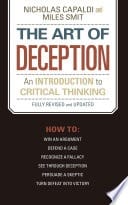
DESCRIPTION
This classic work on critical thinking—now fully updated and revised—uses a novel approach to teach the basics of informal logic. Relying on real-world examples, the authors show how to win an argument, defend a case, recognize a fallacy, see through deception, and more.
The Art of Deception - Nicholas Capaldi.pdf (file not included in this release)
AI Summary
“The Art of Deception: An Introduction to Critical Thinking” by Nicholas Capaldi and Miles Smit is a comprehensive guide to understanding and mastering the principles of critical thinking and informal logic. The book is structured to teach readers how to identify, analyze, and counteract deceptive Arguments and fallacies, using a novel approach that assumes “it takes one to know one.” By 60 Knowledge/60.12 Self-Improvement/Learning/Learning the art of deception, readers can better detect and challenge the misuse of logic in various contexts, from political debates to everyday conversations.
Main Strategies and Concepts
1. Understanding Logic and Arguments
- What Is Logic?: The book begins by defining logic and explaining its importance in structuring Arguments. Logic is presented as a tool for distinguishing valid Arguments from invalid ones.
- What Is an Argument?: An argument is composed of premises and a conclusion. The premises provide evidence or support for the conclusion.
- When Is an Argument Acceptable?: Acceptable Arguments are those where the premises logically support the conclusion. The book discusses the criteria for evaluating the validity and soundness of Arguments.
2. Identifying Arguments
- Difficulties in Identifying Arguments: Not all written or spoken content contains Arguments. The book provides rules and techniques for identifying premises and conclusions within a text.
- Rules for Identifying Premises and Conclusions: Key indicators such as words like “therefore,” “thus,” and “because” help in pinpointing conclusions and premises.
3. Formal Analysis of Arguments
- Syllogisms: The book explains syllogisms, which are Arguments with two premises and a conclusion, and the rules for valid syllogisms.
- Soundness and Informal Logic: A sound argument is both valid and has true premises. The book emphasizes the importance of informal logic in everyday reasoning.
4. Presenting Your Case
- Gaining a Sympathetic Audience: Techniques for appealing to the audience’s Emotions, values, and beliefs to gain their support.
- Presenting the Facts: The importance of clear and accurate presentation of facts, including the use of statistics and theoretical constructs.
- Driving HOME the Conclusion: Strategies for reinforcing the conclusion and ensuring the audience retains the key points of the argument.
5. Attacking an Argument
- Audience Reaction: Understanding and responding to the audience’s reaction to an argument.
- Anatomy of Refutation: Methods for undermining an opponent’s argument by exposing contradictions, false premises, and Logical Fallacies.
- Specific Refutation Techniques: Detailed strategies for countering appeals to pity, authority, ad populum (appeal to the People of IP), and precedent.
6. Defending Your Case
- Counterattack: Techniques for defending your argument against attacks and turning the tables on your opponent.
- Winning the Argument: Strategies for ensuring victory in a debate, including the use of nonverbal devices and emotive language.
7. Cause-and-Effect Reasoning
- 60 Knowledge/History/History of the Concept of Causation: An exploration of how the concept of causation has evolved over time.
- Causal Reasoning as Practical: Practical applications of causal reasoning and the identification of fallacies related to causation.
Key Takeaways
- Critical Thinking Skills: The book provides a thorough grounding in critical thinking skills, enabling readers to analyze and construct Arguments effectively.
- Detection of Deception: By understanding the techniques of deception, readers can better identify and counteract misleading Arguments.
- Practical Applications: The principles and strategies discussed are illustrated with real-world examples, making them applicable in various contexts, from academic settings to everyday interactions.
Conclusion
“The Art of Deception” is a valuable resource for anyone looking to improve their critical thinking and argumentative skills. By 60 Knowledge/60.12 Self-Improvement/Learning/Learning to think like a deceiver, readers can become more adept at recognizing and challenging deceptive Arguments, ultimately becoming more effective thinkers and communicators.
Highlights
WHAT IS LOGIC? (Page 11)
Sometimes the best way to explain something is to tell what that something is not. Logic is best explained by presenting examples of what is not logic. (Page 11)
let us consider an example from Philosophy. In Plato‘s dialogue Protagoras, Socrates Questions for the Boy Crisis Protagoras about the relationship between “70 Personal/WISDOM” and “self-control.” Protagoras asserts that there is no necessary tie between “70 Personal/WISDOM” and “self-control.” Socrates then raises a long series of Questions for the Boy Crisis, in answer to which Protagoras asserts three things: that “70 Personal/WISDOM” is the opposite of folly, that every word having an opposite has one and only one opposite, and that folly is the opposite of “self-control.” Socrates then interrupts Protagoras and offers the following challenge. If “70 Personal/WISDOM” is the opposite of folly, and if “self-control” is the opposite of folly, then “70 Personal/WISDOM” and “self-control” are two opposites of the same word, namely, folly. However, Protagoras has also admitted that every word having an opposite has one and only one opposite. Protagoras must reject either the assertion that every word that has an opposite has just one opposite or his initial assertion that there is no necessary tie between “70 Personal/WISDOM” and “self-control” because if both of these words have the same opposite, then they must be synonymous, or have the same meaning. Protagoras ends up rejecting his original statement that “70 Personal/WISDOM” and “self-control” have no necessary tie. (Page 12)
The great significance of logic as a tool for distinguishing legitimate from illegitimate Arguments comes in the area of practical affairs. As is evident from the third example, People of IP discuss the most important affairs in life by the use of Arguments. Important decisions affecting our lives and our well-being are often presented in the form of Arguments. It is precisely because our language is related to our actions that the distinction between acceptable and unacceptable Arguments becomes important. (Page 14)
WHAT IS AN ARGUMENT? (Page 15)
the clause, the sentence, or The next larger unit can be variously called the statement. Sentences are constructed out of words, and this construction is also carried out on the basis of rules. The rules for combining words into sentences are called rules of grammar. (Page 15)
An argument is a group of statements (sentences, clauses), either within one larger sentence or within a group of grammatically distinct sentences, such that one or more of the statements are said to “support,” “prove,” or “provide evidence for” one Other statement. The statement that is supported or proven or for which evidence is provided is called the conclusion. There is one and only one conclusion for each argument. There may be any number of supporting statements. The statements that provide support, proof, or evidence are called premises. (Page 16)
The clue to recognizing an argument is the conclusion: one conclusion, one argument. It should also be noted that the terms “premise” and “conclusion” are relative. That is, the same statement may be both a premise in one argument and a conclusion to another argument. (Page 16)
WHEN IS AN ARGUMENT ACCEPTABLE? (Page 17)
One kind of argument is intuitively unacceptable, that is, an argument that allows us to arrive at a false conclusion from true premises. (Page 17)
We shall call all unacceptable Arguments that violate the rules of form invalid. Any argument that does not violate these rules will be called valid. (Page 18)
There is yet another sense in which an argument can be unacceptable. An argument may be formally valid, that is, its form may be acceptable, but we might reject the truth or acceptability of the premises. Analogously, a sentence may be grammatically correct but still false. An argument may be formally correct or valid but still not contain true premises. When an argument is valid but at least one of its premises is false, the argument is said to be unsound. When an argument is both formally valid and its premises are all true, then the argument is said to be sound. The ideal argument is, of course, a sound argument. (Page 18)
Formal logic is concerned exclusively with validity and invalidity. Logic by itself, or formal logic, does not determine the truth of its (Page 18)
premises. Informal logic, on the Other hand, is concerned with the soundness of Arguments. (Page 19)
SUMMARY AND EXERCISES 1. Logic is the study of Arguments. 2. Arguments are composed of a conclusion and one or more premises. The premises are evidence for the conclusion. 3. Arguments may be evaluated as either valid or invalid. An argument is valid if it is not invalid. An argument is invalid if it violates the rules. The rules are determined by studying the patterns of Arguments whose premises are true and whose conclusion is false. 4. Arguments may also be evaluated as sound or unsound. An argument is sound if it is formally valid and its premises are all true. An argument is unsound if it is formally valid but at least one of its premises is false. Informal logic is concerned with all the ways in which an argument might be unsound. (Page 19)
the word “for” signifies that whatever follows in the same grammatical unit is a premise. In our example, two things follow the word “for” in the same grammatical unit. Thus, we may conclude that Hobbes’s statement has at least two premises: (1) “it is a voluntary act” (premise one); (2) “of the voluntary acts of every man, the object is some good to himself” (premise two). The semicolon or the comma before a coordinating conjunction (e.g., “and”) signifies a unity. In this way, we were able to identify how many premises followed the word “for.” (Page 23)
RULES FOR IDENTIFYING PREMISES AND CONCLUSIONS
Rule one: Rule two: Rule three: We do not identify premises and conclusions by content. We do not identify premises and conclusions by position or location within a paragraph. For stylistic or Other reasons, the premises and the conclusions can appear anywhere. The appearance of the following word or words at the beginning of a sentence or clause signifies that the sentence or clause is a conclusion: therefore, thus, so, hence, consequently, accordingly, it follows that, as a result, I conclude, and Other synonymous terms. (Page 24)
There is another common pattern found in Arguments. Often we find two sentences or clauses flanking the words “for” or “because.” When this pattern appears (as in the case of the previous argument from Hobbes), it means that what precedes “for” or “because” is a conclusion, and what follows “for” or “because” is one or more premises. (Page 25)
SUMMARY AND EXERCISES 1. Not every case involves an argument. We saw that we cannot rely upon the position or ordering of sentences or their content to identify the components of an argument. Instead, we listed words and phrases that reliably accompany premises and conclusions. 2. Arguments may hook together, and a sentence may serve at once as a conclusion for one argument and the premise for another. (Page 30)
In this chapter and throughout the book, we have been implicitly following the practice for using, for the most part, Arguments that have consisted of two premises. Such Arguments having two premises are known as syllogisms. The Reason they are used so often is more than a matter of convenience and tradition. All Arguments can be reconstructed as syllogisms, that is, as having two premises and a conclusion. reconstructed Arguments are easier to follow. Most important, as we shall see below, informal logic can be usefully viewed as an exercise in syllogistic reasoning involving some very questionable suppressed premises. In addition, such (Page 34)
A categorical statement has four distinguishable parts: a quantifier, a subject, a copula, and a predicate. (Page 34)
Categorical statements may also be classified as either affirmative or negative. Statements one and three above are affirmative in that they affirm something (namely, the predicate) of the subject. Statements two and four are negative in that they deny something of the subject (namely, the predicate). When we talk about the statements being affirmative or negative, we are speaking of the quality of the statement. (Page 35)
There are three kinds of quantity: universal, particular, and singular. A statement is universal when the subject term refers to the entire class of objects that it names. Thus statements one and two above are universal in that they both refer to the entire class of Xs. A statement is particular when the subject term does not refer to the entire class of objects it names; rather, it refers only to some part of that class. Thus statements three and four above are particular in that they both refer to some part of the class of Xs. (Page 35)
A statement is singular when the subject term is a proper name referring to a single individual. (Page 35)
One could embarrass an opponent by attacking the contrary of an argument rather than its contradictory. Take the following example: You wish to argue the A statement that “All Socialists are bad,” and your opponent wishes to argue that “Some Socialists are not bad,” which is an O statement. In attacking him, you pretend that his position is an E and not an O and attack with ease the E Proposition “No Socialists are bad.” While both of you cannot be right—that is, one of you must be wrong either way—the attack on E allows for both of you to be wrong. This is a safety valve in case you find yourself trapped. (Page 37)
In a valid categorical syllogism, if both premises are true, then the conclusion must be true. (Page 38)
There are three rules, the violation of any of which automatically shows the categorical syllogism to be invalid. First Rule: The middle term must be distributed at least once. This rule is the only one that is seriously and frequently violated in everyday reasoning. For example: All Socialists are in favor of reform. All liberals are in favor of reform. All liberals are Socialists. (Page 39)
Second Rule: A term that is distributed in the conclusion must be distributed in one of the premises. For example: All radicals are in favor of reform. No conservatives are radicals. No conservatives are in favor of reform. (Page 40)
. Second, you reconstruct your opponent’s argument to make it invalid and supply the missing premise that would make it invalid (“All radicals are in favor of reform”) and then expose the argument as invalid, and your opponent as a logical ignoramus. (Page 40)
Third Rule: The number of negative premises must be the same as the number of negative conclusions. This rule sounds odd, but just think of the possibilities. Since there is one conclusion (a) if the conclusion is negative then there must be one, and only one, negative premise. As soon as there are two negative premises, the argument is (Page 40)
automatically invalid. (b) If the conclusion is affirmative, there can be no negative premises. If there is a negative premise, there must be a negative conclusion. For example: Suppose your opponent argues that “Country X is not a capitalist Country; therefore, Country X respects workers.” There is no possible way of making this a valid argument. All (or: No) countries that respect workers are capitalist countries. Country X is not a capitalist Country. Country X is a Country that respects workers. Either way, the above argument is invalid. The only way to get to the affirmative conclusion desired is to present the affirmative argument: All noncapitalist countries are countries that respect workers. Country X is a noncapitalist Country. Country X is a Country that respects workers. (Page 41)
The point behind these three rules can be put more intuitively. The first rule about the undistributed middle tells us that things that are alike in one respect may not be alike in Other or all Other respects. The second rule about distribution tells us that the strength of the conclusion cannot exceed the strength of the premises. The conclusion cannot be more general (have a greater distribution) or go beyond what is implicit in the premises. The third rule shows that we cannot reach a positive conclusion from purely negative premises. To (Page 41)
show that a thing lacks one quality does not by itself prove that it has another. To reach a positive or affirmative conclusion, we must at some point introduce one or more affirmative premises. However, negative conclusions can be arrived at by a combination of both positive and negative information. Even a negative conclusion requires some positive backing. (Page 42)
SOUNDNESS AND INFORMAL LOGIC (Page 42)
We have defined a valid argument as one that does not violate the rules so that if its premises are true, then its conclusion must be true. However, this does not mean that a valid argument automatically has true premises. Arguments can be valid and still have false premises. However, when an argument is valid (i.e., it does not violate the rules) and its premises are known to be true, then we say it is a sound argument. It is my contention that one rarely finds invalid Arguments in daily life. On the Other hand, one finds an incredible number of unsound Arguments. This is precisely why knowing about the syllogism is useful. By reconstructing your opponent’s Arguments to make them valid, and thereby bringing out the implicit premise (usually the major premise), you can put your finger on some generalization that might be weak enough to be attacked. We have seen this in the second and third rules above. When you attack that premise as untrue, you are accusing your opponent of having an unsound argument. (Page 42)
SUMMARY AND EXERCISES (Page 43)
The logic we have inherited from classical Greece is patterned on a geometric ideal. It uses a deductive method to draw conclusion from premises. 2. Arguments may be reconstructed as syllogisms made up of classifying or predicating statements: all, some, or no Xs are, or are not, Ys. According to four kinds of statements, both the subject and the predicate may be either distributed or undistributed. The syllogism has two premises, one major and one minor, and a conclusion. 3. In valid syllogisms, the conclusion must be true if both premises are true. 4. The fallacies of informal logic take advantage of valid Arguments that are unsound. That is, they will have at least one false premise. (Page 44)
SUMMARY AND EXERCISES 1. The oldest established causal is Aristotle‘s. He distinguished four types—(i) material cause, (ii) formal cause, (iii) efficient cause, and (iv) final cause. The latter three are not distinguishable in natural objects. taxonomy 2. David Hume sharpened the definition of the relationship of cause and effect—(i) a cause precedes an effect in time, (ii) a cause is (Page 179)
contiguous with its effect in time and place, and (iii) there is a 60 Knowledge/History/History of regular precedence and contiguity between cause and effect. 3. John Stuart Mill affords some very practical methods for analyzing cause and effect. These include—(i) the Method of Agreement, (ii) the Method of Difference, and (iii) a Joint Method of Agreement and Difference. 4. Causality is often invoked with almost magical authority, but it is in the end a practical tool that can be used and manipulated in debate, like Other ideas. There are fallacies of causal reasoning that maybe exploited in a case or caught in an opponent’s case. (Page 180)
The following is intended as a tool, a Reading guide, for helping the reader ask the right Questions for the Boy Crisis when Reading a work designed to present an argument. Not only will these Questions for the Boy Crisis, when raised Reading comprehension, but they should also help develop a more analytical and critical perspective on argumentative works. circumstances, appropriate improve in I. What is the problem? A. How is this problem formulated? B. Why is this problem important? C. What is the 60 Knowledge/History/History of this problem? D. Which prominent personalities have been interested in this problem? II. What solutions to the problem are there? A. What are the conclusions reached? B. By what argument(s) is the conclusion reached? C. What facts or assumptions serve as premises? D. When a prominent personality offers a solution, does he also argue for or against Other prominent personalities? Does he raise (Page 183)
objections to alternative solutions? Does he consider objections to his own solutions? III. Evaluation A. What are the advantages and disadvantages of the alternative formulations to the problem? B. Has the importance or 60 Knowledge/History/History of the problem ever been misrepresented? C. Are the solutions logically related to the premises? D. Are the facts true? Are the assumptions acceptable? Are the objections answerable? (Page 184)