Loose notes on the form of a debate — the rules of engagement you set before the content starts. Full workflow → Debate Playbook (MOC). Course notes → Debate University Course.
🪤 Make Them Take a Side
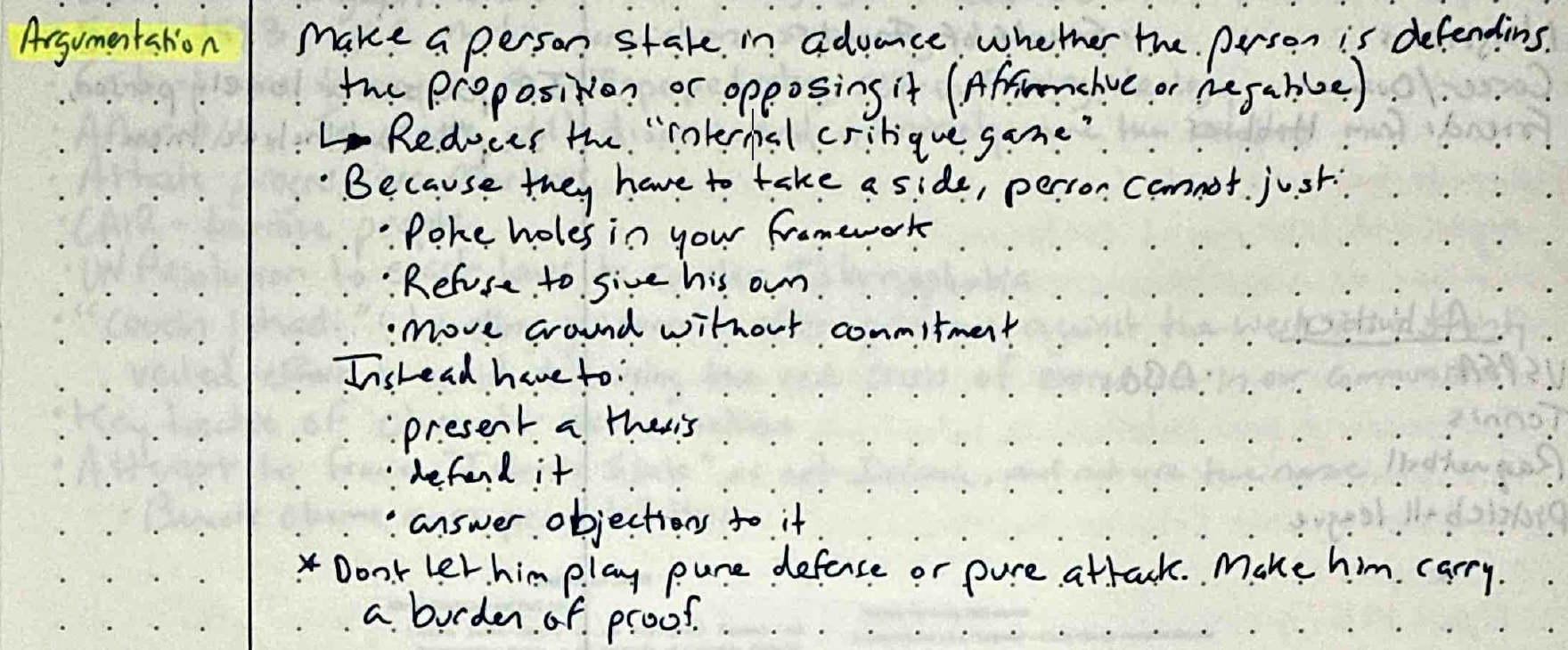
Make a person state in advance whether they are defending the proposition or opposing it — affirmative or negative.
This reduces the “internal critique game.” Because they have to take a side, they can’t just:
- poke holes in your framework
- refuse to give their own
- move around without commitment
Instead they have to:
- present a thesis
- defend it
- answer objections to it
The core rule
Don’t let them play pure defense or pure attack. Make them carry a burden of proof.
See → Shifting The Burden (Fallacy) · Internal Critique · Debate University Course > Proposition
🚭 Don’t Let Them Smuggle a Claim as an Argument
Make sure the opponent doesn’t try to pass off a claim as an argument.
Ex: “Atheists cannot account for morality.”
→ This is a claim. It lacks premises that support a conclusion.
See → Argument Structure > RULES FOR IDENTIFYING PREMISES AND CONCLUSIONS · The Art of Deception > WHAT IS AN ARGUMENT? (Page 15)
🦭 Sealioning
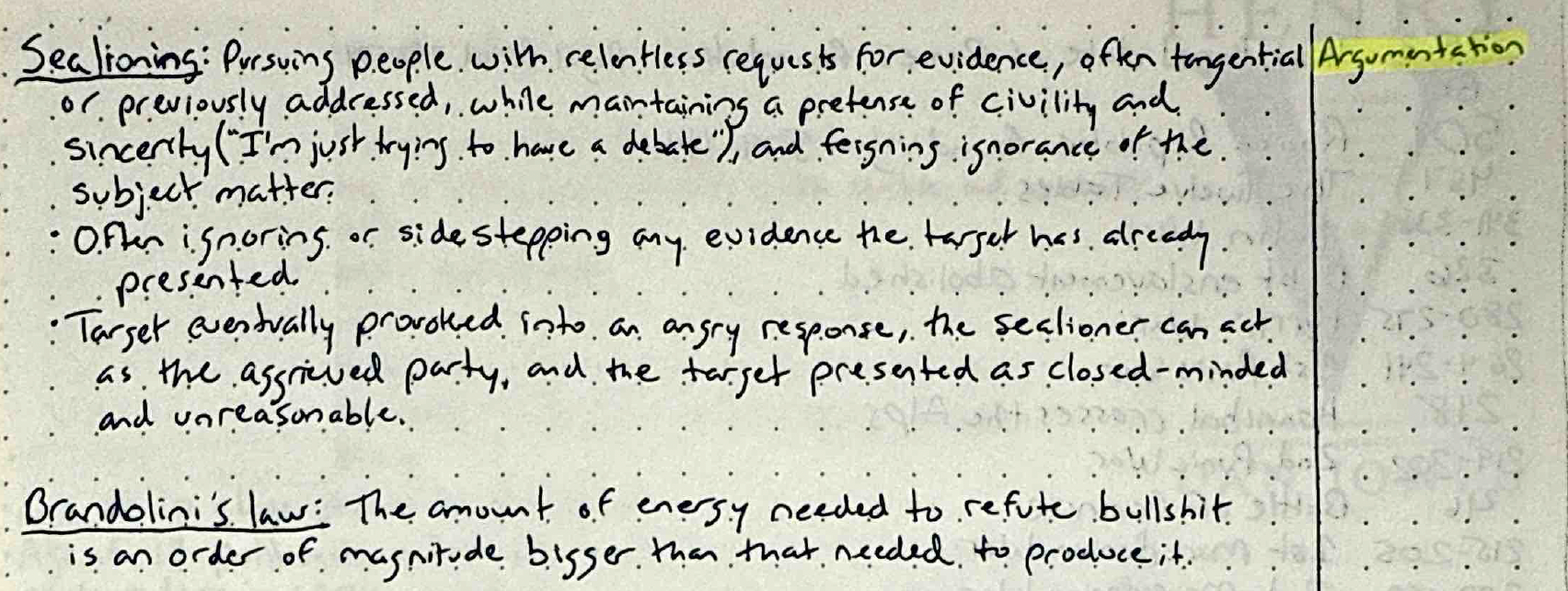
Pursuing people with relentless requests for evidence — often tangential or previously addressed — while maintaining a pretense of civility and sincerity (“I’m just trying to have a debate”), and feigning ignorance of the subject matter.
- Often ignores or sidesteps any evidence the target has already presented.
- The target is eventually provoked into an angry response; the sealioner then acts as the aggrieved party, and the target is presented as closed-minded and unreasonable.
Brandolini’s law — the amount of energy needed to refute bullshit is an order of magnitude bigger than that needed to produce it.
See → Debate Pervertry · Debate Tactics > Info dump · Fallacies & Bad Faith (MOC)
📄 Source Cards