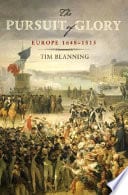
DESCRIPTION
An accessible chronicle of European history from the end of the Thirty Years’ War to the Battle of Waterloo features vivid coverage of such events as the Enlightenment period, the French Revolution, and the Napoleonic era.
Central Thesis
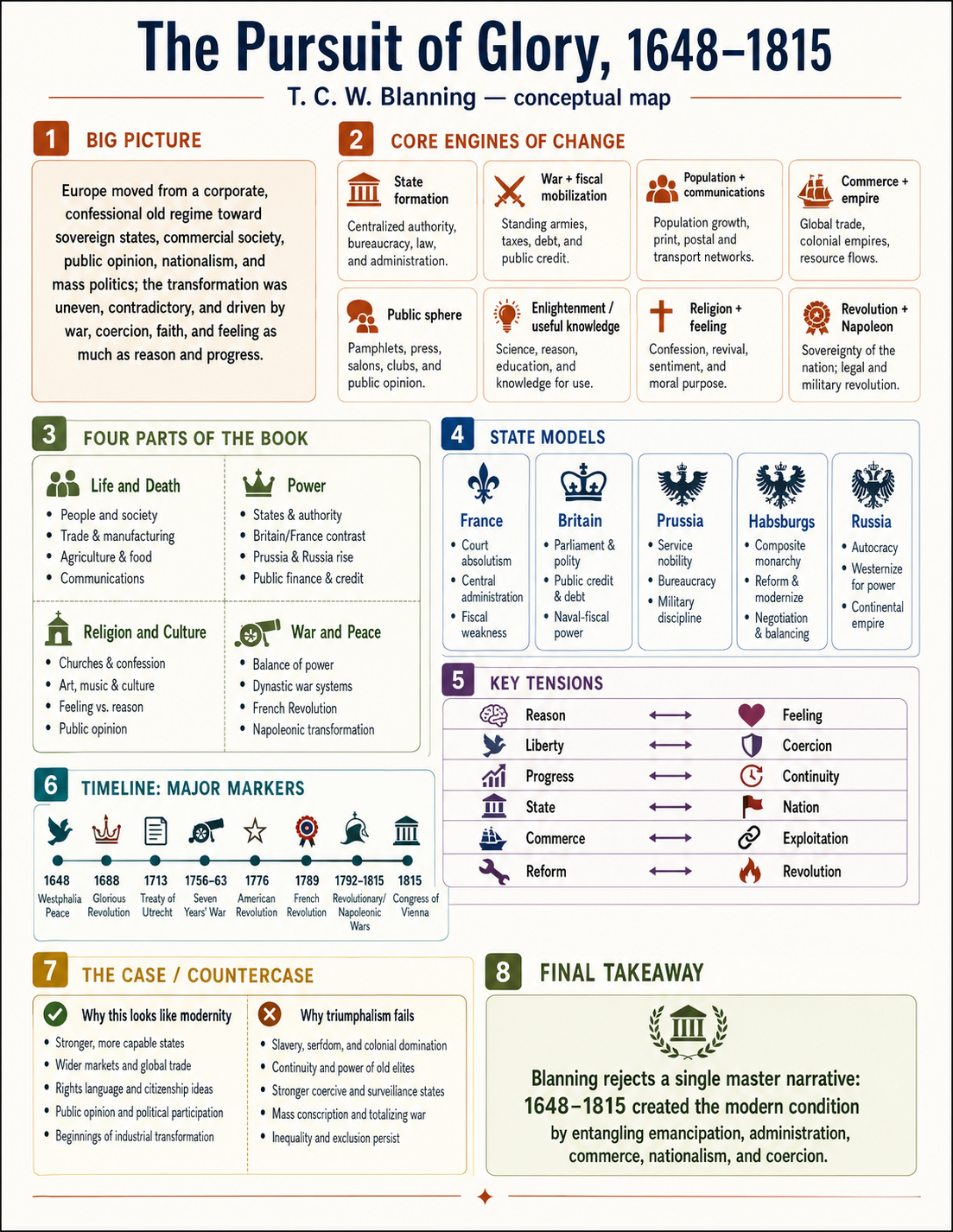
Blanning’s central thesis is that Europe between 1648 and 1815 underwent a profound but uneven transformation from the decentralized, corporate, confessional world of the old regime toward the modern system of sovereign states, commercial societies, public opinion, nationalism, and mass politics.
He explicitly rejects a single deterministic “master narrative” such as inevitable progress, Marxist class development, or the straightforward triumph of Enlightenment reason. Instead, the period is defined by several interconnected developments.>
The central political argument
The strongest long-term development was what Blanning calls the “relentless march of the state to hegemony.” By 1815, successful governments increasingly claimed:
- exclusive authority to legislate within their territories;
- control over taxation and administration;
- a monopoly on legitimate military force;
- the allegiance of individuals over competing churches, estates, provinces, guilds, and corporations.
Political systems that could not establish this authority—most notably the Polish-Lithuanian Commonwealth and the Holy Roman Empire—were partitioned, dissolved, or subordinated by stronger centralized states.
The state had to mobilize society
Centralization alone was insufficient. States also had to integrate their elites and mobilize resources. Different countries found different solutions:
- France used the royal court at Versailles.
- Britain integrated elites through Parliament and public credit.
- Prussia and Russia developed service nobilities and militarized bureaucracies.
- The Habsburg monarchy combined courts, administration, aristocratic cooperation, and territorial compromise.
Britain ultimately proved particularly effective because its representative institutions, commercial wealth, public borrowing, and naval strength allowed it to sustain prolonged warfare more successfully than France.
The rise of the public sphere
A second major transformation was the emergence of the public sphere—the space between private life and official government where people exchanged information and criticism through:
- newspapers and periodicals;
- coffeehouses and salons;
- reading societies;
- Masonic lodges;
- clubs, academies, and voluntary associations.
This created public opinion as a new source of political authority. Governments that successfully engaged public opinion could gain legitimacy and resources. Governments that alienated or misunderstood it, particularly the French monarchy, became vulnerable to revolutionary upheaval.
Economic expansion was transformative but unequal
Europe experienced population growth, improved transportation, colonial expansion, commercial integration, agricultural innovation, and the beginnings of industrialization. Britain emerged as the leading commercial, naval, financial, and industrial power.
However, Blanning rejects a triumphalist account of universal progress. Growth produced both beneficiaries and victims:
- landowners, merchants, financiers, and manufacturers often prospered;
- many laborers experienced falling real wages, underemployment, and malnutrition;
- western and northwestern Europe advanced faster than eastern and southern Europe;
- commercial expansion depended heavily on slavery and colonial exploitation;
- traditional protections were weakened as market relationships expanded.
Thus, modernization increased European power without necessarily improving the lives of most Europeans.
The Enlightenment did not simply defeat religion
Blanning also disputes the familiar idea that the period represents a linear transition from religious faith to secular reason.
The era produced Newton, Locke, Hume, Montesquieu, Kant, and the Encyclopédie, but it also witnessed powerful religious and emotional movements such as:
- Jansenism;
- Pietism;
- Methodism;
- evangelical revival;
- sentimentalism;
- Romanticism.
He therefore interprets eighteenth-century culture as a dialectical struggle between a “culture of reason” and a “culture of feeling,” rather than the inevitable triumph of rationalism over faith.
The French Revolution accelerated rather than created modernity
The French Revolution and Napoleon did not begin all these developments, but they intensified and spread them. They dismantled privileges, established civil equality, centralized administration, mobilized mass armies, and exported uniform legal systems.
Napoleon ultimately failed because conquest became an end in itself. His empire imposed reform, but also taxation, conscription, exploitation, and increasingly authoritarian government. His enemies defeated him only after adopting many of the Revolution’s own methods of mass mobilization and state reform.
Thesis in one sentence
Between 1648 and 1815, Europe was transformed by the rise of the sovereign state, commercial expansion, public opinion, nationalism, and revolutionary mass mobilization—but this transformation was uneven, contradictory, and driven as much by war, coercion, faith, and emotion as by reason or progress.
Pinker’s Chapter 3 supplement — “warriors to courtiers”
Pinker’s presentation of Norbert Elias gives a violence-centered mechanism for Blanning’s “relentless march of the state.” Citing Quincy Wright, he reports a contraction from roughly 5,000 European political units in the fifteenth century, to about 500 around the Thirty Years’ War, 200 around Napoleon, and fewer than 30 by 1953. Gunpowder weapons, standing armies, taxation, and bureaucracy helped larger states absorb smaller lordships. Monarchs then had a fiscal and military interest in suppressing private war: dead peasants and burned fields could no longer supply revenue or soldiers.
Elias’s phrase “warriors to courtiers” captures the accompanying elite adaptation. Advancement increasingly required nobles to navigate court, administration, credit, and reputation rather than merely dominate neighbors by force. Courtesy, foresight, and emotional restraint became political skills before spreading more widely as manners.
Interpretive boundary: the political-unit totals are broad historical estimates, and centralization did not move in lockstep with homicide decline. A stronger state can suppress private feuding while also becoming more capable of taxation, repression, and interstate war; Pinker’s mechanism does not turn state growth into uncomplicated moral progress. Chapter 3 synthesis · Political consolidation and the military revolution, PDF pp. 120–121 (file not included in this release) · Nationalized justice and “warriors to courtiers,” PDF pp. 121–122 (file not included in this release) · Where state centralization and homicide decline diverge, PDF pp. 126–127 (file not included in this release)
The Pursuit of Glory - Tim Blanning.pdf (file not included in this release)
Handwritten Notebook Pages
Source
- Open The Pursuit of Glory, 1648–1815 notebook pages — start at notebook p. 105 (file not included in this release)
- Open The Pursuit of Glory notebook pages — start at notebook p. 153 (file not included in this release)
Review
Handwrite First
Use this section with the book and notes closed. The goal is retrieval, not polish.
1. Before Reading
Prime your mind before reading.
- Prediction:
- Question I want answered:
- What I already think about this topic:
- What I expect to disagree with:
2. Closed-Book Recall Dump
Close the book and notes. Reconstruct what you read from memory.
-
Main points I remember:
-
Key examples, evidence, stories, or cases I remember:
-
Terms, people, dates, or concepts I remember:
-
-
What feels fuzzy or incomplete:
3. Core Argument From Memory
- The book/section in one sentence:
- Main claim:
- Problem the author is responding to:
- Why the author thinks this is true:
- Best evidence/example I remember:
- Conclusion the author wants the reader to accept:
4. Argument Map From Memory
5. Feynman Check
Explain the idea simply, as if teaching it to someone unfamiliar with the topic.
- Simple explanation:
- Analogy or concrete example:
- Where someone might misunderstand this:
6. Pushback From Memory
- Strongest objection or weakness:
- What evidence would weaken the author’s argument?
- What a rival thinker/book might say:
- My current judgment:
7. Personal Takeaway
- What changed, clarified, or challenged my thinking?
- What am I less certain about now?
- One way I could apply this:
- One question I need to keep investigating:
Type Into Obsidian
Use this section after handwriting. The goal is long-term storage, search, linking, and spaced review.
1. Correction After Checking Notes
Reopen the book/notes. Compare them against your handwritten recall.
- I forgot:
- I misunderstood:
- I overemphasized:
- I underemphasized:
- This needs review:
2. Clean Core Argument
- The book/section in one sentence:
- Main claim:
- Problem the author is responding to:
- Why the author thinks this is true:
- Best evidence/example:
- Conclusion the author wants the reader to accept:
3. What Actually Matters?
- Most important idea:
- Best quote or passage:
- Term/concept worth remembering:
- Most useful example:
- Most surprising point:
- One sentence I want to remember:
4. Connections
- Connects to:
- [[]]
- [[]]
- [[]]
- Supports:
- [[]]
- Challenges:
- [[]]
- Reminds me of:
- [[]]
- Possible future note:
- [[]]
5. Clean Pushback
- Strongest objection or weakness:
- What evidence would weaken the author’s argument?
- What the author might say in response:
- What a rival thinker/book would say:
- My current judgment:
Retrieval Questions
Answer these without looking during future reviews.
Basic Recall
- What is the author’s main thesis?
- What problem is the author responding to?
- What are the 3–5 main claims?
- What are the key terms or concepts?
- What is the best example or piece of evidence?
Argument Reconstruction
- How does the author move from evidence to conclusion?
- What assumptions does the argument depend on?
- What would the argument look like in premise-conclusion form?
- What does the author want the reader to reject?
Comparison
- How does this book/section compare with [[]]?
- How does this support or challenge [[]]?
- Which thinker would agree with this?
- Which thinker would disagree with this?
Criticism
- What is the strongest objection?
- What evidence would weaken the argument?
- What does the author ignore, minimize, or assume?
- Is the author’s conclusion stronger than the evidence allows?
Synthesis
- How does this change my larger framework?
- Where does this fit in the broader historical/philosophical debate?
- What question should I ask next?
- What would I write about using this idea?
Flashcards / Atomic Recall
Use only for facts, definitions, distinctions, names, dates, and compact claims.
- Q:
- A:
- Q:
- A:
- Q:
- A:
Retention Check
24 Hours Later
- I can explain the main argument without notes.
- I remember the best example or evidence.
- I can define the key concept.
- I can state one objection.
24-hour recall notes:
- What I remembered:
- What I forgot:
- What needs another review:
1 Week Later
- I can summarize this in 5 sentences.
- I can reconstruct the argument.
- I can connect it to another book, thinker, or historical period.
- I can state whether I agree, disagree, or remain undecided.
1-week recall notes:
- What I remembered:
- What I forgot:
- New connection:
- Revised judgment:
1 Month Later
- I still remember the core argument.
- I can explain why this matters.
- I know whether this changed my larger framework.
- I know whether this is worth rereading, citing, or building into a permanent note.
1-month recall notes:
- What endured:
- What disappeared:
- What this changed:
- Next action:
Scratchpad
Unfiltered thoughts, questions, comparisons, argument trees, future writing ideas, or possible links.
Simplified rule
Handwrite
Use handwriting for:
- Before-reading predictions
- Closed-book recall dump
- Core argument from memory
- Argument map from memory
- Feynman explanation
- Initial pushback
- Personal takeaway
- Confusion list
These are the sections where the benefit comes from struggling to reconstruct the idea.
Type in Obsidian
Use Obsidian for:
- Corrections after checking notes
- Clean one-sentence thesis
- Clean argument summary
- Important quotes
- Key concepts
- Links to other notes
- Retrieval questions
- Flashcards
- Retention checks
- Review logs
- Scratchpad for future essays or synthesis
These are the sections where the benefit comes from searchability, linking, spaced review, and long-term organization.
Best workflow
Use this order:
1. Handwrite from memory.
2. Check the book/notes.
3. Type only the corrected, useful version into Obsidian.
4. Create retrieval questions.
5. Review those questions later without looking.
Do not type all your handwritten notes into Obsidian. That turns the system into transcription work. Only transfer what is worth preserving, linking, or reviewing.
Timeline
Tim Blanning’s book combines political and military history with economic, demographic, religious, intellectual, technological, and cultural change. The timeline therefore includes both discrete events—wars, treaties, revolutions, accessions—and longer developments such as population growth, improved communications, commercialization, secularization, religious revival, the Enlightenment, and industrialization. The book begins with the Peace of Westphalia and ends with the Congress of Vienna settlement.
The Pursuit of Glory - Tim Blanning.pdf
1648–1660: The End of the Thirty Years’ War and the Reconstruction of Europe
1648 — Peace of Westphalia
- The Peace of Westphalia ends the Thirty Years’ War in the Holy Roman Empire.
- Spain formally recognizes the independence of the Dutch Republic.
- The settlement confirms that the Holy Roman Empire will remain a decentralized collection of territories rather than becoming a centralized Habsburg monarchy.
- Catholicism, Lutheranism, and Calvinism receive recognized places within the imperial religious settlement.
- Confessional pluralism becomes an enduring feature of European politics: neither Catholics nor Protestants can realistically impose religious uniformity on the continent.
- France and Sweden emerge as guarantors of the imperial settlement and gain opportunities to intervene in German affairs.
- France receives strategic possessions in Alsace and the fortress of Breisach, strengthening its eastern frontier.
- The year marks the beginning of the book’s broader story: the gradual rise of sovereign states, the subordination of churches to political authority, and the replacement of confessional conflict by dynastic and national rivalry.
The Pursuit of Glory - Tim Blanning.pdf
1648–1653 — The Frondes in France
- A series of civil disturbances known as the Frondes erupts in France.
- Magistrates, nobles, princes, and provincial interests resist royal taxation and ministerial centralization.
- The disorder demonstrates the continuing weakness of the French monarchy after the Thirty Years’ War.
- The young Louis XIV experiences rebellion and insecurity firsthand, helping shape his later determination to control the nobility and strengthen monarchical authority.
- The failure of the Frondes ultimately strengthens rather than weakens absolutism because the rebels fail to produce a coherent constitutional alternative.
1649 — Execution of Charles I and the English Commonwealth
- Charles I is executed following the English Civil Wars.
- England is declared a republic.
- Traditional monarchy, episcopacy, and the House of Lords are temporarily abolished.
- Oliver Cromwell eventually becomes Lord Protector.
- England’s experience contrasts with France: England’s conflict contributes to constitutional government, while France’s civil wars culminate in stronger royal absolutism.
1650s–1660s — The Northern Wars and the Polish “Deluge”
- Sweden, Poland-Lithuania, Denmark, Brandenburg, and Russia fight for dominance in the Baltic.
- Poland-Lithuania suffers devastating invasions collectively remembered as the Potop, or “Deluge.”
- The destruction aggravates Poland’s demographic, economic, and political decline.
- Sweden temporarily confirms its position as the dominant Baltic power.
- Russia and Brandenburg-Prussia begin emerging as stronger regional states.
1658 — Battle of the Dunes
- An Anglo-French army defeats Spanish forces near Dunkirk.
- French troops are commanded by Turenne; the Spanish side includes the prince de Condé.
- The victory places decisive pressure on Spain and prepares the way for peace.
- The battle illustrates the entanglement of international conflict with the French Frondes and the English civil settlement.
The Pursuit of Glory - Tim Blanning.pdf
1659 — Peace of the Pyrenees
- France and Spain conclude the war that Westphalia had failed to end.
- Spain cedes territory to France, confirming the gradual transfer of continental predominance from the Spanish Habsburgs to Bourbon France.
- Louis XIV marries Maria Theresa of Spain.
- Her renunciation of claims to the Spanish inheritance later becomes a source of dispute because the promised dowry is not fully paid.
1660 — Restoration of the English Monarchy
- Charles II is restored to the English throne.
- The monarchy, House of Lords, and Church of England are reestablished.
- Restoration does not erase the constitutional consequences of the civil wars: English kings can no longer govern as though Parliament were politically irrelevant.
1660 — Peace of Oliva
- Sweden’s Baltic empire is confirmed after the Northern Wars.
- Sweden controls territories around much of the Baltic coastline.
- Brandenburg’s ruler Frederick William secures full sovereignty over Ducal Prussia.
- This sovereign territory outside the Holy Roman Empire later allows the Hohenzollerns to adopt a royal title and construct the Prussian monarchy.
The Pursuit of Glory - Tim Blanning.pdf
1661–1688: Louis XIV, Absolutism, and French Expansion
1661 — Louis XIV Begins His Personal Rule
- Following the death of Cardinal Mazarin, Louis XIV announces that he will govern personally.
- He strengthens royal administration, expands the army, disciplines the nobility, and increasingly concentrates political life around the court.
- Versailles becomes both a residence and a mechanism for controlling aristocratic ambition.
- The French monarchy develops the most influential model of court-centered absolutism in Europe.
- Jean-Baptiste Colbert reorganizes administration, manufactures, trade, naval policy, and infrastructure.
1661–1683 — Colbert’s Economic and Administrative Program
- Colbert promotes royal manufactures, protective tariffs, commercial companies, naval expansion, and improved roads.
- The French state tries to regulate economic production through guilds, inspections, monopolies, and quality controls.
- Responsibility for bridges and highways becomes increasingly centralized.
- France improves major arterial roads, though provincial and cross-country routes remain poor.
- Colbert’s policies demonstrate both the capabilities and limitations of state-directed economic modernization.
1662 — Royal Society Receives Its Charter
- The Royal Society in England receives formal royal recognition.
- Experimental science becomes increasingly institutionalized through academies, learned societies, correspondence, journals, and demonstrations.
- Scientific authority begins shifting away from inherited texts toward observation, experiment, measurement, and mathematical proof.
1665–1666 — Plague and Great Fire of London
- The Great Plague strikes London in 1665.
- The Great Fire destroys much of the city in 1666.
- Reconstruction contributes to changes in urban design, construction, insurance, and administration.
- The disasters belong to an older demographic regime in which epidemic disease and urban mortality remained normal threats.
1667–1668 — War of Devolution
- Louis XIV invades the Spanish Netherlands, claiming territory through his wife Maria Theresa.
- French armies make rapid gains.
- England, the Dutch Republic, and Sweden form the Triple Alliance to restrain France.
- The Treaty of Aix-la-Chapelle ends the war, but Louis retains several fortified towns.
- The conflict inaugurates a prolonged period of French expansion and coalition resistance.
1667 — Truce of Andrusovo
- Poland-Lithuania cedes Smolensk, eastern Ukraine, and eventually Kiev to Russia.
- Russia advances westward and strengthens its position in eastern Europe.
- Poland’s weakening political structure becomes increasingly vulnerable to intervention by its neighbors.
The Pursuit of Glory - Tim Blanning.pdf
1670 — Secret Treaty of Dover
- Charles II secretly aligns England with Louis XIV.
- France provides subsidies to the English king.
- The agreement helps isolate the Dutch Republic diplomatically before the approaching French invasion.
1672–1678/79 — Franco-Dutch War
- France, supported initially by England and several German allies, invades the Dutch Republic.
- French armies make spectacular early gains and threaten Amsterdam.
- The Dutch open their dikes, flooding parts of the country to stop the invasion.
- William of Orange emerges as the leader of Dutch resistance.
- Louis XIV’s extreme demands transform a limited campaign into a broader European war.
- The Dutch Republic survives, while other powers organize against French hegemony.
- The Treaties of Nijmegen end the war and produce additional French territorial gains, particularly in Franche-Comté and the Spanish Netherlands.
1675 — Battle of Fehrbellin
- Frederick William, the Great Elector of Brandenburg, defeats Swedish forces.
- The military significance is limited, but the symbolic importance is substantial.
- Brandenburg-Prussia begins acquiring a reputation for military effectiveness.
- The victory later becomes part of the Prussian state’s founding mythology.
The Pursuit of Glory - Tim Blanning.pdf
1670s–1680s — Expansion of Standing Armies
- European rulers enlarge permanent armies and professionalize military administration.
- War becomes more expensive, technically complex, and dependent on taxation, credit, supply systems, and bureaucratic organization.
- Military growth strengthens central states but also places heavier burdens on ordinary populations.
- The “fiscal-military state” begins to emerge: political survival increasingly depends on the ability to borrow, tax, and mobilize resources continuously.
1683 — Ottoman Siege of Vienna
- A large Ottoman army besieges Vienna.
- A relief army led by the Polish king John III Sobieski helps defeat the Ottomans.
- The battle marks the end of the most serious Ottoman attempt to expand into central Europe.
- Habsburg forces subsequently move into Hungary and southeastern Europe.
- Ottoman power does not collapse, but the strategic initiative shifts toward Austria and Russia.
1685 — Revocation of the Edict of Nantes
- Louis XIV revokes the protections granted to French Protestants.
- Protestant worship is suppressed, churches are destroyed, and Huguenots face forced conversion or exile.
- Large numbers of skilled Huguenots flee to Britain, the Dutch Republic, Brandenburg-Prussia, Switzerland, and elsewhere.
- The measure damages France economically and diplomatically.
- It demonstrates the persistence of religious intolerance despite the Westphalian acceptance of confessional pluralism.
1687 — Newton Publishes the
Principia
- Isaac Newton publishes Philosophiae Naturalis Principia Mathematica.
- He unites terrestrial and celestial motion under universal mathematical laws.
- The same gravitational force explains falling bodies and planetary orbits.
- Newtonian science helps establish a mechanistic conception of nature governed by discoverable, regular laws.
- This achievement becomes one of the central foundations of the European Enlightenment.
The Pursuit of Glory - Tim Blanning.pdf
1688–1721: The European Balance of Power
1688 — Glorious Revolution
- James II is overthrown.
- William III of Orange and Mary II assume the English throne.
- The revolution confirms that English monarchy is conditional and legally constrained.
- Parliamentary supremacy, Protestant succession, and regular cooperation between Crown and Parliament become central features of the British political system.
- The event begins what Blanning calls the “Second Hundred Years’ War” between Britain and France.
- Britain’s constitutional and financial institutions allow it to mobilize national resources more effectively than many absolutist rivals.
1688–1697 — Nine Years’ War
- A broad European coalition resists Louis XIV.
- Fighting occurs in the Low Countries, Germany, Ireland, at sea, and in overseas colonies.
- England’s participation after the Glorious Revolution transforms the war into a sustained Anglo-French struggle.
- The conflict demonstrates that France cannot dominate Europe without provoking a counter-coalition.
- The Treaty of Ryswick ends the war in 1697.
1689 — English Bill of Rights
- The Bill of Rights restricts royal prerogative.
- Taxation, standing armies, and major legislation require parliamentary authority.
- It strengthens the constitutional framework that supports British public credit and representative government.
1690 — Battle of the Boyne
- William III defeats James II in Ireland.
- The victory secures the Protestant political settlement in Britain and Ireland.
- It becomes a lasting element of Protestant identity, especially in Ulster.
1694 — Bank of England Founded
- The Bank of England is established to assist government borrowing.
- Britain develops a funded national debt supported by parliamentary taxation.
- Creditors trust the government because taxation and debt service are backed by political institutions.
- Britain’s “financial revolution” provides the resources needed to sustain long wars against France.
1695 onward — Russia’s Expansion Accelerates
- Peter I increasingly directs Russian policy toward access to warm-water ports and European military methods.
- Russia launches campaigns against the Ottoman fortress of Azov.
- Peter studies western European shipbuilding, military organization, administration, and technology.
- Russian reform is designed primarily to strengthen the state and armed forces rather than create political liberty.
1697 — Augustus II Becomes King of Poland
- Frederick Augustus, Elector of Saxony, becomes king of Poland-Lithuania.
- The personal union entangles Saxony in Polish and Baltic affairs.
- Foreign rulers increasingly manipulate Poland’s elective monarchy and decentralized constitution.
1699 — Treaty of Karlowitz
- The Ottoman Empire cedes most of Hungary and Transylvania to the Habsburg monarchy.
- Poland recovers Podolia.
- Venice gains territory in the eastern Mediterranean.
- The treaty confirms Austria’s emergence as a major southeastern European power.
1700 — Death of Charles II of Spain
- Charles II dies without an heir.
- He leaves the Spanish monarchy to Philip of Anjou, grandson of Louis XIV.
- Other powers fear that France and Spain may fall under common Bourbon control.
- The succession crisis produces a general European war.
1700–1721 — Great Northern War
- Russia, Denmark-Norway, and Saxony-Poland attack Sweden.
- Charles XII initially defeats his enemies with remarkable speed.
- Sweden defeats Russia at Narva in 1700.
- Charles becomes entangled in Poland and Saxony rather than eliminating Russia.
- Peter the Great rebuilds the Russian army and establishes a base on the Baltic.
- The war ends Swedish predominance and establishes Russia as a major European power.
1701 — Kingdom of Prussia Established
- Frederick III, Elector of Brandenburg, crowns himself Frederick I, “King in Prussia.”
- The title is possible because Ducal Prussia lies outside the Holy Roman Empire.
- The new monarchy strengthens the political identity of the scattered Hohenzollern territories.
- Prussia’s later rise rests on centralized administration, military organization, taxation, and service by the nobility.
The Pursuit of Glory - Tim Blanning.pdf
1701–1713/14 — War of the Spanish Succession
- Britain, the Dutch Republic, Austria, and other allies oppose the Bourbon inheritance.
- The war takes place in the Low Countries, Germany, Italy, Spain, at sea, and overseas.
- The central issue is not merely who will rule Spain, but whether France will dominate the European balance of power.
1704 — Battle of Blenheim
- The Duke of Marlborough and Prince Eugene of Savoy defeat Franco-Bavarian forces.
- Vienna is saved from a major strategic threat.
- The battle destroys the aura of French military invincibility.
- Bavaria is temporarily removed from the war as a major French ally.
1704 — British Capture of Gibraltar
- An Anglo-Dutch force captures Gibraltar.
- Britain retains it in the peace settlement.
- Gibraltar becomes a strategic base for British naval power in the Mediterranean.
1706 — Battles of Ramillies and Turin
- Marlborough defeats French forces at Ramillies, leading to Allied occupation of much of the Spanish Netherlands.
- Prince Eugene relieves Turin and drives French forces from northern Italy.
- Bourbon military power comes under pressure across several fronts.
1707 — Union of England and Scotland
- The Acts of Union create the Kingdom of Great Britain.
- Scotland gains access to English colonial markets.
- England gains greater political security in the British Isles.
- A unified British state becomes better positioned for imperial and commercial expansion.
1709 — Battle of Poltava
- Peter the Great decisively defeats Charles XII of Sweden.
- Sweden loses the strategic initiative in the Great Northern War.
- Russia’s military transformation is vindicated.
- Poltava marks Russia’s arrival as a central participant in European power politics.
1713 — Treaty of Utrecht
- Philip V remains king of Spain but renounces any claim to the French throne.
- The French and Spanish crowns are prevented from uniting.
- Austria receives the Spanish Netherlands and major Italian territories.
- Britain gains Gibraltar, Minorca, Newfoundland, Nova Scotia, and commercial privileges in Spanish America.
- Britain obtains the asiento, the contract to supply enslaved Africans to Spanish colonies.
- The settlement advances the principle of a European balance of power.
1714 — Treaties of Rastatt and Baden
- Austria and the Holy Roman Empire conclude peace with France.
- The War of the Spanish Succession formally ends.
- Bourbon rule in Spain receives international recognition.
- The Spanish monarchy loses most of its European possessions outside the Iberian Peninsula.
1715 — Death of Louis XIV
- Louis XIV dies after a reign of more than seventy years.
- France remains Europe’s largest continental power but carries heavy debts and widespread war weariness.
- His reign leaves a complex legacy: administrative centralization, cultural brilliance, military expansion, financial exhaustion, and international resistance.
1715 — Hanoverian Succession Consolidated in Britain
- George I, Elector of Hanover, had succeeded Queen Anne in 1714.
- The Protestant succession is secured against Jacobite challengers.
- Britain becomes linked dynastically to Hanover and more deeply involved in German politics.
1715 — Jacobite Rising
- Supporters of the exiled Stuart dynasty attempt to restore James Francis Edward Stuart.
- The rising fails.
- Jacobitism remains a periodic threat but cannot overturn the Hanoverian settlement.
1718–1720 — War of the Quadruple Alliance
- Spain attempts to recover territories lost after the War of the Spanish Succession.
- Britain, France, Austria, and the Dutch Republic combine to restrain Spanish revisionism.
- Spain is defeated and compelled to accept the Utrecht settlement.
1721 — Peace of Nystad
- The Great Northern War ends.
- Sweden cedes Estonia, Livonia, and other Baltic territories to Russia.
- Russia gains a permanent Baltic position.
- Sweden declines as a great power.
- Peter assumes the title of emperor, and Russia becomes one of the principal powers of Europe.
- The treaty closes the first major military period of the book. The years 1648–1721 had transformed the balance of power from French and Swedish predominance toward a multipolar system that included Britain, Austria, Russia, and Prussia.
The Pursuit of Glory - Tim Blanning.pdf
1721–1740: Recovery, Commercial Expansion, and a Changing Public Sphere
1720s — Postwar Recovery and Population Growth
- European population begins a sustained expansion after the wars, famines, plagues, and demographic crises of the seventeenth century.
- Mortality remains high, but catastrophic epidemics become less frequent in much of western Europe.
- Improvements in food distribution, transportation, public order, and disease containment contribute to population growth.
- Rising population enlarges markets and labor supplies but also intensifies pressure on land, wages, and food prices.
1720 — South Sea and Mississippi Bubbles Collapse
- Speculative schemes collapse in Britain and France.
- In France, John Law’s Mississippi System fails, damaging public confidence in paper money and state finance.
- In Britain, the South Sea Bubble leads to scandal but does not destroy the financial system.
- Britain’s parliamentary and credit institutions prove more resilient than the French monarchy’s financial administration.
1721–1742 — Robert Walpole’s Political Ascendancy
- Walpole becomes Britain’s dominant minister.
- Britain experiences relative domestic stability and avoids major continental warfare for much of the period.
- Cabinet government and ministerial management of Parliament become more firmly established.
- Critics condemn corruption, patronage, and oligarchy, but the system proves adaptable and fiscally effective.
1720s–1730s — Expansion of Newspapers, Periodicals, and Coffeehouses
- Printed newspapers, journals, pamphlets, and books circulate more widely.
- Coffeehouses, salons, reading societies, academies, clubs, and Masonic lodges create new spaces for discussion.
- A “public sphere” develops between private life and official government.
- Public opinion begins to function as a new source of political and cultural authority.
- Britain and the Dutch Republic lead because of high literacy, urbanization, commercial networks, and relatively permissive censorship.
The Pursuit of Glory - Tim Blanning.pdf
1720s–1740s — Pietism and Religious Revival
- Pietism spreads through German Protestant territories.
- It emphasizes personal conversion, emotional devotion, biblical reading, charity, and practical morality.
- The movement influences education, missionary activity, social reform, and later German intellectual culture.
- Its growth demonstrates that the eighteenth century was not simply an age of secularization.
1727 — Death of Newton
- Newton dies as Europe’s most prestigious natural philosopher.
- His work becomes the model for rational inquiry and the search for universal laws.
- Newtonianism spreads beyond physics into philosophy, theology, politics, and social theory.
1731 — Royal Dublin Society Founded
- The society promotes agriculture, science, manufacturing, and practical improvement.
- It is one of many associations that institutionalize the Enlightenment’s interest in useful knowledge.
- Similar agricultural and economic societies proliferate across Europe later in the century.
The Pursuit of Glory - Tim Blanning.pdf
1733–1738 — War of the Polish Succession
- The disputed election of the Polish king draws France, Austria, Russia, Spain, and other powers into conflict.
- Stanisław Leszczyński, supported by France, loses to Augustus III, supported by Russia and Austria.
- The settlement redistributes territories in Italy and Lorraine.
- Russia’s ability to determine the Polish succession demonstrates Poland’s increasing dependence.
1733 — John Kay’s Flying Shuttle
- The flying shuttle accelerates weaving.
- It creates greater demand for spun yarn and contributes to later innovations in textile production.
- The invention forms part of the mechanization that eventually transforms British cotton manufacturing.
1730s–1740s — Methodist Revival
- John and Charles Wesley and George Whitefield lead a revival within British Protestantism.
- Methodism emphasizes conversion, disciplined devotion, preaching, hymn singing, and lay participation.
- It reaches groups often neglected by established church structures.
- The revival reflects the continuing power of the “culture of feeling” alongside Enlightenment rationalism.
1739–1748 — War of Jenkins’ Ear and War of the Austrian Succession
- British-Spanish colonial conflict merges into a larger European succession struggle.
- Commercial and imperial rivalry becomes inseparable from continental diplomacy.
1740–1763: Prussia’s Rise and the Globalization of European War
1740 — Accession of Frederick II of Prussia
- Frederick II becomes king and almost immediately invades the Habsburg province of Silesia.
- He exploits the accession of Maria Theresa and disputes surrounding the Habsburg succession.
- Prussia’s seizure of Silesia begins a prolonged Austro-Prussian struggle for leadership in Germany.
- The act reveals that “enlightened” rulers could remain aggressive dynastic conquerors.
1740 — Accession of Maria Theresa
- Maria Theresa inherits the Habsburg lands under the Pragmatic Sanction.
- Several powers challenge her succession or attempt to seize Habsburg territory.
- The crisis prompts significant Austrian administrative, fiscal, and military reform.
1740–1748 — War of the Austrian Succession
- Prussia, France, Bavaria, Spain, Britain, Austria, and other powers fight across Europe and overseas.
- Frederick seizes Silesia and successfully defends it.
- Britain supports Austria largely to prevent French predominance.
- The conflict includes the First and Second Silesian Wars.
1741 — Battle of Mollwitz
- Prussia defeats Austria.
- The battle confirms the effectiveness of the Prussian infantry and military system.
- Frederick’s personal performance is less impressive than the discipline of the army he inherited.
1743 — Battle of Dettingen
- Anglo-Hanoverian and allied forces defeat France.
- George II personally participates, becoming the last British monarch to command troops in battle.
1745 — Battle of Hohenfriedberg
- Frederick wins a major victory over Austrian and Saxon forces.
- Prussia consolidates possession of Silesia.
1745–1746 — Final Major Jacobite Rising
- Charles Edward Stuart lands in Scotland and leads a Jacobite army into England.
- The Jacobites retreat and are defeated at Culloden in 1746.
- The Stuart restoration project effectively ends.
- The British government strengthens control over the Scottish Highlands.
1748 — Treaty of Aix-la-Chapelle
- The War of the Austrian Succession ends.
- Maria Theresa retains most of her inheritance.
- Prussia keeps Silesia.
- The settlement resolves few underlying disputes and serves largely as a truce before renewed war.
1748 — Montesquieu Publishes
The Spirit of the Laws
- Montesquieu examines the relationship between laws, institutions, climate, customs, and social conditions.
- His analysis of divided powers becomes especially influential in Britain, America, and constitutional thought.
- The work exemplifies the Enlightenment attempt to study government comparatively and systematically.
1750s — Consumer Revolution Accelerates
- Demand grows for tea, coffee, sugar, tobacco, textiles, ceramics, furniture, books, clocks, mirrors, and fashionable clothing.
- Consumption expands beyond aristocratic courts into broader urban and middling populations.
- Colonial commodities increasingly shape European habits.
- Consumer growth stimulates manufacturing, trade, advertising, credit, and retailing.
- Much of this prosperity depends on Atlantic slavery, plantation labor, and imperial coercion.
1751–1772 — Publication of the
Encyclopédie
- Denis Diderot and Jean le Rond d’Alembert direct the French Encyclopédie.
- It organizes human knowledge while challenging inherited authority, clerical privilege, superstition, and intellectual censorship.
- The work gives unprecedented attention to mechanical arts, crafts, and practical production.
- It becomes both a monument to the Enlightenment and a target of church and state authorities.
1755 — Lisbon Earthquake
- A massive earthquake, fire, and tsunami destroy much of Lisbon and kill tens of thousands.
- The disaster prompts theological and philosophical debate about providence, evil, nature, and human suffering.
- Voltaire uses it to attack optimistic theories that the existing world is providentially ordered.
- The Portuguese minister Pombal directs reconstruction using rationalized urban planning and stronger administrative authority.
1755 — Winckelmann’s Essay on Greek Art
- Johann Joachim Winckelmann publishes Thoughts on the Imitation of Greek Works in Painting and Sculpture.
- He praises Greek art for its “noble simplicity and calm grandeur.”
- His work contributes decisively to neoclassicism and modern art history.
- Classical Greece becomes an aesthetic and moral alternative to baroque and rococo culture.
The Pursuit of Glory - Tim Blanning.pdf
1756 — Diplomatic Revolution
- Austria abandons its traditional hostility to France and allies with it.
- Britain allies with Prussia.
- The reversal reflects the growing importance of the Austro-Prussian rivalry and Anglo-French colonial competition.
- The European diplomatic system is reorganized immediately before the Seven Years’ War.
1756–1763 — Seven Years’ War
- Prussia, Britain, and Hanover fight Austria, France, Russia, Sweden, Saxony, and eventually Spain.
- Fighting takes place in central Europe, North America, the Caribbean, India, Africa, and at sea.
- It becomes the first genuinely global war between European empires.
- Britain focuses on naval and colonial warfare while subsidizing Prussia on the continent.
- France attempts to fight simultaneously in Europe, at sea, and overseas, overextending its resources.
1756 — Prussian Invasion of Saxony
- Frederick invades Saxony preemptively.
- Saxony is occupied, and its army is forcibly incorporated into Prussian service.
- The act deepens opposition to Prussia within the Holy Roman Empire.
1757 — Battles of Prague, Kolín, Rossbach, and Leuthen
- Frederick wins at Prague but is checked by Austria at Kolín.
- At Rossbach, Prussia defeats a larger French-imperial army.
- At Leuthen, Frederick defeats Austria through maneuver and disciplined infantry tactics.
- Rossbach and Leuthen establish Frederick’s reputation as one of Europe’s leading commanders.
1757 — Battle of Plassey
- Robert Clive defeats the nawab of Bengal and his French-supported forces.
- The British East India Company obtains decisive influence in Bengal.
- The battle becomes a major stage in Britain’s transformation from commercial participant to territorial power in India.
1759 — Britain’s “Year of Victories”
- British forces achieve major successes at Quebec, Quiberon Bay, Lagos, Minden, and elsewhere.
- French naval power is gravely weakened.
- Britain gains the strategic advantage in North America and overseas.
- The year demonstrates the effectiveness of Britain’s naval, financial, and commercial system.
1759 — Battle of Quebec
- British forces under James Wolfe defeat the French under Montcalm.
- Quebec falls, leading to the collapse of New France.
- The conquest helps establish British predominance in North America.
- Blanning treats the removal of France from Canada as a development with major long-term linguistic and imperial consequences.
The Pursuit of Glory - Tim Blanning.pdf
1759 — Jesuits Expelled from Portugal
- Pombal expels the Society of Jesus.
- Jesuit property and educational institutions are transferred or reorganized.
- The expulsion represents the growing attempt by “enlightened” states to subordinate the church to secular authority.
The Pursuit of Glory - Tim Blanning.pdf
1762 — Catherine II Seizes Power in Russia
- Catherine overthrows her husband Peter III.
- She presents herself as an enlightened ruler and corresponds with leading philosophes.
- Her reign combines intellectual patronage and administrative reform with autocracy, noble privilege, serfdom, and imperial expansion.
1762 — Rousseau Publishes
The Social Contract
and
Émile
- The Social Contract argues that legitimate sovereignty rests on the general will.
- Émile presents a theory of natural education and attacks artificial social conventions.
- Rousseau’s emphasis on authenticity, emotion, nature, and moral regeneration strengthens the culture of feeling.
- His thought influences democratic, educational, Romantic, and revolutionary movements.
1762 — British Advances in India and the Caribbean
- Britain consolidates its global advantage as French power weakens.
- Colonial conquest, naval superiority, and control of trade routes become essential components of great-power status.
1763 — Treaty of Paris
- France loses Canada and most of its territorial position in North America.
- Britain emerges as the leading colonial and naval power.
- Spain receives Louisiana but cedes Florida to Britain.
- France regains some Caribbean islands and limited commercial positions in India.
- Britain’s victory creates new problems: governing and financing a larger empire contributes to conflict with its North American colonies.
The Pursuit of Glory - Tim Blanning.pdf
1763 — Treaty of Hubertusburg
- Prussia retains Silesia.
- Austria fails to reverse Frederick’s conquest.
- Prussia is confirmed as a European great power.
- The Austro-Prussian dualism becomes a permanent feature of German politics.
1763–1789: Enlightened Reform, Imperial Crisis, and Revolutionary Preconditions
1760s–1780s — Agricultural Improvement
- Agricultural societies, journals, model farms, surveys, and reform literature proliferate.
- Landowners and tenant farmers experiment with crop rotation, drainage, selective breeding, enclosure, and new fodder crops.
- Productivity improves most clearly in parts of Britain, the Low Countries, and northwestern Europe.
- Agricultural commercialization benefits many large landowners and entrepreneurial farmers.
- Smallholders and rural laborers often suffer from enclosure, loss of customary rights, and rising food prices.
1764 — James Hargreaves Develops the Spinning Jenny
- One worker can spin several threads simultaneously.
- The machine helps relieve the imbalance between faster weaving and slower yarn production.
- Textile production becomes increasingly mechanized.
1764 — Cesare Beccaria Publishes
On Crimes and Punishments
- Beccaria condemns torture, arbitrary punishment, and the death penalty.
- He argues that punishment should be rational, proportionate, predictable, and socially useful.
- His work influences legal reforms across Europe.
1765 — Catherine II’s Free Economic Society Founded
- The society promotes agricultural and economic improvement.
- It reflects the spread of “useful knowledge” and reform through voluntary associations.
- Catherine’s patronage also helps cultivate an enlightened public image.
1765 — James Watt’s Separate Condenser
- Watt develops a major improvement to the steam engine.
- The separate condenser sharply reduces fuel consumption.
- Later commercial partnership with Matthew Boulton enables broad industrial application.
- Steam power eventually reduces dependence on water sites and transforms mining, manufacturing, and transportation.
1765–1783 — Conflict Between Britain and Its American Colonies
- Parliament attempts to tax and regulate the colonies after the Seven Years’ War.
- Colonial resistance develops around representation, constitutional rights, and imperial sovereignty.
- Political ideas formed in European and British debates are applied to colonial grievances.
1766 — Lessing Publishes
Laocoön
- Gotthold Ephraim Lessing distinguishes the proper domains of poetry and visual art.
- The work contributes to the autonomy of aesthetics as a field.
- German intellectuals increasingly treat art as an independent source of truth and moral authority.
The Pursuit of Glory - Tim Blanning.pdf
1767 — Expulsion of Jesuits from Spain and Naples
- Bourbon governments remove the Jesuits from major Catholic monarchies.
- The expulsions continue the process by which states subordinate transnational religious institutions.
- The papacy suppresses the Society of Jesus in 1773.
1768 — Russo-Turkish War Begins
- Russia renews its southern expansion against the Ottoman Empire.
- The war advances Russia toward the Black Sea and increases its influence in southeastern Europe.
1768 — Cook’s First Pacific Voyage
- James Cook begins a series of voyages that map large portions of the Pacific.
- European exploration becomes increasingly scientific, imperial, and commercial.
- Natural history, astronomy, navigation, and territorial claims operate together.
1769 — Arkwright’s Water Frame
- Richard Arkwright patents a water-powered spinning machine.
- Textile production shifts toward larger, centralized factories.
- Industrial discipline, capital concentration, and wage labor become increasingly important.
1769 — Joseph II’s Symbolic “Peasant” Politics
- Joseph II famously takes over a peasant’s plough in Moravia.
- The episode helps cultivate his reputation as a ruler concerned with ordinary cultivators.
- It also illustrates how enlightened monarchy relied on political symbolism as well as legislation.
The Pursuit of Glory - Tim Blanning.pdf
1770 — Famine and Subsistence Crisis
- Poor harvests and food shortages strike parts of Europe.
- The crises reveal the limits of agricultural productivity and transportation.
- Food prices remain a central political issue because ordinary households spend much of their income on bread and grain.
1770 — Marie Antoinette Marries the Future Louis XVI
- The marriage symbolizes the Franco-Austrian alliance.
- Her Austrian identity later contributes to hostility toward the French monarchy.
1771 — Sulzer’s
General Theory of the Fine Arts
- Johann Georg Sulzer argues that art possesses an elevated moral and spiritual function.
- Art should not be reduced to luxury, court display, or political glorification.
- Aesthetic experience increasingly acquires a quasi-religious authority.
1772 — First Partition of Poland
- Russia, Prussia, and Austria seize large portions of Polish-Lithuanian territory.
- Poland’s decentralized political order and foreign interference make effective resistance difficult.
- The partition shows the vulnerability of states that lack a central monopoly of force and taxation.
- It also exposes the contradiction between enlightened rhetoric and aggressive dynastic politics.
1772 — Somerset Case in Britain
- A legal judgment restricts the forcible removal of an enslaved person from England.
- Although it does not abolish slavery throughout the empire, it contributes to growing antislavery consciousness.
1773 — Suppression of the Jesuit Order
- Pope Clement XIV formally suppresses the Society of Jesus.
- Catholic monarchies have already expelled the order from many territories.
- The event represents the high point of state pressure against independent ecclesiastical power.
1773 — Boston Tea Party
- American colonists protest British taxation and imperial regulation.
- Britain responds with coercive measures.
- The confrontation accelerates the movement toward independence.
1774 — Accession of Louis XVI
- Louis XVI inherits a powerful but financially troubled monarchy.
- Attempts at fiscal and administrative reform encounter resistance from privileged groups and political institutions.
- The monarchy’s inability to reform taxation becomes a central cause of the revolutionary crisis.
1774 — Treaty of Küçük Kaynarca
- Russia defeats the Ottoman Empire.
- Russia gains strategic privileges around the Black Sea.
- The treaty enhances Russian claims to protect Orthodox Christians under Ottoman rule.
- It greatly increases Russian influence in Ottoman affairs.
1775–1783 — American War of Independence
- The American colonies rebel against Britain.
- France enters the war in 1778, Spain in 1779, and the Dutch Republic later.
- The war becomes another global struggle involving Europe, North America, the Caribbean, India, and the seas.
- French intervention helps defeat Britain but worsens the French monarchy’s fiscal crisis.
1776 — American Declaration of Independence
- The colonies declare themselves independent.
- The declaration articulates natural rights, political equality, government by consent, and a right of revolution.
- European observers interpret the American cause through Enlightenment and constitutional ideas.
1776 — Adam Smith Publishes
The Wealth of Nations
- Smith criticizes monopolies, mercantilist restrictions, and excessive regulation.
- He describes specialization, division of labor, markets, and exchange as forces of economic growth.
- His work does not advocate the absence of government but argues for a different relationship between public authority and commercial society.
1776 — Watt-Boulton Steam Engines Enter Commercial Use
- Watt’s improved engines begin being installed commercially.
- Their first major application is pumping water from mines.
- Steam power becomes one of the key technologies of industrialization.
1778 — Death and Apotheosis of Voltaire
- Voltaire returns triumphantly to Paris shortly before his death.
- His public celebration symbolizes the prestige attained by writers and philosophes.
- Intellectual authority increasingly competes with royal, aristocratic, and ecclesiastical authority.
- Blanning treats the event as a possible culmination of the culture of reason.
The Pursuit of Glory - Tim Blanning.pdf
1778 — France Enters the American War
- France formally allies with the United States.
- The monarchy seeks revenge for defeat in the Seven Years’ War.
- French naval and military support is essential to American victory.
- The expense deepens France’s fiscal problems without producing sufficient compensating gains.
1778–1779 — War of the Bavarian Succession
- Joseph II attempts to acquire Bavaria.
- Frederick II organizes resistance to Austrian expansion.
- The conflict produces little major fighting but reinforces Austro-Prussian rivalry.
1779 — Crompton’s Spinning Mule
- Samuel Crompton combines features of earlier spinning machines.
- The mule produces finer and stronger yarn.
- It becomes central to the expansion of British cotton manufacturing.
1780 — Death of Maria Theresa
- Joseph II becomes sole ruler of the Habsburg monarchy.
- He accelerates centralized, rationalizing, and secularizing reforms.
1780s — Joseph II’s Reform Program
- Joseph promotes religious toleration, administrative centralization, legal reform, educational change, and state control of the church.
- Monasteries judged socially “unproductive” are dissolved.
- He attempts to reduce serfdom and regulate seigneurial obligations.
- German is promoted as an administrative language.
- His rapid and uniform reforms provoke resistance in Hungary, the Austrian Netherlands, and other Habsburg territories.
- Joseph’s experience demonstrates the limits of imposing reform from above without regard for local privilege and identity.
1781 — Patent of Toleration
- Joseph II extends limited rights to Protestants and Orthodox Christians.
- Religious conformity becomes less important than usefulness and loyalty to the state.
- Toleration remains incomplete but represents a significant shift in Habsburg policy.
1781 — Abolition of Personal Serfdom in Habsburg Lands
- Joseph II reduces peasants’ personal dependence on landlords.
- Peasants receive greater freedom to marry, migrate, and pursue occupations.
- Seigneurial dues and landholding inequalities remain, limiting the reform’s practical scope.
1781 — Kant Publishes
Critique of Pure Reason
- Immanuel Kant investigates the limits and conditions of human knowledge.
- He attempts to reconcile empiricism and rationalism.
- Kant’s philosophy becomes a major turning point in European intellectual history.
1781 — David Conceives
The Oath of the Horatii
- Jacques-Louis David develops the work that becomes the defining image of French neoclassicism.
- Painted in 1783–1784 and exhibited in 1785, it emphasizes sacrifice, civic virtue, discipline, and moral severity.
- It later becomes associated with revolutionary patriotism, although it was commissioned under the monarchy.
The Pursuit of Glory - Tim Blanning.pdf
1783 — Treaty of Paris and American Independence
- Britain formally recognizes the independence of the United States.
- France gains prestige but few material benefits.
- Britain loses political control over the colonies but quickly rebuilds commercial relations.
- British trade and industrial output recover rapidly.
- The war’s financial consequences are far more destabilizing for France than for Britain.
The Pursuit of Glory - Tim Blanning.pdf
1783 — Russia Annexes Crimea
- Catherine II formally annexes Crimea.
- Russia gains a stronger position on the Black Sea.
- The annexation confirms Ottoman decline and Russia’s imperial expansion.
- France and other powers prove unable or unwilling to reverse it.
1783 — Calabrian Earthquakes
- Earthquakes kill tens of thousands and destroy hundreds of settlements in southern Italy.
- Government attempts to redistribute ecclesiastical land fail to benefit many peasants.
- Social disruption contributes to rural violence and banditry.
The Pursuit of Glory - Tim Blanning.pdf
1784 — Kant’s “What Is Enlightenment?”
- Kant defines enlightenment as humanity’s emergence from self-incurred immaturity.
- Individuals should use their own understanding rather than depend automatically on external authority.
- His formulation retains a moral and religious dimension and differs from more militant French anticlericalism.
The Pursuit of Glory - Tim Blanning.pdf
1784 — Frederick II Forms the League of Princes
- Frederick opposes Joseph II’s renewed attempt to exchange the Austrian Netherlands for Bavaria.
- Prussia presents itself as defender of the Holy Roman Empire’s constitutional order.
- The episode reinforces Prussia’s leadership among German states opposed to Habsburg centralization.
1784–1786 — Improved Steam Technology and Mechanized Production
- Watt’s rotary engine makes steam power more useful for manufacturing.
- Mechanization spreads in textiles, mining, iron production, and other sectors.
- Britain begins developing an industrial lead that becomes strategically important during the Revolutionary and Napoleonic Wars.
1785 — Cartwright’s Power Loom
- Edmund Cartwright patents a mechanized loom.
- Weaving begins following spinning toward factory mechanization.
- Adoption is initially uneven, but the invention anticipates nineteenth-century factory production.
1785 — Construction of Paris Customs Barriers
- Claude-Nicolas Ledoux designs monumental customs gates around Paris.
- Architecturally radical neoclassicism serves an unpopular fiscal institution.
- The episode illustrates that artistic modernity did not necessarily imply political radicalism.
1786 — French Monarchy Faces Bankruptcy
- Controller-General Calonne informs Louis XVI that the monarchy faces a severe fiscal crisis.
- War debts, inefficient taxation, exemptions, and resistance to reform undermine royal finances.
- Britain, by contrast, maintains public credit and establishes a sinking fund to reduce debt.
- Blanning treats this institutional contrast as fundamental to Britain’s eventual victory over France.
The Pursuit of Glory - Tim Blanning.pdf
1786 — Death of Frederick the Great
- Frederick leaves Prussia enlarged and internationally respected.
- His reign confirms the power of disciplined administration and military organization.
- Prussia remains socially conservative, with noble dominance and extensive peasant obligations.
1787 — Assembly of Notables
- Louis XVI summons prominent nobles and officials to approve fiscal reforms.
- The notables refuse to accept new taxation without broader constitutional authorization.
- The monarchy’s attempt to impose reform exposes its political weakness.
1787–1792 — Russo-Turkish War
- Russia and Austria fight the Ottoman Empire.
- Russia consolidates its Black Sea position.
- Austria gains less and is distracted by unrest within the Habsburg monarchy.
1787 — Dutch Patriot Movement Suppressed
- Dutch reformers challenge the authority of the stadholder.
- A Prussian invasion restores William V.
- The episode demonstrates the vulnerability of reform movements without sufficient military power or foreign support.
1788 — French Fiscal and Political Breakdown
- The monarchy agrees to summon the Estates-General.
- Poor harvests and high bread prices intensify social distress.
- Administrative paralysis becomes a crisis of political legitimacy.
1789–1794: The French Revolution and the Destruction of the Old Regime
1789 — Estates-General Convenes
- Representatives of the clergy, nobility, and Third Estate meet at Versailles.
- Disputes over voting and representation lead the Third Estate to claim national sovereignty.
- The monarchy loses control of the political process.
June 1789 — National Assembly and Tennis Court Oath
- The Third Estate declares itself the National Assembly.
- Deputies vow not to separate until France has a constitution.
- Sovereignty begins shifting from the king to the nation.
14 July 1789 — Storming of the Bastille
- A Parisian crowd captures the royal fortress-prison.
- The event prevents an apparent royal counterattack and gives popular violence a central role in the Revolution.
- The Bastille becomes an international symbol of resistance to despotism.
Summer 1789 — The Great Fear
- Rural panic and peasant attacks spread across France.
- Seigneurial records and symbols of feudal authority are destroyed.
- The disturbances pressure the Assembly to dismantle aristocratic privilege.
4 August 1789 — Abolition of Privilege
- The National Assembly renounces feudal and corporate privileges.
- Legal distinctions between orders are attacked.
- France moves toward civil equality and uniform citizenship.
August 1789 — Declaration of the Rights of Man and of the Citizen
- The declaration proclaims liberty, equality before the law, national sovereignty, property rights, and freedom from arbitrary authority.
- It provides a universal language of rights that influences Europe and the Atlantic world.
- Tensions remain between universal declarations and exclusions based on sex, race, property, and colonial status.
October 1789 — Women’s March on Versailles
- Parisian women march to Versailles amid bread shortages.
- The royal family is compelled to relocate to Paris.
- The monarchy effectively comes under the supervision of the revolutionary capital.
1789–1790 — Administrative Reconstruction of France
- Historic provinces are replaced by departments.
- Internal tariffs and many corporate privileges are abolished.
- The state seeks legal and administrative uniformity.
- The Revolution accelerates the process of centralization already pursued by the monarchy.
1790 — Civil Constitution of the Clergy
- The church in France is reorganized under state authority.
- Clergy become salaried public officials and must swear loyalty to the constitution.
- The measure divides priests and believers and transforms religious conflict into a major source of counterrevolution.
1790 — Abolition of Noble Titles
- Hereditary legal privilege and aristocratic distinctions are dismantled.
- The new order emphasizes equal citizenship and careers theoretically open to talent.
1791 — Flight to Varennes
- Louis XVI attempts to flee Paris.
- He is recognized, arrested, and returned.
- Public confidence in constitutional monarchy collapses.
- Many revolutionaries increasingly suspect the king of conspiring with foreign powers.
1791 — Constitution of 1791
- France becomes a constitutional monarchy.
- Political rights are limited by property qualifications.
- The Legislative Assembly replaces the National Constituent Assembly.
August 1791 — Haitian Revolution Begins
- Enslaved people revolt in Saint-Domingue.
- France’s most profitable colony enters a prolonged revolutionary war.
- The revolt exposes the contradiction between universal rights and colonial slavery.
- France never regains stable control of the colony.
The Pursuit of Glory - Tim Blanning.pdf
1791 — Declaration of Pillnitz
- Austria and Prussia express concern for Louis XVI and suggest possible intervention.
- Revolutionary leaders interpret the declaration as evidence of an international counterrevolutionary conspiracy.
1792 — France Declares War on Austria
- Revolutionary France begins a conflict that eventually engulfs Europe for more than two decades.
- Initial French military performance is poor.
- War radicalizes domestic politics and increases suspicion of the monarchy.
10 August 1792 — Fall of the French Monarchy
- Insurgents attack the Tuileries Palace.
- Louis XVI is suspended.
- The monarchy effectively ends.
September 1792 — September Massacres
- Prisoners in Paris are killed amid fears of invasion and counterrevolution.
- The killings reveal the interaction between popular violence, wartime panic, and revolutionary radicalization.
20 September 1792 — Battle of Valmy
- French forces stop the Prussian advance.
- The military result is limited, but its psychological significance is enormous.
- The Revolution survives its first major foreign invasion.
21 September 1792 — French Republic Proclaimed
- The National Convention abolishes monarchy.
- France becomes a republic.
- The Revolution enters a more radical political stage.
January 1793 — Execution of Louis XVI
- Louis XVI is convicted of treason and executed.
- The regicide makes compromise with European monarchies more difficult.
- Britain, Spain, the Dutch Republic, and other states join the war against France.
February 1793 — France Declares War on Britain and the Dutch Republic
- The war becomes a global maritime and colonial conflict.
- British naval supremacy causes French overseas commerce to collapse.
- France’s Atlantic ports and colonial economy suffer severe losses.
The Pursuit of Glory - Tim Blanning.pdf
1793 — First Coalition Expands
- Austria, Prussia, Britain, Spain, the Dutch Republic, Sardinia, and other powers fight Revolutionary France.
- France faces invasion, internal rebellion, military desertion, and economic breakdown.
March 1793 — Vendée Rebellion
- A major counterrevolutionary uprising begins in western France.
- Conscription, religious policy, taxation, and local hostility to Parisian rule fuel the revolt.
- The civil war becomes exceptionally brutal.
1793 — Committee of Public Safety Created
- Emergency executive authority becomes concentrated in the Committee.
- Revolutionary government mobilizes resources through centralized direction, surveillance, economic controls, and coercion.
August 1793 —
Levée en masse
- The Convention declares a mass national mobilization.
- Young men are called to fight; other citizens are assigned supporting roles.
- The Revolution transforms warfare by connecting military service with citizenship and national identity.
- Large citizen armies begin replacing the smaller professional forces of the old regime.
1793–1794 — Reign of Terror
- Revolutionary tribunals, political purges, executions, and repression intensify.
- The government targets royalists, refractory clergy, federalists, alleged economic criminals, and rival revolutionaries.
- The Terror is both an ideological project and an emergency response to civil and foreign war.
1793 — French Academies and Universities Abolished
- Revolutionary hostility toward privileged corporations leads to the suppression of traditional academies.
- Universities, considered obsolete and corporatist, are also abolished.
- New centralized institutions are later established to serve the revolutionary state.
The Pursuit of Glory - Tim Blanning.pdf
1793–1794 — De-Christianization
- Radical activists close churches, attack religious symbols, and promote civic cults.
- The revolutionary calendar replaces the Christian calendar.
- Robespierre eventually rejects atheistic excess and promotes the Cult of the Supreme Being.
1794 — Abolition of Slavery in French Colonies
- The National Convention abolishes slavery throughout the French empire.
- Enforcement is uneven.
- Napoleon later restores slavery in colonies where France can impose its authority.
July 1794 — Fall of Robespierre
- Robespierre and his allies are overthrown and executed.
- The centralized Terror declines.
- The Thermidorian Reaction begins, weakening radical democratic institutions and economic controls.
1794 — Lavoisier Executed
- Antoine Lavoisier, a central figure in modern chemistry and a former tax farmer, is guillotined.
- His death illustrates the vulnerability of intellectual and scientific elites associated with old-regime institutions.
The Pursuit of Glory - Tim Blanning.pdf
1795–1799: The Directory and the Rise of Bonaparte
1795 — Peace of Basel
- Prussia and Spain withdraw from war against France.
- Revolutionary France survives and begins moving from defensive warfare to expansion.
- Prussia’s withdrawal allows it to concentrate on Poland.
1795 — Third Partition of Poland
- Russia, Prussia, and Austria divide the remaining Polish-Lithuanian Commonwealth.
- Poland disappears as an independent state.
- The partition exemplifies the triumph of centralized military monarchies over a politically fragmented commonwealth.
- The Polish question remains a major European issue throughout the nineteenth century.
1795 — Directory Established
- A new constitution creates a five-man executive and bicameral legislature.
- The system is designed to prevent both royal restoration and renewed Jacobin dictatorship.
- It depends heavily on property owners, electoral manipulation, and military support.
October 1795 — Bonaparte Suppresses Royalist Insurrection
- Napoleon Bonaparte uses artillery against royalist insurgents in Paris.
- The action establishes his political importance.
- The army’s growing role in domestic government becomes clear.
The Pursuit of Glory - Tim Blanning.pdf
1796–1797 — Bonaparte’s Italian Campaign
- Napoleon defeats Austrian and Italian forces in a rapid series of campaigns.
- He reorganizes northern Italy into French-supported republics.
- French armies finance themselves through requisitions, confiscations, and forced contributions.
- Napoleon’s victories make him the Republic’s most prestigious general.
1797 — Treaty of Campo Formio
- Austria recognizes French gains in Belgium and northern Italy.
- Venice is dissolved and partitioned.
- France expands its influence through “sister republics.”
- Revolutionary language of liberation increasingly masks French military exploitation.
1797 — Coup of 18 Fructidor
- The Directory uses military force to remove royalist electoral victors.
- Constitutional government becomes increasingly hollow.
- Repeated coups demonstrate that the regime cannot survive without coercion.
1798 — French Invasion of Switzerland and Rome
- France creates the Helvetic and Roman republics.
- Traditional political arrangements and ecclesiastical authority are dismantled.
- French rule introduces legal reform while imposing taxation, requisitions, and military dependence.
1798 — French Expedition to Egypt
- Napoleon invades Egypt to weaken Britain’s connection with India.
- The expedition combines military conquest with scientific investigation.
- French scholars study Egyptian geography, history, language, and natural environment.
- The campaign stimulates European Egyptology but fails strategically.
1 August 1798 — Battle of the Nile
- Admiral Nelson destroys the French Mediterranean fleet.
- Napoleon’s army is isolated in Egypt.
- Russia and the Ottoman Empire enter the war against France.
- The Second Coalition forms.
The Pursuit of Glory - Tim Blanning.pdf
1798–1799 — Second Coalition
- Britain, Austria, Russia, the Ottoman Empire, Naples, and other powers attack France.
- French forces initially lose much of Italy.
- Russian and Austrian cooperation later breaks down.
1799 — French-Backed Parthenopean Republic in Naples
- French forces overthrow Bourbon government and establish a republic.
- A religious and royalist counterrevolution led by Cardinal Ruffo mobilizes peasants, clergy, and bandits.
- The republic collapses, followed by severe Bourbon reprisals.
9 November 1799 — Coup of 18 Brumaire
- Napoleon returns from Egypt and conspires with Sieyès and others.
- The Directory is overthrown.
- The Consulate replaces it.
- The coup effectively ends the French Revolution as a period of competitive republican politics.
- Napoleon combines revolutionary principles—civil equality, careers open to talent, legal uniformity—with authoritarian centralization.
The Pursuit of Glory - Tim Blanning.pdf
1800–1804: The Consulate and the Consolidation of Revolutionary Change
1800 — Battle of Marengo
- Napoleon defeats Austria in northern Italy.
- French control in Italy is restored.
- The victory consolidates Napoleon’s domestic authority.
1800 — Bank of France Founded
- Napoleon creates the Bank of France to stabilize credit and state finances.
- Fiscal administration is centralized and regularized.
- The regime seeks to end the inflation and financial instability of the revolutionary decade.
1801 — Treaty of Lunéville
- Austria recognizes French territorial gains.
- France dominates western Germany and northern Italy.
- The settlement prepares the way for a major reorganization of the Holy Roman Empire.
1801 — Concordat with the Papacy
- Napoleon reconciles the French state with the Catholic Church.
- Catholicism is recognized as the religion of most French citizens but not as an established state religion.
- Bishops are nominated under state influence.
- Church property confiscated during the Revolution is not restored.
- The agreement combines religious peace with political subordination of the church.
1801 — Union of Great Britain and Ireland
- Great Britain and Ireland are united into the United Kingdom.
- The Irish Parliament is abolished.
- Catholic emancipation is not immediately granted, preserving religious grievances.
1802 — Treaty of Amiens
- Britain and France conclude a temporary peace.
- Europe experiences a brief respite from general war.
- Underlying colonial, commercial, and strategic conflicts remain unresolved.
1802 — Napoleon Becomes Consul for Life
- A plebiscite strengthens Napoleon’s personal authority.
- Republican constitutional forms increasingly conceal one-man rule.
1802 — Slavery Restored in French Colonies
- Napoleon restores slavery where France can enforce the decision.
- The policy helps turn the struggle in Saint-Domingue into a war for complete independence.
1803 — German Mediatization
- The Reichsdeputationshauptschluss reorganizes the Holy Roman Empire.
- Most ecclesiastical principalities and many small territories are secularized or absorbed by larger states.
- German political fragmentation is greatly reduced.
- Rulers benefiting from the settlement become increasingly dependent on Napoleon.
1803 — War Between Britain and France Resumes
- The Peace of Amiens collapses.
- Britain relies on naval power, commercial strength, public credit, and coalition diplomacy.
- France dominates much of continental Europe but cannot overcome British maritime superiority.
1804 — Haitian Independence
- Saint-Domingue becomes the independent state of Haiti.
- It is the first state created by a successful large-scale slave revolution.
- France loses its most valuable Caribbean colony.
March 1804 — Napoleonic Code Promulgated
- The Civil Code standardizes private law.
- It confirms legal equality, property rights, secular civil authority, and the abolition of feudal privilege.
- It also strengthens paternal and marital authority over women and families.
- The Code becomes one of Napoleon’s most durable legacies throughout Europe.
December 1804 — Napoleon Crowned Emperor
- Napoleon crowns himself emperor in Paris.
- The ceremony combines revolutionary sovereignty, plebiscitary legitimacy, Roman imagery, and monarchical ritual.
- A new imperial dynasty emerges from the Revolution.
1805–1807: Napoleon’s Continental Empire
1805 — Third Coalition
- Britain, Austria, Russia, Sweden, and Naples oppose Napoleon.
- Napoleon abandons plans to invade Britain and turns his army toward central Europe.
October 1805 — Ulm Campaign
- Napoleon surrounds and forces the surrender of a major Austrian army.
- The campaign demonstrates the speed and operational flexibility of the French corps system.
21 October 1805 — Battle of Trafalgar
- Nelson destroys the combined French and Spanish fleet.
- Britain secures maritime supremacy for the remainder of the war.
- Napoleon loses any realistic opportunity to invade Britain.
- British naval control allows sustained trade, colonial conquest, and support for continental coalitions.
2 December 1805 — Battle of Austerlitz
- Napoleon defeats Austrian and Russian armies.
- The victory is commonly regarded as his greatest battlefield success.
- Austria is compelled to seek peace.
December 1805 — Peace of Pressburg
- Austria cedes territory to Napoleon and his allies.
- Bavaria, Württemberg, and Baden receive rewards and enhanced status.
- Tyrol is transferred to Bavaria.
- French influence over Germany expands sharply.
1806 — Confederation of the Rhine
- Napoleon organizes German states into a French-controlled confederation.
- Member states withdraw from the Holy Roman Empire.
- They provide money and troops to France.
- The confederation brings administrative reform but also growing conscription and taxation.
August 1806 — Dissolution of the Holy Roman Empire
- Emperor Francis II renounces the imperial crown.
- The empire that had existed for approximately a millennium comes to an end.
- Its destruction confirms the triumph of territorial state sovereignty over the old corporate imperial order.
The Pursuit of Glory - Tim Blanning.pdf
October 1806 — Battles of Jena and Auerstedt
- Napoleon decisively defeats Prussia.
- The Prussian army’s old reputation collapses.
- French forces occupy Berlin.
- Defeat prompts sweeping Prussian military, administrative, social, and educational reforms.
1806 — Continental System Announced
- Napoleon attempts to exclude British goods from continental European markets.
- The system seeks to defeat Britain economically because direct military invasion is impossible.
- Smuggling, enforcement difficulties, economic disruption, and conflicting regional interests undermine the policy.
1807 — Battles of Eylau and Friedland
- Eylau produces a bloody and inconclusive confrontation with Russia.
- Napoleon defeats Russia decisively at Friedland.
- Tsar Alexander I seeks peace.
July 1807 — Treaties of Tilsit
- France and Russia reach an accommodation.
- Prussia loses more than one-third of its territory and roughly half its population.
- The Grand Duchy of Warsaw is created from Polish lands previously controlled by Prussia.
- The Kingdom of Westphalia and other French client states reshape central Europe.
- Napoleon appears to be at the height of his power.
The Pursuit of Glory - Tim Blanning.pdf
1807 onward — Prussian Reforms
- Reformers such as Stein, Hardenberg, Scharnhorst, and Gneisenau seek to revive Prussia.
- Serfdom and occupational restrictions are reduced.
- Municipal government and administration are reorganized.
- The army opens advancement more broadly, restructures training, and develops reserve forces.
- Reformers attempt to mobilize society without accepting full political democracy.
1808–1811: Resistance and the Limits of Napoleonic Rule
1808 — Napoleon Intervenes in Spain
- Napoleon forces the abdication of the Spanish Bourbons.
- His brother Joseph Bonaparte is installed as king.
- The intervention provokes widespread rebellion.
- Spanish resistance combines dynastic loyalty, Catholic religion, local autonomy, popular violence, and emerging nationalism.
May 1808 — Madrid Uprising
- Madrid residents rebel against French occupation.
- French repression, famously represented by Goya, intensifies resistance.
- Provincial juntas organize opposition.
July 1808 — Battle of Bailén
- A French army surrenders to Spanish forces.
- It is the first major open-field capitulation of a Napoleonic army.
- The defeat destroys the image of French invincibility and encourages resistance elsewhere.
August 1808 — British Forces Land in Portugal
- Arthur Wellesley begins the campaign that becomes the Peninsular War.
- British naval supply allows the army to remain active where French forces depend on overland requisitions.
- The Iberian Peninsula becomes a prolonged drain on Napoleon’s manpower and resources.
The Pursuit of Glory - Tim Blanning.pdf
1808–1814 — Peninsular War
- French forces confront British, Portuguese, Spanish regulars, and guerrilla bands.
- Guerrillas attack detachments, convoys, messengers, and isolated soldiers.
- French reprisals and requisitions deepen popular hostility.
- The conflict becomes a model of national and religious resistance to imperial occupation.
- Napoleon calls it the “Spanish ulcer.”
1808 — Napoleon’s Dynastic Empire Expands
- Joseph becomes king of Spain.
- Joachim Murat becomes king of Naples.
- Napoleon’s relatives control the Netherlands, Westphalia, Spain, Naples, and other territories.
- Dynastic favoritism undermines the Revolution’s promise of careers based purely on merit.
1809 — Fifth Coalition
- Austria attacks France, hoping the Spanish conflict has weakened Napoleon.
- Austrian leaders appeal more openly to German patriotism and popular mobilization.
May 1809 — Battle of Aspern-Essling
- Archduke Charles defeats Napoleon near Vienna.
- It is Napoleon’s first major personal battlefield defeat.
- The victory shows that Napoleon can be stopped, although Austria cannot exploit it decisively.
July 1809 — Battle of Wagram
- Napoleon defeats Austria.
- The battle is enormous and costly.
- Austria is again compelled to accept peace.
The Pursuit of Glory - Tim Blanning.pdf
1809 — Tyrolean Revolt
- Tyroleans led by Andreas Hofer revolt against Bavarian and French rule.
- The rebels fight for “God, Emperor and Fatherland.”
- The uprising combines regional loyalty, religion, and resistance to conscription and administrative centralization.
- It is eventually suppressed.
October 1809 — Treaty of Schönbrunn
- Austria loses additional territory.
- The Habsburg monarchy is weakened but survives.
- Austrian leaders increasingly conclude that internal reform and strategic patience are necessary.
1810 — Napoleon Marries Marie Louise of Austria
- Napoleon divorces Joséphine and marries the Habsburg archduchess.
- The marriage seeks dynastic legitimacy and an heir.
- It also temporarily associates the old Habsburg dynasty with the Napoleonic empire.
1810 — Economic Crisis
- Economic distress spreads through the Napoleonic empire.
- The Continental System disrupts trade and production.
- Taxation, requisitions, and conscription increase resentment.
- By 1813, military failure and economic strain have substantially eroded support for French rule.
The Pursuit of Glory - Tim Blanning.pdf
1810–1811 — Lines of Torres Vedras
- Wellington’s fortified defensive lines protect Lisbon.
- French forces cannot sustain themselves in the devastated countryside and retreat.
- British naval logistics prove decisive.
1812–1814: The Collapse of Napoleon’s Empire
June 1812 — Invasion of Russia
- Napoleon invades Russia with a multinational army of several hundred thousand troops.
- The army includes Frenchmen, Poles, Germans, Italians, Dutch, and other contingents.
- The campaign is intended to compel Alexander I to enforce the Continental System and return to the French alliance.
September 1812 — Battle of Borodino
- French and Russian armies fight an exceptionally bloody battle.
- Napoleon gains the field but fails to destroy the Russian army.
- Russian forces continue withdrawing.
September 1812 — Occupation and Burning of Moscow
- Napoleon enters Moscow, but the city is largely abandoned and devastated by fire.
- Alexander refuses to negotiate.
- Napoleon remains too long and eventually orders a retreat.
October–December 1812 — Retreat from Russia
- Cold, hunger, disease, exhaustion, desertion, Russian attacks, and logistical failure destroy the Grand Army.
- Only a fraction of the invading force returns.
- The catastrophe shatters Napoleon’s military prestige and encourages a new coalition.
- The invasion confirms Clausewitz’s prediction that Russia could become the setting of Napoleon’s destruction.
The Pursuit of Glory - Tim Blanning.pdf
1812 — Cádiz Constitution
- Spanish liberals draft a constitution while resisting French occupation.
- It affirms national sovereignty, representative government, and legal equality.
- Its influence extends to Spain’s American territories and later European liberal movements.
- Conservative and clerical forces remain deeply opposed to many of its provisions.
1813 — Prussia Joins the War of Liberation
- Prussia allies with Russia.
- The Prussian monarchy appeals to patriotic and national sentiment.
- Reformed military institutions mobilize broader sections of society.
- The anti-Napoleonic powers increasingly adopt methods of mass mobilization pioneered by Revolutionary France.
1813 — Sixth Coalition
- Russia, Prussia, Austria, Britain, Sweden, and other powers coordinate against Napoleon.
- Napoleon wins several battles but cannot replace experienced soldiers, cavalry, and equipment lost in Russia.
- His opponents avoid premature peace and improve strategic cooperation.
June 1813 — Battle of Vitoria
- Wellington defeats Joseph Bonaparte’s army in Spain.
- French power in the Iberian Peninsula collapses.
- Allied troops advance toward France.
October 1813 — Battle of Leipzig
- The “Battle of the Nations” involves enormous multinational armies.
- Napoleon is decisively defeated.
- His German allies defect or abandon him.
- The Confederation of the Rhine collapses.
- French imperial control east of the Rhine disintegrates.
1814 — Allied Invasion of France
- Coalition armies enter France from several directions.
- Napoleon wins tactical victories but lacks sufficient manpower and political support.
- Paris falls in March.
April 1814 — Napoleon Abdicates
- Napoleon abdicates and is exiled to Elba.
- Louis XVIII is restored to the French throne.
- France retains many social and legal transformations of the Revolution despite the Bourbon restoration.
May 1814 — First Treaty of Paris
- France returns approximately to its 1792 borders.
- The settlement is relatively lenient.
- The victorious powers prepare to reconstruct Europe at a general congress.
1814 — Congress of Vienna Opens
- Austria, Russia, Prussia, Britain, France, and numerous smaller states negotiate Europe’s political reconstruction.
- The powers seek a balance that will restrain France without permanently humiliating it.
- Legitimacy, compensation, strategic security, and dynastic interest all shape the negotiations.
- Tensions arise particularly over Poland and Saxony.
1815: Waterloo and the Vienna Settlement
1 March 1815 — Napoleon Returns from Elba
- Napoleon lands in France and rapidly regains power.
- Louis XVIII flees.
- The restored empire lasts for approximately one hundred days.
- The European powers declare Napoleon an outlaw and renew their coalition.
18 June 1815 — Battle of Waterloo
- Napoleon attacks the Anglo-Allied army commanded by Wellington.
- Prussian forces under Blücher arrive and help turn the battle decisively.
- Napoleon is defeated.
- Waterloo ends his final attempt to regain the empire.
- Blanning treats the episode as a dramatic but secondary coda to the larger diplomatic reconstruction already underway.
The Pursuit of Glory - Tim Blanning.pdf
June 1815 — Final Abdication
- Napoleon abdicates for a second time.
- He is sent into exile on Saint Helena, where he remains until his death.
9 June 1815 — Final Act of the Congress of Vienna
- France is contained but preserved as a major state.
- The Kingdom of the Netherlands is created as a barrier on France’s northern frontier.
- Prussia receives territory in the Rhineland and parts of Saxony.
- Austria gains predominance in northern Italy.
- Russia receives most of the Duchy of Warsaw as the Kingdom of Poland.
- Switzerland’s neutrality is recognized.
- The German Confederation replaces the Holy Roman Empire.
- The settlement avoids restoring every pre-revolutionary institution and accepts many territorial changes produced since 1789.
September 1815 — Holy Alliance
- Russia, Austria, and Prussia proclaim a Christian-monarchical alliance.
- Its language emphasizes religion and fraternity, although practical European diplomacy operates through more conventional great-power arrangements.
20 November 1815 — Second Treaty of Paris
- France receives harsher terms than in 1814.
- Its borders are reduced, an indemnity is imposed, and an allied occupation follows.
- France is eventually reintegrated into the European concert rather than permanently excluded.
- The treaty formally ends the Revolutionary and Napoleonic Wars.
The Pursuit of Glory - Tim Blanning.pdf
Long-Term Developments Across the Entire Period
Communications Revolution, c. 1660–1815
- European roads in the seventeenth century were generally unpaved tracks, with travel often limited to walking pace.
- France centralizes road administration under Colbert, then accelerates investment after the 1740s.
- Travel times between Paris and major cities fall substantially.
- Britain develops turnpike trusts financed by tolls and private initiative.
- The British turnpike network expands rapidly during the eighteenth century.
- Stagecoach and postal speeds increase, freight costs decline, and markets become more integrated.
- Canals and improved inland waterways reduce the cost of transporting bulky goods.
- Greater mobility helps create national markets, strengthen government administration, spread printed information, and weaken isolated local cultures.
- Improvements remain uneven: Britain, the Netherlands, and parts of France advance much faster than eastern and southern Europe.
The Pursuit of Glory - Tim Blanning.pdf
Demographic Expansion, c. 1700–1815
- Europe’s population rises substantially during the eighteenth century.
- Major plague outbreaks become less frequent in western and central Europe.
- Earlier marriage and higher fertility contribute to growth in some regions.
- Population growth expands markets and labor supply.
- It also produces land hunger, overcrowding, declining real wages, migration, underemployment, and permanent malnutrition.
- Economic growth benefits many merchants, landowners, financiers, and manufacturers but does not eliminate mass poverty.
- Eastern Europe remains characterized by extensive serfdom, low literacy, weak urbanization, and poor communications.
The Pursuit of Glory - Tim Blanning.pdf
Commercial and Colonial Expansion
- Atlantic trade expands through sugar, tobacco, coffee, tea, cotton, and enslaved labor.
- Britain, France, the Dutch Republic, Spain, and Portugal compete for colonial markets.
- Approximately seven million enslaved Africans are transported to the Caribbean during the eighteenth century, according to the book’s introductory synthesis.
- European consumption and commercial prosperity are inseparable from plantation slavery and imperial violence.
- Naval power becomes essential because states must protect merchant shipping and overseas colonies.
- Britain’s combination of commerce, credit, navy, and representative taxation proves especially effective.
Agricultural Commercialization
- Farming becomes increasingly market-oriented.
- Tenant farmers and progressive landowners implement many innovations.
- Enclosure consolidates land and facilitates new techniques but often harms smallholders and customary users.
- New crops, crop rotations, drainage, selective breeding, and improved tools raise output in favored regions.
- Agricultural change remains highly uneven and cannot always keep pace with population growth.
Industrialization, c. 1760–1815
- Industrialization begins most decisively in Britain.
- Textile inventions mechanize spinning and weaving.
- Steam power transforms mining and eventually manufacturing.
- Coal, iron, capital, colonial markets, transportation networks, and relatively flexible institutions reinforce one another.
- Factory production concentrates workers and machinery.
- Rapid industrial growth creates wealth and strategic power while also producing difficult working conditions, urban crowding, and social dislocation.
- Blanning argues that industrialization began in Britain during this period and was already transforming the European balance by 1815.
The Pursuit of Glory - Tim Blanning.pdf
Growth of the State
- States enlarge armies, police forces, tax systems, bureaucracies, and systems of law.
- They increasingly claim a monopoly over legislation, force, and allegiance.
- Churches become subordinate to governments even in strongly religious societies.
- States that cannot mobilize resources effectively—most notably Poland—become vulnerable.
- France demonstrates extraordinary centralized mobilization after 1789.
- Britain demonstrates the effectiveness of public credit, parliamentary taxation, naval power, and collaboration between central and local elites.
- Prussia and Russia develop service states organized heavily around military requirements.
- By 1815, the sovereign territorial state has become the dominant European political form.
The Pursuit of Glory - Tim Blanning.pdf
Enlightenment and the Culture of Reason
- Scientific inquiry increasingly relies on experiment, mathematics, observation, and mechanical explanation.
- Philosophes criticize superstition, intolerance, arbitrary punishment, censorship, and inherited privilege.
- Natural rights, utility, toleration, legal reform, and administrative rationalization enter political discourse.
- Enlightened ideas influence ministers and rulers such as Pombal, Frederick II, Catherine II, and Joseph II.
- Enlightened absolutism remains contradictory: rulers advocate reason and reform while maintaining autocracy, noble privilege, serfdom, censorship, and aggressive foreign policies.
- There is no single uniform European Enlightenment; British, French, German, Italian, Scottish, and other versions differ significantly.
Religious Revival and the Culture of Feeling
- Jansenism, Pietism, Methodism, evangelicalism, Catholic devotion, and popular religion remain powerful.
- Religious literature continues to circulate widely.
- Rousseau, sentimental novels, Sturm und Drang, and Romanticism emphasize emotion, authenticity, nature, inwardness, and individual genius.
- Blanning rejects a simple transition from faith to reason.
- European culture is better understood as a continuing tension between reason and feeling.
The Pursuit of Glory - Tim Blanning.pdf
Transformation of Art and Culture
- Courtly baroque culture reaches its most imposing expression in Versailles and other royal residences.
- Rococo develops as a lighter, intimate, and ornamental court and elite style.
- Neoclassicism reacts against rococo excess with moral seriousness, simplicity, and ancient models.
- Public concerts, exhibitions, theaters, journals, and commercial publishing reduce artists’ dependence on courts.
- Writers and musicians gain autonomous public prestige.
- Handel becomes a figure of British national culture.
- Mozart, Haydn, Beethoven, Goethe, Schiller, Rousseau, Voltaire, and others help elevate the independent creative genius.
- Music increasingly expresses national, emotional, and quasi-religious identity.
- Revolutionary songs such as the “Marseillaise” demonstrate the capacity of culture to mobilize mass politics.
The Pursuit of Glory - Tim Blanning.pdf
Overall Historical Arc
1648 begins with a Europe of dynastic monarchies, corporate privileges, confessional divisions, weak communications, localized economies, and societies organized through legally distinct orders.
1815 ends with:
- stronger territorial states;
- larger bureaucracies and mass armies;
- expanding nationalism;
- the decline of independent corporate and ecclesiastical power;
- more integrated markets and communications;
- British naval, commercial, financial, and industrial predominance;
- Russia and Prussia established as major powers;
- the disappearance of Poland and the Holy Roman Empire;
- civil equality and uniform law introduced across much of continental Europe;
- public opinion established as a political force;
- revolutionary and counterrevolutionary ideologies permanently embedded in European life.
The old regime was not simply destroyed and replaced by modernity. Much of it survived in altered form. Monarchies, aristocracies, religion, and hierarchy remained powerful after 1815, but they now operated in a world transformed by centralized states, commercial society, public opinion, nationalism, revolutionary citizenship, industrialization, and mass warfare.
Summary
The Big Picture (read this first)
Blanning surveys Europe from the Peace of Westphalia (1648) to the Congress of Vienna (1815) and argues that the deepest storyline of the period is the relentless march of the state to hegemony — the rise of an impersonal sovereignty claiming a monopoly of legislation and allegiance — running alongside the slow, uneven expansion of population, agriculture, trade and communications, and the emergence of a new cultural arena, the public sphere. He refuses any single master-narrative (Hegelian, Marxist, or Whiggish), and instead identifies “lines of development” whose benefits fell very unevenly, tilting sharply from the commercializing north-west toward the servile, underdeveloped east.
How he builds the argument:
- He organizes the book thematically, not chronologically — four Parts (Life and Death, Power, Religion and Culture, War and Peace) that each sweep across the whole period.
- He grounds every generalization in contemporary voices — travellers, diplomats, rulers, priests — and in comparative statistics across many states.
- He works by dialectic and paradox rather than teleology: faith versus reason, feeling versus reason, state versus nation, display versus power.
- He treats culture as politics — palaces, gardens, hunting, opera and music are read as instruments of “representational” power.
- He closes each large theme by weighing rival historiographical positions and declining to reduce the age to one of them.
The book’s biggest animating question: was 1648–1815 the birth of the modern world, or merely an evolutionary shuffle dressed up as revolution — and how can both be true at once?
Author’s standpoint
Tim Blanning is a Cambridge historian of early modern and modern Europe, writing here as the author of Volume VI of the Penguin History of Europe. His method is thematic and comparative: instead of marching country by country or year by year, he cuts across the continent theme by theme, drawing on cultural history (the influence of Jürgen Habermas on the public sphere, Peter Burke on the “fabrication” of Louis XIV, Quentin Skinner on the concept of the state) as much as on politics, economics and war. What makes his approach distinctive is his insistence that art, architecture and ceremony are continuations of war and diplomacy by other means, and his deliberate anti-teleology — he explicitly rejects Hegel, Marx and the Whigs, and ends by laying out an “optimistic/progressive” and a “pessimistic/conservative” reading of the whole period side by side and inviting the reader to mix and match. What is contestable is exactly that refusal to synthesize: readers wanting a single thesis will find him deliberately holding two in tension, and his heavy reliance on elite and literate sources leaves the illiterate majority mostly seen from the outside.
🧭 Contents / Navigation
- 🌍 Part I — Life and Death (chs 1–4) — the material base: communications, population, trade, agriculture, and the north-west/east gradient of prosperity.
- 👑 Part II — Power (chs 5–6) — how states integrated their elites, and the rise of the state, the nation and “the people” as the master-nouns of politics.
- 🎭 Part III — Religion and Culture (chs 7–10) — the declining political power of the churches, “representational culture” in palaces and gardens, and the dialectic of feeling versus reason with the public sphere at its centre.
- ⚔️ Part IV — War and Peace (chs 11–13) — the narrative of international relations from French hegemony through the pentarchy to the Revolutionary-Napoleonic cataclysm and Vienna.
- 🎯 Blanning's Key Arguments (Takeaways) — the load-bearing theses in one place.
- 🗓️ Timeline of Major Events — dated events grouped by era.
- 👥 Cast of Major People — the recurring figures, grouped by role.
- 🧩 Key Concepts / Glossary — the conceptual toolkit (public sphere, representational culture, the pentarchy, etc.).
🌍 Part I — Life and Death (chs 1–4)
What Part I does
Part I lays the material foundation. Blanning insists that nothing separates the old regime from modernity more than the tyranny of distance and the primacy of the countryside. He charts the slow recovery from the crises of the early seventeenth century — rising population, better communications, expanding trade, agricultural improvement — while stressing that the gains were real but patchy, geographically skewed toward the north-west, and never fast enough to absorb the growing population. The result was a new, chronic poverty of malnutrition and underemployment alongside a large and growing class of beneficiaries.
Ch 1 — Communications, c. 1648–1815
- The condition of communications, physical and symbolic, is the “best point of entry to the past” and the source of the old regime’s distinctive features; a time-traveller would find nothing more alien than its “glutinous immobility.”
- Roads were essentially neglected Roman tracks; most people moved at walking pace because that was all they could afford. Improvement was real but uneven: English turnpikes halved journey times and created a national market, while Russia had no metalled roads in the whole period and Frederick the Great allegedly left Prussia’s roads bad on purpose.
- Waterways were the true engine of pre-industrial transport, offering economies of scale, though sea travel was hostage to wind and tide — “the timetable was conspicuously absent.”
- The post created the material infrastructure of the coming public sphere: the Thurn and Taxis network, France’s centralized royal service, and England’s precocious system (Dockwra’s penny post, Ralph Allen’s cross-posts). The mail coach (from 1784, John Palmer/Pitt) even taught people to think in minutes.
- Key claim: physical and symbolic communication were symbiotic — the post enabled the “rage for letter-writing,” long-range exchange of opinion among intellectuals, and even shaped literary form (the intimate, sentimental, epistolary style).
Ch 2 — People, c. 1648–1815
- Framed by the 1798 clash between Sonnenfels (a large, growing population is a Good Thing — the conventional mercantilist wisdom) and Malthus (population grows geometrically, food only arithmetically, so misery and “vice” must check it). Demographically the period sat on the cusp between the old regime and the modern, “more like the fifteenth than the twentieth century.”
- The crucial brake was the European (north-western) marriage pattern: late marriage (average bride age roughly 24½–26½) plus high permanent celibacy (10–25% of women never marrying). Blanning stresses that widespread female celibacy was an even more important check on growth than late marriage, and that low illegitimacy meant no compensating extra-marital fertility.
- This was largely a voluntary economic response in the north/west/centre (“no land, no marriage”; couples waited to form an independent household) but often imposed from above by church, guild or seigneur; the east and south married younger into extended households.
- Medicine could do little, with one great exception: smallpox inoculation, popularized in the West by Lady Mary Wortley Montagu after 1717, then Jenner’s safer vaccination (1796) — the one genuine mortality breakthrough.
- Migration measured demographic pressure: mostly west-to-east into the emptied lands of Hungary, Prussia and Russia (the “steppe frontier”), plus large flows across the Atlantic. A pointed aside: the British and Spanish “exported their dissidents” and had their revolutions far from home (America, Latin America); the French exported almost no one — so the French Revolution happened in France.
Ch 3 — Trade and Manufacturing, c. 1648–1815
- Bordeaux (its opera-house, its colonial wealth) exemplifies the century’s boom and the tight link between commerce and culture.
- The headline story is the relative decline of the Dutch entrepôt: crushed by war, ruinous debt and high taxes/wages, and undercut as rivals built their own ships and cut out the middleman, the Republic shifted from manufacturing and trade toward finance — becoming a “rentier economy.”
- Economic gravity moved to the Atlantic and the north-west; Russia rose spectacularly from raw-material supplier to major commercial power.
- The characteristic city was not the port but the court — the golden age of the Residenzstadt, whose economy ran on courtiers’ spending and domestic service, financed by peasant taxes and dues.
- Manufacturing was still dominated by the craft guild, which was ossifying — obsessed with honour, exclusion and monopoly, and a “dead weight” on innovation — while proto-industrial putting-out grew up in the countryside outside guild control.
- On the Industrial Revolution, Blanning stages the Hobsbawm/Landes “revolution” view against the Clark/Coleman/Cannadine “continuity” view and lands on a synthesis: even if the statistics show slow growth, contemporaries (like Robert Owen) experienced a fundamental change; the whole complex of cotton, commerce, Protestantism, liberty and military victory “turned an off-shore island of marginal significance into the mistress of the world,” so the changes do deserve revolutionary status — and they began in Britain, in this period.
Ch 4 — Agriculture and the Rural World, c. 1648–1815
- “The country was king”: in 1815 as in 1660, agriculture was the base of the whole economy, supplying food, raw materials, capital and most employment.
- The central constraint was the problem of productivity — the fallow system (two- and three-field rotations left a third to a half of arable idle) and low yields. Progress came from new fodder crops and the elimination of fallow, and from new-world crops: maize (regionally important but climate-limited and nutritionally poor, risking pellagra) and, above all, the potato (spectacular yields, transformative especially in the east).
- The peasant bore three predators — state, seigneur, church — and the great structural fact is the east/west divide in serfdom: relatively lighter dues in the west, heavy servile burdens (labour service, the seigneur’s monopolies and honorific rights) in the centre and east.
- Over the century the peasant moved, in John Gagliardo’s phrase, “from pariah to patriot,” helped by the physiocrats’ doctrine that land is the only true source of wealth and by rulers’ gesture politics (Joseph II ploughing a furrow, “Farmer George” III, Catherine the Great, Maria Theresa) — another thread of the public sphere’s rising interest in improvement.
👑 Part II — Power (chs 5–6)
What Part II does
Part II is the analytical core of the book’s political argument. It asks how European states organized power and integrated their elites, and then how the very concepts of political life changed. Blanning’s thesis: successful states survived only by integrating their elites — through a court, a representative assembly, a service nobility, or some combination — and the abstraction that came to command everyone’s loyalty was the state, joined by two other “master-nouns,” the nation and the people.
Ch 5 — Rulers and Their Elites, c. 1648–1806
- Opens on the executions and assassinations of the mid-century crisis; out of the turbulent 1640s came, for monarchists, “the dawn of a new era” — the age of absolutism, led by Louis XIV.
- On absolutism, Blanning steers between two errors. It was not despotism/tyranny — the king was held to be bound by divine and natural law (Bossuet) — and it was not omnicompetent or totalitarian; it worked through negotiation and cooperation with elites (intendants succeeded only in “perfect harmony” with governors, Parlements and Estates). But against the extreme revisionists who call “absolutism a myth,” he insists Louis XIV did achieve a legislative and coercive monopoly and created an absolutist political culture (Versailles). Peter Burke’s line frames it: ritual and architecture were “the continuation of war and diplomacy by other means.”
- He then compares the modes of elite integration across states: France (the court), the Habsburg Monarchy (a composite/“absolute” monarchy blending several methods), Brandenburg-Prussia and Russia (a service nobility), Great Britain (a representative assembly — the enduring, conservative 1688–9 settlement / Bill of Rights, aimed at excluding Catholicism and absolutism forever), Spain and Italy.
- The great “losers” were the polities that failed to become states — Poland and the Holy Roman Empire. Blanning mounts a sympathetic defence of the Empire as not a failed state but a “Rechts- und Friedensordnung” (an order of law and peace) that limited every ruler by law and could accommodate a German national identity — judged contemptuously by nineteenth-century power-politics but more kindly after 1945. Its destruction came when the Revolution and Napoleon let “group one gobble up groups two to five” — the big states devouring the small.
Ch 6 — Reform and Revolution, c. 1648–1815
- The century made “the state” the master-noun of political discourse: loyalty became depersonalized (“I serve the state,” not “the king”). Drawing on Skinner, Blanning traces the “conceptual revolution” by which sovereignty (Bodin, Hobbes) became an impersonal abstraction commanding a monopoly of legislation and allegiance — a lesson some rulers (Frederick, Joseph II as “first servant of the state”) grasped and others (Louis XV, Catherine) did not.
- But the state’s “blood ran thin.” The second master-noun, the nation, was far more motivating, operating through a “dialectic of nationalism” — identity defined against a denigrated “other” (his worked example: the English cult of Shakespeare against French literature, and vice versa).
- The third element of the troika was “the people” — defined negatively as what was spontaneous, autonomous and outside official control, and regarded with fear and contempt by rulers and intelligentsia alike (Frederick the Great’s snobbery; d’Holbach on the “imbecilic mass”). The interplay of state, nation and people set the stage for revolution.
🎭 Part III — Religion and Culture (chs 7–10)
What Part III does
Part III argues against a simple secularization story. Religion did not so much fade as become subordinated to the state, while the political power of the churches (above all the papacy) collapsed — yet popular faith remained vigorous and even surged. It then reads high culture as politics (“representational culture”), and reframes the whole cultural history of the period not as a march from faith to reason but as an ongoing dialectic between a culture of feeling and a culture of reason, with the public sphere as the decisive new arena.
Ch 7 — Religion and the Churches, c. 1648–1815
- The theme is the gap between external display and effective power, nowhere sharper than in the papacy: from grand ceremony to humiliation — the expulsion and total dissolution of the Jesuits (1773) and Napoleon’s seizure of Pius VII (1809).
- Everywhere the direction was secularization as subordination of church to state; reform came from above, with the authorities (Jansenism persecuted in France but promoted elsewhere; Pietism absorbed into the Lutheran establishment).
- Blanning rejects “dechristianization” as too strong for the pre-1789 period: this was as much an “age of faith” as an “age of reason” (Jansenism, Pietism, Methodism; two-thirds of reprinted books religious). The real shock was the French Revolution’s violent anti-clericalism, which intensified popular piety (miracles, processions the French could not suppress).
- Crucially, resistance almost always arose not because the church was too conservative but because enlightened reforms of traditional practice were felt to be ungodly (e.g. the 1787 Mainz vernacular-hymnbook riots). France was the exception where the church became identified with “reactionary ossification” — which helps explain why revolution came there.
Ch 8 — Court and Country, c. 1648–1815
- Reads court culture through its favourite daytime occupation, hunting, which historians have neglected out of modern distaste. “To live as a king is to hunt” — the hunt was a liturgy of kingship, central to elite (and not only elite) life.
- Contrasts hunting in France (royal, exclusive), the extravagant entertainments of the Holy Roman Empire (fox-tossing), and stag- and fox-hunting in England, whose more open, landscape-shaping form connects to enclosure, the country gentry and a different political culture.
Ch 9 — Palaces and Gardens, c. 1648–1815
- This was the great age of palace-building; almost every ruler built or rebuilt on a palatial scale. Using Habermas’s concept of “representational culture,” Blanning argues these were expressions of power “represented before the people, not for the people.”
- Versailles is the paradigm — court, machine and total artwork of absolutist self-assertion.
- The revealing exception is Great Britain, which built no grand royal palace despite becoming the greatest power — because a different kind of monarchy, operating through Parliament and the public sphere rather than representational display.
- Gardens were politics: the formal French garden (Le Nôtre’s Versailles) was a “material domination of nature” expressing the centralized state and its will to power, imitated across Europe; the English landscape garden (the “ha-ha,” Capability Brown, Stowe) was a deliberate counter-statement associating formality with French/Stuart absolutism and the natural style with liberty, virtue, toleration and federalism (echoed at Wörlitz). Blanning also sketches a Habsburg alternative.
Ch 10 — The Culture of Feeling and the Culture of Reason, c. 1648–1815
- The book’s central cultural argument (flagged in the Introduction via Goethe’s Faust): reject the linear “faith-to-reason” story; culture was a dialectic between a culture of feeling and a culture of reason. Emblems: Bernini’s Ecstasy of St Theresa (baroque, sensual, transcendental) versus Descartes (systematic doubt, reason, “cogito ergo sum”).
- The engine of change was the public sphere — a genuinely new arena of “public opinion” as the source of cultural and political legitimation — riding on the collapse of Latin, the rise of the vernacular, and expanding literacy (France roughly 29%→47% male literacy over a century; higher still in Britain, the Low Countries and Sweden).
- The “triumph of the culture of reason” was the Enlightenment; but it was followed by the “resurgence of the culture of feeling” — Sturm und Drang and Romanticism — so the age ends not in serene rationalism but in renewed passion.
- Two connected shifts: the move from patronage to the market (Haydn’s servitude versus his London fame; Beethoven’s contempt for public taste; the “sacralization of art”), and the rise of music to cultural hegemony as the medium best able to voice the nation (Handel and English “Protestantism, prosperity and power”; the Marseillaise).
⚔️ Part IV — War and Peace (chs 11–13)
What Part IV does
Part IV switches from theme to narrative and tells the story of international relations. Its throughline is the growth of the state’s war-making capacity and the shift from dynastic to national war, culminating in the Revolutionary-Napoleonic cataclysm — a “world war” that killed on a First-World-War scale, destroyed the softer polities, and left the two peripheral powers, Britain and Russia, as the true victors.
Ch 11 — From the Peace of Westphalia to the Peace of Nystad, 1648–1721
- Opens at Fehrbellin (1675) — Brandenburg’s surprise victory over Sweden — then anatomizes the hegemony of France (roughly the second half of the seventeenth century), resting on the Peace of Westphalia (1648) (little territory, great security; the “soft centre” of Germany kept soft), demographic weight, and an effective state apparatus, all broadcast in the triumphalist iconography of Versailles.
- The decline and fall of French hegemony: 1683 (the relief of Vienna, which made Leopold I rather than Louis the champion of Christendom) was the high-water mark; overreach — above all the Revocation of the Edict of Nantes (1685) — united Protestant Europe against Louis. The Glorious Revolution (1688) began the “Second Hundred Years War” between England and France, decided only at Waterloo 127 years later; the Boyne (1690) followed.
- The Northern Wars: Swedish supremacy was contested and finally broken; the Great Northern War (1700–21) ended at the Peace of Nystad (1721), bringing Russia (Peter the Great) control of the eastern Baltic and great-power status.
Ch 12 — From the Peace of Nystad to the French Revolutionary Wars, 1721–1792
- The settlements of the 1710s–20s (Utrecht–Rastadt–Nystad) proved fragile, “more like 1919.” Foreign policy remained shaped by dynastic as well as national considerations (Spain as “rogue elephant” under Elizabeth Farnese); the period saw the development of the pentarchy — the consolidation of five great powers (France, Britain, Austria, Prussia, Russia).
- “How to win on land under the old regime”: raw numbers were not the key (huge armies still lost Blenheim, Ramillies, etc.). The decisive variable was the ability to maximize resources — Prussia the exemplar. Frederick the Great turned a “third-rate” state into a great power (seizing and holding Silesia from 1740; Hubertusburg 1763) on the base of ruler–nobility cooperation (the 1653 Rezess) and administrative order.
Ch 13 — The Wars of the French Revolution and Napoleon, 1792–1815
- Central military claim: “revolutionary warfare was not revolutionary” — its tools (Gribeauval’s standardized artillery, Broglie’s flexible divisions) were inherited from the old regime, developed after the shock of Rossbach (1757). What was new was the mobilization of national resources: as Scharnhorst saw, the French won through interior lines, superior numbers, unified command, an aggressive strategy in the service of national not dynastic interests, and a ruthless acceptance of unlimited casualties.
- “Why the French won on land and the British at sea”: Britain’s naval supremacy rested on superior gunnery (faster, more accurate broadsides; better gunpowder from Bengal saltpetre; the carronade), professional administration, healthier crews, and above all inexhaustible financial resources and aggression (Jervis at Cape St Vincent, Nelson at the Nile (1798) and Trafalgar (1805)).
- Revolutionary France conquered western and southern Europe; then the Napoleonic Empire unravelled through overextension. The last, desperate return from Elba ended at Waterloo (18 June 1815) — “a coda marked diminuendo,” its outcome decided in advance by allied numbers.
- The Congress of Vienna: the two great victors were the peripheral powers, Britain and Russia — increasingly invulnerable by insularity and size. Following Paul Schroeder, Blanning argues the settlement replaced the old balance-of-power politics with a concert / political equilibrium (“concord without unity,” a system of reciprocal guarantees and “intermediary bodies”), producing an unusually durable peace.
- The chapter’s governing paradox — Hegel’s “cunning of reason”: the revolutionaries’ intended universal war of human liberation contracted to national, then dynastic (the Bonaparte family), then to one man; while their enemies, the old-regime states, moved the opposite way — toward modernization, citizen militias, total war and the rhetoric of liberation.
🎯 Blanning’s Key Arguments (Takeaways)
The theses worth remembering
- The master-narrative of the age is the march of the state to hegemony — the rise of an impersonal sovereignty (Bodin, Hobbes, Skinner) claiming a monopoly of legislation and allegiance; polities that could not become states (Poland, the Holy Roman Empire) became prey.
- Absolutism was neither a totalitarian reality nor a mere myth — Louis XIV achieved a genuine legislative and coercive monopoly and an absolutist culture, but ruled by negotiation with, not obliteration of, his elites.
- States survived by integrating their elites — via a court (France), a representative assembly (Britain), a service nobility (Prussia, Russia), or a combination (the Habsburgs).
- The state’s thin blood needed the nation and the people — three “master-nouns”; nationalism worked as a self-generating dialectic against an “other,” and became a secular religion as fierce as the old confessional hatreds.
- The benefits of expansion were spread very unevenly — a sharp gradient from the commercializing north-west to the servile, illiterate, poor east; growth outran population, creating a new chronic poverty even in the west.
- Culture is politics — palaces, gardens, hunting, opera and music are “representational” instruments of power; the formal French garden encodes the centralized state, the English landscape garden encodes liberty.
- The public sphere is the pivotal new institution — riding on communications, vernacular print and literacy, “public opinion” became a source of legitimacy that states could harness (Britain) or fatally alienate (France).
- Reject the linear “faith-to-reason” story — the period is a dialectic of feeling and reason; it was as much an age of faith as of reason, and ended in the Romantic resurgence of feeling.
- “Dechristianization” is too strong before 1789 — the churches lost political power and were subordinated to the state, but popular piety remained strong and surged in reaction to revolutionary anti-clericalism.
- Revolutionary warfare was not revolutionary in means but in mobilization — the old regime supplied the tools; the nation supplied the will, numbers and ruthlessness. The French won on land, the British (on finance and gunnery) at sea.
- The Revolutionary-Napoleonic wars were a paradox of the “cunning of reason” — a universal cause shrank to one man’s empire, while the old order took up the weapons of modernity; the peripheral powers, Britain and Russia, emerged as the true world-powers.
- No single verdict fits — the age can be told as progressive breakthrough (population, literacy, commerce, the American, French and industrial revolutions) or as superficial change masking continuity and worse (elites still on top, peasants still illiterate, the state more despotic, war more destructive). Both readings are supported; neither is valid alone.
🗓️ Timeline of Major Events
Westphalia to the Glorious Revolution (1648–1688)
- 1648 — Peace of Westphalia ends the Thirty Years War; confessional pluralism accepted; Dutch independence recognized; the “soft centre” of Germany fixed. The Frondes begin in France.
- 1649 — Execution of Charles I; English republic proclaimed.
- 1659 — Peace of the Pyrenees ends the Franco-Spanish war.
- 1661 — Louis XIV’s “sole reign” begins.
- 1675 — Battle of Fehrbellin: Brandenburg defeats Sweden.
- 1683 — Ottoman siege of Vienna relieved (Sobieski, Leopold I); high-water mark of French hegemony.
- 1685 — Revocation of the Edict of Nantes; Huguenot exodus turns Protestant Europe against Louis XIV.
- 1688 — The Glorious Revolution; start of the “Second Hundred Years War.”
From the Bill of Rights to the pentarchy (1689–1763)
- 1688–9 — English Bill of Rights settlement.
- 1690 — Battle of the Boyne.
- 1700–21 — Great Northern War, ending at the Peace of Nystad (1721); Russia’s rise under Peter the Great.
- 1713–14 — Utrecht–Rastadt settle the War of the Spanish Succession; end of French hegemony, arrival of Britain.
- 1740 — Frederick the Great seizes Silesia.
- 1757 — Rossbach (the shock that spurred French military reform).
- 1759 — French defeated at Quebec (Wolfe); Canada lost to Britain.
- 1763 — Peace of Hubertusburg confirms Prussia as a great power.
Revolution and Napoleon (1772–1815)
- 1772 — First Partition of Poland (further partitions follow).
- 1773 — Total dissolution of the Jesuits.
- 1789 — French Revolution begins.
- 1792 — France goes to war; the Revolutionary Wars begin.
- 1798 — Nelson’s victory at the Nile.
- 1805 — Trafalgar.
- 1806 — Jena–Auerstädt; abdication of Francis II and the end of the Holy Roman Empire.
- 1809 — Napoleon seizes Pius VII.
- 1812 — Russia acquires Bessarabia; Napoleon’s Russian catastrophe.
- 1814–15 — Congress of Vienna.
- 1815 — Waterloo (18 June); Second Treaty of Paris (20 November) ends the wars.
👥 Cast of Major People
Rulers and statesmen
- Louis XIV of France (r. 1643/1661–1715) — the emblem of absolutism and French hegemony; the Versailles project.
- Frederick the Great of Prussia (r. 1740–86) — “first servant of the state,” the master maximizer of resources; seizer of Silesia.
- Joseph II (Holy Roman Emperor / Habsburg ruler) — the radical enlightened reformer (“everything exists for the state”; “the peasant’s God”); his bull-in-a-china-shop reforms.
- Maria Theresa — Habsburg ruler; road-building, resettlement, agricultural gesture-politics.
- Catherine the Great of Russia — reformer who pointedly did not adopt the language of “the state.”
- William III — Dutch Stadtholder and, after 1688, king; architect of the anti-French coalition.
- Napoleon Bonaparte — destroyer of the old order (and of the Holy Roman Empire); the war “for one man.”
- Castlereagh, Alexander I, Metternich — the three master-builders of the Vienna settlement.
Churchmen and ideologues of power
- Bossuet — Louis XIV’s eloquent theorist of divinely sanctioned but law-bound kingship.
- Pius VII — the pope seized by Napoleon (1809), symbol of papal humiliation.
- The Jesuits — the ultramontane order expelled and dissolved (1773).
Thinkers, writers and artists
- Descartes — systematic doubt and reason (“cogito ergo sum”); the culture of reason.
- Bernini — the baroque culture of feeling (Ecstasy of St Theresa); the “fabrication” of representational power.
- Malthus vs. Sonnenfels — the 1798 poles of population thought.
- Goethe — Faust supplies the book’s epigraph and its animating image of divided striving.
- Handel / Haydn / Beethoven — the rise of music, the shift from patronage to market, art as national voice.
- André Le Nôtre / Capability Brown — the formal French versus the English landscape garden.
Historians and theorists Blanning leans on
- Jürgen Habermas — the public sphere and “representational culture.”
- Quentin Skinner — the “conceptual revolution” that produced the modern state.
- Peter Burke — the “fabrication” of Louis XIV.
- Paul Schroeder — the transformation of international politics at Vienna.
- Hobsbawm / Landes vs. Clark / Cannadine — the Industrial-Revolution debate.
🧩 Key Concepts / Glossary
Political and conceptual
- The state as “master-noun” — sovereignty as an impersonal abstraction claiming a monopoly of legislation and allegiance; the object of loyalty in place of the ruler’s person.
- Absolutism (revised) — real but bounded (by divine/natural/fundamental law) and non-totalitarian; enacted through negotiation with elites and through political culture, not raw omnipotence.
- Elite integration — the survival test for states: court, representative assembly, service nobility, or a mix.
- The dialectic of nationalism — national identity generated in mutually reinforcing opposition to a denigrated “other.”
- “The people” — the spontaneous, autonomous force outside official control; feared and despised by the establishment.
- The pentarchy — the eighteenth-century system of five great powers (France, Britain, Austria, Prussia, Russia).
- Balance of power → political equilibrium/concert — the shift Blanning (via Schroeder) sees consummated at Vienna.
Cultural and social
- The public sphere — the new arena of “public opinion” as a source of legitimacy, built on communications, vernacular print and literacy.
- Representational culture — pre-modern power made present through palaces, gardens, hunting and ceremony (“before” the people, not “for” them).
- Culture of feeling vs. culture of reason — the dialectic (Bernini↔Descartes; Enlightenment↔Romanticism) that replaces the linear faith-to-reason story.
- Secularization as subordination — not the disappearance of religion but the subjection of church to state.
- The European (north-western) marriage pattern — late marriage plus high celibacy as the great voluntary check on population.
- Residenzstadt — the “residential city” (court, not port) as the characteristic urban economy.
- Proto-industrialization / putting-out — rural manufacturing outside the ossifying craft guilds.
- Physiocracy — the doctrine that land is the sole true source of wealth, underpinning agriculture’s rising prestige.
- The “cunning of reason” — Hegel’s phrase for how intentions invert into their opposites; Blanning’s frame for the Revolutionary-Napoleonic wars.
How to use this note
Scan the Big Picture and Takeaways first for the load-bearing claims, then jump via the Contents links to whichever Part you need and expand the collapsible chapter callouts for the actual argument (not just the topic) of each chapter. For the deepest recall, re-read the pairing of Part II (chs 5–6, the rise of the state, nation and people) with Part III’s Chapter 10 (feeling vs. reason and the public sphere) — together they carry Blanning’s central thesis — and check the narrative against the Timeline; keep the Key Concepts glossary open alongside the chapters, since this book’s argument lives as much in its concepts as in its events.
Notes
Part I: Life and Death
Chapter 1: Communications
Chapter Objective
This chapter explains how physical communication—the movement of people and goods—and symbolic communication—the movement of letters, information, and ideas—shaped European society between the seventeenth and eighteenth centuries.
Blanning uses communication as an entry point into the early modern world because the difficulty of overcoming distance influenced nearly every feature of the old regime. Poor roads, expensive transportation, internal customs barriers, and uneven postal systems kept most communities isolated. Improvements in roads, waterways, and postal networks gradually reduced that isolation, encouraged national markets, imposed greater punctuality, and expanded the circulation of ideas.
The chapter also supports the book’s broader argument that Europe’s transition toward modernity was uneven and geographically unequal. Northwestern Europe—especially Britain and the Dutch Republic—developed more integrated systems of transport and communication than much of southern and eastern Europe. These differences contributed to contrasting levels of commercial activity, state effectiveness, mobility, and cultural exchange.
Roads
The Immobility of Early Modern Europe
- For most Europeans, roads determined how rapidly people, goods, and information could move.
- Most so-called roads were little more than tracks:
- They lacked foundations and drainage.
- Rain turned them into mud.
- Dry weather turned them into dust.
- Deep wheel ruts made wheeled transport difficult or dangerous.
- Average travel speed rarely exceeded walking pace.
- Most people travelled on foot because horses and coaches were too expensive.
- Road systems often followed routes inherited from the Roman period, despite centuries of neglect.
Travelling by stagecoach was only marginally faster and was frequently more unpleasant than walking:
- Coaches jolted violently because suspension systems remained primitive.
- Passengers endured overcrowding, bad smells, noise, poor weather, and uncomfortable seating.
- German, Dutch, Italian, French, and Spanish coaches were repeatedly described by travellers as little more than carts or wagons.
- Even royal officials and diplomatic envoys could spend weeks travelling relatively modest distances.
The Cost and Infrastructure of Coach Travel
Coach travel required an extensive supporting system:
- Four or six animals might be needed to pull a coach.
- Horses had to be replaced every 6–12 miles.
- Large numbers of coachmen, guards, grooms, postillions, innkeepers, and stable workers were required.
- A coach could carry only a small number of passengers, keeping fares high.
For example:
- The Manchester-to-London stagecoach route required approximately 185 horses to support its relays.
- A journey from Augsburg to Innsbruck could cost an unskilled labourer more than a month’s wages.
- Even after eighteenth-century improvements, travelling from Paris to Bordeaux could cost the equivalent of a clerk’s monthly income.
Blanning argues that only the railway, with its ability to carry hundreds of passengers at once, eventually created the economies of scale necessary to democratize long-distance travel.
French Road-Building and Centralized Reform
France pioneered centrally directed road improvement under Jean-Baptiste Colbert, Louis XIV’s chief minister.
Colbert’s reforms included:
- Centralizing responsibility for road maintenance.
- Appointing commissioners for bridges and highways.
- Classifying roads into:
- Royal roads
- Secondary roads
- Side roads
- Increasing state supervision through provincial intendants.
Progress was initially slow. After Colbert’s death, central control weakened, and many official roads became impassable.
More substantial improvement began in the 1740s:
- France reorganized the road administration.
- A specialist academy trained road engineers.
- Government expenditure on roads rose dramatically.
- Large arterial roads connecting Paris to provincial cities were improved.
Travel times fell significantly:
- Paris to Toulouse declined from approximately two weeks to less than half that time.
- Paris to Lyon fell from ten or eleven days to six.
- Paris to Bordeaux fell from fifteen days in 1660 to approximately five and a half days by 1789.
- By the late eighteenth century, virtually every French city could be reached from Paris within two weeks.
Joseph Vernet’s painting The Construction of a Highway symbolized the achievement: engineers and labourers appeared to be conquering difficult terrain through organization, technology, and state power.
The Limits of French Road Improvement
France’s improved royal highways did not automatically create a modern economy.
Several problems remained:
- Improvements were concentrated on routes connecting Paris to major cities.
- Freight remained much slower than passenger transport.
- Secondary and cross-country roads were badly neglected.
- Provincial towns often remained poorly connected to one another.
- Many impressive highways carried little traffic.
Adam Smith criticized the French system for emphasizing prestigious roads that might impress courtiers while neglecting commercially useful local routes.
Arthur Young similarly observed that French roads could be magnificent but nearly empty. In contrast, roads near London were crowded with:
- Coaches
- Commercial wagons
- Horsemen
- Travellers
- Servants
- Well-dressed urban and rural residents
The difference showed that constructing roads was not sufficient. A modern transport economy also required:
- Population density
- Commercial demand
- Available capital
- Urbanization
- Local networks
- Broad access to travel
Most French peasants continued to live within a radius of only four or five miles, rarely travelling beyond the local market, church, notary, or seigneurial court.
British Turnpikes and Market-Led Improvement
Britain adopted a more decentralized and commercially driven system.
An older law required each parish to provide unpaid labour for road maintenance. This system was ineffective because:
- Farmers regarded road labour as an unwanted legal burden.
- Unpaid workers performed reluctantly.
- Local surveyors had limited authority and no financial incentives.
- Forced labour was much less productive than hired labour.
The solution was the turnpike system.
Under a Turnpike Act:
- Parliament granted a trust or entrepreneur the right to charge tolls on a road.
- In exchange, the trust was responsible for maintaining and improving it.
- Road users became paying customers whose demand for speed and reliability created pressure for better service.
The system also illustrated an important feature of the British state:
- Members of Parliament often served locally as Justices of the Peace.
- The people who passed legislation were closely connected to those who enforced it.
- Britain could therefore implement certain policies more effectively than many formally absolutist continental states.
The turnpike network expanded rapidly:
- 143 trusts administered approximately 3,500 miles in 1750.
- About 500 trusts administered approximately 15,000 miles by 1770.
Travel times fell dramatically:
- A Manchester-to-London journey advertised as taking four days in 1754 took only two days about thirty years later.
- Journeys that had once taken several days could increasingly be completed in hours.
- Daily coach services emerged between London and major provincial centres.
Economic and Social Effects of Better Roads
Improved roads benefited freight as well as passengers:
- Wagons carried heavier loads.
- Fewer horses were needed per ton.
- Grain, coal, and manufactured goods became cheaper to transport.
- Regular delivery services appeared, such as Matthew Pickford’s London-to-Manchester wagon service.
Road improvement helped produce:
- A more integrated national market
- Greater labour mobility
- Faster urbanization
- More frequent travel
- Increased circulation of fashions and manners
- Stronger links between London and the provinces
However, contemporaries also identified negative consequences.
Critics complained that roads:
- Encouraged rural inhabitants to leave their villages.
- Spread fashionable urban behaviour.
- Undermined traditional hierarchies.
- Contributed to rural depopulation.
- Increased crime and highway robbery.
- Produced traffic congestion.
John Byng lamented that turnpikes imported “London manners” into the countryside. Oliver Goldsmith’s The Deserted Village similarly expressed nostalgia for a supposedly harmonious rural world disrupted by modernization.
Better roads therefore expanded freedom and prosperity while also generating mobility, anonymity, crime, congestion, and social dislocation.
Southern Europe
Road quality generally declined as one travelled south and east.
In Portugal:
- A few excellent roads linked Lisbon to royal residences and military fortifications.
- Routes serving ordinary economic activity remained primitive.
- Travellers encountered mud, rocks, broken equipment, dangerous slopes, and poor inns.
In Spain:
- The finest roads primarily connected Madrid to royal residences.
- State resources were concentrated on court travel rather than national economic integration.
- Roads became impassable after rain.
- Freight often remained dependent on mules and donkeys.
- Highway robbery was common.
Spain therefore possessed isolated local economies rather than a single national market. Poor roads could make grain from foreign countries cheaper than grain produced only a short distance away within Spain.
In Italy:
- Conditions varied considerably.
- Piedmont, Tuscany, and Habsburg-controlled territories constructed some substantial roads.
- The Papal States and much of southern Italy remained poorly connected.
- Sicily had almost no usable road network outside Palermo.
- Travel relied primarily on mule paths and livestock tracks.
- A journey across Sicily could take three weeks and become impossible during wet weather.
Blanning nevertheless warns against viewing southern Europeans simply as “backward.” People who had never seen British turnpikes did not necessarily experience their own society as deficient. Modern mobility brought material gains, but it also produced the congestion, speed, and alienation characteristic of later industrial societies.
Eastern and Central Europe
Russia had no metalled roads during the period.
- Even the main road from St Petersburg to Moscow became nearly impassable in rain.
- Roads were sometimes constructed from logs covered with sand or gravel.
- Wheeled traffic frequently moved more slowly than pedestrians.
The Holy Roman Empire showed modest improvement but remained fragmented:
- Individual principalities issued their own road regulations.
- Road quality varied greatly between territories.
- Austria developed important routes radiating from Vienna.
- Prussia concentrated more heavily on waterways than roads.
Some contemporaries even reacted negatively to faster travel. Friedrich Carl von Moser complained that new highways moved travellers so rapidly that they disrupted the slower, more deliberate pace he associated with traditional German life.
Waterways
Advantages and Uncertainties of Water Travel
Water transport reduced the friction that made land travel expensive and uncomfortable.
Advantages included:
- Larger carrying capacity
- Fewer draught animals
- Lower freight costs
- More space for passengers
- Reduced physical discomfort
- Access to tides, currents, and wind power
However, sea travel remained unpredictable:
- Ships depended on favourable winds.
- Passengers might wait days or weeks before departure.
- Voyages could be prolonged by storms, tides, or contrary winds.
- Seasickness and dangerous transfers between ships and shore were common.
A voyage from Nantes to Danzig might take:
- Eighteen days under ideal conditions
- About a month under ordinary conditions
- One hundred days or more during adverse winter weather
Modern timetables were largely impossible because departure and arrival remained dependent on natural forces.
Inland Passenger Transport and the Dutch Trekschuit
Inland waterways offered greater predictability.
The most advanced system developed in the Low Countries, where dense urban settlement, flat terrain, rivers, and artificial canals supported scheduled passenger barges known as trekschuiten.
The Dutch system offered:
- Fixed departure times
- Hourly services on some routes
- Connections between major cities
- Comfortable passenger compartments
- Food and drink
- Lower prices than equivalent land travel
- Reliable transfers between barges and sailing vessels
A traveller could journey from Dunkirk to Amsterdam through an interconnected system of barges, coaches, and boats in approximately five days.
The system was economically important, but its symbolic significance was equally great. Dutch boats departed punctually, sometimes refusing to wait even for late passengers.
A New Conception of Time
Blanning connects transport timetables to a broader transformation in European attitudes toward time.
Medieval and early modern societies often perceived time as:
- Cyclical
- Religious
- Seasonal
- Approximate
- Embedded in communal routines
Gradually, time became:
- Linear
- Measurable
- Divisible
- Uniform
- Economically valuable
Clocks, watches, postal schedules, and transport timetables encouraged the idea of “homogeneous, empty time”—time that could be measured independently of particular events.
This transformation supported the principle that time is money.
Sir William Temple praised Dutch barges because merchants could write, eat, sleep, or conduct business while travelling. Time itself increasingly became a resource that could be:
- Saved
- Lost
- Budgeted
- Bought
- Sold
- Converted into productive labour
This new time discipline later became essential to industrial labour, railway schedules, and modern economic organization.
Water Transport and Freight Capacity
Water transport was especially important for heavy, low-value goods.
Approximate carrying capacities illustrate the difference:
- A pack animal could carry roughly one-eighth of a ton.
- A horse-drawn wagon might carry considerably more.
- On an exceptional road, a wagon might carry around two tons.
- A single horse pulling a river barge could move approximately thirty tons.
- On a canal, the same horse might pull approximately fifty tons.
Marshal Vauban estimated that one boat using six men and four horses could carry what would otherwise require hundreds of men and horses overland.
Sea transport could be approximately twenty times cheaper than road transport.
This disparity mattered most for goods such as:
- Grain
- Coal
- Timber
- Salt
- Stone
- Raw materials
High-value goods such as diamonds could be carried personally, but bulk commodities required extensive transport capacity. Waterways were therefore crucial to the formation of large markets and industrial economies.
Europe’s Unequal Natural Geography
European regions were not equally endowed with waterways.
The most favourable areas were in the northwest:
- The Dutch Republic
- Britain
- Northern Germany
The Dutch Republic carried more freight by water than by land. Britain’s freight was divided more evenly between the two.
Germany benefited from several major rivers:
- Rhine
- Weser
- Elbe
- Oder
- Vistula
- Danube
France had an extensive coastline but fewer consistently navigable rivers. The Seine, Rhône, and Loire all faced problems involving:
- Meandering courses
- Variable water levels
- Sandbanks
- Excessive currents
- Seasonal interruption
Natural geography created opportunities, but engineering, capital, and political coordination were necessary to exploit them.
French Canal-Building
France produced two major seventeenth-century canal achievements.
Loire–Seine Connections
A series of canals linked the Loire basin to Paris through the Loing and Seine.
These canals:
- Improved the supply of timber and other goods to Paris.
- Generated substantial commercial traffic.
- Reduced reliance on inadequate roads.
Nevertheless, shipments from Nantes to Paris could still take six to eight months. The continued preference for this route demonstrated just how inefficient French land transport remained.
The Canal du Midi
The Canal du Midi linked the Atlantic and Mediterranean.
Its engineering achievements included:
- Approximately 150 miles of canal
- 101 locks
- An eight-lock staircase at Béziers
- Major aqueducts
- Europe’s first canal tunnel
- An artificial reservoir
- A dedicated Mediterranean port
The canal reduced the maritime journey between the two seas by approximately 2,000 miles and connected agricultural districts to wider markets.
It allowed products such as:
- Grain
- Wine
- Brandy
- Olives
- Oil
to reach consumers at much lower cost.
The project originated with Pierre-Paul Riquet, a landowner and entrepreneur, but depended on the support of Colbert, the monarchy, and the Estates of Languedoc.
Riquet personally invested heavily and died bankrupt shortly before completion. His experience showed that even transformative infrastructure could financially ruin its originator.
France did not immediately enter a sustained canal-building age. Construction slowed after the Canal du Midi and revived only near the end of the eighteenth century.
Dutch and Prussian Canal Networks
The Dutch experienced a seventeenth-century “canal fever” because:
- Construction costs were low.
- Terrain was flat.
- Water was plentiful.
- Cities were densely populated.
- Demand for transportation was high.
Brandenburg-Prussia also invested heavily in canals.
Important developments included:
- Linking the Spree and Oder rivers.
- Connecting Berlin with Silesian and North Sea trade.
- Linking the Weser, Elbe, and Oder systems.
- Constructing the Bromberg Canal to connect the Oder and Vistula.
These projects helped Berlin become the commercial centre of northeastern Germany.
Frederick the Great understood waterways as instruments of both commerce and state power. They enabled:
- Faster movement of salt and grain
- Importation of Russian raw materials
- Expansion of Prussian manufacturing
- Access to eastern European trade
- Greater control over strategically important rivers
Prussia eventually possessed most of the Holy Roman Empire’s artificial waterways despite having almost no paved roads.
Britain’s Canal Age
Britain initially relied on:
- Coastal shipping
- Navigable rivers
- River improvements
- Locks and dredging
Its canal age began later than that of the Dutch Republic.
The decisive model was the Duke of Bridgewater’s Canal, opened in 1761 to transport coal from Worsley to Manchester.
Its success demonstrated that canals could:
- Reduce fuel prices
- Connect mines to cities
- Stimulate industrial growth
- Generate profits
- Encourage private investment
James Brindley’s Grand Trunk system connected the Mersey and Trent, effectively linking England’s western and eastern coasts.
The expansion of canals helped bind mines, manufacturing centres, ports, and cities into an increasingly integrated economic system. Britain’s canal network became one of the foundations of the Industrial Revolution.
Waterways and Political Power
Waterways were not merely economic infrastructure. They were strategic assets.
Control of rivers could provide:
- Commercial leverage
- Tax revenue
- Food security
- Military transport
- Territorial influence
- Control over foreign trade
Frederick the Great’s acquisition of Silesia gave Prussia influence over the Oder. The First Partition of Poland gave it control over the lower Vistula and much of the Polish grain trade.
Control of waterways could therefore determine the balance of political and economic power between states.
Customs and Tolls
Internal Barriers to Commerce
Britain possessed one major structural advantage: the relative absence of internal customs barriers.
Across much of continental Europe, merchants paid fees whenever they:
- Crossed a political frontier
- Entered a town
- Crossed a bridge
- Used a river
- Passed through a mountain route
- Transported goods between provinces
The Rhine demonstrated how political fragmentation could neutralize a natural economic advantage.
Between Basel and Rotterdam:
- Thirty-eight customs posts existed.
- Nineteen different authorities collected duties.
- Merchants repeatedly stopped for inspection, valuation, and payment.
- Customs charges could account for most of the increase in a commodity’s price.
A load of salt costing 400 talers in Cologne could cost 712 talers by the time it reached Frankfurt.
The Elbe faced similar barriers. Political and religious rivalry within the Holy Roman Empire made comprehensive reform extremely difficult.
Reform in the Habsburg Monarchy and Italy
Political unity did not necessarily produce commercial unity.
Within the Habsburg Monarchy:
- Provinces charged tolls against one another.
- Tolls also existed inside individual provinces.
- Monarchs, estates, monasteries, towns, and private landowners all possessed collection rights.
- Officials benefiting from the system resisted reform.
Joseph II abolished many internal tolls in the western Habsburg territories in 1775, although important exceptions remained.
Hungary and Transylvania were excluded because the Hungarian nobility resisted increased direct taxation. These eastern territories remained in a quasi-colonial relationship with the western provinces:
- They supplied inexpensive food and raw materials.
- They served as captive markets for manufactured goods.
Limited customs reform also occurred in Tuscany and the Papal States.
France and Spain as Composite States
France and Spain appeared politically unified but remained economically fragmented.
Spain consisted of territories such as:
- Castile
- Navarre
- Aragon
- The Basque Country
- Andalucia
These regions retained distinct customs systems. It could therefore be cheaper to import foreign goods by sea than to transport domestic goods across internal borders.
France was similarly divided:
- Some provinces formed a relatively unified customs zone.
- Other provinces paid duties when trading with one another.
- Recently acquired territories such as Alsace, Lorraine, and Franche-Comté retained separate arrangements.
- Certain French provinces traded more freely with foreign countries than with other parts of France.
The result was not a single national economy but a collection of partially connected regional economies.
Abusive Tolls and Transport Costs
Tolls were theoretically justified as payments for maintaining:
- Roads
- Bridges
- Ferries
- Mountain passes
In practice, many had become arbitrary forms of extraction.
In Limousin, merchants might encounter seventeen or eighteen tolls over a journey of only sixteen leagues. Local seigneurs sometimes failed to publish legal tariffs and demanded whatever payment they chose.
These obstacles produced several consequences:
- Goods took longer to reach market.
- Transport costs absorbed commercial profits.
- Producers allowed crops to rot rather than attempt to sell them.
- Regional specialization remained limited.
- National markets failed to emerge.
A shipment of wine valued at 500 livres could cost an additional 501 livres to move from southern France to Paris.
The Gabelle and Smuggling
The gabelle was the French tax on salt.
France was divided into regions with dramatically different salt-tax rates. The same quantity of salt might cost many times more on one side of a provincial boundary than on the other.
These differences made smuggling highly profitable.
Smuggling involved:
- Men
- Women
- Children
- Organized gangs
- Pack animals
- Specially trained dogs
A child could earn the equivalent of a labourer’s daily wage by carrying a small amount of salt across a customs boundary.
The government deployed soldiers and customs officers to suppress the trade, but the scale of participation made enforcement extremely difficult.
Smugglers such as Mandrin and Cartouche became folk heroes because many people regarded the laws as irrational and unjust. Smuggling therefore acquired political significance: it undermined respect for government and contributed to popular hostility toward the old regime.
The Post
The Need for Faster Communication
Water transport could carry large quantities cheaply, but it remained slow. Barge travel proceeded at roughly walking pace, while sea travel depended on uncertain winds.
The postal system addressed a different need: the rapid movement of small, valuable, and information-rich objects, especially letters.
Postal development depended on the road network:
- Better roads allowed faster couriers.
- Faster post encouraged passenger-coach services.
- Mail coaches carried both letters and travellers.
- Postal schedules reinforced punctuality and standardized time.
John Palmer and the British Mail Coach
The British mail system was transformed by John Palmer, a theatre manager who recognized that stagecoaches could carry mail more rapidly than traditional postal riders.
In 1784 William Pitt authorized a scheduled mail coach between Bristol and London.
The service:
- Departed at a fixed time.
- Travelled overnight.
- Carried both mail and passengers.
- Improved speed and security.
- Was soon expanded to other routes.
By 1786, the Edinburgh-to-London journey had been reduced to approximately sixty hours.
Mail coaches imposed precise schedules. Passengers might receive exactly thirty-five minutes for dinner and be left behind if they returned late.
Blanning argues that mail coaches prepared Europeans psychologically for the railway age by training them to organize life according to hours and minutes.
The Thurn and Taxis Network
On the European continent, the leading postal organization was operated by the Thurn and Taxis family.
The family held an imperial postal monopoly dating from the early sixteenth century.
Its network:
- Connected much of the Holy Roman Empire.
- Faced competition from Prussia, Saxony, and other territorial postal systems.
- Placed most German communities within half a day’s walk of a station.
- Could move letters approximately 95 miles in twenty-four hours.
- Produced enormous profits.
The Thurn and Taxis system demonstrates how private hereditary privilege could nevertheless support efficient and innovative communications.
The French Royal Postal Service
France developed a centrally controlled royal post.
Important developments included:
- Establishment of a royal service in the fifteenth century.
- Expansion from government correspondence to private letters.
- Increasing regularity during the seventeenth century.
- Publication of postal guides listing departure and arrival schedules.
- Expansion to approximately 1,320 post offices by the beginning of the French Revolution.
The post later played a major role in circulating news, rumours, and political information during the revolutionary crisis.
Madame de Sévigné’s enthusiasm for the reliability of postal couriers illustrates how dependable delivery made sustained personal correspondence possible.
British Postal Innovation
Britain possessed favourable conditions for postal expansion:
- Shorter distances
- Dense population
- Advanced urbanization
- High commercial demand
- A developed public sphere
- Improving roads
Two private initiatives were especially important.
William Dockwra’s Penny Post
William Dockwra established a private London postal service:
- One penny per item
- Collection points in taverns, coffeehouses, and shops
- Multiple collections and deliveries each day
- Service across a seven-mile radius
The Duke of York shut the system down because it violated the royal postal monopoly. However, Dockwra had demonstrated both the demand for and profitability of inexpensive urban mail, forcing the official post office to introduce a substitute.
Ralph Allen’s Cross-Post
Ralph Allen developed a cross-post system after 1720.
Previously, letters between provincial towns often had to travel through London. Allen created lateral connections that linked towns directly.
By the 1750s:
- All of England and much of Wales were included.
- Major towns had daily links to London.
- Provincial cities could communicate directly with one another.
- Britain possessed something approaching a national information network.
Postal Networks Beyond Northwestern Europe
Postal development did not follow the road-quality gradient exactly.
Spain maintained a relatively effective postal system because the Habsburg monarchy needed to communicate across a widely dispersed empire.
Italy inherited similar Habsburg networks and became part of a postal route connecting Naples to Constantinople.
Russia also possessed a long postal tradition:
- Thousands of workers maintained major routes.
- The St Petersburg–Moscow connection could function efficiently.
- Cheap labour supported large numbers of posting stations and personnel.
However, the vast size of Russia and the weakness of provincial roads limited the network. Communities far from major routes could remain isolated from outside news for long periods.
The Expansion of Letter-Writing
As postal services became more reliable, letter-writing expanded.
Manuals taught readers how to write letters concerning:
- Love
- Business
- Family obligations
- Moral advice
- Social etiquette
- Commercial disputes
Samuel Richardson’s Familiar Letters offered 172 model letters combining practical instruction with ethical guidance. Richardson later used the letter form in his influential epistolary novels.
The postal system enabled exceptionally large bodies of correspondence:
- Madame de Sévigné wrote approximately 1,700 letters to her daughter.
- Horace Walpole wrote approximately 1,600 letters to Madame du Deffand.
- Walpole also maintained a forty-four-year correspondence with Sir Horace Mann, whom he did not meet during that period.
The Republic of Letters and Subjective Communication
The postal system created a European and transatlantic network through which intellectuals exchanged:
- Books
- Manuscripts
- Scientific observations
- Political news
- Philosophical arguments
- Personal gossip
- Literary criticism
This network formed part of the Republic of Letters, an international community of educated correspondents.
Postal improvements affected not only how much people communicated but also how they communicated.
Greater regularity and relative immediacy encouraged letters that were:
- More intimate
- More personal
- More emotional
- More subjective
- More conversational
The medium therefore influenced the message. Goethe even blamed the efficiency of the Thurn and Taxis post partly for the era’s flood of sentimental correspondence.
Key Concepts for Chapter 1: Communications
- Physical communication: The movement of people and material goods through roads, rivers, canals, and sea routes.
- Symbolic communication: The transmission of language, letters, news, ideas, and cultural information between people and places.
- Old regime: The political, economic, and social order that existed in Europe before the French and Industrial Revolutions, characterized by inherited privilege, local autonomy, fragmented jurisdictions, and limited mobility.
- Friction of distance: The time, expense, physical difficulty, and uncertainty involved in moving people, goods, or information across space.
- Turnpike trust: A British organization authorized by Parliament to collect road tolls in exchange for maintaining and improving a specified route.
- Commercial integration: The process through which previously isolated local markets become connected into regional or national systems of exchange.
- Trekschuit: A scheduled Dutch passenger barge, usually pulled by a horse along a canal, noted for comfort, affordability, and punctuality.
- Time discipline: The increasingly precise organization of human activity according to clocks, schedules, deadlines, and measurable units of time.
- Homogeneous, empty time: The modern conception of time as uniform, continuous, measurable, and divisible rather than primarily cyclical, sacred, or event-based.
- Canal age: The period during which artificial waterways became major instruments of commercial integration, urban supply, mining, and industrial development.
- Internal customs barrier: A tax or inspection imposed when goods moved between regions within the same nominal state.
- Gabelle: The French salt tax, which varied dramatically between provinces and created extensive opportunities for smuggling.
- Composite state: A political entity composed of territories retaining different laws, privileges, taxation systems, and customs arrangements despite sharing a monarch.
- Mail coach: A scheduled horse-drawn coach carrying letters and passengers, combining postal communication with regularized passenger transportation.
- Republic of Letters: The transnational community of scholars, writers, scientists, and intellectuals connected through correspondence and the exchange of publications.
- Northwest–southeast gradient: Blanning’s general pattern in which transportation, commercial integration, and communication tended to be more advanced in northwestern Europe than in southern and eastern Europe.
- Symbiosis of physical and symbolic communication: The reciprocal relationship by which improved transportation made information circulate faster, while demand for information encouraged improvements in transportation.
Questions for Reflection for Chapter 1: Communications
- Why does Blanning argue that impressive roads or canals were insufficient by themselves to create a modern economy?
- How did Britain’s decentralized turnpike system differ from France’s centrally directed royal-road system, and what does this reveal about the relative effectiveness of the two states?
- In what ways did timetables, watches, mail coaches, and passenger barges help transform European understandings of time?
- How did internal customs barriers prevent politically unified states such as France and Spain from becoming economically unified national markets?
- Did increased mobility represent an unambiguous form of progress, or did the concerns about crime, congestion, rural disruption, and alienation identify genuine costs of modernization?
Chapter 2: People
Chapter Objective
This chapter explains the demographic transformation of Europe between 1648 and 1815 and examines how population change affected states, economies, families, gender relations, disease, and migration.
Blanning’s central argument is that eighteenth-century population growth was not primarily caused by a dramatic increase in fertility or by major advances in medicine. It resulted mainly from a partial reduction in the catastrophic mortality crises that had repeatedly devastated seventeenth-century Europe—especially famine, war, and plague. The period therefore stood between two demographic worlds: it retained the insecurity and high mortality of premodern society while beginning the sustained population expansion associated with modern Europe.
Pages from The Pursuit of Glory - Tim Blanning-2.pdf
The chapter also advances the book’s broader argument that European development was uneven and interconnected. Better communications, stronger states, agricultural improvement, migration, urban growth, and early medical innovation all contributed to demographic change. At the same time, population pressure intensified poverty, labour migration, urbanization, and social conflict.
Population and the State
In 1798, two contrasting theories of population appeared.
- Joseph von Sonnenfels, representing conventional eighteenth-century statecraft, argued that a large and growing population was inherently beneficial.
- More people meant more agricultural workers.
- A populous state could raise larger armies.
- More taxpayers allowed the burden of government to be spread more widely.
- Population growth was therefore regarded as a principal measure of political strength.
- Thomas Malthus reached the opposite conclusion.
- Human population could grow geometrically: 1, 2, 4, 8, 16.
- Food production could grow only arithmetically: 1, 2, 3, 4, 5.
- Population would therefore eventually exceed subsistence.
- Famine, disease, postponed marriage, and contraception would restore the balance.
Both positions appeared plausible in 1798:
- Population growth had strengthened states such as the Habsburg Monarchy.
- Recurrent harvest failures still showed that human numbers could press against the food supply.
- Yet the sustained demographic growth of the nineteenth century would eventually prove that agricultural and industrial production were more elastic than Malthus assumed.
Numbers
The Limits of Early Modern Demography
Blanning begins with a methodological warning: population statistics before modern censuses are necessarily uncertain.
Historians depend on incomplete sources such as:
- Parish registers
- Tax lists
- Military records
- Local censuses
- Household reconstructions
- Estimates derived from isolated communities
The resulting figures may look precise while resting on fragile evidence. Population estimates for England are relatively reliable; estimates for Russia, Hungary, and parts of eastern Europe may be little more than informed guesses.
National totals also conceal substantial regional variation:
- In Spain, Catalonia, Valencia, and Galicia grew faster than Castile.
- In France, growth varied significantly between Normandy, the Paris basin, Brittany, the southwest, and eastern provinces.
- In Germany, the thinly populated east generally grew faster than the more densely settled west.
The chapter’s population tables should therefore be read as indications of broad trends rather than exact measurements.
Pages from The Pursuit of Glory - Tim Blanning-2.pdf
The General Pattern of Growth
Despite the uncertainty, Blanning identifies a clear chronological pattern:
- 1650–1700: stagnation or slow growth
- 1700–1750: modest general growth
- 1750–1800: more rapid expansion
This growth followed the demographic disasters of the late sixteenth and early seventeenth centuries, when famine, plague, and warfare reversed the recovery that had followed the Black Death.
The period from 1650 onward was therefore initially one of demographic recovery. By the second half of the eighteenth century, however, growth had become more durable. Unlike earlier expansions, it was not immediately reversed by a continent-wide mortality crisis.
Europe’s Demographic Centre Moves North
The population balance of Europe shifted away from the Mediterranean and toward the north and northwest.
This was historically important because Mediterranean Europe had dominated the late medieval and Renaissance worlds:
- Italian cities led European finance, manufacturing, and culture.
- Spain constructed a global empire.
- Mediterranean trade connected Europe to the Levant and Asia.
By the eighteenth century, northern Europeans increasingly viewed Italy and Spain as regions of magnificent historical achievement but contemporary stagnation.
Demographic change was both:
- A symptom of the relative decline of southern Europe.
- A cause of the growing economic and political strength of northwestern Europe.
Marriage and Fertility
The European Marriage Pattern
One possible explanation for population growth was increased fertility through earlier marriage. A reduction in the age of marriage could substantially lengthen a woman’s childbearing years.
In northern and western Europe, however, marriage was usually delayed until the couple could establish an independent household.
Typical characteristics included:
- Women often married in their mid-twenties.
- Men generally married at a similar or slightly later age.
- Many people never married.
- Marriage depended on land, employment, savings, and household formation.
The principle was effectively “no land, no marriage.”
Between 10 and 15 percent of women in northwestern Europe never married; in some regions the proportion reached 25 percent. Permanent celibacy may therefore have restrained population growth more than delayed marriage itself.
Southern and eastern Europe displayed a different pattern:
- Marriage generally occurred earlier.
- Extended households were more common.
- Newly married couples were more willing or compelled to live under the authority of parents or other relatives.
- Permanent celibacy was less frequent.
Marriage as an Economic Arrangement
Marriage was not simply a personal or romantic decision. It was also a negotiation over:
- Property
- Land
- Dowries
- Inheritance
- Social status
- Household labour
Newspaper marriage announcements sometimes identified a bride primarily by the fortune she brought to the union.
Dowries could prevent poor women from marrying. Catholic charities occasionally established funds to provide dowries, while convents offered an alternative destination for unmarried women—although entry into a nunnery also normally required a smaller dowry.
Europe’s large clerical and monastic population also acted as a demographic restraint. Monks, nuns, and celibate clergy constituted a substantial body of adults formally excluded from reproduction.
Illegitimacy
Births outside marriage remained relatively uncommon during most of the period:
- Rates were often below 5 percent.
- In rural France, the rate was approximately 1 percent.
- In England, it was initially around 2 percent.
Illegitimacy increased during the eighteenth century, particularly in large cities, but the increase was too limited to explain Europe’s overall population expansion.
Children born outside marriage also faced especially high infant mortality, further reducing their demographic impact.
Family Limitation
Blanning argues that contraception and deliberate family limitation were more widespread than official moral teaching suggests.
Evidence indicates that some couples:
- Delayed marriage.
- Stopped having children before the end of the wife’s reproductive years.
- Spaced births.
- Used withdrawal, condoms, sponges, or post-coital washing.
- Practised forms of sexual activity that reduced the likelihood of conception.
In Rouen, average family size declined from approximately eight children in 1670 to four by 1800. The proportion of marriages producing no children also increased.
The most common and probably most effective method was coitus interruptus, despite strong Catholic and Protestant condemnation.
The available evidence therefore points toward restrained rather than rapidly expanding fertility. Changes in birth rates alone cannot adequately explain eighteenth-century population growth.
Mortality—Famine
Dependence on Local Grain
Early modern families spent a much larger proportion of their income on food than modern households. Most depended on grain grown relatively close to where they lived because land transport was slow and costly.
This created extreme vulnerability to:
- Bad weather
- Harvest failure
- Poor storage
- Limited seed quality
- Primitive agricultural methods
- Weak transportation networks
European agriculture also suffered during the colder conditions associated with the Little Ice Age, especially in the late seventeenth century.
Even in a good year, crop yields were low. Farmers frequently retained seed from the previous harvest rather than selecting improved varieties, and they lacked efficient machinery for harvesting, drying, and storage.
The Subsistence-Crisis Cycle
A harvest crisis produced a destructive economic sequence:
- Rumours of a poor crop caused grain prices to rise.
- Wealthier consumers purchased and stored supplies.
- Landowners and merchants withheld grain while waiting for higher prices.
- Poor peasants needed to buy grain because their own holdings were insufficient.
- At the same time, demand for textiles and other manufactured goods collapsed because consumers spent nearly all their income on food.
- Peasants therefore lost the supplementary work needed to purchase increasingly expensive bread.
The late spring and early summer interval between the exhaustion of the previous harvest and the arrival of the new one was known in France as la soudure, or “the gap.”
When harvest failures continued:
- People consumed seed grain.
- They sold possessions and livestock.
- They turned to begging or crime.
- They ate roots, weeds, animal carcasses, and refuse.
- Malnutrition weakened resistance to disease.
- Marriage and birth rates fell while mortality rose.
A report from Beauvais during the crisis of 1693–94 described starving people eating cats, discarded horse meat, animal blood, offal, nettles, weeds, and seed dug from the ground.
The Famines of the 1690s
The 1690s represented one of the worst subsistence crises in European history.
Estimated losses included:
- Approximately 2.8 million deaths in France, perhaps 15 percent of the population.
- Between one-quarter and one-third of Finland’s population.
- Mortality approaching 20 percent in parts of Scotland.
England and the Dutch Republic suffered less severely. Blanning suggests that their superior water transport allowed grain to move from surplus regions and permitted supplies to be imported from overseas.
Pages from The Pursuit of Glory - Tim Blanning-2.pdf
The Decline of Famine
The eighteenth century did not eliminate hunger:
- Serious shortages occurred in 1741–42.
- Subsistence crises returned in the early 1770s and late 1780s.
- The harvest failure of 1788 contributed to the crisis preceding the French Revolution.
- Sicily experienced catastrophic famine in 1763.
Nevertheless, severe famines became less frequent across much of Europe after 1709.
Possible causes included:
- Improved agricultural methods
- More effective state intervention
- Better transportation and market integration
- Greater circulation of regional surpluses
- Gradually improving climatic conditions
The reduction in the number and severity of famines was a major reason why eighteenth-century population growth became more sustainable.
Pages from The Pursuit of Glory - Tim Blanning-2.pdf
Mortality—Wars
Seventeenth-Century Destruction
The first half of the seventeenth century brought exceptional demographic destruction.
The Thirty Years’ War devastated central Europe through:
- Combat
- Pillage
- Destruction of crops and villages
- Forced migration
- Famine
- Epidemic disease
Blanning emphasizes that armies killed indirectly as well as directly. Troops consumed local food, destroyed productive resources, displaced civilians, and carried pathogens.
Estimates suggest that during the Thirty Years’ War:
- Germany’s urban population declined by roughly one-quarter.
- Its rural population declined by approximately one-third.
- Some regions experienced losses exceeding 50 percent.
Literary and visual works such as Grimmelshausen’s Simplicissimus and Jacques Callot’s The Miseries of War preserved the experience of looting, rape, murder, and social collapse.
Pages from The Pursuit of Glory - Tim Blanning-2.pdf
Continued Warfare after 1648
The Peace of Westphalia did not end demographic devastation.
Examples included:
- Louis XIV’s armies repeatedly ravaging the Palatinate.
- The destruction of Heidelberg, Mannheim, Worms, and Speyer.
- Ottoman-Habsburg warfare depopulating parts of Hungary.
- Baltic conflicts devastating Poland, Denmark, and surrounding territories.
In parts of southern Jutland, warfare and pestilence reportedly reduced some parishes to only a handful of survivors.
The Moderation of Eighteenth-Century Warfare
Wars remained frequent during the eighteenth century, but their demographic impact generally became more limited.
This was not because rulers became peaceful. Rather:
- Armies became more disciplined.
- Military supply systems improved.
- Soldiers were more consistently paid and provisioned.
- States acquired greater control over commanders.
- Campaigns became shorter and geographically more contained.
- Unauthorized pillage became less acceptable.
Sir Michael Howard compared the transformation to turning predatory wolf packs into trained gun dogs. Warfare remained destructive, but it was less likely to dissolve into the uncontrolled military anarchy associated with the Thirty Years’ War.
Pages from The Pursuit of Glory - Tim Blanning-2.pdf
Mortality—Plague
Plague as the Principal Killer
Plague often accompanied war and famine:
- Armies carried infection.
- Malnutrition weakened immunity.
- Refugees spread disease.
- Social collapse undermined quarantine and sanitation.
During the Thirty Years’ War, epidemic disease probably killed more people than direct military violence.
Bubonic plague depended on the interaction of:
- The plague bacillus
- Fleas
- Rats
- Human hosts
Early modern Europeans did not understand this transmission system. Their crowded, poorly ventilated, refuse-filled settlements provided ideal conditions for rats, fleas, lice, and other disease vectors.
Pages from The Pursuit of Glory - Tim Blanning-2.pdf
The Human Impact of Epidemics
Major outbreaks caused enormous losses:
- Naples lost approximately half its population in 1656.
- Genoa lost around 60 percent.
- Marseilles and Aix-en-Provence lost approximately half in 1721.
- Messina lost around 70 percent in 1743.
- Moscow lost approximately 50,000 people in 1771–72.
In Barcelona, plague killed approximately 45,000 people in 1651. The tanner Miquel Parets recorded losing his wife, daughter, and two sons in less than a month. His account gives personal meaning to mortality figures that otherwise risk becoming abstract.
Pages from The Pursuit of Glory - Tim Blanning-2.pdf
Epidemics also produced:
- Flight from cities
- Collapse of public order
- Criminal opportunism
- Accelerated inheritances
- Concentration of property
- Donations to churches and religious foundations
- Construction of plague monuments and votive chapels
Religious and Administrative Responses
The most common explanation for plague was divine punishment. Communities responded through:
- Penitential processions
- Prayer
- Public worship
- Veneration of plague saints
- Religious offerings
These gatherings could worsen transmission.
Public authorities also pursued more practical measures:
- Quarantine
- Pest-houses
- Closure of infected homes
- Restrictions on travellers
- Disposal of corpses
- Destruction of contaminated clothing
Italian cities developed permanent health boards known as sanità.
The Habsburg Monarchy later created a vast cordon sanitaire along its Balkan frontier. Travellers from infected regions could face quarantines lasting up to eighty-four days, and guards were ordered to shoot those attempting to evade the controls.
Pages from The Pursuit of Glory - Tim Blanning-2.pdf
The Retreat of Plague
Plague gradually disappeared from Europe:
- England’s final major outbreak occurred in 1665.
- France’s last occurred in 1720–21.
- Southern Europe’s final major epidemic came in 1743.
- Russia continued to suffer outbreaks into the late eighteenth century.
No single explanation is sufficient. Possible causes include:
- Replacement of the black rat by the less human-dependent brown rat
- Increased rat immunity
- Changes in the plague bacillus
- Greater use of stone buildings
- Improved drainage, ventilation, burial, and refuse disposal
- More effective quarantine
The retreat of plague contributed to population growth, but it did not eliminate epidemic mortality.
Smallpox Replaces Plague
As plague declined, smallpox became the eighteenth century’s dominant epidemic killer.
It was:
- Highly contagious
- Present across all social classes
- Frequently fatal
- Capable of causing blindness, deafness, disability, and permanent scarring
Smallpox may have killed approximately 400,000 Europeans annually, although Blanning stresses the uncertainty of such estimates.
Unlike many diseases, smallpox reached palace and hovel alike. It killed rulers and altered dynastic politics as well as destroying ordinary families.
Medicine
Inoculation and Vaccination
The most important medical achievement of the period concerned smallpox.
Lady Mary Wortley Montagu observed inoculation in the Ottoman Empire, where women deliberately introduced material from a mild smallpox case into a healthy person.
She promoted the procedure in Britain and had her daughter inoculated in 1721. Members of European royal families followed her example, helping the practice spread from elites to ordinary people.
In 1796, Edward Jenner developed the safer procedure of vaccination:
- He observed that cowpox infection protected against smallpox.
- He vaccinated an eight-year-old boy using material from a milkmaid’s cowpox pustule.
- The boy later proved immune to smallpox.
Vaccination produced rapid mortality reductions:
- In Sweden, smallpox deaths per 100,000 fell from 278 in the late 1770s to 15 in the 1810s.
- In Bavaria, annual deaths reportedly fell from around 7,500 to almost none after compulsory vaccination.
- Napoleon vaccinated his army.
Blanning presents vaccination as a rare unequivocal success in early modern medicine and as an example of traditional knowledge combining with systematic observation and experimentation.
Pages from The Pursuit of Glory - Tim Blanning-2.pdf
Humoral Medicine
Most medicine remained governed by the ancient Hippocratic-Galenic theory of the four humours:
- Blood
- Black bile
- Yellow bile
- Phlegm
Illness was understood as an imbalance among these substances. Treatment aimed to remove the excess through:
- Bloodletting
- Purging
- Vomiting
- Sweating
- Dehydration
These interventions often weakened rather than healed patients.
Blanning cautions against drawing a simple line between learned medicine and superstition. University-trained physicians could cause serious harm, while traditional remedies sometimes contained effective substances.
For example, physician William Withering investigated a gypsy woman’s herbal remedy and isolated foxglove, or digitalis, as an effective treatment for certain heart conditions. Willow bark contained salicylates, while cinchona bark contained quinine.
Pages from The Pursuit of Glory - Tim Blanning-2.pdf
Limited Institutional Progress
Medicine changed in four important ways:
- Anatomical and pathological study: Post-mortems connected physical changes in organs with symptoms experienced during life.
- Clinical education: Students increasingly learned at hospital bedsides rather than only through ancient texts.
- Voluntary hospitals and charities: Private initiatives expanded medical care for the poor.
- Professionalization: Physicians, surgeons, and apothecaries acquired more formal training and clearer professional identities.
Hospitals at Leiden, Edinburgh, Vienna, Göttingen, and elsewhere became important centres of clinical instruction.
Surgeons gradually separated from barbers and rose in status. In Britain, the process culminated in the creation of the Royal College of Surgeons.
Nevertheless, germ theory, antibiotics, anaesthesia, and most reliable treatments remained discoveries of later centuries. In 1815, ordinary medical care was still not radically different from that of 1648.
Women, Sex and Gender
Women’s Legal and Social Subordination
Blanning introduces the section through female writers such as:
- Sarah Egerton
- Mary Chudleigh
- Mary Astell
- Margaret Cavendish
- Mary Wollstonecraft
Their writings attacked:
- Forced marriage
- Legal obedience to husbands
- Lack of access to divorce
- Exclusion from education
- Loss of property upon marriage
- The assumption of female intellectual inferiority
Women were disadvantaged throughout Europe by legal systems shaped by Roman law and patriarchal custom.
Marriage generally transferred control of a woman’s property to her husband. Male heirs were favoured, while daughters could be excluded from inheritance.
Educational opportunities were also unequal. Even where girls attended school, instruction emphasized sewing, knitting, and domestic duties rather than intellectual development.
Mary Astell summarized the contradiction: if all men were born free, why were women born slaves?
Enlightenment Ambivalence
The Enlightenment did not automatically produce female equality.
Some developments created opportunities:
- Salons gave elite women cultural influence.
- The novel provided a form suited to women’s experiences.
- Literacy rates among women gradually increased.
- Witch executions declined.
Yet scientific and Enlightenment discourse often reinforced hierarchy:
- Rationality, control, and order were defined as masculine.
- Women were described as emotional, passive, and physically weak.
- “Politeness” encouraged men to treat women courteously without surrendering authority.
Mary Wollstonecraft’s Vindication of the Rights of Woman attacked this combination of apparent benevolence and continued domination.
Pages from The Pursuit of Glory - Tim Blanning-2.pdf
Women’s Work
Most women experienced inequality through labour rather than philosophical debate.
Common forms of work included:
- Domestic service
- Agricultural labour
- Spinning and textile production
- Market trading
- Laundry and household production
- Seasonal migration
- Prostitution
Young women often entered domestic service to accumulate enough money for marriage. Their labour involved physically exhausting tasks such as hauling water, tending fires, washing clothes, cleaning, purchasing food, and disposing of household waste.
Pregnancy, illness, or dismissal could push a servant rapidly from poverty into destitution.
Rural textile production created new opportunities, particularly in spinning, lace, silk, wool, and cotton. Yet wages remained low, employment was unstable, and prostitution often served as a final survival strategy.
Changing Understandings of Sex
Blanning discusses Thomas Laqueur’s argument that European thought shifted from a one-sex model to a two-sex model.
Under the older Galenic theory:
- Female sexual organs were understood as inward versions of male organs.
- Male and female bodies were variations of a common structure.
By the eighteenth century:
- Anatomical investigation increasingly depicted men and women as fundamentally different biological sexes.
This did not promote equality. Biological difference was instead used to give supposedly scientific authority to established gender hierarchies.
Attitudes toward female desire also changed:
- Older writers often portrayed women as more sexually voracious than men.
- Eighteenth-century ideals increasingly represented respectable women as naturally passive, chaste, and passionless.
- Male sexual aggression was treated as normal, even when officially condemned.
Pornography and Sexual Subcultures
The expansion of print culture encouraged a major growth in pornography.
Most such literature:
- Was written by men for men.
- Presented women as eager recipients of male desire.
- Used convents and clergy as recurring anti-clerical settings.
- Reflected male fantasies rather than reliable evidence about women’s sexuality.
Urban growth also made same-sex subcultures more visible.
Male homosexual communities developed in cities such as:
- London
- Paris
- Amsterdam
- The Hague
They possessed their own:
- Meeting places
- Slang
- Social networks
- Clubs
- Taverns
- Cruising grounds
Authorities responded unevenly:
- The Dutch Republic conducted exceptionally severe campaigns, executing around 200 men between 1730 and 1811.
- France carried out fewer executions but used surveillance, entrapment, imprisonment, and public humiliation.
- England imposed the pillory, imprisonment, heavy fines, and occasionally execution.
The documentary record is heavily distorted because most surviving evidence comes from police files, prosecutions, and hostile pamphlets. Same-sex relations between women are especially difficult to reconstruct because they were less frequently prosecuted and therefore left fewer records.
Migration
West-to-East Settlement
Despite the difficulty of travel, early modern Europe experienced substantial migration.
The most important long-distance movement within Europe ran:
- From densely populated western and central regions
- Toward the more sparsely populated territories of Prussia, Hungary, Russia, and the Danubian frontier
The retreat of Ottoman power after 1683 opened large areas of Hungary and the Balkans to resettlement.
Migrants were attracted by:
- Cheap or free land
- Religious toleration
- Freedom from labour dues
- Temporary tax exemptions
- Exemption from military service
- State subsidies
- Employment opportunities
The population of Hungary, Transylvania, and Croatia-Slavonia more than doubled between the late seventeenth and late eighteenth centuries, much of it through immigration.
Pages from The Pursuit of Glory - Tim Blanning-2.pdf
State-Sponsored Population Policy
Governments increasingly treated immigrants as economic and military assets.
The Habsburgs settled Croatian, Serbian, Romanian, and German migrants along the Ottoman frontier. In exchange for land and personal freedom, some served as soldier-settlers.
Brandenburg-Prussia developed a systematic Peuplierungspolitik, or population policy.
Major examples included:
- The invitation of Huguenots after Louis XIV revoked the Edict of Nantes.
- Settlement of Protestant refugees expelled from Salzburg.
- Frederick the Great’s recruitment of hundreds of thousands of immigrants.
By 1720, approximately one-fifth of Berlin’s population was Huguenot or of Huguenot descent.
Frederick the Great claimed that immigration and land reclamation allowed him to “win a province in peacetime.” States able to attract migrants could recover from war and plague faster than those dependent solely on natural population growth.
Pages from The Pursuit of Glory - Tim Blanning-2.pdf
Internal and Seasonal Migration
Most migration was not caused by religious persecution and did not cross international boundaries.
People moved because of:
- Land shortages
- Unemployment
- Seasonal agricultural demand
- Urban wages
- Military opportunities
- Rural manufacturing
- Household service
France displayed three principal patterns:
- Seasonal migration: workers left for several months and returned annually.
- Temporary migration: workers remained away for several years before returning.
- Permanent migration: individuals or families relocated for good.
Mountainous and resource-poor regions sent large numbers of labourers into cities and agricultural districts.
The inhabitants of Saint-Jean-d’Ollières provide a striking example:
- Men left to cut wood and gather olives.
- Other villagers travelled to comb hemp.
- Children worked as chimney sweeps.
- Adults became pedlars or beggars.
- Only mothers and very young children remained at home for extended periods.
Migration was therefore not exceptional adventure but a routine survival strategy.
London and Urban Migration
London became the most important demographic magnet in western Europe.
Its population grew from:
- Approximately 200,000 in 1600
- Around 400,000 in 1700
- Nearly one million by 1800
Because deaths exceeded births, London depended on continual immigration. It functioned as a “demographic black hole” that consumed population while attracting new arrivals.
Its growth reflected:
- Extensive employment opportunities
- Commercial expansion
- Political centrality
- Improved transportation
- Relative freedom from court and ecclesiastical control
- Private rather than centrally planned development
Approximately one in six English adults may have lived in London for at least part of their lives.
Pages from The Pursuit of Glory - Tim Blanning-2.pdf
Overseas Migration
Europeans also migrated across the Atlantic and into colonial territories.
Major streams included:
- British and Irish migration to North America
- German migration to Pennsylvania and other colonies
- Spanish and Portuguese migration to the Americas
- Dutch migration to Southeast Asia
- Russian movement into Siberia and southern frontier regions
The French migrated overseas in smaller numbers than the British, Dutch, Germans, or Iberians.
Blanning ends with a speculative political contrast:
- Britain exported many dissatisfied and ambitious people, and its major revolution occurred in America.
- Spain’s colonial populations later produced Latin American independence movements.
- France sent comparatively few people abroad, and its revolution occurred at home.
Key Concepts for Chapter 2: People
- Demographic transition: The long-term movement from a society characterized by high birth and death rates toward one with lower mortality and sustained population growth. Europe between 1648 and 1815 had begun this process but had not completed it.
- Malthusian ceiling: The point at which population growth exceeds the capacity of available resources, producing famine, disease, delayed marriage, or other checks.
- Positive checks: In Malthusian theory, forces that raise mortality, including famine, war, and disease.
- Preventive checks: Practices that reduce births, including delayed marriage, celibacy, contraception, and family limitation.
- European marriage pattern: The northwestern European tendency toward relatively late marriage, independent household formation, and substantial permanent celibacy.
- Subsistence crisis: A sequence in which harvest failure raises food prices, reduces employment, weakens consumers, and produces hunger, disease, social disorder, and excess mortality.
- La soudure: The annual “gap” between exhaustion of the previous harvest and availability of the next.
- Mortality regime: The recurring combination of famine, war, epidemic disease, and infant mortality that governed population levels before modern public health.
- Cordon sanitaire: A guarded frontier or quarantine zone intended to prevent infected people and goods from entering a territory.
- Inoculation: Deliberate exposure to material from a mild case of smallpox to create immunity, but with some risk of causing the disease.
- Vaccination: Jenner’s safer method of using cowpox exposure to produce immunity against smallpox.
- Humoralism: The ancient medical theory that health depended on the balance of blood, black bile, yellow bile, and phlegm.
- One-sex and two-sex models: Competing historical conceptions of sexual anatomy—first treating female organs as internal versions of male organs, then defining male and female bodies as fundamentally distinct.
- Peuplierungspolitik: A state policy designed to increase population by recruiting immigrants and settling underpopulated territory.
- Demographic black hole: A city in which deaths exceed births, requiring continuous immigration to maintain or increase population.
- Push-and-pull migration: A framework distinguishing pressures that drive migrants from their homes from opportunities that attract them to a destination.
Questions for Reflection for Chapter 2: People
- Why does Blanning consider declining mortality more important than increasing fertility in explaining eighteenth-century population growth?
- How did better roads, waterways, and market integration reduce the demographic consequences of harvest failure?
- To what extent did stronger state control make eighteenth-century warfare and epidemic disease less destructive?
- Why did Enlightenment science and the new biological distinction between male and female fail to produce greater equality for women?
- How did migration simultaneously relieve population pressure, strengthen states, transform cities, and alter the ethnic composition of Europe?
Chapter 3: Trade and Manufacturing
Chapter Objective
This chapter examines how the expansion of commerce and manufacturing altered Europe between 1648 and 1815. Blanning argues that the period witnessed major economic growth, but not through a single, uniform transition from a “traditional” to a “modern” economy.
Three forms of economic organization coexisted:
- Expanding international and colonial trade
- Court-centred residential economies
- Manufacturing organized through guilds, rural households, manufactories, and early mechanized factories
The chapter culminates in the dispute over whether Britain experienced an Industrial Revolution before 1815. Blanning accepts the gradualist argument that many innovations had deep roots and initially affected only limited sectors. Nevertheless, he concludes that the cumulative transformation of British commerce, manufacturing, technology, political power, and consumer culture deserves to be called revolutionary.
Trade
Bordeaux and the Expansion of Atlantic Commerce
Blanning opens with Bordeaux as a visible symbol of eighteenth-century commercial expansion.
Visitors encountered:
- A two-mile quay lined with imposing buildings
- Large numbers of ships on the Garonne
- Expensive merchant houses
- Luxury consumption
- A grand theatre designed for a wealthy commercial public
The Grand Théâtre, constructed between 1772 and 1780, embodied the connection between commerce and culture. Unlike a royal opera house centred architecturally on the monarch’s box, Bordeaux’s theatre emphasized its foyer and staircase, where merchants and their families could display their wealth and status.
Bordeaux’s prosperity rested on rapid commercial growth:
- Its trade increased nearly twentyfold between 1717 and 1789.
- Its share of French commerce rose from approximately 11 to 25 percent.
- Its population doubled from around 55,000 to 110,000.
- Shipyards, ropeworks, sugar refineries, and related industries employed thousands.
Wine remained important, but the principal source of growth was trade with the Caribbean colonies, especially Saint-Domingue, the world’s leading sugar-producing region. Bordeaux’s architectural splendour was therefore inseparable from colonial plantations and enslaved labour.
Pages from The Pursuit of Glory - Tim Blanning-3.pdf
The Growth of World Trade
The eighteenth century experienced an exceptional increase in international commerce.
Important factors included:
- Expanding Chinese demand
- Increased Pacific trade through Manila and Acapulco
- Brazilian gold production
- Greater availability of coin
- Stabilization of European currencies
- Renewed European colonial expansion
- Growth of plantation agriculture
- Expansion of maritime shipping
Between 1740 and 1780, the value of world trade increased by approximately one-quarter to one-third.
French foreign trade illustrates the wider trend:
- Its volume roughly doubled between the 1710s and 1780s.
- Its value increased approximately fivefold.
- Colonial trade increased around tenfold.
International trade grew faster than most other parts of the European economy and stimulated shipbuilding, finance, insurance, refining, manufacturing, and port-city growth.
Slavery and Commercial Expansion
The expansion of Atlantic commerce depended heavily on racial slavery.
In the French West Indies:
- The enslaved population rose from approximately 40,000 to 500,000 during the eighteenth century.
- The price of enslaved labourers quadrupled because plantation demand expanded so rapidly.
All major maritime powers participated:
- Portuguese
- Dutch
- British
- French
- Spanish
Britain became especially prominent. Between 1750 and 1780, nearly 2,000 slave-trading voyages departed from Liverpool, compared with 869 from London and 624 from Bristol.
The prosperity of ports such as Bordeaux and Liverpool therefore cannot be understood solely as a story of entrepreneurship and innovation. It also rested on the coercion, transportation, exploitation, and death of enslaved Africans.
The Continuing Importance of Intra-European Trade
Although Atlantic trade generated the most dramatic growth, most European commerce remained internal to Europe.
The traditional commercial axis ran:
- From the Baltic
- Through the Low Countries
- To the Bay of Biscay and Iberian Peninsula
Branches extended to:
- Scandinavia
- Britain
- The Mediterranean
- The Atlantic colonies
- Asia
The Baltic supplied essential bulk goods:
- Grain
- Timber
- Pitch
- Tar
- Hemp
- Flax
- Naval stores
Southern and western Europe supplied higher-value commodities:
- Wine
- Fruit
- Silk
- Sugar
- Spices
- Silver
- Dyestuffs
European and colonial commerce therefore formed an interconnected system rather than separate spheres.
Dutch Commercial Primacy
In the seventeenth century, the Dutch Republic possessed Europe’s most advanced commercial economy.
By 1670, its merchant marine was larger than those of France, England, Scotland, Spain, Portugal, and the Holy Roman Empire combined.
Dutch commerce rested on several linked sectors:
- Baltic grain transport
- Re-export trade
- Fishing and whaling
- Colonial commerce
- Manufacturing
- Finance and insurance
- Shipbuilding
Baltic grain allowed the Dutch to specialize in more profitable forms of agriculture, including:
- Dairy farming
- Livestock
- Vegetables
- Industrial crops
- Barley and hops
- Hemp and flax
- Plants used for dyes and oils
The Dutch then exported agricultural products and manufactured goods across Europe.
The Fluyt and Dutch Shipping Efficiency
Dutch superiority was partly technological.
The fluyt was a cargo ship designed to maximize carrying capacity while minimizing construction and operating costs.
Its advantages included:
- Standardized construction
- Large cargo capacity
- Small crews
- Limited military equipment
- Lower freight costs
- Greater operational efficiency
A Dutch fluyt might require only ten sailors, compared with approximately thirty on an equivalent English vessel. Dutch shippers could consequently undercut competitors by one-third to one-half.
This cost advantage enabled the Dutch to dominate the European carrying trade and exercise considerable influence over Scandinavian and Baltic commerce.
Fishing and the Dutch East India Company
The Dutch herring industry, known as the Great Fishery, rivalled English cloth as one of Europe’s most valuable commercial sectors.
Dutch ships:
- Followed herring shoals from the Shetlands to the English Channel.
- Salted and barrelled the catch at sea.
- Sold large quantities to Catholic Europe.
- Travelled south during the off-season to acquire salt.
The Dutch also became the dominant European power in Southeast Asian commerce through the Dutch East India Company, or VOC.
At its height, the VOC controlled:
- Approximately 150 trading ships
- Forty warships
- Tens of thousands of sailors, soldiers, and employees
- Strategic ports and islands across Southeast Asia
It established Dutch control over much of Indonesia and displaced Portuguese and British competitors, often through organized violence.
Amsterdam’s Financial Infrastructure
Dutch commercial primacy depended on Amsterdam’s financial institutions:
- The Bank of Amsterdam
- The Loan Bank
- The stock exchange
- Marine insurance
- Bills of exchange
- Commercial credit
Amsterdam offered credit more quickly and cheaply than competing centres. Its insurance system was so trusted that British ships were insured there during an Anglo-Dutch war.
The Dutch advantage therefore came not only from ships or overseas possessions but from a sophisticated institutional system that reduced commercial risk and transaction costs.
Dutch Decline
Dutch commercial primacy persisted into the eighteenth century but gradually weakened.
Symptoms included:
- Declining shipbuilding
- Contraction of the fishing industry
- Loss of textile production
- Stagnant population
- De-urbanization
- Reduced dominance of Baltic freight
- Loss of market share to Britain, France, Scandinavia, and German states
Several causes contributed:
- Competitors copied Dutch shipbuilding techniques.
- Other countries developed their own merchant fleets.
- Mercantilist laws excluded Dutch carriers.
- Repeated wars exhausted Dutch resources.
- Public debt and taxation increased.
- High indirect taxes raised wages and production costs.
- Dutch manufactured goods became less competitive.
The Dutch Republic’s success also provoked imitation and hostility. Britain’s Navigation Acts and French protectionism deliberately targeted Dutch carrying supremacy.
Mercantilism
The dominant economic doctrine was mercantilism, based on the assumption that the world possessed a finite quantity of precious metal.
According to mercantilist reasoning:
- A country grew rich by exporting more than it imported.
- A trade surplus brought specie into the country.
- A trade deficit drained specie away.
- National prosperity was achieved partly at the expense of competitors.
- Economic regulation was necessary for national power.
Governments therefore attempted to:
- Protect domestic shipping
- Restrict imports
- Promote exports
- Subsidize manufacturing
- Acquire colonies
- Exclude foreign merchants
- Expand naval power
Mercantilism was not merely an economic doctrine. It linked trade, taxation, military strength, and geopolitical competition.
The Dutch Rentier Economy
The Dutch commercial system did not collapse, but it became less dynamic.
Dutch capital increasingly moved from:
- Manufacturing
- Shipping
- Commodity trade
toward:
- Banking
- Public debt
- Foreign government loans
- Interest-bearing investments
The Republic became a rentier economy—wealthy and financially sophisticated, but increasingly dependent on income generated by accumulated capital rather than expanding domestic production.
Russia’s Commercial Rise
Russia moved in the opposite direction.
In 1660, it was a remote supplier of raw materials. By 1815, it had become a major European commercial power.
Territorial expansion provided access to trade routes:
- Peter the Great acquired Baltic ports after the Great Northern War.
- St Petersburg became Russia’s principal western port.
- Catherine the Great secured access to the Black Sea.
- Russian merchants gained navigation rights into the Mediterranean.
- The annexation of Crimea added major southern ports.
- The partitions of Poland shifted Russia’s western frontier farther into Europe.
St Petersburg’s commercial importance grew rapidly, and ports such as Kherson, Sevastopol, and Odessa opened southern trade.
Russia remained primarily an exporter of raw materials, especially:
- Timber
- Hemp
- Flax
- Tar
- Pitch
- Resin
- Grain
These commodities were strategically vital because European navies depended on them for ships, sails, ropes, and masts.
Commerce, Diplomacy, and Naval Power
Russia’s economic growth changed its diplomatic relationship with Britain.
Earlier trade agreements allowed Britain to dominate Russian foreign commerce. By the 1780s, however, Russia possessed:
- A growing merchant fleet
- Its own commercial infrastructure
- Greater access to western and Mediterranean markets
- Increased diplomatic leverage
Catherine the Great refused to renew the Anglo-Russian trade treaty on its former terms and entered a commercial agreement with France.
This alarmed Britain because the Royal Navy depended heavily on Russian naval stores. Commerce had become a direct instrument of strategic power.
The Fragility of French Overseas Commerce
French commerce expanded greatly during the eighteenth century but remained structurally vulnerable.
Its weaknesses included:
- Dependence on protected colonial markets
- Reliance on re-exporting colonial goods
- Heavy concentration in Saint-Domingue
- A merchant marine smaller than Britain’s
- Insufficient naval protection
- Competition from cheaper British and continental textiles
Saint-Domingue generated:
- Approximately three-quarters of French colonial trade
- Much of France’s re-export commerce
- Nearly two-thirds of French overseas investment
This concentration made the commercial system highly vulnerable.
The Haitian Revolution beginning in 1791 removed France’s richest colony. War with Britain then allowed the Royal Navy to destroy or capture French shipping.
By 1801, visitors found Bordeaux’s former commercial splendour largely extinguished. The exchange remained crowded, but little business occurred.
Shipping as the Basis of Commercial Power
Blanning identifies the central commercial lesson of the eighteenth century:
A state needed both shipping and the military capacity to protect it.
France possessed:
- A large population
- Atlantic and Mediterranean ports
- A long coastline
- Substantial colonial trade
Yet its merchant navy was never more than half Britain’s size.
Britain benefited from the reciprocal relationship between:
- Merchant shipping
- The Royal Navy
- Naval manpower
- Overseas trade
- Financial capacity
- Colonial expansion
The merchant fleet provided sailors for the navy, while the navy protected commercial routes and colonies.
Commerce and British National Identity
British commercial success was not simply economic. It became part of the country’s political and cultural identity.
Britons increasingly linked:
- Commerce
- Liberty
- Protestantism
- Prosperity
- Naval power
The merchant gained greater social legitimacy. Commerce was portrayed not as a corrupting occupation but as the foundation of national power and individual advancement.
Writers argued that trade:
- Created gentlemen
- Supported the monarchy
- Funded the state
- Expanded employment
- Strengthened national independence
- Allowed Britain to compete with France
Britain remained governed by a landed aristocracy, but commercial interests possessed greater public status and political influence than in France.
Why Britain Surpassed France
Blanning rejects a simple contrast between bourgeois Britain and aristocratic France.
- French nobles participated in overseas commerce.
- British political institutions remained dominated by landowners.
- Merchants did not normally enter the British peerage.
The more important differences were institutional and cultural:
- London was simultaneously a capital, financial centre, port, and centre of public debate.
- Versailles was a court city removed from France’s commercial centres.
- British commercial interests could organize and influence public policy.
- The Royal Navy received sustained strategic priority.
- Commerce acquired a central place in British national identity.
By 1815, Britain had become both the workshop and the warehouse of the world.
The Residential City
The Residenzstadt
Commercial ports represented the economic future, but most European towns were not sustained primarily by international trade.
The characteristic city of the old regime was the Residenzstadt, or residential city.
Its economy depended on the presence of:
- A ruler
- A court
- Government officials
- Nobles
- Clergy
- Soldiers
- Servants
These groups spent income extracted from the countryside through:
- Taxes
- Rents
- Feudal dues
- Ecclesiastical revenue
- Public salaries
The residential city redistributed wealth rather than necessarily creating it. Peasant production financed urban consumption.
Pages from The Pursuit of Glory - Tim Blanning-3.pdf
Vienna and the Economy of Display
Vienna illustrates the residential economy.
Its aristocratic households employed:
- Chambermaids
- Valets
- Footmen
- Cooks
- Stable workers
- Secretaries
- Messengers
- Porters
- Washerwomen
- Huntsmen
- Coachmen
Approximately 20,000 domestic servants lived in a city of around 225,000 people.
Aristocratic spending also supported:
- Tailors
- Jewellers
- Musicians
- Artists
- Builders
- Food suppliers
- Luxury manufacturers
- Entertainers
The residential economy was governed by status display. A noble household required enough servants, vehicles, clothing, and entertainments to communicate its social rank.
The Stabilization of Courts
Earlier European courts frequently moved from place to place. By the late seventeenth century, most major courts had established permanent centres.
Examples included:
- Versailles
- Vienna
- Berlin
- St Petersburg
- Dresden
- Munich
Permanent courts stimulated:
- Palace construction
- Urban growth
- Luxury industries
- Administrative employment
- Cultural institutions
- Domestic service
Versailles developed from a rural site into one of France’s largest urban centres. Vienna expanded rapidly after the Ottoman threat receded following the failed siege of 1683.
The Court as an Economic and Political Institution
The court was more than a royal household.
It functioned as:
- A display of princely authority
- A centre of aristocratic sociability
- A place of entertainment
- A site of political negotiation
- A mechanism for distributing patronage
- A forum for resolving conflicts among elites
- A major employer
The growth of courts did not represent a simple victory of monarchs over aristocrats. Courts created an alliance between ruler and privileged elites.
Behind the appearance of royal authority remained multiple foyers of power—aristocratic families, officials, clergy, military officers, and court factions.
Versailles employed approximately 10,000 people by the end of Louis XIV’s reign, making it one of the kingdom’s largest employers outside the army.
Ecclesiastical Residential Economies
In Catholic Europe, the Church could form the centre of the residential economy.
Rome contained:
- The papal court
- Cardinal families
- Religious orders
- Monasteries and convents
- Pilgrims
- Clergy
- Aristocratic households
Religious institutions owned approximately one-third of Roman real estate, while clergy constituted a significant portion of the population.
Rome also attracted two kinds of visitor:
- Religious pilgrims
- Wealthy cultural tourists undertaking the Grand Tour
Pilgrimage and tourism supported lodging, transport, retail, art dealing, entertainment, and luxury services.
Venice similarly attracted wealthy visitors through:
- Architecture
- Carnival
- Opera
- Sexual freedom
- Public spectacle
Military Residential Cities
Some residential cities depended heavily on military expenditure.
Berlin was the most prominent example:
- Soldiers and their dependants formed a substantial portion of the population.
- Barracks surrounded the city.
- Military administration shaped manufacturing and employment.
- State demand supported uniform, weapon, food, and equipment production.
St Petersburg also contained tens of thousands of soldiers and military dependants.
Smaller Residential Cities
The Holy Roman Empire contained numerous small courts and capitals.
Even a town of only several thousand inhabitants might support:
- A ruler
- Government offices
- Clergy
- A court theatre
- Musicians
- Servants
- Luxury artisans
Mainz, with approximately 30,000 inhabitants, depended heavily on its archbishop-elector, court, clergy, and administration.
When French invasion drove these groups away after 1792, the city lost approximately one-third of its population. The episode demonstrates that court-centred employment could be economically real even when it depended on transferred rural wealth.
Economic Interests and Counter-Revolution
The destruction of ecclesiastical and aristocratic institutions during the French Revolution disrupted many local economies.
People who depended on courts and churches included:
- Servants
- Artisans
- Shopkeepers
- Musicians
- Builders
- Suppliers
- Labourers
Resistance to revolutionary change therefore cannot be explained exclusively by ideology or religious conservatism. It could also reflect direct economic self-interest.
Manufacturing
Craft Guilds
The craft guild remained the dominant urban manufacturing institution across much of Europe.
Guilds performed several functions:
- Controlled quality
- Regulated training
- Protected members
- Provided social welfare
- Organized religious observance
- Maintained occupational status
- Limited entry into the trade
A craftsman normally progressed through:
- Apprenticeship
- Journeyman status
- Travel and work under different masters
- Production of a masterpiece
- Payment of entry fees
- Admission as a master
This system could maintain skills and standards, but it also restricted competition.
Guild Conservatism and Exclusion
Guilds often became entrenched corporate interests.
They resisted:
- New techniques
- New products
- Larger enterprises
- Outsiders
- Competition
- Changes in market demand
Admission could be denied because of:
- Illegitimate birth
- Religious affiliation
- Family occupation
- Social status
- Association with supposedly dishonourable trades
- Failure to pay large fees
Sons of existing masters frequently received preferential treatment.
Regulations governing the required masterpiece were sometimes deliberately complicated to exclude otherwise qualified journeymen.
Turgot’s Critique
The French reformer Anne Robert Jacques Turgot argued that guilds:
- Restricted economic liberty
- Drove skilled craftsmen abroad
- Maintained artificial monopolies
- Obstructed innovation
- Failed to provide genuine quality control
In 1776, he proposed abolishing them.
Turgot fell from power before the reform could be consolidated. The French Revolution later completed the abolition of guild privilege.
Blanning nevertheless avoids treating guilds as simply obsolete. They survived because they also provided:
- Identity
- Welfare
- Social discipline
- Stability
- Political representation
- Mutual assistance
Governments that valued order over productivity often continued to support them.
Privileged Manufactories
Continental rulers frequently bypassed guilds by granting privileges to selected manufacturers.
Jean-Baptiste Colbert established the Gobelins Manufactory, where hundreds of artists and craftsmen produced tapestries and luxury objects glorifying Louis XIV.
Governments supported manufactories through:
- Monopolies
- Subsidies
- Tax exemptions
- Guaranteed contracts
- Protection from guild restrictions
- Access to buildings and equipment
These enterprises aimed to:
- Replace expensive imports
- Improve the balance of trade
- Supply courts and armies
- Display royal magnificence
- Introduce new skills
Some, such as Meissen porcelain, succeeded. Many remained dependent on subsidies and collapsed when state support ended.
Their overall economic impact was limited because they concentrated primarily on expensive luxury goods.
The Putting-Out System
The most important challenge to guild manufacturing came from the putting-out system.
A merchant-capitalist:
- Purchased raw materials.
- Distributed them to rural households.
- Paid workers by the piece.
- Coordinated spinning, weaving, fulling, dyeing, and finishing.
- Collected the finished product.
- Arranged its sale.
This system offered several advantages:
- Cheap rural labour
- Low fixed costs
- Access to women’s and children’s labour
- Supplementary income for peasant households
- Division of labour
- Flexibility in expanding production
- Escape from guild regulation
Rural families could combine manufacturing with agricultural work, especially during evenings and slack seasons.
Growth of Rural Manufacturing
The putting-out system created extensive manufacturing districts across Europe.
Important regions included:
- Lancashire and Yorkshire
- Silesia and Saxony
- Bohemia and Moravia
- Flanders
- Catalonia
- Lombardy
- Brittany and Picardy
- The Lower Rhine
- Lower and Upper Austria
Silesian linen production, for example, expanded significantly, with more than 50,000 workers employed by the end of the eighteenth century.
Catalonia became one of Europe’s largest concentrations of dyers and weavers and was described as a “little England in the heart of Spain.”
Rural manufacturing was therefore not confined to Britain.
Proto-Industrialization
Historians have used the term proto-industrialization to describe large-scale rural manufacturing that preceded factory industrialization.
Supporters argued that proto-industry promoted:
- Population growth
- Commercial agriculture
- Capital accumulation
- Wage labour
- Larger markets
- Proletarianization
- Eventual industrialization
Blanning treats the theory cautiously.
Rural manufacturing did not automatically lead to mechanized industry. Its consequences depended on local institutions such as:
- Guilds
- Village communities
- Merchant organizations
- Landlords
- Political privileges
- Labour arrangements
The presence of rural manufacturing alone cannot explain which regions later industrialized.
Centralized Manufactories
The putting-out system gave merchants limited control over workers.
Household labourers could:
- Work at their own pace
- Reduce production after reaching a desired income
- Divide time between agriculture and manufacturing
- Ignore merchant demands
Entrepreneurs therefore increasingly concentrated workers in centralized manufactories.
Advantages included:
- Direct supervision
- Regular working hours
- Greater labour discipline
- Coordinated production
- Better quality control
Disadvantages included:
- Greater fixed costs
- Larger financial risk
- Vulnerability to market downturns
By 1800, German-speaking Europe contained approximately 1,000 manufactories. Some employed hundreds or thousands of workers.
Many eastern European enterprises were operated by aristocratic landowners who combined estate raw materials with cheap or coerced labour.
An “Industrial Revolution”?
The Traditional Interpretation
The traditional interpretation presents the British Industrial Revolution as a decisive rupture beginning in the late eighteenth century.
In this account:
- Production escaped premodern constraints.
- Mechanization raised productivity.
- Factories replaced household production.
- Coal and steam replaced organic energy.
- Sustained economic growth became normal.
- Britain entered the modern world.
Eric Hobsbawm linked the Industrial and French Revolutions as a dual revolution. The French Revolution transformed politics, while the British Industrial Revolution transformed economic production.
W. W. Rostow later described industrialization as a take-off, when growth overcomes traditional constraints and becomes self-sustaining.
The Gradualist Critique
Revisionist historians argue that “Industrial Revolution” creates a misleading impression of abrupt change.
Their objections include:
- Many technologies developed over centuries.
- Economic growth before 1830 was relatively slow.
- Agriculture remained dominant.
- Most workers did not labour in mechanized factories.
- Traditional energy sources remained important.
- Industrialization varied greatly by region.
- The full social effects appeared mainly after 1815.
Rather than a sudden revolution, industrialization may resemble a long evolutionary process.
Blanning treats the controversy as a dispute not only about economic data but about the nature of historical change itself.
Communications and Gradual Transformation
Transport provides evidence for the gradualist interpretation.
Roads, canals, rails, and vehicles improved through many incremental developments. No single change was revolutionary, but their cumulative effect transformed how contemporaries experienced speed and distance.
Railways themselves developed gradually:
- Wooden rails had long existed in mines.
- Iron rails replaced wood.
- Flanges improved stability.
- Horse-drawn railways preceded locomotives.
- Steam was applied experimentally before 1800.
- Trevithick, Blenkinsop, Hedley, and Stephenson progressively improved locomotive design.
The railway age was therefore emerging before 1815, but it did not arrive as a single sudden invention.
Iron Production
Iron production also developed through cumulative innovation.
Important developments included:
- The blast furnace
- Cast iron
- Wrought iron
- Pig iron
- Coke smelting
- Puddling
- Improved rolling processes
In 1709, Abraham Darby successfully used coke rather than charcoal to smelt iron.
This mattered because:
- Britain possessed abundant coal.
- Coke supported larger furnace loads.
- Iron production was no longer constrained by timber supply.
- Larger furnaces created economies of scale.
In 1784, Henry Cort patented the puddling process, which converted pig iron into malleable iron more efficiently.
British pig-iron production rose from approximately 17,350 tons in 1740 to more than 258,000 tons in 1806.
Even so, cheap steel remained unavailable until the nineteenth century.
Steam Power
Steam technology developed in response to the need to pump water from increasingly deep coal mines.
Major stages included:
- Thomas Savery’s steam pump
- Thomas Newcomen’s atmospheric engine
- James Watt’s separate condenser
- Watt’s double-acting engine
- The Boulton and Watt partnership
Newcomen’s engine was inefficient but useful where coal was cheap.
Watt’s separate condenser reduced fuel consumption by avoiding the repeated heating and cooling of the main cylinder.
His double-acting engine was especially important because it produced controllable rotary power that could be applied beyond mining.
Steam eventually allowed factories to locate independently of rivers and waterwheels. Yet by 1800:
- Britain possessed only about 1,000 steam engines.
- Water remained a major source of industrial energy.
- Many steam engines still used Newcomen’s older design.
- Wind may still have produced more total power than steam.
Steam’s long-term implications were revolutionary, but its immediate economic role remained limited.
Cotton Mechanization
Cotton provides the strongest evidence for revolutionary change.
Cotton was desirable because it was:
- Comfortable
- Strong
- Durable
- Lightweight
- Suitable for warmer climates
But traditional cotton production was extremely labour-intensive.
Mechanization transformed spinning through inventions such as:
- John Kay’s flying shuttle
- James Hargreaves’s spinning jenny
- Richard Arkwright’s water frame
- Samuel Crompton’s spinning mule
These machines:
- Increased output
- Improved yarn quality
- Reduced labour costs
- Encouraged larger-scale production
- Made cotton affordable to wider social groups
A hand spinner required more than 50,000 hours to process 100 pounds of cotton. A power-assisted mule reduced the requirement to approximately 300 hours.
By 1800, fine yarn cost approximately one-quarter of its price twenty years earlier.
Limits of the Cotton Revolution
Cotton mechanization still had important limits:
- Weaving lagged behind spinning.
- Power looms remained unreliable.
- Most weaving continued by hand.
- Cotton represented only a small portion of total British output.
- Wool and leather remained economically more important.
- Many inventions adapted existing techniques rather than introducing entirely new scientific principles.
Cotton was revolutionary in productivity and growth rate, but its initial national economic weight remained modest.
Continental Industrialization
Industrial development was not exclusively British.
Cotton production expanded across:
- France
- Alsace
- Saxony
- Switzerland
- Catalonia
- Russia
- Bohemia
- Belgium
- Northern Italy
- The Rhineland
British technology spread through:
- Migration of entrepreneurs
- Government recruitment
- Machinery copying
- Industrial espionage
- Recruitment of skilled workers
- Adaptation of British designs
John Kay, unable to protect his patent in Britain, moved to France and received government support to teach French manufacturers.
By 1815, versions of British machines operated from Belgium to Russia.
Why Britain Industrialized First
No single explanation is sufficient.
Potential advantages included:
- Coal and iron resources
- Good transport
- Commercial agriculture
- Financial institutions
- Accumulated capital
- Political stability
- Religious toleration
- Flexible social structures
- Imperial markets
- Maritime power
- Technical skill
Most of these characteristics could also be found individually elsewhere. Britain may have been distinctive because it possessed a critical combination of them.
The Consumer Revolution
Blanning places particular emphasis on demand.
Eighteenth-century Britain experienced a consumer revolution in which more people purchased a wider range of goods.
Former luxuries became:
- Decencies
- Conveniences
- Necessities
Demand expanded for:
- Clothing
- Cotton goods
- Ceramics
- Furniture
- Tea
- Sugar
- Printed materials
- Household objects
- Fashionable accessories
Manufacturers had strong incentives to mechanize because they could reasonably expect a large market for cheaper goods.
Adam Smith expressed the new orientation when he argued that consumption is the purpose of production.
Britain’s advantage was therefore not merely that it could produce more. It contained a large, confident, commercially oriented population prepared to buy more.
Revolution or Evolution?
Blanning presents evidence for both interpretations.
The gradualist case emphasizes:
- Long technological antecedents
- Slow aggregate growth
- Limited early use of steam
- Continued importance of agriculture
- Persistence of household manufacturing
- Delayed mechanization of weaving
- Regional variation
The revolutionary case emphasizes:
- Extraordinary cotton productivity
- Rapid growth of commerce
- Mechanization
- New sources of power
- Expansion of markets
- Changes in consumer behaviour
- Increased British military and political power
- Contemporary recognition of fundamental change
Robert Owen wrote in 1815 that mechanical inventions, cotton manufacturing, and commercial growth had transformed Britain’s wealth, population, influence, and ability to defeat France.
Blanning concludes that economic change cannot be isolated from Britain’s wider transformation. Commerce and manufacturing worked together with:
- Naval supremacy
- Imperial expansion
- Protestant identity
- Political stability
- Financial capacity
- Consumer demand
The individual changes may often have been gradual, but their cumulative effect turned a previously peripheral island into the dominant global power. In that broader sense, the transformation deserves revolutionary status.
Pages from The Pursuit of Glory - Tim Blanning-3.pdf
Key Concepts for Chapter 3: Trade and Manufacturing
- Atlantic economy: The system connecting European ports, African slave trading, American plantations, colonial markets, and European manufacturing.
- Mercantilism: The doctrine that national wealth and power depended on accumulating specie, promoting exports, restricting imports, protecting shipping, and controlling colonial commerce.
- Carrying trade: The transport of goods between foreign markets by a merchant fleet, even when the carrier neither produced nor consumed the goods.
- Fluyt: A standardized Dutch cargo ship designed to maximize capacity and minimize construction, labour, and operating costs.
- Entrepôt: A commercial centre where imported goods are stored, financed, processed, and re-exported.
- Rentier economy: An economy increasingly dependent on income from loans, interest, government debt, and accumulated capital rather than active production.
- Residenzstadt: A residential or court city whose economy depended on the expenditure of rulers, nobles, clergy, officials, soldiers, and their households.
- Economy of display: A court-centred system in which status depended on visible consumption, supporting servants, luxury trades, architecture, art, and entertainment.
- Craft guild: A corporate organization controlling entry, training, standards, welfare, and production within a particular urban occupation.
- Privileged manufactory: A manufacturing enterprise granted subsidies, monopolies, exemptions, or contracts by a state, often to produce luxury or strategically important goods.
- Putting-out system: A decentralized production system in which merchants supplied raw materials to rural households and paid workers by the finished piece.
- Proto-industrialization: Large-scale rural manufacturing for distant markets before widespread factory mechanization; its causal relationship to later industrialization remains disputed.
- Manufactory: A centralized workplace employing many wage labourers but not necessarily using powered machinery.
- Industrial Revolution: The contested concept describing the transition toward mechanized production, factories, fossil-fuel energy, sustained productivity growth, and industrial society.
- Gradualist interpretation: The view that industrialization developed incrementally over a long period rather than through a sudden economic rupture.
- Take-off: Rostow’s model of a period in which barriers to sustained growth are overcome and economic expansion becomes self-reinforcing.
- Consumer revolution: The rapid expansion of demand for material goods among a broadening portion of the population, creating incentives for increased and mechanized production.
- Critical mass explanation: The argument that Britain industrialized first not because of one unique advantage but because multiple favourable conditions operated together.
- Commercial-military nexus: The reciprocal system in which commerce financed naval power, the navy protected trade, and overseas expansion enlarged both.
Questions for Reflection for Chapter 3: Trade and Manufacturing
- To what extent should the prosperity of ports such as Bordeaux and Liverpool be understood as a product of commercial innovation rather than colonial coercion and slavery?
- Why did Dutch commercial primacy decline despite the Republic’s advanced financial institutions, shipping technology, and accumulated capital?
- How did the Residenzstadt differ economically from the commercial port, and why did court-centred cities remain more typical of old-regime Europe?
- Did guilds primarily obstruct economic development, or did their welfare, training, and social functions justify their continued existence?
- Does Blanning successfully reconcile the gradualist evidence with his conclusion that Britain’s economic transformation deserves to be called an Industrial Revolution?
Chapter 4: Agriculture and the Rural World
Chapter Objective
This chapter explains why agriculture remained the foundation of European economic and social life between 1660 and 1815, despite the expansion of commerce and manufacturing described in the previous chapter.
Blanning’s central argument is that European agriculture became more productive in selected regions through crop rotation, enclosure, new crops, market integration, and agronomic knowledge. However, progress remained highly uneven because cultivators faced powerful institutional constraints:
- Communal landholding and grazing rights
- Seigneurial dues and forced labour
- Serfdom
- Ecclesiastical tithes
- Weak transportation networks
- Limited access to markets
- Resistance from both elites and vulnerable peasants
Agricultural improvement therefore produced contradictory results. It increased output and enriched commercially positioned landowners and prosperous peasants, but it also weakened customary protections, expanded landlessness, reduced real wages, and intensified rural poverty. The chapter fits the book’s broader argument by showing that European modernization was partial, regionally uneven, socially disruptive, and deeply embedded in the institutions of the old regime.
The Problem of Productivity
The Predominance of the Rural Economy
Nothing distinguished early modern Europe from the modern industrial world more clearly than the importance of agriculture.
In England around 1700:
- Approximately 80 percent of the population lived in the countryside.
- More than two-thirds worked directly on the land.
- Many others depended indirectly on agriculture.
- Farming supplied most food consumed domestically.
- Agricultural products supplied raw materials such as wool, leather, tallow, hops, and dyes.
- Rural wealth provided capital and credit for manufacturing.
- Most towns primarily served their surrounding agricultural districts.
If agriculture remained dominant in commercially advanced England, it was even more important in central and eastern Europe. In 1815, as in 1660, the countryside remained the centre of European life.
Agriculture and the Origins of Civilization
Blanning places the early modern rural economy within the long history of agriculture.
The adoption of crop cultivation and animal domestication around 10,000 BC allowed humans to:
- Produce surpluses
- Store food
- Support non-agricultural populations
- Construct permanent settlements
- Create complex civilizations
Yet organized cultivation created a persistent problem: repeated cropping exhausted the soil. Farmers therefore had to choose between:
- Moving to new land
- Leaving existing land uncultivated
- Restoring fertility through manure, crop rotation, or other methods
How European societies addressed soil exhaustion shaped their agricultural systems.
Extensive Agriculture
Where land was abundant and population sparse, farmers could cultivate land temporarily and then abandon it.
Examples included:
- Swidden agriculture in Finland, Sweden, and northern Russia
- Cultivation of natural grasslands on the southern Russian steppe
In Finnish slash-and-burn agriculture:
- Trees were stripped and allowed to dry.
- The forest was burned.
- Ash fertilized the soil.
- Crops were planted several years later.
Initial yields could be impressive, but fertility disappeared rapidly. The system encouraged deforestation and required enormous quantities of land.
Two-Field and Three-Field Systems
In densely populated regions, land could not be abandoned for decades.
Most European communities relied on:
- The two-field system, with half the land cultivated and half fallow
- The three-field system, with two-thirds cultivated and one-third fallow
In northern France, the usual sequence was:
- Winter grain such as wheat or rye
- Spring grain such as barley or oats
- Fallow
Less fertile regions, including southern France, Iberia, and Scandinavia, often required the two-field system or even longer fallow periods.
Because between one-third and one-half of arable land was idle at any given time:
- Output remained low.
- Large numbers of people were required to produce food.
- Population growth easily outpaced food production.
- Rural economies remained vulnerable to harvest failure.
The Infernal Circle of the Fallow
Farmers knew that manure restored fertility, but manure depended on livestock.
This created what Blanning calls the “infernal circle of the fallow”:
- Low productivity required farmers to devote most land to grain.
- Extensive grain cultivation left little land for pasture.
- Limited pasture restricted livestock numbers.
- Fewer animals produced less manure.
- Insufficient manure required continued fallowing.
- Continued fallowing preserved low productivity.
Early modern cultivators lacked synthetic fertilizers and possessed only an elementary understanding of agricultural chemistry. Nitrogen itself was not identified until the late eighteenth century.
Breaking this cycle required combining arable farming with forage crops and livestock production.
Breaking the “Infernal Circle of the Fallow”
Cultivating the Fallow
The cycle could be broken by cultivating crops that restored or preserved soil fertility.
Such crops included:
- Peas
- Vetch
- Clover
- Sainfoin
- Turnips
- Swedes
- Mangelwurzels
- Potatoes
- Buckwheat
- Artificial grasses
Leguminous plants helped replenish nitrogen. Root crops and artificial pasture also provided winter fodder.
This allowed farmers to:
- Maintain more livestock
- Feed animals in stalls
- Collect manure more efficiently
- Fertilize the fields
- Reduce or eliminate fallow
- Increase both grain and livestock production
The old cycle could therefore be reversed into a mutually reinforcing system of crops, animals, and manure.
Crop Rotation
The logical development from planting the fallow was a regular crop rotation that eliminated fallow entirely.
The most famous example was the Norfolk four-course rotation:
- Wheat
- Turnips
- Barley undersown with clover and ryegrass
- Clover and ryegrass used for grazing or hay
This system created a balance between arable cultivation and livestock farming known as convertible husbandry.
The Low Countries pioneered intensive rotations, although similar innovations appeared in:
- England
- Brandenburg
- The Rhineland
- The Po Valley
- Valencia
- Other localized regions of central and southern Europe
An enterprising Brandenburg landowner, Joachim Friedrich von Kleist, more than doubled the value of his estate after adopting new rotations.
Arthur Young and Agricultural Improvement
The English agronomist Arthur Young travelled through Britain, France, and Italy comparing agricultural systems.
He admired France’s natural fertility but condemned its continued reliance on fallow and traditional rotations.
Young attributed the transformation of Norfolk farming to:
- Enclosure
- Marl used as fertilizer
- New crop rotations
- Turnips
- Clover and ryegrass
- Long leases
- Large farms
He treated agricultural backwardness largely as the product of ignorance and inertia. Blanning argues, however, that the obstacles were more complicated and included legal rights, communal organization, poverty, political weakness, and legitimate fears about the social consequences of reform.
The Spread of Agricultural Knowledge
The eighteenth century witnessed a significant growth of agronomic knowledge through:
- Agricultural academies
- University chairs
- Printed manuals
- Journals
- Agricultural societies
- Model farms
- Travelling reformers
- Prize competitions
Examples included:
- The Accademia dei Georgofili in Tuscany
- The first Italian chair of agriculture at Padua
- German agricultural publishing
- Arthur Young’s extensive surveys
By 1803, one German agricultural bibliography contained more than 6,000 titles.
Knowledge was increasingly available, but information alone could not overcome the social and institutional barriers to change.
Obstacles to Agricultural Growth
Communal Agriculture
The greatest institutional obstacle was the communal organization of cultivation.
In open-field villages, community members possessed rights to graze animals:
- On fallow land
- On harvested fields
- On meadows after hay had been cut
- Sometimes on the land of neighbouring villages
In France, these rights were known as:
- Vaine pâture
- Parcours
Agricultural decisions were made collectively:
- What to plant
- When to plant
- When to harvest
- How land should be used
- When livestock could enter the fields
An individual farmer could not simply plant turnips on the fallow because the community’s livestock possessed a legal right to graze there.
Enclosure and Individual Initiative
An innovative farmer who fenced his plot risked:
- Having the fence destroyed
- Being sued by neighbours
- Violating customary rights
- Losing communal support
Agricultural innovation therefore required political authority capable of overriding collective arrangements.
Reformers condemned communal grazing as irrational because carefully cultivated pasture could support more cattle than open stubble. Yet communal rights provided real benefits to poor villagers who owned little land but depended on access to common grazing.
The conflict was not simply between knowledge and ignorance. It was between:
- Aggregate productivity
- Individual property rights
- Communal property
- Subsistence protections
- Social stability
Limits of French Absolutism
French reformers understood that communal rights restricted productivity, but the monarchy failed to introduce comprehensive reform.
Officials feared that abolishing communal rights would:
- Injure poor peasants
- Violate established property
- Produce rural disorder
- Exceed the government’s enforcement capacity
Controller-General Bertin acknowledged the dilemma between protecting “suffering humanity” and promoting agriculture as a whole.
Blanning uses this failure to demonstrate the practical weakness of French absolutism. The monarchy appeared powerful but was constrained by:
- Local customs
- Provincial institutions
- Courts
- Property rights
- Administrative delay
- Limited policing capacity
English Parliamentary Enclosure
Britain possessed a more effective mechanism for agricultural restructuring.
Parliament could pass enclosure acts that allowed:
- Consolidation of scattered strips
- Division of common land
- Removal of communal grazing rights
- Establishment of fenced private holdings
- Individual crop selection
- More intensive capital investment
Landowners who passed legislation at Westminster often enforced it locally as Justices of the Peace.
Nearly 4,000 enclosure acts were passed between 1750 and 1810, affecting approximately one-fifth of England and Wales.
Enclosure could:
- Raise rents
- Increase land values
- Encourage crop rotation
- Promote livestock breeding
- Support large commercial farms
It also often deprived poorer villagers of customary access to common resources.
Reform Elsewhere
Other states pursued enclosure and consolidation through different means:
- Frederick the Great promoted enclosure on royal lands in Prussia.
- Sweden passed a Field Consolidation Act in 1749.
- Denmark used agricultural commissions and land-use regulations.
- The Austrian Netherlands encouraged division of commons.
- Free peasants promoted consolidation in Schleswig-Holstein.
Agricultural restructuring depended on the particular balance among rulers, landowners, peasants, and local institutions.
New Crops
Maize
Maize arrived from the Americas and spread through warmer European regions.
Its advantages included:
- High yields
- Deep roots
- Ability to reduce fallow
- Suitability for some poor soils
- Use within more intensive rotations
It became important in:
- Northern Italy
- Southwestern France
- Spain
- Portugal
- The Black Sea region
Its limitations included:
- Dependence on a warm climate
- High labour requirements
- Inferior protein quality
- Niacin deficiency
- Risk of pellagra when consumed excessively
Maize increased production but could not solve Europe’s general subsistence problem.
Rice
Rice was concentrated primarily in northern Italy.
It supported profitable exports, but irrigated rice fields also encouraged malaria. Increased production could therefore carry significant public-health costs.
The Potato
The potato was the most consequential new crop.
Its advantages included:
- Very high yields per acre
- Rapid maturity
- Limited cultivation requirements
- Resistance to some forms of adverse weather
- No need for threshing or milling
- High caloric output
- Easy preparation
- Suitability for small plots
Its net caloric value per acre greatly exceeded that of grain. A small area could sustain a relatively large family.
The potato also provided insurance against cereal failure. Communities cultivating both grain and potatoes were less vulnerable to famine than communities dependent on a single cereal harvest.
Resistance to the Potato
Despite its advantages, the potato spread slowly because of cultural prejudice.
It was accused of:
- Causing leprosy
- Spreading disease
- Being related to poisonous nightshade
- Lacking taste or smell
- Being unfit for humans
- Being absent from the Bible
Examples included:
- French peasants refusing to feed potatoes even to pigs.
- Neapolitans rejecting potatoes during famine.
- Prussian townspeople telling Frederick the Great that even dogs would not eat them.
- Russian peasants resisting compulsory cultivation.
Turgot publicly ate potatoes to demonstrate that they were not poisonous. Marie Antoinette reportedly wore potato flowers to promote the crop.
Ireland and Northern Europe
The potato had its greatest early impact in:
- Ireland
- Britain
- The Low Countries
- Germany
- Prussia
- Northern Europe
Irish peasants became Europe’s most intensive potato cultivators. Using the lazy-bed method, a family of six could survive on approximately one acre.
The potato supported population growth and reduced short-term famine risk, though later dependence on a single crop would expose Ireland to catastrophic blight in the 1840s.
Prussian potato cultivation expanded rapidly after grain failures in the early 1770s demonstrated its value as an alternative staple.
Serfdom and the Peasant’s Burdens
State, Lord, and Church
Peasants faced demands from three principal authorities:
- The state
- The seigneur
- The Church
These demands included:
- Taxes
- Rent
- Payments in kind
- Labour services
- Tithes
- Fees on inheritance or land transfer
- Monopoly charges
- Compulsory domestic service
- Military obligations
Because peasants expected much of any additional surplus to be taken from them, exploitation weakened the incentive to increase productivity.
Seigneurial Rights
Lords possessed a variety of economic and symbolic privileges.
These included:
- Special seating in church
- Hunting rights
- Dovecots
- Fees when peasant land changed hands
- Monopoly rights over mills, ovens, breweries, and distilleries
- Rights to purchase peasant produce below market value
- Control over village assemblies
- Judicial authority
- Recruitment and tax-collection functions
Some obligations were financially burdensome; others reinforced the peasant’s inferior social status.
In parts of Austria and Bavaria, adolescent peasant children could be compelled to serve in the lord’s household.
Forced Labour and Eastern Serfdom
The most oppressive burden in eastern Europe was forced labour on the lord’s estate.
In western and central Europe, peasants commonly owed payments because of the land they cultivated.
East of the Elbe, many peasants owed labour and obedience because they were personally tied to the estate.
An eastern serf might be unable to:
- Leave the estate
- Marry without permission
- Choose an occupation
- Move to a town
- Dispose freely of property
He might also owe several days of unpaid labour each week on the lord’s domain.
Blanning distinguishes:
- Grundherrschaft: lordship based primarily on dues attached to land
- Gutsherrschaft: lordship based on direct estate control over dependent peasants
- Grundwirtschaft: a peasant-based land economy
- Gutswirtschaft: a lord-operated estate economy
In parts of Brandenburg, four to six days of forced labour each week could be regarded as normal.
Why Serfdom Survived in the East
Serfdom was strongest where:
- Towns were sparse
- Labour was scarce
- Land was abundant
- Noble landowners were politically powerful
- Central governments were weak
- Western demand encouraged grain exports
- Seventeenth-century war had reduced populations
Landowners responded to labour scarcity by binding peasants more tightly to estates.
The contrast between eastern and western Europe therefore reflected both economic geography and political power.
The State’s Dilemma
Rulers had reasons to protect peasants:
- Peasants paid taxes.
- They supplied soldiers.
- Productive peasants strengthened the economy.
- Seigneurial exploitation could cause rebellion.
Yet rulers also depended on nobles:
- To administer the countryside
- To collect taxes
- To command armies
- To serve as officials
- To maintain political order
Reforming serfdom meant confronting the elite on whom the monarchy depended.
Frederick the Great condemned serfdom as inhumane but retreated when Pomeranian nobles resisted abolition. Their military service and political importance outweighed his reformist intentions.
Joseph II’s Reforms
Emperor Joseph II mounted the most ambitious attack on serfdom.
He objected that serfdom:
- Subjected citizens to private landlords.
- Violated natural equality.
- Allowed lords to seize too much peasant income.
- Reduced state taxation.
- Caused rebellion.
- Restricted labour mobility.
- Obstructed manufacturing.
- Limited military recruitment.
Beginning in 1781, Joseph granted peasants the right to:
- Marry without permission
- Migrate
- Choose an occupation
- Leave compulsory domestic service
These reforms weakened personal servitude but did not initially abolish labour dues or manorial jurisdiction.
The Transylvanian Revolt
The urgency of reform became clear during the Transylvanian peasant revolt of 1784.
At its height:
- Tens of thousands joined the uprising.
- Villages and noble residences were destroyed.
- Thousands were killed.
- Peasant grievances centred on landlord violence and administrative failure.
Joseph complained that repeated investigations had merely protected officials and left abuses untouched. Oppression, he warned, was like a bow pulled so tightly that it eventually snapped.
Joseph’s Taxation and Urbarial Regulation
Joseph attempted to restructure the entire rural economy.
His plan proposed:
- A comprehensive land survey
- Equal taxation of noble and peasant land
- Replacement of multiple dues with a single cash payment
- Conversion of forced labour into monetary obligations
- A fixed division of agricultural income
Under the final proposal:
- Peasants would retain 70 percent of gross produce.
- The state would receive 12.5 percent.
- Lords would receive 17.5 percent, including tithes and labour obligations.
The programme sought to replace personal subordination with a more direct relationship between individual cultivators and the state.
Noble and bureaucratic resistance, war, and political crisis forced Joseph to revoke the reform. Full emancipation in the Habsburg lands did not arrive until the revolutions of 1848–49.
Russian Serfdom
Russian serfdom lasted until 1861.
Its persistence reflected:
- A short growing season
- Low yields
- Sparse urbanization
- Vast distances
- Weak communications
- Military vulnerability
- Dependence on noble administration
Richard Pipes describes Russia as a dyarchy:
- The tsar possessed absolute authority at the centre.
- Nobles exercised extensive authority over the countryside.
- Nobles were subjected to the sovereign.
- Peasants were subjected to the nobles.
Russian peasants were divided into many legal categories, including:
- Noble-owned serfs
- State peasants
- Church peasants
- Crown peasants
Obligations took two principal forms:
- Barshchina: labour services
- Obrok: dues paid in cash or kind
Serfdom was not a uniform condition, but all forms restricted autonomy.
Serfdom and Productivity
Forced labour weakened productivity because people worked less carefully when the output benefited someone else.
“To work as if on the lord’s land” became synonymous with deliberately working slowly.
Peasants often fulfilled labour obligations using:
- Their weakest workers
- Their worst animals
- Inferior tools
- Passive resistance
- Evasion
Serf distrust of innovation was often rational. Improvements introduced by landlords could mean only higher dues or increased labour demands.
The Mir
In Russia, serfdom reinforced the power of the village commune, or mir.
The mir:
- Distributed land
- Set the agricultural calendar
- Determined crop choices
- Collected taxes
- Maintained discipline
- Represented the village collectively
It offered security but discouraged individual initiative.
Peasants trusted the commune more than landlords or officials because governmental and judicial institutions were dominated by the same elites who exploited them.
Tithes
The Ecclesiastical Claim
In addition to state taxes and seigneurial dues, cultivators owed the Church a tithe.
Although the name implied one-tenth, the actual rate varied enormously:
- Between regions
- Between crops
- Between social groups
- Between individual fields
In France, the average may have been approximately 7–8 percent, but rates ranged from negligible levels to one-quarter of produce.
What Was Tithable
Cereals were almost always subject to tithes.
Other disputed products included:
- Wine
- Flax
- Fruit
- Livestock
- Clover
- Roots
- Potatoes
- Artificial pasture
- Garden produce
New agricultural crops generated endless litigation because tithe owners attempted to extend their claims to new forms of output.
Tithe Collection
Tithes were often collected in kind rather than cash because rising agricultural prices made produce increasingly valuable.
Collection was frequently leased to professional contractors or grain merchants.
The tithe possessed priority over other claims: crops could not be removed until the tithe owner’s share had been separated.
This created:
- Delay
- Opportunities for evasion
- Corruption
- Litigation
- Local hostility
Absentee Beneficiaries
Peasants might have accepted the tithe more readily had it supported:
- Their parish priest
- Local worship
- Church repairs
- Poor relief
Instead, much of the revenue flowed to:
- Bishops
- Monasteries
- Cathedral chapters
- Absentee clerics
- Lay impropriators
Some parish priests remained poor even while distant institutions collected their communities’ tithes.
French peasants complained in 1789 that wealthy monks and canons took the tithe while local churches deteriorated.
Protestant Tithes
Tithes were not confined to Catholic Europe.
They remained important in England, where:
- Clergy and lay proprietors collected them.
- Courts usually supported tithe owners.
- New crops were brought under tithe liability.
- Prosperous rectories demonstrated their value.
Arthur Young condemned the tithe because the owner received a share of increased production without contributing to drainage, manure, seed, rent, or labour.
Peasant Resistance
From Tax Revolts to Seigneurial Conflict
Seventeenth-century peasant revolts often targeted royal taxation.
Examples in France included uprisings against:
- The salt tax
- New fiscal demands
- Wartime levies
- Removal of provincial exemptions
By 1700, large tax revolts had declined as states became more orderly and effective.
Peasant hostility increasingly shifted toward:
- Lords
- Labour dues
- Seigneurial courts
- Communal-right disputes
- Land enclosures
- Tithes
Litigation
The growing power of royal courts gave peasants a new means of resistance.
They sued landlords over:
- Excessive labour demands
- Illegal fees
- Encroachment on property
- Communal rights
- Judicial abuse
On the Stavenow estate in Prussia, peasants fought their landlord for more than thirty years and ultimately won in the royal court.
State growth therefore had a dual effect:
- It imposed new demands.
- It also created institutions through which subjects could challenge local elites.
Everyday Resistance
Where courts were unavailable or untrustworthy, peasants resisted through:
- Deliberate slowness
- Feigned ignorance
- Evasion
- Non-cooperation
- Concealment
- Destruction of fences
- Refusal to pay
- Flight
These methods rarely overthrew rural authority but could make exploitation more expensive and difficult.
Banditry
In regions with weak state authority, rural conflict could turn into banditry.
Calabria experienced what one historian called a rural class war as landlords attacked communal rights and peasants resisted seigneurial jurisdiction.
Poverty, taxes, famine, and natural disaster drove some villagers into the mountains, where they became:
- Smugglers
- Outlaws
- Robbers
- Members of armed gangs
The celebrated Calabrian bandit Fra Diavolo emerged from this environment.
Social Banditry
Eric Hobsbawm defined social bandits as peasant outlaws regarded by authorities as criminals but celebrated by rural society as:
- Champions
- Avengers
- Defenders of justice
- Enemies of oppressive officials
- Redistributors of wealth
Examples included:
- Stenka Razin
- Robert Mandrin
- Rob Roy
- Dick Turpin
- Juro Jánošík
- Schinderhannes
- Fra Diavolo
The historical individuals were often ordinary criminals, but their popular image mattered. Rural society transformed them into symbolic defenders against landlords, tax collectors, and state officials.
Robert Mandrin became a hero because his smuggling operations appeared to target unpopular tax farmers rather than ordinary peasants.
Stenka Razin’s Revolt
The largest late-seventeenth-century rural uprising occurred along the Don and Volga.
Stenka Razin assembled:
- Cossacks
- Fugitives
- Landless migrants
- Dispossessed peasants
His forces captured major settlements and advanced hundreds of miles toward Moscow.
The government eventually defeated the revolt, and Razin was publicly executed. The uprising demonstrated how weak imperial control allowed marginalized populations to form large insurgent movements.
Pugachev’s Rebellion
A century later, Emelian Pugachev led an even larger revolt.
Pugachev claimed to be the deposed emperor Peter III and promised:
- Freedom from serfdom
- Land
- Religious liberty
- Exemption from taxes
- Exemption from conscription
- Food and money
His supporters included:
- Cossacks
- Fugitive peasants
- Factory serfs
- Old Believers
- Bashkirs
- Tatars
- Nomadic communities threatened by Russian expansion
The rebellion spread across an enormous area, killing landlords, officials, clergy, and their families.
Pugachev’s claim to be Peter III mattered less than the traditional legitimacy it gave to rebellion. His followers could portray themselves not as revolutionaries but as loyal subjects fighting an illegitimate government.
The revolt was defeated after the end of Russia’s war with the Ottoman Empire allowed regular troops to concentrate against it.
Pauperization and Prosperity
Population Pressure and Food Prices
European population increased during the eighteenth century, but agricultural production did not expand at the same rate.
The result was:
- Rising food prices
- Cultivation of marginal land
- Conversion of pasture to arable
- Greater pressure on communal resources
- Increased demand for agricultural labour
- More landlessness
Because transport remained limited, food shortages could rarely be corrected through imports except in regions with good water communications.
The Price Scissors
Food prices generally rose faster than wages and manufactured goods.
This created the price scissors:
- Landowners and surplus-producing peasants sold grain at rising prices.
- Labourers and smallholders purchased food at rising prices.
- Wages failed to keep pace.
- Owners gained while consumers lost.
The economic effect depended heavily on access to markets. A cultivator in an isolated region had little incentive to produce a surplus because it could not easily be sold.
Commercial Agriculture
Farmers located near:
- Rivers
- Ports
- Roads
- Cities
- Industrial districts
could specialize in market-oriented production.
Examples included:
- Fruit and vegetables in the Rhineland
- Cabbage exports to Holland
- Wine production
- Orchards
- Market gardening around Barcelona
- Specialized dairy and livestock production
Commercial access encouraged greater diversity and productivity.
Prosperous Peasants
Not all peasants were poor.
Some village elites—known in France as coqs de village—benefited from:
- Large holdings
- Access to markets
- High grain prices
- Commercial crops
- Local officeholding
- Control over labour
A wealthy peasant wedding near Magdeburg in 1763 included hundreds of guests, enormous quantities of food and drink, and a substantial dowry.
Material evidence from prosperous rural regions includes:
- Larger houses
- Decorative furniture
- Clocks
- Fine clothing
- Improved vehicles
- Household goods
Such prosperity was real but belonged to a minority.
Rural Pauperization
The majority of peasants lacked enough land to produce a marketable surplus.
For them:
- Food costs rose.
- Real wages declined.
- Population increased competition for work.
- Common rights weakened.
- Landownership became more concentrated.
- Dependence on wage labour increased.
In France, wages rose far more slowly than living costs. Similar or more severe discrepancies appeared in Spain.
Rural Proletarianization
Large numbers of rural inhabitants became landless labourers.
The proportion varied greatly:
- Lower in some smallholding regions
- High in Normandy and Flanders
- Extremely high in parts of southern Spain
- Particularly extensive in commercialized England
Britain’s agricultural productivity depended increasingly on:
- Large farms
- Tenant farmers
- Landless wage labourers
Commercial efficiency and rural inequality grew together.
Food Riots and the Moral Economy
Rising prices and grain shortages caused recurrent food riots.
Crowds feared:
- Grain hoarding
- Export from the district
- Speculation
- Manipulation by middlemen
- Artificial scarcity
E. P. Thompson described popular expectations surrounding food as a moral economy.
Crowds did not necessarily seize grain without payment. They often:
- Stopped shipments.
- Opened warehouses.
- Required grain to be sold locally.
- Imposed what they considered a fair price.
- Paid producers at that regulated rate.
Their actions defended customary ideas about obligation rather than unrestricted market exchange.
The Status of Agriculture and the Peasant
The Traditional Image of the Peasant
At the beginning of the period, educated elites commonly portrayed peasants as:
- Ignorant
- Coarse
- Violent
- Drunken
- Superstitious
- Dishonest
- Nearly subhuman
- Fit only for discipline and physical punishment
Such contempt helped justify exclusion from:
- Political representation
- Education
- Literary culture
- Property rights
- Social equality
From Pariah to Patriot
During the eighteenth century, the image of the peasant gradually improved.
The shift reflected:
- Recognition of agriculture’s economic importance
- Criticism of mercantilism
- Physiocratic theory
- Agronomic reform
- Enlightened government
- Interest in natural virtue
- Increasing concern with national population and prosperity
Frederick the Great argued that agriculture preceded every other human activity because merchants, courts, rulers, writers, and philosophers all depended on food from the land.
Physiocracy
The physiocrats argued that agriculture was the ultimate source of wealth.
They maintained that:
- Land alone produced a genuine surplus.
- Productive agriculture strengthened the entire state.
- Peasant poverty weakened national power.
- Arbitrary taxation and feudal burdens reduced output.
- Economic policy should protect cultivators and rationalize land taxation.
Their ideas helped raise the political status of agriculture and influenced reformers such as Joseph II.
Royal Agricultural Symbolism
Rulers publicly presented themselves as supporters of agriculture.
Examples included:
- Maria Theresa helping with the grape harvest
- George III cultivating the image of “Farmer George”
- Catherine the Great promoting agricultural societies
- Joseph II taking over a peasant’s plough in Moravia
Joseph’s ploughing became an exceptionally successful act of political theatre. Prints, monuments, and even the preserved plough portrayed him as the protector of peasants and earned him the image of the “peasant’s God.”
Pages from The Pursuit of Glory - Tim Blanning-4.pdf
Agricultural Societies
Agricultural societies spread across Europe.
They:
- Sponsored essays
- Published research
- Distributed seeds
- Promoted new crops
- Established model farms
- Offered prizes
- Connected landowners, scientists, and officials
Their expansion demonstrated that agriculture had become a central topic in the European public sphere.
Recognition of Peasant Skill
Writers such as Adam Smith argued that farming required substantial:
- Experience
- Judgement
- Practical knowledge
- Adaptation to weather and soil
- Management skill
The stereotype of the stupid peasant increasingly conflicted with the realization that national survival depended on cultivators’ expertise.
The Russian Free Economic Society even awarded a prize to an essay arguing that peasants should be emancipated and allowed to own land, though its noble members declined to publish it.
Rousseau and Rural Virtue
Jean-Jacques Rousseau gave the rural world a new moral and cultural prestige.
He argued that civilization had alienated humanity from its natural condition.
In his works:
- Peasants represented simplicity and authenticity.
- Rural labour represented natural human activity.
- Cities represented artificiality, corruption, and inequality.
- Agriculture offered moral as well as economic value.
His opera Le Devin du village and novel Julie, or the New Héloïse helped popularize an idealized image of rural virtue.
Idealization and Reality
The arts increasingly celebrated:
- Peasant life
- Pastoral landscapes
- Rural simplicity
- Agricultural labour
- Village community
Blanning warns that this cultural elevation could obscure worsening material conditions.
The period’s most productive agricultural economies also produced:
- Landlessness
- Wage dependence
- Poor relief
- Food riots
- Declining real wages
- Greater social inequality
The countryside gained cultural prestige while many actual rural workers became poorer.
Key Concepts for Chapter 4: Agriculture and the Rural World
- Infernal circle of the fallow: The self-reinforcing cycle in which low productivity required extensive grain cultivation, leaving insufficient pasture for livestock, producing too little manure, and therefore making fallow necessary.
- Fallow: Arable land deliberately left uncultivated so that soil fertility could recover.
- Besömmerung: The cultivation of crops on land previously left fallow, especially roots, legumes, and artificial pasture.
- Convertible husbandry: A rotational system alternating arable crops and pasture to preserve soil fertility and support livestock.
- Norfolk four-course rotation: A rotation of wheat, turnips, barley, and clover or grass that eliminated fallow and integrated crop and livestock production.
- Open-field system: Communal agriculture in which cultivators held scattered strips and were subject to shared planting, harvesting, and grazing rules.
- Vaine pâture: The French customary right to graze livestock on fallow land and harvested fields.
- Parcours: Reciprocal grazing rights shared by neighbouring communities.
- Enclosure: The consolidation and fencing of land, extinguishing communal rights and permitting individualized farming decisions.
- Agricultural improvement: The eighteenth-century programme of crop rotation, drainage, enclosure, livestock breeding, new crops, and scientific cultivation intended to raise output.
- Seigneurial regime: The system of dues, monopolies, labour obligations, judicial authority, and symbolic privileges exercised by landowners over peasants.
- Grundherrschaft: A western and central European form of lordship primarily based on payments attached to land.
- Gutsherrschaft: An eastern European system in which landlords directly controlled estates and personally dependent peasants.
- Robot: Compulsory unpaid labour owed by eastern European peasants to their lord.
- Barshchina: Russian serf labour performed on a landlord’s estate.
- Obrok: Russian serf dues paid in money or goods.
- Mir: The Russian village commune that allocated land, organized cultivation, collected taxes, and imposed collective discipline.
- Tithe: A claim by the Church or a lay tithe owner to a portion of agricultural production.
- Social banditry: Hobsbawm’s concept describing rural outlaws regarded by authorities as criminals but celebrated by peasants as defenders or avengers.
- Price scissors: The widening gap between rapidly rising food prices and more slowly rising wages or manufactured-goods prices.
- Rural proletarianization: The expansion of a landless population dependent primarily on agricultural wage labour.
- Moral economy: Customary popular beliefs about fair prices, legitimate exchange, and communal obligations that justified intervention against grain hoarding or profiteering.
- Physiocracy: The theory that agriculture and land constituted the fundamental source of national wealth.
- From pariah to patriot: The eighteenth-century cultural transformation in which the peasant was increasingly represented as economically necessary, morally authentic, and central to the nation.
Questions for Reflection for Chapter 4: Agriculture and the Rural World
- Why did technically straightforward improvements such as crop rotation and planting the fallow prove so difficult to implement across much of Europe?
- Did enclosure represent necessary agricultural modernization, or did its gains depend on removing protections essential to poor rural households?
- Why were monarchs such as Frederick the Great and Joseph II unable to abolish serfdom despite recognizing its economic and moral defects?
- How could commercial agriculture produce greater national prosperity while simultaneously creating rural pauperization and landlessness?
- What does the contrast between the eighteenth century’s idealization of rural virtue and the worsening condition of many rural labourers reveal about the relationship between cultural representation and social reality?
Part II: Power
Chapter 5: Rulers and Their Elites
Chapter Objective
This chapter examines how European rulers acquired, exercised, justified, and sometimes lost political authority between 1648 and 1815. Blanning compares the governing structures of France, the Habsburg Monarchy, Brandenburg-Prussia, Russia, Spain, Italy, Great Britain, and the Holy Roman Empire.
The chapter challenges two simple interpretations:
- That the period was uniformly an “age of absolutism” in which monarchs defeated all rival institutions.
- That European states followed a common path toward centralized, bureaucratic nation-states.
Instead, rulers governed through unstable partnerships with social and institutional elites:
- Nobles
- Clergy
- Provincial estates
- Courts
- Military officers
- Bureaucrats
- Landowners
- Urban oligarchies
Even the strongest monarchs depended on these groups to collect taxes, administer provinces, command armies, and maintain order. Political modernization therefore did not necessarily eliminate privilege. In many states, centralization strengthened both the ruler and the traditional elite.
The chapter also traces a major redistribution of European power. During this period, Spain declined, France and Austria encountered growing limits, while Britain, Prussia, and Russia emerged as dominant powers.
Two Executions and Two Assassinations
Charles I and Louis XVI
Blanning begins by comparing the executions of Charles I of England in 1649 and Louis XVI of France in 1793.
Both rulers:
- Were placed on trial by revolutionary assemblies.
- Rejected the moral legitimacy of the charges against them.
- Knew that conviction was virtually inevitable.
- Prepared carefully for death.
- Presented themselves as innocent Christian monarchs.
- Became symbols for later royalist movements.
The comparison reveals a profound transformation in European political culture.
Charles I’s Defence of Monarchy
Charles refused to recognize the authority of the court established to try him.
His principal arguments were:
- The tribunal represented only a faction of Parliament.
- The House of Lords had not approved the proceedings.
- The people had not been consulted.
- English law recognized the king as constitutionally inviolable.
- Scripture required obedience to rulers ordained by God.
Charles presented himself not merely as a defender of royal privilege but as the defender of his subjects’ liberty.
His argument was that liberty required:
- Settled law
- Secure property
- Legitimate government
- A clear distinction between sovereign and subject
Without lawful authority, no individual could be certain of life or property.
The Royal Martyr
Charles used his trial and execution to construct a political legacy.
At the scaffold:
- He displayed composure and courage.
- He wore two shirts so that shivering from the cold would not be mistaken for fear.
- He forgave his enemies.
- He reaffirmed the sacred and lawful foundations of kingship.
His execution became a propaganda victory for royalism. Contemporary observers reported that the crowd responded with a profound groan rather than celebration.
The publication of Eikon Basilike, which presented Charles as a suffering Christian king, strengthened this image. It became one of the seventeenth century’s greatest publishing successes.
The execution intended to destroy monarchy instead created a royal martyr cult that helped prepare the way for the Stuart Restoration.
Louis XVI’s Trial
Louis XVI faced a political world very different from that of Charles I.
The revolutionary doctrine of popular sovereignty meant that:
- The king was no longer above the nation.
- The National Convention claimed to embody the sovereign people.
- The constitutional inviolability formerly granted to the king could be withdrawn.
- Monarchy itself, rather than merely Louis’s conduct, was placed on trial.
Louis weakened his position by participating in his defence and thereby implicitly recognizing the Convention’s authority.
Blanning captures the contrast through the image of “two hats”:
- Charles defiantly kept his hat on during his trial.
- Louis had previously worn the revolutionary Phrygian cap to placate a hostile crowd.
Charles represented uncompromising royal authority; Louis represented failed accommodation.
Louis’s Execution
Louis used David Hume’s account of Charles I’s final days as a model for how to die.
He:
- Heard Mass.
- Received communion.
- Affirmed his innocence.
- Forgave his enemies.
- Expressed confidence in divine judgement.
On the scaffold he began to declare his innocence, but officials ordered the drums to drown out his voice.
The revolutionaries attempted not merely to execute an individual but to destroy the sacred institution of kingship. Saint-Just summarized the revolutionary position: no person could reign innocently.
Louis’s body was buried under quicklime to prevent the creation of a royal shrine. Yet monarchism and Catholicism survived. The Vendée rebels soon called themselves the Catholic and Royal Army.
Like Charles’s execution, Louis’s death generated both revolutionary and counter-revolutionary myths.
Damiens and the Sacral King
Robert-François Damiens attempted to assassinate Louis XV in 1757.
His attack was treated as parricide because the king was symbolically regarded as the father of his people.
Damiens was subjected to:
- Torture
- Burning
- Molten lead and oil
- Dismemberment by horses
- Posthumous destruction of his remains
- Punishment of his family
The savagery of the sentence demonstrated the continuing sacred status of monarchy. An attack upon the king was understood as an assault on the divinely sanctioned political order.
George III and Loyal Monarchy
George III survived two assassination attempts.
His responses strengthened his public image:
- When Margaret Nicholson attempted to stab him, he protected her from the crowd and described her as mentally ill.
- When James Hadfield fired at him in a theatre, the audience responded by singing an additional verse of “God Save the King.”
In Britain, failed assassination attempts reinforced an increasingly personal and patriotic attachment to the monarch.
Gustavus III and Paul I
The assassinations of Gustavus III of Sweden and Paul I of Russia were different.
They were not isolated acts by disturbed individuals but aristocratic conspiracies.
Gustavus III:
- Had strengthened royal power through a coup.
- Alienated sections of the nobility.
- Was shot at a masked ball in 1792.
- Died after an aristocratic conspiracy rather than a Jacobin attack.
Paul I:
- Alienated the Russian Guards and senior aristocrats.
- Was attacked in his bedroom in 1801.
- Was beaten and strangled by officers.
- Was officially reported to have died from a stroke.
These assassinations show that elite violence remained a method of political correction where no reliable constitutional mechanism existed.
The Russian system was memorably described as “despotism tempered by assassination.”
The Persistent Vulnerability of Monarchs
The image of absolute monarchy concealed the insecurity of rulers.
European monarchs faced:
- Civil war
- Noble conspiracy
- Popular revolt
- Military coups
- Assassination
- Deposition
- Exile
- Execution
The revolutions of the 1640s were especially destabilizing. France experienced the Fronde; England executed its king; Portugal, Catalonia, Naples, Denmark, Poland, and Muscovy experienced major disturbances.
The apparent triumph of absolutism after 1650 was therefore partly a response to the experience of disorder.
Louis XIV and Absolute Monarchy
The Defeat of the Fronde
The failure of the Fronde allowed Louis XIV to portray royal authority as the necessary alternative to civil disorder.
Royal propaganda represented him as:
- Jupiter defeating rebellion
- God’s anointed ruler
- Protector of the Church
- Father of his people
- Supreme source of justice
- Miraculous healer
At his coronation, Louis was anointed with sacred oil and later touched thousands suffering from scrofula in the ceremony of the royal touch.
French kingship remained fundamentally religious. The monarch’s authority was understood to derive from God.
The Theory of Absolute Monarchy
Absolute monarchy claimed that the king possessed a monopoly over legislation and recognized no coercive authority above him within the kingdom.
Its intellectual foundations included:
- Biblical commands to obey rulers
- Roman law
- Divine-right theory
- The sacred character of coronation
- The indivisibility of sovereignty
Yet absolute did not theoretically mean arbitrary.
Writers such as Bishop Bossuet argued that the king remained bound by:
- Divine law
- Natural law
- The Ten Commandments
- Justice
- Contracts
- The fundamental laws of the kingdom
The king could not be compelled by another human institution, but he remained accountable to God.
Fundamental Laws
The French monarchy recognized certain fundamental laws, especially:
- The Salic succession excluding women and heretics
- The inalienability of the royal domain
- Preservation of the Catholic character of the monarchy
Other customary principles remained less clearly defined.
This ambiguity later allowed the Parlements to claim that they were defending the constitution against royal encroachment.
Personal Government
After Cardinal Mazarin’s death in 1661, Louis announced that he would govern personally.
He refused to appoint another chief minister and selected officials whose social position made them dependent upon him.
The principal ministerial families included:
- Colbert
- Le Tellier
- Phélypeaux
Louis preferred the nobility of the robe over princes and great magnates with independent political power.
His government centred on the royal council, where he personally reviewed:
- Foreign policy
- Finance
- Military affairs
- Administrative appointments
- Provincial reports
- Religious policy
The effectiveness of personal monarchy depended heavily on Louis’s intelligence, discipline, and capacity for sustained work.
Weakening Representative Institutions
Louis restricted institutions that might oppose royal policy.
- The Estates General was not summoned.
- The Parlements had to register royal laws before issuing criticism.
- Provincial estates were instructed to vote taxation before presenting grievances.
- Great nobles lost control of private military forces.
- The army became directly subordinate to the crown.
These changes significantly strengthened the monarch’s legislative and coercive authority.
The Intendants
The most visible agents of royal centralization were the intendants, provincial officials responsible for:
- Justice
- Finance
- Taxation
- Public order
- Military provisioning
- Economic regulation
- Enforcement of royal decrees
They were appointed by the crown, could not purchase their offices, and were moved periodically to prevent them from developing excessively strong local affiliations.
They represented “the king present in the provinces.”
The intendants expanded the reach of the monarchy, but their effectiveness depended on cooperation with local elites.
The Limits of Centralization
Blanning rejects the older view that intendants created a completely centralized bureaucratic state.
France remained divided by:
- Different legal systems
- Provincial privileges
- Languages and dialects
- Tax arrangements
- Local customs
- Corporate bodies
- Noble patronage networks
An intendant who alienated the dominant provincial families could accomplish little.
Royal government therefore rested on negotiation as well as command.
Monarchy and the Nobility
Louis did not destroy the nobility.
Instead, he redirected noble ambition toward service within the monarchy.
Nobles gained opportunities through:
- Court offices
- Military commands
- Provincial governorships
- Diplomatic appointments
- Royal patronage
- Pensions
- Ecclesiastical positions
Military service preserved the martial identity of the nobility of the sword.
Louis’s system was therefore an alliance:
- The monarch monopolized central decision-making.
- The nobility retained local influence, status, and privileged access to service.
- Both benefited from war, court expansion, and administrative growth.
Was Absolutism a Myth?
Blanning accepts some revisionist qualifications:
- “Absolutism” is a later term.
- Royal government was not omnipotent.
- Provincial elites remained powerful.
- Administrative capacity was limited.
- The king could not standardize all laws and institutions.
- Policy implementation was often uneven.
Nevertheless, absolute monarchy was real in important respects.
Louis achieved:
- A legislative monopoly
- A more effective monopoly of coercion
- Greater control over representative bodies
- Direct personal control of central government
- A political culture centred on royal supremacy
Royal ritual, art, ceremony, and architecture were not decorative additions. They were instruments of power. As Peter Burke argues, cultural representation continued war and diplomacy by other means.
Absolute Monarchy in the Habsburg Monarchy
A Composite Monarchy
The Habsburg Monarchy was far more diverse than France.
It included territories across central, eastern, western, and southern Europe, with populations speaking:
- German
- Czech
- Slovak
- Polish
- Hungarian
- Romanian
- Croatian
- Serbian
- Italian
- Flemish
- French
- Ukrainian
- Yiddish
- Other regional languages
It was not a unified state but a composite monarchy whose territories possessed distinct:
- Laws
- Estates
- Privileges
- Tax systems
- Languages
- Religions
- Political traditions
The Habsburg ruler governed each territory under a different title and constitutional arrangement.
The Post-White Mountain Settlement
The Habsburg victory at the Battle of White Mountain in 1620 allowed the dynasty to defeat the Protestant and political opposition in Bohemia.
Consequences included:
- Execution of rebel leaders
- Confiscation of estates
- Forced Catholicization
- Exile of Protestant nobles and burghers
- Establishment of hereditary Habsburg succession
- Reduction of the Bohemian Estates’ legislative authority
Large quantities of confiscated land were transferred to loyal Catholic magnates.
This created a durable alliance among:
- The Habsburg dynasty
- The Catholic Church
- Great aristocratic families
Approximately three-quarters of Bohemian land changed hands during the 1620s. The new magnates became enormously wealthy and closely tied to the dynasty.
The Continuing Power of the Estates
Habsburg victories did not eliminate provincial institutions.
The Estates retained influence over:
- Taxation
- Recruitment
- Local administration
- Provincial privilege
- Noble property
The monarchy lacked enough professional officials to govern without elite cooperation.
Habsburg centralization was therefore constrained by the need to negotiate with provincial magnates.
Hungary
Hungary presented the greatest challenge.
The Magyar nobility possessed:
- County assemblies
- Strong corporate identity
- Tax privileges
- Military experience
- A tradition of constitutional resistance
- Organizational capacity
Hungarian nobles repeatedly rebelled or exploited Habsburg weakness.
Yet Maria Theresa’s treatment of them illustrates successful political compromise. In 1741, threatened by foreign enemies, she appealed personally to the Hungarian Estates while holding the infant Joseph. They pledged their “lives and blood” to her.
She preserved noble privileges while securing military and fiscal cooperation.
Maria Theresa’s Achievement
Maria Theresa strengthened the monarchy without attempting to erase all provincial differences.
She:
- Increased central revenue.
- Reformed administration.
- Expanded the army.
- Improved taxation.
- Negotiated with privileged elites.
- Preserved the cohesion of the monarchy after the loss of Silesia.
Her achievement rested on combining central reform with political restraint.
Blanning contrasts her flexible approach with Joseph II’s later attempt to impose uniform reform by decree. Maria Theresa demonstrated that a light touch did not require a weak state.
Pages from The Pursuit of Glory - Tim Blanning-5.pdf
Brandenburg-Prussia
A Scattered Territorial State
Brandenburg-Prussia also consisted of geographically separated provinces.
Its territories stretched across northern Europe and initially lacked a common political identity. Provincial Estates often treated neighbouring Hohenzollern lands as foreign.
Its rise was therefore not inevitable. It resulted from the interaction of:
- Military danger
- Dynastic ambition
- Territorial opportunity
- Administrative innovation
- Noble cooperation
- Exceptional rulers
Frederick William, the Great Elector
The Thirty Years’ War convinced Frederick William that Brandenburg had to become either predator or prey.
His governing logic formed a cycle:
- A permanent army required taxation.
- Taxation required control over the Estates.
- Greater control provided more soldiers.
- A larger army strengthened bargaining power and territorial claims.
He created:
- A central administration
- A permanent fiscal system
- A standing army
He generally negotiated with the Estates but used coercion when necessary, particularly in East Prussia.
The Compact with the Junkers
The Junkers, the landed nobility east of the Elbe, accepted stronger central government because:
- Peasants bore much of the direct tax burden.
- Towns paid much of the excise.
- The crown protected noble authority over serfs.
- A standing army defended noble estates.
- Territorial expansion created military and administrative opportunities.
The result was not the destruction of noble power.
Central absolutism and local noble authority developed together. The monarchy gained control over national policy while the Junkers retained substantial power over the countryside.
Frederick I and Royal Status
Frederick I elevated Prussia from an electorate to a kingdom in 1701.
The coronation was extravagantly theatrical, but the title had genuine political importance:
- It raised Hohenzollern diplomatic status.
- It placed Prussia among Europe’s monarchies.
- It strengthened territorial identity.
- It prepared the way for great-power ambitions.
Royal ceremony and cultural patronage were therefore part of state-building.
Frederick William I
Frederick William I transformed Prussia into a heavily militarized administrative state.
He:
- More than doubled the army.
- Accumulated a large financial reserve.
- Reorganized central government.
- Reduced the Estates’ political independence.
- Promoted administrative discipline.
- Created professional training for officials.
- Established university chairs in cameralism.
The General Directory combined military, financial, and economic administration.
His government was intensely personal and frequently brutal, but it produced a bureaucracy that was:
- Hierarchical
- Centrally supervised
- Non-venal
- Professionally trained
- Increasingly merit-based
The Landräte
Local administration continued to depend on noble district officials called Landräte.
They:
- Collected taxes
- Managed military provisioning
- Communicated royal orders
- Mediated between peasants and landlords
- Promoted agricultural improvement
- Managed local emergencies
The Landräte were simultaneously representatives of:
- The crown
- The provincial nobility
Their dual identity helped preserve the alliance between monarchy and Junkers.
Frederick the Great
Frederick II inherited the military and administrative machine created by his father.
He expanded Prussian power through war, especially by taking Silesia.
Politically, however, he remained socially conservative.
He:
- Favoured nobles for senior office.
- Preserved noble estates.
- Protected the Junkers from bankruptcy.
- Restricted commoner acquisition of noble land.
- Maintained noble dominance of the officer corps.
- Restored noble influence over local appointments.
Frederick’s Prussia was:
- Absolute in legislation
- Autocratic in administration
- Aristocratic in social policy
- Bureaucratic in execution
- Military in institutional ethos
The First Servant of the State
Frederick presented himself as the first servant of the state.
He cultivated an image of:
- Tireless work
- Personal inspection
- Frugality
- Administrative expertise
- Military readiness
- Sacrifice for the public interest
This did not make Prussia liberal or egalitarian. Rather, it subordinated both monarch and nobility to an ethos of disciplined service.
Noble status was justified not only by birth but by useful service to the monarchy and army.
Pages from The Pursuit of Glory - Tim Blanning-5.pdf
Russia
Peter the Great and the Service Nobility
Peter the Great reorganized the Russian nobility around compulsory state service.
Traditional Muscovite ranks were replaced by western titles and by the Table of Ranks of 1722.
The Table contained fourteen grades across:
- The army
- The navy
- Civil administration
- The court
Advancement depended partly on service and performance, although established nobles retained advantages.
A commoner reaching a sufficiently high rank could acquire hereditary nobility.
Peter’s objective was not to abolish hierarchy but to make privilege conditional on service.
Compulsory Service and Education
Noble sons were subjected to:
- Educational inspection
- Military or administrative training
- Cadet schools
- Foreign study
- Lifelong state employment
Peter himself symbolically entered military service at a low rank and advanced through the hierarchy.
Russian nobles were expected to prove their superiority by merit and service as well as birth.
Westernization
Peter attempted to westernize the Russian elite.
Changes included:
- Moving the capital to St Petersburg
- Introducing western dress
- Removing beards
- Adopting European court culture
- Expanding secular education
- Reforming the army and navy
- Reducing the independence of the Orthodox Church
- Importing foreign experts
- Using western administrative models
St Petersburg was designed as Russia’s window on the West.
Peter also promoted the language of:
- The fatherland
- The common good
- The nation
- The impersonal state
He told his troops that they were fighting not for Peter personally but for the state entrusted to him.
Coercive Westernization
Peter’s reforms depended on extreme coercion.
St Petersburg was built by conscripted labourers under appalling conditions. Contemporary estimates claimed that tens of thousands died.
Nobles were compelled to:
- Build houses in the capital
- Attend social events
- Adopt foreign customs
- Serve in government
- Send children abroad
- Participate in prescribed leisure activities
The result was a paradox: Peter westernized the appearance and technical capacity of the elite while intensifying Russia’s authoritarian political culture.
Servility
Russian society remained structured by personal subordination.
Blanning emphasizes the pattern:
- Nobles were servile toward the tsar.
- Officials were servile toward superiors.
- Lords exercised harsh authority over dependants.
- Corporate resistance remained weak.
- Interests were pursued individually through patronage.
Peter’s reforms strengthened state service but did not create an autonomous public elite comparable to those found in western Europe.
Succession and the Guards
Peter failed to establish a stable succession system.
After executing his son Aleksei, he allowed each ruler to designate a successor but died without doing so.
The imperial Guards then became kingmakers.
They intervened repeatedly in succession, helping to elevate:
- Catherine I
- Anna
- Elizabeth
- Catherine II
The Guards resembled a Russian version of the Roman Praetorian Guard.
They generally supported autocracy because lesser nobles preferred one powerful monarch to domination by a small group of magnates.
Emancipation of the Nobility
The compulsory service obligation was gradually reduced.
In 1762, Peter III formally freed nobles from compulsory lifelong service.
This did not produce constitutional liberty. Nobles continued to depend on the crown for:
- Offices
- Land
- Serfs
- Promotion
- Court access
- Social status
Most also continued to serve voluntarily because service remained a principal route to wealth and influence.
Catherine the Great
Catherine gained power through a Guards coup and understood the insecurity of her position.
She preserved:
- Noble privilege
- Autocracy
- Serfdom
- The alliance with the Guards
- Service as the basis of imperial favour
Her Legislative Commission of 1767 brought together deputies from many social groups, though serfs were excluded.
The Commission gathered information and helped legitimate Catherine’s rule, but it was not a parliament.
Catherine’s Great Instruction explicitly defended absolute government on the grounds that Russia’s vast territory required rapid, centralized decision-making.
Provincial Reform
After the Pugachev rebellion exposed administrative weakness, Catherine reorganized provincial government.
She:
- Created smaller provinces.
- Expanded local administration.
- Gave provincial nobles elected offices.
- Strengthened noble assemblies.
- Increased judicial and policing capacity.
The policy devolved administrative functions without limiting imperial sovereignty.
The Charter to the Nobility of 1785 confirmed noble privileges but also reaffirmed nobles’ obligation to serve whenever required by the state.
Autocracy and Noble Dependence
The Russian state and nobility remained mutually dependent.
- The crown required nobles to administer the empire.
- Nobles required imperial service and patronage.
- Noble wealth was often measured by the number of serfs received from the ruler.
- Catherine distributed hundreds of thousands of serfs to favourites and officials.
Russia combined:
- Westernized elites
- Centralized autocracy
- Personal patronage
- Serfdom
- Military coups
- Weak corporate institutions
Blanning therefore treats Russia as politically distinct from western European monarchy.
Pages from The Pursuit of Glory - Tim Blanning-5.pdf
Spain and Italy
The Shift of Power Northward
During the period, European power moved north and east.
By the mid-eighteenth century:
- Britain dominated naval and colonial commerce.
- Prussia had become a major military power.
- Russia dominated eastern Europe.
- France and Austria remained major powers but showed growing strain.
- Spain and the Ottoman Empire had declined from their earlier pre-eminence.
Political institutions and the quality of rulers contributed to this transformation.
Charles II and Spanish Decline
Spain demonstrates the damage an incapable monarch could cause.
Charles II suffered severe physical and mental disabilities, partly resulting from generations of Habsburg intermarriage.
Because he could not govern effectively:
- Court factions competed for power.
- Royal favourites dominated access.
- Grandees captured central institutions.
- Provincial elites expanded their autonomy.
- The monarchy became administratively fragmented.
The Spanish bureaucracy did not operate as a straightforward instrument of royal absolutism. It mediated among:
- The crown
- Nobles
- The Church
- Tax farmers
- Towns
- Provincial oligarchies
Spain became a system of negotiated elite government rather than effective central monarchy.
The Bourbon Settlement
Charles II’s death caused the War of the Spanish Succession.
The victory of Philip V and the Bourbons strengthened Madrid at the expense of the peripheral kingdoms.
The Nueva Planta decrees abolished many of the institutions and privileges of:
- Aragon
- Valencia
- Catalonia
They imposed Castilian laws and administrative forms.
Bourbon reforms introduced:
- Secretaries of state
- French-style intendants
- More centralized taxation
- Greater military control
- Reduced political autonomy for the grandees
The new system did not eliminate aristocracy. It renewed the ruling elite by drawing lawyers, officers, and newly created nobles into government.
Philip V
Philip V remained psychologically unstable and deeply dependent upon his wives and favourites.
His reign was marked by:
- Depression
- Religious anxiety
- Court faction
- Withdrawal from government
- Dynastic foreign policy
- Dependence on ministers
The castrato singer Farinelli became central to court life after his music helped draw Philip from a severe depressive episode. Farinelli was then required to sing to the royal couple night after night.
The story illustrates the extent to which government could depend on a ruler’s physical and psychological condition.
Ferdinand VI and Charles III
Ferdinand VI continued the pattern of royal instability, though capable ministers achieved some administrative progress.
The accession of Charles III brought greater continuity and effectiveness.
Charles:
- Possessed greater personal stability.
- Selected capable ministers.
- Supported public works.
- Reformed administration.
- Promoted economic development.
- Strengthened the monarchy.
He remained an absolute ruler, but after disturbances in 1766 government became somewhat more ministerial and consultative.
The Italian States
Italy remained divided among multiple dynastic and political units.
These included:
- The Kingdom of Naples and Sicily
- The Papal States
- Tuscany
- Piedmont-Sardinia
- Venice
- Genoa
- Parma
- Modena
- Austrian Lombardy
Italian government therefore varied widely.
Naples
Naples combined royal absolutism with a deeply entrenched aristocracy, Church, legal profession, and provincial elite.
Reformers attempted to:
- Reduce ecclesiastical privilege
- Improve taxation
- Restrain feudal jurisdiction
- Modernize administration
- Strengthen royal sovereignty
Progress was limited because the monarchy lacked the institutional force to overcome established interests.
Piedmont-Sardinia
The rulers of Piedmont-Sardinia developed a more effective centralized state.
They:
- Expanded professional administration
- Strengthened the army
- Reduced noble independence
- Integrated conquered territories
- Promoted disciplined royal service
Its development resembled Prussia on a smaller scale.
Tuscany
The Habsburg-Lorraine rulers of Tuscany pursued unusually ambitious reforms.
Under Peter Leopold:
- Taxation was rationalized.
- Economic restrictions were reduced.
- Capital punishment was abolished.
- Torture was eliminated.
- Church privilege was attacked.
- Administration was simplified.
Peter Leopold also explored a constitutional project that would have established representative institutions.
The plan failed, but it demonstrates that eighteenth-century reform did not always point toward stronger autocracy. Reform could also lead toward constitutional government.
Great Britain
The Glorious Revolution
The political settlement of 1688–89 emerged from the failure of the restored Stuarts.
James II’s attempts to promote Catholicism and expand royal authority alienated much of the political nation.
The Glorious Revolution was conservative in form:
- It claimed to restore traditional laws and liberties.
- It replaced James II with William and Mary.
- It preserved monarchy.
- It reinforced Parliament.
- It excluded Catholics from the throne.
- It prevented future unilateral royal government.
The revolution did not create democracy. It established a durable system of limited monarchy controlled by a Protestant political elite.
The Bill of Rights
The Bill of Rights restricted the monarch’s capacity to:
- Suspend laws
- Levy taxation without Parliament
- Maintain a standing army without consent
- Interfere with elections
- Manipulate parliamentary debate
- Obstruct legal process
Regular parliamentary sessions and elections were also required.
The decisive constitutional principle was that the ruler needed Parliament, especially to finance war.
Religious Settlement
The political order remained confessional.
- Catholics were excluded from the crown and public power.
- The Church of England remained established.
- Protestant dissenters received limited toleration.
- Nonconformists could maintain chapels and schools.
- Full political equality was not granted.
The settlement reduced the threat posed by Protestant dissent while intensifying the identification of Catholicism with foreign influence and political disloyalty.
Ireland
The settlement had oppressive consequences in Ireland.
Following Catholic defeat:
- Catholics were excluded from Parliament.
- Penal laws restricted landholding, education, worship, inheritance, and arms.
- Catholic land was confiscated.
- A Protestant Anglo-Irish elite consolidated political control.
- The Irish Parliament remained subordinate to Westminster.
The freedom secured by the English constitution rested partly on the subordination of the Catholic Irish majority.
Scotland and Union
In Scotland, the Revolution established Presbyterianism.
Continuing tension among:
- Presbyterians
- Episcopalians
- Highlanders
- Lowlanders
- Jacobites
- Supporters of the new monarchy
eventually contributed to the Act of Union of 1707.
The union created Great Britain but preserved several Scottish institutions, including:
- Scots law
- The Presbyterian Church
- Education
- Local administration
The settlement combined central political union with institutional pluralism.
The Fiscal-Military State
Parliamentary government did not weaken the state. It enabled Britain to raise unprecedented resources.
Parliamentary taxation and public credit supported:
- A permanent navy
- A standing army
- National debt
- Long wars
- Colonial expansion
- Subsidies to allies
The Bank of England and funded national debt allowed the government to borrow at lower rates than many continental monarchies.
Because creditors trusted Parliament’s control over taxation, constitutional limitation increased fiscal capacity.
This was a central paradox of British government:
Limiting the monarch strengthened the state.
Parties and Parliament
Political life developed around the Whig and Tory traditions.
These were not modern mass parties, but they organized conflict over:
- The succession
- The Church
- Foreign policy
- Royal prerogative
- War
- Patronage
- Taxation
Parliament became a central arena for elite competition.
Crown, Ministers, and Patronage
The monarch remained politically important.
Kings and queens influenced:
- Ministerial appointments
- Foreign policy
- Court patronage
- Parliamentary management
- Distribution of offices
Yet ministers increasingly needed to maintain support in Parliament.
Government became a partnership among:
- Crown
- Ministers
- Parliament
- Landed elites
- Financial interests
- Officeholders
Robert Walpole’s long ministry demonstrated the importance of managing Parliament through patronage, negotiation, and control of public finance.
Oligarchy and Participation
The British constitution was admired for liberty, but political participation was narrowly distributed.
Parliament was dominated by:
- Landowners
- Aristocrats
- Gentry
- Wealthy merchants
- Patronage boroughs
Electoral districts varied enormously in size, and many seats were controlled by patrons.
Britain was therefore not democratic. It was an oligarchical constitutional monarchy.
Nevertheless, authority was more broadly dispersed than in most continental states.
Political participation occurred through:
- Elections
- Petitions
- Local government
- Newspapers
- Clubs
- Associations
- Public meetings
- Juries
- Parish administration
Local Government
Britain possessed relatively few professional state officials.
Much government was performed by unpaid local elites:
- Justices of the peace
- Sheriffs
- Parish officers
- Grand juries
- Landowners
- Municipal corporations
This system blurred the distinction between state and civil society.
The gentry were not merely subjects of government. They were partners in oligarchy.
Liberty and State Power
Britain’s system combined:
- Constitutional limitation
- Elite privilege
- Religious exclusion
- Local participation
- Expanding taxation
- Military strength
- Commercial power
Its success did not result from weak government. It resulted from the capacity to secure elite consent for an increasingly powerful fiscal-military state.
The Holy Roman Empire
A Fragmented Political Order
The Holy Roman Empire contained hundreds of political units, including:
- Major principalities
- Minor principalities
- Ecclesiastical territories
- Free Imperial Cities
- Imperial counties
- Imperial knights
- Monasteries and abbeys
Its constitution did not conform to the model of a centralized sovereign state.
Authority was distributed among:
- The emperor
- The imperial Estates
- Territorial rulers
- Provincial Estates
- Courts
- Cities
- Ecclesiastical corporations
- Local magistracies
The Reichstag
After 1663, the Imperial Diet or Reichstag sat permanently at Regensburg.
It contained three colleges:
- Electors
- Princes
- Free Imperial Cities
Its composition reflected medieval hierarchy more than contemporary power. Small ecclesiastical rulers could rank above rulers with far larger populations and armies.
Nevertheless, the Reichstag allowed elites from across the Empire to participate in politics and served as a major centre for diplomatic information and political publication.
Imperial Institutions
Other institutions included:
- The Reichskammergericht, or Imperial Cameral Tribunal
- The Reichshofrat, or Imperial Aulic Council
- Imperial Circles
- The imperial army
- Imperial law
These institutions were slow and underfunded. The imperial courts accumulated enormous case backlogs.
Yet they could restrain territorial rulers and enforce legal settlements. Imperial intervention protected Estates and subjects against several princely attempts at arbitrary government.
Constitutional Liberty
The Empire lacked concentrated power, but its legal pluralism protected corporate and individual liberties.
Every territory possessed a recognized constitutional framework.
Political participation occurred through:
- Provincial Estates
- City councils
- Cathedral chapters
- Territorial bureaucracies
- Rural officials
- Imperial courts
These bodies were not democratic, but they distributed authority more widely than centralized monarchies.
The Empire was therefore not simply politically backward. Its fragmentation gave subjects and elites multiple forums through which to contest power.
Imperial Knights and Ecclesiastical Mobility
The Imperial Knights governed small territories directly under the emperor.
They performed many functions normally associated with the state.
Imperial monasteries also allowed unusual forms of social mobility. A peasant’s son could become an abbot and thereby acquire princely status.
Such cases illustrate the Empire’s complex mixture of hierarchy, privilege, local autonomy, and institutional openness.
“Germany Is Governed in German”
The Empire’s constitution could not be reduced to a clear theory of sovereignty.
It operated through:
- Treaties
- Fundamental laws
- Custom
- Privilege
- Judicial precedent
- Religious settlements
- Negotiation
Johann Jakob Moser summarized this distinctive order by saying that Germany was governed in German.
It was a legal and political system adapted to Germany’s particular history rather than to abstract theories of the state.
Austria and Prussia
The growth of Austria and Prussia increasingly threatened imperial equilibrium.
Frederick the Great:
- Seized Silesia.
- Challenged Habsburg leadership.
- Treated imperial institutions with contempt.
- Established Prussia as an independent great power.
- Encouraged other Protestant rulers to look toward Berlin.
Yet Prussia could not simply absorb the smaller imperial territories because they relied on the Empire for protection.
Joseph II and Imperial Decline
Joseph II increasingly placed the interests of the Habsburg Monarchy above his obligations as emperor.
He:
- Ignored imperial law.
- Attacked ecclesiastical rights.
- Withdrew diplomatic subsidies.
- Considered exchanging territories without proper consultation.
- Alienated German princes.
- Contemplated abandoning the imperial title.
His aggressive policies enabled Frederick the Great to present Prussia as the defender of the imperial constitution.
The League of Princes of 1785 united several German rulers against Joseph’s plans.
A Legal and Peace Order
The Holy Roman Empire should not be judged by whether it behaved like a centralized great power.
Its principal function was to serve as a legal and peace order.
It sought to:
- Prevent territorial aggression
- Protect weaker members
- Resolve disputes
- Restrain princes
- Preserve religious coexistence
- Maintain constitutional diversity
It did not seek to maximize taxation, armies, or conquest.
From the perspective of nineteenth-century nationalism, this appeared weak. After 1945, its legal pluralism and restraint of sovereign power appeared more defensible.
Imperial Patriotism
The Empire could support a form of German national identity.
Writers argued that Germans were united by:
- A common imperial constitution
- Shared laws
- Historical traditions
- Political liberties
- A common head
- Collective institutions
This identity was constitutional and pluralistic rather than based on a centralized nation-state.
Destruction of the Empire
The Empire did not collapse because its subjects universally rejected it.
Its destruction resulted primarily from external power politics:
- French Revolutionary expansion to the Rhine
- Secularization of ecclesiastical territories
- Territorial consolidation
- Austrian and Prussian rivalry
- Napoleon’s support for larger German states
The smaller principalities and corporate bodies were absorbed by larger rulers.
In 1806, Francis II abdicated the imperial crown.
Napoleon preferred large states because they could provide more soldiers and money. The legal protections of smaller territories had no place in his strategic system.
The Empire’s weakness was therefore also its defining virtue: it restrained the concentration of political power but could not defend itself against states committed to maximizing it.
Key Concepts for Chapter 5: Rulers and Their Elites
- Sacral monarchy: Kingship understood as a religious institution in which the ruler derived authority from God and possessed a sacred status.
- Royal martyrdom: The political transformation of an executed monarch into a symbol of innocence, religion, lawful government, and resistance.
- Popular sovereignty: The doctrine that legitimate authority originates in the people or nation rather than in dynasty or divine hereditary right.
- Divine right of kings: The theory that rulers are appointed by God and are not coercively accountable to earthly institutions.
- Absolute monarchy: A system in which the ruler claims a monopoly over legislation and recognizes no higher coercive authority within the state.
- Arbitrary government: Government based on personal caprice rather than divine law, natural law, established custom, contracts, or fundamental constitutional rules.
- Fundamental laws: Principles understood to limit even absolute rulers, including succession rules, religious settlement, and the inalienability of the royal domain.
- Composite monarchy: A dynastic state composed of multiple territories retaining distinct laws, institutions, privileges, and political identities.
- State of Estates: A political order in which authority is distributed among corporate bodies such as nobles, clergy, towns, provincial Estates, and courts.
- Intendant: A royal official sent to administer justice, taxation, finance, policing, and policy in a French province.
- Nobility of the robe: Nobles whose status derived from legal, judicial, or administrative office rather than hereditary military lineage.
- Nobility of the sword: The traditional martial nobility whose status was associated with ancestry, landholding, honour, and military service.
- Service nobility: An elite whose status and privileges are connected to military, administrative, diplomatic, or court service.
- Fiscal-military state: A state organized to raise taxation and credit on a large scale in order to finance permanent military forces and prolonged warfare.
- Cameralism: The German science of administration concerned with taxation, economic development, population, public finance, and efficient government.
- Kabinettsregierung: Personal government from the ruler’s private cabinet, especially associated with the Prussian kings.
- Table of Ranks: Peter the Great’s hierarchy linking military, civil, and court position to official status and noble advancement.
- Guards politics: A system in which elite military units influence or determine dynastic succession through coups.
- Pronunciamento: A military declaration or intervention intended to force a political or governmental change.
- Glorious Revolution: The English political settlement of 1688–89 that replaced James II, affirmed parliamentary authority, and established a Protestant limited monarchy.
- Confessional state: A state in which political rights, public office, and loyalty are tied to membership in an established religion.
- Protestant Ascendancy: The Anglo-Irish Protestant elite that controlled Irish land and political institutions after the defeat of Catholic resistance.
- Parliamentary oligarchy: A political system in which representative institutions constrain the monarch but remain controlled by a narrow social elite.
- Partners in oligarchy: Local elites who both governed society and represented it, blurring the distinction between state officials and private citizens.
- Reichstag: The permanent imperial assembly representing the electors, princes, and Free Imperial Cities of the Holy Roman Empire.
- Rechts- und Friedensordnung: A legal and peace-maintaining order; Blanning’s preferred framework for understanding the function of the Holy Roman Empire.
- Polycentrism: A political structure in which authority is dispersed across numerous institutions and territorial centres rather than concentrated in a single sovereign state.
- Enlightened absolutism: Monarchical reform justified by reason, utility, improvement, and public welfare while preserving the ruler’s ultimate authority.
- Elite accommodation: The process through which rulers expanded state power by preserving or enlarging the privileges and opportunities of established elites.
Questions for Reflection for Chapter 5: Rulers and Their Elites
- Why did stronger central monarchies so often reinforce noble privilege rather than destroy it?
- In what sense was Louis XIV an absolute monarch, and in what sense did his government remain dependent on negotiation with traditional elites?
- Why did constitutional limitation allow Great Britain to construct a more effective fiscal-military state than many absolute monarchies?
- Did Peter the Great westernize Russia, or did the coercive methods of his reforms make Russian political culture more distinct from the West?
- Should the Holy Roman Empire be judged as a failed state, or as a successful constitutional system designed to prevent the concentration and abuse of power?
Chapter 6: Reform and Revolution
Chapter Objective
This chapter explains how European politics was transformed by the growing importance of three abstractions: the state, the nation, and the people.
Blanning argues that eighteenth-century reforming monarchs attempted to strengthen and rationalize government by subordinating inherited privileges to an impersonal state. At the same time, national identity and public opinion created alternative sources of political legitimacy, while ordinary people acquired a greater capacity to intervene through riots, associations, print, and revolutionary action.
These forces did not move harmoniously:
- State reform could provoke resistance from privileged institutions and local communities.
- National identity could support monarchy or turn against it.
- Popular participation could promote liberty, religious intolerance, social order, or violence.
- Revolution could destroy privilege while creating a more powerful and coercive state.
The French Revolution became historically unique because it fused state power, national sovereignty, and popular mobilization into a new political culture. Its most enduring achievement was not a complete social or economic transformation, but the establishment of modern politics based on the state, nation, people, citizenship, rights, and mass participation.
The State
From Serving the King to Serving the State
During the eighteenth century, political loyalty became increasingly depersonalized.
The abbé de Véri observed that people no longer said, “I serve the king,” but rather, “I serve the state.” The distinction expressed a major conceptual change:
- The ruler was no longer identical with government.
- The state possessed an existence independent of the monarch.
- Officials served a public and constitutional order rather than merely a royal household.
- Citizens increasingly owed allegiance to an abstract political entity.
Frederick the Great described himself as the “first servant of the state,” while Joseph II declared that everything existed for the state and should promote its interests.
The Modern Concept of the State
Drawing on Quentin Skinner, Blanning identifies three components of the modern state:
- Politics became conceptually separate from theology.
- Supreme political authority became independent of external institutions such as the papacy or Holy Roman Empire.
- The state claimed a monopoly over legislation, legitimate force, and political allegiance within its territory.
Thinkers such as Jean Bodin and Thomas Hobbes, responding to religious and civil war, developed theories of undivided sovereignty.
The state was impersonal in two directions:
- It existed separately from the ruler who temporarily governed it.
- It existed separately from the subjects whose obedience it demanded.
Louis XV’s Proprietorial Monarchy
Louis XV continued to speak of:
- “My kingdom”
- “My subjects”
- “My courts”
- “My authority”
During the séance de la flagellation of 1766, he declared that sovereignty resided in his person alone and that courts exercised authority only in his name.
This represented an older, proprietorial conception of monarchy. Louis saw the state as an extension of the king rather than as an autonomous public order.
Blanning argues that this attitude became increasingly incompatible with the political language of the later eighteenth century.
Material Causes of State Formation
The conceptual rise of the state reflected material changes as well as political philosophy.
Important forces included:
- Improved communications
- Urbanization
- Migration
- Commercialization
- Centralized taxation
- Permanent bureaucracies
- Standing armies
- Large-scale warfare
As people moved beyond local communities and entered national armies, markets, and administrative systems, political authority became less personal and more abstract.
War and State Power
Blanning adopts Otto Hintze’s argument that war was the great flywheel of modern state formation.
European armies expanded dramatically:
- France’s army grew from tens of thousands in the sixteenth century to nearly 400,000 at the height of Louis XIV’s wars.
- Austrian forces exceeded 300,000 by the late eighteenth century.
- Britain’s Royal Navy employed almost 150,000 seamen during the Revolutionary and Napoleonic Wars.
The table on page 5 illustrates the widening military gap between sovereign great powers and weaker states such as Saxony and Bavaria. As Prussia’s forces expanded, Saxony’s army contracted sharply.
Recruiting, financing, equipping, and directing these forces required governments to expand their control over:
- Taxation
- Population
- Administration
- Transportation
- Industry
- Public credit
- Political loyalty
Frederick William I and Traditional Monarchy
Frederick William I of Prussia justified government through:
- Christian piety
- Dynastic obedience
- Moral discipline
- Personal monarchical authority
His political testament condemned theatre, opera, dancing, luxury, and sexual immorality as threats to a God-fearing state.
His son Frederick the Great adopted a radically different language.
Frederick the Great and the Social Contract
Frederick grounded authority in an authoritarian version of the social contract.
Individuals had surrendered power to the sovereign so that he could:
- Protect them from foreign threats
- Preserve internal order
- Maintain the laws
- Promote collective welfare
Subjects had no right to revoke the agreement or resist the ruler. Yet the ruler was obligated to govern for the whole society.
Frederick presented the sovereign as:
- The first judge
- The first general
- The first minister
- The first servant of the state
The ruler’s authority was absolute, but it was legitimate only when exercised rationally, legally, and without selfish interest.
Absolutism and Despotism
Blanning distinguishes absolute monarchy from despotism.
- Absolute authority could be lawful, rational, and directed toward the common welfare.
- Despotism was arbitrary, capricious, and dependent on the ruler’s personal whim.
Frederick’s legitimacy rested on the claim that his authority was constrained morally and intellectually by:
- The rule of law
- The social contract
- Public welfare
- Rational administration
- Responsibility to the state
Enlightened Absolutism
The concept of enlightened absolutism describes rulers who retained concentrated political authority while adopting Enlightenment principles.
Typical reforms included:
- Religious toleration
- Legal rationalization
- Reduction of torture
- Relaxation of censorship
- Educational reform
- Administrative professionalization
- Attacks on ecclesiastical privilege
- Promotion of commerce and agriculture
Blanning rejects the claim that enlightenment was merely decorative propaganda. Even where rulers acted opportunistically, Enlightenment ideas influenced their:
- Ministers
- Bureaucrats
- Legal advisers
- Professors
- Physicians
- Administrative institutions
Examples include:
- The Marquês de Pombal in Portugal
- Joseph von Sonnenfels in the Habsburg Monarchy
- Reforming professors and civil servants throughout the Holy Roman Empire
Gesture Politics
Enlightened government also depended on political style.
Frederick the Great recalled the philosopher Christian Wolff from exile immediately after becoming king. The act signalled to European intellectuals that Prussia had adopted a new cultural identity.
Frederick explained the partnership between philosophy and political power:
- Philosophers should discover rational principles.
- Rulers should translate those principles into practical government.
Joseph II similarly attracted intellectual support by declaring that criticism of the sovereign should be permitted unless it was deliberately defamatory.
Such gestures helped rulers present themselves as:
- Rational
- Accessible
- Tolerant
- Hard-working
- Public-spirited
- Open to criticism
Josephism and Church Reform
Josephism began partly as an internal Catholic reform movement.
Its supporters sought to replace Baroque religious culture with:
- Simplicity
- Discipline
- Parish-centred worship
- Moral rigor
- Reduced papal influence
- Reduced power for monasteries and the Jesuits
Joseph II transformed this ecclesiastical reform movement into a programme of state control.
He:
- Granted limited toleration to Protestants, Orthodox Christians, and Jews.
- Dissolved religious orders he considered socially useless.
- Established state-controlled seminaries.
- Restricted papal jurisdiction.
- Required the Church to become useful to the state.
Joseph remained personally Catholic, but his policies made religious institutions subordinate to administrative utility.
Reform and Privilege
Joseph’s reforms encountered resistance because privilege permeated old-regime society.
Privilege belonged not only to nobles but also to:
- Clergy
- Towns
- Guilds
- Provinces
- Courts
- Estates
- Universities
- Religious corporations
- Local communities
Rationalization appeared to reformers as liberation from irrational inequality. To those whose rights were abolished, it appeared as arbitrary despotism.
The Belgian Revolution
Joseph attempted to replace the historic political and judicial institutions of the Austrian Netherlands with a standardized centralized system.
Resistance escalated through:
- Provincial protests
- Tax strikes
- Refusal to recognize administrative changes
- Armed rebellion
Joseph declared traditional constitutions and privileges invalid. The provinces responded by expelling Austrian forces and proclaiming the United States of Belgium in January 1790.
The revolt was conservative in purpose: it sought to protect inherited liberties rather than establish democratic equality.
The Hungarian Crisis
Joseph also attacked the Magyar nobility’s control of Hungary.
His measures included:
- Dividing Hungary into new administrative districts
- Suspending county assemblies
- Installing centrally appointed commissioners
- Imposing German as the administrative language
- Refusing coronation and the accompanying constitutional oath
- Reforming taxation and peasant obligations
These measures threatened the Hungarian nobility’s political, social, and cultural position.
War with the Ottoman Empire and the threat of Prussian intervention brought the Habsburg Monarchy close to disintegration.
Leopold II and Political Retreat
Joseph revoked many of his reforms shortly before his death.
His successor Leopold II restored stability by:
- Reaffirming historic constitutions
- Negotiating with provincial elites
- Ending the war with the Ottoman Empire
- Avoiding conflict with Prussia
- Being crowned under traditional forms in Hungary and Bohemia
The contrast demonstrates Blanning’s central point: rational reforms could not be implemented solely through administrative command. Effective government required political legitimacy and elite cooperation.
The American Revolution
Britain’s attempt to tax its American colonies after the Seven Years’ War produced a different conflict between state sovereignty and local liberty.
Britain argued:
- Parliament possessed full sovereignty over the empire.
- Colonists benefited from imperial defence.
- American taxation was extremely light.
- Parliament could legislate for the colonies “in all cases whatsoever.”
The colonists argued:
- Taxation required representation.
- Colonial assemblies possessed their own constitutional authority.
- Parliament was external to their political communities.
- Their rights derived from natural law, the English constitution, and colonial charters.
The conflict became insoluble because both parties claimed sovereign authority.
The Boston Tea Party
The destruction of East India Company tea in Boston was materially limited but symbolically decisive.
George III concluded that the colonies must either submit or triumph. The episode polarized political opinion and converted a dispute over taxation into a struggle over sovereignty.
Blanning emphasizes the political superiority of symbol over technical policy: the tea itself mattered less than what its destruction represented.
Why the Americans Succeeded
The American colonists succeeded because they possessed:
- A coherent ideology
- Armed force
- Representative institutions
- Geographic distance
- A large and growing population
- Foreign assistance
- A favourable international situation
Their ideology combined:
- Traditional English liberties
- Natural rights
- Constitutional government
- Popular sovereignty
America demonstrated that a state’s demand for obedience could be defeated when force, ideology, and international opportunity converged.
Ireland
Ireland gained concessions while Britain was distracted by the American War.
The Irish Volunteers, numbering tens of thousands, provided political leverage. Britain consequently relaxed:
- Commercial restrictions
- English oversight of Irish legislation
- Constraints on the Irish Parliament
Yet Ireland did not achieve independence because it lacked unity among:
- Anglicans
- Presbyterians
- Catholics
Protestant elites wanted greater autonomy but feared Catholic political power. Ireland’s divisions prevented the formation of a coalition comparable to that of the American revolutionaries.
The Nation
The Nation as a Source of Legitimacy
The nation became a more emotionally powerful idea than the state.
The state was:
- Abstract
- Administrative
- Demanding
- Impersonal
The nation offered:
- Shared history
- Language
- Culture
- Memory
- Pride
- Collective identity
- A distinction between “us” and “them”
National identity developed through what Blanning calls a dialectic of nationalism:
- A nation praised its own virtues.
- It contrasted them with another nation’s defects.
- The rival nation responded with its own claims.
- Mutual antagonism reinforced both identities.
Shakespeare and British National Culture
Eighteenth-century Britain elevated Shakespeare into a national cultural icon.
British admirers treated him as evidence of:
- English genius
- Cultural independence
- Emotional depth
- Superiority to French classical restraint
French critics, especially Voltaire, condemned Shakespeare’s disregard for dramatic rules and taste.
The argument was not simply literary. Shakespeare became a symbolic battlefield in Anglo-French rivalry.
National Stereotypes
National stereotypes had long existed, but Renaissance humanists integrated them into broader historical narratives.
Nations were assigned characteristic virtues and vices:
- Bravery
- Pride
- Cunning
- Avarice
- Chastity
- Drunkenness
- Liberty
- Servility
These stereotypes helped produce historical foundation myths and national comparisons.
National States and National Consciousness
Nationalism was strengthened where states, religious institutions, and political bodies converged.
In England, early nationalism drew strength from:
- The Reformation
- Parliament
- War with Spain
- Protestantism
- The defeat of the Armada
- The constitutional settlement of 1688
The Hanoverian monarchy survived partly because it respected Parliament, which had become a central institution of English national identity.
France and Personalized National Monarchy
Louis XIV successfully identified his dynasty with French glory.
Versailles projected:
- Royal greatness
- French cultural supremacy
- Military victory
- Dynastic prestige
- National power
This concentration of representation was initially effective, but it made the French nation’s identification with government dependent on the king’s personal success.
When later monarchs failed, the symbolic system turned against them.
French Aggression and German Nationalism
Louis XIV’s military aggression helped strengthen German national identity.
French actions in the Rhineland were associated with:
- Destruction
- Looting
- Forced annexation
- Religious persecution
- Sexual immorality
- Political despotism
German writers contrasted alleged French corruption with German:
- Honesty
- Simplicity
- Courage
- Chastity
- Constitutional liberty
The Holy Roman Empire’s corporate constitution was presented as evidence that Germans had preserved freedoms lost elsewhere.
Rossbach
At the Battle of Rossbach in 1757, Frederick the Great’s smaller army rapidly defeated a Franco-imperial force.
Public opinion transformed the battle into:
- A German victory over France
- Evidence of French decline
- Proof of Prussian military excellence
- A moment of national triumph
The interpretation was politically selective because many of the defeated troops were themselves German. Nevertheless, the symbolic meaning mattered more than the precise composition of the armies.
Prussian and Austrian Germany
The Seven Years’ War shifted the orientation of German nationalism.
Earlier, the Habsburg emperor had appeared as Germany’s defender against:
- France
- The Ottoman Empire
- External aggression
After Rossbach, Frederick the Great increasingly occupied that role.
This produced a long-term rivalry between:
- A Habsburg-centred imperial patriotism
- A Prussian-centred German nationalism
Cultural Nationalism
National identity also developed through cultural institutions.
Rulers and intellectuals promoted:
- National theatres
- National literature
- Vernacular languages
- Historical writing
- Folk traditions
- National academies
Language became especially important because it appeared to express the distinctive character of a people.
Britain: Constitution and National Identity
English and British nationalism was closely connected to constitutional liberty.
Foreign observers linked English national pride to the belief that citizens were governed by laws rather than personal dependence.
George III eventually strengthened his position by representing himself as defender of:
- The constitution
- Protestantism
- National prosperity
- Political stability
His recovery from illness in 1789 generated hundreds of loyal addresses and became a nationwide patriotic event.
France: Nation Against Monarchy
In France, the concept of the nation gradually detached itself from the monarchy.
The Parlements increasingly described themselves as:
- The tribunal of the nation
- The council of the nation
- Guardians of national law
- Representatives of national consent
Yet they remained defenders of corporate privilege and the division of society into three Estates.
By 1789, three competing political identities had emerged:
- Royalists
- Parlementaires
- Nationals
The Parlements helped weaken royal legitimacy but could not monopolize national representation.
The Monarchy’s Representational Failure
Louis XV and Louis XVI failed to identify themselves convincingly with the nation.
Their errors included:
- Remaining isolated at Versailles
- Continuing divisive religious policies
- Supporting an unpopular Austrian alliance
- Suffering military humiliation
- Failing to manage public opinion
- Appearing self-indulgent and detached
- Responding clumsily to criticism
Louis XIV could symbolically identify himself with the state. Louis XVI could not plausibly identify himself with the nation.
On 17 June 1789, the deputies of the Third Estate claimed the national role by declaring themselves the National Assembly.
People
Defining “the People”
The meaning of the people was unstable.
It might refer to:
- The entire political community
- Ordinary working people
- A cultural or ethnic nation
- The politically active public
- A disorderly crowd
Blanning uses the term mainly for political action that was:
- Spontaneous
- Autonomous
- Outside official institutions
- Not directed by established authorities
Elite Fear of the Crowd
Educated elites often described ordinary people as:
- The mob
- The rabble
- Ignorant
- Irrational
- Violent
- Easily manipulated
Frederick the Great believed only a tiny minority possessed the intelligence necessary for serious political thought.
Similar elitism appeared among Enlightenment thinkers. Even radical writers often distinguished property-owning citizens from the supposedly irrational mass.
The Enlightenment did not automatically imply democracy.
Palermo and Naples
Popular revolts in Palermo and Naples during 1647–48 initially appeared to confirm elite fears.
The revolts experienced:
- Factional division
- Violent leadership changes
- Counter-coups
- Public executions
- Rapid collapse
The Neapolitan leader Masaniello was elevated by the crowd, murdered by it, and then posthumously rehabilitated with a heroic funeral.
Later historians have identified greater structure beneath the apparent disorder:
- Guild participation
- Reform proposals
- Ritualized violence
- Community legitimation
- Attempts to reconstruct urban government
Popular revolts were not necessarily mindless, but their political language differed from elite constitutional discourse.
Bread Riots and the Moral Economy
Population growth and unstable grain supplies produced frequent food riots.
Crowds generally did not seek unrestricted looting. They attempted to enforce a moral economy by:
- Opening granaries
- Preventing exports
- Punishing suspected hoarders
- Requiring goods to be sold locally
- Fixing what they regarded as a fair price
These actions reflected customary beliefs that food producers and merchants had obligations to the community.
The Madrid Riots of 1766
Rioting began after grain-market liberalization coincided with a poor harvest.
Protesters:
- Opened granaries
- Fixed prices
- Removed unpopular officials
- Opposed regulations on hats and cloaks
- Forced the dismissal of the minister Esquilache
Traditional popular grievances became entangled with aristocratic and clerical opposition to reform.
The uprising achieved limited immediate concessions but produced no lasting redistribution of political power.
The Flour War
France’s Flour War of 1775 followed a similar pattern.
Grain-market liberalization and harvest failure caused rapidly rising bread prices. Riots spread across northern France as consumers attacked:
- Grain dealers
- Millers
- Bakers
- Prosperous farmers
- Suspected hoarders
The government restored order using military force.
The episode demonstrated that subsistence unrest could be suppressed when:
- The army remained loyal.
- The central government remained intact.
- Economic crisis did not coincide with constitutional collapse.
In 1789, all three conditions would be reversed.
The Gordon Riots
The Gordon Riots of 1780 were directed against Catholic relief.
They caused:
- Widespread arson
- Destruction of property
- Attacks on prisons and Catholic targets
- Hundreds of deaths and arrests
The riots demonstrated that popular mobilization could support religious intolerance rather than progressive reform.
They also frightened many middle-class reformers into supporting order and monarchy.
The Middling People
William Beckford distinguished the politically respectable “people” from both aristocratic elites and the mob.
His people consisted of:
- Merchants
- Manufacturers
- Yeomen
- Country gentlemen
- Property-owning householders
This conception anticipated a middle-class claim to political authority based on:
- Property
- Independence
- Tax contribution
- Economic usefulness
- Political judgement
John Wilkes
John Wilkes demonstrated how a politician could mobilize different political worlds.
He drew support from:
- Aristocratic patrons
- Parliamentary allies
- The London middle classes
- Journalists
- Urban workers
- Popular crowds
The cry “Wilkes and Liberty!” linked his legal struggles to a broader defence of English freedom.
Wilkes used:
- Newspapers
- Pamphlets
- Cartoons
- Songs
- Letters
- Election organization
- Public demonstrations
His achievements included:
- Judicial rejection of general warrants
- Greater freedom to report parliamentary proceedings
Yet his opportunism and later reintegration into the establishment exposed the limits of personal radicalism.
Parliamentary Reform
The Wilkite movement generated demands for:
- Annual elections
- A secret ballot
- Wider suffrage
- Abolition of rotten boroughs
- Redistribution of parliamentary seats
- Restrictions on officeholders
Reform stalled because Parliament alone possessed the legal power to reform itself, while its members benefited from the existing system.
The Rockingham Whigs appealed to public opinion but rejected reforms that threatened aristocratic patronage.
The Public Sphere
Ordinary political participation expanded through the public sphere.
Its institutions included:
- Coffeehouses
- Newspapers
- Reading clubs
- Literary societies
- Masonic lodges
- Taverns
- Theatres
- Political associations
- Pamphlet networks
Coffeehouses were especially important because people from different social backgrounds could:
- Read newspapers
- Exchange information
- Debate government
- Criticize rulers
- Discuss commerce and war
Attempts to suppress them generally failed because they had become embedded in urban social life.
Public Opinion
By the late eighteenth century, public opinion was increasingly treated as an independent tribunal.
Writers and ministers recognized that it could:
- Create or destroy reputations
- Legitimate or delegitimate governments
- Shape policy
- Mobilize opposition
- Form national identity
Malesherbes compared men of letters addressing the reading public to the orators of ancient republics speaking before assembled citizens.
Necker described public opinion as a throne from which reputations were rewarded or destroyed.
The Ambiguity of Public Opinion
Public opinion was not inherently enlightened.
It could favour:
- Religious toleration
- Political liberty
- Legal reform
It could also promote:
- Anti-Semitism
- Anti-Catholicism
- Conservative religion
- National hatred
- Opposition to reform
The public sphere was a neutral vehicle. Reactionaries could use it as effectively as progressives.
Joseph II discovered this when expanded freedom of expression helped mobilize resistance to his reforms.
Managing Public Opinion
Successful rulers adapted themselves to the public sphere.
Frederick the Great mastered:
- Political symbolism
- Print culture
- Intellectual patronage
- Personal publicity
George III recovered political authority by presenting himself as the defender of national stability.
Louis XV and Louis XVI failed because their public image remained associated with:
- Versailles isolation
- Luxury
- Incompetence
- Despotism
- Foreign influence
By the late 1780s, rulers could no longer disregard the public’s judgement.
The American Constitution
The American Constitution began with the declaration “We the People.”
It combined:
- National sovereignty
- Representative government
- Federalism
- Separation of powers
- A written constitution
- An independent judiciary
The Americans demonstrated that popular and pluralistic government could produce political stability rather than anarchy.
Herder and the Volk
Johann Gottfried Herder gave “the people” a cultural meaning through the concept of the Volk.
The Volk was:
- More than an aggregate of individuals
- A historical and cultural community
- United by language, memory, custom, and feeling
- Most authentically represented by ordinary rural people
Herder rejected the assumption that elite classical culture possessed exclusive value.
He treated:
- Folk songs
- Folk poetry
- Folk dances
- Oral traditions
as the living archives of national identity.
This relocated cultural authority from cosmopolitan elites toward the common people.
The French Revolution—People, Nation, State
Why the French Revolution Was Unique
The late eighteenth century contained many revolts, but most were:
- Conservative
- Local
- Unsuccessful
- Easily suppressed
- Elite coups rather than social revolutions
The French Revolution alone was simultaneously:
- Progressive
- Successful
- National
- Social
- Political
- Ideological
- Popular
Its unique force came from the convergence of a political-financial crisis and a social-subsistence crisis.
The Financial Crisis
By 1786:
- Debt interest consumed more than half of annual state revenue.
- Future income had already been spent.
- Credit was deteriorating.
- New loans required increasingly punitive terms.
- Privileged elites resisted taxation reform.
Attempts to introduce reform forced the monarchy to consult the elites, who used the opportunity to demand constitutional change.
Louis XVI eventually summoned the Estates General for May 1789.
The Social Crisis
The harvest failure of 1788 caused:
- Rising bread prices
- Falling demand for manufactured goods
- Unemployment
- Fear of famine
- Suspicion of grain conspiracies
- Violence against officials and property owners
Political and social crises fused during the spring of 1789.
Earlier bread riots had occurred without destroying the regime. In 1789, subsistence violence coincided with the collapse of political authority.
The National Assembly
The Estates General became deadlocked over whether voting should occur:
- By separate Estate
- By individual deputy in a common assembly
The Third Estate responded by:
- Proceeding unilaterally on 10 June
- Declaring itself the National Assembly on 17 June
- Taking the Tennis Court Oath on 20 June
These actions asserted:
- National sovereignty
- The unity of the nation
- The Assembly’s authority to create a constitution
- The replacement of representation by orders with representation of citizens
This was the true constitutional beginning of the Revolution.
Collapse of the Royal Monopoly of Force
Louis concentrated troops around Paris but became convinced that they might refuse to attack the population.
Blanning adopts Antoine Rivarol’s judgement that the army’s defection was not merely a cause of the Revolution but the Revolution itself.
The revolutionaries simultaneously created the National Guard.
The storming of the Bastille mattered because the crowd sought weapons and ammunition for this new force. The Revolution succeeded because it:
- Neutralized the old army
- Armed its supporters
- Acquired coercive power
- Destroyed the monarchy’s monopoly of legitimate force
Elite Defection
The old regime’s elite was deeply divided.
Some of the Revolution’s early leaders were aristocratic officers, including:
- Lafayette
- Mirabeau
- Noailles
- La Rochefoucauld
- Lameth
They were alienated by France’s military decline, political paralysis, and loss of international prestige.
The Revolution was therefore partly a revolt within the elite as well as a popular uprising.
Abolition of Privilege
During the night of 4–5 August 1789, the National Assembly abolished or attacked:
- Seigneurial jurisdiction
- Feudal dues
- Tithes
- Hunting rights
- Venal offices
- Provincial privileges
- Corporate inequalities
The new principles were:
- Uniformity
- Legal equality
- Merit
- Standardization
- Citizenship
Much of this abolition had already been forced in practice by peasants and townspeople attacking the institutions of the old order.
Declaration of the Rights of Man
The Declaration of the Rights of Man and the Citizen proclaimed universal natural rights.
These included:
- Liberty
- Property
- Security
- Resistance to oppression
- Equality before the law
- Fiscal equality
- Religious toleration
- Freedom of expression
- Freedom from arbitrary arrest
It also asserted:
- Sovereignty resided in the nation.
- Law expressed the general will.
- Citizens were the source of legitimate government.
- Representatives controlled taxation and legislation.
Its universal language allowed the French Revolution to challenge every political system in Europe.
Church Property and State Expansion
The Revolution’s financial crisis continued after 1789.
The Assembly responded by nationalizing the property of the Catholic Church, which held approximately one-tenth of France’s cultivable land.
The state assumed responsibility for:
- Clerical salaries
- Poor relief
- Religious administration
The measure:
- Provided financial assets
- Created purchasers committed to the Revolution
- Destroyed the Church’s independent economic base
- Expanded the responsibilities of the state
Civil Constitution of the Clergy
The Church was reorganized according to rational administrative principles.
Changes included:
- One bishop per département
- Standardized parish populations
- Election of bishops and clergy
- State salaries
- Subordination to the national constitution
The reforms transformed the Church from an autonomous corporate order into a branch of the state.
The Revolutionary State
The Revolution dramatically expanded governmental competence.
It introduced or accelerated:
- Uniform administrative districts
- Standardized law
- The metric system
- State control of religion
- Mass political mobilization
- National education
- Conscription
- Direct intervention in social life
The Revolution attacked old-regime state power but ultimately created a more penetrating state.
Participatory Political Culture
Revolutionary legitimacy depended on claims to represent the people.
Political actors used:
- Newspapers
- Clubs
- Elections
- Songs
- Symbols
- Festivals
- Processions
- Public speeches
- Theatre
- Demonstrations
Political representation became performative: leaders had to present themselves as embodiments of popular sovereignty.
After 1789, European governments could no longer ignore some form of participatory legitimacy.
Religion and Counter-Revolution
Religion gave counter-revolution a mass social base.
Many priests refused the required oath to the Civil Constitution, particularly in:
- Western France
- Brittany
- Alsace
- Other culturally distinct regions
Parishioners defended traditional clergy against the revolutionary state.
Conflict over religion transformed political opposition into sustained civil violence.
Flight to Varennes
Louis XVI’s attempted escape in June 1791 destroyed confidence in his sincerity.
The episode demonstrated that:
- The king regarded himself as a prisoner.
- His acceptance of the Revolution had been tactical.
- Foreign intervention remained possible.
- Monarchy and revolution might be incompatible.
Republicanism entered mainstream political debate, although the constitutional monarchy temporarily survived.
War and the Fall of the Monarchy
War began in April 1792.
Early military defeat intensified fears of:
- Treason
- Counter-revolution
- Foreign invasion
- Internal conspiracy
The Brunswick Manifesto threatened Paris with destruction if the royal family were harmed.
Instead of intimidating the revolutionaries, it provoked them. On 10 August 1792, insurgents stormed the Tuileries, killed the Swiss Guards, and forced the suspension of the monarchy.
France formally became a republic in September.
Execution of Louis XVI
The republic placed Louis on trial and executed him in January 1793.
His death:
- Made reconciliation with monarchy virtually impossible
- Radicalized political competition
- Intensified war with Europe
- Defined loyalty to the Revolution more sharply
- Contributed to civil conflict
War and the Vendée
France’s war expanded until it faced most of Europe.
The conscription of 300,000 men in February 1793 triggered a major uprising in the Vendée.
The Catholic and Royal Army opposed:
- Conscription
- Religious persecution
- Revolutionary administration
- The republican state
The revolt controlled a substantial territory before being crushed with extreme violence.
Blanning estimates the total death toll from the conflict and repression at around 400,000, placing it among the major atrocities of modern European history.
Pages from The Pursuit of Glory - Tim Blanning-6.pdf
The Terror
Military invasion, civil war, economic disorder, and political rivalry produced revolutionary dictatorship.
The Committee of Public Safety used:
- Emergency laws
- Political trials
- Executions
- Surveillance
- Centralized administration
- Mass mobilization
The Terror defended itself in the language of reason, liberty, and humanity while suspending the rule of law.
The Revolution’s legacy therefore became Janus-faced:
- Universal rights and political liberty
- State terror and ideological violence
Thermidor
Military victory reduced the need for emergency dictatorship.
After the French victory at Fleurus, Robespierre and his allies were overthrown on 9 Thermidor, or 27 July 1794.
The Terror ended, but its consequences endured:
- Political society remained polarized.
- Conservatives associated reform with violence.
- Revolutionary factions remained divided.
- The European establishment became more defensive.
- Moderate reform became harder to pursue.
Militarization
Continuous warfare militarized the Revolution.
The state mobilized:
- Soldiers
- Resources
- Industry
- Propaganda
- National identity
Successful generals acquired political authority.
Napoleon Bonaparte demonstrated military influence when he suppressed royalist unrest in Paris in 1795 and supported later political coups.
The Coup of Brumaire
In November 1799, Napoleon and Sieyès overthrew the Directory and established the Consulate.
The coup reflected widespread exhaustion with:
- Ideological conflict
- Instability
- Corruption
- War
- Repeated coups
- Weak civilian authority
Napoleon promised to reconcile liberty and order, but provided the appearance of the former and the reality of the latter.
Plebiscitary Dictatorship
Napoleon used plebiscites to present predetermined political outcomes as expressions of popular sovereignty.
Plebiscites approved:
- The Consulate
- Napoleon as consul for life
- The Empire
Representative institutions survived formally but possessed little independent authority.
This produced a new political form: authoritarian rule legitimated through claims of popular consent.
The Prefects
Napoleon created a centralized administrative system led by prefects in each département.
The bureaucracy was:
- Hierarchical
- Uniform
- Professional
- Salaried
- Centrally directed
- Effective
Yet appointments depended heavily on personal loyalty, wealth, and social status.
Many prefects came from old noble families, showing how the Napoleonic state combined revolutionary institutions with elite social continuity.
Restoration of Order
Napoleon’s government:
- Pacified the Vendée
- Suppressed banditry
- Restored public order
- Repaired roads
- Enforced conscription
- Improved revenue collection
- Stabilized the currency
- Created the Bank of France
- Controlled the national debt
France became more effectively governed from the centre than at any earlier point.
Concordat
The Concordat of 1802 reconciled the state with the Catholic Church.
The papacy accepted:
- Loss of Church property
- State influence over appointments
- The Revolution’s territorial settlement
- Continued subordination of religion to public authority
Napoleon thereby deprived royalist counter-revolution of its most powerful popular issue.
The Napoleonic Code
The Civil Code of 1804 replaced hundreds of conflicting legal traditions with a standardized national system.
It affirmed:
- Legal equality
- Property rights
- Secular civil law
- Uniform administration
It was conservative regarding:
- Women
- Family authority
- Property
- Inheritance
Despite these limitations, the Code became the most influential legal document produced by the revolutionary-Napoleonic era.
Continuity and Change After 1815
Blanning cautions against treating the Revolution as a complete social transformation.
After 1815:
- Rich landowners remained socially dominant.
- Many nobles retained or regained power.
- Notables continued to govern.
- Economic structures remained substantially traditional.
- France fell behind Britain industrially.
- War damaged overseas commerce and distorted manufacturing.
The Revolution did not create a modern industrial society.
The Revolution’s Principal Achievement
The Revolution’s greatest transformation was political.
It united:
- The state
- The nation
- The people
It created a new political vocabulary centred on:
- National sovereignty
- Citizenship
- Universal rights
- Constitutional government
- Public opinion
- Mass participation
- Political ideology
- National mobilization
This political culture possessed both emancipatory and coercive possibilities.
European Consequences
The Revolution spread primarily through war rather than voluntary imitation.
Its consequences included:
- Collapse of Spanish and Portuguese imperial authority
- Restructuring of Italy
- Creation of new national expectations in Belgium
- Destruction of the Holy Roman Empire
- Territorial consolidation in Germany
- Intensification of German nationalism
- Creation of more centralized states
Napoleon’s reorganization weakened historic legal protections and humiliated conquered populations. In Germany, this strengthened the national forces that would eventually contribute to unification and revenge against France.
Key Concepts for Chapter 6: Reform and Revolution
- Modern state: An impersonal legal and political order claiming supreme authority, legislative sovereignty, legitimate force, and the allegiance of citizens within a defined territory.
- Sovereignty: The highest and theoretically indivisible authority to make and enforce law.
- Depersonalization of authority: The transition from loyalty to a ruler personally toward service to an abstract state, constitution, or nation.
- Social contract: The theory that political authority originates in an agreement by which individuals surrender certain powers to a sovereign in exchange for protection and order.
- First servant of the state: Frederick the Great’s formulation that the ruler possesses extensive authority but must exercise it for the public welfare rather than private gratification.
- Enlightened absolutism: Reforming monarchy that retains concentrated sovereign power while adopting selected Enlightenment principles such as toleration, rational law, administrative efficiency, and public utility.
- Gesture politics: Symbolic actions intended to communicate a ruler’s principles, identity, or political alignment to the public.
- Josephism: The Habsburg programme of religious and administrative reform that subordinated the Church and inherited privilege to the rational interests of the state.
- Privilege: A legally recognized right or exemption belonging to a person, order, corporation, locality, or province rather than equally to all citizens.
- National sovereignty: The principle that ultimate political authority belongs to the nation rather than to a monarch, dynasty, Estate, or corporation.
- Dialectic of nationalism: The reciprocal process by which national communities define their virtues through contrast with the supposed defects of rival nations.
- Representational culture: The use of ceremony, architecture, art, print, ritual, and public behaviour to establish political authority and legitimacy.
- The people: A politically ambiguous category referring either to the whole community, ordinary social groups, or autonomous popular action outside established authority.
- Moral economy: Customary popular beliefs about fair prices, legitimate exchange, and communal obligations, especially in the grain trade.
- Public sphere: The network of print, coffeehouses, clubs, lodges, associations, and social spaces in which private individuals discussed public affairs.
- Public opinion: The collective judgement of the politically informed public, increasingly regarded as an independent source of political legitimacy.
- Volk: Herder’s concept of a historically rooted cultural people united by language, tradition, shared feeling, and popular culture.
- Rights of Man: Universal rights regarded as inherent in human nature rather than granted by a monarch or particular legal tradition.
- Citizenship: Membership in a political nation involving equal legal status, rights, obligations, and participation in sovereignty.
- Civil Constitution of the Clergy: The revolutionary reorganization of the French Church as a standardized, elected, and state-controlled institution.
- Popular sovereignty: The principle that legitimate authority originates in the people and must be exercised in their name.
- Revolutionary state: A government that destroys inherited institutions while using centralized power to reconstruct society according to ideological principles.
- The Terror: The revolutionary dictatorship of 1793–94 that suspended ordinary law and used centralized coercion and execution to defeat internal and external enemies.
- Plebiscitary dictatorship: Authoritarian rule legitimated through controlled popular votes that give predetermined decisions the appearance of democratic consent.
- Prefectural system: Napoleon’s hierarchical territorial administration in which centrally appointed prefects governed standardized départements.
- Napoleonic Code: The standardized civil law introduced in 1804, combining revolutionary legal equality and property rights with conservative family and gender relations.
- Janus-faced revolutionary legacy: The coexistence of universal liberty and rights with ideological dictatorship, mass coercion, and state violence.
Questions for Reflection for Chapter 6: Reform and Revolution
- Why did reforms intended to promote rationality and equality frequently appear despotic to the communities affected by them?
- How did the nation become a more powerful source of emotional legitimacy than the impersonal state?
- Why could public opinion support both Enlightenment reform and reactionary religious or social movements?
- What combination of political, social, military, and ideological conditions made the French Revolution successful when most eighteenth-century revolts failed?
- Did the French Revolution liberate the individual from the old regime, or did it primarily replace traditional privilege with a more powerful modern state?
Part III: Religion and Culture
Chapter 7: Religion and the Churches
Chapter Objective
This chapter examines the position of Christianity and the institutional churches in Europe between 1648 and 1815. Blanning challenges the familiar description of the eighteenth century as simply an “Age of Reason” marked by secularization and religious decline.
His central argument is more complex:
- The papacy’s political authority declined sharply as sovereign states rejected external ecclesiastical interference.
- Senior clergy and religious institutions remained wealthy, politically influential, and deeply embedded in old-regime society.
- Monasteries reached a peak of prosperity and architectural magnificence before coming under attack from reforming states.
- Popular religion remained vigorous, expressed through pilgrimages, processions, confraternities, miracles, and local devotional practices.
- The most serious conflicts often arose not between religion and unbelief, but between traditional popular piety and enlightened religious reform imposed from above.
- Before 1789, the evidence supports religious change and growing unbelief among sections of the elite, but not a general European process of dechristianization.
The chapter fits the book’s broader argument by showing that modernization did not simply eliminate religion. It transformed the relationship among churches, states, elites, and ordinary believers. Secular states weakened ecclesiastical institutions, but their attacks could also intensify popular religious identity and increase the symbolic importance of the papacy.
Rome and the Papacy
The Appearance of Papal Supremacy
Blanning opens with Giovanni Paolo Pannini’s painting of the French ambassador leaving St Peter’s Square in 1757.
The scene displays:
- St Peter’s Basilica
- Michelangelo’s dome
- Bernini’s colonnade
- Papal ceremonial
- Diplomatic splendour
- The physical majesty of Rome
The French ambassador approached the pope through the Vatican’s monumental spaces, performed repeated genuflections, and kissed the pope’s foot.
The ceremony asserted that the pope was:
- Bishop of Rome
- Successor to St Peter
- Supreme Pontiff
- Christ’s representative on Earth
Yet the ambassador, the future duc de Choiseul, was personally sceptical of Christianity and would later help secure the expulsion and eventual dissolution of the Jesuits. The episode therefore captures the chapter’s central contrast between magnificent external display and diminishing effective power.
The Decline of Papal Power
The pope retained immense ceremonial prestige but had lost much of the political authority exercised during the medieval period.
Blanning contrasts:
- Canossa in 1077, when Emperor Henry IV sought absolution from Pope Gregory VII
- Rome in 1809, when Napoleon’s soldiers arrested Pius VII and carried him into captivity
The papacy’s political decline resulted from the rise of sovereign territorial states unwilling to recognize an external authority.
Papal Infallibility and Historical Timing
The doctrine of papal infallibility was not formally defined until 1870, but theologians increasingly used the language of infallibility during the late seventeenth and eighteenth centuries.
Ultramontane thinkers argued that the pope possessed an authoritative teaching office that could not err in matters of faith and morals.
Blanning identifies a historical contradiction:
- Claims for papal authority became more absolute.
- The effective political power and public prestige of the papacy declined.
- The human weaknesses of individual popes made sweeping claims for the office less credible.
The distinction between the perfection of the office and the fallibility of its occupant was difficult to sustain publicly.
Nepotism and the Baroque Papal Court
Urban VIII restored the papacy’s emphasis on dynastic display and family advancement.
He:
- Appointed relatives as cardinals.
- Gave family members military and administrative offices.
- Enriched the Barberini dynasty.
- Constructed a magnificent court.
- Used art and architecture to glorify both the Church and his family.
Bernini’s baldacchino in St Peter’s displayed the Barberini bees, while the Barberini Palace became one of Europe’s largest secular residences.
A contemporary satire accused Urban of fattening his bees while starving his flock.
Papal nepotism weakened the moral claims of the institution by making spiritual office resemble dynastic government.
The Quality of the Popes
Between 1644 and 1815, the popes were:
- All Italian
- Generally aristocratic
- Usually elderly at election
- Often physically incapable of sustained government
Some were intelligent and conscientious, notably Benedict XIV. Others were ineffective, unlucky, nepotistic, or overwhelmed by the political pressures surrounding them.
Their age and restricted social background contributed to:
- Institutional conservatism
- Slow responses to change
- Dependence on factions
- Weak diplomatic leadership
Rome: Pilgrimage and Tourism
Rome remained a major destination for religious pilgrims, particularly during jubilee years.
At the same time, it became a destination for secular Grand Tourists.
These visitors often approached Rome through a classical and Protestant framework that contrasted:
- Ancient Roman greatness
- Modern papal poverty
- Classical reason
- Catholic superstition
- Northern liberty and commerce
- Southern clericalism and despotism
Edward Gibbon famously conceived the idea for The History of the Decline and Fall of the Roman Empire while listening to friars sing in a church occupying the site of a Roman temple.
The educated visitor increasingly came to Rome “to admire the past and scorn the present.”
From Hatred to Contempt
Earlier Protestant criticism had portrayed the pope as the Antichrist.
By the eighteenth century, hostility was often replaced by something more corrosive: contempt.
Writers such as Voltaire and Frederick the Great ridiculed:
- Papal elections
- Nepotism
- Canonizations
- Claims of supernatural authority
- The pope’s declining diplomatic influence
The papacy appeared not terrifying but irrelevant.
This shift from fear to ridicule signalled a profound loss of political and cultural authority.
Spiritual and Temporal Claims
The papacy continued to insist that spiritual authority had temporal consequences.
The annual bull In Coena Domini condemned secular actions such as:
- Taxing clergy without papal permission
- Trying clerics in secular courts
- Seizing ecclesiastical property
- Interfering in Church jurisdiction
- Occupying papal territory
These claims asserted the Church’s legal independence from the state.
The problem was that Catholic rulers increasingly refused to accept them.
The Parma Crisis
In 1768, the Duke of Parma required papal communications to receive state approval.
Pope Clement XIII condemned the decree and defended ecclesiastical liberty.
The Catholic powers responded by supporting Parma:
- France occupied Avignon.
- Naples seized papal enclaves.
- Spain and Austria backed the duke.
- The papacy found itself diplomatically isolated.
The pope’s claims could no longer be enforced. The bull In Coena Domini was never publicly proclaimed again.
The crisis demonstrated that even Catholic rulers now placed state sovereignty above papal authority.
The Peace of Westphalia
The papacy’s diplomatic decline had already become visible in 1648.
The Peace of Westphalia:
- Redrew Europe’s religious map.
- Secularized Church lands.
- Reduced payments to Rome.
- Recognized Protestant political rights.
- Proceeded without papal approval.
Pope Innocent X condemned the settlement, but the protest had no effect.
Subsequent European treaties were negotiated without meaningful papal participation.
Sovereignty and the Papacy
The modern state claimed to be the ultimate authority within its territory.
This was incompatible with papal claims to:
- International spiritual jurisdiction
- Legal immunity for clergy
- Independent Church courts
- Control over ecclesiastical property
- Authority over rulers’ consciences
As secular states grew stronger, the balance shifted decisively against Rome.
The Paradoxical Recovery of Papal Centrality
Blanning identifies a long-term paradox.
The political weakening of the papacy could strengthen its religious importance among committed Catholics.
As secular rulers:
- Subordinated national churches
- Dissolved monasteries
- Expelled the Jesuits
- Promoted religious toleration
- Confiscated Church property
Catholics increasingly looked beyond their own governments toward Rome as the centre of religious identity.
The modern state weakened papal temporal power while helping make the pope more clearly the spiritual centre of Catholicism.
Prelates
The Ecclesiastical Landscape
Churches, towers, bells, monasteries, and episcopal residences dominated the visual and acoustic landscape of European towns.
This was true in:
- Catholic Rome
- Anglican London
- Protestant Amsterdam
- German episcopal cities
- Rural villages
After fires or wars, ecclesiastical buildings were usually rebuilt quickly and often on a grander scale.
The rebuilding of fifty-five London churches by Christopher Wren after the Great Fire expressed the continuing importance of Christianity in public life.
Church Wealth
The Church was one of Europe’s greatest landowners.
Approximate holdings included:
- About one-tenth of cultivated land in France
- Significant proportions in Spain and Italy
- More than half of the land in Bavaria according to some estimates
- Around 40 percent in Lower Austria
- Large numbers of serfs in Russia
Because ecclesiastical corporations did not die and divide estates among heirs, property tended to remain in their hands permanently.
Rising rents and agricultural prices made wealthy churches richer during much of the eighteenth century.
Unequal Distribution of Wealth
Church wealth was extremely unevenly distributed.
At the top stood:
- Popes
- Archbishops
- Bishops
- Cathedral chapters
- Major abbeys
- Court clergy
At the bottom stood:
- Poor parish priests
- Rural curates
- Minor clerics
- Underfunded dioceses
The Church cannot therefore be treated as a single economic body with uniform interests.
Prince-Bishops of the Holy Roman Empire
The most striking combination of spiritual and secular authority appeared in the Holy Roman Empire.
Prince-bishops:
- Governed sovereign territories.
- Sat in the Reichstag.
- Collected taxes.
- Administered courts.
- Maintained households and officials.
- Exercised episcopal jurisdiction.
The archbishops of Mainz, Trier, and Cologne were also imperial electors and played a central role in choosing the emperor.
These ecclesiastical states embodied the old regime’s fusion of:
- Church and state
- Spiritual authority and temporal rule
- Aristocratic privilege and ecclesiastical office
Political Weakness and Cultural Magnificence
Individually, most ecclesiastical states were militarily weak.
Yet their rulers constructed grand Baroque palaces and churches in:
- Bamberg
- Bonn
- Brühl
- Bruchsal
- Würzburg
- Salzburg
Critics treated this as evidence of absurd pretension: tiny rulers imitating great monarchs.
Blanning presents a more balanced view. Their power was limited, but their collective constitutional and cultural importance within the Empire was real.
Imperial Knights and the Reichskirche
Many prince-bishops came from the Imperial Knights, minor noble families directly subject to the emperor.
Through control of cathedral chapters, these families gained:
- Ecclesiastical offices
- Political representation
- Patronage
- Diplomatic influence
- Income for younger sons
Cathedral chapters often imposed strict ancestry requirements to preserve elite control.
Episcopal elections could involve extensive bribery by foreign powers seeking favourable candidates.
The Holy Spirit was jokingly said to inspire canons only after the highest bidder had appeared.
Prelates in Catholic Monarchies
Senior clergy remained central political figures across Catholic Europe.
Examples included:
- The Archbishop of Gniezno acting as regent during Polish interregnums
- The Archbishop of Esztergom serving as Hungary’s Prince Primate
- French cardinals serving as first ministers
- Bishops occupying court and administrative offices
In France, the king controlled nearly all episcopal appointments under the Concordat of 1516.
The episcopate was therefore closely connected to:
- Royal patronage
- Noble birth
- Court politics
- Government service
Court Religion at Versailles
Religion structured the king’s daily routine at Versailles.
The royal day included:
- Formal prayers at the lever
- Mass
- Evening devotions
- Prayers at the coucher
- Religious observances for feast days
Around 200 clergy served the court.
Because the king controlled ecclesiastical appointments, Versailles became a centre for clerical career advancement.
Absenteeism and Aristocratic Careers
Many bishops preferred life at Versailles or Paris to residence in their dioceses.
Court clerics frequently accumulated:
- Abbey revenues
- Benefices
- Bishoprics
- Court positions
For aristocratic younger sons, the main career choices were often the army or the Church.
This system attracted some men who lacked a religious vocation and treated ecclesiastical office as a source of income and status.
The French Episcopate: Corruption and Reform
Blanning avoids portraying the French episcopate as uniformly corrupt.
Many bishops were:
- Educated
- Pious
- Administratively effective
- Committed to improving parish clergy
- Active in diocesan reform
The eighteenth century may even have represented a golden age of French episcopal administration.
Yet the episcopate’s close association with aristocratic privilege, court patronage, wealth, and absenteeism undermined its reputation.
Ecclesiastical Irrationality
The French Church reflected the kingdom’s broader institutional fragmentation.
Its dioceses were:
- Too numerous in some southern regions
- Too large in the north
- Unequal in wealth
- Poorly aligned with population patterns
- Divided by historic privileges
The Church adapted slowly to demographic and political change.
The Revolution would later replace this inherited structure with standardized dioceses based on administrative departments.
The Anglican Ascendancy
After 1688, the Church of England occupied a privileged position within the British state.
The Test and Corporation Acts restricted public office to those who conformed to Anglican worship.
This created what some historians call the Anglican Ascendancy:
- Bishops sat in the House of Lords.
- The government influenced episcopal appointments.
- Anglicanism became central to elite identity.
- Catholics and Protestant dissenters were politically disadvantaged.
Anglican Bishops and Aristocracy
The Anglican episcopate initially drew heavily from commoners, but aristocratic influence increased after 1740.
Younger sons of noble families increasingly secured the richest bishoprics.
The most valuable sees offered:
- High income
- Political influence
- Patronage
- Seats in Parliament
- Opportunities to promote relatives
Appointment depended more heavily on political connections than on learning or piety.
Patronage and Nepotism
Bishops possessed extensive patronage over:
- Archdeaconries
- Cathedral offices
- Parish livings
- Chancellorships
They frequently appointed sons, sons-in-law, and political allies.
This resembled the familial patronage found in Catholic institutions.
The distinction between Catholic corruption and Protestant purity therefore becomes difficult to sustain.
The Russian Orthodox Church
In Russia, Patriarch Nikon claimed that spiritual authority was superior to secular authority.
Tsar Alexis defeated and deposed him.
Peter the Great completed the subordination of the Church by:
- Leaving the patriarchate vacant after 1700
- Abolishing it in 1721
- Transferring its powers to a state-controlled Holy Synod
The Russian Church became effectively a department of government.
Its bishops were less capable of resisting because they were drawn from a socially weak monastic clergy rather than a powerful nobility.
Monasteries
The Baroque Monastic Renaissance
The eighteenth century witnessed an extraordinary wave of monastic construction.
Large monasteries and abbeys were rebuilt in:
- Austria
- Bavaria
- Switzerland
- Catholic Germany
- Portugal
- Poland
- Italy
Examples included:
- Melk
- Ottobeuren
- St Florian
- Göttweig
- Einsiedeln
- Weingarten
- St Gallen
This architectural flourishing occurred during the supposed Age of Reason, demonstrating that Catholic institutional vitality persisted well into the eighteenth century.
By the middle of the century, Europe contained approximately:
- 15,000 male monasteries
- 10,000 female houses
- More than 250,000 monks and nuns
Monastic life reached its numerical and material peak in many regions during the second or third quarter of the century.
Italy and Monastic Saturation
Italy had the highest concentration of religious houses.
By the mid-eighteenth century:
- Approximately one in every hundred Italians was a monk or nun.
- Naples contained nearly 200 monasteries and convents.
- In Florence, nuns may once have outnumbered married women.
Montesquieu described Italy as the “paradise of monks.”
Monasteries shaped:
- Urban geography
- Employment
- Property ownership
- Education
- Charity
- Daily rhythms
- Social identity
Female Religious Orders
The eighteenth century was especially important for active female religious communities.
Orders such as the Sisters of Charity:
- Operated hospitals
- Educated poor children
- Cared for the sick
- Worked outside strict enclosure
- Supplied services neglected by the state
By 1789, the Sisters of Charity operated hundreds of institutions, including 175 hospitals.
Female orders contributed significantly to higher literacy and welfare provision in parts of France.
Monastic Wealth
Monasteries had accumulated vast estates through:
- Pious donations
- Royal patronage
- Land purchases
- Permanent corporate ownership
- Tithes and feudal dues
Examples included:
- St Germain-des-Prés in France
- Melk in Austria
- St Sergius-Trinity in Russia
- Major Bavarian monasteries
Some Russian monasteries owned enormous numbers of serfs and vast areas of agricultural land.
Political Influence
Major abbots could exercise secular and political authority.
In the Holy Roman Empire, some abbeys were imperially immediate, meaning they:
- Ruled their own territories
- Sat in the Reichstag
- Exercised sovereign rights
- Participated in territorial Estates
Unlike many bishoprics, some imperial abbeys offered commoners a route to high political and social status.
The Jesuits
The Society of Jesus became the most politically influential religious order.
Jesuits served as:
- Royal confessors
- Teachers
- University administrators
- Missionaries
- Intellectual advisers
Their educational influence placed them close to Catholic elites throughout Europe.
Their strength also made them vulnerable.
Criticism of Monastic Life
Critics accused monks of:
- Idleness
- Luxury
- Gluttony
- Sexual misconduct
- Superstition
- Economic parasitism
- Accumulating property in “dead hands”
Voltaire reduced their functions to the phrase: “They sing, they eat, they digest.”
Large Baroque abbeys seemed difficult to reconcile with monastic ideals of poverty and renunciation.
Monastic Contributions
Blanning qualifies these criticisms.
Monasteries often served as:
- Relatively humane landlords
- Major employers
- Providers of famine relief
- Parish administrators
- Educators
- Libraries and archives
- Centres of music and scholarship
- Patrons of the arts
A substantial portion of monks worked outside their monasteries as parish priests.
Some monasteries contributed directly to the early Enlightenment by preserving scholarship and supporting intellectual culture.
Changing Secular Attitudes
The crisis of monasticism arose not primarily because monks suddenly became less pious or useful, but because secular values changed.
Reforming rulers increasingly judged institutions according to:
- Practical utility
- Economic productivity
- Population growth
- Education
- Health care
- Service to the state
Contemplative orders appeared socially useless because they did not teach, nurse, produce children, or contribute directly to the economy.
Suppression of the Jesuits
The Jesuits were expelled from:
- Portugal
- France
- Spain
- Naples
- Parma
- Malta
In 1773, Pope Clement XIV formally dissolved the Society.
Their vulnerability resulted from:
- Absolute loyalty to the pope
- International organization
- Mobility across borders
- Secrecy
- Wealth
- Political influence
- Rivalries with other orders
- Association with alleged conspiracies
The order conflicted directly with the growing principles of state sovereignty and nationalism.
Ironically, former Jesuits found protection in Protestant Prussia and Orthodox Russia, where rulers valued their educational abilities.
Reform in France
The French Commission des réguliers investigated monastic institutions and suppressed hundreds of small houses.
The numerical effect was limited, but the psychological consequences were significant:
- Morale declined.
- Recruitment weakened.
- Monastic legitimacy eroded.
- State intervention became normalized.
Joseph II and Monastic Suppression
Joseph II ordered the dissolution of orders he considered “completely and utterly useless.”
He preserved communities involved in:
- Education
- Health care
- Practical charity
- Parish work
He suppressed contemplative houses.
In the Habsburg lands:
- Hundreds of monasteries disappeared.
- The population of monks and nuns fell dramatically.
- The regular clergy’s share of the total clergy declined from more than half to less than one-third.
The Counter-Reformation monastic order of the Danubian lands was permanently dismantled.
Popular Religion and “Dechristianization”
The Age of Religion
Blanning argues that the eighteenth century may be described more accurately as an Age of Religion than an Age of Reason.
Religious vitality appeared in:
- Jansenism
- Pietism
- Methodism
- Pilgrimages
- Processions
- Confraternities
- Religious publishing
- Miracles
- Popular devotional cults
These movements demonstrate that religious life was not simply fading. It was changing form and often intensifying.
Pilgrimages
Pilgrimage revived strongly after the confessional conflicts of the Reformation era.
Major destinations included:
- Rome
- Santiago de Compostela
- Mariazell
- Maria Taferl
- Ettal
- Weingarten
Mariazell attracted hundreds of thousands of pilgrims in exceptional years.
Pilgrimages created a sacral landscape of:
- Shrines
- Chapels
- Crosses
- Sacred roads
- Inns
- Processional routes
They also demonstrated that ordinary believers continued to invest substantial time, money, and physical effort in religious devotion.
Miracles and Sacred Objects
Popular Catholicism remained strongly associated with:
- Healing images
- Relics
- Miracle-working statues
- Sacred blood
- Marian apparitions
- Local saints
Enlightened critics dismissed these practices as superstition.
For believers, they represented direct evidence of divine presence and protection.
Processions
Religious processions combined:
- Worship
- Festival
- Community identity
- Local memory
- Entertainment
- Social hierarchy
Some processions incorporated secular activities such as:
- Games
- Bonfires
- Football
- Cockfighting
- Food and drink
Authorities often attempted to purify or regulate them, but popular communities defended their traditional forms.
Beating the Bounds
The practice of walking parish boundaries at Rogationtide performed both religious and social functions.
It:
- Sought divine blessing for crops.
- Preserved knowledge of territorial boundaries.
- Defined parish membership.
- Identified entitlement to poor relief.
- Created collective memory.
- Distinguished insiders from outsiders.
Religion was therefore inseparable from local geography and communal organization.
Confraternities
Religious confraternities were among the period’s most important voluntary associations.
They organized:
- Worship
- Charity
- Funerals
- Mutual assistance
- Processions
- Local festivals
- Devotional practices
Their membership often exceeded that of better-known secular organizations such as Masonic lodges and reading societies.
The success of Tridentine Catholicism depended partly on its ability to incorporate traditional popular practices rather than abolish them.
Reforming Popular Religion
Enlightened clergy and governments sought to reform popular religion by reducing:
- Feast days
- Pilgrimages
- Processions
- Miracle cults
- Local devotions
- Monastic festivals
Their motives included:
- Elimination of superstition
- Increased labour productivity
- Greater social discipline
- State control
- Theological purification
In some French dioceses, religious festivals had once removed roughly one hundred working days from the economic calendar.
The Vernacular Hymnbook Revolt
In 1787, authorities in Mainz introduced a German-language hymnbook.
Many parishioners believed it was Protestant because:
- It used German rather than Latin.
- The hymns were numbered.
- Its format resembled Lutheran books.
People:
- Refused to use it.
- Tore up and burned copies.
- Intimidated officials.
- Conducted their own services.
- Broke imprisoned leaders out of jail.
Troops eventually suppressed the unrest, but the government retreated and allowed the traditional Latin liturgy to continue.
The episode demonstrates that resistance to religious reform could become an organized defence of communal identity.
Revolution and Religious Resistance
French revolutionary forces attacked:
- Churches
- Religious images
- Monasteries
- Processions
- Pilgrimages
- Clergy
- Traditional worship
Far from eliminating religion, this violence often strengthened popular devotion.
Regions bordering France—including Belgium, the Rhineland, Spain, and Italy—were among Europe’s most intensely Catholic areas.
French invasion intensified:
- Clericalism
- Miracle reports
- Marian devotion
- Religious resistance
- Counter-revolution
Religion and Material Survival
Popular religion was not merely symbolic.
Many rural people believed that correct worship was necessary for:
- Successful harvests
- Protection from disease
- Prevention of storms
- Community survival
- Divine favour
When processions were banned, poor harvests could be interpreted as divine punishment.
Religious practice was therefore woven into people’s understanding of causation, security, and economic life.
Was Europe Becoming Dechristianized?
Evidence of growing unbelief existed, particularly in France and among educated urban groups.
Contemporaries reported:
- Secret scepticism
- External conformity without belief
- Anti-clericalism
- Declining sacramental practice in some regions
- Increased circulation of irreligious literature
Yet the evidence is uneven.
Religious books remained a major share of publishing, while large numbers of people continued to participate in:
- Worship
- Pilgrimage
- Confraternities
- Devotional reading
- Popular cults
Change in Religious Style
Some apparent decline may reflect changes in the style rather than substance of religion.
Movements such as Jansenism, Pietism, and Methodism emphasized:
- Interior devotion
- Moral discipline
- Personal conversion
- Scriptural reading
- Emotional sincerity
- Distrust of ceremonial excess
Traditional authorities might regard these movements as heterodox, but their members considered themselves intensely Christian.
The Limits of “Dechristianization”
Blanning concludes that dechristianization is too strong a term for Europe before 1789.
The eighteenth century witnessed:
- Growing scepticism among some elites
- Conflict over religious authority
- Internal reform
- Secular state intervention
- Changes in devotional style
It did not witness a general collapse of Christianity among the European population.
The term is more appropriate for the deliberate revolutionary assault on religion after 1789.
France and the Rest of Europe
France was unusual because anti-clericalism became closely associated with the Enlightenment and the Revolution.
Elsewhere:
- Reform often operated through established churches.
- Pietism was absorbed into Lutheran institutions.
- Jansenist ideas influenced Catholic reformers.
- Monarchs supported religious modernization.
- Clergy could participate in enlightened government.
Outside France, organized religion did not acquire the same universal reputation for reactionary rigidity.
For much of Europe, ordinary believers opposed ecclesiastical authorities not because the clergy were too conservative, but because the clergy’s reforms appeared too rational, too standardized, and insufficiently sacred.
Key Concepts for Chapter 7: Religion and the Churches
- Ultramontanism: The doctrine emphasizing the pope’s supreme authority over the Catholic Church, including national churches and secular rulers.
- Papal infallibility: The belief that the pope cannot err when formally defining doctrine concerning faith or morals; formally established only in 1870 but increasingly asserted during this period.
- Nepotism: The granting of offices, wealth, and patronage to relatives; the term derives from the papal practice of favouring nephews.
- Temporal power: The pope’s political and territorial authority as a secular ruler, distinct from his spiritual leadership.
- In Coena Domini: An annually proclaimed papal bull condemning secular interference in Church jurisdiction, property, courts, and clerical privileges.
- State sovereignty: The principle that the state constitutes the highest authority within its territory and cannot accept intervention by an external power such as the papacy.
- Gallicanism: The tradition asserting the relative independence of the French Church and monarchy from direct papal control.
- Reichskirche: The Imperial Church of the Holy Roman Empire, including prince-bishoprics, ecclesiastical territories, cathedral chapters, and imperial abbeys.
- Prince-bishop: A bishop who exercised both spiritual authority and sovereign political rule over a territory.
- Imperial immediacy: The status of an institution or noble subject directly to the Holy Roman Emperor rather than to an intermediate territorial ruler.
- Anglican Ascendancy: The political and social dominance of the established Church of England after 1688, reinforced by restrictions on Catholics and Protestant dissenters.
- Regular clergy: Monks, nuns, and other members of religious orders governed by a rule, as distinguished from bishops and parish clergy.
- Secular clergy: Clergy living and working within diocesan structures, especially bishops and parish priests, rather than in religious orders.
- Dead-hand property: Land held permanently by an ecclesiastical corporation and therefore removed from ordinary inheritance and market circulation.
- Society of Jesus: The Jesuit order, known for education, missions, loyalty to the pope, and influence over Catholic elites.
- Useful religion: The enlightened-state principle that religious institutions should justify their existence through education, health care, charity, or another practical social function.
- Josephist suppression: Joseph II’s dissolution of contemplative religious houses judged economically or socially unproductive.
- Popular religion: Religious practice shaped by local communities through pilgrimages, processions, confraternities, relics, miracles, festivals, and customary rituals.
- Sacral landscape: A physical environment structured by churches, shrines, crosses, pilgrimage routes, chapels, and places associated with sacred power.
- Confraternity: A voluntary lay religious association organized around worship, charity, mutual assistance, funerals, or a particular saint or devotion.
- Moral and devotional reform: Attempts by educated clergy to replace elaborate, miraculous, or festive religion with disciplined, interior, scriptural, and rational worship.
- Jansenism: A Catholic reform movement emphasizing sin, grace, moral rigour, and opposition to Jesuit theology and papal centralization.
- Pietism: A Protestant reform movement emphasizing personal conversion, Bible study, devotional fellowship, and the inner experience of faith.
- Methodism: An Anglican revival movement emphasizing personal conversion, disciplined devotion, preaching, and lay religious activity.
- Dechristianization: The decline or deliberate destruction of Christian belief, practice, and institutions; Blanning considers the term inappropriate for Europe generally before 1789.
Questions for Reflection for Chapter 7: Religion and the Churches
- How could the papacy lose political power while eventually gaining greater spiritual centrality among Catholics?
- Were eighteenth-century monasteries primarily unproductive remnants of the old regime, or essential institutions of welfare, education, employment, and culture?
- Why did enlightened reforms of religious practice provoke such intense resistance from ordinary believers?
- Does the evidence presented by Blanning justify describing the eighteenth century as an Age of Reason, an Age of Religion, or both?
- To what extent did the secular state weaken Christianity, and to what extent did its interventions unintentionally strengthen popular religious identity?
Chapter 8: Court and Country
Chapter Objective
This chapter examines hunting, horse-racing, cock-fighting, and related sports as central institutions of European court and country life between 1648 and 1815.
Blanning’s purpose is not merely to describe elite leisure. He argues that these activities reveal how old-regime society organized:
- Monarchical authority
- Court hierarchy
- Aristocratic identity
- Relations between rulers and subjects
- Landscape and agricultural development
- National character
- Social integration
- Changing attitudes toward cruelty and privilege
The comparison among France, the Holy Roman Empire, and England shows three distinct political cultures:
- In France, hunting was an elaborate royal liturgy that elevated the monarch above the aristocracy.
- In the Holy Roman Empire, princely hunting became competitive spectacle, displaying the magnificence of numerous territorial rulers.
- In England, hunting and field sports spread beyond the royal court into the gentry, commercial classes, and rural communities, helping connect court and country.
The chapter fits the book’s broader argument by showing that politics and social order were expressed not only through laws and institutions, but through ritual, recreation, architecture, animals, fashion, and public performance.
Hunting in France
Hunting as the Rhythm of Court Life
Blanning opens with a 1676 letter from Elizabeth Charlotte of the Palatinate, known as Liselotte, describing life at Versailles:
- Hunting throughout the morning
- Gambling in the afternoon
- Theatre in the evening
- Supper
- Dancing until three in the morning
The schedule captures the court’s combination of ritual, entertainment, sociability, and physical display. Hunting was not an occasional diversion; it structured the daily and seasonal life of the monarchy.
Hunting as a Royal Duty
To live as a king was to hunt regularly.
French court hunting resembled a liturgy because it:
- Followed elaborate procedures.
- Required specialized officers.
- Displayed hierarchy.
- Repeated symbolic actions.
- Presented the ruler as the centre of an ordered world.
Hunting was part of the monarch’s occupation, not simply private recreation.
Louis XIV and “L’État, c’est moi”
One legend associated with Louis XIV’s authority begins with a hunt.
In 1655, Louis allegedly arrived at the Parlement of Paris:
- Still dressed in hunting clothes
- Wearing boots
- Carrying a riding whip
- Angered by the magistrates’ attempt to discuss registered edicts
When the First President invoked the interests of the state, Louis supposedly replied, “L’État, c’est moi.”
The phrase may be apocryphal, but the image was politically credible. The king’s arrival directly from the hunt intensified the impression of physical force, confidence, and sovereign command.
Louis XVI and the Fall of the Bastille
Louis XVI’s hunting diary provides the opposite symbolic image.
His entry for 14 July 1789 read simply: “Nothing.”
This did not necessarily mean that he considered the fall of the Bastille insignificant. It meant that he had killed no game that day.
Yet the diary still reveals his priorities. Even during the political collapse of 1789, hunting remained central to his understanding of the day.
On 5 October, as Parisian crowds marched toward Versailles, Louis recorded that he had killed eighty-one animals before being “interrupted by events.”
The contrast suggests a monarchy still absorbed in its old rituals while the political world around it disintegrated.
The Scale of Royal Slaughter
Royal hunting produced extraordinary totals.
Examples included:
- Louis XVI killing more than 8,000 animals in a single year
- Louis XV shooting hundreds of partridges within hours
- More than 1,500 partridges killed during one Bourbon hunt
- Nearly one million animals killed by the prince de Condé’s establishment between 1748 and 1785
These results required an enormous administrative and material apparatus.
The Royal Hunting Establishment
The royal hunt included specialized organizations for:
- Falconry
- Stag-hunting
- Wolf-hunting
- Boar-hunting
- Shooting
- Kennels
- Stables
- Forest management
The establishment employed:
- Huntsmen
- Falconers
- Stable staff
- Dog handlers
- Trackers
- Forest workers
- Officers of the royal household
It maintained hundreds of horses, dogs, and birds.
The economic cost was substantial, but the return was not measured primarily in meat. The hunt generated status, hierarchy, ceremony, and royal representation.
Falconry
Falconry possessed the highest traditional prestige because of its antiquity and association with aristocratic skill.
The royal establishments maintained:
- Gyrfalcons
- Merlins
- Kestrels
- Hobbies
- Greenland and Icelandic falcons
Falconry required intricate coordination among:
- Bird
- Dog
- Horse
- Falconer
- Quarry
Its expense and difficulty made it suitable for courtly display, though it declined during the eighteenth century as firearms and other forms of hunting became more convenient.
The Stag as Royal Quarry
The stag became the principal prey of the French royal hunt.
Its prestige derived from:
- Size
- Beauty
- Longevity
- Elaborate mating behaviour
- Large antlers
- Associations with sexual potency
The stag appeared symbolically appropriate for kingship because it combined majesty, strength, masculinity, and natural nobility.
The Ritual of the Stag Hunt
The stag hunt followed a highly structured sequence:
- A tracker identified a suitable animal.
- The hunt assembled nearby.
- Horn calls communicated the stag’s movements.
- Hounds pursued the selected quarry.
- Fresh dogs replaced exhausted sections of the pack.
- Huntsmen kept the chase focused on the original stag.
- The exhausted stag was immobilized.
- A senior participant administered the final killing.
- Horns announced success.
- The dogs received the entrails.
- The antlers were displayed as trophies.
This sequence transformed killing into a choreographed court ceremony.
The Hunting Landscape
Royal forests were redesigned to facilitate the chase.
They contained:
- Broad roads
- Radial avenues
- Bridges
- Crossroads
- Viewing points
- Lodges
- Geometrically organized tracks
Louis XIV and Louis XV created hundreds of miles of hunting roads.
The result was what Martin Knoll calls a “scenery of princely presence”: nature reorganized around the movement and visibility of the ruler.
The hunt therefore represented a symbolic conquest of:
- Animals
- Forests
- Space
- Disorder
- Nature itself
Hunting Reserves
The monarchy maintained vast hunting territories at:
- Versailles
- Fontainebleau
- Compiègne
- Rambouillet
- Saint-Germain
- Other royal and princely estates
These reserves were necessary because the court hunted repeatedly, sometimes several days each week.
The royal household and cadet Bourbon branches together maintained hundreds of horses and approximately a thousand dogs.
Hunting as War
Hunting was often described as a substitute for warfare.
It cultivated or displayed:
- Courage
- Endurance
- Horsemanship
- Physical strength
- Command
- Pursuit
- Mastery over danger
Writers described hunting as war without its guilt.
Royal portraits presented monarchs hunting as if they were conducting military campaigns.
Representational Power
Hunting offered rulers opportunities to present themselves as:
- Courageous
- Virile
- Disciplined
- Magnificent
- Physically capable
- Masters of nature
The activity was therefore part of the representational culture of monarchy.
Even mediocre rulers could improve their public image through hunting portraits that attributed ideal princely qualities to them.
The Civilizing Process
Norbert Elias argued that aristocratic hunting reflected a broader civilizing process.
Direct violence was increasingly delegated:
- Hounds performed much of the pursuit.
- Huntsmen performed much of the killing.
- Court participants followed elaborate behavioural rules.
- The spectacle became increasingly visual and ceremonial.
Pleasure shifted partly from doing violence to watching it performed within a regulated code.
Hunting and Court Hierarchy
Participation in the royal hunt was carefully graded.
Courtiers competed for:
- A place in the king’s carriage
- Permission to dine with him
- Membership in the official hunting party
- The right to wear a particular hunting uniform
- Attendance at the king’s booting and unbooting ceremonies
Different royal residences used different uniforms, creating additional distinctions.
The hunt reproduced the competitive hierarchy of Versailles in an outdoor setting.
Presentation at Court
Newly presented nobles could be required to join the royal hunt.
Chateaubriand’s memoirs provide a comic example:
- He reluctantly attended after his court presentation.
- His assigned horse bolted.
- He collided with courtiers.
- He reached the kill before the king, violating etiquette.
- He then avoided the unbooting ceremony.
The experience left him with a permanent dislike of court life.
The story reveals how hunting operated simultaneously as recreation, initiation, social test, and political obligation.
Women and Hunting
Elite women participated actively in French hunting.
Hunting offered:
- Physical activity
- Court visibility
- Fashionable dress
- Social access
- Relative freedom from ordinary supervision
It could also create opportunities for romantic or sexual encounters away from the formal spaces of the palace.
Hunting and Personal Pleasure
Blanning does not reduce royal hunting entirely to political calculation.
Monarchs and courtiers may also have enjoyed:
- Horses
- Dogs
- Birds
- Forests
- Exercise
- Outdoor meals
- Companionship
- Speed and danger
Its political effectiveness derived partly from the fact that it was both genuinely pleasurable and symbolically useful.
Fox-Tossing and Other Entertainments in the Holy Roman Empire
The French Model
The prestige of Versailles encouraged other European courts to expand their hunting establishments.
German princes imitated French:
- Stag-hunting
- Falconry
- Hunting uniforms
- Lodges
- Ceremonies
- Specialized personnel
- Courtly display
Because the Holy Roman Empire contained many courts, hunting became an arena of intense princely competition.
Falconry and German Courts
Falconry remained particularly prestigious in German territories.
Some princes kept meticulous records of enormous numbers of birds and animals taken by hawks.
Clemens August, Elector and Archbishop of Cologne, expressed his passion architecturally through:
- Schloss Brühl
- The hunting lodge Falkenlust
- Decorations devoted to falconry
Falkenlust was deliberately positioned along the flight path of local herons.
Hunting Lodges
German forests contained numerous Jagdschlösser, or hunting palaces.
These were often substantial residences rather than modest lodges.
They allowed courts to:
- Move seasonally through their territories
- Avoid exhausting local game
- Display magnificence in rural regions
- Meet subjects outside the capital
- Symbolically occupy distant territory
The court’s semi-nomadic hunting calendar therefore had political value.
Princely Presence
Moving among hunting residences allowed a ruler to make authority visible.
Hunting displayed:
- Wealth
- Horses
- Servants
- Uniforms
- Music
- Architectural patronage
- Command over land and animals
It asserted possession of the territory through repeated royal or princely movement.
Parforce Hunting
French-style stag-hunting spread quickly through German courts.
It was expensive because it required:
- Large packs
- Specialist huntsmen
- Horses
- Forest roads
- Lodges
- Extensive reserves
Its cost made it especially useful as a status symbol.
Financial crisis after war could force rulers to abandon it, showing how court culture depended on fiscal capacity.
Kampfjagd
Some German hunting spectacles involved animals fighting one another in enclosed spaces.
Examples included:
- Bears against dogs
- Wolves against stags
- Bulls against large predators
- Horses against lions or tigers
The ruler and court watched the combat as staged entertainment.
Fox-Tossing
In fox-tossing, participants held nets or slings and hurled animals into the air until they died.
Animals used included:
- Foxes
- Hares
- Badgers
- Wild cats
Men and women of the court could participate.
In Saxony during 1747, hundreds of animals were killed in this manner.
To modern observers, the practice appears exceptionally cruel, but at the time it functioned as a socially accepted court spectacle.
Park Hunting
The most common German princely form was park hunting.
Beaters drove animals into enclosed spaces where rulers and guests shot them at close range.
Advantages included:
- Predictable results
- Minimal physical exertion
- Large kill totals
- Easy observation
- Suitability for visiting dignitaries
- Integration with music and architecture
Unlike the uncertain pursuit of a single stag, park hunting guaranteed spectacle.
The Heidelberg Hunt
In 1764, the Elector Palatine organized an elaborate hunt for the visiting Archbishop-Elector of Mainz.
Preparations included:
- Three hundred peasants beating deer into pens
- Landscaped hillsides
- Decorative arches
- A fleet of approximately 150 boats
- Musical pavilions
- Thousands of spectators
- Specially uniformed personnel
Deer were driven into the River Neckar and shot from boats.
The event reveals the close relationship among:
- Forced labour
- Animal slaughter
- Architecture
- Court ceremony
- Political hospitality
- Public spectacle
Competitive Slaughter
German princes competed through the size of their hunting bags.
Major events killed:
- Hundreds of stags
- Thousands of deer
- Thousands of boar
- Several thousand animals in a single celebration
The escalating totals reflected competition among courts rather than practical need.
Early Criticism
By the eighteenth century, some rulers and writers criticized hunting.
Frederick the Great condemned it as:
- Sensual
- Cruel
- Intellectually empty
- A distraction from government
- A source of insensitivity toward human suffering
He argued that antiquity did not make a practice rational or moral.
Frederick the Great
Frederick rejected the hunting culture of other German princes and prevented large court slaughters in Prussia.
His criticism reflected his preferred image as:
- Philosopher-king
- Rational administrator
- Hard-working servant of the state
- Opponent of empty court display
His rejection of hunting distinguished Prussian kingship from the lavish styles of neighbouring courts.
Habsburg Reform
Maria Theresa and Joseph II also restricted hunting.
Maria Theresa reduced excessive game populations because they damaged peasant crops.
Joseph II:
- Required compensation for damage.
- Permitted peasants to remove game.
- Weakened restrictive game laws.
- Abolished the imperial hunting establishment.
- Pensioned or reassigned staff.
- Ordered surplus deer destroyed.
Their reforms placed agricultural productivity and peasant welfare above princely sport.
Humanitarian Criticism
Public criticism increasingly presented the hunted animal as an innocent victim.
An anonymous pamphlet written from the perspective of a stag asked a prince to imagine being hunted by hounds himself.
Such arguments reflected a growing language of:
- Sympathy
- Compassion
- Animal suffering
- Rational moral restraint
This did not yet produce a broad movement to abolish hunting, but it signalled changing sensibilities.
Poaching
Peasants challenged aristocratic hunting rights through poaching.
Poaching could be:
- A subsistence activity
- A defence of customary rights
- Resistance to game laws
- Organized violence against authorities
The Bavarian poacher Matthias Klostermeyer became a legendary figure because his gang fought officials and reportedly enjoyed local support.
He can be interpreted as a social bandit resisting elite control over forests and game.
Stag- and Fox-Hunting in England
Royal Hunting
English monarchs also hunted enthusiastically.
Examples included:
- Charles I
- Queen Anne
- George II
- George III
Queen Anne continued hunting despite age, ill health, obesity, and numerous pregnancies.
George II expanded the royal hunting establishment and involved the royal family extensively.
Wider Participation
English royal hunting differed from continental practice because participation was socially broader.
Those joining or observing could include:
- Nobles
- Gentry
- Merchants
- Professionals
- Clergy
- Townspeople
- Spectators
Royal dinners after hunts could be viewed publicly.
The English hunt therefore created fewer rigid barriers between the sovereign and social elites than its French counterpart.
Decline of Stag-Hunting
Stag-hunting declined in much of England because:
- Agricultural expansion destroyed woodland habitat.
- Enclosure altered the landscape.
- Naval shipbuilding consumed large numbers of trees.
- Deer populations contracted.
- Remaining stag country was concentrated in remote regions.
As deer declined, the fox became the principal quarry.
Advantages of the Fox
The fox was:
- Common
- Fast
- Cunning
- Durable
- Legally classified as vermin
- Available across agricultural regions
Unlike the stag, it could be hunted without royal privilege.
Its inedibility meant that fox-hunting was pursued primarily for sport rather than food.
Selective Breeding
The development of modern fox-hunting depended on selective breeding.
Hugo Meynell bred hounds specifically for:
- Speed
- Endurance
- Scenting ability
- Coordinated pack behaviour
His work paralleled Robert Bakewell’s selective breeding of livestock.
The sport therefore reflected the same empirical and commercial culture transforming English agriculture.
Agricultural Change
Enclosure and conversion from arable to pasture created ideal fox-hunting terrain.
Grasslands:
- Preserved scent.
- Allowed fast pursuit.
- Supported horses.
- Increased visibility.
Hedges and ditches introduced the challenge of jumping.
The development of fox-hunting was therefore inseparable from the transformation of the English countryside.
Transport and Accessibility
Improved turnpike roads allowed fashionable participants to travel more easily from London to hunting regions such as Leicestershire.
The sport became increasingly centred on:
- Quorn
- Belvoir
- Cottesmore
- Pytchley
- Melton Mowbray
Improved communications helped create a national sporting culture.
Horses and Hounds
Faster hounds required faster horses.
Selective breeding produced the English thoroughbred, regarded by 1800 as an ideal hunting animal.
Hunting stimulated complementary improvements in:
- Horse breeding
- Hound breeding
- Saddles
- Veterinary knowledge
- Kennel management
Sporting Art
The growth of hunting created a major market for sporting painters.
Artists such as:
- John Wootton
- George Stubbs
- Ben Marshall
painted:
- Horses
- Hounds
- Hunts
- Country houses
- Sporting owners
During the eighteenth century, hunting moved from the background of estate portraiture to the centre.
Animals became visible symbols of:
- Wealth
- Breeding
- Taste
- Landownership
- Masculine identity
Aristocracy and Gentry
Great aristocrats led the most prestigious hunts, but local gentry and tenant farmers spread the practice across the country.
Hunts could be financed through:
- Subscriptions
- Membership contributions
- Fines
- Local patronage
By 1815, hunting was deeply embedded in rural society.
Hunting as a Public Sphere
The hunting field functioned as a form of rural public sphere.
It brought together:
- Peers
- Gentry
- Farmers
- Clergy
- Tradesmen
- Local officials
Participants exchanged:
- News
- Political opinions
- Agricultural knowledge
- Social contacts
- Patronage
The field was compared to a coffeehouse, but one operating outdoors and across social ranks.
Social Integration
English hunting promoted:
- Local unity
- Friendship
- Reconciliation
- Deference
- Personal familiarity between elites and tenants
- Shared rural identity
It helped connect great landowners to the communities over which they exercised social and political influence.
Hunting therefore became an adhesive between court and country.
Limits of Social Equality
The hunt did not erase hierarchy.
Prestigious packs required considerable wealth, and the most fashionable circles remained socially exclusive.
Nevertheless, hunting’s broad local participation prevented it from being identified exclusively with a closed royal court.
Politics of Country Life
Hunting was sometimes associated with:
- Toryism
- Country gentlemen
- Rural conservatism
- Opposition to metropolitan commercial culture
The fictional Sir Roger de Coverley embodied the benevolent but intellectually limited Tory squire.
Yet the association was incomplete because:
- Whig aristocrats also maintained hunts.
- Merchants participated.
- Urban elites enjoyed field sports.
- Politically sophisticated figures could be accomplished hunters.
The hunt crossed party and class lines more effectively than simple town-country stereotypes suggest.
Horse-Racing, Cock-Fighting and Other Sports
The Sporting Complex
Hunting was closely connected to a broader culture of sport.
A typical sporting gathering could include:
- Hunting
- Racing
- Cock-fighting
- Dining
- Dancing
- Theatre
- Gambling
- Prizefighting
These were not isolated pastimes. Together they constituted a social world linking court, aristocracy, gentry, merchants, and ordinary spectators.
Newmarket
Newmarket became the centre of English horse-racing.
Its rise began when James I recognized that the heath used for hunting was also suitable for racing.
Charles II promoted the sport through:
- Personal participation
- Royal residence
- Prizes
- Adjudication
- Court attendance
Newmarket combined racing with court sociability, gambling, sexuality, and conspicuous consumption.
Royal Patronage
Later monarchs continued supporting racing.
- William III attended races.
- Queen Anne established racing at Ascot.
- George II expanded the number of major royal racing prizes.
Ascot developed a more respectable image than Newmarket and became closely associated with the royal court.
National Expansion
By the eighteenth century, races were held throughout England.
Royal plates and local subscriptions helped create racecourses in:
- Towns
- Market centres
- Rural districts
- Aristocratic estates
Racing became a national rather than purely courtly activity.
The English Thoroughbred
Modern horse-racing depended on the development of the English thoroughbred.
Every modern thoroughbred descends through the male line from three imported stallions:
- The Byerley Turk
- The Darley Arabian
- The Godolphin Arabian
Selective breeding produced:
- Greater speed
- Younger racing horses
- Shorter races
- Professional jockeys
- More systematic pedigrees
Racing functioned as a competitive method for identifying breeding stock.
Standardization
Horse-racing became increasingly regulated.
Developments included:
- Racing calendars
- Standardized records
- Common rules
- Recognized race distances
- Professional jockeys
- The Jockey Club
The Jockey Club emerged as an authority capable of settling disputes involving large financial stakes.
The sport therefore reflected the broader eighteenth-century movement toward standardization, regulation, and institutional authority.
Classic Races
Major national races were established:
- St Leger
- Oaks
- Derby
- Two Thousand Guineas
- One Thousand Guineas
These created a shared national sporting calendar and increased racing’s public visibility.
Racing and Politics
Sporting centres also became political meeting places.
Government negotiations could take place at:
- Newmarket
- Ascot
- Private sporting gatherings
Critics mocked ministers as jockeys transferred from the stud to the state.
The joke reflected the close social relationship between political elites and sporting aristocracy.
Cock-Fighting
Cock-fighting was one of the period’s most widespread sports.
It appeared in:
- Royal courts
- Inns
- Market towns
- London
- Industrial cities
- Rural communities
- Race meetings
Participants came from nearly every rank of society.
Its later decline has obscured how central it was to eighteenth-century recreation.
Racing and Cock-Fighting
Race meetings commonly included cock-fights.
The two sports shared:
- Gambling
- Breeding
- Competitive masculinity
- Elite patronage
- Public spectatorship
- Regional rivalry
The Oaks race derived its name from an inn associated with both racing society and cock-fighting.
The Social Range of Cock-Fighting
Cock-fighting attracted:
- Aristocrats
- Courtiers
- Merchants
- Miners
- Farmers
- Urban workers
It was both elite and popular, rural and urban.
This broad participation made it a significant point of contact among social groups.
Gentlemanly Identity
Hawks, hounds, horses, and fighting cocks became recognized attributes of the country gentleman.
Sport demonstrated:
- Wealth
- Courage
- Knowledge of animals
- Masculinity
- Independence
- Participation in local society
A gentleman without such recreations could appear socially incomplete.
Sport and National Character
English writers associated field sports with national virtues.
They claimed that hunting, racing, and cock-fighting cultivated:
- Courage
- Constancy
- Martial spirit
- Physical vigour
- Independence
- Resistance to effeminacy
English hounds and horses were presented as superior products of a free and vigorous nation.
National Rivalry
French and English sportsmen mocked one another’s hunting styles.
The French criticized English fox-hunting as inferior and disorderly.
The English celebrated:
- Faster hounds
- Better horses
- Broader participation
- Greater freedom
National rivalry shaped the interpretation of animal breeds and sporting practices just as it shaped literature, politics, and military reputation.
Criticism of Cruelty
Opposition to hunting and animal sports gradually increased.
Critics included:
- Frederick the Great
- Rousseau
- Encyclopédie writers
- Alexander Pope
- Humanitarian observers
- Some hunters themselves
Their objections focused on:
- Animal suffering
- Arbitrary privilege
- Destruction of crops
- Waste
- Elite extravagance
- The contrast between luxurious kennels and poor human housing
The Encyclopédie described hunting as one of the ways humans waged war against animals.
Natural Right and Privilege
Some critics accepted hunting as a natural human activity but condemned its monopolization by monarchs and nobles.
The political issue was therefore not always whether animals should be hunted, but whether elites possessed an exclusive legal right to do so.
Game laws symbolized broader inequalities in access to land and natural resources.
Humanitarian Sensibility
Growing sympathy for animals formed part of a wider eighteenth-century humanitarian sensibility.
The suffering animal was increasingly represented as:
- Innocent
- Conscious
- Vulnerable
- Morally considerable
Yet intellectual criticism remained too weak to produce major legislative change during the period.
George III and the Reconciliation of Court and Country
George III completed the assimilation of royal hunting into English country society.
He:
- Hunted regularly.
- Avoided Newmarket’s reputation for vice.
- Attended Ascot.
- Presented himself as morally respectable.
- Reduced the killing of hunted stags.
- Interacted personally with country gentlemen.
His royal hunt presented the king not as a distant absolute monarch but as a gentleman among gentlemen.
In the revolutionary 1790s, this image acquired political importance. Britain could contrast:
- George III surrounded by loyal subjects
- Louis XVI executed by revolutionaries
Royal hunting became a symbol of harmony among monarchy, elites, and country society.
A European Culture
Although Blanning concentrates on France, the Holy Roman Empire, and England, court hunting existed throughout Europe.
Hunting establishments and lodges appeared in:
- Spain
- Portugal
- Savoy
- Austria
- Russia
- The Dutch Republic
- The Papal States
- Bohemia
Versailles itself began as a hunting lodge.
The geographic spread of hunting architecture demonstrates how deeply the chase was embedded in European monarchy and elite culture.
Key Concepts for Chapter 8: Court and Country
- Court culture: The rituals, entertainments, offices, ceremonies, and social competition organized around a monarch or prince.
- Hunting as royal liturgy: The idea that the royal hunt operated like a ceremonial religious rite, repeatedly displaying hierarchy, authority, and kingship.
- Representational culture: The use of performance, ceremony, architecture, clothing, portraiture, and spectacle to communicate political status and legitimacy.
- Scenery of princely presence: A landscape deliberately redesigned through roads, lodges, avenues, and reserves to make the ruler’s authority physically visible.
- Parforce hunting: French-style pursuit of a single stag by mounted hunters and hounds until the exhausted animal was killed.
- Park hunting: A staged form of hunting in which animals were driven into an enclosure and shot at close range.
- Kampfjagd: A German court spectacle in which captive animals were forced to fight one another.
- Fox-tossing: A court entertainment in which animals were repeatedly thrown into the air using nets or slings until they died.
- Civilizing process: Norbert Elias’s theory that elite violence became increasingly regulated, indirect, ceremonial, and constrained by behavioural codes.
- Game laws: Legal restrictions controlling who could hunt particular animals and where hunting could occur.
- Poaching: Unauthorized hunting, which could function as subsistence, criminal activity, or resistance to elite property rights.
- Social bandit: An outlaw treated by authorities as a criminal but celebrated by local communities as a defender against oppression.
- Selective breeding: The deliberate reproduction of animals possessing desired characteristics, central to the development of foxhounds, thoroughbred horses, and improved livestock.
- Sporting public sphere: The social network created through hunts, races, clubs, inns, publications, and meetings where participants exchanged information and formed relationships.
- Court-country integration: The use of shared sport and sociability to connect monarchs and aristocrats with gentry, farmers, merchants, and rural communities.
- Thoroughbred: A standardized breed of racehorse descended through its paternal lines from three imported Middle Eastern stallions.
- Jockey Club: The emerging institutional authority that regulated English horse-racing and settled disputes.
- Sporting calendar: A standardized national schedule of races and sporting events that created shared public attention.
- Humanitarian sensibility: The expanding belief that animal suffering should evoke sympathy and impose moral limits on human recreation.
- Country gentleman: A landed figure whose identity combined property, local authority, independence, sociability, and participation in field sports.
- National sporting culture: The use of animals and sporting practices to express claims about national character, liberty, courage, and superiority.
Questions for Reflection for Chapter 8: Court and Country
- Was royal hunting principally a genuine personal pleasure, or was it an intentional instrument of political representation and social control?
- Why did hunting reinforce the monarch’s separation from the aristocracy in France but promote broader social integration in England?
- How did agricultural enclosure, road improvement, and selective breeding transform English fox-hunting into a distinctively modern sport?
- What does the increasing criticism of animal cruelty reveal about the wider transformation of eighteenth-century moral sensibilities?
- How could activities based on privilege, exclusion, and animal suffering nevertheless help produce social cohesion and political stability?
Chapter 9: Palaces and Gardens
Chapter Objective
This chapter explains why the period from the mid-seventeenth to the late eighteenth century produced the most concentrated wave of palace-building in European history.
Blanning argues that palaces and gardens were not merely luxurious residences or decorative works of art. They formed part of representational culture: a political system in which rulers made authority physically visible through:
- Architecture
- Court ceremony
- Clothing
- Art
- Music
- Gardens
- Patronage
- Public spectacle
The political meaning of these spaces varied across Europe:
- Palace-monasteries represented confessional monarchy and the ruler’s submission to God.
- Versailles represented secular royal supremacy, dynastic magnificence, and control of the nobility.
- French court culture became a model across Europe, but its influence was often overstated; Italian artists and styles remained central.
- Formal French gardens expressed the disciplined domination of nature, while English landscape gardens became associated with liberty, naturalness, and opposition to absolutism.
- The Habsburgs developed an alternative representational system based on Catholic piety, music, dynastic loyalty, and magnificence distributed among allied aristocratic and ecclesiastical courts.
- Court expenditure could strengthen rulers through patronage and prestige, but it could also alienate subjects, produce debt, and weaken military capacity.
The chapter fits the book’s broader argument by showing that political power in old-regime Europe depended not only on administration and coercion, but also on the capacity to make hierarchy appear natural, legitimate, magnificent, and emotionally compelling.
Representational Culture in a Palatial Age
The European Palace-Building Boom
Between the middle of the seventeenth century and the end of the eighteenth, rulers across Europe built or substantially reconstructed major residences.
Examples included:
- Versailles, Marly, and the Trianons in France
- Schönbrunn and the Hofburg in the Habsburg Monarchy
- The Winter Palace, Peterhof, and Tsarskoye Selo in Russia
- Caserta in Naples
- Mafra in Portugal
- The Royal Palace in Madrid
- Charlottenburg, Sanssouci, and the New Palace in Prussia
- Drottningholm and Stockholm Palace in Sweden
- Amalienborg in Denmark
The scale and concentration of construction were historically exceptional.
The Revealing Exceptions
Blanning identifies three major exceptions:
- Great Britain
- The papacy
- The Dutch Republic
Britain’s limited royal palace-building was particularly significant because the country became Europe’s greatest global power during the same period.
The contrast suggests that palace-building was not simply a product of wealth or monarchy. It was associated with a particular kind of monarchy dependent on:
- Court concentration
- Dynastic display
- Personal rule
- Aristocratic hierarchy
- Representational authority
Britain’s constitutional and decentralized political culture reduced the need for a single overpowering royal residence.
The papacy’s limited building activity reflected its declining temporal power, while the Dutch Republic lacked a monarchy around which palatial representation could be organized.
Habermas and Representational Culture
Blanning draws on Jürgen Habermas’s concept of the representational public sphere.
In premodern political culture:
- The ruler did not merely represent the state as a delegate.
- The ruler personally embodied authority.
- Power was made present before the population.
- Subjects were expected primarily to observe rather than participate.
Authority was displayed through:
- Regalia
- Ceremonial clothing
- Gesture
- Processions
- Architecture
- Court ritual
- Public audiences
The ruler did not represent the people; he represented power before them.
The Palace as Political Space
During the Baroque age, political display shifted increasingly from:
- Cathedrals
- City streets
- Public squares
to:
- Palaces
- State apartments
- Court theatres
- Formal gardens
- Hunting grounds
In a modern home, ceremonial rooms are still intended for ordinary use. In a Baroque palace, even private rooms served public and ceremonial purposes.
The most intimate room—the ruler’s bedroom—could become the political centre of the palace.
The Political Crisis Behind Palace Culture
The palace-building boom followed an era of intense challenges to monarchy:
- The French Wars of Religion
- The Fronde
- The Thirty Years’ War
- The English Civil War and execution of Charles I
- Portuguese and Catalan revolts against Spain
- Bohemian and Hungarian resistance to the Habsburgs
- Noble resistance in Brandenburg-Prussia
- Political factionalism in Russia
Monarchs emerged from these conflicts determined to:
- Restore authority
- Separate themselves from powerful nobles
- Legitimate their dynasties
- Stabilize court hierarchy
- Prevent renewed rebellion
Palatial representational culture offered a means of converting political insecurity into visible magnificence.
Palace-Monasteries
El Escorial as the Model
The model palace-monastery was San Lorenzo de El Escorial, built by Philip II of Spain.
It combined:
- Royal residence
- Monastery
- Basilica
- Dynastic burial place
- Administrative centre
Its architectural centre was the church rather than the royal bedroom.
The structure expressed the ideal of a monarch whose authority remained subordinate to:
- God
- Catholicism
- Religious duty
- Dynastic piety
Religious Foundations of Court Life
The secular splendour of old-regime courts should not obscure their confessional foundations.
Religious observance shaped:
- Court calendars
- Architecture
- Daily routine
- Royal ceremony
- Dynastic legitimacy
- Public identity
Even pleasure palaces could include churches, convents, hermitages, and devotional spaces.
Mafra
King John V of Portugal built Mafra after vowing to construct a religious foundation if granted a male heir.
The complex included:
- A royal palace
- A basilica
- A Franciscan monastery
- Approximately 800 palace rooms
- Accommodation for hundreds of friars
- A monumental library
- Enormous bells audible miles away
Its construction was financed partly by Brazilian gold and involved tens of thousands of workers.
Mafra represented a final great flowering of the Iberian palace-monastery tradition.
Critical Reactions to Mafra
Later visitors were divided.
Some admired:
- Its scale
- Marble
- Church
- Library
- Monumental staircase
- Interior splendour
Others saw:
- Waste
- Incomplete construction
- Poor craftsmanship
- Desolation
- An unused library
- Discontented monks
These conflicting reactions reveal the changing standards by which eighteenth-century architecture was judged. What had been intended as sacred magnificence could later appear as irrational extravagance.
Klosterneuburg
Emperor Charles VI planned an Austrian equivalent of El Escorial at the Augustinian monastery of Klosterneuburg.
The project reflected his experience in Spain and his enthusiasm for Spanish dynastic piety.
It was intended to unite:
- Monastery
- Palace
- Imperial symbolism
- Religious devotion
The project remained incomplete because Austrian resources were consumed by repeated wars against France and the Ottoman Empire.
Charles VI’s Courtly Piety
Charles VI’s court was deeply religious.
A French envoy estimated that during Holy Week he spent more than one hundred hours attending services with the emperor.
This religious intensity distinguished the Habsburg court from the more secular representational culture of Versailles.
The Decline of the Palace-Monastery
After 1740, the palace-monastery model increasingly appeared outdated.
- Maria Theresa halted work at Klosterneuburg.
- Joseph I of Portugal abandoned Mafra to its monks.
- European rulers increasingly emulated Versailles rather than El Escorial.
This change marked a movement from architecture emphasizing the monarch’s service to God toward architecture emphasizing the subjects’ subordination to the monarch.
Versailles
A Secular Palace
Versailles differed fundamentally from the palace-monastery.
Its central architectural point was:
- Not the chapel
- Not a basilica
- Not a monastic institution
- But the king’s bedroom
The chapel remained important, but it was secondary within the overall composition.
Versailles celebrated not the king’s subordination to God but the political and social world’s subordination to the king.
The Architectural Approach
Visitors approached Versailles through a carefully staged sequence:
- Forest
- Broad avenues
- Expanding courtyards
- Marble court
- State apartments
- Royal bedroom
The palace stood on a relatively open site, free from the visual competition and constricted streets of Paris.
This allowed architects and gardeners to control the visitor’s experience.
Mastery of Nature
André Le Nôtre transformed the surrounding landscape into:
- Straight avenues
- Geometric parterres
- Controlled water
- Pruned trees
- Axial vistas
- Ordered groves
The gardens represented the imposition of human and royal design upon disorderly nature.
Saint-Simon accused Louis XIV of taking pleasure in tyrannizing nature through art and money.
The Cult of the Sun King
Outside the chapel, the palace’s iconography centred on Louis XIV.
The king identified himself with Apollo, the sun god.
The sun represented:
- Uniqueness
- Light
- Constancy
- Life-giving power
- Universal reach
- Order
- A central body surrounded by lesser stars
The metaphor defined the court as a system in which all social and political life revolved around the monarch.
Diplomacy by Other Means
Versailles functioned as a continuation of war and diplomacy through architecture.
Foreign ambassadors moved through a deliberately intimidating sequence:
- Ambassadors’ Staircase
- Decorated salons
- Salon of War
- Hall of Mirrors
- Royal presence chamber
The palace was designed to produce:
- Awe
- Submission
- Psychological disorientation
- Recognition of French power
One Turkish envoy was reportedly so overwhelmed that he lost control of his bodily functions before reaching the king.
Whether literally true or not, the anecdote captures the intended effect of the building.
Versailles and Domestic Order
Versailles was directed at domestic nobles as much as foreign diplomats.
The palace celebrated:
- The defeat of rebellion
- The end of civil war
- The king’s personal government
- The subordination of great aristocratic families
- Bourbon dynastic legitimacy
Louis XIV’s monarchy was still comparatively young, and some great families continued to view the king as merely first among equals.
Versailles made visible the claim that the monarch was not merely first, but uniquely superior.
Distance Between King and Nobility
Royal magnificence established a distance that private aristocrats could not cross.
Louis could appear in clothing decorated with jewels worth millions of livres, demonstrating that no subject could compete with the resources of the crown.
Nobles could compete only with one another.
This competition:
- Increased aristocratic expenditure
- Encouraged dependence on pensions
- Drew nobles away from provincial power bases
- Redirected ambition toward court favour
- Reduced resources available for political resistance
Conspicuous Consumption as Social Control
Life at Versailles was extremely expensive.
Courtiers required:
- Numerous servants
- Appropriate clothing
- Carriages
- Urban and court residences
- Gambling funds
- Entertainment expenses
Many nobles could survive only through:
- Royal pensions
- Offices
- Sinecures
- Gifts
- Patronage
Court extravagance therefore functioned as an instrument of dependence.
The Attraction of Versailles
Versailles was not merely a prison for nobles.
It offered the most prestigious aristocratic life in Europe:
- Hunting
- Music
- Opera
- Theatre
- Dancing
- Gambling
- Fashion
- Sexual intrigue
- Political gossip
- Access to the monarch
The court worked because participation was desirable as well as compulsory.
A noble absent from court was not only politically disadvantaged but socially ridiculous.
Court Entertainment
Louis XIV organized frequent court entertainments called appartements.
These included:
- Cards
- Billiards
- Dancing
- Refreshments
- Conversation
- Gossip
- Masquerades
- Balls
Dancing was particularly important. Louis himself was an accomplished dancer and used performance to display:
- Grace
- Physical discipline
- Superiority
- Self-command
Versailles as a Coalition
Older interpretations described Versailles as a gilded cage in which Louis XIV emasculated the nobility.
The newer court history offers a more complex interpretation.
The court was a coalition in which:
- The king controlled the rules.
- Nobles gained access to office and patronage.
- Aristocratic influence survived through royal service.
- Court participation preserved elite authority.
- Monarchy and nobility negotiated their relationship.
The nobles were subordinated, but they were not politically annihilated.
French Cultural Nationalism
Versailles was created overwhelmingly by French artists, architects, musicians, and craftsmen.
This was unusual in a Europe where courts regularly imported foreign talent.
French rulers deliberately sought to establish national control over:
- Architecture
- Music
- Painting
- Sculpture
- Literature
- Theatre
- Dance
- Language
The cultural programme asserted that France should not depend on foreigners for artistic greatness.
Bernini and the Louvre
The Italian architect Gian Lorenzo Bernini was invited to redesign the Louvre in 1665.
His visit received enormous ceremonial attention, but his plans were rejected.
The failure reflected:
- Personal conflict with Colbert
- Expense
- Disruption
- Louis XIV’s growing preference for Versailles
- Rejection of Bernini’s Italian Baroque style
The Louvre’s east façade was instead completed by Claude Perrault in a more restrained French classical manner.
This episode marked a shift from Italian artistic authority toward a consciously national French style.
The French Academies
Louis XIV’s government founded or controlled academies devoted to:
- Language
- Painting
- Sculpture
- Dance
- Inscriptions
- Science
- Music
- Architecture
These institutions:
- Codified standards
- Controlled professional advancement
- Distributed patronage
- Directed artists toward state service
- Restricted cultural independence
High culture became closely connected to government.
Artists in State Service
Most major French cultural figures depended on:
- Royal appointments
- Pensions
- Commissions
- Academic positions
- Court employment
The state provided extraordinary opportunities but also expected loyalty.
Art, music, literature, and architecture became instruments of royal glory.
French Cultural Hegemony
By the late seventeenth century, France claimed leadership across the arts.
French became:
- The language of courts
- A diplomatic language
- A mark of elite education
- A medium of international scholarship
- The preferred language of polite society
The Académie française’s dictionary helped standardize the language.
By the eighteenth century, international treaties—including some not involving France—were drafted in French.
Frederick the Great described French as Europe’s universal language of scholars, politicians, women, and courtiers.
L’Europe française?
The Spread of the Versailles Model
European rulers and aristocrats visited Versailles or encountered it through:
- Engravings
- Printed descriptions
- Architectural plans
- Diplomatic reports
- Travel literature
Louis XIV deliberately commissioned visual publications displaying:
- Palaces
- Gardens
- Festivals
- Ceremonies
- Public spectacles
These images broadcast French magnificence across Europe.
French Architects Abroad
French architects and designers worked at courts throughout Europe.
French influence appeared in:
- Germany
- Denmark
- Spain
- Portugal
- Russia
- Italy
Smaller pleasure palaces and hunting lodges often adopted French names and concepts derived from:
- Marly
- The Trianons
- Versailles
Limits of French Architectural Hegemony
Blanning rejects the simplistic claim that eighteenth-century Europe became fully French.
Many major palaces outside France looked more Italian than French.
Italian influence remained powerful in:
- Architecture
- Painting
- Sculpture
- Opera
- Court music
Many supposedly French palaces were designed by:
- Italians
- German-trained Italians
- Architects trained in Rome
- Local architects combining several styles
A distinction must therefore be made between:
- The political and functional model supplied by Versailles
- The architectural style used to execute that model
Versailles as Impetus Rather Than Template
European rulers did not necessarily copy Versailles’s appearance.
They copied its underlying ambition:
- Build on a vast scale.
- Construct outside the old capital.
- Concentrate court and government.
- Create axial ceremonial spaces.
- Express dynastic supremacy.
- Dominate the surrounding landscape.
The Versailles model was therefore institutional and representational more than stylistically uniform.
Caserta
Charles VII of Naples commissioned the enormous palace of Caserta.
Designed by Luigi Vanvitelli, it contained approximately 1,200 rooms and functioned as:
- Royal residence
- Administrative centre
- Representational space
- Monument to Bourbon kingship
Its imagery attributed to the ruler:
- Magnificence
- Virtue
- Conquest
- Divine-like authority
- Eminence of rank
The Problem of Disproportion
Caserta was constructed for a kingdom with limited international power.
Its enormous scale therefore seemed disproportionate to the resources and political importance of Naples.
When Charles inherited the Spanish throne and left Naples, the project lost its political centre.
Vanvitelli lamented that without the king, the palace’s magnificence had no purpose.
Caserta became a warning that representational architecture depended on a functioning relationship between:
- Ruler
- Court
- Territory
- Political ambition
- Financial capacity
Without that relationship, a palace could become a white elephant.
Gardens and Politics
The French Formal Garden
French influence was clearest in garden design.
The garden style perfected by Le Nôtre at Versailles emphasized:
- Formality
- Symmetry
- Geometric order
- Axial organization
- Straight avenues
- Terraces
- Parterres
- Controlled groves
- Fountains
- Statues
The centre of the garden aligned with the palace and ultimately the king’s bedroom.
Nature was organized around the sovereign.
Water and Engineering
Versailles’s fountains required enormous engineering works because the site lacked sufficient natural water.
The system included:
- Reservoirs
- Aqueducts
- Pumps
- Signals
- Coordinated operators
Some fountains functioned only when the king approached.
His movement activated the landscape, reinforcing the idea that royal presence animated the world.
Garden Iconography
The statues and fountains celebrated Louis XIV.
Examples represented:
- Apollo
- French military victories
- The crossing of the Rhine
- Peace treaties
- Royal order
The gardens translated political propaganda into three-dimensional form.
Material Domination of Nature
Versailles represented the capacity of the monarchy and state to transform disorder into disciplined form.
The garden asserted:
- Human control over nature
- State control over territory
- Royal command over resources
- France’s claim to succeed ancient Rome
A visitor could supposedly understand the authority of king, state, and nation simply by entering the gardens.
European Imitations
French formal gardens appeared throughout Europe, including:
- Herrenhausen
- Belvedere
- La Granja
- German princely residences
- Aristocratic estates
No ruler could fully reproduce Versailles, but many created smaller versions.
The English Challenge
By the eighteenth century, the formal garden faced a challenge from the English landscape garden.
The English style favoured:
- Open grass
- Irregular tree groupings
- Curving paths
- Broad views
- Lakes
- Apparent naturalness
- Concealed boundaries
The change was aesthetic but also political.
Climate, Agriculture, and Hunting
The English landscape style developed partly from practical conditions:
- A wetter climate
- Extensive pasture
- Enclosure
- Country-house agriculture
- Fox-hunting
- Livestock grazing
The ha-ha, a concealed ditch, allowed animals to remain outside the garden while preserving an uninterrupted visual landscape.
House, park, livestock, and countryside appeared to merge naturally.
Garden Liberty
English writers associated open landscapes with political liberty.
Joseph Addison argued that the human mind disliked confinement and found freedom in:
- Wide horizons
- Variety
- Open prospects
- Irregular natural forms
Formal gardens appeared oppressive because they imposed restraint on both nature and the viewer.
Shaftesbury
The Earl of Shaftesbury associated formal gardens with:
- Grandeur
- Luxury
- Corrupted taste
- Courtly servility
- French influence
- Political despotism
He called for a national culture grounded in:
- Liberty
- Natural beauty
- Moral virtue
- Independence
The ideal gardener should submit design to nature rather than force nature to submit to design.
Gardens as Political Statements
English gardens could express specific political programmes.
At Stowe, Lord Cobham used:
- Temples
- Statues
- Inscriptions
- Artificial ruins
- Historical figures
to criticize Robert Walpole’s government and celebrate:
- Ancient virtue
- Constitutional liberty
- Patriotism
- Resistance to corruption
The garden became a political text written in architecture and landscape.
The Temple of British Worthies
Stowe’s Temple of British Worthies celebrated figures associated with:
- Liberty
- Law
- Science
- Literature
- National greatness
- Resistance to tyranny
These included:
- Alfred the Great
- Elizabeth I
- William III
- Shakespeare
- Milton
- Locke
- Newton
- Bacon
Garden design became a medium for constructing national political memory.
Capability Brown
Lancelot “Capability” Brown helped transform approximately two hundred estates.
His landscapes used:
- Sweeping lawns
- Lakes
- Tree groupings
- Curved approaches
- Hidden boundaries
The collective effect permanently altered the British countryside.
The European Spread of the English Garden
Foreign aristocrats toured British estates and carried the English style back to continental Europe.
At Wörlitz, Prince Franz of Anhalt-Dessau created a garden containing:
- Palladian architecture
- A Gothic house
- An artificial volcano
- Grottos
- An English seat
- A model iron bridge
The landscape communicated a political and cultural programme centred on:
- Bildung, or individual cultivation
- Virtue
- Toleration
- Federalism
- Intellectual improvement
Where Versailles represented centralized state power, Wörlitz represented cultivated individual freedom.
Pages from The Pursuit of Glory - Tim Blanning-9.pdf
The Habsburg Alternative
External Signs of Authority
German political writers agreed that rulers needed visible signs of superiority.
Subjects, they argued, would not respond adequately to abstract reasoning alone.
Authority required:
- Magnificent clothing
- Guards
- Courtiers
- Ambassadors
- Retinues
- Ceremony
The ruler’s special position had to be made visible.
The Rise of Vienna
The Austrian Habsburg court became firmly established at Vienna during the seventeenth century.
Its growing prestige followed:
- Dynastic consolidation
- Survival of internal rebellion
- Victory over Protestants
- Wars against France
- Wars against the Ottoman Empire
- The decline of the Spanish Habsburgs
Habsburg survival appeared to supporters as proof of divine favour.
Pietas Austriaca
The Habsburg representational tradition was grounded in Pietas Austriaca, a distinctive form of dynastic Catholic devotion.
It emphasized:
- Marian worship
- Pilgrimages
- Eucharistic devotion
- Religious humility
- Divine protection of the dynasty
- The sacred mission of the House of Austria
Leopold I repeatedly visited Marian shrines and placed his territories under the Virgin’s protection.
During the relief of Vienna in 1683, the battle cry “Mary, help us!” connected military victory with Catholic devotion.
Leopold I and Humility
Leopold described himself as an unworthy servant of the Virgin.
Austrian writers contrasted his humility with Louis XIV’s self-glorification.
Where Versailles represented the monarch as a sun god, Habsburg representation presented the emperor as:
- Servant of Mary
- Defender of Christianity
- Beneficiary of divine grace
- Pious ruler
This self-abasement was itself a form of political representation.
Architecture and Restraint
Leopold built relatively little compared with Louis XIV.
His Hofburg additions were surpassed by some aristocratic palaces.
His representational culture relied less on one overwhelming royal residence and more on:
- Religion
- Music
- Court size
- Ceremony
- Dynastic networks
- Allied noble residences
Music as Representation
Music was Leopold’s preferred medium.
He:
- Composed music.
- Supported opera.
- Participated in court productions.
- Employed Italian musicians.
- Used performance to celebrate dynastic events.
The Habsburg court made music a central instrument of political magnificence.
Il Pomo d’Oro
The opera Il Pomo d’Oro celebrated Leopold’s marriage to Margarita Teresa of Spain.
It involved:
- More than fifty solo roles
- Elaborate machinery
- Numerous stage sets
- Expensive costumes
- A specially constructed theatre
- Performances extending over two evenings
The allegory awarded the golden apple to the empress because she united wisdom, beauty, and majesty.
The production was staged only twice, emphasizing that its purpose was not ordinary entertainment but singular representational magnificence.
Reproduction and Publicity
The spectacle was recorded and circulated through engravings.
Representational culture depended on both:
- Immediate performance before the court
- Wider dissemination through print and images
Those absent had to be informed of what they had missed.
Vienna as the Centre of the World
Court festivities proclaimed Vienna as:
- Imperial capital
- Centre of Catholic Europe
- Defender against the Ottomans
- Seat of universal monarchy
These claims competed directly with French assertions of cultural supremacy.
Representation at One Remove
The Habsburgs often achieved representational power through the palaces of allied nobles, abbots, and bishops.
Across the Habsburg Monarchy and Holy Roman Empire, elite residences displayed:
- Habsburg emblems
- Imperial portraits
- Victory over the Turks
- Allegories of Austrian monarchy
- Apotheoses of emperors
This distributed representation was unlike France, where royal iconography was concentrated more directly around the Bourbon monarch.
St Florian
At St Florian Abbey, frescoes portrayed:
- The Habsburg Monarchy as successor to ancient empires
- Charles VI as Jupiter
- Austria and Hungary paying homage
- The Ottoman enemy defeated
Ecclesiastical and aristocratic spaces became extensions of imperial representational culture.
Palaces, Courts and Politics
The Viennese Palace Boom
After the Ottoman defeat in 1683, hundreds of palaces were built in and around Vienna.
The boom expressed the alliance between:
- Habsburg dynasty
- Catholic Church
- Great aristocratic families
The major beneficiaries of seventeenth-century conflict were magnates who gained:
- Land
- Titles
- Offices
- Political influence
- Court access
Their loyalty to the Habsburgs and Catholicism helped secure these gains.
The Esterházy Example
The Esterházy family rose from minor Hungarian gentry to princely status.
They accumulated:
- Vast estates
- Court offices
- Palaces
- Dynastic connections
- Cultural prestige
Their rise illustrates the reciprocal relationship between dynasty and aristocracy:
- The monarchy protected and elevated loyal families.
- The aristocracy supplied political, military, and administrative support.
Vienna as Aristocratic Centre
Vienna became the principal social centre for nobles across the monarchy and Empire.
Residence there provided:
- Court access
- Offices
- Promotions
- Marriages
- Pensions
- Loans
- Gifts
- Political information
Proximity to the ruler was essential for advancement.
Court Expenditure and Dependence
Maintaining a Viennese establishment was expensive.
Aristocrats spent heavily on:
- Palaces
- Servants
- Clothing
- Entertainment
- Carriages
- Social competition
Debt increased their dependence on royal patronage.
Even politically independent Hungarian magnates could be drawn into the court’s financial and social orbit.
Court as an Instrument of Pacification
A hostile contemporary claimed that Hungarian nobles were transformed from defenders of liberty into:
- Courtiers
- Debtors
- Spendthrifts
- Dependants
The criticism echoed interpretations of Versailles.
Yet the process was not simple destruction. Court service offered genuine opportunities for wealth, honour, and influence.
Court Culture as Foreign Policy
A splendid court could strengthen a ruler’s international position.
Augustus the Strong of Saxony used representational culture to support his claim to the Polish crown.
His court at Dresden featured:
- Opera
- Balls
- Pageants
- Hunting
- Fine arts
- Porcelain
- Architecture
- Music
He employed leading European artists and craftsmen to transform Dresden into a premier cultural capital.
Dynastic Marriage
Augustus’s investment produced tangible dynastic returns.
His family secured marriages and appointments connecting it to:
- The Habsburgs
- France
- Spain
- Bavaria
- The Austrian Netherlands
- Major ecclesiastical territories
Court magnificence demonstrated that the Saxon dynasty was worthy of joining Europe’s highest ruling houses.
The Dresden Wedding
The 1719 marriage of Augustus’s son to Maria Josepha of Austria was celebrated with:
- Two years of preparation
- A month of ceremonies
- Expansion of the Zwinger
- A new opera house
- Printed and engraved records
The event converted cultural display into dynastic capital.
Court Culture and Political Promotion
Other rulers similarly used magnificent courts to support advancement.
Examples included:
- Hanover’s elevation to electoral status
- Brandenburg’s acquisition of royal status
- Saxony’s Polish kingship
Court expansion was not merely a result of political promotion. It helped make promotion plausible by displaying the ruler as already possessing the attributes of higher rank.
Court Culture as Investment
Representational culture could produce:
- Prestige
- Alliances
- Marriages
- Offices
- Loyalty
- Cultural influence
- International recognition
In favourable circumstances, expenditure on court display was politically rational.
Württemberg: A Failed Court Project
Representational culture could also backfire.
In Württemberg, the regent Friedrich Karl attempted to replace an older provincial court culture with:
- French opera
- Ballet
- Salons
- French language
- Fashion
- Versailles-style ceremony
The territory’s political structure made the programme unsuitable.
Unlike France, Württemberg lacked a powerful territorial nobility requiring court discipline.
Its Estates were dominated by:
- Protestant abbots
- Urban representatives
- Burghers
These groups associated French culture with:
- Despotism
- Profligacy
- Sexual immorality
- Catholic influence
- Standing armies
- Destruction of constitutional liberty
Religion and Political Resistance
Pietist and Lutheran convictions strengthened resistance.
Critics presented French court culture as incompatible with:
- Christian morality
- German traditions
- Constitutional government
- Civic independence
The conflict demonstrates that representational culture worked only when compatible with the society it sought to govern.
The Limits of Cultural Seduction
Württemberg’s urban elites did not respond like the aristocrats of Versailles.
They resisted rather than competed for court favour.
The regent was ultimately removed, and the Estates preserved substantial constitutional authority.
Representational display could not substitute for political cooperation.
Saxony and Prussia
The sharpest contrast was between:
- The magnificent, indebted court of Saxony
- The austere, militarized state of Prussia
Augustus the Strong invested in:
- Art
- Architecture
- Ceremony
- Festivals
- Court splendour
Frederick William I invested in:
- The army
- Treasury reserves
- Administration
- Military discipline
Cultural Capital Versus Military Capital
Augustus left:
- A great cultural centre
- Heavy debts
- An army of fewer than 30,000
- Limited great-power influence
Frederick William left:
- An austere court
- A treasury of millions of talers
- An army of approximately 81,000
- A highly effective military state
The comparison reveals the opportunity cost of court expenditure.
The Defeat of Saxony
Frederick the Great used Prussia’s military and financial strength against Saxony.
During the Seven Years’ War:
- Prussia occupied Saxony.
- The Saxon army was absorbed.
- Saxon resources were requisitioned.
- The territory financed a major part of Prussia’s war effort.
Frederick compared Saxony to a flour sack that released more flour each time it was struck.
Blanning concludes that Saxon wealth helped finance Prussia’s rise to great-power status.
The Ambiguous Verdict
Court culture could be:
- A successful investment in political authority
- A system of noble integration
- A source of international prestige
- A medium of cultural hegemony
- An instrument of dynastic advancement
It could also become:
- Financially ruinous
- Politically alienating
- Militarily disabling
- Socially inappropriate
- Detached from effective power
The value of palace culture depended on whether magnificence was supported by:
- Financial resources
- Administrative competence
- Elite cooperation
- Military strength
- Political legitimacy
Key Concepts for Chapter 9: Palaces and Gardens
- Representational culture: A political culture in which rulers and elites make authority visibly present through architecture, clothing, ceremony, art, gesture, and spectacle.
- Representational public sphere: Habermas’s term for a premodern public realm in which rulers displayed power before largely passive subjects rather than representing those subjects politically.
- Palatial age: The period of exceptionally intense palace construction from the mid-seventeenth through the eighteenth century.
- Palace-monastery: A combined royal residence and religious institution expressing the monarch’s subordination to God and commitment to a confessional mission.
- Confessional monarchy: A political order in which dynastic legitimacy and state identity are closely tied to an established religion.
- Versailles model: A secular system of palace organization centred on the monarch’s person, court hierarchy, political control, and representational magnificence.
- Solar monarchy: Louis XIV’s presentation of kingship through the image of the sun, with the court and kingdom revolving around the ruler.
- Conspicuous consumption: Public expenditure on luxury intended to communicate status, wealth, and power.
- Court dependency: The reliance of nobles on royal pensions, offices, gifts, and access because participation in court life required extraordinary expenditure.
- Gilded cage interpretation: The theory that rulers neutralized nobles by drawing them into luxurious but politically restrictive court environments.
- Court as coalition: The revisionist view that court government involved reciprocal negotiation and cooperation between ruler and aristocracy rather than unilateral noble subjugation.
- Cultural hegemony: The establishment of political influence through dominance in language, art, architecture, literature, music, fashion, and standards of taste.
- State cultural patronage: The use of academies, pensions, offices, and commissions to regulate cultural production and place artists in government service.
- L’Europe française: The argument that eighteenth-century European elite culture became predominantly French in language, taste, and court practice.
- Italianate Baroque: The continuing Italian influence over European architecture, visual art, theatre, and music despite French cultural claims.
- Megapalace: A palace of enormous scale combining royal residence, administration, ceremony, and monumental representation, exemplified by Caserta.
- Garden à la française: A formal French garden based on symmetry, straight axes, geometric parterres, controlled vegetation, and the domination of nature.
- Material domination of nature: The use of engineering and design to transform the landscape into visible evidence of state and royal power.
- English landscape garden: A naturalistic garden characterized by open lawns, irregular trees, lakes, concealed boundaries, and apparent continuity with the countryside.
- Ha-ha: A concealed ditch separating livestock from gardens without interrupting the visual landscape.
- Horticultural liberty: The political association between open, irregular landscapes and constitutional freedom, contrasted with the alleged despotism of formal gardens.
- Bildung: Individual moral, intellectual, and cultural self-cultivation, represented in landscapes such as Wörlitz.
- Pietas Austriaca: The Habsburg tradition of dynastic Catholic piety centred on Marian devotion, pilgrimage, humility, and divine protection of the House of Austria.
- Representation at one remove: The dissemination of dynastic imagery through the palaces, monasteries, and residences of allied nobles and prelates rather than through a single central royal palace.
- Court society: A political and social network organized around access to the ruler, patronage, officeholding, ceremony, and elite competition.
- Dynastic capital: Prestige generated through court display that could be converted into marriages, titles, alliances, and higher political rank.
- Cultural versus military capital: The contrast between resources invested in artistic magnificence and those invested in armies, administration, and fiscal strength.
Questions for Reflection for Chapter 9: Palaces and Gardens
- Were palaces such as Versailles primarily expressions of secure power, or were they responses to monarchical insecurity?
- To what extent did Versailles actually weaken the French nobility, and to what extent did it preserve aristocratic power through royal service?
- Why did the formal French garden become associated with absolutism while the English landscape garden became associated with political liberty?
- How did the Habsburg model of distributed, religious representation differ from Louis XIV’s concentrated and secular cult of monarchy?
- When did investment in court magnificence become politically productive, and when did it become a dangerous substitute for fiscal and military strength?
Chapter 10: The Culture of Feeling and the Culture of Reason
Chapter Objective
This chapter explains European cultural development between 1648 and 1815 through a dialectical relationship between feeling and reason.
Blanning does not present the period as a simple progression from religious Baroque culture to secular Enlightenment and then Romanticism. Instead, the two cultural tendencies repeatedly interacted:
- The culture of feeling emphasized emotion, religious experience, sensuality, imagination, intuition, subjectivity, and organic unity.
- The culture of reason emphasized systematic doubt, empirical investigation, natural law, criticism, analysis, utility, and confidence in human improvement.
- The Enlightenment weakened inherited supernatural explanations and expanded the authority of reason.
- The expanding public sphere allowed both rationalist and emotional cultures to reach broader audiences.
- The apparent triumph of reason generated resistance from Rousseau, Gothic culture, Sturm und Drang, and early Romanticism.
- The conflict was partly reconciled through the elevation of art into an autonomous, quasi-sacred sphere capable of joining intellect and emotion.
The chapter fits the book’s broader argument by showing how improvements in communication, education, print, commerce, and public sociability transformed European authority. Churches and courts no longer controlled culture completely; writers, critics, readers, artists, and audiences increasingly appealed to the public, while art and the artist acquired an authority previously associated with religion and rulers.
The Culture of Feeling
Feeling and Reason as Cultural Poles
Blanning begins with two contrasting figures:
- Gian Lorenzo Bernini, representing theatrical, sensual, religious, and emotionally immersive Baroque culture
- René Descartes, representing systematic doubt, rational analysis, and distrust of the senses
These are not absolute opposites. Both remained Christians, and reason and emotion frequently coexisted. They nevertheless illustrate different assumptions about how human beings gain access to truth.
Bernini’s Ecstasy of Saint Teresa
Bernini’s Ecstasy of Saint Teresa presents Teresa’s vision of an angel piercing her heart with a flaming spear.
The work combines:
- Spiritual devotion
- Bodily sensation
- Religious ecstasy
- Erotic suggestion
- Sculpture
- Architecture
- Theatre
- Concealed lighting
Teresa’s experience cannot be reduced neatly to either sexuality or religion. It is simultaneously sensual and spiritual.
The work epitomizes the Roman Baroque because it attempts to overwhelm the spectator and dissolve the boundary between:
- Heaven and Earth
- Representation and reality
- Body and spirit
- Observer and participant
Descartes and Systematic Doubt
Descartes’s Discourse on Method offered an opposing cultural method.
His project began by doubting every belief that could not be established with certainty. The senses were unreliable because they could deceive.
The one indisputable foundation was the thinking self:
- Cogito ergo sum — “I think, therefore I am.”
From this foundation, Descartes attempted to reconstruct knowledge through reason.
His method was:
- Analytical
- Sceptical
- Rational
- Individualistic
- Optimistic
- Directed toward secure knowledge
Although God remained essential to Cartesian philosophy as the guarantor of cognition, Descartes shifted intellectual authority away from tradition and inherited scholasticism toward the reasoning individual.
Confessional and Representational Culture
In the mid-seventeenth century, Descartes’s approach remained culturally subordinate to a religious worldview.
Almost every European state was a confessional state. Ecclesiastical and secular authorities jointly enforced religious conformity.
Dominant culture was also representational: it sought to make divine truth visibly and emotionally present.
Just as Versailles represented royal power before the subject, Baroque churches represented:
- God’s glory
- Catholic doctrine
- The reality of heaven
- The authority of the Church
- The integration of the visible and invisible worlds
The Asam Brothers
Cosmas Damian and Egid Quirin Asam created churches that functioned as complete theatrical environments.
Their techniques included:
- Trompe-l’œil
- False perspective
- Chiaroscuro
- Concealed light
- Architecture merging into sculpture
- Painted ceilings appearing to open into heaven
- Figures projecting toward the congregation
At Weltenburg, St George appears to emerge from the altar while the painted heaven above seems to dissolve the church’s physical ceiling.
The purpose was not merely decoration. It was to make the worshipper feel that the earthly church opened directly into the supernatural world.
Confessional Art
The Asams openly celebrated doctrines rejected by Protestants:
- Veneration of Mary
- The Immaculate Conception
- Saints
- Relics
- The Sacred Heart
- The Church Triumphant
Baroque art therefore acted as a confessional weapon. It did not seek ecumenical common ground but dramatized specifically Catholic doctrines.
The Transparente at Toledo
The Tomé family’s Transparente in Toledo Cathedral used architecture, sculpture, painting, and concealed light to illuminate the consecrated Host.
Its function was Eucharistic:
- Light focused attention on the sacrament.
- Material boundaries appeared to dissolve.
- The congregation encountered an orchestrated vision of divine presence.
- Catholic sacramentalism was reaffirmed against Jansenist austerity.
Like Weltenburg, it was a total work of art intended to produce transcendental experience rather than detached aesthetic contemplation.
Protestant Cultures of Feeling
Protestant Europe generally avoided the visual exuberance of Catholic Baroque churches, although buildings such as St Paul’s Cathedral and Dresden’s Frauenkirche still expressed religious magnificence.
Protestant feeling found its strongest expression in music, particularly in the work of Johann Sebastian Bach.
Bach and Religious Music
Bach understood composition as service to God.
He frequently marked scores with:
- J.J. — Jesu Juva: “Jesus, help me”
- S.D.G. — Soli Deo Gloria: “To God alone be the glory”
His church music joined:
- Technical complexity
- Scriptural exposition
- Emotional intensity
- Congregational worship
- Personal faith
The result was not abstract theology but Christianity rendered emotionally and imaginatively present.
Bach’s Cantata No. 61
Blanning examines Nun komm, der Heiden Heiland, composed for the first Sunday of Advent.
Its movements take the listener through stages of Christian experience:
- Invocation of Christ
- Prayer for the Church
- Christ knocking at the believer’s door
- The soul opening itself to him
- Anticipation of eternal life
The cantata demonstrates music’s ability to intensify a sacred text. Its structure transforms doctrine into dramatic inward experience.
Emotionalization of the Intellect
Bach’s achievement represents what Wagner later called the “emotionalization of the intellect.”
Bach combined:
- Rational musical structure
- Counterpoint
- Harmonic discipline
- Biblical argument
- Emotional force
- Religious longing
His work therefore complicates any sharp division between reason and feeling. Intellect and emotion can reinforce one another.
Wider Examples
Blanning places Bach, Bernini, and the Asams within a broader European culture that included:
- Pascal’s Pensées
- Bunyan’s Pilgrim’s Progress
- Handel’s Messiah
- Andrea Pozzo’s Jesuit frescoes
- Catholic sculpture and sacred music
Pascal’s statement that “the heart has its reasons which reason knows nothing of” summarizes the culture of feeling’s resistance to purely rational explanation.
Witches and Witch-Hunting
The Supernatural Worldview
The same worldview that inspired Baroque religious art could also justify persecution.
Most Europeans believed that:
- God actively intervened in the world.
- The Devil possessed real power.
- Demons could influence human beings.
- Individuals could form pacts with Satan.
- Witchcraft could cause illness, death, crop failure, and misfortune.
The visible and invisible worlds formed one causal order.
Chronology of Decline
By 1648, witch prosecution had largely declined in:
- Spain
- France
- England
- Geneva
- The Dutch Republic
It continued longer in:
- Scotland
- German territories
- Sweden
- Poland
- Bohemia
- Hungary
- Transylvania
The last officially sanctioned European execution for witchcraft occurred in Switzerland in 1782.
Over the preceding centuries, perhaps 40,000 people had been formally executed, with additional victims killed by mobs.
Popular Belief Outlived Legal Prosecution
The decline of trials did not mean the disappearance of belief.
In 1751, a crowd at Tring subjected John and Ruth Osborne to a water ordeal. Ruth sank—traditionally evidence of innocence—but was repeatedly immersed until she drowned.
The episode shows that:
- Popular belief remained powerful.
- Withdrawal of legal sanction did not immediately alter communal assumptions.
- State institutions could become more sceptical before ordinary populations did.
Learned Belief in Witchcraft
Witchcraft was not simply a superstition of the uneducated.
Highly educated figures such as:
- Bossuet
- John Wesley
- William Blackstone
defended its reality.
Their reasoning drew upon:
- Biblical authority
- Historical testimony
- Eyewitness reports
- Established theology
- Legal tradition
For literal readers of Scripture, denying witchcraft seemed equivalent to denying divine revelation.
The West–East Gradient
Witch trials generally ended earlier in western Europe than in central and eastern Europe.
Possible factors included:
- Stronger central courts
- Earlier judicial scepticism
- Restrictions on torture
- Greater evidentiary standards
- More effective state intervention
- Different regional religious and legal cultures
The timing was not determined simply by Catholicism or Protestantism. Both confessions prosecuted witches, and both produced sceptics.
Social Marginality
Some witch panics targeted socially marginal people.
The Salzburg Zauberer-Jackl trials killed large numbers of:
- Beggars
- Vagrants
- Poor children
- Young males
This unusual profile suggests that witch prosecution could become a means of disciplining populations regarded as socially dangerous.
Hungary and State Intervention
Hungarian prosecutions continued into the eighteenth century.
Maria Theresa eventually required all witchcraft convictions to be reviewed by the central appellate authorities.
The result was:
- Fewer convictions
- Judicial delay
- Greater sceptical scrutiny
- Eventual termination of trials
The state ended witch prosecution not by eliminating popular belief but by preventing local communities and courts from acting upon it.
From Persecution to Prosecution of Persecutors
Blanning summarizes the transformation sharply:
- In 1648, alleged witches were executed across Europe.
- By 1815, a person attempting to prosecute or kill a witch was more likely to face criminal punishment.
This reversal marks a major change in the relationship among evidence, law, state authority, and supernatural belief.
The Culture of Reason
Intellectual Change Without Simple Secularization
The decline of witch trials forms part of a larger shift toward a mechanistic and rational understanding of the world.
Blanning cautions against treating this as a clean transition from superstition to science.
Figures such as Newton and Boyle combined major scientific achievements with beliefs in:
- Alchemy
- Biblical prophecy
- Miracles
- Astrology
- Sacred chronology
Early modern intellectual categories did not correspond to modern disciplinary boundaries.
Heliocentrism
Copernicus’s heliocentric theory initiated a long transformation in cosmology.
Tycho Brahe and Johannes Kepler contributed:
- Better instruments
- More exact observations
- Mathematical planetary laws
- Rejection of the rigid separation between perfect heavens and changing Earth
Kepler’s laws were important because they were:
- Precise
- Universal
- Verifiable
- Mathematically expressible
Galileo and Ecclesiastical Authority
Galileo’s condemnation in 1633 damaged the Catholic Church’s intellectual reputation.
The tribunal declared heliocentrism contrary to Scripture.
The controversy made the Church appear to defend traditional authority against observable and mathematical evidence.
Blanning nevertheless distinguishes between:
- Institutional ecclesiastical resistance
- The personal faith of scientists
Scientific inquiry was frequently motivated by belief in a rational divine creation.
Mathematization of Nature
The major intellectual transformation was the discovery that motion could be described mathematically.
Mathematics offered:
- Precision
- Repeatability
- Universality
- Predictive power
- Independence from inherited textual authority
Nature increasingly appeared governed by regular laws rather than by unpredictable spiritual agencies.
Newton’s Principia
Newton’s Principia Mathematica unified terrestrial and celestial physics.
The same force—gravity—explained:
- Falling objects
- Planetary orbits
- Motion on Earth
- Motion in the heavens
This destroyed the traditional distinction between separate celestial and earthly realms.
The universe could now be interpreted as a mechanism governed by immutable laws.
Mechanization and Disenchantment
A mechanistic universe did not necessarily eliminate God.
God could remain:
- Creator
- Designer
- First cause
- Guarantor of natural order
But it reduced the explanatory space available for:
- Demons
- Witchcraft
- Miraculous interference
- Magical causation
This contributed to what Max Weber later called the disenchantment of the world.
Why Trials Ended Before Belief
Ordinary people did not need to understand Newton for witch trials to end.
What mattered was scepticism among:
- Judges
- Magistrates
- Legislators
- Physicians
- Central officials
Once authorities doubted:
- Confessions obtained through torture
- Eyewitness testimony
- Devil’s marks
- Magical causation
the legal system could no longer sustain prosecutions.
Popularization of Science
Scientific change reached broader audiences through accessible works.
Popularizers translated technical ideas into:
- Dialogues
- Introductions
- Lectures
- Periodicals
- Vernacular books
Readers did not need to master Newtonian mathematics to absorb the idea that nature followed consistent laws.
Hazard and the Crisis of European Consciousness
Paul Hazard described the period around 1680–1715 as a rapid intellectual revolution in which Europe moved from Bossuet’s religious worldview toward Voltaire’s scepticism.
Blanning regards this as powerful but overly abrupt.
Religious worldviews remained resilient, and many apparent radicals retained traditional assumptions.
Jonathan Israel and the Radical Enlightenment
Jonathan Israel moved the supposed intellectual revolution earlier, to approximately 1650–1680, and emphasized:
- Spinoza
- The Dutch Republic
- Materialism
- Atheism
- Republicanism
- Egalitarianism
- A European radical intellectual network
Blanning accepts Israel’s achievement in restoring Spinoza and Dutch networks to importance but judges the argument overstated.
The radical underground was:
- Small
- Elite
- Marginal to most Europeans
- Less influential than its surviving texts may suggest
The Persistence of Religion
The spread of mechanistic thinking did not make eighteenth-century Europe generally irreligious.
Most Europeans—including most educated Europeans—remained Christian.
Many major controversies occurred between rival believers rather than between believers and atheists.
The century can therefore be described as both:
- An Age of Reason
- An Age of Religion
The Public Sphere
The Emergence of “The Public”
During this period, the public acquired its modern meaning as an impersonal source of cultural and political judgement.
It was neither:
- The court
- The Church
- The state
- A formal corporation
It consisted of private individuals connected through communication, consumption, discussion, and criticism.
Vernacularization
The decline of Latin and rise of vernacular languages greatly expanded cultural access.
Authors increasingly wrote in:
- English
- French
- German
- Italian
- Other spoken languages
This allowed knowledge to move beyond clerical and university elites.
In German-speaking Europe, Latin declined from dominating publication to representing only a small minority of titles by 1800.
Rising Literacy
Literacy increased across much of Europe, though unevenly.
The highest levels appeared in:
- England
- Scotland
- The Dutch Republic
- Sweden
- Northeastern France
- Some German regions
Literacy generally remained lower:
- In rural regions
- Among women
- In eastern Europe
- In Russia
The public sphere was expanding, but it was not socially universal.
Religion and Education
Churches were initially the principal promoters of mass education.
Protestants emphasized literacy so believers could read Scripture.
Catholic teaching orders also established:
- Schools
- Charitable education
- Teacher networks
- Instruction for poor children
Confessional competition encouraged educational expansion across denominational boundaries.
State Educational Reform
During the eighteenth century, states increasingly treated education as a political instrument.
Governments wanted schools to produce:
- Officials
- Soldiers
- Merchants
- Manufacturers
- Skilled artisans
- Disciplined workers
- Loyal subjects
Education shifted gradually from an ecclesiastical responsibility toward a function of the modernizing state.
The Reading Revolution
The growth of literacy and cheaper print produced what contemporaries described as a reading mania.
Reading spread to:
- Women
- Soldiers
- Artisans
- Farmers
- Rural households
- Lower-middle-class consumers
James Lackington claimed that country families who once exchanged stories about ghosts and witches now read novels aloud during winter evenings.
Intensive and Extensive Reading
Blanning distinguishes two reading modes:
- Intensive reading: Repeated study of a small number of authoritative texts, such as the Bible, devotional works, or legal manuals.
- Extensive reading: Consumption of numerous books and periodicals for information, practical advice, and entertainment.
The expansion of print encouraged extensive reading.
Reading Clubs and Lending Libraries
Because books remained expensive, readers formed:
- Informal reading circles
- Subscription clubs
- Reading societies
- Commercial lending libraries
These institutions allowed people to share:
- Books
- Newspapers
- Periodicals
- Political discussion
- Literary criticism
They turned private reading into collective sociability.
The Novel
The modern novel developed alongside the new reading public.
It combined:
- Realistic social settings
- Individual experience
- Family relationships
- Psychological interiority
- Entertainment
- Moral reflection
Major English novelists included:
- Defoe
- Swift
- Richardson
- Fielding
- Smollett
- Sterne
The English novel achieved exceptional international influence.
Pamela and Social Adaptation
Richardson’s Pamela was translated widely.
In France, the heroine’s social origins were altered to make her marriage more compatible with aristocratic expectations.
The example shows that cultural works crossed borders but were reshaped by local social assumptions.
Moral Anxiety About Novels
Critics accused novels of:
- Distorting reality
- Encouraging sexual fantasy
- Corrupting women
- Wasting time
- Weakening serious reading
- Spreading emotional excess
The complaint that cultural expansion caused declining quality accompanied the growth of mass culture from its beginning.
Women as Readers and Writers
The novel moved women toward the centre of literary culture.
Women increasingly became:
- Readers
- Authors
- Subjects
- Professional writers
Aphra Behn was among the first European women to earn a living through writing.
Other successful women included:
- Fanny Burney
- Maria Edgeworth
- Sophie La Roche
- Marie-Jeanne Riccoboni
- Françoise de Graffigny
The reading revolution widened female cultural participation even where political and educational equality remained limited.
Public Concerts and the Symphony
The musical counterpart to the novel was the symphony.
Public concerts created a separation between:
- Professional performer
- Paying audience
- Musical work
- Anonymous public
The symphony developed from the operatic overture into an independent multi-movement form capable of extended musical argument.
Standardization of Music
The expanding musical market encouraged:
- Standard orchestral forms
- Circulation of printed scores
- International performance
- Publishing businesses
- Professional impresarios
- Reduced dependence on a single patron
Haydn’s music circulated across Europe and even to North America.
Cultural Commercialization
Publishers and entrepreneurs connected:
- Composers
- Performers
- Readers
- Audiences
Commercial success could give artists greater independence from courts, although copyright protections remained weak.
Haydn’s London visits demonstrated the financial and reputational opportunities created by the public market.
Art Exhibitions and Critics
The French Academy’s public Salons attracted increasingly large audiences.
The public was invited to judge works previously evaluated mainly by:
- Patrons
- Courts
- Academies
- Artists
This created the modern cultural critic as an intermediary between artist and audience.
The Public as Judge
By the late eighteenth century, the public increasingly claimed sovereign authority in matters of taste.
Its supposed advantages were:
- Independence from patronage
- Numerical breadth
- Open debate
- Absence of inherited rank
- Collective judgement
The Salon appeared as a cultural theatre in which rank and wealth could not guarantee approval.
Schiller’s Appeal to the Public
After fleeing ducal control, Friedrich Schiller declared that he served no prince and belonged only to the public.
He described the public as:
- Sovereign
- Friend
- Tribunal
- Source of authority
His later acceptance of official employment shows the limitations of this ideal. The anonymous public could not always provide financial security or artistic freedom.
Characteristics of the Public Sphere
The public sphere consisted of private individuals voluntarily exchanging ideas.
It claimed authority because it was:
- Numerically broad
- Independent of the state
- Open to criticism
- Based on discussion
- Potentially unhierarchical
- Connected through print and commerce
Yet access still depended on literacy, money, leisure, and social opportunity.
The Triumph of the Culture of Reason
Mid-Century Enlightenment
The mid-eighteenth century appeared to mark reason’s triumph.
Two major works symbolized this moment:
- Montesquieu’s Spirit of the Laws
- Diderot and d’Alembert’s Encyclopédie
Both circulated internationally and provoked strong opposition.
Attempts to censor them often increased their prestige.
Universal Criticism
The Enlightenment’s central method was criticism.
Diderot insisted that everything should be examined and shaken.
Kant later argued that:
- Religion
- Law
- Political authority
could claim respect only after surviving free and public scrutiny.
No institution should be immune merely because it invoked sanctity or majesty.
Republic of Letters
Enlightened intellectuals understood themselves as members of a transnational Republic of Letters.
It was held together by:
- Correspondence
- Periodicals
- Academies
- Travel
- Books
- Postal systems
- Personal visits
Its members exchanged ideas despite differences in nationality and confession.
Enlightenment as Light
The shared metaphor of enlightenment existed across European languages:
- Enlightenment
- Lumières
- Aufklärung
- Ilustración
Light represented:
- Knowledge
- Clarity
- Progress
- Exposure of error
- Defeat of superstition
Critics later argued that this light was clear but shallow, illuminating surfaces while neglecting emotional and historical depth.
Reason and Empiricism
The Enlightenment admired Descartes’s doubt but rejected his great deductive systems.
It preferred the English empirical tradition associated with:
- Bacon
- Locke
- Newton
Knowledge should proceed through:
- Observation
- Experiment
- Comparison
- Induction
- Practical verification
In this sense, the Enlightenment was not simply rationalist; it was partly a revolt against abstract rationalism.
Mastering Nature
Reason was valued not merely for understanding the world but for controlling it.
Francis Bacon argued that science should produce useful discoveries and powers.
Benjamin Franklin’s lightning conductor illustrated the new attitude:
- Traditional society prayed or rang church bells.
- Enlightened society studied electricity and installed protective technology.
Knowledge became an instrument of practical human improvement.
Locke and the Blank Slate
Locke argued that the mind began as blank paper and acquired ideas through experience.
This doctrine challenged:
- Innate ideas
- Original sin as fixed psychology
- Immutable social character
If human beings were shaped by their environment, then society could improve them through:
- Education
- Law
- Institutions
- Discipline
- Social reform
This provided an intellectual basis for social engineering.
Anthropocentrism and This-Worldliness
Enlightenment thought shifted attention from salvation after death toward human life in this world.
Its concerns included:
- Happiness
- Health
- Prosperity
- Justice
- Education
- Toleration
- Social usefulness
Alexander Pope’s claim that “the proper study of mankind is man” expresses this anthropocentric orientation.
Cosmopolitanism
Because reason was regarded as universal, enlightened intellectuals considered national and confessional divisions secondary.
They imagined Europe as:
- A republic of cultivated peoples
- A shared intellectual community
- Part of a larger human civilization
The highest moral loyalty was ideally to humanity rather than to one nation.
Religious Toleration
The Enlightenment condemned religious persecution as:
- Irrational
- Cruel
- Contrary to natural law
- Economically wasteful
- Politically destructive
The relative success of England, Prussia, and the Dutch Republic was attributed partly to toleration.
Voltaire imagined the ruler as neutral between rival confessions rather than enforcing one exclusive truth.
Limits Regarding Women
Enlightenment universalism did not consistently include women.
Some thinkers recognized female oppression but continued to claim that nature made women intellectually or socially subordinate.
This exposed a contradiction between:
- Universal reason
- Natural equality
- Continued gender hierarchy
Salons and Female Authority
Women nevertheless exercised substantial cultural power as salonnières.
Madame Geoffrin and others connected:
- Writers
- Artists
- Aristocrats
- Officials
- Foreign visitors
- Patrons
Salons could temporarily suspend rank in favour of intelligence, civility, and conversation.
Yet the later public sphere became increasingly masculine as debating clubs and political associations displaced the aristocratic salon.
Enlightenment and Gender Exclusion
Some historians argue that women’s exclusion was not incidental but foundational to the bourgeois public sphere.
From this perspective:
- Enlightenment expanded male public freedom.
- It reduced some forms of elite female influence.
- Political revolution did not necessarily mean emancipation for women.
Cultural Relativism
Growing knowledge of Asia, the Americas, and the Pacific weakened European assumptions about Christianity and civilization.
Other societies demonstrated:
- Long histories
- Sophisticated moral systems
- Alternative religions
- Different sexual customs
- Different political arrangements
European society could now be examined from an imagined external perspective.
China and the Philosophes
Voltaire idealized Chinese scholar-official culture as rational and comparatively free from superstition.
Such accounts often distorted non-European societies, but their main purpose was criticism of Europe.
Foreign cultures became mirrors through which philosophes exposed:
- Clerical hypocrisy
- Religious intolerance
- European arrogance
- Political cruelty
Persian Letters and External Criticism
Montesquieu’s Persian Letters used foreign observers to make French and Christian customs appear strange.
The device showed that institutions treated as natural at home could appear irrational from outside.
Noble Savages and Colonial Ambivalence
Accounts of Pacific peoples encouraged the image of the noble savage:
- Natural
- Uncorrupted
- Sexually freer
- Less guilt-ridden
- Unburdened by artificial European institutions
European explorers also recognized that contact brought:
- Disease
- Exploitation
- Violence
- Moral disruption
The Enlightenment therefore combined criticism of colonization with belief in a European civilizing mission.
Robinson Crusoe
Robinson Crusoe combines reason, religion, colonialism, and toleration.
Crusoe:
- Uses reason to master his environment.
- Initially interprets natural events as miracles.
- Experiences personal conversion.
- Rejects indiscriminate violence against unfamiliar peoples.
- Permits different religions within his small domain.
The novel represents a Protestant Enlightenment in which personal faith coexists with practical reason and liberty of conscience.
Anti-Clericalism
French Enlightenment culture developed especially aggressive anti-clericalism.
Voltaire used:
- Biblical criticism
- Satire
- Historical examples
- Irony
- Comparison with pagan religion
to attack clerical authority and Christian doctrine.
The Encyclopédie criticized:
- Monasticism
- Celibacy
- Clerical property
- Tax privileges
- Relics
- Church control of education
National Enlightenments
Blanning rejects the idea that Enlightenment culture was identical across Europe.
French Enlightenment was often:
- Anti-clerical
- Literary
- Salon-based
- Politically oppositional
German Aufklärung was more frequently:
- Academic
- Philosophical
- Theological
- State-connected
- Reformist rather than revolutionary
British Enlightenment operated within a relatively accepted political and religious system and was therefore less systematically hostile to authority.
Kant and German Enlightenment
Kant defined enlightenment as humanity’s emergence from self-incurred immaturity through the independent use of understanding.
Yet he distinguished between:
- Public reason: Free intellectual discussion
- Private reason: Obedient performance of one’s official role
An official could debate policy publicly as a scholar but had to obey while acting as a servant of the state.
This reflected the German strategy of reform through gradual intellectual change rather than rebellion.
Universities in German Culture
German universities occupied a central cultural position.
They:
- Trained officials and clergy
- Supported scholarship
- Enabled social mobility
- Connected intellectual life to territorial states
- Provided competing centres of thought
The plurality of German states sometimes protected academic freedom because a scholar expelled from one territory could find employment in another.
Weak Universities Elsewhere
Universities in England, France, and Spain were often criticized for:
- Clerical conservatism
- Outdated curricula
- Patronage
- Intellectual stagnation
- Social exclusivity
Innovation frequently occurred outside them through:
- Academies
- Salons
- Learned societies
- Private writers
- Commercial publishing
State and Market Patronage
Cultural systems differed sharply.
In Russia, intellectual life depended heavily on the state, making criticism dangerous.
In England, writers and artists could rely more extensively on:
- Commercial sales
- Journalism
- Theatre
- Publishing
- Private commissions
This relative independence encouraged criticism without necessarily producing revolutionary opposition.
France and England
French academies were created and directed by the monarchy.
English cultural institutions often began as private initiatives, later receiving limited royal support.
This difference shaped the relationship between intellectuals and government:
- Heavy state patronage could create a gilded cage.
- Market independence brought greater freedom but also commercial insecurity.
Neoclassicism
The visual style associated with the culture of reason was Neoclassicism.
It rejected Rococo:
- Frivolity
- Ornament
- Erotic playfulness
- Courtly luxury
It promoted:
- Moral seriousness
- Clarity
- Simplicity
- Civic virtue
- Didactic purpose
- Classical form
Winckelmann
Johann Joachim Winckelmann defined Greek art through “noble simplicity and calm grandeur.”
He urged modern artists to imitate the ancients—not by copying their works, but by pursuing the ideal beauty the Greeks had discovered.
His influence spread throughout Europe.
Aesthetic and Political Criticism
Shaftesbury associated Baroque and French court art with:
- Tyranny
- Luxury
- Corruption
- Artificiality
- Cultural servility
He admired Poussin’s restraint while condemning the theatricality of Versailles.
Aesthetic criticism thus became political criticism.
Boucher and Greuze
François Boucher represented Rococo sensuality and courtly pleasure.
Diderot attacked him as morally degraded and promoted Jean-Baptiste Greuze, whose paintings celebrated:
- Family
- Sobriety
- Chastity
- Parental authority
- Domestic virtue
- Punishment of vice
Greuze’s sentimental art joined reason to emotion: feeling was mobilized in support of rational morality.
Sensibility
Sensibility was not necessarily opposed to Enlightenment reason.
It could serve as the emotional force motivating individuals to perform the good identified by reason.
The rational moral lesson had to be felt before it would shape conduct.
The Oath of the Horatii
Jacques-Louis David’s Oath of the Horatii became an icon of:
- Patriotism
- Sacrifice
- Fraternity
- Public duty
It was later interpreted as revolutionary, though its original political meaning was more ambiguous.
Its later reception shows that an artwork’s political significance may change with historical circumstances.
Neoclassicism and the Old Regime
Neoclassical forms were not inherently revolutionary.
They also served:
- Monarchical patronage
- Tax administration
- Churches
- State projects
- Old-regime elites
The style of a work cannot by itself establish its politics.
The Resurgence of the Culture of Feeling
Voltaire’s Apotheosis
In 1778, Voltaire returned to Paris and received an extraordinary public tribute at the Théâtre Français.
His bust was crowned, and the audience treated him as a national hero.
The event represented the apparent triumph of:
- The philosophe
- Public opinion
- Anti-clerical criticism
- Intellectual celebrity
- Enlightened reason
Yet the culture of feeling was already re-emerging powerfully.
Feeling Had Never Disappeared
Emotional religion continued through:
- Pietism
- Methodism
- Jansenism
- Revivalism
- Devotional literature
The public sphere was neutral regarding content. Print, clubs, and associations could transmit religious enthusiasm as effectively as rational criticism.
Even during periods of relaxed French censorship, religious books dominated sales.
The French Revolution as False Dawn
Many intellectuals initially interpreted the French Revolution as philosophy realized through politics.
The Terror undermined this confidence.
Condorcet, who had celebrated reason’s advance, died while fleeing revolutionary prosecution.
The Revolution revealed that rational schemes could produce coercion, violence, and ideological fanaticism.
Rousseau’s Epiphany
In 1749, Rousseau read an academy question asking whether the sciences and arts had improved morality.
He experienced an emotional revelation and concluded that civilization had corrupted humanity.
His insight came through:
- Intoxication
- Tears
- Physical collapse
- Sudden conversion
The form of the experience itself contradicted the Enlightenment’s ideal of calm rational discovery.
Rousseau Against Civilization
Rousseau argued that:
- Scientific progress did not produce virtue.
- Luxury corrupted morals.
- Civilization created artificial needs.
- Intellectual sophistication increased inequality.
- Human beings had lost natural simplicity.
He inverted Enlightenment values by presenting ignorance, innocence, and poverty as possible sources of happiness.
The Gothic Revival
Horace Walpole’s Castle of Otranto emerged from a dream and deliberately restored:
- Supernatural events
- Medieval settings
- Terror
- Imagination
- Irrationality
- Mystery
Walpole attempted to combine the freedom of ancient romance with the realism of the modern novel.
The Gothic revived cultural materials that Enlightenment taste had dismissed as barbarous.
Strawberry Hill
Walpole transformed his home at Strawberry Hill into a Gothic fantasy.
Architecture and literature reinforced one another, demonstrating the renewed attraction of:
- Medievalism
- Darkness
- Mystery
- Fragmentation
- Historical imagination
Goethe and Strasbourg Cathedral
Goethe initially inherited the standard view that Gothic architecture was crude and irrational.
Strasbourg Cathedral overturned his assumptions.
Its:
- Irregularity
- Asymmetry
- Incompleteness
- Vertical energy
- Organic appearance
produced an emotional response that classical rules could not explain.
Goethe experienced the cathedral as a revelation.
Characteristic Art
Goethe argued that true art must grow organically from the culture that produces it.
Characteristic art was:
- Original
- Spontaneous
- Culturally rooted
- Independent
- Unconstrained by foreign rules
Strasbourg Cathedral became not only beautiful but authentically German.
This linked artistic feeling to emerging nationalism.
Sturm und Drang
Goethe, Herder, and others formed the core of Sturm und Drang.
The movement rejected:
- French classical rules
- External authority
- Restraint
- Abstract rationalism
- Cultural imitation
It celebrated:
- Passion
- Genius
- Subjectivity
- Originality
- Rebellion
- Inner experience
Its heroes were often isolated individuals destroyed by conventional society.
Götz von Berlichingen
Goethe’s drama violated classical unities through:
- Multiple plots
- Numerous locations
- Extended time
- Rough language
- Dialect
- Historical subject matter
Its form embodied its political message: externally imposed rules suppress authentic freedom.
The Sorrows of Young Werther
Werther became the first major international bestseller by a German author.
Its protagonist is destroyed by emotional passion he cannot reconcile with social convention.
The novel provoked:
- Clerical attacks on its treatment of suicide
- Enlightenment criticism of irrationality
- Intense emotional identification among readers
- Rapid translation and imitation
Its reception demonstrated the public’s appetite for subjective emotional experience.
The Romantic Revolution
The developing Romantic worldview opposed:
- Emotion to reason
- Intuition to logic
- Subjectivity to objectivity
- Historicism to natural law
- Organic unity to mechanical analysis
- Poetry to prose
- Mystery to clarity
Romantics accused the Enlightenment of being able to explain everything while understanding nothing.
Remystification
Romantics believed the mechanistic worldview had stripped the world of meaning.
They sought to restore:
- Mystery
- Religion
- Myth
- Symbolism
- Organic nature
- Night
- Dreams
- The unconscious
- Genius
William Blake’s claim that “Art is the Tree of Life; Science is the Tree of Death” expresses this hostility to reductive rationalism.
Inner Vision
Caspar David Friedrich argued that the artist must paint not only external objects but what he sees within himself.
Art became the projection of inward consciousness rather than imitation of an objective world.
Night Against Enlightenment
Romantics inverted the Enlightenment metaphor of light.
Daylight represented:
- Surface clarity
- Rational reduction
- Exposure without depth
Night represented:
- Mystery
- Interior life
- Dreams
- Imagination
- Spiritual truth
The Romantic night became a privileged realm of beauty and knowledge.
Pages from The Pursuit of Glory - Tim Blanning-10.pdf
The Sacralization of Art and the Status of the Artist
From Representation to Autonomous Art
During the eighteenth and early nineteenth centuries, art increasingly ceased to be understood merely as:
- Religious representation
- Court entertainment
- Political propaganda
- Decoration
- Skilled craft
It became an autonomous and quasi-sacred source of truth and value.
Mozart and Beethoven’s Funerals
Blanning illustrates the transformation through two funerals.
Mozart’s burial in 1791 was modest:
- Few participants
- No public procession of major scale
- No known graveside mourners beyond officials
- No permanent marked grave
Beethoven’s funeral in 1827 attracted thousands.
It involved:
- Public mourning
- Formal procession
- Choirs
- Actors
- Writers
- Visual documentation
- A major funeral oration
The contrast represents a profound increase in the cultural status of the composer.
Art as Secular Religion
Grillparzer’s funeral oration for Beethoven made almost no reference to God.
Instead, it treated Art as:
- Consoler
- Redeemer
- Refuge
- Source of immortality
- Companion of truth and goodness
Art assumed functions previously performed by religion.
Aesthetics as a Discipline
During the eighteenth century, aesthetics emerged as a distinct intellectual field concerned with:
- Beauty
- Artistic experience
- Relations among the arts
- Imagination
- Sensuous knowledge
- Autonomy of artistic value
German thinkers played a particularly important role.
German aesthetics has been described as the “ex-theology of an ex-clerisy” because many of its concepts transferred religious intensity into art.
Art Against Representation
Thinkers such as Lessing and Sulzer rejected the reduction of art to:
- Royal glory
- Luxury
- Court display
- Patronal prestige
Art possessed its own value and should not be subordinated to external political objectives.
Winckelmann’s Aesthetic Religion
Winckelmann wrote about classical sculpture in devotional language.
The Apollo Belvedere did not merely represent divinity; it became an object of quasi-religious reverence.
Pietist inwardness was transferred into the contemplation of pagan beauty.
Schiller’s Aesthetic Education
Schiller attempted to reconcile reason and feeling.
The French Revolution demonstrated that abstract rational principles alone could not transform human character.
People act through emotion and imagination, not through concepts alone.
Therefore:
- Reason must identify the good.
- Feeling must motivate action.
- Aesthetic experience must harmonize the rational and sensual faculties.
His principle was: “The way to the head must be opened through the heart.”
Beauty and Political Freedom
Schiller argued that aesthetic education could prepare humanity for lawful freedom.
Beauty teaches individuals to be:
- Free without becoming lawless
- Active without domination
- Sensuous without irrationality
- Rational without emotional sterility
Political reform therefore required cultural and emotional formation.
The Modern Meaning of Art
During this period, “art” acquired its modern sense.
A distinction emerged between:
- Fine arts: Literature, painting, sculpture, music
- Mechanical or useful arts: Practical crafts and technologies
The fine arts were increasingly considered valuable precisely because they were not directly useful.
Artistic Autonomy
If art possessed intrinsic value, artists required freedom from:
- Court demands
- Religious instruction
- Political propaganda
- Commercial expectation
The artist increasingly appeared as:
- Genius
- Prophet
- Priest
- Independent creator
- Interpreter of transcendent truth
Haydn and Patronage
Haydn’s career illustrates the transition.
In Esterházy service, he enjoyed security and resources but sometimes felt like a servant forced to meet a patron’s preferences.
In London, the public offered:
- Fame
- Money
- Wider audiences
- Greater personal independence
Yet Haydn retained his aristocratic connection because the public market could also be unpredictable.
Patron Versus Public
The artist faced two possible tyrannies:
- The aristocratic patron could demand obedience.
- The public could demand popularity and easy entertainment.
Commercial audiences often preferred:
- Familiar melodies
- Regular rhythms
- Short works
- Accessible styles
The public’s judgement did not necessarily correspond to artistic merit.
Sacralization as Protection
Artists responded by placing art above both patron and market.
By treating art as sacred, they claimed the right to resist:
- Aristocratic interference
- Popular taste
- Commercial vulgarity
- Political utility
The doctrine of autonomy protected the artist’s creative authority.
Art as a Better World
Novalis described art, books, and nature as a secret church offering:
- Friendship
- Homeland
- Love
- Divinity
- Escape from worldly dissatisfaction
Goethe called poetry a secular gospel capable of lifting people above ordinary life.
These formulations show how art inherited religious language and functions.
Music as the Highest Art
Romantics elevated music because it appeared to communicate directly with the psyche.
Unlike language or representational imagery, music seemed to bypass rational concepts and express:
- Primordial feeling
- Infinite longing
- Inner truth
- Unity
- Transcendence
Music was therefore especially suited to the culture of feeling.
Music and National Identity
Music also became a powerful national medium.
Handel’s oratorios gave voice to British identity through:
- Protestantism
- Prosperity
- Power
His national commemoration demonstrated the union of:
- Artist
- Monarchy
- Elite culture
- Public participation
- National pride
French revolutionary songs such as the Marseillaise similarly mobilized political identity.
The Rise of the Musician
In earlier European hierarchies, architects and painters generally enjoyed greater prestige than composers and performers.
By the beginning of the nineteenth century, music and musicians were moving toward cultural supremacy.
The composer was no longer merely a skilled servant. He increasingly appeared as an inspired genius whose work could:
- Express the nation
- Reveal inner truth
- Reconcile reason and feeling
- Provide secular transcendence
Key Concepts for Chapter 10: The Culture of Feeling and the Culture of Reason
- Culture of feeling: A cultural orientation emphasizing emotion, spirituality, sensuality, intuition, imagination, subjectivity, and organic experience.
- Culture of reason: A cultural orientation emphasizing criticism, analysis, empirical evidence, natural law, systematic doubt, utility, and human improvement.
- Dialectic of feeling and reason: Blanning’s framework in which emotion and reason interact, oppose one another, and repeatedly generate new cultural forms.
- Systematic doubt: Descartes’s method of withholding assent from any belief that cannot be established with certainty.
- Cogito ergo sum: Descartes’s foundational proposition, “I think, therefore I am,” establishing the thinking subject as the first certainty.
- Representational religious culture: Art that attempts to make divine reality visibly and emotionally present before worshippers.
- Total work of art: A unified creation combining several artistic media—such as architecture, sculpture, painting, light, theatre, and music—into one experience.
- Baroque: A theatrical, dynamic, illusionistic style designed to produce emotional and sensory immersion.
- Confessional culture: Culture organized around the doctrines and institutional identity of a specific Christian denomination.
- Supernatural worldview: A conception of reality in which divine, demonic, magical, and material forces operate within one causal system.
- Disenchantment of the world: The decline of magical and supernatural explanations as nature becomes understood through regular, impersonal laws.
- Natural philosophy: The early modern study of nature that preceded the modern disciplinary category of science.
- Mathematization of nature: The representation of natural processes through precise, universal, and verifiable mathematical laws.
- Mechanistic worldview: The conception of the universe as a system governed by regular laws rather than organic purpose or supernatural intervention.
- Radical Enlightenment: The interpretation emphasizing Spinoza, materialism, atheism, republicanism, and egalitarianism as the Enlightenment’s central revolutionary current.
- Public sphere: A cultural and political space in which private individuals exchange ideas and form collective judgements independently of direct state control.
- Public opinion: The collective judgement of the communicating public, increasingly treated as a source of cultural and political legitimacy.
- Vernacularization: The replacement of Latin by spoken national languages in scholarship, literature, and print.
- Reading revolution: The rapid expansion of literacy, publishing, readership, and reading institutions during the eighteenth century.
- Intensive reading: Repeated and close reading of a small number of authoritative texts.
- Extensive reading: Consumption of numerous publications for information, entertainment, and practical use.
- Republic of Letters: The transnational intellectual network connected through correspondence, travel, periodicals, academies, and books.
- Philosophe: An Enlightenment intellectual committed to criticism, reason, toleration, utility, and human improvement.
- Empiricism: The doctrine that knowledge originates in experience, observation, and reflection rather than innate ideas or pure deduction.
- Tabula rasa: Locke’s metaphor of the mind as blank paper shaped by experience.
- Social engineering: The attempt to improve people by altering education, institutions, laws, and environment.
- Cosmopolitanism: Identification with humanity or a transnational community rather than exclusive attachment to one nation or confession.
- Religious toleration: Acceptance of multiple confessions and rejection of coercion in matters of belief.
- Cultural relativism: Recognition that customs and beliefs vary across societies and should not automatically be judged by one culture’s standards.
- National Enlightenments: The argument that French, British, German, and other Enlightenment cultures shared principles but differed according to local institutions, religion, and politics.
- Aufklärung: The German Enlightenment, distinguished by its academic, theological, philosophical, and state-reformist character.
- Public use of reason: Kant’s concept of free intellectual discussion by individuals addressing the broader public.
- Neoclassicism: A style emphasizing classical order, moral seriousness, clarity, civic virtue, and restrained grandeur.
- Sensibility: Cultivated emotional responsiveness, understood as a motivational complement to rational morality.
- Characteristic art: Goethe’s ideal of art growing organically from the artist’s personality and native culture rather than following imported rules.
- Sturm und Drang: A German movement emphasizing passion, genius, individuality, rebellion, and freedom from classical restraint.
- Romantic revolution: The cultural revolt against Enlightenment rationalism through subjectivity, emotion, imagination, historicism, mystery, and organic nature.
- Remystification: The Romantic attempt to restore sacredness, mystery, symbolism, and spiritual meaning to a disenchanted world.
- Aesthetics: The philosophical study of beauty, art, artistic experience, and relations among the arts.
- Sacralization of art: The elevation of art into an autonomous, quasi-religious source of truth, consolation, transcendence, and moral authority.
- Artistic autonomy: The principle that art should be free from the practical, political, religious, or commercial demands of patrons and audiences.
- Genius: The Romantic conception of the artist as an original creator deriving authority from inner inspiration rather than external rules.
- Aesthetic education: Schiller’s proposal that art harmonizes reason and emotion and prepares people for moral and political freedom.
Questions for Reflection for Chapter 10: The Culture of Feeling and the Culture of Reason
- Does Blanning’s dialectic of feeling and reason provide a better explanation of European culture than a linear transition from religion to Enlightenment and then Romanticism?
- Why did the decline of witch trials depend more immediately on sceptical judges and governments than on the disappearance of popular supernatural belief?
- Did the expansion of the public sphere genuinely democratize culture, or did it replace control by courts and churches with control by commercial audiences?
- In what ways did Romanticism correct genuine limitations in Enlightenment rationalism, and in what ways did it risk rehabilitating irrationality?
- Did the sacralization of art truly liberate artists, or did it create a new ideology designed to protect them from both aristocratic patrons and popular taste?
Part IV: War and Peace
Chapter 11: From the Peace of Westphalia to the Peace of Nystad, 1648–1721
Chapter Objective
This chapter explains the transformation of the European states-system between the end of the Thirty Years’ War in 1648 and the conclusion of the Great Northern War in 1721.
Blanning’s central argument is that this period began under the shadow of French hegemony but ended with a more plural and geographically expanded balance of power:
- France converted its demographic, fiscal, and military resources into European predominance under Louis XIV.
- Louis’s pursuit of gloire, territorial security, and Bourbon dynastic power repeatedly united rival states against him.
- The Dutch Republic, Britain, Austria, and the German princes developed stronger military, diplomatic, and financial capacities in response.
- The Peace of Utrecht defeated the prospect of Bourbon universal monarchy and established the balance of power as a central European principle.
- In northeastern Europe, Sweden’s Baltic empire collapsed and Russia emerged as a major European power.
- Military outcomes depended not only on armies, but also on finance, diplomacy, propaganda, leadership, geography, and domestic political stability.
The chapter fits the book’s broader argument by showing how warfare accelerated state-building and redistributed power across Europe. Between Westphalia and Nystad, the centre of international politics widened from the traditional Franco-Habsburg struggle to include Britain, Prussia, Russia, and the Baltic world.
Fehrbellin
Frederick William’s Rapid Advance
In June 1675, Frederick William, Elector of Brandenburg, marched approximately 20,000 troops more than 180 miles from Franconia to Magdeburg in less than three weeks.
He then:
- Imposed an information blackout.
- Crossed the Elbe.
- Took approximately 7,000 cavalry and 1,000 cart-borne musketeers northward.
- Surprised Swedish forces dispersed along the Havel.
The operation demonstrated the importance of:
- Speed
- Secrecy
- Intelligence
- Decisive command
- Operational mobility
The Capture of Rathenow
Frederick William first isolated the Swedish forces by taking Rathenow.
According to Frederick the Great’s later account:
- A local official distracted Swedish officers with a banquet.
- Brandenburg troops surrounded the town.
- A detachment deceived the guards by posing as Swedish reinforcements.
- The gates were opened and the town was stormed.
The Landgrave Frederick of Hessen-Homburg described the action enthusiastically in a letter to his wife, reporting prisoners, slaughter, and confidence that God would grant further victory.
The episode captures the mixture of:
- Personal correspondence
- Religious confidence
- Brutal warfare
- Tactical deception
- Aristocratic military culture
The Battle of Fehrbellin
The retreating Swedish army was caught near Hakenberg and Fehrbellin.
Although the Swedes possessed roughly a two-to-one numerical advantage, Frederick William refused to wait for his full infantry and artillery.
Key factors in the Brandenburg victory included:
- Occupation of the battlefield’s only raised ground
- Effective use of artillery
- Aggressive cavalry attacks
- Swedish inability to cross the damaged bridge
- Frederick William’s willingness to act before all forces had arrived
Over two days:
- The Swedes lost approximately 3,000 men.
- Brandenburg lost roughly 500.
- Peasants killed many fleeing Swedish soldiers in the marshes.
Military Reputation
Fehrbellin was a relatively small battle, but its symbolic consequences were substantial.
It:
- Destroyed Sweden’s reputation for invincibility.
- Elevated Frederick William’s standing.
- Encouraged contemporaries to call him the Great Elector.
- Marked Brandenburg’s emergence as a serious military power.
- Encouraged Denmark, the Dutch, and German princes to attack Swedish possessions.
The battle’s importance came less from territorial change than from the reputation it created.
The Campaign Against Sweden
Between 1676 and 1678, Brandenburg continued its attacks.
Sweden lost:
- Stettin
- Stralsund
- Much of Pomerania
- Military credibility in northern Germany
A Swedish invasion of East Prussia in 1678 ended in disastrous retreat. Only about 3,000 of an original force of approximately 12,000 returned to Riga.
Military Victory and Diplomatic Defeat
Despite Brandenburg’s battlefield success, Frederick William could not keep most of his conquests.
Louis XIV dominated the peace negotiations ending the wider European war.
France:
- Made separate peace with England.
- Reached agreement with the Dutch.
- Settled with Spain.
- Settled with Emperor Leopold I.
- Left Brandenburg isolated except for Denmark.
French troops then devastated Frederick William’s western territories.
At the Peace of Saint-Germain in 1679, Brandenburg returned most of its gains to Sweden.
The Lesson of Fehrbellin
Fehrbellin reveals a central theme of the chapter:
- Military success did not automatically determine political outcomes.
- A smaller state could defeat a powerful opponent in battle yet lose at the diplomatic table.
- European politics remained shaped by coalitions and the overriding power of France.
Brandenburg gained prestige and military confidence, but France determined the settlement.
The Hegemony of France
Foundations of French Predominance
France’s dominance during the second half of the seventeenth century rested on:
- Europe’s largest population
- Extensive agricultural resources
- Tax revenues
- A large army
- Effective ministers and commanders
- Relative territorial cohesion
- A powerful monarchy
- Weak or divided neighbours
Louis XIV’s court represented this dominance visually.
The Salon of War and Hall of Mirrors at Versailles portrayed:
- Louis trampling his enemies
- France surrounded by victories
- Spain weakened
- The Dutch Republic collapsing
- Germany submitting
- Domestic rebellion defeated
Representational culture converted military and diplomatic achievements into claims of permanent supremacy.
The Peace of Westphalia and French Security
The Peace of Westphalia gave France limited immediate territory but greatly improved its strategic position.
It:
- Recognized Dutch independence from Spain.
- Reduced the danger of Habsburg encirclement.
- Preserved the political fragmentation of the Holy Roman Empire.
- Gave France opportunities to intervene in German affairs.
- Made France and Sweden guarantors of the settlement.
France benefited from a politically divided central Europe that could not easily coordinate against it.
The Fronde and the Franco-Spanish War
French international power was temporarily weakened by the Fronde, the domestic rebellions of 1648–1653.
Internal and external conflict overlapped.
At the Battle of the Dunes in 1658:
- Turenne led the French army.
- Condé, previously a French commander, fought for Spain.
- English troops served on both sides.
- Cromwell supported France.
- The exiled Duke of York fought for Spain.
The French victory led to the Peace of the Pyrenees in 1659.
France gained:
- Roussillon
- Cerdagne
- Artois
- Fortified positions in Flanders
Louis XIV also married Maria Theresa of Spain, opening a future Bourbon claim to the Spanish inheritance.
Gloire and Monarchical Warfare
After Mazarin’s death in 1661, Louis XIV assumed personal rule.
Blanning emphasizes that war was not understood only as a rational instrument for obtaining territory.
Within aristocratic and royal culture, war produced gloire:
- Honour
- Reputation
- Greatness
- Dynastic prestige
- Personal immortality
A successful king was expected to expand his frontiers and demonstrate martial superiority.
Louis later admitted that ambition and glory were legitimate royal motives and that reputation could achieve more than armies.
The War of Devolution
After Philip IV of Spain died, Louis claimed portions of the Spanish Netherlands on behalf of Maria Theresa.
He based his argument on the local law of devolution, although this was a private inheritance custom rather than a valid principle of international succession.
French armies invaded:
- The Spanish Netherlands
- Franche-Comté
The campaigns were militarily successful, but they alarmed the Dutch, England, and Sweden, which formed the Triple Alliance.
At the Peace of Aachen in 1668:
- France returned Franche-Comté.
- It retained important northern towns, including Lille.
The war improved French frontiers but showed that aggressive expansion could create hostile coalitions.
Conflict with the Dutch Republic
Louis resented the Dutch because they:
- Blocked further French expansion.
- Preferred a weak Spanish neighbour to a powerful French one.
- Competed with French commerce.
- Dominated European shipping.
- Retaliated against Colbert’s protectionist tariffs.
The French principle encountered Dutch strategic logic: France was acceptable as a friend, but not as a neighbour.
The Invasion of 1672
After detaching Charles II of England from the Dutch alliance, occupying Lorraine, and buying support from Cologne and Münster, Louis invaded the Dutch Republic in 1672.
The French army:
- Numbered approximately 130,000.
- Captured forty towns in twenty-two days.
- Advanced close to Amsterdam.
- Enjoyed overwhelming numerical superiority.
French victory appeared almost complete.
Louis’s Strategic Overreach
Louis then demanded terms so punitive that they transformed Dutch fear into resistance.
His demands would have imposed:
- Territorial losses
- Financial indemnities
- Commercial subordination
- Religious humiliation
- Military weakness
- Ceremonial acknowledgment of dependence
Blanning treats this as a major turning point.
Louis allowed battlefield success to dictate ever-expanding political objectives. Instead of securing a favourable settlement, he made continued resistance the Dutch Republic’s only acceptable choice.
William III and Dutch Resistance
The Dutch breached their dykes to create a defensive water line.
Popular pressure brought William of Orange to power as stadtholder.
William possessed:
- Political determination
- Diplomatic skill
- Resources
- A lasting commitment to resisting French expansion
He became the central organizer of anti-French coalitions.
The survival of the Dutch Republic prevented France from absorbing:
- Its navy
- Its commerce
- Its colonies
- Its financial strength
The Anti-French Coalition
Louis’s demands alarmed other European rulers.
By 1673, the coalition against France included:
- The Dutch Republic
- Spain
- Emperor Leopold I
- Brandenburg
- The exiled Duke of Lorraine
- Several German princes
France remained militarily strong but was forced to disperse its armies across multiple theatres.
The Peace of Nijmegen
The peace agreements of 1678–1679 produced mixed outcomes.
- The Dutch largely restored their prewar position.
- Sweden regained most German territories lost to Brandenburg.
- Spain lost Franche-Comté and fortified positions.
- France strengthened its northeastern frontier.
- Brandenburg emerged embittered by its diplomatic losses.
Louis failed to destroy the Dutch Republic, but France remained Europe’s strongest state.
Representation of Victory
Louis invested heavily in portraying the Dutch War as an overwhelming triumph.
Media included:
- Paintings
- Engravings
- Medals
- Tapestries
- Theatre
- Poetry
- Ballet
- Triumphal arches
The crossing of the Rhine in 1672, essentially an unopposed river crossing, was celebrated as one of the century’s greatest military feats.
This confirms that reputation depended upon representation, not merely military facts.
Counter-Propaganda
French triumphalism provoked equally powerful hostile propaganda.
In the Dutch Republic, Louis was depicted as:
- A biblical tyrant
- A destroyer
- A persecutor
- A new Spanish oppressor
Dutch writers reused the imagery of the earlier struggle against Spain to create a new anti-French “Black Legend.”
French Violence in Germany
French forces systematically devastated parts of the Holy Roman Empire.
The destruction of the Palatinate during Turenne’s withdrawal in 1674 helped transform France into Germany’s principal external enemy.
German propaganda portrayed Louis as:
- A tyrant
- An ally of the Turks
- An enemy of Christianity
- A seeker of universal monarchy
- The exploiter of both French subjects and German victims
French representational culture increased Louis’s glory but also encouraged German patriotism and Francophobia.
The Reunions
After the peace, Louis continued expansion through the policy of reunions.
French legal bodies claimed that dependencies historically attached to territories recently acquired by France should also submit to the French crown.
Between 1680 and 1684, France annexed:
- Much of Alsace
- Luxembourg territories
- Montbéliard
- Zweibrücken
- Strasbourg
Louis achieved many of these gains without a major war because Austria was preoccupied with the Ottoman threat.
High Point of French Hegemony
The Truce of Regensburg in 1684 allowed France to retain Strasbourg and other reunited territories.
At this point, Louis’s power appeared overwhelming.
The claim that no European power could act without French permission exaggerated reality, but accurately reflected the confidence of the French court.
The Decline and Fall of French Hegemony
The Failure of Louis’s Imperial Ambitions
The year 1683 marked the height and beginning of the decline of French predominance.
Louis hoped that an Ottoman victory over Austria might:
- Destroy Habsburg power.
- Allow France to appear as the defender of Germany.
- Open the imperial crown to Louis or a Bourbon candidate.
Instead:
- John Sobieski of Poland helped relieve Vienna.
- The Ottomans were defeated.
- Leopold I emerged as defender of Christendom.
- Leopold’s son Joseph secured the imperial succession.
The result strengthened the Habsburg Monarchy rather than France.
Revocation of the Edict of Nantes
In 1685, Louis revoked the Edict of Nantes and intensified the forced conversion of French Protestants.
Approximately 200,000 Huguenots fled France despite restrictions on emigration.
The revocation:
- Damaged France economically.
- Outraged Protestant Europe.
- Discredited Louis’s claim to moderation.
- Suggested that French hegemony threatened religious as well as political liberty.
- Helped William III construct an anti-French coalition.
The Glorious Revolution
The birth of a son to James II in 1688 created the prospect of a permanent Catholic dynasty in England allied with France.
English political leaders invited William III to intervene.
The Dutch supported William because:
- James II appeared aligned with Louis.
- France threatened Dutch religion and commerce.
- William’s success would place England’s resources in the anti-French camp.
William’s invasion deposed James II and transformed the European balance.
The Second Hundred Years’ War
The Glorious Revolution initiated a prolonged era of Anglo-French conflict lasting, with interruptions, until Waterloo.
Its first phase included:
- The Jacobite struggle
- The Battle of the Boyne
- The Nine Years’ War
- Conflict in Europe and overseas
The Battle of the Boyne ended James II’s immediate attempt to regain the throne and consolidated Protestant dominance in Ireland.
The League of Augsburg
French concern grew as Austria defeated the Ottomans and expanded in Hungary and the Balkans.
A coalition formed around:
- Austria
- Spain
- Sweden
- German princes
- The Dutch Republic
- England under William III
Louis attempted to intimidate the Empire into accepting the reunions permanently.
Instead, the campaign initiated a prolonged war.
The Devastation of the Palatinate
French commanders adopted a systematic scorched-earth policy in western Germany.
The intention was to:
- Deny supplies to enemy armies.
- Create a defensive wasteland.
- Intimidate German princes.
- Prevent military approach to France.
French troops destroyed or heavily damaged:
- Mannheim
- Heidelberg
- Worms
- Speyer
- Bingen
- Oppenheim
- Numerous villages
This destruction was authorized by the French government rather than resulting merely from uncontrolled troops.
The Creation of the Hereditary Enemy
The devastation permanently intensified German hostility toward France.
The French became the German Erbfeind, or hereditary enemy.
Leopold I appealed to Germans across confessional divisions to unite against a common national enemy.
The conflict helped transform war from:
- A dynastic struggle against Louis XIV
into:
- A broader confrontation between Germans and French
The memory remained powerful a century later.
The Military-Fiscal State in England
The Nine Years’ War produced no decisive victory on land, but it transformed England’s capacity to wage war.
England established:
- The National Debt
- The Bank of England
- More effective taxation
- Expanded public credit
- Stronger administrative machinery
These innovations created the English military-fiscal state.
England could now compensate for its smaller population by mobilizing financial resources more effectively than France.
The Peace of Ryswick
By 1697, exhaustion compelled both sides to settle.
At Ryswick, Louis:
- Recognized William III as King of England.
- Retained Alsace and Strasbourg.
- Returned most reunion territories.
- Restored Lorraine.
- Evacuated recent Spanish conquests.
France remained powerful, but it could no longer impose its will unilaterally.
Austrian Expansion in the East
While France struggled in the west, Austria defeated the Ottoman Empire.
Prince Eugène’s victory at Zenta in 1697 led to the Treaty of Karlowitz in 1699.
The Habsburgs gained:
- Most of Hungary
- Transylvania
- A much stronger eastern position
The Austrian Habsburgs emerged as a major power independent of the declining Spanish branch.
The Spanish Succession
The approaching death of the childless Charles II of Spain threatened another major conflict.
The central question was whether the Spanish inheritance would pass to:
- The French Bourbons
- The Austrian Habsburgs
- A compromise candidate
Initial partition plans failed after the death of Joseph Ferdinand of Bavaria.
Charles II ultimately left the whole inheritance to Louis XIV’s grandson, Philip, Duke of Anjou.
Louis Accepts the Spanish Crown
Louis presented Philip to the French court as Philip V of Spain and described the succession as the command of Heaven.
War was not yet unavoidable, but Louis took steps that alarmed Europe:
- He preserved Philip’s theoretical claim to the French throne.
- French advisers entered Spanish government.
- French troops occupied the Spanish Netherlands.
- Dutch barrier garrisons were expelled.
- French merchants received the Spanish colonial asiento.
- Louis recognized James II’s son as the legitimate British king.
These actions made Spain appear a French satellite and turned suspicion into war.
The War of the Spanish Succession
England, the Dutch Republic, and Austria declared war in 1702.
The allies aimed to prevent:
- Union of the French and Spanish crowns
- French control of the Spanish empire
- Bourbon dominance of Europe
- French control of the Low Countries and Mediterranean
The conflict marked a shift from French predominance toward allied military advantage.
Marlborough and Prince Eugène
The allied coalition benefited from two exceptional commanders:
- John Churchill, Duke of Marlborough
- Prince Eugène of Savoy
They combined:
- Strategic aggression
- Operational mobility
- Coalition management
- Diplomatic skill
- Tactical effectiveness
Eugène’s career also illustrates the international character of military service. Rejected by Louis XIV, he entered Habsburg service and became one of France’s most formidable enemies.
Blenheim
At Blenheim in 1704, Marlborough and Eugène defeated a Franco-Bavarian army.
The battle:
- Prevented a march on Vienna.
- Saved the Habsburg Monarchy from possible defeat.
- Removed Bavaria as an effective French partner.
- Forced France onto the defensive.
- Demonstrated the strategic effectiveness of allied cooperation.
Its importance lay not in opening a British road to world empire directly, but in preventing a potentially decisive French victory.
Allied Victories
The allies continued to win at:
- Ramillies in 1706
- Turin in 1706
- Oudenarde in 1708
- Malplaquet in 1709
These victories drove France from:
- Northern Italy
- Much of the Spanish Netherlands
Malplaquet, however, cost the allies so heavily that it helped produce strategic stalemate.
Exhaustion and Political Division
By 1709–1710:
- France had avoided invasion and collapse.
- The allies could not deliver a final blow.
- Spain remained divided by civil war.
- Governments faced financial exhaustion.
- Harvest failure and severe winter increased suffering.
- Coalition unity deteriorated.
War termination depended as much on domestic politics as military conditions.
Britain Changes Course
In 1710, Queen Anne replaced the Marlborough-Godolphin ministry with a Tory government led by:
- Robert Harley
- Henry St John
The new government favoured peace.
The death of Emperor Joseph I in 1711 strengthened this position because Archduke Charles inherited the Austrian lands and imperial title.
A complete Habsburg victory now threatened to produce the same excessive concentration of power that the allies had opposed in Bourbon form.
The Peace of Utrecht and Rastatt
The settlements of 1713–1714 created a new partition of the Spanish inheritance.
Philip V retained:
- Spain
- The Spanish overseas empire
But:
- He and his descendants renounced the French succession.
- Austria received the Spanish Netherlands and major Italian territories.
- Britain retained Gibraltar and Minorca.
- Britain acquired the asiento.
- France recognized the Protestant succession in Britain.
- France expelled the Stuart pretender.
- Prussia received recognition as a kingdom.
The agreements defeated the possibility of Bourbon universal monarchy without destroying France.
Britain’s Gains
Britain emerged as a major beneficiary.
It gained:
- Strategic Mediterranean bases
- Commercial access to Spanish America
- North American territories
- Recognition of the Protestant succession
- A more secure balance in the Low Countries
- Increased diplomatic authority
The settlement marked a major step toward British global power.
Balance of Power
Utrecht established the balance of power as an explicit objective of European diplomacy.
The principle held that:
- No single dynasty should dominate Europe.
- Territorial settlements should preserve counterweights.
- Britain should intervene to prevent continental hegemony.
- Peace required equilibrium rather than the total victory of one state.
Louis XIV secured a Bourbon throne in Spain, but his wider bid for hegemony failed.
The Northern Wars
Sweden’s Baltic Empire
At the Peace of Oliva in 1660, Sweden possessed a Baltic empire extending across:
- Finland
- The eastern Baltic provinces
- Northern Germany
- Much of the Baltic coastline
Sweden’s position rested on:
- Military organization
- Control of strategic ports
- Tax revenues from Baltic territories
- Weak or divided neighbours
Poland survived the mid-century Deluge, but lost:
- Eastern Ukraine and Kiev to Russia
- Podolia temporarily to the Ottoman Empire
Its internal political disorder weakened its capacity for sustained great-power action.
The Anti-Swedish Coalition
In 1700, Denmark, Russia, and Poland-Saxony attacked Sweden.
Their objective was to partition Swedish possessions.
Augustus II of Saxony-Poland sought Livonia and Riga.
The coalition assumed Sweden could be defeated quickly because its new king, Charles XII, was only seventeen.
Charles XII’s Early Victories
Charles XII proved an exceptional military leader.
He:
- Forced Denmark out of the war.
- Transported his army across the Baltic.
- Defeated a much larger Russian army at Narva.
- Invaded Poland.
- Deposed Augustus II.
- Installed Stanisław Leszczyński as king.
- Invaded Saxony and forced Augustus to renounce the Polish crown.
Swedish success depended on both Charles’s leadership and the military resources accumulated by previous governments.
The Invasion of Russia
In 1707, Charles invaded Russia with the intention of dethroning Peter and breaking the Russian state into smaller principalities.
Peter avoided decisive battle and used:
- Strategic retreat
- Scorched-earth tactics
- Geographic depth
- Denial of supplies
- Time to rebuild his army
The vastness of eastern Europe neutralized Swedish operational superiority.
The Ukrainian Turn
Charles turned south toward Ukraine in 1708.
He expected:
- Support from the Cossack leader Ivan Mazepa
- Better supplies
- A favourable regional uprising
Instead:
- Assistance proved limited.
- The winter of 1708–1709 was exceptionally severe.
- Swedish numbers declined.
- Russian forces improved in training and artillery.
Poltava
At Poltava in June 1709, Peter’s army decisively defeated Sweden.
The Swedish army:
- Lost thousands killed and wounded.
- Surrendered in large numbers.
- Ceased to function as the dominant Baltic military force.
Charles XII escaped into Ottoman territory.
Blanning considers Poltava more consequential than Blenheim because it transformed the long-term balance of power in northeastern Europe.
Russia’s Emergence
Peter described Poltava as laying the final foundation stone of St Petersburg.
The victory confirmed:
- Russia’s military transformation
- Peter’s reforms
- Russia’s access to the Baltic
- The decline of Swedish power
- Russia’s entry into European great-power politics
European observers now regarded Russia as potentially formidable.
Continuation of the War
Poltava did not immediately end the conflict.
Charles XII:
- Remained in Ottoman territory for five years.
- Refused to accept Sweden’s strategic defeat.
- Returned north in 1714.
- Continued the war despite declining resources.
His obstinacy prolonged suffering and demonstrates the importance of individual decisions in international history.
Death of Charles XII
Charles was shot during the siege of Fredrikshald in 1718, possibly by one of his own soldiers.
His death made peace more achievable and ended Sweden’s aggressive absolutist phase.
It also contributed to Sweden’s later Age of Freedom, in which aristocratic constitutional government replaced royal absolutism.
Partition of the Swedish Empire
Sweden made separate settlements with its enemies:
- Hanover received Bremen and Verden.
- Prussia gained most of Swedish Pomerania, including Stettin.
- Denmark secured sovereignty over Schleswig.
- Russia obtained the major eastern Baltic provinces.
The Peace of Nystad
At Nystad in 1721, Sweden ceded to Russia:
- Livonia
- Estonia
- Ingria
- Much of Karelia
The treaty gave Russia more than a narrow “window on the West.” It gave Russia a broad Baltic position and confirmed its replacement of Sweden as the dominant power in northeastern Europe.
Poland’s Decline
The Northern Wars also weakened Poland.
Poland became increasingly subject to Russian influence because:
- Its elective monarchy invited foreign intervention.
- Noble factionalism obstructed effective government.
- Saxon dynastic ambitions drew it into damaging wars.
- Its military and fiscal institutions remained weak.
The decline of Poland removed another possible counterweight to Russia.
The Collapse of France’s Eastern Alliance System
France had traditionally relied on Sweden, Poland, and the Ottoman Empire to pressure the Habsburgs from the north and east.
By 1721:
- Sweden had lost its empire.
- Poland was weakened and increasingly dependent on Russia.
- The Ottomans had suffered major defeats.
- Austria had expanded in Hungary and the Balkans.
- Russia had become a major Baltic power.
France failed to respond effectively when Peter offered an alliance in 1717.
This inability to recognize the permanence of Russia’s rise would later damage French diplomacy.
Foreign War and Domestic Conflict
Blanning concludes by emphasizing the interaction between international and domestic instability.
Major wars overlapped with:
- Catholic-Protestant civil war in Ireland
- Jacobite-Hanoverian conflict in Britain
- Hungarian and Transylvanian revolt against the Habsburgs
- Bavarian and Tyrolean uprisings
- The Camisard rebellion in France
- Cossack revolts against Peter the Great
- Aristocratic opposition in Sweden
States could not separate external power from internal cohesion.
Domestic rebellion could:
- Divert armies
- Drain resources
- Weaken alliances
- Alter military outcomes
- Limit foreign policy
Conversely, foreign war could intensify domestic political and confessional conflict.
Key Concepts for Chapter 11: From the Peace of Westphalia to the Peace of Nystad
- Hegemony: The predominant influence or leadership of one state over others without necessarily establishing formal imperial rule.
- French hegemony: France’s mid- and late-seventeenth-century predominance based on population, wealth, military capacity, diplomacy, and monarchical organization.
- Gloire: The aristocratic and monarchical ideal of glory, honour, reputation, and greatness achieved especially through successful warfare.
- Representational warfare: The use of art, architecture, medals, engravings, literature, and ceremony to transform military events into political reputation.
- Universal monarchy: The feared domination of Europe by a single dynasty, especially the Bourbons or Habsburgs.
- Coalition warfare: Warfare conducted by alliances whose members possess different objectives and must coordinate armies, finance, and diplomacy.
- Law of devolution: A private inheritance custom used by Louis XIV as a justification for claiming parts of the Spanish Netherlands.
- Reunions: Louis XIV’s policy of annexing territories claimed as historical dependencies of lands recently acquired by France.
- Scorched-earth strategy: The systematic destruction of settlements, crops, and supplies to deny resources to an enemy army.
- Erbfeind: “Hereditary enemy”; the German image of France created and intensified by Louis XIV’s invasions and devastation.
- Military-fiscal state: A state capable of sustaining large-scale war through taxation, public credit, administrative institutions, and long-term borrowing.
- National Debt: Government borrowing secured by future tax revenue, allowing Britain to finance prolonged warfare.
- Balance of power: The principle that European peace required preventing any single state or dynasty from becoming overwhelmingly dominant.
- Barrier fortresses: Fortified positions in the Low Countries intended to protect the Dutch Republic and Europe from French expansion.
- Asiento: The contract granting the right to supply enslaved Africans to Spanish America, transferred to British merchants at Utrecht.
- Dynastic succession crisis: An international conflict arising when the inheritance of several territories by one dynasty threatens the existing balance of power.
- Partition settlement: A diplomatic division of a disputed inheritance among rival powers to prevent excessive territorial concentration.
- Second Hundred Years’ War: The long period of Anglo-French geopolitical rivalry extending from 1688 to 1815.
- Baltic empire: Sweden’s seventeenth-century system of territorial control around the Baltic Sea.
- Strategic depth: The ability of a large state to retreat into its territory, lengthen enemy supply lines, and exchange space for time.
- Poltava: The decisive 1709 Russian victory that destroyed Sweden’s military predominance and established Russia as a European great power.
- Peace of Nystad: The 1721 settlement ending the Great Northern War and transferring Sweden’s eastern Baltic provinces to Russia.
- Domestic-foreign interdependence: The principle that a state’s international power depends upon internal political, social, and confessional stability.
Questions for Reflection for Chapter 11: From the Peace of Westphalia to the Peace of Nystad
- Did Louis XIV’s pursuit of gloire strengthen France by increasing its reputation, or weaken it by repeatedly generating hostile coalitions?
- Why could Brandenburg win decisively against Sweden at Fehrbellin yet fail to preserve most of its territorial gains?
- Was the decline of French hegemony caused primarily by Louis XIV’s mistakes, or by the institutional development of Britain, Austria, the Dutch Republic, and Brandenburg-Prussia?
- Why was Poltava more consequential for the long-term European balance of power than many larger or more celebrated western battles?
- How did domestic rebellions, confessional conflicts, and constitutional politics shape the outcomes of supposedly international wars?
The chapter is organized below according to Blanning’s five original sections.
Chapter 12 — From the Peace of Nystad to the French Revolutionary Wars, 1721–87
Chapter Objective
This chapter explains how the European international system was transformed between 1721 and 1787. Blanning traces the decline of the unstable postwar settlements created at Utrecht, Rastatt, and Nystad, the rise of Prussia and Russia, the relative decline of France, and the consolidation of a five-power European order composed of Britain, France, Austria, Prussia, and Russia.
The chapter’s broader argument is that military power did not depend simply on population or army size. States succeeded when they could:
- Convert economic and demographic resources into usable military power.
- Sustain wars through effective taxation, borrowing, and administration.
- Coordinate political and military decision-making.
- Select achievable strategic objectives.
- Adapt alliances to changing geopolitical conditions.
Britain’s financial institutions and Prussia’s militarized administrative system enabled relatively small states to outperform larger but less efficiently organized rivals. France, by contrast, remained wealthy and populous but could not reform its fragmented fiscal system, contributing to both its diplomatic decline and the crisis of the monarchy.
Dynastic Problems and the Development of the Pentarchy
The Fragility of the Postwar Settlement
- The treaties ending the War of the Spanish Succession and the Great Northern War did not create a stable European order.
- Blanning compares the settlements of Utrecht, Rastatt, and Nystad to the fragile peace of 1919, rather than the more durable settlement produced by the Congress of Vienna.
- European foreign policy remained heavily shaped by dynastic interests rather than by modern ideas of national interest.
- Even apparently surprising alliances, such as the cooperation between Britain and France after 1716, were driven largely by rulers’ concerns about succession, family claims, and territorial inheritances.
Elizabeth Farnese and Spanish Revisionism
- Spanish policy after 1714 was dominated by Elizabeth Farnese, the second wife of Philip V.
- Because her sons, Don Carlos and Don Philip, were unlikely to inherit Spain, she sought Italian territories where they could become independent rulers.
- Supported by the minister Giulio Alberoni, Spain invaded:
- Sardinia in 1717
- Sicily in 1718
- Spain’s attempt to revise the Utrecht settlement brought Britain and France together against it.
- A British fleet destroyed the Spanish fleet at Cape Passaro in 1718, while French and British forces attacked Spanish territory.
- Alberoni was dismissed, and Spain was forced to accept a new settlement.
- Elizabeth Farnese nevertheless eventually succeeded:
- Don Carlos became Duke of Parma and later King of Naples and Sicily.
- Don Philip eventually obtained Parma, Piacenza, and Guastalla.
Her career demonstrates how the ambitions of an individual royal family could redirect the military resources of an entire state.
The Brief British Ascendancy
- During the 1720s, Britain exercised an unusual degree of influence over European diplomacy.
- Britain defended the post-Utrecht order, protected its commercial privileges, and forced Austria to abandon its attempt to create a major trading company at Ostend.
- This period of pax Britannica was brief.
- By the 1730s, France had recovered sufficiently to challenge Britain’s diplomatic supremacy.
Succession Crises and the War of the Polish Succession
- Several European monarchies faced uncertain successions:
- The Stuart claim continued to threaten the Hanoverian monarchy in Britain.
- Peter the Great’s failure to establish a stable Russian succession created repeated political crises.
- Emperor Charles VI had no male heir.
- Charles VI issued the Pragmatic Sanction of 1713, declaring that his territories should pass intact to his daughter Maria Theresa.
- He spent years purchasing international recognition for the arrangement through diplomatic concessions.
- Prince Eugène argued that military strength and a full treasury would have protected the Habsburg inheritance better than diplomatic promises.
The War of the Polish Succession began after Augustus II died in 1733:
- Austria and Russia supported his son, Augustus III.
- France supported Stanislas Leszczyński, Louis XV’s father-in-law.
- France concentrated its military campaigns in Germany and Italy rather than Poland.
- The resulting settlement showed how territory was redistributed to satisfy dynastic claims:
- Augustus III retained Poland.
- Stanislas received Lorraine, which would eventually pass to France.
- Francis Stephen surrendered Lorraine and received Tuscany.
- Don Carlos received Naples and Sicily.
Colonial Rivalry and the War of Jenkins’ Ear
- Competition outside Europe increasingly shaped European diplomacy.
- Britain and France collided in North America, particularly in the Ohio Valley, where French ambitions to connect Canada with Louisiana conflicted with British westward expansion.
- Britain and Spain also clashed over commerce, smuggling, Georgia, Florida, Gibraltar, and Minorca.
- The immediate symbol of the conflict was Captain Robert Jenkins, who claimed that Spanish coastguards had cut off his ear.
- Jenkins later displayed the preserved ear before Parliament, helping generate public support for war.
- The resulting War of Jenkins’ Ear, beginning in 1739, revealed both the power and limitations of British naval strength.
- Britain could win dramatic victories, such as the capture of Porto Bello, but initially lacked sufficient ships and overseas bases to dominate every maritime theatre.
The War of the Austrian Succession
The conflict expanded after three important monarchs died in 1740:
- Frederick William I of Prussia.
- Tsarina Anna of Russia.
- Emperor Charles VI.
Their deaths created an opportunity for Frederick II of Prussia.
Frederick William I had left his son:
- An army of approximately 81,000 men.
- One of Europe’s most disciplined military establishments.
- A large financial reserve.
- A centralized state capable of supporting war.
Frederick II invaded Silesia in December 1740 because:
- It was wealthy, populous, and strategically valuable.
- Austria appeared temporarily vulnerable.
- Russia was distracted by a succession crisis.
- Frederick wanted to increase Prussia’s power and international prestige.
- He feared that Saxony might otherwise acquire the province.
At Mollwitz in 1741, Frederick left the battlefield when defeat appeared likely, but the Prussian infantry recovered and won under Count Schwerin. The battle showed that the army created by Frederick William I could preserve Prussia even when its king performed poorly.
Mollwitz also transformed the diplomatic situation:
- France concluded that Prussia could survive.
- France, Bavaria, Saxony, and other powers joined the effort to dismantle the Habsburg Monarchy.
- France envisioned breaking Habsburg central Europe into several smaller states that France could balance against one another.
Frederick, however, refused to become dependent on France:
- He repeatedly negotiated separately with Austria.
- His objective was not France’s domination of Europe but Prussia’s acquisition of Silesia.
- He used alliances instrumentally and abandoned them once his limited objectives were achieved.
Maria Theresa preserved most of the Habsburg Monarchy by:
- Mobilizing resources from Hungary.
- Rebuilding her armies.
- Exploiting divisions among her enemies.
- Receiving British financial and military support.
Frederick secured Silesia after victories including:
- Hohenfriedberg
- Soor
- Kesselsdorf
The Peace of Dresden in 1745 confirmed Prussian control of Silesia.
The Peace of Aachen and the Rise of Prussia
- France won major victories in the Austrian Netherlands, especially at Fontenoy, but failed to convert battlefield success into lasting political gains.
- Britain’s naval power threatened French commerce and colonial possessions.
- Austria recovered its position in Italy.
- Financial exhaustion pushed the belligerents toward the Peace of Aachen in 1748.
- France returned most of its conquests and gained little directly, making the settlement deeply unpopular at home.
The most important territorial result was Prussia’s possession of Silesia:
- Silesia contained approximately one million inhabitants.
- It had a major textile industry and strong river communications.
- It generated approximately one-quarter of the tax revenue of the Austrian and Bohemian lands.
- Its transfer weakened Austria and strengthened Prussia simultaneously.
- Prussian armies were now positioned closer to Prague and Vienna.
The effect was therefore greater than the simple loss of one province: the same resources were subtracted from Austria and added to its principal German rival.
By 1748:
- Spain and the Dutch Republic had lost independent great-power status.
- Prussia had joined Britain, France, Austria, and Russia.
- Europe had developed into a pentarchy, or five-power system.
The Decline and Fall of France: The Seven Years War
The Diplomatic Revolution
The alliances of the War of the Austrian Succession collapsed after 1748:
- Austria resented Britain for imposing peace before Silesia had been recovered.
- Britain regarded Austria as expensive and unreliable.
- France distrusted Frederick because of his repeated separate agreements with Austria.
- Frederick understood that France would sacrifice Prussian interests whenever convenient.
Austrian foreign minister Wenzel Anton von Kaunitz concluded that Austria needed to change its strategic priorities:
- The Austrian Netherlands and Italian possessions were peripheral and difficult to defend.
- Recovering Silesia had to become the central objective.
- Because Silesia was landlocked, maritime allies such as Britain could provide only limited direct assistance.
- Austria therefore needed continental allies, especially Russia and France.
France was becoming increasingly focused on its global rivalry with Britain:
- North America
- The Caribbean
- Africa
- India
- The Atlantic and Mediterranean seas
An alliance with Austria appeared to offer France continental security while it concentrated against Britain overseas.
The resulting Diplomatic Revolution of 1756 reversed traditional alignments:
- Austria allied with France.
- Britain reached an agreement with Prussia.
- Russia remained committed to weakening Prussia.
The first Treaty of Versailles was formally defensive, but Frederick feared that Austria, Russia, Saxony, and Sweden were preparing to partition Prussia.
Frederick’s Pre-emptive War
- Frederick invaded Saxony in August 1756.
- He hoped to defeat Austria before Russia could fully mobilize.
- He quickly occupied Saxony and absorbed much of its army.
- However, he failed to knock Austria out of the war.
- By attacking Austria, he activated the Franco-Austrian alliance and helped create the large coalition he had feared.
By 1757, Prussia faced:
- France
- Austria
- Russia
- Sweden
- Spain
- Most German princes
Prussia could rely mainly on:
- Britain
- Hanover
- Brunswick
- Hessen-Kassel
The war that Frederick intended as a short preventive campaign lasted seven years.
Rossbach and Leuthen
The coalition came closest to destroying Prussia in 1757.
Frederick initially suffered serious reverses:
- He failed to capture Prague.
- Austria defeated him at Kolin.
- France defeated his German allies at Hastenbeck.
- Russia invaded East Prussia.
- Austrian troops briefly occupied Berlin.
Frederick recovered through two extraordinary victories:
- Rossbach, 5 November 1757
- Frederick defeated a much larger French and imperial army.
- Most French infantry never fired their weapons.
- The defeat discredited French military leadership and weakened French commitment to the continental war.
- British confidence in Prussia revived, ensuring continued subsidies.
- Leuthen, 5 December 1757
- Frederick defeated a much stronger Austrian army.
- Austria was forced to evacuate Silesia.
- The victory demonstrated the battlefield effectiveness of Prussian movement, discipline, and command.
Rossbach had a particularly damaging effect on French prestige:
- French public opinion had never strongly supported the Austrian alliance.
- Frederick became admired in France as an efficient and energetic ruler.
- The Austrian alliance was increasingly portrayed as France sacrificing its resources for Habsburg interests.
Prussia’s Survival
Frederick continued fighting Austria and Russia on multiple fronts:
- Zorndorf, 1758 — an extremely bloody battle against Russia.
- Hochkirch, 1758 — a serious defeat by Austria.
- Kunersdorf, 1759 — Frederick’s most devastating defeat.
At Kunersdorf:
- More than half the Prussian army was killed, wounded, or captured.
- Frederick believed that Prussia had been ruined.
- Yet the Austrians and Russians failed to exploit their victory.
Their failure illustrates one of Blanning’s central arguments:
- Frederick possessed unity of command, combining political and military authority.
- His opponents operated through a coalition with different objectives, commanders, supply systems, and strategic priorities.
- Coalition disunity prevented numerical superiority from producing decisive results.
The death of Tsarina Elizabeth in 1762 helped Prussia because her successor, Peter III, withdrew Russia from the war. Blanning nevertheless rejects the idea that this event alone saved Frederick:
- Austria and Russia had already failed to exploit their victory at Kunersdorf.
- All major combatants were financially and militarily exhausted.
- Prussia’s administration continued raising troops, supplies, and money.
- Prussia’s military system remained operational when its enemies could no longer deliver a decisive blow.
The Peace of Hubertusburg in 1763 left Silesia in Prussian hands and confirmed Prussia’s permanent status as a great power.
Britain’s Global Victory
Britain initially performed poorly:
- Political divisions weakened strategic direction.
- France captured British positions in North America.
- Britain lost Minorca.
- Admiral John Byng was executed after failing to attack aggressively enough.
Blanning argues that Byng’s execution reinforced an aggressive institutional culture within the Royal Navy: officers learned that avoiding combat could be more dangerous to their careers than risking defeat.
Under William Pitt, Britain expanded:
- The army to approximately 150,000.
- The navy to approximately 400 vessels.
British victories followed:
- Louisbourg
- Guadeloupe
- Quebec
- Montreal
- Quiberon Bay
- Martinique
- Havana
- Manila
In India:
- Robert Clive combined military force with political manipulation.
- Britain obtained control of Bengal and Bihar.
- The French were defeated at Wandiwash.
- Pondicherry fell in 1761.
- French hopes of controlling India ended.
The war became a decisive global victory for Britain:
- France lost Canada.
- French expansion in India was checked.
- Britain achieved maritime supremacy.
- The eventual dominance of the English language in North America was one long-term consequence.
Why France Lost
France attempted to fight simultaneously:
- On the European continent.
- At sea.
- In North America.
- In the Caribbean.
- In India.
This divided French resources and prevented concentration in any one theatre.
The diplomatic revolution became a symbol of royal failure because:
- France appeared to serve Austrian objectives.
- French armies suffered humiliating defeats.
- French colonial possessions were lost.
- France gained little from the final peace.
- Opposition to royal foreign policy became associated with national honour.
The Seven Years War therefore damaged not only French power but also the legitimacy and reputation of the Bourbon monarchy.
The First Partition of Poland and the Eastern Question
The Rise of Russian Power
After 1763, France’s diplomatic influence continued to decline.
- In 1764, Catherine II imposed Stanislas II Poniatowski, her former lover, as King of Poland.
- Poland had effectively become a Russian satellite.
- France, which had fought over the Polish succession in 1733, could no longer intervene effectively.
The Eastern Question concerned the future of Ottoman territories as the Ottoman Empire weakened and Russia expanded.
The Russo-Turkish War beginning in 1768 revealed Russia’s growing power:
- Russian armies pushed southward.
- A Russian Baltic fleet sailed into the Mediterranean.
- Russia destroyed the Ottoman fleet at Chesme in 1770.
- Observers feared that Russia might expel the Ottomans from Europe.
The First Partition of Poland
Frederick feared that Russian expansion against the Ottomans would provoke an Austro-Russian war that Prussia might be forced to join.
His solution was the First Partition of Poland in 1772:
- Russia would moderate its demands against the Ottomans.
- Russia, Prussia, and Austria would compensate themselves with Polish territory.
- Their rivalry would be redirected toward a weaker state.
The partition was one of Frederick’s most effective diplomatic achievements.
Russia obtained:
- A large area of eastern Poland.
Prussia obtained:
- A smaller but highly valuable territory.
- A land connection between East Prussia and Brandenburg.
- Control of the lower Vistula.
- Important fiscal, commercial, and strategic advantages.
Austria obtained Galicia:
- It was large and populous.
- It lay beyond the Carpathian defensive frontier.
- It was economically underdeveloped.
- It contained a Polish population hostile to Habsburg rule.
- It proved more of a burden than Prussia’s compact and strategically useful acquisition.
Maria Theresa expressed moral opposition but accepted Austria’s share. Frederick summarized her position with the remark: “She wept—but she took.”
The partition demonstrated that the major powers could settle their disputes by dismantling a weaker state.
The Eastward Shift of European Power
The Treaty of Küçük Kaynarca in 1774 gave Russia:
- Territory near the Black Sea.
- Access to the Sea of Azov.
- Navigation rights through Ottoman waters.
- Influence over the nominally independent Crimean Khanate.
The Black Sea was no longer effectively an Ottoman-controlled body of water.
Austria then annexed Bukovina in 1775.
These developments represented a major geopolitical shift:
- Russia, Austria, and Prussia acted without effective western mediation.
- Britain and France condemned the territorial seizures but could not prevent them.
- Political initiative was moving from western to eastern Europe.
Russia’s Intervention in Germany
The War of the Bavarian Succession, 1778–79, emerged when Joseph II attempted to annex part of Bavaria.
- Frederick opposed the project.
- The conflict produced manoeuvring rather than major battles.
- Russian diplomatic pressure helped force Austria to retreat.
- The Treaty of Teschen allowed Russia to become a guarantor of the Holy Roman Empire.
For approximately the next decade, Russia replaced France as the most influential external power in German affairs.
The Austro-Russian Alliance and the Greek Plan
After Maria Theresa’s death, Joseph II allied Austria with Catherine II.
Catherine’s Greek Plan envisioned:
- Partitioning the Ottoman Empire’s European territories.
- Creating a Russian-controlled Kingdom of Dacia.
- Re-establishing a Byzantine Empire centered on Constantinople.
- Placing Catherine’s grandson Constantine on its throne.
Although Austria did not fully embrace the plan, Russia proceeded with the annexation of Crimea in 1783.
France strongly opposed Russian expansion but lacked the power to reverse it, partly because it had just incurred enormous expense supporting the American Revolution.
France and the American War
Foreign minister Vergennes regarded Britain and Russia as the two expanding peripheral powers threatening France.
French policy therefore aimed to:
- Weaken Britain by supporting the American colonists.
- Protect France’s traditional partners in eastern Europe.
- Restore French prestige after the Seven Years War.
After the American victory at Saratoga in 1777:
- France entered the war openly.
- Spain joined in 1779.
- Britain declared war on the Dutch in 1780.
French assistance was crucial at Yorktown in 1781:
- Washington and Lafayette’s army trapped Cornwallis on land.
- Admiral de Grasse’s fleet blocked British relief by sea.
- Cornwallis surrendered.
Britain nevertheless recovered strategically in 1782:
- Rodney defeated the French fleet at the Saintes.
- Gibraltar resisted a Franco-Spanish assault.
- British naval power limited French ambitions in India and the Caribbean.
The peace of 1783 recognized American independence, but Britain retained:
- Canada
- Newfoundland
- Nova Scotia
- Its increasingly dominant position in India
France gained relatively little despite the enormous expense of the war.
Many contemporaries predicted the collapse of Britain, but the opposite occurred:
- Anglo-American trade recovered.
- British global commerce expanded.
- Industrial production increased.
- Britain retained the institutional capacity to recover from defeat.
France had helped win American independence but had further weakened its own finances and gained little strategic compensation.
“The Sinews of War Are Infinite Money” — War and Public Finance
Britain’s Military-Fiscal State
Blanning argues that Britain’s long-term victory over France was achieved primarily through public finance.
Britain’s system developed after the Glorious Revolution of 1688:
- Parliament controlled taxation and expenditure.
- The political class had a direct interest in maintaining public credit.
- Taxes were authorized by representatives of those who paid them.
- Revenue collection was comparatively standardized and publicly supervised.
Parliamentary government did not prevent Britain from mobilizing resources. Instead, it made taxation and borrowing more legitimate because creditors trusted that the national government would honour its obligations.
The creation of the Bank of England in 1694 institutionalized public borrowing:
- Loans were made to the nation, not merely to the monarch.
- Parliamentary taxation guaranteed interest payments.
- The landed wealth represented in Parliament served as collateral.
- Confidence allowed the government to borrow at progressively lower interest rates.
This system permitted a dramatic expansion of military expenditure:
- State spending rose sharply.
- National debt increased enormously.
- The Royal Navy expanded from 173 vessels at the beginning of the long Anglo-French struggle to nearly 1,000 by its conclusion.
- The army expanded from an average of approximately 75,000 during the Nine Years War to more than 300,000 by 1809.
Britain could repeatedly borrow because lenders viewed the national debt as a reliable investment rather than a desperate loan to an unpredictable king.
Britain’s Tax System
Britain combined borrowing with increasing taxation:
- Direct taxes were applied nationally.
- Local landowners assessed and collected much of the taxation.
- Indirect taxes expanded through customs and excise.
- Administrative oversight improved.
- The state could identify revenues and expenditures through a functioning budgetary system.
The result was a military-fiscal state capable of:
- Financing allies.
- Maintaining large fleets.
- Sustaining wars across several continents.
- Absorbing temporary defeats without financial collapse.
France’s Fiscal Weakness
France possessed a larger population and a substantial economy, but its fiscal system was fragmented and resistant to reform.
The monarchy’s victory in the Fronde had preserved royal control over finance, but this control was more apparent than real.
Structural problems included:
- Different provinces possessing different tax privileges.
- Nobles and officeholders receiving exemptions.
- The sale of public offices.
- Private tax farming.
- The absence of a unified treasury.
- The absence of an effective national bank.
- Unreliable information about revenue and expenditure.
- Resistance from privileged groups whose wealth depended on the existing system.
The sale of offices, or venality, raised short-term revenue but produced long-term paralysis:
- Offices became hereditary property.
- Holders received income, status, and tax privileges.
- Reform threatened legally established property rights.
- The monarchy could not eliminate the offices without compensating their owners.
Tax farming produced what Blanning describes as private affluence and public squalor:
- Private financiers collected taxes for profit.
- A large portion of what subjects paid never reached the royal treasury.
- The government lacked direct administrative control over its own revenue.
France had no reliable central budget:
- Necker could claim that the monarchy had a surplus.
- Calonne could later claim that it had a large deficit.
- The administration lacked adequate records to establish conclusively which claim was correct.
France’s financial system therefore combined royal absolutism with administrative weakness.
The American War and French Bankruptcy
The American War cost France approximately as much as its previous three wars combined.
By the 1780s:
- Naval spending had multiplied.
- More than one billion livres had been borrowed since 1776.
- Debt service absorbed approximately half of royal revenue.
- The annual deficit exceeded 100 million livres.
- New loans could be raised only slowly and at higher interest rates.
France entered an interest-deficit spiral:
- Existing debt produced large interest costs.
- The government borrowed to meet those costs.
- New borrowing enlarged the debt.
- The enlarged debt increased future interest payments.
- Creditors demanded higher rates because confidence declined.
Court expenditure was not the principal cause of bankruptcy, but conspicuous royal spending damaged public confidence and made new taxation politically harder to justify.
The monarchy’s failure to make royal finance transparent and genuinely national ultimately produced a credit strike. Unable to borrow on acceptable terms, Louis XVI was forced toward the political crisis that resulted in the convening of the Estates General.
Blanning’s conclusion is that Britain defeated France not because Britain was inherently wealthier, but because Britain could mobilize and borrow against its wealth more effectively.
How to Win on Land Under the Old Regime
Numbers Were Not Enough
The largest European populations did not automatically produce the most successful armies.
- France’s enormous armies under Louis XIV still suffered major defeats.
- The coalition against Prussia during the Seven Years War possessed overwhelming numerical superiority but failed to destroy Frederick.
- Prussia had less than one-eighth of France’s population in 1756 yet emerged as a permanent great power.
The decisive factor was not the total quantity of resources but the ability to maximize, organize, and concentrate them.
The Prussian System
Prussia’s rise rested on a political bargain between the Hohenzollern monarchy and the landed nobility, or Junkers.
Under the Rezess of 1653:
- Nobles received secure ownership of their estates.
- They obtained extensive authority over peasants.
- They preserved their social privileges.
- In return, they accepted the taxation required to maintain a standing army.
The monarchy and nobility became mutually dependent:
- The crown needed noble officers and tax revenue.
- The nobles needed the monarchy to preserve their estates and social dominance.
- Military service became a central route to prestige and employment.
Frederick William I intensified this system:
- The army became the central institution of the state.
- Civil administration was organized around military requirements.
- Recruitment, taxation, agriculture, and population policy were coordinated.
- The monarchy accumulated money in peacetime for future wars.
- Officers and officials were subjected to close supervision.
Prussia became a militarized state supported by a militarized society.
Geography and Strategic Necessity
Prussia’s development was partly a response to geography:
- Its territories were scattered and exposed.
- The North German Plain lacked strong natural frontiers.
- Prussia was surrounded by stronger or potentially stronger neighbours.
- The experience of the Thirty Years War encouraged the belief that survival required permanent military readiness.
Blanning characterizes the geopolitical environment as one of “eat or be eaten.”
Prussia’s rise was also made possible by the decline of neighbouring powers:
- Russia destroyed Sweden’s Baltic supremacy.
- Russia weakened and dominated Poland.
- This removed two potential obstacles to Prussian expansion.
Frederick then made the decisive choice to exploit the favourable situation in 1740. Structural conditions created the opportunity, but political action was still necessary.
Leadership and Unity of Command
Frederick enjoyed an important advantage because he was both:
- Head of state.
- Commander-in-chief.
This gave him unity of command:
- Political and military objectives could be coordinated quickly.
- Decisions did not require prolonged coalition negotiation.
- Armies could be redirected rapidly between fronts.
- Frederick could accept battlefield risks because he understood the political stakes.
His opponents frequently suffered from:
- Conflicting strategic objectives.
- Separate national command structures.
- Rivalries between generals.
- Disputes over supplies and territorial rewards.
- Reluctance to risk one state’s army for another state’s objectives.
This helps explain why the coalition failed to exploit victories such as Kunersdorf.
Limited War and Political Objectives
Frederick’s warfare remained subordinate to political goals.
His preferred strategy was:
- Seek limited territorial objectives.
- Deliver a rapid military shock.
- Negotiate before a prolonged war exhausted Prussia.
- Avoid conquest that exceeded the state’s resources.
During the later stages of the Seven Years War, he increasingly shifted from decisive battle to:
- Manoeuvre.
- Defence of key positions.
- Attrition of enemy resources.
- Accumulation of smaller gains.
Blanning contrasts Frederick with the later French revolutionaries and Napoleon:
- They learned from Frederick’s speed, concentration, and aggressiveness.
- They did not consistently preserve his subordination of military action to limited political ends.
- Napoleon’s military success eventually encouraged objectives beyond the sustainable capacity of the French state.
Resource Maximization
Prussia succeeded because it integrated:
- Taxation.
- Recruitment.
- Noble cooperation.
- Military discipline.
- Administrative centralization.
- Strategic leadership.
- Geographic priorities.
- Limited political objectives.
Frederick summarized the distinction between efficient small states and inefficient empires: a small state with industry and order could resist a larger monarchy whose resources were weakened by confusion and abuse.
The central lesson is therefore not that small states inherently defeat large ones. It is that organized power can defeat potential power.
Key Concepts for Chapter 12
- Dynastic politics — Foreign policy driven by royal marriages, succession claims, and the interests of ruling families rather than by a clearly defined national interest.
- Pragmatic Sanction — Charles VI’s decree permitting Maria Theresa to inherit the undivided Habsburg territories. Its failure to deter aggression demonstrated the limited value of diplomatic guarantees unsupported by military and financial power.
- Pentarchy — The European system dominated by five independently acting great powers: Britain, France, Austria, Prussia, and Russia.
- Diplomatic Revolution of 1756 — The reversal of traditional alliances in which Austria aligned with France while Britain aligned with Prussia.
- Eastern Question — The geopolitical problem created by Ottoman decline, especially the question of which powers would acquire Ottoman territory and influence in southeastern Europe.
- Military-fiscal state — A state whose taxation, borrowing, financial institutions, and administration are organized to sustain large and prolonged military commitments.
- Public or national debt — Government borrowing guaranteed by national institutions and future taxation rather than by the personal credit of a monarch.
- Venality — The sale of public offices as private and often hereditary property. It gave the French monarchy immediate revenue but entrenched privilege and obstructed administrative reform.
- Tax farming — The outsourcing of tax collection to private financiers, who paid the crown an agreed sum and retained part of the taxes collected as profit.
- Resource maximization — The capacity to transform population, wealth, taxation, administration, and political authority into usable military power.
- Unity of command — The concentration of political and military authority in a single decision-making structure, allowing rapid strategic coordination.
- Limited war — Warfare directed toward specific and achievable political objectives rather than the total destruction or transformation of the enemy.
- Balance of power — The effort to prevent one state from dominating Europe by shifting alliances and supporting counterweights against the strongest power.
- First Partition of Poland — The 1772 division of Polish territory among Russia, Prussia, and Austria, demonstrating the vulnerability of weak states within a great-power system.
- Organized power versus potential power — Blanning’s underlying distinction between states that possess large resources in theory and states capable of effectively mobilizing the resources they possess.
Questions for Reflection
- Why did the diplomatic guarantees supporting the Pragmatic Sanction fail to protect Maria Theresa, while Prussia’s army and treasury enabled Frederick to seize Silesia?
- To what extent was Prussia’s survival during the Seven Years War the result of Frederick’s leadership, and to what extent was it produced by institutions built before his accession?
- Why did parliamentary control of finance strengthen Britain’s capacity to tax and borrow, while royal control over finance weakened the French monarchy?
- Did France make a strategic error by trying to fight Britain globally while also maintaining a major continental war, or was such a broad commitment unavoidable for a state claiming European leadership?
- How did the partition of Poland and Russian expansion alter the European balance of power, and what do these events reveal about the position of weak states in a great-power system?
Chapter 13 — The Wars of the French Revolution and Napoleon, 1787–1815
Chapter Objective
This chapter explains how the conflicts beginning in eastern Europe in 1787 expanded into the French Revolutionary and Napoleonic Wars, transforming warfare, diplomacy, and the European states-system.
Blanning’s central argument is that France’s early success did not result from revolutionary enthusiasm alone. It emerged from a combination of:
- Military reforms inherited from the old regime.
- Mass mobilization and numerical superiority.
- Promotion by talent rather than birth.
- Unified political and military command.
- Aggressive strategy and a willingness to accept enormous casualties.
- The disunity and competing eastern interests of France’s enemies.
France established continental supremacy, but Britain secured command of the seas. Napoleon ultimately failed because he subordinated policy to continuous military victory, overextended France’s limited demographic and economic resources, alienated subject populations, and eventually forced his enemies to reform and unite.
The Congress of Vienna then replaced the predatory eighteenth-century balance-of-power system with a more cooperative order based on reciprocal restraint, intermediary states, and the preservation of the European states-system.
The Beginning of the French Revolutionary Wars
The Wider War Begins in 1787
- The French Revolutionary Wars are conventionally dated from France’s declaration of war on Austria on 20 April 1792.
- Blanning instead begins the conflict in August 1787, when the Ottoman Empire declared war on Russia by imprisoning the Russian ambassador.
- The Ottoman decision reflected the attempt of a declining power to recover security through violence.
- It activated the Austro-Russian alliance and drew Joseph II’s Habsburg Monarchy into a difficult Balkan war.
The conflict created a chain reaction:
- Austria became preoccupied in the Balkans.
- Prussia intervened in the Dutch Republic.
- Sweden attacked Russia.
- Revolts broke out in the Austrian Netherlands and Hungary.
- The major powers repeatedly attempted to exploit one another’s temporary weakness.
- France’s financial paralysis exposed the collapse of its old-regime foreign policy.
The Dutch Crisis and France’s Humiliation
The Dutch Republic was divided between:
- The Regents, merchant oligarchs dominant in the maritime provinces.
- The Orangists, supporters of Stadtholder William V.
- The radical Patriots, who sought democratic reform and possibly the abolition of the stadtholderate.
The crisis became internationally important because:
- The Dutch had allied with France in 1785.
- William V was married to the sister of Frederick William II of Prussia.
- French influence over Dutch naval bases threatened British routes to India.
- Britain feared that France might use Dutch bases at the Cape of Good Hope and Ceylon to challenge British power in Asia.
After Dutch Patriots detained the Princess of Orange in 1787:
- Prussia invaded the Dutch Republic.
- Britain encouraged the intervention.
- France failed to assist its Dutch allies because the monarchy could not finance a military response.
- The Stadtholder was restored.
- The Netherlands entered an alliance with Britain and Prussia.
This failure was the terminal humiliation of the French old regime:
- France could not defend a major ally in its own strategic neighbourhood.
- Its weakness further demoralized the army.
- It confirmed that fiscal bankruptcy had translated into diplomatic impotence.
- Joseph II concluded that France had collapsed and might never recover.
The Habsburg Crisis
Joseph II’s war against the Ottomans initially went badly:
- Russian commander Potemkin remained cautious.
- Austrian armies suffered from hunger, disease, and poor logistics.
- Sweden opened a second front against Russia.
- Ottoman forces invaded Habsburg territory.
Joseph’s reform program had also provoked resistance within his monarchy:
- The Austrian Netherlands rebelled.
- In January 1790, the insurgents proclaimed the United States of Belgium.
- Hungary also appeared close to rebellion.
- Prussia planned to exploit the apparent dissolution of the Habsburg Monarchy.
Joseph’s successor, Leopold II, avoided disaster through diplomacy:
- Austrian military victories improved his bargaining position.
- The Convention of Reichenbach in July 1790 ended the immediate Prussian threat.
- Austria agreed to restore its Ottoman conquests in return for Prussian demobilization.
- Austrian forces then reconquered Belgium.
The episode demonstrates the resilience of the Habsburg Monarchy: it repeatedly appeared close to collapse but survived through diplomacy, military recovery, and the competing interests of its enemies.
Britain’s Growing Strategic Position
Britain benefited from continental instability:
- The Dutch Republic became a British ally.
- French influence declined.
- British routes to India became more secure.
- Spain was forced to retreat during the Nootka Sound crisis because revolutionary France could not provide the expected assistance.
By 1790, Britain’s commercial and maritime expansion was increasingly difficult for the continental states to resist.
France Joins the War
Revolutionary Foreign Policy
The French Revolution did not initially provoke a united European effort to restore Louis XVI.
- Austria, Prussia, Russia, and Britain remained focused on their own interests.
- Catherine II condemned the Revolution rhetorically but cared far more about Poland.
- Joseph II refused to intervene for the French royal family.
The National Assembly initially proclaimed a peaceful foreign policy:
- Dynastic alliances and “ministerial wars” were rejected.
- Foreign policy was to be controlled by the nation rather than the king.
- In May 1790, France renounced wars of conquest and declared that it would not use force against the liberty of another people.
This apparent pacifism contained revolutionary principles that destabilized the existing European order.
National Sovereignty Versus Dynastic Treaties
The Revolution abolished the feudal rights of German princes holding property in Alsace.
The dispute raised a fundamental question:
- Were the treaties concluded by monarchs binding on a sovereign nation?
- Or could the French nation redefine its political and social order without regard to old-regime contracts?
Revolutionary leaders argued that:
- The national social contract took priority over treaties concluded by princes.
- Sovereignty belonged to the people.
- “The treaties of princes” could not govern the rights of nations.
The annexation of Avignon and the Comtat Venaissin introduced a related principle:
- Territory could be incorporated into France through the expressed wishes of its inhabitants.
- This introduced self-determination as a justification for territorial change.
These doctrines challenged the foundations of an international system based on dynastic legitimacy, inherited rights, and treaties between rulers.
Competing Misjudgments
France and the old-regime powers interpreted Europe’s condition in opposite ways.
The revolutionaries believed:
- Europe’s monarchies were divided and decaying.
- The Dutch, Belgians, Poles, Hungarians, Irish, and other peoples were ready to revolt.
- French armies would be welcomed as liberators.
- Austria would be isolated.
- Prussia might even ally with France.
The monarchies believed:
- Revolutionary France was bankrupt and internally divided.
- Popular revolutionary movements had proved militarily weak.
- A small, disciplined army could easily defeat the revolutionary state.
Both sides expected a short and easy confrontation.
The Declaration of Pillnitz
After Louis XVI’s failed flight to Varennes, Austria and Prussia issued the Declaration of Pillnitz in August 1791.
Its actual meaning was limited:
- Austria and Prussia promised action only if all major European powers agreed.
- Britain was unlikely to participate.
- Russia remained preoccupied in the east.
- Leopold therefore believed the condition for intervention would never be met.
The declaration nevertheless produced a triple misunderstanding:
- French émigrés believed military restoration was imminent.
- Austria and Prussia believed intimidation had stabilized France.
- French revolutionaries believed a European invasion was being organized.
A statement intended to deter radicalism therefore strengthened the French war party.
The Brissotins and the Road to War
The campaign for war was led by Jacques-Pierre Brissot and the Brissotins, later associated with the Girondins.
They believed war would:
- Expose Louis XVI’s treason.
- Radicalize the Revolution.
- Destroy the monarchy.
- Establish a republic.
- Restore national unity.
- Improve confidence in the assignats, France’s revolutionary paper currency.
- Bring the Brissotins themselves to power.
They appealed to several powerful emotions:
- Hatred of Austria.
- Resentment over France’s decline since the alliance reversal of 1756.
- National pride.
- Confidence in the universal appeal of revolutionary liberty.
- Belief in a quick military victory.
Austrian threats against French intervention in Germany reinforced their argument that war was inevitable and should begin with a French pre-emptive strike.
On 20 April 1792, only seven deputies voted against war.
The Brissotins were wrong about nearly everything:
- Europe did not rise in revolution.
- Austrian soldiers did not desert.
- French forces were not immediately irresistible.
- Prussia joined Austria rather than France.
They were correct, however, that war would destroy the monarchy. The threat posed by the invading armies contributed to the fall of Louis XVI and the proclamation of the republic in September 1792.
Revolutionary France Conquers Western Europe
War and Domestic Radicalization
Blanning stresses the close relationship between military events and revolutionary politics.
- Early French invasions failed.
- Austrian and Prussian forces advanced into France.
- Military collapse encouraged fears of treason.
- These fears contributed to the September Massacres, in which approximately 1,100–1,400 prisoners were murdered.
Foreign invasion intensified domestic violence because military defeat was interpreted as evidence of internal conspiracy.
Valmy and Jemappes
At Valmy on 20 September 1792:
- The Prussians expected to face a revolutionary rabble.
- They encountered a large, disciplined, and well-armed French army.
- The battle itself consisted mainly of artillery exchanges.
- The Prussian advance stopped.
Goethe famously declared that a new epoch in world history had begun.
France then advanced rapidly:
- Savoy was occupied.
- French armies moved into the Rhineland.
- Mainz and Frankfurt were taken.
- The Austrians were defeated at Jemappes.
- Belgium fell.
These victories transformed a defensive war into an expansionist one.
Natural Frontiers
France had entered the war without clearly defined territorial objectives.
Victory produced the doctrine of natural frontiers:
- The Rhine in the east.
- The Alps in the southeast.
- The Pyrenees in the south.
- The ocean in the west.
This doctrine merged revolutionary ideology with traditional French strategic ambitions.
Its consequences were expansive:
- Reaching the Rhine required control of Belgium and parts of the Dutch Republic.
- British governments regarded the independence of the Netherlands as essential to British security.
- French expansion into the Low Countries therefore brought Britain into the war.
France declared war on Britain and the Dutch Republic in February 1793 and on Spain in March.
The Crisis of 1793
French military strength temporarily collapsed:
- Volunteers returned home after their enlistments expired.
- Conscription failed to fill quotas.
- Resistance to conscription contributed to civil war in the Vendée.
- Austria recovered Belgium.
- Prussia pushed France from the Rhineland.
- Spain invaded from the south.
- Britain besieged Dunkirk.
- Counter-revolutionaries surrendered Toulon to the Royal Navy.
The Revolution appeared close to destruction.
The Levée en Masse and Total War
In August 1793, the Convention issued the levée en masse.
The decree mobilized the entire nation:
- Young men were to fight.
- Married men were to produce arms and transport supplies.
- Women were to make clothing and serve in hospitals.
- Children were to prepare medical materials.
- Older men were to inspire patriotic resistance.
- Horses, weapons, public buildings, workshops, and raw materials were requisitioned.
Blanning describes it as more than mass conscription: it was an early declaration of total war, placing society and its resources under the control of the war effort.
France may have placed approximately 800,000 men under arms by 1794, probably the largest army Europe had yet seen.
Revolutionary Command and Terror
Representatives of the Convention were sent to the armies with extraordinary powers.
- Generals were forced to attack.
- Failure could be interpreted as treason.
- Officers were dismissed, arrested, or executed.
- New commanders understood that passivity could be fatal.
This system was brutal but produced aggressive military leadership.
French forces recovered:
- Dunkirk was relieved.
- Austria was pushed across the Rhine.
- Victories at Tourcoing and Fleurus forced Austria from Belgium.
- By 1795, France controlled Belgium, the Dutch Republic, and most of the Rhine’s left bank.
Poland Saves the French Revolution
The coalition’s failure also resulted from eastern European rivalries.
Russia, Prussia, and Austria remained more concerned with Poland than with France.
- Russia invaded Poland.
- Prussia sought Danzig, Thorn, and Great Poland.
- Austria hoped to exchange Belgium for Bavaria.
- The Polish uprising led by Tadeusz Kościuszko diverted Prussian and Austrian attention.
Blanning argues that the Poles effectively saved the French Revolution by:
- Keeping Russia out of the western war.
- Dividing Prussia and Austria.
- Forcing Prussia to concentrate on the east.
- Encouraging Prussia to make a separate peace with France.
Prussia withdrew through the Peace of Basel in 1795, allowing France to consolidate its western conquests.
Revolutionary Conquest and Exploitation
By 1795:
- Belgium had been annexed.
- The Netherlands had become the French-controlled Batavian Republic.
- France controlled the left bank of the Rhine.
- The Revolution had conquered more territory than Louis XIV at the height of his power.
French victory was also financially exploitative:
- The Dutch paid a massive indemnity.
- Satellite states were required to support French armies.
- Occupied territories provided money, supplies, and strategic depth.
The liberation of Europe was becoming an imperial project.
Revolutionary France Conquers Southern Europe
Austria Remains in the War
After Prussia, Spain, and the Dutch withdrew, Austria remained the only continental state capable of defeating France.
In 1796, France planned a three-part offensive:
- Two major armies would advance through Germany.
- A secondary force under Napoleon Bonaparte would attack through Italy.
The German offensives failed when Archduke Charles prevented the French armies from joining and defeated them separately.
The supposedly secondary Italian campaign became decisive.
Bonaparte’s Italian Campaign
Napoleon arrived at Nice in March 1796 and moved with exceptional speed:
- Piedmont was defeated within weeks.
- The Austrians were beaten at Lodi.
- Milan was occupied.
- Most Austrian Italy fell before the northern French armies had begun their principal movements.
- Repeated Austrian attempts to relieve Mantua failed.
- The final relief army was defeated at Rivoli.
- Mantua surrendered.
Napoleon’s success rested on:
- Rapid concentration.
- Operational mobility.
- Separation of enemy armies.
- Aggressive pursuit.
- Living off conquered territory.
- Independent political and diplomatic action.
He also imposed heavy contributions:
- Italian rulers paid large sums.
- Artworks were seized.
- Papal and Neapolitan governments were forced into submission.
- French armies increasingly financed themselves through conquest.
Campo Formio
Napoleon advanced toward Vienna, forcing Austria to negotiate.
The Treaty of Campo Formio in 1797 divided territory in a manner resembling old-regime power politics:
France received:
- Belgium.
- Most of the Rhine’s left bank.
- Lombardy.
- The Ionian Islands.
- Venetian territories in Albania.
Austria received:
- Venice and much of its mainland and Adriatic empire.
The treaty demonstrated that revolutionary France had become a conventional imperial great power:
- Venice was destroyed without ideological justification.
- Populations were transferred between states.
- Territorial compensation took priority over national self-determination.
- Austria agreed to the secularization of ecclesiastical territories in Germany.
Campo Formio also marked the beginning of the end of the Holy Roman Empire.
The Egyptian Expedition
Napoleon and Talleyrand supported an invasion of Egypt because it might:
- Compensate for lost Caribbean opportunities.
- Threaten British India.
- Protect French interests in the eastern Mediterranean.
- Provide markets and raw materials.
- Extend French strategic influence eastward.
Napoleon sailed in 1798 with a massive fleet and army.
At the Battle of the Nile, Nelson destroyed nearly the entire French battlefleet.
The defeat:
- Trapped Napoleon’s army in Egypt.
- Restored British control of the Mediterranean.
- Ended France’s realistic naval challenge.
- Demonstrated the emerging strategic division of Europe: France dominated the land, while Britain ruled the seas.
Napoleon acknowledged that France had been granted hegemony on land while Britain had become “ruler of the waves.”
Why the French Won on Land and the British at Sea
Revolutionary Warfare Was Not Entirely Revolutionary
Napoleon and the revolutionary armies inherited major reforms from the monarchy.
Before 1789, French reformers had already developed:
- More mobile and standardized artillery under Gribeauval.
- Interchangeable artillery components.
- More flexible divisions.
- Combined formations containing infantry, cavalry, artillery, and light troops.
- Greater initiative for subordinate commanders.
- Faster movement from marching column into battle formation.
The Revolution fused these military reforms with political and social transformation.
Why the Old-Regime Armies Failed
The allies suffered from:
- Defensive strategic thinking.
- Excessive concern for communications and fortresses.
- Thinly spread cordon systems.
- Divided political and military authority.
- Conflicting coalition objectives.
- Reluctance to accept casualties.
- Preoccupation with territorial compensation.
France possessed:
- Interior lines.
- Larger armies.
- Unified political direction.
- Greater operational speed.
- An aggressive strategy.
- Willingness to concentrate overwhelming force at decisive points.
- Acceptance of exceptionally high casualties.
Scharnhorst recognized that France’s strength came from the relationship between military power and its internal political condition, not simply from tactical innovations.
Revolutionary Enthusiasm
Some French soldiers genuinely fought as ideological citizen-soldiers:
- They identified military service with defence of the Republic.
- Revolutionary liberty gave sacrifice a political meaning.
- Foreign invasion encouraged patriotic mobilization.
Blanning nevertheless rejects revolutionary enthusiasm as a complete explanation:
- French armies alternated between victories and defeats.
- Ideological motivation remained present in both cases.
- Austrian and Prussian troops were also capable of courage and sacrifice.
- Motivation is difficult to measure and can become a circular explanation: victories are attributed to enthusiasm, while defeats are explained by its supposed absence.
The more concrete explanation was numerical superiority. Blanning argues that French armies generally won when they could concentrate more troops and usually lost when they could not.
Military Meritocracy
The Revolution opened every military rank to talent.
This transformed the officer corps:
- Noble privilege was abolished.
- Commoners could rise to senior command.
- Non-commissioned officers gained commissions.
- Artillery and engineering officers gained opportunities previously denied by social prejudice.
- Experienced old-regime professionals advanced rapidly.
The revolutionary commanders were therefore not inexperienced amateurs:
- Most generals had served professionally before 1789.
- Many had more than thirteen years of military experience.
- They combined professional training with youth, ambition, and rapid promotion.
Meritocracy allowed France to make more effective use of its existing human capital.
Command Through Fear
Promotion by talent was reinforced by terror:
- Hundreds of generals were dismissed.
- Many were guillotined.
- Commanders were expected to lead from the front.
- Failure was politically dangerous.
- Generals therefore had strong incentives to act aggressively.
The revolutionary state produced commanders who were:
- Young.
- Experienced.
- Ambitious.
- Replaceable.
- Under constant pressure to attack.
Why Britain Won at Sea
France’s large population could be converted into a mass land army but not into a mass navy.
Naval power required specialized human and material resources:
- Experienced seamen.
- A large merchant marine.
- Deep-sea fishing communities.
- Shipyards.
- Timber.
- Cordage.
- Naval stores.
- Continuous training at sea.
- Skilled gunnery.
France possessed only a limited pool of experienced sailors. Heavy defeats therefore inflicted losses that could not easily be replaced.
Revolutionary disorder worsened the problem:
- Naval discipline collapsed.
- Pay fell into arrears.
- Stores deteriorated.
- Toulon’s timber reserves were destroyed.
- British blockades restricted access to Baltic and Black Sea supplies.
- French crews could not train at sea.
Britain possessed:
- A much larger maritime labour pool.
- Parliamentary willingness to fund the Navy.
- Better shipyard administration.
- Reliable access to naval materials.
- Better health and hygiene aboard ships.
- Continuous operational training.
- Superior gunnery and gunpowder.
- A professional and increasingly aggressive officer corps.
British crews could often fire broadsides approximately twice as quickly as their opponents. Naval victories therefore resulted not simply from courage or superior admirals, but from a deeply institutionalized maritime system.
The War of the Second Coalition
Formation of the Coalition
Napoleon’s expedition to Egypt alarmed Russia because:
- Russian commercial interests were expanding in the Black Sea and eastern Mediterranean.
- Russia feared revolutionary support for Polish resistance.
- Malta had been seized from the Knights of St John, an order closely associated with Tsar Paul I.
A new coalition included:
- Britain.
- Austria.
- Russia.
- the Ottoman Empire.
- Portugal.
- Naples.
The improbable cooperation between Russia and the Ottomans showed how French expansion had disrupted traditional alignments.
French Reverses
In 1799, French forces suffered defeats:
- Archduke Charles stopped them in Germany.
- Austrian troops occupied Zürich.
- Suvorov expelled the French from most of Italy.
- Anti-French revolts broke out in occupied territories.
The revolts reflected the contradiction between revolutionary rhetoric and French rule:
- French armies promised liberation.
- Because France was bankrupt, they lived off occupied populations.
- Cash, food, livestock, and property were requisitioned.
- Looting and violence increased.
- French political and linguistic imperialism provoked local nationalism.
The experience transformed French attitudes:
- Europeans were no longer viewed as peoples awaiting liberation.
- They were increasingly treated as backward populations to be controlled and exploited.
- Universal liberation contracted into French national interest.
Coalition Disunity
The coalition collapsed because its members pursued incompatible objectives:
- Russia wanted restoration of traditional governments.
- Austria wanted territory in Italy.
- Britain attempted to dictate strategy through subsidies.
- Britain and Russia distrusted Austria.
Masséna’s victory over Russia at Zürich and the failure of the Anglo-Russian invasion of Holland led Tsar Paul to withdraw.
Once again, coalition disunity prevented France’s enemies from converting military success into decisive victory.
Napoleon Seizes Power
The Directory lost legitimacy through repeated interference in elections.
In November 1799:
- Sieyès organized the coup of Brumaire.
- Napoleon became First Consul.
- Although three consuls formally governed, Napoleon controlled the regime.
Napoleon then benefited from unity of command:
- He formulated strategy.
- Controlled resources.
- Coordinated military operations.
- Used Switzerland’s central position to deploy a reserve army.
Marengo and Hohenlinden
Napoleon’s victory at Marengo in June 1800 was both militarily and politically decisive.
- Defeat might have destroyed his new regime.
- Victory consolidated his domestic authority.
- It effectively sealed the fate of the Second Coalition.
Moreau’s victory at Hohenlinden forced Austria to accept the Peace of Lunéville in 1801.
The settlement:
- Confirmed French gains.
- Accelerated the reorganization of Germany.
- Eliminated ecclesiastical states, free cities, and small territories.
- Strengthened larger German states such as Bavaria, Württemberg, Baden, and Prussia.
France intended these states to be strong enough to support French power but too weak to threaten it. In the long term, however, the consolidation made Germany less fragmented and potentially more powerful.
The Napoleonic Wars
From Revolutionary War to Napoleonic Imperialism
Blanning treats 1802 as a dividing point.
The earlier wars produced three broad spheres:
- Britain dominated the seas and overseas world.
- France dominated western and southern Europe.
- Russia dominated eastern Europe.
A durable settlement was possible only if each power accepted limits.
Napoleon refused to do so.
After the Peace of Amiens, he:
- Continued excluding British goods from Europe.
- Sought to rebuild a colonial empire.
- Re-established slavery.
- Sent forces to Saint-Domingue.
- Annexed Piedmont and Elba.
- Occupied Parma.
- Maintained troops in the Netherlands.
- Imposed a constitution on Switzerland.
- Expanded French influence in Germany and Italy.
Britain’s refusal to evacuate Malta occurred within this broader context of repeated French expansion. War resumed in May 1803.
The Failed Invasion Project
Napoleon assembled a large invasion army at Boulogne.
- Thousands of barges were built.
- Approximately 165,000 troops and 23,000 horses were prepared.
- Napoleon believed temporary control of the Channel would permit invasion.
Blanning regards the project as unrealistic:
- Embarkation alone would have required prolonged favourable weather.
- The Channel crossing required calm conditions.
- The plan assumed that the Royal Navy would remain inactive.
The enterprise nevertheless trained the Grande Armée to a high standard.
Ulm and Austerlitz
A Third Coalition formed among Britain, Austria, and Russia.
Napoleon rapidly shifted the Grande Armée from the Channel to Germany:
- Approximately 190,000 troops marched 300 miles in thirteen days.
- The Austrian army under Mack was surrounded at Ulm.
- Tens of thousands surrendered.
At Austerlitz in December 1805, Napoleon defeated the combined Austrian and Russian armies.
The victory demonstrated:
- Exceptional operational mobility.
- Concentration of forces.
- Deception.
- Napoleon’s battlefield judgment or coup d’œil.
- The weakness of divided coalition command.
Austria surrendered substantial territories through the Peace of Pressburg.
Trafalgar
One day after Ulm, Britain defeated the Franco-Spanish fleet at Trafalgar.
- More than half the allied fleet was captured or destroyed.
- Britain lost no ships.
- British gunnery inflicted vastly greater casualties.
Trafalgar established absolute British maritime supremacy:
- Britain was safe from invasion.
- Its colonial and commercial expansion could continue.
- It could finance continental coalitions.
- Napoleon was forced to seek an indirect economic method of defeating Britain.
The contrast defined the war: Napoleon dominated continental battlefields, but Britain controlled the strategic environment beyond them.
Prussia’s Collapse
Prussia remained neutral until 1806.
Its neutrality had produced territorial, economic, and cultural benefits, but Napoleon’s creation of the Confederation of the Rhine threatened to convert Germany into a collection of French satellites.
Prussia declared war and suffered catastrophic defeat at:
- Jena
- Auerstedt
The state then appeared to collapse:
- Fortresses surrendered without resistance.
- Administrative confidence disappeared.
- The prestige of Frederick the Great’s military system was destroyed.
Continued resistance tied Prussia’s survival to Russia and brought Napoleon deeper into eastern Europe.
Tilsit
Napoleon fought Russia at:
- Eylau, an indecisive and exceptionally bloody battle.
- Friedland, a decisive French victory.
The Treaty of Tilsit in 1807 divided Europe into spheres:
- France dominated western, central, and southern Europe.
- Russia was permitted influence in the east and southeast.
Prussia was the principal victim:
- It lost more than one-third of its territory.
- It lost roughly half its population.
- Its army was restricted.
- It paid a large indemnity.
- French troops occupied the country.
- Polish territories became the Grand Duchy of Warsaw under the King of Saxony.
Tilsit appeared to represent the summit of Napoleon’s continental power, but it also drew him into conflicts with Russian economic and strategic interests.
The Napoleonic Empire Unravels
Dynastic Empire
Napoleon distributed European territories among members of his family:
- Louis ruled the Netherlands.
- Joseph ruled Naples and later Spain.
- Jérôme ruled Westphalia.
- Murat ruled Naples.
- Eugène governed Italy.
- Other relatives received principalities and territories.
The Revolution’s universal language had contracted into a form of Bonaparte dynastic politics.
This system differed little in principle from the dynastic practices the Revolution had originally condemned.
The Spanish Ulcer
Napoleon’s installation of Joseph Bonaparte in Spain provoked nationwide resistance.
The conflict drew strength from:
- Local grievances.
- Dynastic loyalty.
- Catholic religion.
- National identity.
- Social conflict.
- Resistance to French requisitions and political control.
A French army surrendered at Bailén in 1808, demonstrating that Napoleon’s armies were not invincible.
British forces under Wellington established themselves in Portugal.
British naval supremacy allowed Wellington to:
- Maintain supplies.
- Move troops.
- Retreat safely when necessary.
- Continue campaigning while French armies struggled to sustain themselves.
Spanish guerrillas:
- Attacked isolated troops.
- Destroyed convoys.
- Killed messengers.
- Disappeared into the countryside.
- Forced France to disperse troops.
They could not defeat Napoleon alone, but they imposed a continuous drain on French manpower and communications.
Religion and National Resistance
Resistance to France often combined nationalism with religion.
In Spain:
- The struggle was portrayed as a Christian crusade against revolutionary atheism.
- Traditional symbols of resistance to Islam were redirected against France.
- Defence of the fatherland became inseparable from defence of Catholicism.
A similar combination appeared in the Tyrol:
- Insurgents fought for “God, Emperor and Fatherland.”
- Clergy participated directly in the fighting.
- Tyrolean peasants defeated regular French and Bavarian troops at Bergisel.
These movements show that revolutionary France did not possess a monopoly on ideological mobilization.
Austria’s War of 1809
Austria attempted to exploit Napoleon’s difficulties in Spain.
- Austria achieved an important victory at Aspern.
- It was later defeated at Wagram.
- The Treaty of Schönbrunn imposed further territorial losses.
The defeat had important political consequences:
- Prussia responded to defeat by empowering reformers.
- Austria dismissed reformers and turned toward Metternich’s conservative diplomacy.
- Metternich pursued accommodation and arranged Napoleon’s marriage to Marie Louise.
The Continental System
Unable to invade Britain, Napoleon attempted to “conquer the sea by the land.”
The Continental System prohibited European trade with Britain.
Its weaknesses included:
- Extensive smuggling.
- Napoleon’s own issue of commercial licences.
- Dependence of continental economies on British trade.
- Britain’s access to overseas markets.
- British credit and financial resilience.
- French inability to control every European coastline.
Britain suffered economic difficulties but remained capable of continuing the war.
The Breakdown with Russia
Russia depended heavily on British trade:
- Britain purchased Russian flax, hemp, tallow, iron, and other exports.
- British ships dominated traffic through Russian ports.
- The blockade damaged Russian landowners and merchants.
Other tensions included:
- French expansion into northern Germany.
- Napoleon’s occupation of Oldenburg.
- French influence in Poland through the Grand Duchy of Warsaw.
- French activity involving Persia and the Ottoman Empire.
- Russian fear of a restored Polish state.
Russia abandoned effective enforcement of the blockade.
Napoleon prepared to invade.
The Russian Campaign
Napoleon crossed the Niemen in June 1812 with more than 600,000 troops drawn from across Europe.
Blanning rejects the claim that “General Winter” was the primary cause of defeat.
The decisive problem was distance:
- Supply lines lengthened continuously.
- Food and fodder disappeared.
- Horses died.
- Disease reduced the army before major battles occurred.
- The Russians avoided the decisive engagement Napoleon needed.
At Borodino:
- Napoleon won the battlefield.
- French casualties were enormous.
- The Russian army escaped intact.
- Russia could replace its losses more easily.
Moscow’s capture did not force peace.
During the retreat:
- Hunger and disease destroyed cohesion.
- Partisans attacked isolated soldiers.
- Horses died in enormous numbers.
- Most of the army was killed, captured, or dispersed.
Of approximately 655,000 troops who crossed the Vistula, only about 93,000 remained.
The Coalition Finally Unites
Prussia broke with France after the Russian disaster.
Austria initially hesitated because Metternich feared replacing French hegemony with Russian hegemony.
By 1813:
- Britain had won decisively in Spain.
- Napoleon rejected compromise.
- Austria, Russia, and Prussia agreed to field large armies and avoid separate peace.
This was the first effective unity among the three major continental powers.
At Leipzig in October 1813:
- Napoleon’s German allies defected.
- French forces suffered enormous losses.
- French control of Germany collapsed.
Allied armies crossed the Rhine and entered France.
Napoleon repeatedly rejected peace terms that would have allowed him to retain France’s natural frontiers. His political authority depended so heavily on military prestige that he believed compromise would destroy his regime.
He abdicated in April 1814.
Why the French Lost Eventually
Battles Were Not Strategically Decisive
Napoleon won numerous spectacular victories, but none permanently removed his major enemies.
The old-regime states repeatedly recovered because:
- Their monarchies survived military defeats.
- Their territories and populations remained extensive.
- Austria and Russia could raise new armies.
- Britain continued financing coalitions.
- French victories produced treaties that Napoleon later violated.
The need to win repeated “decisive” battles demonstrates that they were not decisive at the strategic level.
France’s Narrow Resource Base
France no longer possessed the demographic dominance it had enjoyed under Louis XIV.
- Other European populations had grown faster.
- France’s population represented a declining proportion of Europe.
- Continental empire required resources beyond what France alone could provide.
Napoleon compensated through satellite states, but they became increasingly unstable because France demanded:
- More soldiers.
- More taxes.
- More supplies.
- Greater political obedience.
The extraction necessary to maintain the empire undermined the collaboration on which it depended.
The Failure of the Satellite System
French rule initially offered real reforms:
- Legal equality.
- Careers open to talent.
- Administrative rationalization.
- Modern legal codes.
- The metric system.
These benefits were outweighed by:
- Conscription.
- Taxation.
- Requisitions.
- Political repression.
- Foreign occupation.
- Dynastic rule by Napoleon’s relatives.
Satellite regimes lacked independent legitimacy and collapsed when French military support disappeared.
Napoleon Educates His Enemies
France’s enemies initially failed because of:
- Rivalries over eastern Europe.
- Mutual distrust.
- Limited mobilization.
- Refusal to adopt revolutionary methods.
Napoleon gradually removed these advantages:
- His expansion united Austria, Russia, and Prussia.
- His brutality convinced them that compromise was impossible.
- His threat to their dynasties justified radical reforms.
- They created mass armies and mobilized national sentiment.
- They began to use revolutionary methods against revolutionary France.
Napoleon therefore trained his enemies to defeat him.
War Without Political Limits
Napoleon’s fundamental failure was the absence of stable political war aims.
Clausewitz’s principle that war should be the continuation of policy by other means implied that military force must serve a defined political settlement.
Napoleon reversed this relationship:
- He made war first.
- Political objectives depended on the scale of victory.
- Each success produced new demands.
- Peace treaties became temporary pauses.
- No settlement could satisfy his desire for glory and security.
His victories expanded his commitments faster than his resources. His invasion of Russia made the resulting destruction nearly inevitable.
The Congress of Vienna
The Final Defeat
Napoleon returned from Elba in 1815, but the Hundred Days were only a final episode.
- The allies possessed overwhelming numerical superiority.
- Napoleon was defeated at Waterloo.
- The Second Treaty of Paris ended the wars in November 1815.
Approximately five million Europeans may have died during the twenty-three years of conflict.
The Victors
Britain achieved its major strategic goals:
- French continental hegemony was destroyed.
- The Netherlands became a barrier against France.
- Ceylon, Mauritius, the Cape of Good Hope, and Malta secured maritime routes.
- Britain emerged as the dominant commercial, colonial, and naval power.
Russia gained:
- Finland.
- Bessarabia.
- Most of Poland.
- A dominant position in eastern Europe.
Prussia gained strategically valuable territories:
- Northern Saxony.
- The Rhineland.
- Westphalia.
- The Ruhr.
- The Saar region.
These acquisitions transformed Prussia into a more distinctly German and economically powerful state.
Austria recovered much of its territory and became:
- President of the German Confederation.
- The leading power in Italy.
- A major Balkan power.
These gains also created future conflicts with Prussia, Russia, France, and Italian nationalism.
The Cost to France
France was treated relatively generously in territorial terms and returned roughly to its 1790 frontiers.
Its deeper losses were structural:
- Approximately 1.4 million Frenchmen had died.
- France’s demographic weight declined.
- Maritime power collapsed.
- Britain gained an overwhelming commercial and industrial advantage.
- War interrupted France’s potential industrial development.
- France no longer possessed the economic and fiscal capacity required for European hegemony.
A New European System
The Vienna settlement was more than a restoration of old borders.
European statesmen concluded that the previous system had failed because of:
- Arbitrary territorial aggression.
- Predatory balance-of-power politics.
- Disregard for the independence of weaker states.
- Repeated efforts to obtain compensation at another state’s expense.
The settlement introduced:
- Reciprocal territorial guarantees.
- Accepted norms of international conduct.
- Consultation among the great powers.
- Separation of European disputes from colonial and maritime conflicts.
- Intermediary bodies connecting and separating major powers.
Examples included:
- The Kingdom of the Netherlands.
- Switzerland.
- Scandinavia.
- The German Confederation.
- Italy.
- The Ottoman Empire.
The German Confederation created concord without unity:
- Germany was strong enough to resist conquest.
- It was not unified under one power capable of threatening Europe.
Blanning adopts the image of Europe as a catamaran:
- Britain and Russia formed the secure peripheral outriggers.
- The intermediary states stabilized the more vulnerable European centre.
The settlement contributed to the absence of a general European war until the Crimean War in 1854.
The Final Paradox
The war began with French claims to universal liberation.
Its ideological purpose progressively contracted:
- Liberation of humanity
- French national greatness
- The interests of the Bonaparte dynasty
- Napoleon’s personal power
France’s enemies moved in the opposite direction:
- They began with limited dynastic and territorial objectives.
- They adopted administrative reform.
- They mobilized national populations.
- They created citizen militias.
- They invoked liberation from French domination.
- They constructed a more universal system of European order.
The revolutionary power became a military dictatorship, while the old-regime states adopted many of the Revolution’s methods in order to defeat it.
Key Concepts for Chapter 13
- Revolutionary warfare — Warfare combining older military reforms with mass mobilization, political centralization, aggressive strategy, meritocratic command, and national ideology.
- National sovereignty — The principle that political authority belongs to the nation rather than to monarchs, dynasties, or inherited treaty rights.
- Self-determination — The claim that populations may choose the state to which they belong, used by revolutionary France to justify territorial annexation.
- Natural frontiers — The belief that France’s proper borders were geographically defined by the Rhine, Alps, Pyrenees, and ocean.
- Levée en masse — The mass requisition of French society for war in 1793, extending beyond military conscription to labour, materials, transportation, and ideological mobilization.
- Total war — Warfare in which the state mobilizes the population, economy, institutions, and material resources of society toward complete victory.
- Citizen-soldier — A soldier understood as a politically engaged member of the nation defending a state and social order in which he possesses citizenship.
- Military meritocracy — Promotion according to ability and performance rather than noble birth, wealth, or purchased commissions.
- Interior lines — The strategic advantage of operating within a central position, allowing forces to move more rapidly between separate enemy armies.
- Unity of command — Coordination of political authority, strategic planning, and military operations under a single leadership structure.
- Satellite state — A formally independent state whose government, military, finances, and foreign policy remain controlled by a dominant external power.
- Continental System — Napoleon’s attempt to exclude British commerce from continental Europe and defeat Britain economically.
- Guerrilla warfare — Decentralized resistance in which irregular forces attack communications, isolated troops, and supplies while avoiding decisive conventional battle.
- Coup d’œil — The commander’s ability to comprehend a complex battlefield rapidly and identify the decisive point for action.
- War as the continuation of policy — Clausewitz’s principle that military force should remain subordinate to defined political purposes.
- Strategic overextension — Expansion of military commitments beyond the demographic, fiscal, economic, and logistical resources available to sustain them.
- Intermediary bodies — States or confederations designed to link, separate, and stabilize relations among great powers rather than serving merely as defensive buffers.
- Concert system — A post-1815 arrangement in which the great powers consulted one another and cooperated to preserve the European political order.
- Cunning of reason — The paradoxical historical process by which actions produce results opposite to those intended: revolutionary France became dynastic and imperial, while its monarchical enemies adopted national and revolutionary methods.
Questions for Reflection
- Were the French Revolutionary Wars caused principally by ideological conflict, or by mutual strategic miscalculation and the unresolved balance-of-power crisis that began in 1787?
- Why could revolutionary France mobilize its population successfully for land warfare but not create an equally effective navy?
- To what extent did Napoleon’s victories contain the causes of his eventual defeat by expanding his commitments, alienating subject populations, and uniting his enemies?
- Was the levée en masse a genuinely revolutionary form of popular national defence, or primarily a coercive system of state mobilization?
- Did the Congress of Vienna establish a fundamentally new international order, or merely a more cautious and cooperative version of the traditional balance of power?
Conclusion — The Legacy of Europe, 1648–1815
Chapter Objective
The conclusion evaluates the broader legacy of the period covered in The Pursuit of Glory, from the aftermath of the Thirty Years’ War to the defeat of Napoleon.
Blanning rejects both a purely progressive narrative, in which Europe steadily advanced toward science, capitalism, liberty, and democracy, and a purely pessimistic narrative, in which modernization produced stronger states, mass warfare, exploitation, and new forms of oppression.
His central claim is that the period must be understood through both perspectives. It produced genuine intellectual, political, economic, and social advances, but these developments were incomplete, uneven, and often accompanied by greater coercion and suffering. The reader should therefore assess the evidence critically rather than accept a single predetermined interpretation.
The International Legacy: From Balance of Power to Political Equilibrium
- The most valuable legacy of the Revolutionary and Napoleonic era was the warning against allowing concentrated state power to escape traditional restraints and fall under the control of one ruler.
- Napoleon’s treatment of defeated states was so exploitative and brutal that the European powers recognized that simply defeating him was insufficient.
- Napoleon represented an extreme expression of a deeper problem already present in eighteenth-century diplomacy: the predatory pursuit of the balance of power.
The Failure of the Old Balance-of-Power System
- The old system encouraged states to:
- Seek territorial compensation.
- Exploit the temporary weakness of neighbouring powers.
- Rearrange borders without regard for smaller states.
- Treat war as a routine mechanism of political adjustment.
- Napoleon did not invent this behaviour; he carried it to an unprecedented and intolerable extreme.
- The wars demonstrated that a system based only on competition could eventually permit one state to dominate the rest.
The Emergence of the Concert System
- After 1815, the major powers sought a system based on:
- Concert among the great powers.
- Consultation rather than unilateral action.
- Political equilibrium rather than constant territorial compensation.
- Mutual recognition of legitimate security interests.
- The new order did not eliminate war, but it substantially reduced the frequency and destructiveness of major European conflicts.
- Between Waterloo in 1815 and the First World War in 1914, the principal European wars were relatively short conflicts connected with Italian and German unification.
- Relative to population, battle deaths during the nineteenth century were approximately seven times lower than during the eighteenth century.
The Napoleonic catastrophe therefore helped produce a more restrained international order. Europe’s rulers recognized that preserving the states-system required limits not only on revolutionary or Napoleonic aggression but on their own traditional practices as well.
The Domestic Legacy: Popular Sovereignty, Liberalism, and Nationalism
The political legacy within European states was much less settled.
The Principle of Popular Sovereignty
- The violence of the French Revolution initially made many Europeans hostile to revolutionary ideas.
- Restoration governments often attempted to return to pre-revolutionary assumptions.
- Nevertheless, after 1789, no political regime could permanently ignore the principle that legitimate government required some form of public consent.
This did not necessarily require democracy in the modern sense. It meant that governments increasingly had to:
- Claim to represent the nation.
- Accommodate public opinion.
- Establish constitutions or representative institutions.
- Demonstrate that political authority rested on more than hereditary right.
Examples include:
- The restored French Bourbons failed to adapt sufficiently and were overthrown again in 1830.
- Britain’s unreformed political system became increasingly unstable before the Great Reform Act of 1832 expanded political representation.
- Russia failed to assimilate the principle of popular sovereignty and remained politically vulnerable.
The Revolution therefore established a standard of legitimacy that even its opponents could not entirely reject.
Liberal Constitutionalism and Nationalism
- The relationship between liberalism and nationalism remained uncertain.
- Both movements could oppose dynastic and imperial rule.
- Both could appeal to popular sovereignty.
- They were not, however, necessarily inseparable.
Metternich treated liberalism and nationalism as mutually reinforcing threats to the established order. Blanning argues that this was a serious misjudgment.
- Nationalism could be used to weaken liberal constitutionalism.
- A state could satisfy demands for national unity while preserving authoritarian political structures.
- Bismarck later demonstrated this by using nationalism to unify Germany while limiting liberal political power.
The nineteenth century would therefore reveal that nationalism could serve either liberal emancipation or conservative state-building.
The Progressive and Optimistic Interpretation
One possible interpretation of the period emphasizes genuine advancement between 1648 and 1815.
Scientific and Intellectual Progress
- In 1648, belief in an earth-centred universe remained widespread.
- By 1815, heliocentrism had been accepted even within previously resistant institutions.
- In 1757, Pope Benedict XIV removed the prohibition on heliocentric works.
- People increasingly explained natural phenomena through observation and science rather than supernatural intervention.
The replacement of church bells and prayers against thunderstorms by lightning conductors represents this broader transformation:
- Nature was becoming intelligible.
- Scientific knowledge could be applied practically.
- Human beings increasingly believed that physical dangers could be understood and controlled.
Decline of Religious Persecution
- In the mid-seventeenth century, heretics and alleged witches were still being executed.
- By 1815, prosecutions for witchcraft had largely disappeared.
- Those making irrational or persecutory accusations were increasingly subject to criticism themselves.
This shift reflected:
- Greater religious toleration.
- Legal reform.
- Enlightenment criticism of superstition.
- Changing standards of evidence.
- Reduced clerical control over public life.
Expansion
Blanning identifies expansion as the principal recurring theme of the period.
Europe experienced growth in:
- Population.
- Literacy.
- Towns and cities.
- Communications.
- Voluntary associations.
- Economic activity.
- Overseas empires.
- Commercial networks.
- State capacity.
- The circulation of information.
These developments made European society more connected, mobile, and economically productive.
The Transition to Modern Society
The period witnessed a gradual movement away from:
- Feudalism.
- The society of orders.
- Political privilege based on legal status.
- The dominance of landed wealth.
- Unrestrained authoritarian government.
It moved toward:
- Social classes.
- Capitalism.
- Political representation.
- Equality before the law.
- Careers based more on talent.
- Democratic and constitutional principles.
The major turning points included:
- The American Revolution.
- The French Revolution.
- The early Industrial Revolution.
From this perspective, 1648–1815 represents the decisive beginning of the modern world.
The Conservative and Pessimistic Interpretation
An opposing interpretation emphasizes continuity, inequality, coercion, and the destructive consequences of modernization.
The Limits of Political and Social Change
- Landowning elites remained dominant even in the most advanced states.
- Most Europeans were still poor, rural, and illiterate.
- Superstition remained widespread.
- A major religious revival was underway by the end of the period.
The supposed transition to modernity was therefore incomplete.
The French Revolution itself could be interpreted as largely superficial:
- France remained governed by a mixed elite of nobles and wealthy commoners.
- Social hierarchy survived under new forms.
- Revolutionary disorder may have made French society more conservative after 1815.
- Many individuals and families who exercised power before 1789 regained influence afterward.
Evolution Rather Than Revolution
Terms such as:
- Agricultural Revolution
- Commercial Revolution
- Industrial Revolution
may exaggerate the speed and completeness of historical change.
Blanning suggests that these labels were retrospectively imposed on processes that were:
- Gradual.
- Uneven.
- Regional.
- Evolutionary rather than sudden.
Industrialization did not transform all of Europe at once. Agriculture remained dominant, and traditional forms of labour and social organization persisted.
The Growth of State Coercion
Modernization also strengthened the state.
Governments became:
- More intrusive.
- More administratively capable.
- More demanding.
- Better able to tax.
- Better able to conscript.
- Better able to monitor and regulate populations.
Larger and more effective states could provide services and enforce law, but they could also mobilize societies for destruction.
The Revolutionary and Napoleonic Wars demonstrated that modern administration could produce:
- Mass conscription.
- Larger armies.
- More destructive warfare.
- Greater taxation.
- More systematic exploitation of occupied populations.
The Human Cost of Industrialization
For many poor Europeans, industrial and urban development brought:
- Dangerous factory work.
- Overcrowded housing.
- Pollution.
- Disease.
- Long working hours.
- Economic insecurity.
- Weakening of traditional communal protections.
The language of progress could therefore obscure the deteriorating conditions experienced by sections of the working population.
The Limits of Enlightenment Emancipation
The Enlightenment promised liberation through reason, reform, and the destruction of inherited prejudice.
The pessimistic interpretation argues that this emancipation was incomplete or illusory:
- One form of authority could simply be replaced by another.
- Rationalized bureaucratic power could be more intrusive than traditional authority.
- The centralizing and mobilizing state created instruments later used by totalitarian regimes.
- Modern ideas of social engineering could contribute to the mass violence of the twentieth century.
This interpretation does not claim that the Enlightenment directly caused totalitarianism. It argues that the period created new forms of concentrated political and administrative power capable of much greater coercion.
Persistent Exclusion and Exploitation
Despite claims of universal rights:
- Women remained politically and legally subordinate.
- Ethnic and religious minorities continued to suffer discrimination.
- People considered sexually deviant remained subject to persecution.
- Serfdom remained widespread.
- Atlantic slavery continued.
- Elite consumption was sustained by the involuntary labour of others.
The prosperity, architecture, clothing, and culture of elite Europe were often financed through systems of coercion.
The Culmination in World War
The period ended with twenty-three years of Revolutionary and Napoleonic warfare.
- The wars extended across Europe and beyond.
- They mobilized unprecedented numbers.
- They inflicted greater destruction than previous European conflicts.
- They demonstrated the violent possibilities created by stronger states, ideological conflict, and mass mobilization.
From this perspective, the period’s apparent progress culminated not in liberation but in a war of unprecedented scale.
Neither Progress nor Decline Alone
Blanning concludes that neither interpretation is sufficient in isolation.
The period was simultaneously characterized by:
- Scientific progress and continued superstition.
- Greater toleration and continued discrimination.
- Political emancipation and stronger state coercion.
- Economic growth and intensified exploitation.
- Constitutional reform and authoritarian reaction.
- International stabilization and unprecedented warfare.
- Revolutionary transformation and substantial social continuity.
The reader does not have to accept either the progressive or pessimistic narrative as a complete package.
Instead, historical judgment should involve:
- Comparing competing interpretations.
- Testing each against specific evidence.
- Recognizing differences among states, regions, and social groups.
- Distinguishing intentions from consequences.
- Accepting that developments could be beneficial in one respect and harmful in another.
Blanning’s objective is not to impose a final verdict but to provide enough evidence and argument for readers to make a critical choice.
Faust and Active Engagement
The conclusion returns to Goethe’s Faust, which was invoked in the book’s introduction.
Faust’s life is defined by:
- Dissatisfaction.
- Intellectual curiosity.
- Constant striving.
- The desire to understand nature, humanity, and himself.
He wagers that he will never experience a moment of satisfaction so complete that he will ask it to remain forever.
In old age, Faust finally finds fulfilment while organizing a land-reclamation project. Yet he is ultimately redeemed not because he reaches perfect knowledge or creates a perfect world, but because he remained actively engaged in the effort to understand and improve it.
The story provides Blanning’s final model for historical study:
- History should not supply passive certainty.
- It should stimulate investigation.
- Understanding requires continuous engagement.
- Contradictions should be examined rather than eliminated.
- Intellectual striving is more important than allegiance to a single narrative.
The appropriate response to the period is therefore neither celebration nor condemnation, but sustained critical inquiry.
Key Concepts for the Conclusion
- Balance of power — A system in which states attempt to prevent domination by adjusting alliances, territories, and military strength. Blanning argues that its competitive and predatory operation contributed to repeated eighteenth-century wars.
- Concert system — An international arrangement in which major powers consult and cooperate to preserve political equilibrium and prevent unilateral domination.
- Political equilibrium — A condition in which the security and independence of states are maintained through restraint, accepted rules, and mutual recognition rather than constant territorial competition.
- Popular sovereignty — The principle that legitimate political authority ultimately derives from the people or nation rather than solely from heredity or divine right.
- Liberal constitutionalism — Government limited by law, representative institutions, civil rights, and constitutional restraints on executive power.
- Nationalism — The belief that political identity and legitimacy should be based on the nation. It could support liberal self-government but could also be used by authoritarian rulers to consolidate state power.
- Society of orders — A social structure divided into legally defined estates, such as clergy, nobility, and commoners, each possessing different rights and privileges.
- Progressive interpretation — A historical narrative emphasizing scientific advancement, economic growth, social mobility, toleration, constitutionalism, and the emergence of modernity.
- Conservative or pessimistic interpretation — A narrative emphasizing continuity, elite dominance, coercive state growth, exploitation, inequality, warfare, and the destructive consequences of modernization.
- Modernization — The interconnected development of stronger states, capitalist economies, urbanization, literacy, industrial production, scientific knowledge, and new political ideologies.
- Historical continuity — The persistence of institutions, elites, beliefs, and social structures despite apparent revolutionary change.
- Historical contingency — The principle that outcomes are not inevitable but depend on choices, conflicts, circumstances, and unintended consequences.
- Active engagement — Blanning’s preferred intellectual posture: a continuous effort to evaluate evidence, confront contradictions, and understand human affairs without relying on a single totalizing interpretation.
Questions for Reflection
- Does the relative peace after 1815 demonstrate that European states had genuinely learned to restrain power, or did it depend primarily on the exhaustion produced by the Napoleonic Wars?
- Which development was more historically consequential: the growth of popular sovereignty or the expansion of the modern state’s coercive and administrative power?
- Can the Enlightenment and the French Revolution be credited with expanding liberty while also contributing to stronger and potentially more oppressive forms of government?
- To what extent did Europe undergo a true transformation between 1648 and 1815, and to what extent did older elites and social structures merely adapt to new conditions?
- Is Blanning’s refusal to choose between progressive and pessimistic narratives a more accurate form of historical judgment, or does it make it harder to reach meaningful conclusions about the period?