⬅️ Folder: 60.3.7 Economics · Hub: Politics MOC · Core concept: Hayek's Knowledge Problem · Institutional pluralism: Ostrom · Companion: Refutations of Socialism & Communism · Cross: Political Philosophy (MOC) · Ideology & Foundations
Central hub for everything in the vault on capitalism, free markets, and the case against socialism/communism. The positive case is summarized below; the rebuttals live in the companion note Refutations of Socialism & Communism. Every claim links to its source note.
The core lesson
Degree of genuine individual freedom → degree of human flourishing. Whenever coercion replaces voluntary exchange — via socialism, communism, or corporatist planning — poverty, stagnation, and oppression follow. → The Nature of Capitalism - Peterson Academy
🧭 What capitalism actually is
Capitalism is not fundamentally about “capital” (money, machinery, land). It is a social system based on the recognition of individual rights — including property rights — in which all property is privately owned and force is banned from human relationships (Rand’s definition). Its two defining features:
- Individual freedom — people act on their own judgment without coercion.
- The profit-and-loss price system — prices integrate billions of decentralized decisions into an adaptive, self-correcting order with no central planner.
→ Full treatment: The Nature of Capitalism - Peterson Academy · philosophical roots in Political Philosophy (MOC) · Libertarianism
📈 The case for capitalism (in brief)
The Great Enrichment
For most of history everyone lived near subsistence; half of children died before 10. In ~250 years living standards rose hundreds-fold — what Deirdre McCloskey calls the Great Enrichment. Its cause was not resources, size, or empire but the liberation of the individual mind under secure property rights.
Pinker’s Chapter 3 supplement — the “gentle commerce” mechanism
Pinker’s version of the doux commerce thesis is narrower than “capitalism makes people good.” Division of labor and exchange create positive-sum relationships: a farmer with surplus grain and a herder with surplus milk can both gain, and each trading partner becomes more valuable alive than dead. Repeated exchange also rewards planning, reliability, reputation, and anticipating what another person wants. State infrastructure—money, roads, contract enforcement, and protection from plunder—can make trade more attractive, while lawful economic alternatives can make predation easier to deter.
This mechanism complements the prosperity case in this note, but it is not a blanket acquittal of commercial society. Markets can coexist with slavery, colonial extraction, monopoly, fraud, and state violence; the European homicide decline does not isolate commerce from state formation, changing manners, policing, or other causes. The strongest claim is conditional: when exchange is voluntary, repeated, and protected by comparatively legitimate rules, it can convert some zero-sum conflicts into relationships whose continuation benefits both parties. Chapter 3 synthesis · From zero-sum land conflict to positive-sum exchange, PDF pp. 122–123 (file not included in this release) · Trade, perspective-taking, and gentle commerce, PDF pp. 123–124 (file not included in this release) · Mutual reinforcement of commerce and state capacity, PDF pp. 124–125 (file not included in this release)
Pinker’s Chapter 4 supplement — markets can replace coercive functions without morally self-correcting
Chapter 4 adds an important qualification to the gentle-commerce thesis. Smith argued that paid labor should be more productive than slavery because voluntary workers share in the gains, but Pinker notes that slaveholders did not abandon slavery on that reasoning and that historians have disputed how economically inefficient antebellum slavery actually was. Markets did not automatically abolish coercion; moral argument, political organization, law, and sometimes military force were required.
Pinker’s history of debt supplies the complementary institutional lesson. Western systems moved from enslaving, executing, or imprisoning defaulters toward asset recovery, protected assets, and bankruptcy discharge. Credit checks, ratings, insurance, and card networks then performed risk-allocation functions that defenders once assumed required bodily coercion. The useful claim is not that every reform was costless, but that removing a violent enforcement tool can induce new, less violent mechanisms rather than destroy the underlying economic activity. Chapter 4 synthesis · Smith, slavery, and disputed efficiency, PDF pp. 227–229 (file not included in this release) · From debt bondage to prison, PDF pp. 230–231 (file not included in this release) · Bankruptcy and nonviolent substitutes, PDF pp. 231–232 (file not included in this release)
Pinker’s Chapter 5 supplement — the liberal-peace claim is conditional and correlational
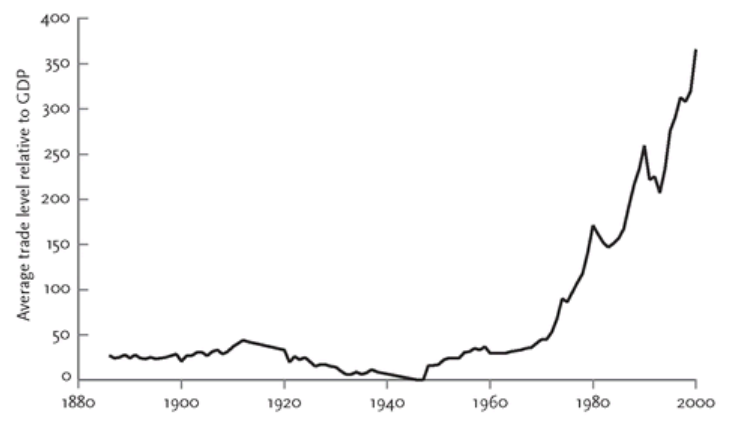
Chapter 5 turns “gentle commerce” into a testable international claim. Trade can raise the opportunity cost of war, make each side dependent on the other’s continued production, reward reliable contracting, and give owners and workers reasons to resist a leader’s destructive search for glory. In Russett and Oneal’s pair-year analysis, countries more dependent on trade were less likely to enter a militarized dispute in the following year even after controls for democracy, power, great-power status, and economic growth.
Figure 5-24 — International trade relative to GDP, 1885–2000. Pinker does not treat trade as sufficient or automatically humane. Pre-1914 interdependence did not prevent World War I; ships and roads can enable raiding as well as exchange; empires imposed commerce by force; leaders may value ideology or grandeur above prosperity; peace itself enables trade; and development, democracy, alliances, and institutions are entangled with openness. The figure is a historical series ending in 2000, and the regression evidence supports an association under a model—not a guarantee that any capitalist state, commercial relationship, or trade policy is pacifying. Chapter 5 synthesis · The liberal-peace hypothesis, PDF pp. 402–404 (file not included in this release) · Trade regression and Figure 5-24, PDF pp. 404–405 (file not included in this release) · Commercial openness and the capitalist-peace debate, PDF pp. 405–407 (file not included in this release)
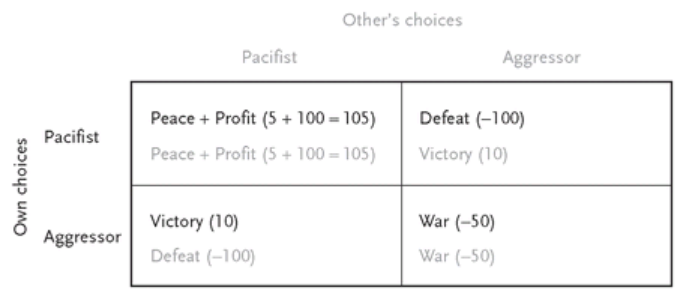
Pinker’s Chapter 10 synthesis — commerce changes the payoff to peace, but it is not a magic switch
Figure 10-3 — How commerce resolves the Pacifist’s Dilemma. Specialization and voluntary exchange add a continuing profit to mutual peace and can make a potential adversary more valuable as a partner than as a target. The mechanism depends on an enabling infrastructure—transport, finance, record-keeping, contracts, and protection from plunder—and may reward perspective-taking and reliable dealing without requiring personal warmth. Pinker connects it to historical commercial expansion, lower conflict among trading states, lower civil-war and genocide risk in more open economies, and the opposite association for extraction-based resource wealth.
The causal boundary is as important as the mechanism. Trade, peace, law, state capacity, and development grow together; peaceful relations can enable commerce as commerce may support peace. Pinker also says that the specific psychological claim—that completing a mutually profitable exchange reduces hostility—had not been directly tested in the laboratory. The defensible claim is conditional and institutional, not that markets automatically civilize every transaction, firm, or state. Chapter 10 synthesis · Commerce and Figure 10-3, PDF pp. 934–935 (file not included in this release) · Untested psychological mechanism, PDF p. 936 (file not included in this release)
Henrich, Chapter 9 — markets depend on learned norms, not self-interest alone
Henrich’s cross-cultural games suggest that more market-integrated communities make fairer offers to anonymous others. Among 53 Oromo communities, shorter travel time to a market town was associated with stronger conditional cooperation; those communities were then more likely to form rule-bound forest cooperatives, monitor free riders, and preserve shared resources. The proposed mechanism is cultural learning: repeated exchange rewards standards of impartial honesty, fairness, reputation, and cooperation beyond kin, while effective institutions feed back into better markets. market integration and Dictator Game offers, Figure 9.2, PDF p. 296 (file not included in this release) · Oromo conditional cooperation, Figure 9.3, PDF pp. 300–301 (file not included in this release) · markets–associations feedback model, Figure 9.4, PDF p. 302 (file not included in this release)
Credence goods expose why price and self-interest are insufficient. In an endnoted field study of informal milk markets in Delhi and Uttar Pradesh, every purchased sample was diluted by 4–37% water, averaging 18%; even milk sellers could not reliably detect dilution below about 40%. Among 72 sellers, more false reports in a private die task predicted more dilution. This is one field study, not a verdict on Indian markets or caste, but it shows why testing, reputation, enforceable standards, and internalized honesty matter when buyers cannot verify quality. milk credence-good study, Chapter 9 endnote 29, PDF pp. 574–575 (file not included in this release)
The causal and moral limits are substantial. Economic games measure selected norms, not virtue; market proximity can proxy towns and other institutions; a randomized market-access intervention in two African countries found no rise in impersonal trust after two years; and markets may strengthen conditional fairness toward strangers while reducing interpersonal warmth or enabling fraud, exploitation, and commodification. The strongest conclusion is that capitalism requires a cultural and legal infrastructure it cannot simply assume—not that commerce automatically makes people good. interpersonal versus impersonal prosociality, PDF pp. 302–304 (file not included in this release) · game and market-causality qualifications, PDF pp. 571–573 (file not included in this release) · Chapter 9 source audit
Henrich, Chapters 10–11 — competitive markets select organizations and cultivate minds
Chapter 10 adds an organizational mechanism. After U.S. banking deregulation expanded credit and firm turnover, generalized trust rose; German workers who moved into more competitive industries became more trusting; and French undergraduates contributed more in Public Goods Games when their groups competed. Henrich’s claim is not that rivalry makes each actor generous. Competition among groups can favor firms that suppress internal free riding and elicit cooperation, with some habits spilling into stranger trust. The banking design is quasi-experimental, the German evidence follows movers, and the lab identifies a short-run effect, but none establishes that every deregulation, industry, or competitive setting has the same result. Competition can also select fraud, monopoly, pollution, labor exploitation, sabotage, or kin-based exclusion when rules reward them. Banking deregulation and generalized trust, Figure 10.3, PDF p. 344 (file not included in this release) · Group competition and public goods, Figure 10.4, PDF p. 346 (file not included in this release)
Chapter 11 shifts from institutions to psychological calibration. Markets and occupational mobility may reward punctuality, patient effort, self-presentation, differentiated personalities, and stronger ownership norms. Henrich links urban individualism to faster walking, medieval Cistercian density to later work values, falling interest and murder rates to patience and self-control, urbanization to more independent WEIRD-5 dimensions, and Hadza market integration to a stronger endowment effect. These are heterogeneous and often indirect studies, not one demonstrated chain: Henrich explicitly calls the chapter speculative, with some claims resting on a single population or ecological association. The useful capitalist thesis is coevolutionary—markets require learned people and then help make them—not that market psychology is natural, uniformly rational, or morally complete. Individualism and walking speed, Figure 11.1, PDF p. 362 (file not included in this release) · Urbanization and personality dimensions, Figure 11.4, PDF p. 385 (file not included in this release) · Hadza endowment experiment, PDF pp. 386–389 (file not included in this release) · Chapter 10 source audit · Chapter 11 source audit
- Ideas + freedom, not raw resources. Oil, iron, and land are inert until human reason transforms them; Russia and China had more and stayed poor. → The Nature of Capitalism - Peterson Academy (§3)
- Prices are the language of the economy. They coordinate fragments of dispersed, local, tacit, and changing knowledge without requiring one actor to possess the whole picture. They remain imperfect signals rather than moral verdicts. → Hayek - Knowledge Problem
- Profit rewards value creation; loss disciplines waste — creative destruction reallocates resources to their best use. → Economics in One Lesson - Henry Hazlitt
- Voluntary trade is win-win and cooperative on a global scale (43 countries build one iPhone).
- Even Marx conceded capitalism “created more colossal productive forces than all preceding generations combined.” → Karl Marx
- The moral case: properly understood self-interest (rational egoism) is virtuous — rationality, productiveness, trade — and capitalism is the only system consistent with human nature. → The Nature of Capitalism - Peterson Academy (§7–8)
Moral egoism is not motivational monism
The claim that people ought to pursue rational self-interest is a normative argument. It should not be defended by the separate empirical claim that people are always purely self-interested material maximizers. Ostrom's Nobel lecture finds that the latter model predicts well in competitive private-goods markets and anonymous, noncommunicating dilemmas, but not universally. Repeated interaction, communication, reputation, fairness norms, reciprocity, and legitimate participant-made rules frequently alter behavior. Capitalism’s strongest defense can therefore retain incentives, property, prices, and voluntary exchange without resting on a psychologically implausible one-motive theory.
Incentives
Incentives, Compulsory Labor, and Productivity
Under England’s traditional statute-labor system, farmers were legally required to provide labor, servants, horses, and equipment for maintaining local roads. Because they regarded the work as an imposed burden from which they received no direct benefit, it was performed slowly, grudgingly, and inadequately.
Contemporary observers noted that paid labor was dramatically more productive than compelled labor: three hired teams could accomplish more than five compulsory teams, while five hired laborers could outperform twenty statute laborers.
Blanning uses this example to illustrate how the absence of personal benefit weakened motivation and productivity. The General Highway Acts of 1766 and 1773 therefore allowed compulsory labor duties to be converted into cash payments, while turnpike trusts introduced toll revenue and the profit motive into road construction and maintenance.
This is the calculation/incentive argument in miniature — see Refutations of Socialism & Communism §1.
🛑 The case against socialism & communism
Fully developed in the companion note — Refutations of Socialism & Communism — which covers:
- §1 Theory — the Economic Calculation Problem (Mises) and the Knowledge Problem (Hayek). → Mises Institute Notes
- §2 Empirical record — USSR, Mao’s China, North Korea, Venezuela, Cuba. → The Rise of Communism - Vejas Gabriel Liulevicius · Frank Dikötter and the True History of Communist China
- §3 Marxist theory refuted — labor theory of value, the “exploitation” inversion, Hoppe’s class analysis. → @hoppeMarxistAustrianClass1993
- §4 Answering the 7 objections to capitalism (poverty, exploitation, inequality, monopoly, boom/bust, cronyism, war).
- §7 Debate talking points — the majority-faction problem, the force-doctrine transfer. → Communism Debate - Andrew Wilson VS Haz Al-Din
- §8 Steelman + honest objections — where the anti-socialist case overreaches. → Alex — Capitalism, Imperialism, Palestine, Labor, and Fascism Argument Map
NOT Socialism (e.g. Nordic countries)
- Nations falsely called socialist:
- Norway, Sweden (school choice), Finland
- Less tax and regulation than the U.S. on the Index of Economic Freedom on some measures
- Cuba provides healthcare for all its citizens — that doesn’t make it “socialist” in the ownership sense
- Harmonious, low-immigration populations (Norway, Sweden, Finland) → lower costs; no national military
- Sweden’s own history debunks the myth: laissez-faire boom (1870–1930) → decline under 80%+ taxes (1970–91) → recovery after deregulation. → Refutations of Socialism & Communism §6
🗺️ Related notes in the vault
Knowledge, coordination, and institutional design
- Hayek - Knowledge Problem — how prices use dispersed knowledge; Mises, Lange, Coase, Polanyi, Scott, Simon, Stiglitz, and Ostrom
- Elinor Ostrom - Beyond Markets and States — commons, polycentric governance, bounded rationality, trust, and when user-made institutions outperform simple market/state prescriptions
- Markets, Free Speech and the Common Good — why coordination does not by itself settle moral legitimacy
- Do Liberalism, Capitalism, and the Enlightenment Cause Atomization — steelmans the market-society and postliberal critique without treating modernity as one cause
- Communism - Inefficiency, Corruption, and the Accountability Problem — calculation, distorted feedback, soft budgets, and political accountability
- Conservative vs Liberal Visions · A Conflict of Visions - Thomas Sowell — the political consequences of limited knowledge
Courses, books & primary texts
- The Nature of Capitalism - Peterson Academy — the pro-capitalism spine
- Economics in One Lesson - Henry Hazlitt · Gold Standard · Tax Cuts & Debt · Taxes paid by class
- The Rise of Communism - Vejas Gabriel Liulevicius · Vejas Liulevicius - Communism Marxism Nazism Stalin Mao Hitler · Communism in Power · The Communist Manifesto
- The Shock Doctrine - The Rise of Disaster Capitalism (the opposing thesis)
People & ideologies
- Karl Marx · Adam Smith · Ayn Rand
- Libertarianism · Democratic Socialists of America (DSA) · Socialism_Marxism
Debates, clippings & current affairs
- Communism Debate - Andrew Wilson VS Haz Al-Din · Would anarcho-capitalism be a disaster? A Soho Forum debate
- Keyu Jin China's Economy, Tariffs, Trade, Trump, Communism & Capitalism Lex Fridman Podcast 477
- Alex — Capitalism, Imperialism, Palestine, Labor, and Fascism Argument Map (steelman of the left)
- @Socialism2024 · @Communism2024 · @PeterThielCapitalism2025 · @MamdaniBlastsCapitalism2026 · @EveryTimeSocialist · @JamesLindsayAntiCommunist2025 · @archiveWokeCapitalismAbsurd2024
📚 References
- Index of Economic Freedom: Read the Report | The Heritage Foundation
- Deirdre McCloskey, The Great Enrichment / Bourgeois trilogy
- Ludwig von Mises, Economic Calculation in the Socialist Commonwealth → Mises Institute Notes