⬅️ Hub: Philosophers (MOC) · Related: Rights · Utilitarianism · The Philosophy of Politics - Part 2 - Peterson Academy
A working profile of Cesare Beccaria and his Enlightenment case for clear laws, proportionate punishment, deterrence, and opposition to torture and capital punishment.
Journal source
Notebook p. 100 — Beccaria, criminal-law reform, punishment, prevention, and arms (file not included in this release). The prose below converts and checks that handwritten page; it is not a verbatim transcript.
Why Beccaria Matters
Cesare Beccaria Bonesana (1738–1794) was a Milanese Enlightenment thinker whose short book On Crimes and Punishments (1764) helped recast criminal law as a public institution answerable to reason. The notebook’s labels—“father of modern criminal law” and “father of criminal justice”—are honorific rather than exclusive historical titles, but they capture his unusually broad influence on penal reform, later utilitarianism, and American constitutional thought.
His central move was to replace inherited cruelty and judicial discretion with a public test:
Punishment is legitimate only insofar as it is necessary to protect the social compact, prevent future injury, and do so with the least needless suffering.
This is neither a theory of revenge nor a claim that offenders lack responsibility. It makes punishment prospective and civic: stop the offender from repeating the injury, deter others, and preserve equal security under known laws.
A Rational Penal System
| Principle | Beccaria’s argument | Institutional implication |
|---|---|---|
| Legality | Citizens must be able to know in advance what conduct is criminal. | Clear, public, stable statutes rather than improvised offenses. |
| Proportionality | Punishments should track the social harm of crimes. | A graded scale, not indiscriminate severity. |
| Parsimony | Any suffering beyond what prevention requires is unjustified. | Use the least severe effective sanction. |
| Celerity | A prompt consequence forms a clearer association between act and punishment. | Avoid arbitrary or interminable delay while preserving due process. |
| Certainty over spectacle | Ever-harsher penalties lose force as people habituate to them; predictable enforcement matters more. | Improve detection, adjudication, and consistency instead of escalating cruelty. |
| Equality | Status and personal connections should not determine sentence. | General laws and equal treatment. |
Judges and legislation
The notebook says judges should not “interpret the law.” Beccaria’s target was expansive, arbitrary discretion under obscure criminal codes. His ideal sharply separates legislation from adjudication: legislators define crimes and penalties; judges decide whether the evidence places the accused under the law. A modern qualification is necessary: no legal text applies itself, so interpretation cannot literally disappear. His durable point is narrower—penal liability should not depend on a judge inventing crimes or punishments after the fact.
What He Opposed
Torture and secret accusation
Torture is a defective truth-finding device: it makes pain tolerance, not guilt, determine who confesses. It also punishes before conviction. Secret accusations deny the accused a meaningful chance to answer and allow private malice to borrow the state’s coercive power.
Capital punishment
The notebook correctly records his two principal objections:
- Individuals entering a social compact do not thereby grant the state an ordinary right to take their lives.
- Execution is neither necessary nor the most useful deterrent when a lasting, less cruel penalty can protect society and provide a more continuous warning.
Beccaria allows an exceptional necessity argument in circumstances where a person’s continued existence could endanger the state, so “categorically opposed in every imaginable case” would overstate the text. His presumption, however, is radically against capital punishment.
Pinker’s Chapter 4 supplement — Beccaria’s argument in the long penal retreat
Pinker places On Crimes and Punishments inside a broader shift from punishment as spectacular vengeance to punishment as a publicly justified instrument. Beccaria’s key claims were mutually reinforcing: penalties should track social harm; certainty and promptness matter more than severity; trials should be public and evidence-based; torture corrupts adjudication; and the state has not shown that execution is necessary for deterrence. Pinker reports that the book became an international sensation and that the major Western abolitions of judicial torture followed within decades, though influence is not the same as single-cause proof.
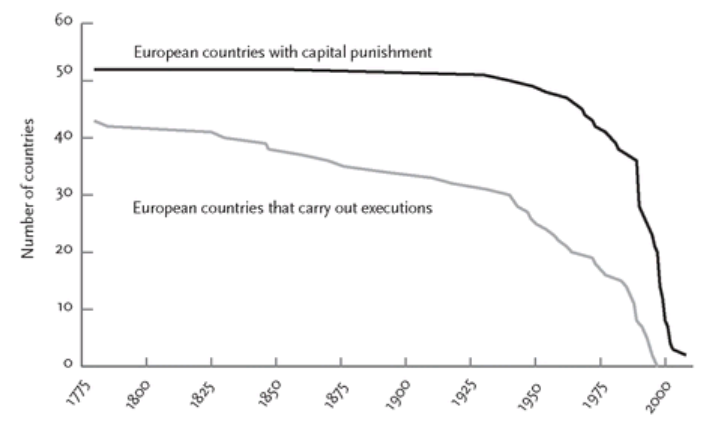
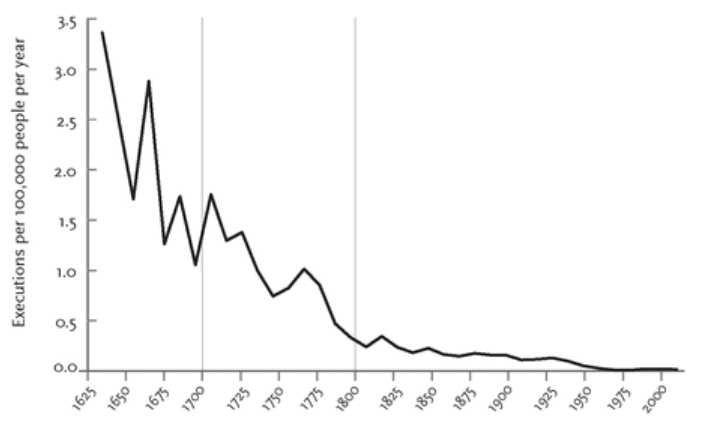
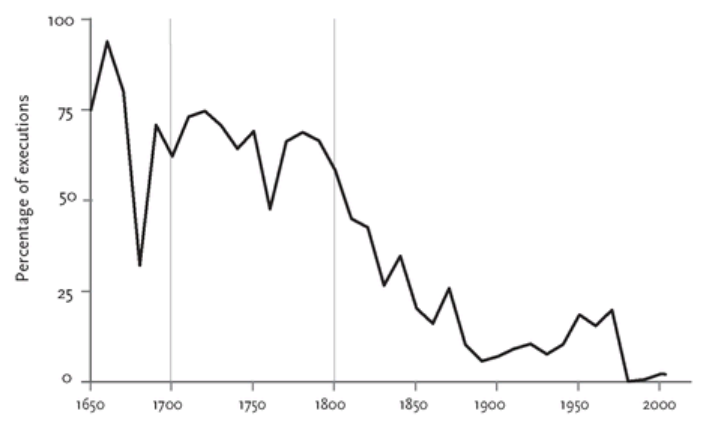
Figures 4-3 to 4-5 — European legal abolition and the contraction of American execution rates and capital offenses. The American series supports a long decline in the frequency and scope of execution, while the European chart also shows that formal abolition often lagged a country’s last execution by decades. These are historical charts published in 2011, with data ending around 2010 or earlier; they should not be used as a current inventory of death-penalty law. Chapter 4 synthesis · Beccaria’s principles and reception, PDF pp. 219–220 (file not included in this release) · Capital punishment and legal contraction, PDF pp. 221–225 (file not included in this release) · Figures 4-3 and 4-4, PDF p. 223 (file not included in this release) · Figure 4-5, PDF p. 225 (file not included in this release) · Abolition and homicide, PDF p. 226 (file not included in this release)
Suicide laws, dueling, and bounty hunting
- Punishing suicide is largely futile because the supposed offender is dead; threatening surviving family members creates innocent victims.
- Dueling is best reduced by changing the laws and honor incentives that make refusal socially ruinous, not simply by severe punishment.
- State rewards for apprehending offenders can turn citizens into informers or bounty seekers and create perverse incentives unless tightly constrained.
Prevention Before Severity
The constructive program on the page is concise:
- enact clear and simple laws;
- make enforcement regular rather than theatrical;
- reward civic virtue;
- improve education;
- reduce opportunities for arbitrary privilege; and
- connect consequences closely enough to conduct for deterrence to work.
This is the ancestor of a modern distinction between the certainty, swiftness, and proportionality of punishment and its raw severity. The theory also fits the notebook’s personal position—firmness toward repeat offenders combined with reintegration—better than either indiscriminate leniency or punitive maximalism.
The Passage About Arms
The notebook preserves a real passage from chapter 40, “Of False Ideas of Utility.” Beccaria argues that a general prohibition on carrying arms may disarm people disposed to obey while leaving determined assailants armed, thereby making attack easier.
Scope of the claim
This is an eighteenth-century argument against a broad prohibition, not a ready-made verdict on every modern firearm regulation. Licensing, prohibited-person rules, domestic-violence disqualification, storage requirements, and weapon-specific restrictions must each be tested on their own effects. The passage supplies a question—whom does this rule actually constrain?—not a complete contemporary policy.
Influence and Tensions
- Jeremy Bentham developed a more systematic utilitarian theory of legislation, but Beccaria was a major precursor.
- American founders and early jurists read Beccaria, especially on proportionality, due process, and the death penalty; influence does not mean every constitutional clause is a direct transcription of his views.
- A deterrence-centered model can undervalue desert, rehabilitation, victims, and expressive condemnation.
- His confidence that rational legislation could sharply confine judging is difficult to sustain in hard cases.
- “Public utility” can itself license coercion unless constrained by rights and evidentiary standards.
Questions for Reuse
- Does a proposed punishment prevent future harm, or mainly express anger?
- Would greater certainty of enforcement outperform greater severity?
- Is the offense and penalty clear before the act?
- Does the rule burden compliant citizens more than likely offenders?
- What process protects against false accusation and coerced confession?
- What route returns a punished person to lawful membership in society?
Sources
- Cesare Beccaria, Of Crimes and Punishments, ch. 12, “Of the Intent of Punishments”.
- Cesare Beccaria, ch. 28, “Of the Punishment of Death”.
- Cesare Beccaria, ch. 40, “Of False Ideas of Utility”.
- Cesare Beccaria, Internet Encyclopedia of Philosophy.