Distilled Knowledge
Source contribution
Sandel’s course teaches political philosophy as comparative moral reasoning. Hard cases reveal that public disputes turn on competing ideas of welfare, freedom, consent, desert, equality, virtue, and the common good—not simply on different factual beliefs.
- Utilitarian route: maximize aggregate welfare, but explain whether rights may be sacrificed or preferences corrupted.
- Kantian route: respect persons as ends, but explain how abstract duties govern tragic conflicts.
- Rawlsian route: choose fair terms behind a veil of ignorance, prioritizing basic liberties and protections for the least advantaged.
- Aristotelian/communitarian route: ask what a practice is for and which virtues it should honor, while guarding against coercive moralism.
- Method: move from intuition to principle, expose inconsistency with counterexamples, and revise toward reflective equilibrium.
Routes into the permanent notes
- Liberty, Equality, Authority, and the Common Good holds the comparative argument map.
- Political Philosophy Allocates Power and Goods generalizes the cases into an allocation-and-authority diagnostic.
- My Political Beliefs records the user’s provisional synthesis; it should not be attributed to Sandel.
Evidence boundary
Classroom exchanges demonstrate reasoning; they are not representative polling or empirical proof. Exact quotations need checking against the video or book.
# Episode 1: The Moral Side of Murder ([[60 Knowledge/60.9 Philosophy/60.9.3 Branches/60.9.3.2 Ethics/Normative Ethics/Utilitarianism|Utilitarianism]] vs Categorial Moral Reasoning)Links
Summary
Here is an extensive summary of the first lecture from Michael Sandel’s Justice: What’s the Right Thing to Do?, based on the video transcript you provided. The lecture introduces moral reasoning through classic trolley problem variations and a real-world cannibalism case, setting up the central philosophical tensions between consequentialism and categorical moral reasoning.
🧭 Part 1: The Trolley Problem – Hypothetical Moral Dilemmas
⚖️ Case 1: The Classic Trolley Problem
- A runaway trolley is headed toward five workers.
- You can steer it onto a side track, where it will kill one worker instead.
- Majority of students say they would steer the trolley to kill one and save five.
Justifications:
- It’s better to kill one than five — a utilitarian or consequentialist justification.
- Comparison is made to passengers on Flight 93 on 9/11 who sacrificed themselves to save others.
⚖️ Case 2: The Fat Man Variation
- Same runaway trolley scenario, but now you’re on a bridge.
- You can push a large man off the bridge to stop the trolley and save five workers.
Reactions:
- Most students wouldn’t push the fat man.
- Despite the same utilitarian trade-off (1 life vs. 5), this feels morally different.
Why the difference?
- Some argue pushing the fat man is more personal and direct than steering the trolley.
- Others highlight agency and involvement: the fat man was not part of the original danger.
- I think I would turn into the 1 man on the tracks and throw the fat man. You are making the decision in both cases, either deciding to do it or not.
🧭 Part 2: Medical Variants of the Dilemma
⚕️ Case 3: Emergency Room Triage
- A doctor must decide between saving one severely injured patient or five moderately injured ones.
- Majority say they would save the five — again using a utilitarian framework.
⚕️ Case 4: Transplant Surgeon Case
- A healthy man comes for a check-up.
- Doctor could harvest his organs to save five dying patients.
- Almost no one supports this action — again, the personal act of killing seems morally worse than letting five die.
⚖️ Key Philosophical Distinction Introduced
1. Consequentialist Moral Reasoning (Utilitarianism)
- Morality depends on the outcomes of actions.
- If more people benefit, the action is justified.
- Famous proponents: Jeremy Bentham and John Stuart Mill.
- Key principle: maximize utility — i.e., maximize happiness and minimize suffering.
2. Categorical Moral Reasoning
- Some acts are intrinsically wrong, regardless of the outcome.
- E.g., murder is always wrong, even if it saves more lives.
- Most famous advocate: Immanuel Kant.
- Emphasizes duty, rights, and moral absolutes.
🧭 Part 3: Real-Life Case – The Queen v. Dudley and Stephens (1884)
The Facts:
- Four shipwrecked sailors stranded at sea.
- After 19 days, they kill and eat the sickly 17-year-old cabin boy, Richard Parker, to survive.
- They are rescued four days later and arrested.
Moral Debate:
- Defense (Utilitarian View): It was necessary. Killing one to save three, plus their dependent families, was justified.
- Prosecution (Categorical View): Murder is murder, regardless of the outcome.
Sub-debates:
- Consent: If Parker had given permission, would it be okay?
- Lottery: Would randomly selecting a victim make it justifiable?
- Intent and Remorse: Lack of remorse, as in Dudley’s diary, further complicates moral judgment.
🧭 Philosophical Questions Raised
Sandel presents three critical philosophical questions to guide future inquiry:
-
Why is murder categorically wrong?
- Is it because all people have inviolable rights?
- If so, where do these rights come from?
-
Does a fair procedure (like a lottery) justify the outcome?
- If all agree, does that make killing morally acceptable?
-
What moral weight does consent carry?
- Does an act become morally right if the victim consents to it?
- Can consent under duress be valid?
🧭 Purpose and Warning of the Course
- The course will explore these debates through readings from Aristotle, Locke, Kant, Mill, and others.
- It will also connect philosophy to real-world political/legal debates: equality, free speech, same-sex marriage, conscription, etc.
⚠️ Warning:
- Philosophy is risky: It unsettles our assumptions and forces self-reflection.
- Like Socrates, students risk becoming alienated from common beliefs.
- Skepticism is a temptation (i.e., “we’ll never resolve these debates”), but it’s an evasion.
- Kant’s response: Skepticism is a “resting place,” not a “dwelling place.”
“This may sound appealing enough, but here I have to issue a warning.
And the warning is this:
To read these books in this way—as an exercise in self-knowledge—carries certain risks. Risks that are both personal and political. Risks that every student of political philosophy has known.
These risks spring from the fact that philosophy teaches us and unsettles us by confronting us with what we already know. There’s an irony: the difficulty of this course consists in the fact that it teaches what you already know.
It works by taking what we know from familiar, unquestioned settings, and making it strange. That’s how those examples worked—the hypotheticals with which we began, with their mix of playfulness and sobriety.
It’s also how these philosophical books work.
Philosophy estranges us from the familiar, not by supplying new information, but by inviting and provoking a new way of seeing.
But—and here’s the risk—once the familiar turns strange, it’s never quite the same again.
Self-knowledge is like lost innocence: however unsettling you find it, it can never be unthought or unknown.
What makes this enterprise difficult, but also riveting, is that moral and political philosophy is a story—and you don’t know where the story will lead. But what you do know is that the story is about you.”
“Skepticism is a resting place for human reason where it can reflect upon its dogmatic wanderings, but it is no dwelling place for permanent settlement. Simply to acquiesce in skepticism can never suffice to overcome the restlessness of reason.”
Immanuel Kant
🧠 Final Message
- This course aims to “awaken the restlessness of reason.”
- Even if we can’t answer all moral questions definitively, we live by moral choices every day.
- Therefore, examining them philosophically is unavoidable — and profoundly personal.
Transcript
Duration: 54:56
00:04 Funding for this program is provided by: Additional funding provided by This is a course about Justice and we begin with a story suppose you’re the driver of a trolley car, and your trolley car is hurdling down the track at sixty miles an hour and at the end of the track you notice five workers working on the track
00:49 you tried to stop but you can’t your brakes don’t work you feel desperate because you know that if you crash into these five workers they will all die let’s assume you know that for sure and so you feel helpless until you notice that there is off to the right a side track at the end of that track there’s one worker working on track you’re steering wheel works
01:21 so you can turn the trolley car if you want to onto this side track killing the one but sparing the five. Here’s our first question what’s the right thing to do? What would you do? Let’s take a poll, how many would turn the trolley car onto the side track? How many wouldn’t? How many would go straight ahead keep your hands up, those of you who’d go straight ahead. A handful of people would, the vast majority would turn let’s hear first
02:09 now we need to begin to investigate the reasons why you think it’s the right thing to do. Let’s begin with those in the majority, who would turn to go onto side track? Why would you do it, what would be your reason? Who’s willing to volunteer a reason? Go ahead, stand up.
02:32 Because it can’t be right to kill five people when you can only kill one person instead. it wouldn’t be right to kill five if you could kill one person instead that’s a good reason that’s a good reason who else? does everybody agree with that
02:56 reason? go ahead. Well I was thinking it was the same reason it was on 9/11 we regard the people who flew the plane who flew the plane into the Pennsylvania field as heroes because they chose to kill the people on the plane and not kill more people in big buildings. So the principle there was the same on 9/11 it’s tragic circumstance,
03:21 but better to kill one so that five can live is that the reason most of you have, those of you who would turn, yes? Let’s hear now from those in the minority those who wouldn’t turn. Well I think that same type of mentality that justifies genocide and totalitarianism in order to save one type of race you wipe out the other.
03:50 so what would you do in this case? You would to avoid the horrors of genocide you would crash into the five and kill them? Presumably yes. okay who else? That’s a brave answer, thank you. Let’s consider another trolley car case and see whether those of you in the majority want to adhere to the principle,
04:30 better that one should die so that five should live. This time you’re not the driver of the trolley car, you’re an onlooker standing on a bridge overlooking a trolley car track and down the track comes a trolley car at the end of the track are five workers the brakes don’t work the trolley car is about to careen into the five and kill them
04:55 and now you’re not the driver you really feel helpless until you notice standing next to you leaning over the bridge is it very fat man. And you could give him a shove he would fall over the bridge onto the track right in the way of the trolley car he would die
05:33 but he would spare the five. Now, how many would push the fat man over the bridge? Raise your hand. How many wouldn’t? Most people wouldn’t. Here’s the obvious question, what became of the principle better to save five lives even if it means sacrificing one, what became of the principal that almost everyone endorsed in the first case
06:09 I need to hear from someone who was in the majority in both cases is how do you explain the difference between the two? The second one I guess involves an active choice of pushing a person and down which I guess that that person himself would otherwise not have been involved in the situation at all
06:29 and so to choose on his behalf I guess to involve him in something that he otherwise would have this escaped is I guess more than what you have in the first case where the three parties, the driver and the two sets of workers are already I guess in this situation.
06:50 but the guy working, the one on the track off to the side he didn’t choose to sacrifice his life any more than the fat guy did, did he? That’s true, but he was on the tracks. this guy was on the bridge. Go ahead, you can come back if you want. Alright, it’s a hard question
07:15 but you did well you did very well it’s a hard question. who else can find a way of reconciling the reaction of the majority in these two cases? Yes? Well I guess in the first case where you have the one worker and the five it’s a choice between those two, and you have to make a certain choice and people are going to die because of the trolley car not necessarily because of your direct actions. The trolley car is a runway, thing and you need to make in a split second choice whereas pushing the fat man over is an actual act of murder on your part you have control over that whereas you may not have control over the trolley car.
07:57 So I think that it’s a slightly different situation. Alright who has a reply? Is that, who has a reply to that? no that was good, who has a way who wants to reply? Is that a way out of this? I don’t think that’s a very good reason because you choose either way you have to choose who dies because you either choose to turn and kill a person which is an act of conscious thought to turn, or you choose to push the fat man
08:21 over which is also an active conscious action so either way you’re making a choice. Do you want to reply? Well I’m not really sure that that’s the case, it just still seems kind of different, the act of actually pushing someone over onto the tracks and killing them, you are actually killing him yourself, you’re pushing him with your own hands you’re pushing and that’s different
08:43 than steering something that is going to cause death into another…you know it doesn’t really sound right saying it now when I’m up here. No that’s good, what’s your name? Andrew. Andrew and let me ask you this question Andrew, suppose standing on the bridge next to the fat man I didn’t have to push him, suppose he was standing over a trap door that I could open by turning a steering wheel like that would you turn it?
09:18 For some reason that still just seems more more wrong. I mean maybe if you just accidentally like leaned into this steering wheel or something like that or but, or say that the car is hurdling towards a switch that will drop the trap then I could agree with that. Fair enough, it still seems wrong in a way that it doesn’t seem wrong in the first case to turn, you say An in another way, I mean in the first situation you’re involved directly with the situation in the second one you’re an onlooker as well.
09:52 So you have the choice of becoming involved or not by pushing the fat man. Let’s forget for the moment about this case, that’s good, but let’s imagine a different case. This time your doctor in an emergency room and six patients come to you they’ve been in a terrible trolley car wreck five of them sustained moderate injuries one is severely injured you could spend all day caring for the one severely injured victim,
10:27 but in that time the five would die, or you could look after the five, restore them to health, but during that time the one severely injured person would die. How many would save the five now as the doctor? How many would save the one? Very few people, just a handful of people.
10:49 Same reason I assume, one life versus five. Now consider another doctor case this time you’re a transplant surgeon and you have five patients each in desperate need of an organ transplant in order to survive on needs a heart one a lung, one a kidney, one a liver and the fifth a pancreas. And you have no organ donors you are about to see you them die and then it occurs to you that in the next room there’s a healthy guy who came in for a checkup. and he is you like that and he’s taking a nap you could go in very quietly
11:56 yank out the five organs, that person would die but you can save the five. How many would do it? Anyone? How many? Put your hands up if you would do it. Anyone in the balcony? You would? Be careful don’t lean over too much How many wouldn’t? All right. What do you say, speak up in the balcony, you who would yank out the organs, why?
12:35 I’d actually like to explore slightly alternate possibility of just taking the one of the five he needs an organ who dies first and using their four healthy organs to save the other four That’s a pretty good idea. That’s a great idea except for the fact
13:00 that you just wrecked the philosophical point. Let’s step back from these stories and these arguments to notice a couple of things about the way the arguments have began to unfold. Certain moral principles have already begun to emerge from the discussions we’ve had and let’s consider what those moral principles look like the first moral principle that emerged from the discussion said that the right thing to do the moral thing to do depends on the consequences that will result from your action at the end of the day better that five should live even if one must die. That’s an example of consequentialist
13:56 moral reasoning. consequentialist moral reasoning locates morality in the consequences of an act. In the state of the world that will result from the thing you do but then we went a little further, we considered those other cases and people weren’t so sure about
14:17 consequentialist moral reasoning when people hesitated to push the fat man over the bridge or to yank out the organs of the innocent patient people gestured towards reasons having to do with the intrinsic quality of the act itself. Consequences be what they may. People were reluctant people thought it was just wrong categorically wrong to kill
14:50 a person an innocent person even for the sake of saving five lives, at least these people thought that in the second version of each story we reconsidered so this points a second categorical way of thinking about
15:14 moral reasoning categorical moral reasoning locates morality in certain absolute moral requirements in certain categorical duties and rights regardless of the consequences. We’re going to explore in the days and weeks to come the contrast between consequentialist and categorical moral principles. The most influential example of
15:40 consequential moral reasoning is utilitarianism, a doctrine invented by Jeremy Bentham, the eighteenth century English political philosopher. The most important philosopher of categorical moral reasoning is the eighteenth century German philosopher Emmanuel Kant.
16:02 So we will look at those two different modes of moral reasoning assess them and also consider others. If you look at the syllabus, you’ll notice that we read a number of great and famous books. Books by Aristotle John Locke Emanuel Kant, John Stuart Mill, and others. You’ll notice too from the syllabus that we don’t only read these books,
16:28 we also all take up contemporary political and legal controversies that raise philosophical questions. We will debate equality and inequality, affirmative action, free speech versus hate speech, same sex marriage, military conscription, a range of practical questions, why not just to enliven these abstract and distant books
16:55 but to make clear to bring out what’s at stake in our everyday lives including our political lives, for philosophy. So we will read these books and we will debate these issues and we’ll see how each informs and illuminates the other.
17:15 This may sound appealing enough but here I have to issue a warning, and the warning is this to read these books in this way, as an exercise in self-knowledge, to read them in this way carry certain risks
17:38 risks that are both personal and political, risks that every student of political philosophy have known. These risks spring from that fact that philosophy teaches us and unsettles us by confronting us with what we already know. There’s an irony
18:03 the difficulty of this course consists in the fact that it teaches what you already know. It works by taking what we know from familiar unquestioned settings, and making it strange. That’s how those examples worked worked the hypotheticals with which we began with their mix of playfulness and sobriety.
18:29 it’s also how these philosophical books work. Philosophy estranges us from the familiar not by supplying new information but by inviting and provoking a new way of seeing but, and here’s the risk, once the familiar turns strange, it’s never quite the same again.
18:58 Self-knowledge is like lost innocence, however unsettling you find it, it can never be unthought or unknown what makes this enterprise difficult but also riveting, is that
19:20 moral and political philosophy is a story and you don’t know where this story will lead but what you do know is that the story is about you. Those are the personal risks, now what of the political risks. one way of introducing of course like this would be to promise you that by reading these books and debating these issues you will become a better more responsible citizen. You will examine the presuppositions of public policy, you will hone your political judgment you’ll become a more effective participant in public affairs
20:02 but this would be a partial and misleading promise political philosophy for the most part hasn’t worked that way. You have to allow for the possibility that political philosophy may make you a worse citizen rather than a better one or at least a worse citizen before it makes you a better one
20:27 and that’s because philosophy is a distancing even debilitating activity And you see this going back to Socrates there’s a dialogue, the Gorgias in which one of Socrates’ friends Calicles tries to talk him out of philosophizing.
20:49 calicles tells Socrates philosophy is a pretty toy if one indulges in it with moderation at the right time of life but if one pursues it further than one should it is absolute ruin. Take my advice calicles says, abandon argument learn the accomplishments of active life, take for your models not those people who spend their time on these petty quibbles,
21:16 but those who have a good livelihood and reputation and many other blessings. So Calicles is really saying to Socrates quit philosophizing, get real go to business school and calicles did have a point he had a point
21:39 because philosophy distances us from conventions from established assumptions and from settled beliefs. those are the risks, personal and political and in the face of these risks there is a characteristic evasion, the name of the evasion is skepticism. It’s the idea well it goes something like this we didn’t resolve, once and for all, either the cases or the principles we were arguing when we began and if Aristotle
22:11 and Locke and Kant and Mill haven’t solved these questions after all of these years who are we to think that we here in Sanders Theatre over the course a semester can resolve them and so maybe it’s just a matter of each person having his or her own principles and there’s nothing more to be said about it
22:34 no way of reasoning that’s the evasion. The evasion of skepticism to which I would offer the following reply: it’s true these questions have been debated for a very long time but the very fact that they have reoccurred and persisted may suggest that though they’re impossible in one sense their unavoidable in another
22:59 and the reason they’re unavoidable the reason they’re inescapable is that we live some answer to these questions every day. So skepticism, just throwing up their hands and giving up on moral reflection, is no solution Emanuel Kant described very well the problem with skepticism when he wrote
23:23 skepticism is a resting place for human reason where it can reflect upon its dogmatic wanderings but it is no dwelling place for permanent settlement. Simply to acquiesce in skepticism, Kant wrote, can never suffice to overcome the restless of reason. I’ve tried to suggest through theses stories and these arguments
23:47 some sense of the risks and temptations of the perils and the possibilities I would simply conclude by saying that the aim of this course is to awaken the restlessness of reason and to see where it might lead thank you very much. Like, in a situation that desperate, you have to do what you have to do to survive. You have to do what you have to do you? You’ve gotta do What you gotta do. pretty much, If you’ve been going nineteen days without any food
24:25 someone has to take the sacrifice, someone has to make the sacrifice and people can survive. Alright that’s good, what’s your name? Marcus. Marcus, what do you say to Marcus? Last time we started out last time
24:46 with some stores with some moral dilemmas about trolley cars and about doctors and healthy patients vulnerable to being victims of organ transplantation we noticed two things about the arguments we had one had to do with the way we were arguing it began with our judgments in particular cases
25:13 we tried to articulate the reasons or the principles lying behind our judgments and then confronted with a new case we found ourselves re-examining those principles revising each in the light of the other and we noticed the built-in pressure to try to bring into alignment our judgments about particular cases and the principles we would endorse on reflection
25:46 we also noticed something about the substance of the arguments that emerged from the discussion. We noticed that sometimes we were tempted to locate the morality of an act in the consequences in the results, in the state of the world that it brought about. We called is consequentialist
26:09 moral reason. But we also noticed that in some cases we weren’t swayed only by the results sometimes, many of us felt, that not just consequences but also the intrinsic quality or character of the act matters morally.
26:35 Some people argued that there are certain things that are just categorically wrong even if they bring about a good result even if they save five people at the cost of one life. So we contrasted consequentialist moral principles with categorical ones. Today and in the next few days we will begin to examine one of the most influential versions of consequentialist moral theory
27:10 and that’s the philosophy of utilitarianism. Jeremy Bentham, the eighteenth century English political philosopher gave first the first clear systematic expression to the utilitarian moral theory. And Bentham’s idea, his essential idea is a very simple one with a lot of morally intuitive appeal. Bentham’s idea is the following the right thing to do the just thing to do it’s to maximize utility. What did he mean by utility? He meant by utility the balance of pleasure over pain, happiness over suffering. Here’s how we arrived at the principle of maximizing utility. He started out by observing that all of us all human beings
28:27 are governed by two sovereign masters, pain and pleasure. We human beings like pleasure and dislike pain and so we should base morality whether we are thinking of what to do in our own lives or whether as legislators or citizens we are thinking about what the law should be, the right thing to do individually or collectively is to maximize, act in a way that maximizes the overall level of happiness.
29:11 Bentham’s utilitarianism is sometimes summed up with the slogan the greatest good for the greatest number. With this basic principle of utility on hand, let’s begin to test it and to examine it by turning to another case another story but this time not a hypothetical story, a real-life story the case of the Queen versus Dudley and Stephens. This was a nineteenth-century British law case that’s famous and much debated in law schools. Here’s what happened in the case I’ll summarize the story and then I want to hear how you would rule imagining that you are the jury. A newspaper account of the time described the background: A sadder story of disaster at sea was never told than that of the survivors of the yacht Mignonette.
30:16 The ship foundered in the south Atlantic thirteen hundred miles from the cape there were four in the crew, Dudley was the captain Stephens was the first mate Brooks was a sailor, all men of excellent character, or so the newspaper account tells us. The fourth crew member was the cabin boy, Richard Parker seventeen years old. He was an orphan he had no family and he was on his first long voyage at sea. He went, the news account tells us, rather against the advice of his friends. He went in the hopefulness of youthful ambition thinking the journey would make a man of him. Sadly it was not to be, the facts of the case were not in dispute, a wave hit the ship and the Mignonette went down. The four crew members escaped to a lifeboat the only food they had were two cans of preserved turnips no fresh water for the first three days they ate nothing on the fourth day that opened one of the cans of turnips and ate it. The next day they caught a turtle together with the other can of turnips the turtle enabled them to subsist for the next few days and then for eight days they had nothing no food no water. Imagine yourself in a situation like that what would you do? Here’s what they did
31:55 by now the cabin boy Parker is lying at the bottom of the lifeboat in a corner because he had drunk sea water against the advice of the others and he had become ill and he appeared to be dying so on the nineteenth day Dudley, the captain, suggested that they should all have a lottery. That they should all draw lots to see who would die to save the rest. Brooks refused he didn’t like the lottery idea
32:29 we don’t know whether this was because he didn’t want to take that chance or because he believed in categorical moral principles but in any case no lots were drawn. The next day there was still no ship in sight so a Dudley told Brooks to avert his gaze and he motioned to Stephens that the boy Parker had better be killed. Dudley offered a prayer he told a the boy his time had come and he killed him with a pen knife stabbing him in the jugular vein.
33:03 Brooks emerged from his conscientious objection to share in the gruesome bounty. For four days the three of them fed on the body and blood of the cabin boy. True story. And then they were rescued. Dudley describes their rescue in his diary with staggering euphemism, quote: “on the twenty fourth day as we were having our breakfast a ship appeared at last.” The three survivors were picked up by a German ship. They were taken back to Falmouth in England where they were arrested and tried Brooks turned state’s witness Dudley and Stephens went to trial. They didn’t dispute the facts they claimed they had acted out of necessity that was their defense they argued in effect better that one should die
34:03 so that three could survive the prosecutor wasn’t swayed by that argument he said murder is murder and so the case went to trial. Now imagine you are the jury and just to simplify the discussion put aside the question of law, and let’s assume that you as the jury are charged with deciding whether what they did was morally permissible or not. How many would vote not guilty, that what they did was morally permissible? And how many would vote guilty what they did was morally wrong? A pretty sizable majority.
34:57 Now let’s see what people’s reasons are, and let me begin with those who are in the minority. Let’s hear first from the defense of Dudley and Stephens. Why would you morally exonerate them? What are your reasons? I think it’s I think it is morally reprehensible
35:20 but I think that there’s a distinction between what’s morally reprehensible what makes someone legally accountable in other words the night as the judge said what’s always moral isn’t necessarily against the law and while I don’t think that necessity justifies theft or murder any illegal act, at some point your degree of necessity does in fact exonerate you form any guilt. ok. other defenders, other voices for the defense? Moral justifications for what they did? yes, thank you I just feel like in a situation that desperate you have to do what you have to do to survive. You have to do what you have to do ya, you gotta do what you gotta do, pretty much. If you’ve been going nineteen days without any food
36:09 you know someone just has to take the sacrifice has to make sacrifices and people can survive and furthermore from that let’s say they survived and then they become productive members of society who go home and then start like a million charity organizations and this and that and this and that, I mean they benefit everybody in the end so I mean I don’t know what they did afterwards, I mean they might have gone on and killed more people
36:30 but whatever. what? what if they were going home and turned out to be assassins? What if they were going home and turned out to be assassins? You would want to know who they assassinated. That’s true too, that’s fair I would wanna know who they assassinated. alright that’s good, what’s your name? Marcus. We’ve heard a defense a couple voices for the defense
36:54 now we need to hear from the prosecution most people think what they did was wrong, why? One of the first things that I was thinking was, oh well if they haven’t been eating for a really long time, maybe then they’re mentally affected that could be used for the defense, a possible argument that oh, that they weren’t in a proper state of mind, they were making decisions that they otherwise wouldn’t be making, and if that’s an appealing argument
37:28 that you have to be in an altered mindset to do something like that it suggests that people who find that argument convincing do you think that they’re acting immorally. But I want to know what you think you’re defending you k 0:37:41.249,0:37:45.549 you voted to convict right? yeah I don’t think that they acted in morally appropriate way. And why not? What do you say, Here’s Marcus he just defended them, he said, you heard what he said, yes I did yes that you’ve got to do what you’ve got to do in a case like that. What do you say to Marcus? They didn’t, that there is no situation that would allow human beings to take the idea of fate or the other people’s lives into their own hands that we don’t have that kind of power.
38:19 Good, okay thanks you, and what’s your name? Britt? okay. who else? What do you say? Stand up I’m wondering if Dudley and Stephens had asked for Richard Parker’s consent in, you know, dying, if that would would that exonerate them
38:41 from an act of murder, and if so is that still morally justifiable? That’s interesting, alright consent, now hang on, what’s your name? Kathleen. Kathleen says suppose so what would that scenario look like? so in the story Dudley is there, pen knife in hand, but instead of the prayer or before the prayer, he says, Parker, would you mind we’re desperately hungry, as Marcus empathizes with we’re desperately hungry you’re not going to last long anyhow, you can be a martyr, would you be a martyr how about it Parker? Then, then then what do you think, would be morally justified then? Suppose Parker in his semi-stupor
39:40 says okay I don’t think it’ll be morally justifiable but I’m wondering. Even then, even then it wouldn’t be? No You don’t think that even with consent it would be morally justified. Are there people who think who want to take up Kathleen’s consent idea and who think that that would make it morally justified? Raise your hand if it would if you think it would. That’s very interesting Why would consent make a moral difference? Why would it? Well I just think that if he was making his own original idea and it was his idea to start with then that would be the only situation in which I would see it being appropriate in anyway 0:40:25.940,0:40:28.359 because that way you couldn’t make the argument that
40:28 he was pressured you know it’s three to one or whatever the ratio was, and I think that if he was making a decision to give his life then he took on the agency to sacrifice himself which some people might see as admirable and other people might disagree with that decision. So if he came up with the idea that’s the only kind of consent we could have confidence in
40:52 morally, then it would be okay otherwise it would be kind of coerced consent under the circumstances you think. Is there anyone who thinks that the even the consent of Parker would not justify their killing him? Who thinks that? Yes, tell us why, stand up I think that Parker would be killed
41:22 with the hope that the other crew members would be rescued so there’s no definite reason that he should be killed because you don’t know when they’re going to get rescued so if you kill him you’re killing him in vain do you keep killing a crew member until you’re rescued and then you’re left with no one? because someone’s going to die eventually? Well the moral logic of the situation seems to be that. That they would keep on picking off the weakest maybe, one by one, until they were rescued and in this case luckily when three at least were still alive.
41:57 Now if if Parker did give his consent would it be all right do you think or not? No, it still wouldn’t be right. Tell us why wouldn’t be all right. First of all, cannibalism, I believe is morally incorrect so you shouldn’t be eating a human anyway. So cannibalism is morally objectionable outside
42:19 so then even in the scenario of waiting until someone died still it would be objectionable. Yes, to me personally I feel like of it all depends on one’s personal morals, like we can’t just, like this is just my opinion of course other people are going to disagree. Well let’s see, let’s hear what their disagreements are and then we’ll see
42:42 if they have reasons that can persuade you or not. Let’s try that Let’s now is there someone who can explain, those of you who are tempted by consent can you explain why consent makes such a moral difference, what about the lottery idea does that count as consent. Remember at the beginning Dudley proposed a lottery suppose that they had agreed to a lottery then how many would then say it was all right. Say there was a lottery, cabin boy lost, and the rest of the story unfolded. How many people would say it’s morally permissible?
43:33 So the numbers are rising if we add a lottery, let’s hear from one of you for whom the lottery would make a moral difference why would it? I think the essential element, in my mind that makes it a crime is the idea that they decided at some point that their lives were more important than his, and that I mean that’s kind of the basis for really any crime right? It’s like my needs, my desire is a more important than yours and mine take precedent and if they had done a lottery were everyone consented
44:04 that someone should die and it’s sort of like they’re all sacrificing themselves, to save the rest, Then it would be all right? A little grotesque but, But morally permissible? Yes. what’s your name? Matt. so, Matt for you what bothers you is not
44:27 the cannibalism, but the lack of due process. I guess you could say that And can someone who agrees with Matt say a little bit more about why a lottery would make it, in your view, morally permissible. The way I understood it originally was that that was the whole issue is that the cabin boy was never consulted
44:56 about whether or not it something was going to happen to him even though with the original lottery whether or not he would be a part of that it was just decided that he was the one that was going to die. Yes that’s what happened in the actual case but if there were a lottery and they all agreed to the procedure you think that would be okay? Right, because everyone knows that there’s gonna be a death whereas
45:17 you know the cabin boy didn’t know that this discussion was even happening there was no you know forewarning for him to know that hey, I may be the one that’s dying. Okay, now suppose the everyone agrees to the lottery they have the lottery the cabin boy loses any changes his mind. You’ve already decided, it’s like a verbal contract, you can’t go back on that. You’ve decided the decision was made
45:40 you know if you know you’re dying for the reason for at others to live, you would, you know if the someone else had died you know that you would consume them, so But then he could say I know, but I lost. I just think that that’s the whole moral issue is that there was no consulting of the cabin boy and that that’s what makes it the most horrible
46:04 is that he had no idea what was even going on, that if he had known what was going on it would be a bit more understandable. Alright, good, now I want to hear so there’s some who think it’s morally permissible but only about twenty percent, led by Marcus,
46:26 then there are some who say the real problem here is the lack of consent whether the lack of consent to a lottery to a fair procedure or Kathleen’s idea, lack of consent at the moment of death and if we add consent then more people are willing to consider the sacrifice morally justified.
46:54 I want to hear now finally from those of you who think even with consent even with a lottery even with a final murmur of consent from Parker at the very last moment it would still be wrong and why would it be wrong that’s what I want to hear. well the whole time
47:18 I’ve been leaning towards the categorical moral reasoning and I think that there’s a possibility I’d be okay with the idea of the lottery and then loser taking into their own hands to kill themselves so there wouldn’t be an act of murder but I still think that even that way it’s coerced and also I don’t think that there’s any remorse like in Dudley’s diary we’re getting our breakfast
47:44 it seems as though he’s just sort of like, oh, you know that whole idea of not valuing someone else’s life so that makes me feel like I have to take the categorical stance. You want to throw the book at him. when he lacks remorse or a sense of having done anything wrong. Right. Alright, good so are there any other defenders who who say it’s just categorically wrong, with or without consent, yes stand up. Why?
48:13 I think undoubtedly the way our society is shaped, murder is murder murder is murder and every way our society looks down at it in the same light and I don’t think it’s any different in any case. Good now let me ask you a question, there were three lives at stake versus one, the one, that the cabin boy, he had no family he had no dependents, these other three had families back home in England they had dependents they had wives and children think back to Bentham, Bentham says we have to consider the welfare, the utility, the happiness of everybody. We have to add it all up
48:51 so it’s not just numbers three against one it’s also all of those people at home in fact the London newspaper at the time and popular opinion sympathized with them Dudley in Stephens and the paper said if they weren’t motivated by affection and concern for their loved ones at home and dependents, surely they wouldn’t have done this. Yeah, and how is that any different from people on the corner trying to having the same desire to feed their family, I don’t think it’s any different. I think in any case if I’m murdering you to advance my status, that’s murder and I think that we should look at all of that in the same light. Instead of criminalizing certain activities and making certain things seem more violent and savage when in that same case it’s all the same act and mentality that goes into the murder, a necessity to feed their families. Suppose there weren’t three, supposed there were thirty, three hundred, one life to save three hundred or in more time, three thousand or suppose the stakes were even bigger. Suppose the stakes were even bigger I think it’s still the same deal. Do you think Bentham was wrong to say the right thing to do is to add up the collected happiness, you think he’s wrong about that?
50:02 I don’t think he is wrong, but I think murder is murder in any case. Well then Bentham has to be wrong if you’re right he’s wrong. okay then he’s wrong. Alright thank you, well done. Alright, let’s step back from this discussion and notice how many objections have we heard to what they did.
50:23 we heard some defenses of what they did the defense has had to do with necessity the dire circumstance and, implicitly at least, the idea that numbers matter and not only numbers matter but the wider effects matter their families back home, their dependents Parker was an orphan, no one would miss him.
50:47 so if you add up if you tried to calculate the balance of happiness and suffering you might have a case for saying what they did was the right thing then we heard at least three different types of objections, we heard an objection that’s said what they did was categorically wrong, right here at the end categorically wrong. Murder is murder it’s always wrong even if it increases the overall happiness
51:23 of society the categorical objection. But we still need to investigate why murder is categorically wrong. Is it because even cabin boys have certain fundamental rights? And if that’s the reason
51:44 where do those rights come from if not from some idea of the larger welfare or utility or happiness? Question number one. Others said a lottery would make a difference a fair procedure, Matt said.
52:05 And some people were swayed by that. That’s not a categorical objection exactly it’s saying everybody has to be counted as an equal even though, at the end of the day one can be sacrificed for the general welfare. That leaves us with another question to investigate, Why does agreement to certain procedure, even a fair procedure, justify whatever result flows from the operation of that procedure? Question number two. and question number three the basic idea of consent. Kathleen got us on to this. If the cabin boy had agreed himself and not under duress as was added then it would be all right to take his life to save the rest. Even more people signed on to that idea
53:04 but that raises a third philosophical question what is the moral work that consent does? Why does an act of consent make such a moral difference that an act that would be wrong, taking a life, without consent is morally permissible with consent? To investigate those three questions
53:31 we’re going to have to read some philosophers and starting next time we’re going to read Bentham, and John Stuart Mill, utilitarian philosophers. Don’t miss the chance to interact online with other viewers of Justice join the conversation, take a pop quiz, watch lectures you’ve missed, and a lot more. Visit <www.justiceharvard.org>. It’s the right thing to do.
54:36 Funding for the program is provided by Additional funding provided by
Episode 2: Putting a Price Tag on Life (Utilitarianism)
Summary
Here is an extensive, ordered summary of Lecture 2 of Michael Sandel’s Justice: What’s the Right Thing to Do?, covering utilitarianism, its real-world applications, and the transition to John Stuart Mill.
📚 Lecture 2: Putting a Price on Life — Utilitarianism and Its Critics
I. 🔁 Recap & Setup
- Sandel recaps the Queen v. Dudley and Stephens cannibalism-at-sea case.
- Connects it to Jeremy Bentham’s philosophy of utilitarianism, asking: Is maximizing overall happiness the right basis for morality?
II. 📜 Jeremy Bentham and Classical Utilitarianism
- Born in 1748, Bentham was a prodigy who never practiced law but devoted his life to philosophy.
- Core principle: Maximize utility — the overall balance of pleasure over pain, or the greatest good for the greatest number.
- Communities, laws, and policies should be judged by whether they produce more happiness than suffering.
III. 💵 Real-World Application: Cost-Benefit Analysis
A. Philip Morris in the Czech Republic
- Tobacco giant justified smoking by calculating that the Czech government saves money:
- Smokers die younger → fewer pensions and housing costs
- Net public gain: $147 million
- Critics condemned this as morally grotesque.
B. The Ford Pinto Case
- In the 1970s, Ford calculated it would cost more to fix gas tanks than pay for projected deaths.
- $11/part × 12.5M cars = $137M
- Value of a human life: $200,000
- Benefit of saving lives: $49.5M → not worth it
- Jurors were outraged when this calculation surfaced.
IV. 🤔 Student Reactions and Critiques
Objections to Cost-Benefit Analysis:
- Julie: Human life shouldn’t be quantified; some losses (like love) are incalculable.
- Voicheck: It’s necessary to assign some number for practical reasons.
- Raul: Argues from economic utility — if companies don’t do these analyses, they go bankrupt, harming many more people.
Sandel presses Raul:
- What dollar value should we assign to a life lost due to distracted driving (e.g., using cell phones)? Raul hesitates but settles on $1 million.
Insurance Companies and their dollar value for human life
Insurance companies do not assign a fixed universal dollar value to a human life across the board. Instead, the value depends on context, purpose, and type of insurance, with significant variation based on:
🔍 1. Life Insurance Policies
- Life insurers calculate the policy payout based on:
- Income replacement (how much a person earns and would have earned over their lifetime)
- Debt coverage
- Family needs
- Age and health
- Typical life insurance policies in the U.S. range from $100,000 to several million dollars, depending on the person’s income, obligations, and requested coverage.
🧮 2. “Value of a Statistical Life” (VSL)
Used by government agencies (like the EPA, DOT, FDA) to assess regulatory cost-benefit analyses—not individual insurance.
- As of 2024, U.S. government agencies typically use a VSL of about $12.5 million.
- Example: If a new safety regulation costs $12.5 million but is projected to save one life, it may be considered cost-effective.
- This does not mean a human life is “worth” that much to insurers—it’s a tool for policy and economics, not compensation.
⚖️ 3. Wrongful Death Lawsuits & Settlements
- Courts may award compensation for:
- Lost income
- Pain and suffering
- Medical bills
- Funeral expenses
- Emotional distress for survivors
- Awards can range from hundreds of thousands to tens of millions of dollars depending on:
- The victim’s age and earning potential
- Degree of negligence
- Jury and jurisdiction
🏢 4. Worker’s Compensation
- In fatal workplace accidents, states may cap benefits.
- Payouts often range from $100,000 to $500,000, depending on the state, and may seem low compared to VSL estimates.
Summary
| Context | Typical Value Range | Notes |
|---|---|---|
| Life Insurance | $100,000 – $5 million+ | Based on income, debt, family needs |
| Government VSL (2024 avg.) | ~$12.5 million | Used for regulatory cost-benefit |
| Wrongful Death Settlements | $500,000 – $20 million+ | Varies greatly by case |
| Worker’s Compensation Death | $100,000 – $500,000 | Varies by state, often capped |
🔹 1. Life Insurance Underwriting
Insurance companies estimate the “human life value” to help determine:
- Maximum insurable amount someone can apply for
- Appropriate premium levels
This value often considers: - Earning potential (projected over remaining working years)
- Age
- Occupation
- Dependents
- Debt obligations
Example: A 35-year-old making $100,000/year might be eligible for a policy worth $2–3 million, based on projected income until retirement.
🔹 2. Actuarial Tables
Insurers use actuarial science—based on vast datasets—to estimate:
- Life expectancy
- Mortality risk
- Expected future income loss
These models don’t value life morally, but financially, to assess liability and premiums.
🔹 3. Accidental Death & Dismemberment (AD&D) Policies
Here, companies apply specific dollar values to body parts and injuries, e.g.:
- Loss of one eye = 50% of policy value
- Loss of both hands = 100%
- Death = full policy payout
This is sometimes called a “schedule of benefits” or “table of losses”.
🔹 4. Litigation & Corporate Risk Management
Insurance companies involved in:
- Wrongful death claims
- Mass tort settlements
- Product liability cases
…often use internal models similar to the government’s “Value of a Statistical Life” (VSL)—ranging from $1 million to $10+ million per life depending on risk and context.
📌 Notable Example:
In the 1970s, Ford Motor Company famously conducted a cost-benefit analysis (as part of the Pinto case) that effectively valued a human life at $200,000—based on average wrongful death settlements and insurance payouts at the time. This was controversial and widely criticized.
✅ Summary:
Yes, insurance companies routinely assess the dollar value of a human life, but:
- It’s contextual, financial, and actuarial—not moral.
- The purpose is to price risk, not assign personal worth.
- Values vary dramatically by case, age, income, and legal environment.
Would you like sample formulas they use to calculate “human life value”? 🔹 1. Life Insurance Underwriting
Insurance companies estimate the “human life value” to help determine: - Maximum insurable amount someone can apply for
- Appropriate premium levels
This value often considers: - Earning potential (projected over remaining working years)
- Age
- Occupation
- Dependents
- Debt obligations
Example: A 35-year-old making $100,000/year might be eligible for a policy worth $2–3 million, based on projected income until retirement.
🔹 2. Actuarial Tables
Insurers use actuarial science—based on vast datasets—to estimate:
- Life expectancy
- Mortality risk
- Expected future income loss
These models don’t value life morally, but financially, to assess liability and premiums.
🔹 3. Accidental Death & Dismemberment (AD&D) Policies
Here, companies apply specific dollar values to body parts and injuries, e.g.:
- Loss of one eye = 50% of policy value
- Loss of both hands = 100%
- Death = full policy payout
This is sometimes called a “schedule of benefits” or “table of losses”.
🔹 4. Litigation & Corporate Risk Management
Insurance companies involved in:
- Wrongful death claims
- Mass tort settlements
- Product liability cases
…often use internal models similar to the government’s “Value of a Statistical Life” (VSL)—ranging from $1 million to $10+ million per life depending on risk and context.
📌 Notable Example:
In the 1970s, Ford Motor Company famously conducted a cost-benefit analysis (as part of the Pinto case) that effectively valued a human life at $200,000—based on average wrongful death settlements and insurance payouts at the time. This was controversial and widely criticized.
✅ Summary:
Yes, insurance companies routinely assess the dollar value of a human life, but:
- It’s contextual, financial, and actuarial—not moral.
- The purpose is to price risk, not assign personal worth.
- Values vary dramatically by case, age, income, and legal environment.
🔢 1. Human Life Value (Income-Based Method)
This is the most common approach in life insurance and financial planning.
Formula:
ini
CopyEdit
HLV = (Annual income – Personal expenses) × Remaining working years × Discount factor
Example:
- Annual income: $100,000
- Personal consumption: 30% (i.e., $30,000 used by self, not family)
- Remaining working years: 30
- Discount factor: ~0.85 (present value of future earnings)
ini
CopyEdit
HLV = ($100,000 – $30,000) × 30 × 0.85 = $1,785,000
This person would be insurable for $1.7–2 million based on this model.
🧮 2. Needs Analysis Method (Expense-Based)
This model looks at what your family needs after your death.
Formula:
ini
CopyEdit
HLV = (Immediate needs + Ongoing annual expenses × Years needed) – Existing assets
Components:
- Immediate needs: Funeral costs, debts, emergency funds
- Ongoing expenses: Mortgage, childcare, education
- Years: Number of years dependents need support
- Subtract: Any current savings, investments, insurance
📈 3. Capitalization of Income Method
Treats a person’s income like an asset that generates returns, similar to valuing a business.
Formula:
ini
CopyEdit
HLV = Annual income ÷ Capitalization rate
- Capitalization rate = assumed safe return rate (e.g., 5%)
Example:
bash
CopyEdit
$100,000 ÷ 0.05 = $2,000,000
⚖️ 4. Value of a Statistical Life (VSL)
Used by governments and occasionally by insurers in large settlements or public risk assessments.
2024 U.S. government average:
nginx
CopyEdit
VSL ≈ $12.5 million
This isn’t a personal value—it’s the value used in policy cost-benefit analyses (e.g., how much should be spent to prevent one death via safety regulations).
Summary of Methods
| Method | Use Case | Typical Value Range |
|---|---|---|
| Human Life Value (Income) | Life insurance, financial planning | $500,000 – $5 million+ |
| Needs Analysis | Planning for family survival | Varies based on dependents |
| Capitalization of Income | Business-style income valuation | ~$1M–$5M |
| Statistical Life Value | Public policy, lawsuits, tort law | ~$9M–$13M (U.S. agencies) |
V. ⚖️ Objections to Utilitarianism
1. Disregard for Individual Rights
- Anna: Utilitarianism sacrifices minority rights. In cases like the lifeboat or Roman coliseum, the suffering of a few is wrongly traded for the pleasure of many.
2. All Values Cannot Be Aggregated
- Can you truly compare pleasures, values, or preferences on the same scale?
- Example: Thorndike’s 1930s study asked people how much money they’d need to:
- Pull a tooth: $4,500
- Eat a worm: $100,000
- Live in Kansas: $300,000
- Strangle a stray cat: low values
- Result: Humorously disturbing data undermines the idea that all preferences are commensurable.
VI. 🆚 Higher vs Lower Pleasures
Mill’s Critique of Bentham:
- Bentham: All pleasures are equal in kind; only duration and intensity matter.
- Famous quote: “Pushpin is as good as poetry.”
John Stuart Mill’s Response:
- Upholds utilitarianism, but tries to refine it.
- Mill’s test for higher pleasures:
- If those who’ve experienced both consistently prefer one over the other, that is the higher pleasure.
- Quote: “It is better to be a human being dissatisfied than a pig satisfied; better to be Socrates dissatisfied than a fool satisfied.”
Experiment:
- Students watch:
- Shakespeare’s Hamlet
- Fear Factor
- The Simpsons
- Most enjoyed The Simpsons, but acknowledged Shakespeare as a “higher” form of experience.
Aneesha: Says we’re taught to like Shakespeare.
Joe: Says over a lifetime, we’d choose the deeper, more meaningful content — supports Mill’s point.
Objections to Utilitarianism
- Failure to respect individual rights
- Not possible to aggregate all values and preferences
- Using a single measure like $
- Isn’t there a distinction between higher and lower pleasures?
- Ex: Romans throwing Christians into the colosseum to see them killed, while enjoying the show?
VII. 📙 Mill on Justice and Rights
- Mill distinguishes justice as part of utility:
- It has higher social utility than other moral obligations.
- Rights are instrumentally sacred: their protection produces the most good in the long run.
- Mill grounds rights in long-term utility, not inherent value.
VIII. ⚰️ Bentham’s Legacy
- Bentham died in 1832 but lives on (literally):
- His embalmed body is on display at University College London.
- Wax head atop the body; real head sits in a plate below.
- Still “attends” board meetings: “present but not voting.”
IX. ⚖️ Final Philosophical Questions
- Can all values be reduced to a single metric (e.g., money)?
- Does utilitarianism adequately protect individual rights and dignity?
- Can we reliably distinguish higher pleasures from lower ones within a utilitarian framework?
- Is Mill’s refinement consistent, or does it stray into a different theory of value altogether?
Next Steps:
Sandel transitions toward non-utilitarian moral theories, beginning with those that ground rights independently of consequences, continuing with Kant in the next lecture.
Transcript
00:03 Funding for this program provided by Additional funding provided by
00:32 last time we argued about the case of the Queen verses Dudley and Stephens the lifeboat case, the case of cannibalism at sea and with the arguments about the lifeboat in mind the arguments for and against what Dudley and Stephens did in mind, let’s turn back to the
00:56 philosophy the utilitarian philosophy of Jeremy Bentham Bentham was born in England in 1748, at the age of twelve he went to Oxford, at fifteen he went to law school he was admitted to the bar at age nineteen but he never practiced law, instead he devoted his life to jurisprudence and moral
01:19 philosophy. last time we began to consider Bentham’s version of utilitarianism the main idea is simply stated and it’s this, the highest principle of morality whether personal or political morality is to maximize the general welfare or the collective happiness or the overall balance of pleasure over pain in a phrase maximize utility
01:56 Bentham arrives at this principle by the following line of reasoning we’re all governed by pain and pleasure they are our sovereign masters and so any moral system has to take account of them. How best to take account? By maximizing and this leads to the principle of the greatest good for the greatest number what exactly should we maximize? Bentham tells us happiness or more precisely utility.
02:29 Maximizing utility is a principal not only for individuals but also for communities and for legislators what after all is a community Bentham asks, it’s the sum of the individuals who comprise it and that’s why in deciding the best policy, in deciding what the law should be, in deciding what’s just, citizens and legislators should ask themselves the question if we add up, all of the benefits of this policy and subtract all of the costs, the right thing to do is the one that maximizes the balance of happiness over suffering. that’s what it means to maximize utility
03:24 now, today I want to see whether you agree or disagree with it, and it often goes, this utilitarian logic, under the name of cost-benefit analysis which is used by companies and by governments all the time and what it involves is placing a value usually a dollar value to stand for utility on the costs and the benefits of various proposals. recently in the Czech Republic there was a proposal to increases the excise tax on smoking Philip Morris, the tobacco company, does huge business in the Czech Republic. They commissioned a study of cost-benefit analysis of smoking in the Czech Republic and what their cost benefit analysis found was the government gains by having Czech citizens smoke.
04:30 Now, how do they gain? It’s true that there are negative effects to the public finance of the Czech government because there are increased health care costs for people who develop smoking-related diseases on the other hand there were positive effects and those were added up on the other side of the ledger the positive effects included, for the most part, various tax revenues that the government
05:01 derives from the sale of cigarette products but it also included health care savings to the government when people die early pensions savings, you don’t have to pay pensions for as long, and also savings in housing costs for the elderly and when all of the costs and benefits were added up the Philip Morris study found that there is a net public finance gain in the Czech Republic of a hundred and forty seven million dollars and given the savings in housing and health care and pension costs the government enjoys the saving of savings of over twelve hundred dollars
05:46 for each person who dies prematurely due to smoking. cost-benefit analysis now, those among you who are defenders utilitarianism may think that this is a unfair test Philip Morris was pilloried in the press and they issued an apology for this heartless calculation you may say
06:12 that what’s missing here is something that the utilitarian can be easily incorporate mainly the value to the person and to the families of those who die from lung cancer. what about the value of life? Some cost-benefit analyses incorporate a measure for the value of life. One of the most famous of these involved the Ford Pinto case did any of you read about that? this was back in the 1970’s, you remember that the Ford Pinto was, a kind of car? anybody? it was a small car, subcompact car, very popular
06:55 but it had one problem which is the fuel tank was at the back of the car and in rear collisions the fuel tank exploded and some people were killed and some severely injured. victims of these injuries took Ford to court to sue and in the court case it turned out that Ford had long
07:24 since known about the vulnerable fuel tank and had done a cost-benefit analysis to determine whether it would be worth it to put in a special shield that would protect the fuel tank and prevent it from exploding. They did a cost benefit analysis the cost per part to increase the safety of the Pinto, they calculated at eleven dollars per part and here’s, this was the cost benefit analysis that emerged in the trial, eleven dollars per part at 12.5 million cars and trucks came to a total cost of 137 million dollars to improve the safety
08:17 but then they calculated the benefits of spending all this money on a safer car and they counted 180 deaths and they assigned a dollar value 200 thousand dollars per death 180 injuries 67 thousand and then the cost to repair the replacement cost for two thousand vehicles that would be destroyed without the safety device 700 dollars per vehicle,
08:48 so the benefits turned out to be only 49.5 million, and so they didn’t install the device needless to say when this memo of the Ford Motor Company’s cost-benefit analysis came out in the trial it appalled the jurors who awarded a huge settlement is this a counter example to the utilitarian idea of calculating because Ford included a measure of the value life.
09:27 Now who here wants to defend cost-benefit analysis from this apparent counter example who has a defense? or do you think it’s completely destroys the whole utilitarian calculus? I think that once again they’ve made the same mistake the previous case did that they’ve assigned a dollar value to human life and once again they failed to take into account things like suffering and emotional losses of families, I mean families lost earnings
10:00 but they also lost a loved one and that is more value than 200 thousand dollars. Good, and wait wait wait, what’s you’re name? Julie Roto. so if two hundred thousand, Julie, is too too low a figure because it doesn’t include the loss of a loved one, and the loss of those years of life, what would be, what do you think would be a more accurate number?
10:27 I don’t believe I could give a number I think that this sort of analysis shouldn’t be applied to issues of human life. I think it can’t be used monetarily so they didn’t just put to low a number, Julie says, they were wrong to try to put any number at all. all right let’s hear someone who you have to adjust for inflation all right fair enough
11:00 so what would the number of being now? this is was thirty five years ago two million dollars you would put two million and what’s your name Voicheck Voicheck says we have to allow for inflation we should be more generous then would you be satisfied that this is the right way of thinking about the question? I guess unfortunately it is for
11:29 there’s needs to be of number put somewhere I’m not sure what number would be but I do agree that there could possibly be a number put on a human life. all right so Voicheck says and here he disagrees with Julie Julie says we can’t put a number of human life for the purpose of a cost-benefit analysis, Voicheck says we have to
11:53 because we have to make decisions somehow what do other people think about this? Is there anyone prepared to defend cost-benefit analysis here as accurate, as desirable? I think that if ford and other car companies didn’t use cost-benefit analysis they’d eventually go out of business because they wouldn’t be able to be profitable and millions of people wouldn’t be able to use their cars to get to jobs, to put food on the table
12:23 to feed their children so I think that if cost-benefit analysis isn’t employed the greater good is sacrificed in this case. Alright let me ask, what’s your name? Raul. Raul. there was recently a study done about cell phone use by drivers, when people are driving a car, and there’s a debate about whether that should be banned and
12:48 the figure was that some two thousand people die as a result of accidents each year using cell phones and yet the cost benefit analysis which was done by the center for risk analysis at Harvard found that if you look at the benefits of the cell phone use
13:13 and you put some value on the life, it comes out about the same because of the enormous economic benefit of enabling people to take advantage of their time, not waste time, be able to make deals and talk to friends and so on while they’re driving doesn’t that suggest that it’s a mistake to try to put monetary figures on questions of human life? well I think that if the great majority of people tried to derive maximum utility out of a service like using cell phones and the convenience that cell phones provide that sacrifice is necessary for satisfaction to occur.
13:53 You’re an outright utilitarian. In, yes okay. all right then, one last question Raul and I put this to Voicheck, what dollar figure should be put on human life to decide whether to ban the use of cell phones well I don’t want to arbitrarily
14:16 calculate a figure, I mean right now I think that you want to take it under advisement. yeah I’ll take it under advisement. but what roughly speaking would it be? you’ve got 23 hundred deaths you’ve got to assign a dollar value to know whether you want to prevent those deaths by banning the use of cell phones in cars
14:37 so what would you’re hunch be? how much? million two million two million was Voitech’s figure is that about right? maybe a million. a million.?! Alright that’s good, thank you So these are some of the controversies that arise these days from cost-benefit analysis especially those that involve placing a dollar value on everything to be added up.
15:06 well now I want to turn to your objections, to your objections not necessarily to cost benefit analysis specifically, because that’s just one version of the utilitarian logic in practice today, but to the theory as a whole, to the idea that the right thing to do, the just basis for policy and law, is to maximize utility. How many disagree with the utilitarian approach to law and to the common good? How many bring with it?
15:52 so more agree than disagree. so let’s hear from the critics my main issue with it is that I feel like you can’t say that just because someone’s in the minority what they want and need is less valuable than someone who’s in the majority so I guess I have an issue with the idea that the greatest good for the greatest number
16:16 is okay because there is still what about people who are in the lesser number, like it’s not fair to them they didn’t have a say in where they wanted to be. alright now that’s an interesting objection, you’re worried about the effect on minority. yes. what’s your name by the way. Anna. alright who has an answer to Anna’s worry about the effect on the minority What do you say to Anna? she said that the minorities value less, I don’t think that’s the case because individually the minorities value is just the same as the individual in the majority it’s just that the numbers outweigh the minority and I mean at a certain point you have to make a decision
16:58 and I’m sorry for the minority but sometimes it’s for the general for the greater good. For the greater good, Anna what do you say? what’s your name? Youngda. What do you say to Youngda? Youngda says you just have to add up people’s preferences and those in the minority do have their preferences weighed. can you give an example of the kind of thing you’re worried about when you say you’re worried about utilitarianism violating the concern or respect due the minority? can you give an example.
17:29 so well with any of the cases that we’ve talked about, like with the shipwreck one, I think that the boy who was eaten still had just as much of a right to live as the other people and just because he was the minority in that case the one who maybe had less of a chance to keep living that doesn’t mean that the others automatically have a right to eat him just because it would give a greater amount of people the chance to live.
18:03 so there may be a certain rights that the minority members have that the individual has that shouldn’t be traded off for the sake of utility? yes Anna? Now this would be a test for you, back in ancient Rome they threw Christians to the lions in the coliseum for sport if you think how the utilitarian calculus would go yes, the Christian thrown to the lion suffers enormous excruciating pain,
18:38 but look at the collective ecstasy of the Romans. Youngda. Well in that time I don’t think in the modern-day of time to value the, um, to given a number to the happiness given to the people watching I don’t think any policy maker would say
19:07 the pain of one person, the suffering of one person is much much, in comparison to the happiness gained no but you have to admit that if there were enough Romans delirious with happiness, it would outweigh even the most excruciating pain of a handful of Christians thrown to the lion.
19:28 so we really have here two different objections to utilitarianism one has to do with whether utilitarianism adequately respects individual rights or minority rights and the other has to do with the whole idea of aggregating utility for preferences or values is it possible to aggregate all values to translate them into dollar terms? there was in the 1930’s a psychologist who tried to address the second question. He tried to prove what utilitarianism assumes, that it is possible to translate all goods, all values, all human concerns into a single uniform measure and he did this by conducting a survey of the young recipients of relief, this was in the 1930’s and he asked them, he gave them a list of unpleasant experiences and he asked them how much would you have to be paid to undergo the following experiences and he kept track
20:49 for example how much would you have to be paid to have one upper front tooth pulled out or how much would you have to be paid to have one little one tow cut off? or eat a live earth worm, six inches long or to live the rest of your life on a farm in Kansas or to choke a stray cat to death with your bare hands
21:24 now what do you suppose what do you suppose was the most expensive item on that list Kansas? You’re right it was Kansas for a Kansas people said they’d have to pay them they have to be paid three hundred thousand dollars what do you think what do you think was the next most expensive? not the cat not the tooth not the toe the worm! people said you’d have to pay them a hundred thousand dollars to eat the worm what do you think was the least expensive item? not the cat the tooth during the depression people were willing to have their tooth pulled for only forty five hundred dollars
22:39 now here’s what Thorndike concluded from his study any want or satisfaction which exists, exists in some amount and is therefore measurable the life of a dog or a cat or a chicken consists of appetites cravings desires and their gratifications
23:04 so does the life of human beings though the appetites and desires are more complicated but what about Thorndike’s study? does it support Bentham’s idea that all goods all values can be captured according to a single uniform measure of value or does the preposterous character of those different items on the list suggest the opposite conclusion that may be whether we’re talking about life or Kansas or the worm maybe the things we value and cherish can’t be captured according to a single uniform measure of value and if they can’t what are the consequences for the utilitarian theory of morality that’s a question we’ll continue with next time
24:13 alright now let’s take the other part of the poll which is the the highest experience or pleasure? how many say Shakespeare how many say fear Factor no you can’t be serious really? last time
24:48 last time we began to consider some objections to Jeremy Bentham’s version of utilitarianism people raised two objections in the discussion we had the first was the objection, the claim that utilitarianism, by concerning itself with the greatest good for the greatest number fails adequately to respect individual rights. today we have debates about torture and terrorism suppose a suspected terrorists was apprehended on September tenth
25:41 and you had reason to believe that the suspect had crucial information about an impending terrorist attack that would kill over three thousand people and you couldn’t extract the information would it be just to torture the suspect to get the information or do you say no there is a categorical moral duty of respect for individual rights in a way we’re back to the questions we started with t
26:17 about trolley cars and organ transplants so that’s the first issue and you remember we considered some examples of cost-benefit analysis but a lot of people were unhappy with cost-benefit analysis when it came to placing a dollar value on human life
26:39 and so that led us to the second objection, it questioned whether it’s possible to translate all values into a single uniform measure of value it asks in other words whether all values are commensurable let me give you one other example
27:01 of an experience, this actually is a true story, it comes from personal experience that raises a question at least about whether all values can be translated without loss into utilitarian terms some years ago when I was a graduate student I was at Oxford in England and they had men’s and women’s colleges they weren’t yet mixed and the women’s colleges had rules against overnight male guests by the nineteen seventies these rules were rarely enforced and easily violated,
27:44 or so I was told, by the late nineteen seventies when I was there, pressure grew to relax these rules and it became the subject of debate among the faculty at St. Anne’s College which was one of these all women colleges the older women on the faculty we’re traditionalists they were opposed to change on conventional moral grounds
28:12 but times had changed and they were embarrassed to give the true grounds of their objection and so the translated their arguments into utilitarian terms if men stay overnight, they argued, the costs to the college will increase. how you might wonder well they’ll want to take baths, and that will use up hot water they said furthermore they argued we’ll have to replace the mattresses more often the reformers met these arguments by adopting the following compromise each woman could have a maximum of three overnight male guest each week they didn’t say whether it had to be the same one, or three different provided and this is the compromise provided the guest paid fifty pence to defray the cost to the college the next day the national headline in the national newspaper read St. Anne’s girls, fifty pence a night another illustration of the difficulty of translating all values in this case a certain idea of virtue into utilitarian terms
29:44 so that’s all to illustrate the second objection to utilitarianism, at least the part of that objection that questions rather the utilitarianism is right to assume that we can assume the uniformity of value, the commensurability of values and translate all moral considerations into dollars or money.
30:12 But there is a second aspect to this worry about aggregating values and preferences why should we weigh all preferences that people have without assessing whether they’re good preferences or bad preferences shouldn’t we distinguish between higher pleasures and lower pleasures.
30:41 Now, part of the appeal of not making any qualitative distinctions about the worth of people’s preferences, part of the appeal is that it is non-judgmental and egalitarian the Benthamite utilitarian says everybody’s preferences count and they count regardless of what people want regardless of what makes it different people happy. For Bentham, all that matters you’ll remember are the intensity and the duration of a pleasure or pain
31:18 the so-called higher pleasures or nobler virtues are simply those, according to Bentham that produce stronger, longer, pleasure yet a famous phrase to express this idea the quantity of pleasure being equal pushpin is as good as poetry. What was pushpin?
31:41 It was some kind of a child’s game like to tidily winks pushpin is as good as poetry Bentham said and lying behind this idea I think is the claim the intuition that it’s a presumption to judge whose pleasures are intrinsically higher or worthier or better
32:03 and there is something attractive in this refusal to judge, after all some people like Mozart, others Madonna some people like ballet others bowling, who’s to say a Benthamite might argue, who’s to say which of these pleasures whose pleasures are higher worthier nobler than others?
32:31 But, is that right? this refusal to make qualitative distinctions can we altogether dispense with the idea that certain things we take pleasure in are better or worthier than others think back to the case of the Romans in the coliseum, one thing that troubled people about that practice is that it seemed to violate the rights of the Christian another way of objecting to what’s going on there is that the pleasure that the Romans take in this bloody spectacle should that pleasure which is a base, kind of corrupt degrading pleasure, should that even be valorized or weighed in deciding what the the general welfare is?
33:33 so here are the objections to Bentham’s utilitarianism and now we turn to someone who tried to respond to those objections, a later day utilitarian John Stuart Mill so what we need to examine now is whether John Stuart Mill had a convincing reply to these objections to utilitarianism. John Stuart Mill was born in 1806 his father James Mill was a disciple of Bentham’s
34:14 and James Mills set about giving his son John Stuart Mill a model education he was a child prodigy John Stuart Mill the knew Latin, sorry, Greek at the age of three, Latin at eight and at age ten he wrote a history of Roman law. At age twenty he had a nervous breakdown this left him in a depression for five years
34:43 but at age twenty five what helped lift him out of this depression is that he met Harriet Taylor she in no doubt married him, they lived happily ever after and it was under her influence the John Stuart Mill try to humanize utilitarianism what Mill tried to do was to see whether the utilitarian calculus could be enlarged and modified to accommodate humanitarian concerns like the concern to respect individual rights
35:20 and also to address the distinction between higher and lower pleasures. In 1859 Mill wrote a famous book on liberty the main point of which was the importance of defending individual rights and minority rights and in 1861 toward the end of his life he wrote the book we read is part of this course Utilitarianism. It makes it clear that utility is the only standard of morality in his view
35:50 so he’s not challenging Bentham’s premise, he’s affirming it. he says very explicitly the sole evidence, it is possible to produce that anything is desirable is that people actually do desire it. so he stays with the idea that our de facto actual empirical desires are the only basis for moral judgment.
36:15 but then page eight also in chapter two, he argues that it is possible for a utilitarian to distinguish higher from lower pleasures. now, those of you who’ve read Mill already how according to him is it possible to draw that distinction? How can a utilitarian distinguish qualitatively higher pleasures from lesser ones, base ones, unworthy ones? If you tried both of them and you’ll prefer the higher one naturally always that’s great, that’s right. What’s your name? John.
36:59 so as John points out Mill says here’s the test, since we can’t step outside actual desires, actual preferences that would violate utilitarian premises, the only test of whether a pleasure is higher or lower is whether someone who has experienced both would prefer it. And here, in chapter two we see the passage where Mill makes the point that John just described of two pleasures, if there be one to which all are almost all who have experience of both give a decided preference, irrespective of any feeling of moral obligation to prefer it, in other words no outside, no independent standard, then that is the more desirable pleasure. what do people think about that argument. does that does it succeeded? how many think that it does succeed? of arguing within utilitarian terms for a distinction between higher and lower pleasures. how many think it doesn’t succeed?
38:17 I want to hear your reasons. but before we give the reasons let’s do an experiment of Mills’ claim. In order to do this experiment we’re going to look that three short excerpts of popular entertainment
38:44 the first one is a Hamlet soliloquy it’ll be followed by two other experiences see what you think. ‘what a piece of work is a man how noble in reason how infinite in faculties in form and moving, how express and admirable in action how like an angel. In apprehension, how like a god the beauty of the world the paragon of animals and yet, to me what is this quintessence of dust? man delights not me. Imagine a world where your greatest fears become reality each show, six contestants from around the country battle each other in three extreme stunts. these stunts are designed to challenge these contestants both physically and mentally six contestants, three stunts, one winner. Fear factor.
40:16 The Simpsons. Well hi diddly-o peddle to the metal o-philes! Flanderssince when do you like anything cool. well, I don’t care for the speed, but I can’t get enough of that safety gear helmets, roll bars, caution flags. I like the fresh air and looking at the poor people in the infield. Dang Cletus, why you got to park by my parents.
40:41 Now hunny, it’s my parents too. I don’t even have to ask which one you like most the Simpsons? How many like the Simpson’s most? How many Shakespeare? What about fear factor? how many preferred fear factor? really? people overwhelmingly
41:24 like the Simpsons better than Shakespeare. alright, now let’s take the other part of the poll which is the highest experience or pleasure? how many say Shakespeare? how many say fear factor? no you can’t be serious really? alright go ahead you can say it. I found that one the most entertaining
42:04 I know but which do you think was the worthiest, the noblest experience, I know you find it the most anything if something is good just because it is pleasurable what is the matter if you have some kind of abstract idea of whether it is good by someone else’s sense or not. Alright so you come down on the straight Benthamite’s side whose to judge and why should we judge apart from just registering and aggregating de facto preferences, alright fair enough. what’s your name?
42:35 Nate? okay fair enough Alright so how many think that the Simpson’s is actually apart from liking is actually the higher experience higher than Shakespeare. Alright let’s see the vote for Shakespeare again how many think Shakespeare is higher? alright so why is it
42:55 ideally I’d like to hear from someone is there someone think Shakespeare is highest but who preferred watching the Simpsons Like I guess just sitting and watching the Simpsons, it’s entertaining because the make jokes, they make us laugh but someone has to tell us that Shakespeare was this great writer we had to be taught how to read him, how to understand him, we had to be taught how to take in Rembrandt, how to analyze a painting. well how do, what’s your name? Aneesha.
43:25 Aneesha, when you say someone told you that Shakespeare’s better are you accepting it on blind faith you voted that Shakespeare’s higher only because the culture tells you that our teachers tell you that or do you actually agree with that yourself well in the sense that Shakespeare, no, but earlier you made an example of Rembrandt I feel like I would enjoy a reading a comic book more than I would enjoy a kind of analyzing
43:54 Rembrandt because someone told me it was great, you know. Right so of some this seems to be, you’re suggesting a kind of cultural convention and pressure. We’re told what books, what works of art are great. who else?
44:15 although I enjoyed watching the Simpsons more in this particular moment in Justice, if I were to spend the rest of my life considering the three different video clips shown I would not want to spend that remainder of my life considering the latter two clips. I think I would derive more pleasure from being able to branch out in my own mind
44:39 sort of considering more deep pleasures, more deep thoughts. and tell me your name Joe. Joe, so if you had to spend the rest of your life on on a farm in Kansas with only with only Shakespeare or the collected episodes of the Simpsons you would prefer Shakespeare what do you conclude from that about John Stuart Mill’s test
45:12 but the test of a higher pleasure is whether people who have experienced both prefer it. can I cite another example briefly? in biology in neuro biology last year we were told of a rat who was tested a particular center in the brain where the rat was able to stimulate its brain and cause itself intense pleasure repeatedly the rat did not eat or drink until it died
45:38 so the rat was clearly experiencing intense pleasure now if you asked me right now if I’d rather experience intense pleasure or have a full lifetime of higher pleasure, I would consider intense pleasure to be lower pleasure, right now enjoy intense pleasure yes I would
46:01 but over a lifetime I think I would think almost a complete majority here would agree that they would rather be a human with higher pleasure that rat with intense pleasure for a momentary period of time so now in answer to your question, right, I think this proves that, or I won’t say proves I think the conclusion is that Mill’s theory that when a majority people are asked what they would rather do, they will answer that they would rather
46:34 engage in a higher pleasure. So you think that this supports Mills, that Mills was on to something here I do. all right is there anyone who disagrees with Joe who thinks that our experiment disproves Mills’ test shows that that’s not an adequate way that you can’t distinguish higher pleasures within the utilitarian framework. If whatever is good is truly just whatever people prefer it’s truly relative and there’s no objective definition then
47:11 there will be some society where people prefer Simpsons more anyone can appreciate the Simpsons, but I think it does take education to appreciate Shakespeare Alright, you’re saying it takes education to appreciate higher true thing Mill’s point is that the higher pleasures do require cultivation and appreciation and education he doesn’t dispute that
47:37 but once having been cultivated and educated people will see not only see the difference between higher lower pleasures but will it actually prefer the higher to the lower. you find this famous passage from John Stuart Millit is better to be a human being dissatisfied then a pig satisfied.
48:06 Better to the Socrates dissatisfied than a fool satisfied and if the fool or the pig are of a different opinion it is because they only know their side of the question. so here you have an attempt to distinguish higher from lower pleasures
48:28 so going to an art museum or being a couch potato, swilling beer watching television at home sometimes Mill agrees we might succumb to the temptation to do the latter, to be couch potatoes, but even when we do that out of indolence and sloth,
48:50 we know that the pleasure we get gazing at Rembrandts in the museum is actually higher, because we’ve experienced both. And is a higher pressure gazing at Rembrandts because of engages our higher human faculties what about Mill’s attempt to reply to the objection about individual rights? In a way he uses the same kind of argument and this comes out in chapter five he says while I dispute the pretensions of any theory which sets up an imaginary standard of justice not grounded on utility,
49:39 but still he considers justice grounded on utility to be what he calls the chief part and incomparably the most sacred and binding part of all morality. so justice is higher individual rights are privileged
50:00 but not for reasons that depart from utilitarian assumptions. Justice is a name for certain moral requirements which, regarded collectively stand higher in the scale of social utility and are therefore of more paramount obligation than any others
50:23 so justice is sacred, it’s prior, it’s privileged, it isn’t something that can easily be traded off against lesser things but the reason is ultimately Mills Claims a utilitarian reason once you consider the long run interests of humankind, of all of us, as progressive beings. If we do justice and if we respect rights
50:51 society as a whole will be better off in the long run. Well is that convincing? Or is Mill actually, without admitting it, stepping outside utilitarian considerations in arguing for qualitatively higher pleasures and for sacred or specially important individual rights? we haven’t fully answered that question because to answer that question in the case of rights and justice will require that we explore other ways, non utilitarian ways of accounting for the basis or rights and then asking whether they succeed as for Jeremy Bentham, who launched utilitarianism as a doctrine
51:47 in moral and legal philosophy Bentham died in 1832 at the age of eighty five but if you go to London you can visit him today literally. he provided in his will that his body be preserved, embalmed and displayed in the university of London where he still presides in a glass case with a wax head dressed in his actual clothing. you see before he died,
52:17 Bentham addressed himself to a question consistent with his philosophy, of what use could a dead man be to the living one use, he said, would be to make one’s corpse available for the study of anatomy in the case of great philosophers, however, better yet to preserve one’s physical presence in order to inspire future generations of thinkers. You want to see what Bentham looks like stuffed? Here’s what he looks like There he is
52:53 now, if you look closely you’ll notice that the embalming up his actual had was not a success so they substituted a waxed head and at the bottom for verisimilitude you can actually see his actual had on a plate you see it? right there
53:22 so, what’s the moral of the story? the moral of the story by the way they bring him out during meetings of the board at university college London and the minutes record him as present but not voting. here is a philosopher in life and in death who adhered to the principles
53:48 of his philosophy. we’ll continue with rights next time. Don’t miss the chance to interact online with other viewers of Justice join the conversation, take a pop quiz, watch lectures you’ve missed, and a lot more. Visit Justiceharvard.org It’s the right thing to do.
54:49 funding for this program is provided by additional funding provided by
Episode 3: Free to Choose (Libertarianism)
Summary
I. Recap of John Stuart Mill and Utilitarianism
- Mill attempts to improve Bentham’s utilitarianism by distinguishing between higher and lower pleasures.
- Class experiment (Simpsons vs. Shakespeare): Many students preferred The Simpsons but still judged Shakespeare as the worthier pleasure, highlighting tension in Mill’s qualitative distinction.
- Mill also defends individual rights and justice (Chapter 5 of Utilitarianism), arguing they are essential because in the long run, respecting them benefits society.
II. The Problem with Mill’s Justification
- Mill justifies rights instrumentally—they are important because they lead to good outcomes.
- Challenge: What if violating a right leads to a better long-term outcome (e.g., sacrificing one to save five)? Is it still wrong?
- Another issue: Should rights be respected only because of their long-term utility? Or do people have intrinsic moral worth beyond utility?
III. Transition to Strong Theories of Rights
- Mill’s view seems to rely on non-utilitarian ideas, like human dignity.
- This leads to strong theories of rights that emphasize intrinsic respect for individuals.
- Example: Libertarianism—the view that individuals are separate beings with inviolable rights, not means to others’ ends.
IV. Introduction to Libertarianism (Robert Nozick)
- Central claim: Self-ownership—we are the proprietors of our own person.
- Individuals have rights so strong that even the state must be limited.
- Three types of laws libertarians reject:
- Paternalist laws (e.g., seatbelt mandates).
- Morals legislation (e.g., laws banning gay relationships).
- Redistributive taxation (e.g., welfare, income redistribution).
- Only what everyone needs is taxed: Enforce contracts (courts), military, police
What Makes Income Distribution Just?
- Justice in Acquisition (initial holdings)
- Justice in Transfer (free market)
- Libertarian idea of Justice is a free market conception of Justice
V. Nozick’s Minimal State
- The state is only justified in enforcing contracts, protecting property, and ensuring security (police/military).
- Beyond that, any coercion—even for good causes—is morally unjustified.
VI. Thought Experiments: Gates, Jordan, and Redistribution
- Bill Gates’ vast wealth is used to pose the question: should the rich be taxed to help the poor?
- Utilitarian answer: Yes—even a small amount of wealth from Gates could vastly improve others’ lives.
- Libertarian answer: No—if Gates earned his wealth fairly, taxation is coercion and violates self-ownership.
VII. The Principles of Justice (Nozick’s Framework)
- Justice in acquisition – Was the initial holding obtained fairly?
- Justice in transfer – Was it exchanged voluntarily?
- As long as both are satisfied, any resulting inequality is just.
- Pattern or end-result distribution doesn’t matter without knowing how it came about.
VIII. Class Debate: Is Redistribution Theft?
- Pro-libertarian argument (Joe): Taxation is like taking someone’s private property—like stealing skateboards.
- Joe admits theft might be necessary in extreme cases but maintains it’s still theft.
- Others object: There’s a difference between need and desert; people may need help but not necessarily deserve someone else’s money.
IX. Objections and Replies
- Need doesn’t justify violation of rights (John & Julia): The fact that the poor need help doesn’t override the property rights of others.
- Consent of the governed (Raul): If taxation is decided democratically, it isn’t coercion.
- Libertarian reply: Rights shouldn’t be subject to majority vote. Fundamental rights (like speech, religion, property) must be protected from mob rule.
- Debt to society: Successful people like Michael Jordan owe their wealth to social cooperation.
- Libertarian reply: They’ve already compensated society through service, payments, and voluntary transactions.
X. Coercion and Forced Labor
- Nozick argues taxation is akin to forced labor:
- Taking someone’s money is taking the fruits of their labor.
- Taking their labor is to partially enslave them.
- Therefore, redistribution implies partial ownership of individuals by society—morally equivalent to slavery.
XI. Foundations of Libertarianism
- Core principle: Self-ownership—we own our bodies, labor, and what we create with them.
- Thus, it is wrong to:
- Violate rights even for social benefit.
- Use laws to impose virtues or protect people from themselves.
- Redistribute wealth through taxation.
- If the society can go to a rich individual and tax away a portion of their wealth, what the society is really asserting a collective property right to that rich individual—violating the principle that we belong to ourselves.
XII. Critique from Students
- Victoria: Self-ownership is limited by living in society. If we’re part of a collective, we must account for others’ needs.
- Others argue:
- The state provides the structure enabling wealth accumulation (e.g., roads, legal system, education).
- Social stability is essential to wealth creation, and taxation helps maintain that.
Milton Friedman’s Minimal State
- Many of the functions we take for granted can be isolated and exclusive for those who pay
- Good idea to save for retirement, but wrong for government to force everyone to put aside earnings for retirement
XIII. Julia’s Defense of Libertarianism
- Argues that even in disaster (e.g., Hurricane Katrina), there’s a difference between needing help and deserving it.
- Voluntary charity is acceptable; forced taxation is not.
- Michael Jordan paid his “debt” by entertaining millions and being compensated accordingly.
XIV. Summary and Philosophical Foundations
- The debate hinges on the idea of self-possession.
- Rejecting libertarianism requires disputing that we own ourselves absolutely.
- The idea of self-ownership derives from John Locke, who argued that property arises from mixing labor with unowned resources.
- To further examine self-ownership and private property, Sandel transitions to John Locke in the next lecture.
Counter-Arguments to Taxation is Theft, Violates self-ownership
🟦 1. Property Rights Are Socially Constructed
- Counter: Property rights are not natural or absolute—they are created and enforced by society through laws, courts, and public institutions.
- If society defines and secures property, it is legitimate for society to place conditions—such as taxation—on it.
- Philosopher Thomas Nagel argues that pre-tax income is a fiction; all income exists in the context of a legal and institutional structure that society determines.
🟨 2. Social Cooperation Produces Wealth
- Counter: Individual wealth is not created in isolation; it is the product of a stable society—laws, infrastructure, education, currency, security, markets, and labor.
- Therefore, taxation is not theft but a dividend owed to the society that made that wealth possible.
- John Rawls would say that people who benefit from the “natural lottery” (e.g. intelligence, birth in wealthy families) have no moral claim to all their gains and owe something back to level the playing field.
🟩 3. Taxation Does Not Imply Ownership of Persons
- Counter: Taxing wealth is not the same as asserting ownership over the individual. It’s a limited claim on income or capital, not a claim on their body or personhood.
- Society has long limited property without violating personhood (e.g., zoning laws, eminent domain, regulatory compliance).
🟥 4. Democratic Consent
- Counter: In a democratic society, taxation is the result of collective self-rule. It’s not some alien force imposing theft—it’s the mechanism through which people decide together how to fund common goods.
- If one accepts the benefits of society (roads, courts, military), one is also morally and logically bound to contribute to its upkeep.
🟪 5. The “Self-Ownership” Premise Can Be Misleading
- Counter: The idea that we fully “own ourselves” may sound appealing but leads to problematic outcomes (e.g., justifying the sale of one’s organs, or voluntary slavery).
- Philosophers like G.A. Cohen have critiqued the incoherence of absolute self-ownership, arguing it fails to account for the interconnectedness of human life.
Transcript
Funding for this program provided by Additional funding provided by When we finished last time, we were looking at John Stuart Mill’s and his attempt to reply to the critics of Bentham’s utilitarianism in his book Utilitarianism, Mill tries to show that critics to the contrary, it is possible within utilitarian framework to distinguish between higher and lower pleasures, it is possible to make qualitative distinctions of worth, and we tested of that idea
01:10 with the Simpsons in the Shakespeare excerpts and the results of our experiment seemed to call into question Mill’s distinctions because a great many of you reported
01:31 that you prefer the Simpsons but that you still consider Shakespeare to be the higher for the worthier pleasure that’s the dilemma with which our experiment confronts Mill. what about Mill’s attempt to account for especially weighty character of individual rights and justice in chapter five of utilitarianism? he wants to say that individual rights are worthy of special respect
02:07 in fact he goes so far as to say that justice is the most sacred part and the most incomparably binding part of morality but the same challenge could be put to this part of Mill’s defense why is justice the chief part and the most binding part of our morality? well he says because in the long run if we do justice and if we respect rights,
02:39 society as a whole will be better off in the long run. well what about that? what if we have a case where making an exception and violating individual rights actually will make people better off in the long run is it all right then? to use people? and there’s a further objection that could be raised against Mill’s case for justice and rights suppose the utilitarian calculus in the long run works out as he says it will such that respecting people’s rights is a way of making everybody better off in the long run
03:21 is that the right reason is that the only reason to respect people? if the doctor goes in and yanks the organs from the healthy patient who came in for a checkup to save five lives there would be adverse effects in the long run eventually people would learn about this and would stop going in for checkups
03:47 is it the right reason is the only reason that you as a doctor won’t yanked the organs out of a healthy patient that you think well if I use him in this way in the long run more lives will be lost? or is there another reason
04:08 having to do with intrinsic respect for the person as an individual and if that reason matters and it’s not so clear that even Mill’s utilitarianism can take account of it fully to examine these two worries or objections to Mill’s defense we need to we need to push further we need to ask in the case of higher or worthier pleasures are there theories of the good life that can provide independent moral standards for the worth of pleasures?
04:54 if so what do they look like? that’s one question in the case of justice and rights if we suspected that Mill is implicitly leaning on notions of human dignity or respect for persons that are not, strictly speaking, utilitarian we need to look to see whether there are some stronger theories of rights that can explain the intuition which even Mill shares the intuition
05:24 that the reason for respecting individuals and not using them goes beyond even utility in the long run. today we turn to one of those strong theories of rights strong theories of rights say individuals matter
05:48 not just as instruments to be used for a larger social purpose or for the sake of maximizing utility individuals are separate beings with separate lives worthy of respect and so it’s a mistake according to strong theories rights, it’s a mistake to think about justice or law by just getting up preferences and values the strong rights theory we turn to today is libertarianism libertarianism take individual rights seriously it’s called libertarianism because it says the fundamental individual right is the right to liberty precisely because we are separate individual beings we’re not available to any use
06:52 that the society might desire or devise. precisely because we’re individual separate human beings we have a fundamental right to liberty and that means a right to choose freely to live our lives as we please provided we respect other people’s rights to do the same that’s the fundamental idea Robert Nozick
07:21 one of the libertarian philosophers we read for this course puts it this way individuals have rights so strong and far-reaching are these rights that they raise the question of what, if anything the state may do.
07:43 so what does libertarianism say about the role of government or of the state well there are three things that most modern states do that on the libertarian theory of rights are illegitimate are unjust one of them is paternalist legislation that’s passing laws that protect people from themselves
08:13 seat belt laws for example or motorcycle helmet laws the libertarian says it may be a good thing if people wear seat belts, but that should be up to them and the state the government has no business coercing them, us to wear seat belts by law its coercion
08:40 so no paternalist legislation number one. number two no morals legislation many laws try to promote the virtue of citizens or try to give expression to the moral values of the society as a whole.
09:03 libertarians say that’s also a violation of the right to liberty take the example of, well a classic example of legislation offered in the name of promoting morality traditionally, have been laws that prevent sexual intimacy between gays and lesbians the libertarian says nobody else is harmed nobody else’s rights are violated
09:34 so the state should get all of the business entirely of trying to promote virtue or to enact morals legislation. and the third kind of law or policy it is ruled out on the libertarian philosophy is any taxation or other policy that serves the purpose
10:00 of redistributing income or wealth from the rich to the poor redistribution is a kind of, if you think about it says libertarianists, a kind of coercion what it amounts to is theft by the state or by the majority if we’re talking about a democracy from people who happen to do very well and earn a lot of money
10:33 now Nozick and other libertarians allow that there can be a minimal state that taxes people for the sake of what everybody needs the national defense police force judicial system to enforce contracts and property rights but that’s it.
10:53 Now I want to get your reactions to this third feature of the libertarian view I want to see who among you agree with that idea and who disagree and why and just to make a concrete and to see what’s at stake
11:14 consider the distribution of wealth in the united states. The united states is among the most In-egalitarian societies as far as distribution of wealth, of all the advanced democracies now is this just or unjust well what is the libertarian say the libertarian says
11:39 you can’t know just from the facts I just given you you can’t know whether that distribution it’s just or unjust. you can’t know just by looking at a pattern or a distribution or a result whether it’s just or unjust you have to know how it came to be you can’t just look at the end state or the result you have to look at two principles the first he calls justice in acquisition or in initial holdings and what that means simply is did people get the things they use to make their money fairly
12:25 so we need to know was there justice in the initial holdings, did they steal the land or the factory or the goods that enabled them to make all that money? if not, if they were entitled to whatever it was that enabled them to gather the wealth the first principle is met. the second principle is
12:46 did the distribution arise from the operation of free consent people buying and trading on the market as you can see the libertarian idea of justice corresponds to a free market conception of justice provided people got what they used fairly didn’t steal it and provided
13:11 the distribution results from the free choice of individuals’ buying and selling things the distribution is just and it’s not it’s unjust. so let’s, in order to fix ideas for this discussion, take an actual example
13:38 who’s wealthiest person in the united states, wealthiest person in the world Bill Gates, it is, you’re right. here he is. you’d be happy too now, what’s his net worth? anybody have any idea? that’s a big number
14:04 during the Clinton years remember there was a controversy, donors, big campaign contributors were invited to stay overnight in the Lincoln bedroom at the white house I think if you contributed twenty five thousand dollars or above someone figured out at the median contribution that got you invited to stay a night in the Lincoln bedroom Bill Gates could afford to stay in the Lincoln bedroom every night for the next sixty six thousand years
14:38 somebody else figured out how much does he get paid on an hourly basis and so they figured out since he began Microsoft suppose the worked about fourteen hours per day a reasonable guess and you calculate this is net wealth it turns out that his rate of pay is over a hundred and fifty dollars not per hour, not per minute a hundred and fifty dollars, more than a hundred and fifty dollars per second which means which means that if on his way to the office Gates noticed a hundred-dollar bill on the street it wouldn’t be worth his time to stop and pick it up
15:37 now most of you would say someone that wealthy surely we can tax them to meet the pressing needs of people who lack of education or lack enough to eat or lack decent housing they need it more than he does and if you were a utilitarian what would you do? What tax policy would you have
16:07 you’d redistribute in a flash wouldn’t you because you would know being a good utilitarian that taking some, a small amount, he’s scarcely going to notice it, but it will make a huge improvement in the lives and in the welfare of those at the bottom
16:28 but remember the libertarian theory says we can’t just add up and aggregate preferences and satisfactions that way we have to respect persons and if he earned that money fairly without violating anybody else’s rights in accordance with the two principles of justice in acquisition and justice in transfer, then it would be wrong it would be a form of coercion to take it away Michael Jordan is not as wealthy Bill Gates
17:05 but he did pretty well for himself you want to see Michael Jordan? there he is his income alone in one year was thirty one million dollars and then he made another forty seven million dollars in endorsements for Nike and other companies
17:25 so his income was in one year seventy eight million the require him to pay say a third of his earnings to the government to support good causes like food and health care and housing and education for the poor that’s coercion that’s unjust that violates his rights and that’s why
17:55 redistribution is wrong. Now, how many agree with that argument agree with the libertarian argument that redistribution for the sake of trying to help the poor is wrong? and how many disagree with that argument? all right let’s begin with those who disagree? what’s wrong with the libertarian case against
18:25 redistribution? I think these people like Michael Jordan have received, we’re talking about working within the society they received a larger gift from the society and they have a larger obligation in return to give that through distribution you know you can say that Michael Jordan may work just as hard as someone who works
18:46 you know doing laundry twelve hours, fourteen hours a day but he’s receiving more I don’t think it’s fair to say that you know it’s all on his inherent hard work. All right let’s hear from defenders of libertarianism why would it be wrong in principle to tax the rich to help the poor. My name is Joe and I collect skateboards.
19:14 I’ve since bought a hundred skate boards and live in a society the hundred people I’m the only one with skateboards suddenly everyone decides they want skateboard they come into the house to take my, they take ninety nine of my skateboards. I think that is unjust now I think in certain circumstances, it becomes necessary to overlook injustice and perhaps condone that injustice as in the case of the cabin boy being killed for food if people are on the verge of dying perhaps it is necessary
19:41 to overlook that injustice but I think it’s important to keep in mind they were still committing injustice by taking people’s belonging or assets. Are you saying that taxing Michael Jordan say at thirty three percent tax rate for good causes to feed the hungry is theft
20:01 I think it’s unjust, yes I do believe it’s theft, but perhaps it is necessary to condone that theft. But it’s theft. Yes. why is it theft, Joe? because why is it like your collection of skateboards? it’s theft because or at least in my opinion and by the libertarian opinion he earned that money fairly and
20:32 it belongs to him and so take it from him is by definition theft. alright let’s see if there is who wants to reply to Joe? yes go ahead I don’t think this necessarily a case in which you have ninety nine skateboards and the government, or you have a hundreds skateboards and the government is taking ninety nine of them it’s like the it’s like you have more skateboards than there are days in the year, you have more skateboards than you’re going to be able to use your entire lifetime and the government is taking part of those. And
21:08 I think that if you’re operating in society in which the government in which the government doesn’t redistribute wealth that that allows for people to amass so much wealth that people who haven’t started from the equal footing in our hypothetical situation, that doesn’t exist in our real society, get undercut for the rest of their lives.
21:30 so you’re worried that if there isn’t some degree of redistribution if some are left at the bottom there will be no genuine equality of opportunity alright. the idea that taxation is theft, Nozick takes that point one step further he agrees that it’s theft he’s more demanding than Joe, Joe says it is theft, maybe in an extreme case it’s justified maybe a parent is justified in stealing a loaf of bread to feed his or her hungry family
22:09 so Joe is a what? What would you call yourself a compassionate quasi libertarian? Nozick says, if you think about it taxation amounts to the taking of earnings in other words it means taking the fruits of my labor
22:39 but if the state has the right to take my earnings or the fruits of my labor, isn’t that morally the same as according to the state the right to claim a portion of my labor?
23:00 So taxation actually is morally equivalent to forced labor because forced labor involves the taking of my leisure, my time, my efforts just as taxation takes the earnings that I make with my labor.
23:30 And so for Nozick and for the libertarians taxation for redistribution is theft as Joe says, but not only thing left it is morally equivalent to laying claim to certain hours of a person’s life and labor
23:53 so it’s morally equivalent to forced labor if the state has a right to claim the fruits of my labor that implies that it really has an entitlement to my labor itself and what is forced labor? forced labor Nozick points out it’s what? it’s slavery because
24:20 if I don’t have the right, the sole right to my own labor then that’s really to say that the government or the political community is a part owner in me and what does it mean for the state to be a part owner in me? if you think about it it means that I am a slave that I don’t own myself
24:49 so what this line of reasoning brings us to is the fundamental principle that underlies the libertarian case for rights what is that principle? it’s the idea that I own myself it’s the idea of self-possession if you want to take rights seriously if you don’t want to just regard people as collections of preferences the fundamental moral idea to which you will be lead is the idea
25:27 that we are the owners or the proprietors of our own person and that’s why utilitarian goes wrong and that’s why it’s wrong to yank the organs from that healthy patient you’re acting as if that patient belongs to you or to the community
25:47 but we belong to ourselves and that’s the same reason that it’s wrong to make laws to protect us from ourselves or to tell us how to live to tell us what virtues we should be governed by and that’s also why it’s wrong to tax the rich to help the poor even for good causes even to help those who are displaced by the hurricane Katrina ask them to give charity
26:17 but if you tax them it’s like forcing them to labor could you tell Michael Jordan he has to skip next week’s games and go down to help the people displaced by hurricane Katrina? morally it’s the same so the stakes are very high
26:39 so far we’ve heard some objections to the libertarian argument but if you want to reject it you have to break into this chain of reasoning which goes taking my earnings is like taking my labor but taking my labor is making me a slave and if you disagree with that you must believe in the principle of self-possession those who disagree gather your objections and we’ll begin with them next time. anyone like to take up that point? yes
27:26 I feel like when you live in a society you give up that right, I mean technically, if I want to personally and kill someone because they offend me, that is self-possession. Because I live in a society I cannot do that Victoria, are you questioning the fundamental premise of self-possession? yes. I think that you don’t really have self-possession if you choose to live in a society because you cannot just discount the people around you. we were talking last time about libertarianism
27:57 I want to go back to the arguments for and against the redistribution of income but before we do that just one word about the state Milton Friedman the libertarian economist he points out that many of the functions that we take for granted as properly belonging to government, don’t
28:26 they are paternalist. one example he gives is social security he says it’s a good idea for people to save for their retirement during their earning years but it’s wrong it’s a violation of people’s liberty for the government to force everyone whether they want to or not
28:50 to put aside some earnings today for the sake of their retirement. If people want to take the chance or if people want to live big today and live a poor retirement that should be their choice they should be free to make those judgments and take those risks
29:12 so even social security would still be at odds with the minimal state that Milton Friedman argued for it’s sometimes thought that collective goods like police protection and fire protection inevitably create the problem of free riders unless their publicly provided
29:37 but there are ways to prevent free riders, there are ways to restrict even seemingly collective goods like fire protection I read an article a while back about a private fire company the Salem Fire corporation in Arkansas you can sign up with this Salem Fire Corporation pay a yearly subscription fee, and if your house catches on fire they will come and put out the fire
30:08 but they won’t put out everybody’s fire, they will only put it out if it’s a fire in the home of subscriber or if it starts to spread and to threaten the home of a subscriber the newspaper article told the story of a homeowner who had subscribed to this company in the past
30:32 but failed to renew his subscription his house caught on fire the Salem Fire Corporation showed up with its trucks and watched the house burn. Just making sure that it didn’t spread the fire chief was asked well he wasn’t exactly the fire chief I guess he was the CEO he was asked how can you stand by with fire equipment
30:55 and allow a person’s home to burn? he replied once we verified there was no danger to a member’s property we had no choice but to back off according to our rules. If we responded to all fires, he said, there would be no incentive to subscribe the homeowner in this case tried to renew his subscription at the scene of the fire
31:19 but the head of the company refused you can’t wreck your car, he said, and then buy insurance for it later so even public goods that we take for granted as being within the proper province of government can, many of them, in principle be isolated, made exclusive to those who pay. that’s all to do with the question of collective goods and the libertarian’s injunction against paternalism
31:50 let’s go back now to the arguments about redistribution now, underlying the libertarian’s case for the minimal states is a worry about coercion, but what’s wrong with coercion? libertarian offers this
32:14 answer to coerce someone to use some person for the sake of the general welfare is wrong because it calls into question the fundamental fact that we own ourselves the fundamental moral fact of self-possession or self ownership
32:39 the libertarian’s argument against redistribution begins with this fundamental idea that we own ourselves Nozick says that if this is society as a whole can go to Bill Gates or go to Michael Jordan and tax away a portion of their wealth,
33:04 what the society is really asserting is a collective property right in Bill Gates or in Michael Jordan but that violates the fundamental principle that we belong to ourselves now we’ve already heard a number of objections to the libertarian argument what I would like to do today it’s to give the libertarians among us a chance to answer the objections that have been raised
33:43 and some have been some have already identified themselves have agreed to come and make the case for libertarianism to reply to the objections that have been raised so raise your hand if you are among the libertarians who’s prepared to stand up for the theory and response to the objections you are? Alex Harris. Alex Harris who he’s been a star on the web blog, alright Alex come here stand-up we’ll create a libertarian corner over here and who else other libertarians who will join what’s you’re name? John. John Sheffield, John, and who else wants to join other brave libertarians who are prepared to take on yes what’s your name Julia Roto, Julia come join us over there
34:44 now while the, team libertarian Julia, John, Alex while team libertarian is gathering over there let me just summarize the main objections that I’ve heard in class and on the web site objection number one and here I’ll come down too, I want to talk to team libertarian over here
35:15 so objection number one is that the poor need the money more that’s an obvious objection a lot more than than do Bill Gates and Michael Jordan objection number two it’s not really slavery to tax because
35:40 at least in a democratic society there’s not a slave holder it’s congress it’s a democratic, you’re smiling Alex, you’re already a confident you can reply to all of these so taxation by consent of the governed is not coerced third
36:02 some people have said don’t be successful like Gates owe a debt to society for their success that they repay by paying taxes who wants to respond to the first one the poor need the money more all right you’re John John all right John what’s the answer, here I’ll hold it. alright the poor need the money more, that’s quite obvious
36:25 I could use money you know I certainly wouldn’t mind if Bill Gates gave me a million dollars I mean I’d take a thousand but at some point you have to understand that the benefits of redistribution of wealth don’t justify the initial violation of the property right if you look at the argument the poor need the money more at no point in that argument you contradict the fact that we extrapolated from agreed upon principles that people own themselves
36:52 we’ve extrapolated that people have property rights and so whether or not it would be a good thing or a nice thing or even a necessary thing for the survival of some people we don’t see that that justifies the violation of the right that we logically extrapolated and so that also I mean they’re still exist this institution of of individual philanthropy, Milton Freidman makes this argument
37:14 alright so Bill gates can give to charity if he wants to but it would still be wrong to coerce him exactly to meet the needs of the poor. are the two of you happy with that reply? anything to add? alright Go ahead, Julie? Julia, ya, I think I could also ass I guess I could add that
37:39 there’s a difference between needing something and deserving something. I mean in an ideal society everyone’s needs would be met but here we’re arguing what do we deserve as a society and the poor don’t deserve the benefits that would flow from taxing Michael Jordan to help them. Based on what we’ve come up with here, I don’t think
38:00 you deserve something like that. Alright let me, push you a little bit on that Julia the victims of hurricane Katrina are in desperate need of help would you say that they don’t deserve the help that would come from the federal government through taxation.
38:22 okay that’s a, difficult question I think this is a case where they need help not deserve it, but I think again if you hit a certain level of of requirements to reach sustenance, you’re going to need help, like if you don’t have food or place to live that’s a case of need. So need is one thing and dessert is another. exactly who would like to reply? Come back to that first point that he made about the property rights of the individual the property rights are established and enforced by the government which is a democratic government and we have representatives who enforce those rights,
39:07 if you live in a society that operates under those rules then it should be up to the government to decide how those resources that come about through taxation are distributed because it’s through the consent of the governed and if you disagree with it you don’t have to live in that society where that operate. Alright, good so, and tell me your name. Raul
39:30 Raul is pointing out actually Raul is invoking point number two if the taxation is by the consent of the governed it’s not coerced it’s legitimate Bill Gates and Michael Jordan are citizens of the United States, they get to vote for congress and they get to vote their policy convictions just like everybody else who would like to take that one on? John?
39:58 Basically what the libertarians are objecting to in this case is the middle eighty percent deciding what the top ten percent are doing for the bottom ten percent with wait wait wait, John, majority, don’t you believe in democracy? well right but at some point, don’t you believe in the, I mean, you say eighty percent ten percent, majority, majority rule is what? majority! exactly but, in a democracy aren’t you for democracy? Yes I’m for democracy but, hang on,
40:26 democracy and mob rule are not the same thing. Mob rule? mob rule. But in an open society, you have recourse to address that through your representatives and if the majority of the consent of those who are govern doesn’t agree with you then you know, you’re choosing to live in the society and you have to operate under what
40:47 the majority of the society concludes Alright, Alex, on democracy, what about that? The fact I have, you know, one five hundred thousandth of a vote for one representative in congress is not the same thing as my having the ability to decide for myself how to use my property rights. I’m a drop in the bucket
41:08 and you know while.. You might lose the vote exactly and they might take? and I will, I mean I don’t have the decision right now of whether not to pay taxes if I don’t get locked in jail or they tell me to get out of the country. Now Alex, let me make a small case for democracy and see what you would say. why can’t you
41:31 we live in a democratic society with freedom of speech why can’t you take to the hustings, persuade your fellow citizens that taxation is unjust and try to get a majority? I don’t think that people should be, should have to convince two hundred and eighty million others simply in order to exercise their own rights, in order to not have their self ownership violated. I think people should be able to do that without having to convince two hundred eighty million people. Does that mean you’re against democracy as a whole? No I just believe in a very limited from democracy whereby we have a constitution that severely limits the scope of what decisions can be made democratically
42:10 Alright so you’re saying that democracy is fine except where fundamental rights are involved, and I think you could win if you’re going on the hustings let me add one element to the argument you might make maybe you could say, put aside the economic debates taxation suppose the individual right to religious liberty were at stake then Alex you could say on the hustings, surely you would all agree that we shouldn’t put the right to individual liberty up to a vote yeah that’s exactly right
42:48 and that’s why we have constitutional amendments and why we make it so hard to amend our constitution. so you would say that the right to private property the right of Michael Jordan to keep all the money he makes at least to protect it from redistribution is that same kind of right with the same kind of weight as the right to freedom of speech the right to religious liberty, rights that should trump what the majority wants
43:17 absolutely the reason why we have a right to free speech is because we have a right to own ourselves, to exercise our voice in any way that we choose. alright, good. alright who would like to respond to that argument about democracy being, alright there stand up I think comparing religion and economics, it’s not the same thing
43:41 the reason why Bill Gates was able to make so much money is because we live in an economically and socially stable society and if the government didn’t provide for the poorest ten percent as you say, through taxation then we would need more money for police to prevent crime and so either way there would be more taxes taken away to provide what you guys calling and then necessary things that the government provides. What’s your name? Anna. Anna let me ask you this why is the fundamental right to religious liberty different the right Alex asserts as a fundamental right to private property and to keep what I earn what’s the difference between the two? because you wouldn’t have you wouldn’t be able to make money, you wouldn’t be able to own property
44:36 there wasn’t socially like if society wasn’t stable. and that’s very different from religion that’s like something personal, something you can practice on your own in your own your own home whereas like me practicing my religion isn’t going to affect another person, whereas if I’m poor and I’m desperate, I might commit a crime to feed my family and that can affect others. Okay thank you
44:59 would it be wrong for someone to steal a loaf of bread to feed his starting family is that wrong? I believe that it is. let’s take let’s take a quick poll of the three of you, you say yes it is wrong. it violates property rights it’s wrong. even to save the starving family? I mean there there definitely other ways around that and by justifying
45:25 now hang on hang on before you laugh at me before justifying the act of stealing you have to look at violating the right that we’ve already agreed exists, the right of self-possession and the possession of I mean, your own things we agree on property right. Alright, we agree it’s stealing
45:48 so property rights are not the issue, alright so why is it wrong to steal even to feed your starving family? sort of the original argument that I made in the very in the very first question you asked, the benefits of an action don’t justify, don’t make the action just well what would you say Julia? Is it right to steal a loaf of bread to feed a starving family or to steal a drug that your child needs to to survive
46:18 I think I’m okay with that honestly, even from the libertarian standpoint, I think that okay saying that you can just take money arbitrarily from people who have a lot to go to this pool of people who need it but you have an individual who’s acting on their own behalf to kind of save themselves I think you said from the idea of self-possession they are also in charge of protecting themselves and keeping themselves alive
46:40 so therefore even from a libertarian standpoint that might be okay Alright that’s good, that’s good. Alright what about number three up here isn’t it the case that the successful, the wealthy owe a debt, they did do that all by themselves they had to cooperate with other people that they owe a debt to society and that that’s expressed in taxation. DO you want to take that on Julie?
47:05 okay this one, I believe that there is not a debt to society in a sense that how did people become wealthy? they did something that society valued highly I think that society has already been providing for them if anything I think it’s everything is cancelled out, they provided a service to society and society responded by somehow they got their wealth
47:26 well be concrete, in the case of Michael Jordan, some, I mean to illustrate your point there were people who helped him make money, teammates the coach people taught him how to play, but those you’re saying, but they’ve all been paid for their services exactly and society derived a lot of benefit and pleasure from watching Michael Jordan play
47:49 and I think that that’s how he paid his debt to society good, who would, anyone like to take up that point? I think that there’s a problem here that we’re assuming that a person has self-possession when they live in a society I feel like when you live in a society you give up that right. I mean if I wanted
48:11 personally to kill someone because they offend me that is self-possession. Because I live in a society, I cannot do that I think it’s kind of an equivalent to say, because I have more money I have resources that that could save people’s lives is it not okay for the government to take that from me? it’s self-possession only to a certain extent because I’m living in a society where I have to take account of people around me. so are you questioning, what’s your name? Victoria. Victoria, are you questioning the fundamental premise of self-possession?
48:41 Yes. I think that you don’t really have self-possession if you choose to live in a society because you cannot just discount the people around you. Alright I want to quickly get a response of the libertarian team to the last point. the last point builds on, well maybe it builds on Victoria’s suggestion that we don’t own ourselves because it says that Bill Gates is wealthy that Michael Jordan makes a huge income isn’t wholly their own doing it’s the product of a lot of luck
49:19 and so we can’t claim that they morally deserve all the money they make. who wants to reply to that, Alex? You certainly could make the case that it is not, that their wealth is not appropriate to the goodness of their hearts but that’s not really the more the morally relevant issue. the point is that they have received what they have through the free exchange of people who have given them
49:42 their holdings usually in exchange for providing some other service. good enough I want to try to sum up what we’ve learned from this discussion but first let’s thank John Alex and Julia for a really wonderful job, toward the end of the discussion just now Victoria challenged
50:07 the premise of this line of reasoning this libertarian logic maybe, she suggested, we don’t own ourselves after all if you reject the libertarian case against redistribution there would seem to be an incentive
50:29 to break into the libertarian line of reasoning at the earliest, at the most modest level which is why a lot of people disputed that taxation is morally equivalent to forced labor but what about the big claim the premise, the big idea underlying the libertarian argument, is it true that we own ourselves or can we do without that idea and still of avoid what libertarians want to avoid
51:12 creating a society and an account of Justice where some people can be just used for the sake of other people’s welfare or even for the sake of the general good libertarians combat the utilitarian idea of using people as means for the collective happiness
51:39 by saying the way to put a stop to that utilitarian logic of using persons is to resort to the intuitively powerful idea that we are the proprietors of our own person That’s Alex and Julia and John, and Robert Nozick what are the consequences for a theory of justice and an account of rights of calling into question the idea of self-possession does it mean that we’re back to utilitarianism and using people and aggregating preferences and pushing the fat man off the bridge? Nozick doesn’t himself,
52:33 fully develop the idea of self-possession he borrows it from an earlier philosopher John Locke John Locke accounted for the rise of private property from the state of nature by a chain of reasoning very similar to the one that Nozick and the libertarians use John Locke said private property arises because when we mix our labor with things
53:06 unowned things we come to acquire a property right in those things the reason? the reason is that we own our own labor and the reason for that we’re the proprietors the owners of our own person and so in order to examine the moral force of the libertarian claim that that we own ourselves we need to turn
53:36 to the English political philosopher John Locke and examine his account of private property and self ownership and that’s what we’ll do next time don’t miss the chance to interact online with other viewers of Justice join the conversation, take a pop quiz, watch lectures you’ve missed, and learn a lot more. Visit justiceharvard.org, it’s the right thing to do.
54:47 funding for this program is provided by Additional funding provided by
Episode 4: This land is my land (John Locke)
Summary
🧠 Part 1: Natural Rights & the State of Nature
[00:00–08:00]
- Locke believes in fundamental individual rights—life, liberty, and property—that are pre-political and cannot be overridden by any government.
- These rights exist in a state of nature, a state of liberty but not of license.
- Even in the absence of government, we are governed by the law of nature, which is known through reason or, for Locke, also grounded in God’s ownership of us.
- Thus, we can’t harm others or ourselves, sell ourselves into slavery, or give absolute power over ourselves to another.
- Rights are inalienable—like non-transferable tickets: you can use them, but can’t give them away.
🌱 Part 2: Property Before Government
[08:00–12:30]
- Locke argues that private property predates government.
- Individuals own their labor, and when they mix their labor with something unowned (e.g., picking fruit, farming land), they make it their property.
- This is justified as long as there is “enough and as good left in common” for others.
- So, if you till land and grow food, the land and produce become your property.
💊 Part 3: Property Rights in Practice—Intellectual Property Example
[12:30–15:00]
- Modern disputes over intellectual property, such as patents on AIDS drugs, mirror Locke’s theory of labor mixing with unowned resources.
- The U.S. tried to block South Africa from using generics to save lives.
- Raises the question: who has the rightful claim to property? The one who labors to invent, or those trying to save lives?
🧭 Part 4: Critique of Locke—Colonial Implications
[15:00–21:30]
- Students question whether Locke’s justification of property via labor implicitly justifies colonization, especially in North America.
- Native Americans didn’t enclose land as Europeans did, but used the land.
- Some students argue Locke’s logic rationalizes dispossession, others argue that Native use could be interpreted as labor and thus property under Locke.
- Locke himself was connected to colonial administration, potentially influencing his theory.
🏛️ Part 5: Government by Consent
[21:30–28:30]
- Locke says we leave the state of nature to form government by consent to avoid violence and overreach.
- In the state of nature, everyone is judge and executioner of the law of nature—this leads to insecurity and escalation.
- Consent entails giving up the personal right to enforce natural law, and agreeing to abide by majority rule.
- But even then, natural rights persist—government can’t violate them.
🧾 Part 6: Limits of Government—Taxation Debate
[28:30–40:00]
- Raises the puzzle: how can government be limited if the majority rules?
- Student Ben argues Locke opposes taxation without consent, citing Section 138.
- Locke says no property can be taken without consent, but also that consent can be given via majority rule or representation.
- This suggests property is both natural (requiring respect) and conventional (defined by law).
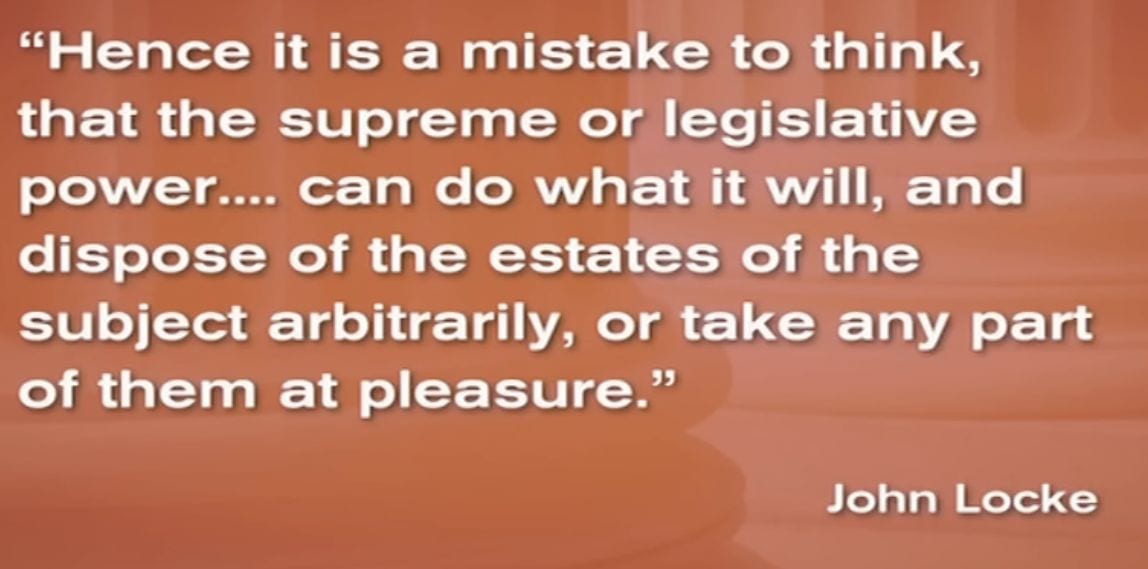
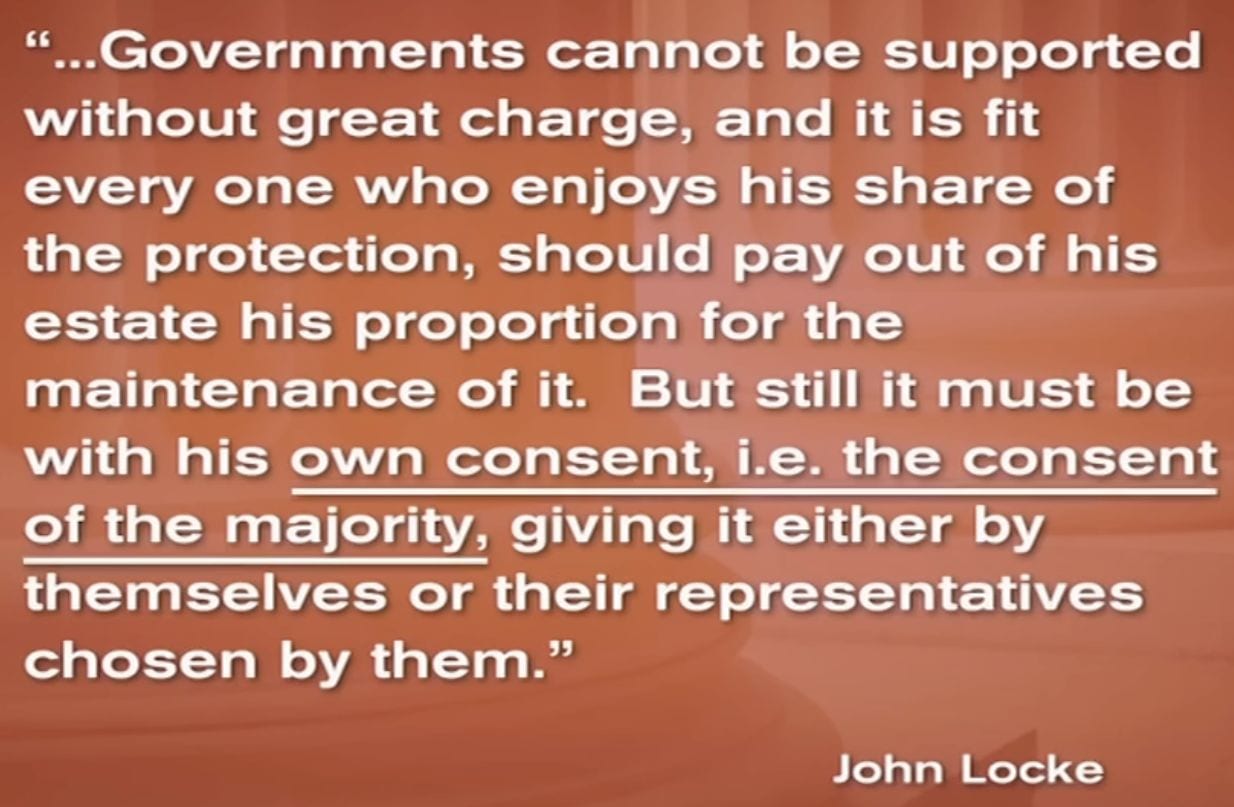
❓ Part 7: What Counts as Consent?
[40:00–44:30]
- Nicola challenges the idea of implied consent—being born into a government doesn’t mean you agreed to it.
- Others argue that using public services is itself a form of tacit agreement (e.g., roads, legal protections).
- Raises Locke’s own warning: you can’t take benefits of society and refuse to pay for them.
⚔️ Part 8: Military Conscription & Rights
[44:30–50:00]
- Can the government force military service?
- Student Gogol argues a lottery conscription is like electing representatives—a fair process that avoids arbitrary choice.
- Locke is against arbitrary power, but supports general, non-arbitrary laws even if they require sacrifice.
Locke’s Puzzle
- (Heart of Legitimate Government)
- On one hand you have unalienable rights for life liberty and property which means that even we don’t have the power to give them up. And that’s what creates the limits on legitimate government its not what we consent to that limits government, it’s what we lack in power to give away when we consent that limits government.
- If we can’t give up our own life (suicide), if we can’t give up our right to property how can we then agree to be bound by a majority that will force us to sacrifice ours lives or give up our property?
- Locke is against singling out a particular citizen or group of people, but if there’s a general law that the majority’s action is nonarbitary, that it doesn’t really amount to a violation of people’s basic rights. What does count as as violation is an arbitrary taking because it would essentially say that there is no rule of law or an institution of property.
🧩 Part 9: Final Reflection—Is Locke a Libertarian Ally?
[50:00–54:58]
- Ally: Private Property
- Disappointment for libertarians:
- Rights are unalienable—you can’t do whatever you want with your life/property.
- Certain constraints by reason or God.
- Once government is formed, it can define what counts as property, life, liberty, etc.
- Only limits on arbitrary taking of life, liberty or property. If the majority a generally applicable law, there is no violation.
- Locke’s theory of consent is key to limiting rulers—but also raises questions when used to justify colonization and property acquisition without the consent of others.
- Sets up next lecture: limits of consent in markets.
- Darker size of Locke
- Came up with a theory of private property that didn’t have to do with consent. May have to do with his second treatise about America.
Transcript
Duration: 54:58
00:04 funding for this program is provided by additional funding provided by today we turn to John Locke on the face of it Locke is a powerful ally of the libertarian first he believes, as libertarians today maintain that there are certain fundamental individual rights
00:59 that are so important that no government even a representative government even a democratically elected government can override them. not only that he believes that those fundamental rights include a natural right to life liberty and property and furthermore he argues that the right to property is not just the creation of government or of law the right to property is a natural right in the sense that it is pre-political it is a right that attaches to individuals as human beings even before government comes on the scene even before parliaments and legislatures enact laws to define rights and to enforce them Locke says in order to think about what it means to have a natural right we have to imagine the way things are before government before law and that’s what Locke means by the state of nature. he says the state of nature is the state of liberty human beings are free and equal beings there is no natural hierarchy
02:46 it’s not the case that some people are born to be kings and others were born to be serfs we’re free and equal in the state of nature and yet he makes the point but there’s a difference between a state of liberty and the state of license
03:08 and the reason is that even in the state of nature there is a kind of the law it’s not the kind of law the legislatures enact it’s the law of nature and this law of nature constrains what we can do even though we’re free even though we’re in the state of nature well what are the constraints? the only constraint given by the laws of nature is that the rights we have the national rights we have we can’t give up
03:49 nor can we take them from somebody else under the law of nature I’m not free take somebody else’s life or liberty or property nor am I free to take my own life liberty or property even though I’m free, I’m not free to violate the laws of nature, I’m not free to take my own life or to sell myself into slavery
04:22 or to give to somebody else arbitrary absolute power over me so where does this constraint you may think it’s a fairly minimal constraint, but where does it come from? Well Locke tells us where it comes from and he gives two answers here’s the first answer for men being all the workmanship of one omnipotent and infinitely wise maker, namely God, they’re his property whose workmanship they are, made to last during his, not one another’s pleasure.
05:05 so one answer the question is why can’t I give up my natural rights to life liberty and property well they’re not strictly speaking yours after all you are the creature of God. God has a bigger property right in us a prior priority right
05:31 now you might say that an unsatisfying unconvincing answer at least for those who don’t believe in God what did Locke have to say to them well here’s where Locke appeals to the idea of reason and this is the idea that if we properly reflect on what it means to be free we will be lead to the conclusion that freedom can’t just be a matter of doing whatever we want I think this is what Locke means when he says the state of nature has a law of nature to govern it which obliges everyone
06:10 and reason which is that law teaches all mankind, who will but consult it, that being all equal and independent no one ought to harm another in his life health liberty for possessions this leads to a puzzling paradoxical feature to Locke’s account of rights familiar in one sense
06:36 but strange in another it’s the idea that out natural rights are inalienable what does unalienable mean? it’s not for us to alienate them or to get them up to give them a way to trade them the way to sell them consider an airline ticket airline tickets are nontransferable or tickets to the patriots or to the red sox nontransferable tickets are unalienable I own them in the limited sense
07:09 that I can use them for myself but I can’t trade them away so in one sense an unalienable right, a nontransferable right makes something I own less fully mine but in another sense of unalienable rights especially where we’re thinking about life liberty and property for a right to be unalienable, makes it more deeply more profoundly mine and that’s Locke’s sense of unalienable
07:47 we see it in the American declaration of independence Thomas Jefferson drew on this idea of Locke unalienable rights to life liberty and as Jefferson amended Locke, to the pursuit of happiness. unalienable rights rights that are so essentially mine that even I can’t trade them away or give them up
08:17 so these are the rights we have in the state of nature before there is any government in the case of life and liberty I can’t take my own life I can’t sell myself into slavery anymore than I can take somebody else’s life or take someone else as a slave by force but how does that work in the case of property? because it’s essential to Locke’s case that private property can arise even before there is any government how can there be a right to private property even before there is any government? Locke’s famous answer comes in section twenty seven
09:04 every man has a property in his own person this nobody has any right to but himself the labor of his body the work of his hands we may say are properly his so he moves as the libertarians later of would move from the idea that we own ourselves
09:29 that we have property in our persons to the closely connected idea that we own our own labor and from that to the further claim that whatever we mix our labor with is unowned becomes our property
09:49 whatsoever then he removes out of the state that nature has provided, and left it in, he has mixed his labor with, and joined to it something that is his own, and thereby makes it his property why? because the labor is the questionable property of the laborer and therefore no one
10:12 but the laborer can have a right to what is joined to or mixed with his labor and then he adds this important provision at least where there is enough and as good left in common for others. but we not only acquire our property in the fruits of the earth in the deer that we hunt in the fish that we catch
10:40 but also if we till and plow and enclose the land and grow potatoes we own not only the potatoes but the land the earth as much land as a man tills, plants, improves, cultivates, and can use the product of, so much is his property. he by his labor
11:06 encloses it from the commons. so the idea is that rights are unalienable seems to distance Locke from a libertarian libertarian wants to say we have an absolute property rate in our selves and therefore we can do with ourselves whatever we want Locke is not a sturdy ally for that view in fact he says if you take natural rights seriously you’ll be led to the idea that there are certain constraints on what we can do with our natural rights, constraints given either by God
11:43 or by reason reflecting on what it means really to be free and really to be free means recognizing that our rights are unalienable so here’s the difference between Locke and the libertarians but when it comes the Locke’s account of private property he begins to look again like a pretty good ally because he’s argument for private property
12:08 begins with the idea that we are the proprietors of our own person and therefore of our labor and there of the fruits of our labor including not only the things we gather and hunt in the state of nature but also we acquire a property right in the land that we enclosed and cultivate and improve
12:34 there are some examples that can bring out the the moral intuition that our labor can take something that is unowned and make it ours though sometimes there are disputes about this there’s a debate among rich countries and developing countries about trade related intellectual property rights it came to a head recently over drug patent laws western countries and especially the united states say we have a big pharmaceutical industry that develops new drugs we want all countries in the world to agree to respect the patents
13:25 then there came along the aids crisis in south Africa and the American aids drugs were hugely expensive far more than could be afforded by most Africans so the south African government said we’re going to begin to buy a generic version of the AIDS antiretroviral drug at a tiny fraction of the cost because we can find an Indian manufacturing company that figures out how the thing is made and produces it and for a tiny fraction of the cost we can save lives if we don’t respect that patent and then the American government said no here’s a company that invested research and created this drug you can just start mass-producing these drugs without paying the licensing fee
14:25 so there was a dispute the US and the pharmaceutical companies sued the south African government to try to prevent their buying the cheap generic this they saw it, pirated version of an aids drug and eventually the pharmaceutical industry gave in and said
14:49 all right you can do that but this dispute about what the rules of property should be of intellectual property of drug patenting in a way is the last frontier of the state of nature because among nations where there is no uniform law of patent rights and property rights it’s up for grabs
15:13 until by some act of consent some international agreement people enter into some settled rules. what about Locke’s account of private property and how it can arise before government and before law comes on the scene is it successful? how many think it’s pretty persuasive? how many don’t find it persuasive?
15:50 now let’s hear from some critics what is wrong with Locke’s account of how private property can arise without consent I think it’s justifies European cultural norms as far as you look at how native Americans may not cultivated American land by their arrival in the America’s that
16:16 that contributed to the development of America which would have otherwise necessarily happened then or by that specific group so you think that this defense this defense of private property in land yes because it complicate original acquisitions if you only site the arrival of foreigners that cultivated the land I see, and what’s your name? Rachelle Rachelle? Rachelle says this account of how property arises would fit what was going on in north America during the time of the settlement, the European settlement do you think Rochelle, that it’s it’s a way of defending the appropriation of the land indeed, because he is
17:05 also you know, justifying the glorious revolution, so I don’t think it’s inconceivable that he’s also justifying colonization as well well that’s an interesting historical suggestion and I think there’s a lot to be said for it what do you think of the validity of his argument though? because if you’re right that this would justify the taking of land in north America from native Americans who didn’t enclose it, if it’s a good argument then Locke’s given us a justification for that if it’s a bad argument then Locke’s given us a mere rationalization it is morally indefensible
17:51 I’m leaning to the second one. You’re leaning to the second one, but that’s my opinion as well alright let’s hear if there’s a defender of Locke’s account of private property and it would be interesting if they could address Rachelle’s worried that this is just a way of defending the the appropriation of land by the American colonists from the native Americans who didn’t enclose it
18:19 is there someone who will defend Locke on that point? you’re ready are you going to defend Locke? but you’re you’re accusing him of justifying the European basically massacre of the native Americans but who says he’s defending it maybe the European colonization isn’t right you know maybe it’s the state of war that he talked about in his second treatise, you know
18:45 so the war is between the native Americans and the colonists, the settlers that might have been a state of war that we can only emerged from by an agreement or an act of consent and that’s what would have been required yeah and both sides would have to agree to and carry out and everything
19:08 but what about and what’s your name? Dan. Dan, what about Rachelle’s says this argument in section twenty seven and then in thirty two about appropriating land that argument if it’s valid would justify the settlers appropriating that land and excluding others from it you think that argument’s a good argument? well does it kind of imply that the native Americans hadn’t already done that?
19:42 well the native Americans as hunter gatherers didn’t actually enclose enclose land so I think Rochelle is on to something there what I wanted I go ahead Dan. At the same time he’s saying that just by picking an acorn or taking a apple or maybe killing of buffalo on a certain amount of land that makes it yours because it’s your labor and that’s your labor would enclose that land
20:06 so by that definition maybe they didn’t have fences around little plots of land but didn’t they were using it so by Locke’s definitions, so maybe by Locke’s definition the native Americans could have claimed a property rights in the land itself but they just didn’t have Locke on their side as she points out. good okay that’s good One more defender of Locke well I mean just to defend Locke, he does say there are
20:35 some times in which you can’t take another person’s land for example you can’t acquire land that is common property to people and in terms of American Indians I feel like they already have civilizations themselves and they were using land in common so it’s kind of like an analogy to what he was talking about with like the common English property you can’t take land that everyone has in common. That’s very interesting and you can’t take land unless you make sure that there’s as much land as possible enough for other people take as well
21:04 so if you’re taking common, so you have to make sure whenever you take land or that there’s enough let for other people to use that’s just as good as the land that you took That’s true, Locke says there has to be this right to private property in the earth is subject to the provision that there be as much and as good left for others what’s your name. I’m Fang
21:27 So Fang in a way agrees with Dan that maybe there is a claim within Locke’s framework that could be developed on behalf of the native Americans here’s the further question, if the right to private property is natural not conventional,
21:48 if it’s something that we acquire even before we agree to government how does that right constrain what the legitimate government can do in order for finally to see, whether Locke is an ally or potentially a critic of the libertarian idea of the state we have to ask what becomes of our natural rights
22:20 once we enter into society we know that the way we enter into society is by consent by agreement to leave the state of nature and to be governed by the majority and by a system of laws, human laws but those human laws our only legitimate if they respect our natural rights if they respect our inalienable rights to life liberty and property No parliament no legislature however democratic its credentials can legitimately violate our natural rights. this idea that no law can violate our right to life liberty and property would seem to support
23:20 the idea of a government so limited that it would gladden the heart of the libertarian after all but those hearts should not be so quickly gladdened because even though for Locke the law of nature persists once government arrived even though Locke insists on limited government government limited by the end for which it was created namely the preservation of property
23:54 even so there’s an important sense in which what counts as my property what counts as respecting my life and liberty are for the government to define that there be property that there be respect for life and liberty is what limits government
24:26 but what counts as respecting my life and respecting my property that is for governments to decide and define how can that be is Locke contradicting himself or is there an important distinction here in order to answer that question which will decide Locke’s fit with the libertarian view we need to look closely at what legitimate government looks like for Locke, and we turn to that next time. Nikola, if you didn’t think you’d get caught would you pay your taxes
25:24 umm, I don’t think so I would rather have a system personally that I could give money to exactly those sections of the government that I support and not just blanket support everything. you’d rather be in the state of nature at least on April fifteenth last time we began to discuss Locke’s state of nature his account of private property his theory of legitimate government
26:05 which is government based on consent and also limited government Locke believes in certain fundamental rights that constrain what government can do and he believes that those rights are natural rights not rights that flow from law or from government
26:27 and so Locke’s great philosophical experiment is to see if he can give an account of how there could be aright of private property without consent, before government and legislators arrive on the scene to define property that’s his question that’s his claim. there is a way, Locke argues, to create property, not just in the things we gather and hunt
26:58 but in the land itself provided there is enough and it’s good enough for others today I want to turn to the question of consent which is Locke’s second big idea, private property is one consent is the other what is the work of consent people here have been invoking the idea of consent since we began since the first week you remember when we were talking about
27:33 pushing the fat man off the bridge someone said but he didn’t agree to sacrifice himself it would be different if he consented or when we were talking about the cabin boy killing and eating the cabin boy some people said well if they had consented to a lottery it would be different then it would be all right
27:55 so consent has come up a lot and here in John Locke we have one of the great philosophers of consent consent is an obvious, familiar idea in moral and political philosophy Locke says that legitimate government is government founded on consent and who nowadays would disagree with him?
28:20 sometimes when ideas of political philosophies are as familiar as Locke’s ideas about consent it’s hard to make sense of them or at least to find them very interesting but there are some puzzles some strange features of Locke’s account of consent as the basis of legitimate government and that’s what I’d like to take up today one way of testing the possibility of Locke’s idea of consent
28:55 and also probing some of its perplexities, is to ask just what a legitimate government founded and consent can do what are its powers according to Locke, well in order to answer that question it helps to remember what the state of nature is like. remember the state of nature is the condition that we decide to leave and that’s what gives rise to consent why not stay there why bother with government at all? well, what’s Locke’s to answer to that question
29:39 he says there’s some inconveniences in the state of nature but what are those inconveniences? the main inconveniences is that everyone can enforce the law of nature everyone is an enforcer or what Locke calls the executor of the state of nature and he means executor literally
30:06 if someone violates the law of nature he’s an aggressor he’s beyond reason and you can punish him and you don’t have to be too careful or fine about gradations of punishment in the state of nature you can kill him
30:28 you can certainly kill someone who comes after you tries to murder you that’s self-defense but the enforcement power the right to punish everyone can do the punishing in the state of nature and not only can you punish with death people who come after you seeking to take your life
30:51 you can also punish a thief who tries to steal your goods because that also counts as aggression against the law of nature if someone has stolen from a third party you can go after him why is this well violations of the law of nature are an act of aggression there’s no police force there are no judges, no juries
31:18 so everyone is the judge in his or her own case and Locke observes that when people are the judges of their own cases they tend to get carried away and this gives rise to the inconvenience in the state of nature people over shoot the mark there’s aggression there’s punishment
31:44 and before you know it everybody is insecure in their enjoyment of his or her unalienable rights to life liberty and property now he describes in pretty harsh and even grim terms what you can do to people who violate the law of nature one may destroy a man who makes war upon him
32:11 for the same reason that he may kill a wolf or a lion such men have no other rule, but that of force and violence, listen to this and so may be treated as beasts of prey those dangerous and noxious creatures that would be sure to destroy you if you fall into their power
32:32 so kill them first so what starts out as a seemingly benign state of nature where everyone’s free and yet where there is a law and the law respects people’s rights and those rights are so powerful that they’re unalienable what starts out looking very benign once you look closer is pretty fierce and filled with violence and that’s why people want to leave how do they leave well here’s where consent comes in the only way to escape from the state of nature is to undertake an active of consent where you agree to give up the enforcement power and to create a government or a community where there will be a legislature to make law and where everyone agrees in advance everyone who enters agrees in advance to abide by whatever the majority decides
33:51 but then the question and this is our question and here’s where I want to get your views then the question is what powers what can the majority decide now here it gets tricky for Locke because you remember alongside the whole story about consent and majority rule there are these natural rights, the law of nature these unalienable rights and you remember they don’t disappear when people
34:22 join together to create a civil society so even once the majority is in charge the majority can’t violate you’ re inalienable rights can’t violate your fundamental right to life liberty and property so here’s the puzzle, how much power does the majority have how limited is the government created by consent? it’s limited by the obligation on the part of the majority to respect and to enforce the fundamental natural rights of the citizens they don’t give those up we don’t give those up when we enter government that’s this powerful idea taken over from Locke
35:17 by Jefferson in the Declaration unalienable rights so let’s go to our two cases remember Michael Jordan, Bill Gates libertarian objection to taxation for redistribution well what about Locke’s limited government is there anyone who thinks that Locke does give grounds for opposing taxation
35:46 for redistribution anybody? if you, if the majority rules that there should be taxation even if the minority should still not have to be taxed because that’s taking away property which is one of the rights of nature
36:09 so and what’s your name? Ben so if the majority taxes the minority without the consent of the minority to that particular tax law it does amount to the taking of their property without their consent and it would seem that Locke should object to that
36:40 you want some textual support for your reading of Locke, Ben I brought some along just in case you raised it if you’ve got, if you have your text look at one thirty eight passage one thirty eight the supreme power by which Locke means legislature, cannot take from any man any part of his property without his own consent for the preservation of property being the end of government
37:11 and that for which men enter into society it necessarily supposes and requires that people should have property that was the whole reason for entering a society in the first place to protect the right to property and when Locke speaks about the right to property he often uses that as a kind of global term for the whole category, the right to life liberty and property
37:35 so that part of Locke at the beginning of one thirty eight seems to support Ben’s reading but what about the part of one thirty eight if you keep reading Men therefore in society having property they have such a right to the goods which by the law of the community are theirs,
37:59 look at this, and that no one can take from them without their consent and then at the end of this passage we see he said so it’s a mistake to think that the legislative power can do what it will to dispose to the estates of the subject arbitrarily or take any part of them at pleasure here’s what’s elusive on the one hand he says the government can’t take your property without your consent he’s clear about that
38:32 but then he goes on to say and that’s the natural right to property but then it seems that property, what counts as property is not natural but conventional defined by the government the goods which by the law of the community are theirs and the plot thickens if you look ahead to section one forty in one forty he says governments can’t be supported without great charge. Government is expensive and it’s fit that everyone who enjoys his share of the protection should pay out of his estate and then here’s a crucial line
39:13 but still it must be with his own consent i.e. the consent of the majority giving it either by themselves or through their representatives so what is Locke actually saying property is natural in one sense but conventional in another it’s natural in the sense that we have a fundamental unalienable right that their be property that the institution of property exist and be respected by the government
39:46 so an arbitrary taking property would be a violation of the law of nature and would be illegitimate but it’s a further question here’s the conventional aspect of property, it’s a further question what counts as property, how it’s defined and what counts as taking property, and that’s up to the government
40:12 so the consent here we’re kind of back to our question what is the work of consent what it takes for taxation to be legitimate is that it be by consent not the consent of Bill Gates himself that he’s the one who has to pays the tax
40:33 but by the content that he and we, all of us within the society gave when we emerged from the state of nature and created the government in the first place it’s the collective consent and by that reading it looks like consent is doing a whole lot and the limited government consent creates isn’t all that limited does anyone want to respond that or have a question about that? go ahead, stand up well I’m just wondering what Locke’s view is on once you have a government that’s already in place whether it is possible for people who are born into that government to then leave and return to the state of nature I mean, I don’t think that Locke mentioned that at all. what do you think? well I think as the convention it would be very difficult to leave the government because you were no longer
41:50 there’s because nobody else is just living in the state of nature, everybody else is now governed by this legislature what would it mean today, you’re asking and what’s your name? Nicola to leave the state, suppose you wanted to leave civil society today, you want to withdraw your consent and return to the state of nature. Well because you didn’t actually consent to it, you were just born into it, it was your ancestors who joined you didn’t sign
42:22 the social contract I didn’t sign all right so what does Locke say there I don’t think Locke says that you have to sign anything I think he says that it’s kind of implied consent by willingly taking government services you are implying you’re consenting to the government taking things from you all right so implied consent, that’s a partial answer to this challenge
42:45 now you may not think that implied consent is as good as the real thing is that what you’re shaking your head about Nicola? speak up stand up and I don’t think that necessarily just by utilizing the government’s you know various resources that we are necessarily implying that we agree with the way that this government was formed
43:11 or that we have consented to actually join into the social contract so you don’t think the idea of implied consent is strong enough to generate any obligation at all to obey government not necessarily no, Nicola if you didn’t think you’d get caught would you pay your taxes umm
43:35 I don’t think so I would rather have a system, personally, that I could give money to exactly those sections of the government that I support and not just blanket support everything. you’d rather be in the state of nature of at least on April fifteenth
43:58 but what I’m trying to get at is you consider that you’re under no obligation since you haven’t actually entered into an active consent but for prudential reasons you do what you’re supposed to do according to the law. exactly. if you look at it that way then you’re violating another one of Locke’s treatises which is that you can’t take anything from anyone else like you can’t you can’t take the government’s services and then not give them anything in return if you if you want to go live in a state of nature that’s fine
44:28 but you can’t take anything from the government because by the government’s terms which are the only terms under which you can enter the agreement say that you have to pay taxes to take those things. so you’re saying that Nicola can go on back to the state of nature if she wants to but you can’t drive on Mass Ave. Exactly I want to raise the stakes beyond using Mass Ave, and even beyond taxation what about life what about military conscription yes, what do you think, stand up first of all we have to remember that sending people to war is not necessarily implying that they’ll die, I mean obviously you’re not raising their chances here, it’s not a death penalty
45:12 so if you’re going to discuss whether or not military conscriptions is equivalent to you know suppressing people’s right to life you shouldn’t approach it that way secondly the real problem here is Locke has this view about consent and natural rights but you’re not allowed to give up your natural rights either
45:32 so the real question is how does he himself figure it out between I agree to give up my life give up my property when he talks about taxes or military conscription for the fact, but I guess Locke would be against suicide and that’s still you know my own consent I mean. Good. What’s your name?
45:54 Eric. so I Eric brings us back to the puzzle we’ve been wrestling with since we started reading Locke on the one hand we have these unalienable rights to life liberty and property which means that even we don’t have the power to give them up and that’s what creates the limits on legitimate government it’s not what we consent to that limits government it’s what we lack the power to give away when we consent that limits government that’s the that’s the point at the heart of Locke’s whole account of legitimate government
46:34 but now you say well if we can’t give up our own life, if we can’t commit suicide if we can’t give up our rights to property how can we then agree to be bound by a majority that will force us to sacrifice our lives or give up our property does Locke have a way out of this or is he basically sanctioning an all-powerful government despite everything he says about unalienable rights does he have a way out of it? who would speak here in defense of Locke or make sense find a way out of this predicament all right go ahead. I feel like there’s a general distinction to be made between the right to life that individuals possess and the the fact that the government cannot take away an individual’s right to life I think if you look at conscription as the government picking out certain individuals to go fight in war then that would be a violation of the rights their national right to life on the other hand if you have conscription of
47:41 let’s say a lottery for example then in that case I would view that as the population picking their representatives defend them in the case of war the idea being that since the whole population cannot go out there to defend its own right of property it picks its own representatives through a process that’s essentially random and the these
48:01 these sort of elected representatives go out and fight for the rights of the people it looks very similar, it works just like an elected government in my opinion alright so an elected government can conscript citizens to go out and defend the way of life the community that makes the enjoyment of rights possible. I think I think it can because to me it seems that it’s very similar to the process of electing representatives the legislature although here it’s as if the government it’s electing by conscription certain citizens to go die for the sake of the whole is that consistent with respect for a natural right to liberty well what I would say is there’s a distinction between picking out individuals and having a random choice of individuals. between let me make sure, between picking out individuals, well I don’t, let me what’s your name? Gogol. Gogol says there’s a difference between picking out individuals to lay down their lives and having a general law I think this is
49:18 on I think this is the answer Locke would give, actually Locke is against arbitrary government he’s against the arbitrary taking the singling out of Bill Gates to finance the war in Iraq he’s against singling out a particular citizen or group of people to go off and fight
49:40 but if there’s a general law such that the the government’s choice the majority’s action is non arbitrary, it doesn’t really amount to a violation of people’s basic rights what does count as a violation
50:00 is an arbitrary taking because that would essentially say not only to Bill Gates, but to everyone there is no rule of law there is no institution of property because at the whim of the king or for that matter of the parliament we can name you or you to give up your property or to give up your life
50:24 but so long as there is a no arbitrary rule of law then it’s permissive now you may say this doesn’t amount to a very limited government and the libertarian may complain that Locke is not such a terrific ally after all the libertarian has two grounds for disappointment in Locke first that the rights are unalienable and therefore I don’t really own myself after all I can’t dispose of my life or my liberty or my property in a way that violates my rights that’s disappointment number one, disappointment number two once there is a legitimate government based on consent the only limits for Locke are limits on arbitrary the takings of life or of liberty or of property
51:23 but if the majority decides or if the majority promulgates a generally applicable law and if it votes duly according to fare procedures then there is no violation whether it’s a system of taxation or system of conscription
51:44 so it’s clear that Locke is worried about the absolute arbitrary power of kings but it’s also true and here’s a darker side of Locke that this is great theorist of consent came up with a theory of private property that didn’t require consent that may and this goes back to the point Rochelle made last time,
52:12 may have had something to do with Locke’s second concern which was America you remember when he talks about the state of nature he’s not talking about an imaginary place in the beginning he says all the world was America and what was going on in America the settlers we’re enclosing land and engaged in wars with the native Americans Locke who was an administrator of one of the colonies may have been as interested in providing a justification for private property through enclosure without consent through enclosure and cultivation as he was with developing a theory of government based on consent that would reign in kings and arbitrary rulers the question we’re left with the fundamental question we still haven’t answered is what then becomes of consent what work can it do what is its moral force what are the limits of consent consent matters not only for governments
53:26 but also from markets and beginning next time we’re going to take up questions of the limits of consent in the buying and selling of goods don’t miss the chance to interact online with other viewers of Justice join the conversation, take a pop quiz watch lectures you’ve missed, and a lot more. Visit justiceharvard.org it’s the right thing to do
54:38 funding for this program is provided by additional funding provided by
Episode 5: Hired Guns (John Locke)
Summary
Here is a thorough, ordered summary of the lecture, which begins with John Locke’s theory of consent and moves through debates on conscription, market coercion, and the ethics of commodifying reproduction:
Part I: Locke, Consent, and the Limits of Government
- Locke on Taxation and Consent:
- Government can tax people without each individual’s direct consent, as long as there is prior consent to join society.
- Joining society entails agreeing to be bound by majority rule, which legitimizes taxes for the common good.
- Right to Life and Military Conscription:
- Locke says the government can conscript soldiers, even ordering them to face near-certain death.
- Key distinction: Government/military can command soldiers’ lives but not arbitrarily take their money—taking money would be outside rightful authority.
- Rule of Law vs. Arbitrary Power: (Locke. 139)
- Even limited government must act under the rule of law and avoid arbitrary decisions.
- Consent matters not to every act, but consent to be governed forms the moral basis of state authority.
Part II: Case Study – Military Conscription in the U.S.
- Modern Recruitment Crisis:
- U.S. military facing recruitment challenges.
- Three proposed solutions:
- Increase pay and benefits.
- Conscription via lottery.
- Outsourcing to mercenaries.
Civil War Precedent: The Buyout System
- Draftees could pay a substitute to take their place.
- Example: Andrew Carnegie did this for less than what he spent on cigars yearly.
Class Debate on Civil War System:
- Objections:
- Liz: It puts a dollar value on life.
- Sam & Raul: The system is coercive, especially toward the poor—choices appear voluntary but are shaped by inequality.
- Defenses:
- Jason: Individuals can freely choose to accept money and risk.
- Emily: Even the volunteer army today is coercive—targets the poor with financial incentives and patriotic messaging.
Emily’s Challenge:
- If coercion and inequality make the Civil War system unjust, why not object to today’s volunteer military, which also targets the poor disproportionately?
- She argues conscription spreads responsibility more equally.
Responses:
- Jackie: Volunteer soldiers are better motivated by patriotism, not just money.
- Phillip: Mercenaries can be just as effective; patriotism is not necessary.
- Debate ensues: is patriotism a better motivation than market incentives?
Part III: Market Exchange & Moral Limits
- Two main objections to markets allocating military service:
- Coercion and Inequality (Sam & Raul)
- Erosion of Civic Obligation (Emily, Jackie)
- These raise deeper questions:
- What inequalities undermine free choice?
- What are our obligations as citizens?
- Do civic obligations (e.g. military service) require consent, or are they intrinsic to citizenship?
Part IV: Markets in Reproduction
Case 1: Egg and Sperm Donation
- Egg Donor Ad: $50,000 for a tall, athletic, high-SAT scorer.
- Sperm Donor Market: Cryobank pays ~$900/month; ideal donor is tall, educated, and attractive.
- Raises concern: Are reproductive capacities being commodified?
Part V: Baby M – Commercial Surrogacy
- Case Summary:
- Couple pays $10,000 to surrogate Mary Beth Whitehead.
- After birth, she wants to keep the child.
- Contract enforced by lower court, overturned by New Jersey Supreme Court.
Classroom Debate:
- Patrick & Kathleen: A deal is a deal; informed adults consented.
- Evan & Anna: Emotional bond wasn’t known at contract time—consent was uninformed.
- Andrew: This is baby selling, dehumanizing.
Vivian’s Insight:
- Her brother donated sperm—no emotional bond.
- Surrogacy involves much more time and emotional investment than sperm donation.
Court’s Reasoning:
- Rejected contract on two grounds:
- Informed consent was impossible: mother couldn’t foresee emotional bond.
- Commodification is morally problematic: profit motive corrupts what should be a non-commercial relationship.
Philosophical Perspective: Elizabeth Anderson
- Argues surrogacy alienates women’s labor.
- Pregnancy’s proper purpose (forming a bond) is disrupted by treating it as a job.
- Suggests some goods (e.g., childbearing) should be treated with respect, sanctity, love, not use value.
Conclusion:
- These debates raise profound ethical questions:
- How free must consent be?
- Are some goods inappropriate for market exchange?
- Returns us to earlier discussions in the course: Are utility and market value the only valid ways to assign worth?
Transcript
Funding for this program is provided by Additional funding provided by When we ended last time we were discussing Locke’s idea of government by consent and the question arose what are the limits on government that even the the agreement of the majority can’t override that was the question we ended with we saw in the case of property rights that on Locke’s view a democratically elected government has the right to tax people it has to be taxation with consent because it does involve the taking of people’s property for the common good
01:20 but it doesn’t require the consent of the each individual at the time the tax is enacted or collected what it does require is a prior act of consent to join the society to take on the political obligation
01:44 but once you take on that obligation you agree to be bound by the majority so much for taxation but what, you may ask about the right to life can the government conscript people and send them into battle what about the idea that we own ourselves is the idea of self possession violated if the government can through coercive legislation and enforcement powers say you must go risk your life to fight in Iraq what would Locke say? does the government have the right to do that? yes in fact he says in one thirty nine he says what matters is that the political authority or the military authority not be arbitrary that’s what matters he gives a wonderful example he says a a sergeant even a sergeant let alone a general, a sergeant
02:55 can command a soldier to go right up to the face of a cannon where he is almost sure to die that the sergeant can do the general can condemn the soldier to death for deserting his post or for not obeying even a desperate order
03:22 but with all their power over life and death what these officers can’t do is take a penny of that soldier’s money because that has nothing to do with the rightful authority that would be arbitrary and it would be corrupt
03:43 so consent winds up being very powerful in Locke, not consent of the individual to the particular tax or military order, but consent to join the government and to be bound by the majority in the first place that’s the consent that matters and it matters so powerfully the even the limited government created by the fact that we have an unalienable right to life liberty and property even that limited government is only limited in the sense that it has to govern by generally applicable laws, the rule of law, it can’t be arbitrary that’s Locke. well this raises a question about consent. Why is consent such a powerful moral instrument in creating political authority and the obligation to obey today we begin to investigate the question of consent by looking at a concrete case the case of military conscription.
04:52 now some people say if we have a fundamental right that arises from the idea that we own ourselves it’s a violation of that right for a government to conscript citizens to go fight in wars. others disagree others say that’s a legitimate power of government, of democratically elected government anyhow, and that we have an obligation to obey let’s take the case the united states fighting a war in Iraq. news accounts tell us that the military is having great difficulty meeting its recruitment targets consider three policies that the US government might undertake to deal with the fact that it’s not achieving its recruiting targets
06:00 solution number one increase the pay and benefits to attract a sufficient number of soldiers, option number two shift to a system of military conscription have a lottery and who’s ever numbers are drawn go to fight in Iraq, system number three
06:33 outsource, hire what traditionally have been called mercenaries people around the world who are qualified, able to do the work, able to fight well and who are willing to do it for the existing wage so let’s take a quick poll here how many favor increasing the pay? huge majority. how many favor going to conscription? all right maybe a dozen people in the room favor conscription.
07:14 what about the outsourcing solution? okay so there maybe about two, three dozen. during the civil war the union used a combination of conscription and the market system to fill the ranks of the military to fight in the civil war it was a system that began with conscription
07:51 but if you were drafted and didn’t want to serve you could hire a substitute take your place and many people did you could pay whatever the market required in order to find a substitute people ran ads in newspapers in the classified ads offering five hundred dollars
08:22 sometimes a thousand dollars for a substitute who would go fight the civil war in their place in fact it’s reported that Andrew Carnegie was drafted and hired a substitute to take his place for an amount that was a little less than the amount to spend for a year on fancy cigars
08:52 now I want to get your views about this civil war system call it the a hybrid system conscription but with the buyout provision how many think it was a just system how many would defend the civil war system? anybody? one, anybody else? to three four five. how many think it was unjust? most of you don’t like the civil war system you think it’s unjust, let’s hear an objection why don’t you like it? what’s wrong with it? yes. well by paying three hundred dollars for to be exempt one time around you’re really putting a price on valuing human life
09:46 and we established earlier that’s really hard to do so they’re trying to accomplish something that really isn’t feasible. good, so so paying someone three hundred or five hundred or a thousand dollars you’re basically saying that’s what their life is worth you. that’s what their life is worth it’s putting a dollar value on life that’s good, and what’s your name? Liz. Liz. well who has an answer for Liz you defended the civil war system what do you say? if you don’t like the price then you have the freedom to
10:21 not be sold or for so it’s up to you and I don’t think it’s necessarily putting a specific price on you and if it’s done by himself I don’t think there’s anything that’s really morally wrong with that. So the person who takes the five hundred dollars let’s say, he’s putting his own price on his life on the risk of his life and he should have the freedom to choose to do that. exactly.
10:53 what’s your name? Jason. Jason thank you. now we need to hear from another critic of the civil war system. yes. it’s a kind of coercion almost of people who have lower incomes for Carnegie he can totally ignore the draft three hundred dollars is you know irrelevant in terms of his income, but for someone of a lower income they are essentially being coerced to draft to be drafted or I mean it’s probably they’re not able to find a replacement the tell me your name. Sam.
11:25 Sam, all right so you say Sam that when a poor laborer buys his, accepts three hundred dollars to fight in the civil war he is in effect being coerced by that money given his economic circumstances whereas Carnegie can go off pay the money and not serve
11:51 I want to hear if someone has a reply to Sam’s argument that what looks like a free exchange is actually coercive who has an answer to to Sam. go ahead I’d actually agree with him. You agree with him I agree with him in saying that it is coercion in the sense that it robs an individual
12:18 of his ability to reason properly okay and what’s your name? Raul. ok so Raul and Sam agree that what looks like a free exchange, free choice voluntary act is actually coercion it involves coercion it’s profound coercion of the worst kind because it falls so disproportionately
12:38 upon one segment of society good, all right so Raul and Sam have made a powerful point who would like to reply who has an answer for Sam and Raul? Go ahead I just I don’t think that these drafting systems are really terribly different from you know all
12:59 volunteer army sort of recruiting strategies the whole idea of you know having benefits in pay for joining the army is you know sort of a coercive strategy to get people to join it is true that military volunteers come from disproportionately, you know, lower economic status and also from certain regions of the country where you can use the patriotism to try and coerce people, if you’re like it’s the right thing to do to volunteer to go over to Iraq. and tell me your name. Emily. alright Emily says
13:32 and Raul you’re going to have to reply to this so get ready Emily says fair enough there is a coercive element to the civil war system when the laborer takes the place of Andrew Carnegie for five hundred dollars Emily concedes that but she says if that troubles you about the civil war system
13:57 shouldn’t that also trouble you about the volunteer army today? and let me, before you answer, how did you vote on the first poll, did you defend a volunteer army? I didn’t vote. you didn’t vote. either way you didn’t vote
14:17 but did you sell your vote to the person sitting next to you? no, all right so what would you say to that argument? I think that the circumstances are different and that there was conscription in the civil war there is no draft today and I think that the volunteers for the army today have a more profound sense of patriotism that is of an individual choice than those who were forced into the military in the civil war
14:50 somehow less coerced. less coerced. even though there is still inequality in American society even though as Emily points out the make-up of the American military is not reflective of the population as a whole. Let’s just do an experiment here how many here have either served in the military or have a family member who has served in the military in this generation not parents family members in this generation and how many have neither served nor I have any brothers or sisters who have served does that bear out your point Emily?
15:36 Alright now we need we need to hear from most of you defended the idea of the of the all-volunteer military overwhelmingly and yet overwhelmingly people consider the civil war system unjust Sam and Raul articulated
16:01 reasons for objecting to the civil war system it took place against a background of inequality and therefore the choices people made to buy their way into military service were not truly free but at least partly coerced then Emily extends that argument in the form of a challenge all right everyone here who voted in favor of the all-volunteer army should be able should have to explain well what’s the difference in principle doesn’t the all-volunteer army simply universalize the feature that almost everyone find objectionable in the civil war buy-out provision did I state that challenge fairly Emily?
16:50 ok, so we need to hear from a defender of the all-volunteer military who can address Emily’s challenge who can do that? Go ahead the difference between the civil war system and the all-volunteer army system is that in the civil war you’re being hired not by the government but by individuals and as a result different people to get hired a different individuals, get paid different in the case of the all-volunteer army everyone who gets hired is hired by the government and gets paid the same amount it’s precisely the universalization of all of essentially paying your service you pay your way to the army that makes the all volunteer army just. Emily? I guess I’d frame the principal slightly differently, on the all-volunteer army
17:41 it’s possible for somebody to just step aside and not really think about, you know, the war at all. it’s possible to say well I don’t need the money, you know I don’t need to have an opinion about this I don’t need to feel obligated to take my part and defend my country with a coercive system, I’m sorry, with an explicit draft, then you know there’s the threat at least that every individual will have to make some sort of decision
18:04 you know, regarding military conscription and you know perhaps in that way it’s more equitable you know it’s true that Andrew Carnegie might not serve in any case but in one you know he can completely step aside from it and in the other there is some level of responsibility. While you’re there Emily, so what system do you favor conscription
18:25 I would be hard to say but I think so because it makes the whole country feel a sense of responsibility for the conflict instead of you know having a war that’s maybe ideologically supported by a few but only if there’s no you know, real responsibility. good. who wants to reply, go ahead. so I was going to say that the fundamental difference between the all-volunteer army and then the army in the civil war is that in all volunteer army if you want to volunteer that fact comes first and then the pay comes after whereas in the civil wars system the people who are volunteering, who are accepting the pay aren’t necessarily doing it because they want to, they’re just doing it for the money first. what motivation beyond the pay do you think is operating in the case of the all volunteer army? Like patriotism for the country. patriotism well what about pay. And a desire to defend the country and
19:23 there’s some motivation in pay but the fact that it’s first and foremost in an all-volunteer army will motivate them first, I think personally okay you think it’s better, and tell me your name. Jackie. Jackie do you think it’s better if people serve in the military out of a sense of patriotism than just for the money yes definitely because that people who that was one of the main problems in the civil war I mean is that the people that you’re getting to go in it or to go to war
19:51 aren’t necessarily people who want to fight and so they won’t be as good soldiers as they will be had they been there because they wanted to be all right what about Jackie’s having raised the question of patriotism that patriotism is a better or a higher motivation than money for military service who, who would like to address that question?
20:17 patriotism absolutely is not necessary in order to be a good soldier because mercenaries can do just as good of a job of the job as anyone who waves the American flag around and wants to defend what the government believes that we should do. did you favor the outsourcing solution? yes sir.
20:42 all right so let Jackie respond, what’s your name? Phillip what about that Jackie? so much for patriotism if you’ve got someone who’s heart is in it more than another person’s they’re going to do a better job when it comes down to the wire and there is like a situation in which someone has to put their life on the line
21:04 someone who is doing it because they love this country will be more willing to go into danger than someone who’s just getting paid they don’t care they’ve got the technical skills but they don’t care what happens because the really have they have nothing, like, nothing invested in this country there’s another aspect though once we get on to the issue of patriotism if you believe patriotism as Jackie does, should be the foremost consideration and not money does that argue for or against
21:36 the paid army we have now we call it the volunteer army, though if you think about it that’s a kind of a misnomer a volunteer army as we use the term is a paid army. so what about the suggestion that patriotism should be the primary motivation for military service not money? does that argue in favor of the paid military that we have or does it argue for conscription
22:07 and just to sharpen that point building on Phil’s case for outsourcing if you think that the all-volunteer army, the paid army is best because it lets the market allocate positions according to people’s preferences and willing willingness to serve for a certain wage doesn’t the logic that takes you from a system of conscription to the hybrid civil war system to the all-volunteer army doesn’t the the idea of expanding freedom of choice in the market doesn’t that lead you all the way if you followed that principle consistently to a mercenary army? and then if you say no Jackie says no, patriotism should count
23:04 for something doesn’t that argue for going back to conscription if by patriotism you mean a sense of civic obligation let’s see if we can step back from the discussion that we’ve had and see what we’ve learned about consent as it applies to market exchange. we’ve really heard two arguments two arguments against the use of markets and exchange in the allocation of military service one was the argument raised by Sam and Raul the argument about coercion the objection that leading the market allocate military service may be unfair and may not even be free if there is
24:20 severe inequality in this society so that people who buy their way into military service are doing so not because they really want to but because they have so few economic opportunities that that’s their that’s their best choice and Sam and Raul say there’s an element of coercion in that that’s one argument. then there is a second objection to using the market to allocate military service that’s the idea that military service shouldn’t be treated as just another job for pay because it’s bound up with patriotism and civic obligation this is a different argument from the argument about unfairness and inequality and coercion it’s an argument that suggests that maybe where civic obligations are concerned we shouldn’t allocate duties and rights by the market
25:36 now we’ve identified two broad objections what do we need to know to assess those objections to assess the first the argument from coercion inequality and fairness, Sam, we need to ask what inequalities in the background conditions of society undermine the freedom of choices people make to buy and sell their labor question number one. question number two, to assess the civic obligation patriotism argument we have to ask what are the obligations of citizenship is military service one of them or not
26:25 what obligates us as citizens what is the source of political obligation is it consent or are there some civic obligations we have even without consent for living in sharing in a certain kind of society. we haven’t answered either of those questions
26:48 but our debate today about the civil war system and the all-volunteer army has at least raised them and those are questions we’re going to return to in the coming weeks. Do you think you should be able to bid for a baby that’s up for adoption? That’s Andrew’s Challenge. Do I think that I should be able to bid for a baby? I’m not, sure. it’s a market. today at I’d like to turn our attention and get your views about an argument over the role of markets in the realm of human reproduction and procreation.
27:47 now with infertility clinics people advertise for egg donors and from time to time in the Harvard Crimson ads appear for egg donors, have you seen them? there was one that ran a few years ago it wasn’t looking for just any egg donor, it was an ad that offered a large financial incentive for a donor from a woman who was intelligent athletic at least five foot ten and with at least fourteen hundred or above on her SAT’s how much do you think
28:41 the person looking for this together was willing to pay for an egg from a woman of that description what would you guess? thousand dollars? fifteen thousand? ten? I’ll show you the ad fifty thousand dollars for an egg
29:12 but only a premium egg what do you think about that? well there are also sometimes ads in the Harvard crimson and in a other college newspapers for sperm donors so the market in reproductive capacities is an equal opportunity market well not exactly equal opportunity they’re not offering fifty thousand dollars for sperm
29:52 but there is a company a large commercial sperm bank that markets sperm it’s called California cryobank it’s a for-profit company it imposes exacting standards on the sperm it recruits and it has offices in Cambridge between Harvard and MIT and in Palo alto near Stanford cryobank’s marketing materials play up
30:35 the prestigious source of its sperm here is from the web site of cryobank the information here they talk about the compensation
30:55 although compensation should not be the only reason for becoming of sperm donor we are aware of the considerable time and expense involved in being a donor so you know what they offer? donors will be reimbursed seventy five dollars per specimen up to nine hundred dollars a month if you donate three times a week and then they add, we periodically offer incentives such as such as movie tickets our gifts certificates for the extra time and effort expended by participating donors it’s not easy to be a sperm donor they accept fewer than five percent of the donors who apply their admission criteria are more demanding than Harvard’s the head of the sperm bank said the ideal sperm donor is six feet tall with a college degree brown eyes blond hair and dimples
32:21 for the simple reason that these are the traits that the market has shown the customers want quote, quoting the head of the sperm bank, if our customers wanted high school dropouts we would give them high school dropouts. so here are two instances the market in eggs for donation and the market in sperm that raise a question a question about whether eggs and sperm
32:55 should or should not be bought and sold for money. as you ponder that I want you to consider another case involving a market and in fact a contract in human reproductive, in the human reproductive capacity and this is the case of commercial surrogate motherhood. and it’s a case that wound up in court
33:28 some years ago it’s the story of baby M it began with William and Elizabeth Stern, a professional couple wanting a baby but they couldn’t have one of their own, at least not without medical risk to Mrs. Stern. they went to an infertility clinic where they met Mary Beth Whitehead a twenty nine-year-old mother of two the wife of a sanitation worker she had replied to and ad that the center had placed seeking the service of a surrogate mother they made a deal they signed a contract in which William Stern agreed to pay Mary Beth Whitehead a ten thousand dollar fee plus all expenses in exchange for which Mary Beth Whitehead agreed to be artificially inseminated with William Stern’s sperm, to bear the child and then to give the baby to the Sterns
34:35 well you probably know how the story unfolded Mary Beth gave birth and changed her mind she decided she wanted to keep the baby the case wound up in court in New Jersey so let’s take put aside any legal questions and focus on this issue as a moral question how many believe that the right thing to do in the baby M case would have been to uphold the contract, to enforce the contract? and how many think the right thing to do would have been not to enforce that contract?
35:26 so it’s about the majority say enforce so let’s now hear the reasons that people have either for enforcing or refusing to enforce this contract first from those, I want to hear from someone in the majority, why do you uphold the contract why do you enforce it? who can offer a reason? yes. stand up. it’s a binding contract all the parties involved knew the terms of the contract before any action was taken it’s a voluntary agreement the mother knew what she was getting into
36:12 all four are intelligent adults regardless of formal education or whatever so it makes sense if you know what you’re getting into beforehand and you make a promise you should uphold that promise in the end. Ok, a deal is a deal in other words? Exactly. And what’s your name? Patrick is Patrick’s reason the reason that most of you in the majority
36:34 favored upholding the contract? yes? 0:36:37.769,0:36:38.969 all right now let’s hear from someone who would not enforce the contract what do you say to Patrick? Why not? Yes well I mean I agree I think contracts should be upheld when
36:55 all the parties know all the information but in this case I don’t think there’s a way a mother before the child exists could actually know how she’s going to feel about that child so I don’t think the mother actually had all the information she didn’t know the person that was going to be born and didn’t know how much she would love that person
37:15 so that’s my argument so you would not, and what’s your name? Evan Wilson Evan he says he would not uphold the contract because when it was entered into the surrogate mother couldn’t be expected to know in advance how she would feel so she didn’t really have the relevant information when she made that contract who else who else would not uphold the contract?
37:51 I think, I also think that a contact should generally be uphold but I think that the child has an inalienable right to its actual mother and I think that if that mother wants it then that child should have a right to that mother. you mean the biological mother not the adoptive mother. right. and why is that, first of all tell me your name. Anna. Anna, why is that Anna? because I think that that bond that is created by nature is stronger than any bond that is created by
38:26 you know a contract. good thank you. Who else, yes. I disagree I don’t think that a child has a inalienable right to her biological mother I think that adoption and surrogacy are both trade offs and I agree with the point made that day it’s a voluntary agreement, an individual made, and you can’t apply coercion to this argument you can’t apply the objection from coercion to this argument. correct. what’s your name? Kathleen Kathleen, what do you say to Evan, that though there may not have been, Evan claimed that the consent was tainted not by coercion
39:08 but by lack of adequate information she couldn’t have known the relevant information namely, how she would feel about the child I don’t think her emotion content plays into this I think the emotional content or her feelings plays into this, I think in, you know, in a case of law, in the justice of this scenario, her change of feelings are not relevant if I give up my child for adoption and then I decide later on that I really want that child back too bad, it’s a trade-off it’s a trade off that the mother has made.
39:39 so a deal is a deal, you agree with Patrick? I agree with Patrick, a deal is a deal, yes. good, yes. I would say that though I’m not really sure if I agree with the idea that the child has a right to their mother I think the mother definitely has a right to her child. and I also think there are some areas where market forces shouldn’t necessarily penetrate, I think that the whole surrogate mother area smacks a little bit of dealing in human beings it seems dehumanizing and it doesn’t really seem right
40:14 so that’s my main reason and what is could, tell us your name. I’m Andrew. Andrew. what is dehumanizing about buying and selling the right to a child for money, what is the humanizing about it? well because you’re buying someone’s biological right I mean you can’t and the law as it states you can’t sell your own child like were you to have a child I believe that the law prohibits you selling it
40:46 to another person. so this is like baby selling? Right. To a certain extent, I mean though there is a contract with another person, you’ve made agreements and whatnot there is an undeniable emotional bond that takes place between a mother and child and it’s wrong to simply ignore this because you’ve written out something contractually. you want to reply to Andrew? to stay there you point out that there is an undeniable emotional bond I feel like when in this situation we’re not necessarily against adoption
41:18 or surrogacy in itself we’re just sort of pointing out the emotional differences well but wait, it’s easy to break everything down to just numbers and say well we have contracts like you’re buying and selling a car but there are underlying emotions I mean you’re dealing with people I mean these are not objects to be bought and sold but what about Andrew’s claim that this is like baby selling I believe that adoption and surrogacy should be permitted whether I actually will partake in it
41:44 is not really relevant but I think that the government should, the government should give its citizens the rights to allow for adoption and surrogacy. But adoption, adoption is not according to.. Is adoption baby selling? well do you think you should be able to to bid for a baby that’s up for adoption that’s Andrew’s challenge Do I think that I should be able to bid for a baby? I’m not… sure. it’s a market I mean, I feel like the extent to which it’s been applied I’m not sure if the government
42:21 should be able to permit it and I have to think about it more but, Alright fair enough, are you satisfied Andrew? well ya, I think surrogacy should be permitted I think that people can do it but I don’t think that it should be forced upon people that once a contract is signed it’s absolutely like the end-all I think it’s unenforceable
42:43 so people should be free, Andrew, to enter into these contracts but it should not be enforceable in a court not in a court no. who would like to turn on one side or the other I think I have an interesting perspective on this because my brother was actually one of the people who donated to a sperm bank and he was paid a very large amount of money
43:05 he was six feet tall, but not blond he had dimples though, so he actually has, I’m an aunt now and he has a daughter she donated sperm to a lesbian couple in Oklahoma and he has have been contacted by them and he has seen pictures of his daughter but he still does not feel an emotional bond to his daughter he just has a sense of curiosity about what she looks like and what she’s doing and how she is he doesn’t feel love for his child
43:37 so from this experience I think the bond between a mother and a child cannot be compared to the bond between the father and the child. That’s really interesting. what’s your name? Vivian. Vivian so we’ve got the case of surrogacy, commercial surrogacy and it’s been compared to baby selling and we’ve been exploring whether that analogy is apt and
44:04 it can also be compared, as you point out to sperm selling but you’re saying that sperm selling and baby selling or even surrogacy are very different. Because they’re unequal services. they’re unequal services and that’s because Vivian you say that the tie, the bond,
44:28 yes and also the time investment that’s given by a mother, nine months cannot be compared to the man, you know going into a sperm bank looking at pornography you know, and depositing into a cup. I don’t think those are equal
44:49 good. Alright so we, Because that’s what happens in a sperm bank. alright so, this is really interesting we have notice the arguments that have come out so far, the objections to surrogacy the objections to enforcing that contract, are of at least two kinds there was the objection about tainted consent this time not because of coercion or implicit coercion
45:22 but because of imperfect or flawed information so tainted or flawed consent can arise either because of coercion or because of a lack of relevant information at least according to one argument that we’ve heard and then a second objection to enforcing the surrogacy contract
45:47 was that it was somehow the humanizing. now when this case was decided by the court what did they say about these arguments? the lower court ruled that the contract was enforceable neither party had a superior bargaining position a price for the service was struck and a bargain was reached one side didn’t forced the other neither had disproportionate bargaining power then it went to the new Jersey supreme court and what did they do they said this contract is not enforceable they did grant custody to Mister Stern as the father because they thought that would be in the best interest of the child
46:37 but they restored the rights of Mary Beth Whitehead and left it to lower courts to decide exactly what the visitation rights should be they invoked two different kinds of reasons along the lines that Andrew proposed first there was not sufficiently informed consent the court argued under the contract the natural mother is irrevocably committed
47:04 before she knows the strength of her bond with her child she never makes a truly voluntary informed decision for any decision prior to the baby’s birth is, in the most important sense, uninformed. that was the court then the court also made a version of the second argument against commodification in this kind of case this is this the sale of a child the court said or at the very least the sale of a mother’s right to her child whatever idealism may motivate the participants, the profit motive predominate, permeates and ultimately governs the transaction
47:47 and so regardless the court said, regardless of any argument about consent or flawed consent or full information there are some things in a civilized society that money can’t buy, that’s what the courts said in voiding this contract well what about these two arguments against the extension of markets to procreation and to reproduction how persuasive are they? there was, it’s true, a voluntary agreement a contract struck between William Stern and Mary Beth Whitehead
48:30 but there are at least two ways that consent can be other than truly free first if people are pressured or coerced to give their agreement and second if their consent is not truly informed and in the case of surrogacy the courts said
48:54 a mother can’t know even one who already has kids of her own, what it would be like to bear a child and give it up for pay. so in order to assess criticism, objection number one, we have to figure out just how free does a voluntary exchange have to be with respect to the bargaining power and equal information question number one. how do we assess the second objection? the second objection is more elusive, it’s more difficult
49:34 Andrew acknowledged this right? what does it mean to say there’s something dehumanizing to make childbearing a market transaction? well one of the philosophers we read on this subject Elizabeth Anderson tries to give some bring some philosophical clarity to the unease that Andrew articulated she said by requiring the surrogate mother to repress whatever parental love she feels for the child surrogacy contracts convert women’s labor into a form of alienated labor the surrogate’s labor is alienated because she must divert it from the end from the and
50:23 which the social practices of pregnancy rightly promote, namely an emotional bond with her child so what Anderson is suggesting is that certain goods should not be treated as open to use or to profit certain goods are properly valued in ways other than use what are other ways of valuing and treating? good that should not be open to use?
51:00 Anderson says there are many, respect, appreciation, love, honor, awe, sanctity there are many modes of valuation beyond use and certain goods are not properly valued if they’re treated simply as objects of use.
51:25 how do we go about evaluating that argument of Anderson? in a way it takes us back to the debate we had with utilitarianism is use the only, in utility is use, the only proper way of treating goods? including life military service procreation childbearing? and if not, how do we figure out how can we determine what modes of valuation are fitting are appropriate to those goods
52:03 several years ago there but the scandal surrounding a doctor an infertility specialist in Virginia named Cecil Jacobson he didn’t have a donor catalog because unknown to his patients, all of the sperm he used to inseminate his patients came from one donor doctor Jacobson himself. at least one woman who testified in court was unnerved at how much her newborn daughter looked just like him
52:38 now it’s possible to condemn doctor Jacobson for failing to inform the women in advance that would be the argument about consent the columnist Ellen Goodman described the bizarre scenario as follows doctor Jacobson, she wrote, gave his infertility business
52:58 the personal touch but now the rest of us, she wrote, are in for a round of second thoughts about sperm donation Goodman concluded that fatherhood should be something you do not something you donate, and I think what she was doing
53:20 and what the philosopher Elizabeth Anderson is doing and what Andrew was suggesting with this argument about dehumanization is pondering whether there are certain goods that money shouldn’t buy not just because of tainted consent but also perhaps because certain goods are properly valued in a way a higher than mere use
53:44 those at least are the questions we’re going to pursue with the help of some philosophers in the weeks to come don’t miss the chance to interact online with other viewers of Justice 0:54:01.280,0:54:03.829join the conversation, take a pop quiz, watch lectures you’ve missed, and learn a lot more. Visit justiceharvard.org, it’s the right thing to do.
Episode 6: Mind Your Motives (Immanuel Kant)
Summary
Introduction to Immanuel Kant
- Immanuel Kant is considered one of the most challenging philosophers covered in the Justice course, known for his complex but influential moral philosophy.
- Kant studied at the University of Königsberg and became a lecturer at 31, earning a modest living based on student attendance.
- His first major work, Critique of Pure Reason, was published at 57, followed by Groundwork for the Metaphysics of Morals, which this lecture focuses on.
Key Philosophical Principles
- Rejection of Utilitarianism
- Kant rejects the utilitarian view that morality is determined by the consequences of actions or the maximization of pleasure over pain.
- He argues that human beings possess a unique dignity due to their rational and autonomous nature, not because they serve as means to others’ happiness.
- Rational and Autonomous Beings
- Humans are not just physical creatures driven by desires but are capable of rational, autonomous action.
- This autonomy sets humans apart from animals, as it allows them to act freely rather than being bound by natural impulses.
- Freedom and Autonomy
- For Kant, freedom is not merely the absence of obstacles or the ability to pursue desires, but the capacity to act according to self-given laws of reason.
- Acting based on desires, such as choosing a drink based on an ad, is acting heteronomously, as it is determined by external influences rather than self-imposed rational principles.
- Autonomy, in contrast, involves acting according to principles that one rationally chooses for oneself.
- Heteronomy vs. Autonomy
- Heteronomy is the opposite of autonomy and refers to actions determined by external influences or natural desires.
- Kant argues that to act freely is to act autonomously, guided by reason rather than the laws of cause and effect that govern the physical world.
The Moral Worth of Actions
- Moral Worth and Duty
- The moral worth of an action is determined not by its consequences but by the motive behind it.
- Actions done out of a sense of duty, rather than self-interest or inclination, possess true moral worth.
- Kant emphasizes that even if a morally good act fails to achieve its intended outcome, it retains its moral worth due to the purity of its motive.
- Examples of Duty vs. Inclination
- The Shopkeeper: A shopkeeper who gives correct change to maintain his reputation acts out of self-interest, not moral duty.
- The Suicidal Person: Someone who chooses not to commit suicide purely out of a sense of duty to preserve their life demonstrates a morally worthy act.
- Business Ethics: Companies that promote honesty for profit (e.g., the Better Business Bureau) lack moral worth if their actions are driven by profit rather than principle.
- Reverence for the Moral Law
- Kant allows for some incentive to follow moral law, but this incentive must be based on reverence for the moral law itself, not self-interest.
- Moral actions must stem from a genuine respect for moral duty, not from contingent desires or external rewards.
- Kant talks about having reverence for the moral law as an incentive that’s good.
The Categorical Imperative
- Hypothetical vs. Categorical Imperatives
- Hypothetical Imperatives: Conditional commands based on personal desires (e.g., “If you want a good reputation, be honest”).
- Categorical Imperatives: Unconditional moral laws that apply universally, independent of personal desires or outcomes.
- Formulations of the Categorical Imperative
- Formula of Universal Law: Act only according to maxims that you can will to become universal laws.
- Formula of Humanity as an End: Treat humanity, whether in yourself or others, always as an end in itself, never merely as a means.
- Applications to Real-Life Scenarios
- False promises violate the categorical imperative because they cannot be universalized without contradiction.
- Suicide and murder are morally equivalent for Kant, as both involve using a rational being as a mere means rather than respecting their inherent dignity.
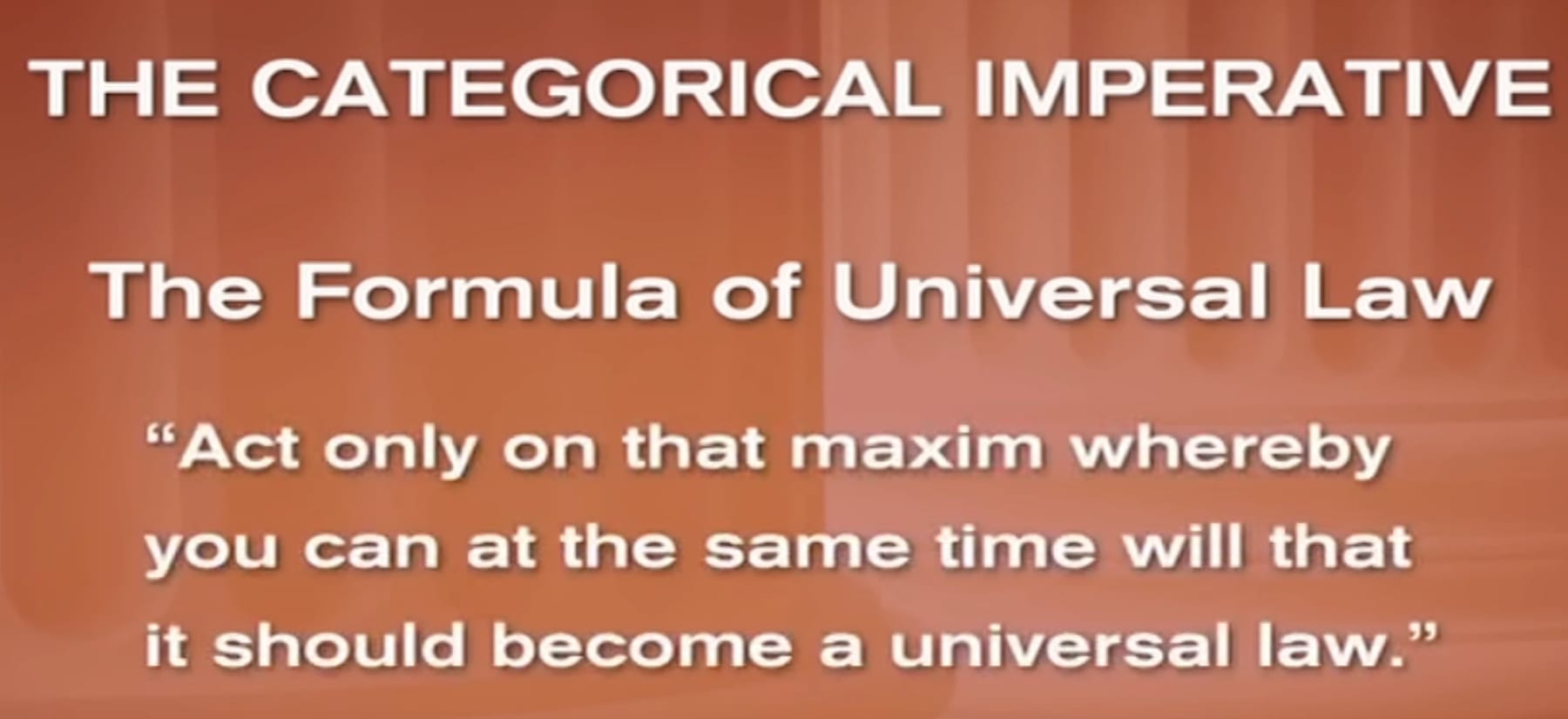
Autonomy, Rationality, and the Moral Law
- Kant asserts that the moral law arises from our shared capacity for reason, making it universally binding.
- Respecting the dignity of persons means recognizing their rational nature as the basis for moral consideration, not their individual traits or circumstances.
- This universal respect forms the foundation of Kantian ethics, contrasting sharply with consequentialist approaches like utilitarianism.
Supreme Principle of Morality
- 3 Dualisms or Contrasts
- Motives: Duty—doing the right thing for the right reasons vs. inclination
- Determination of Will: Autonomous vs heteronomous
- Reason: Imperatives
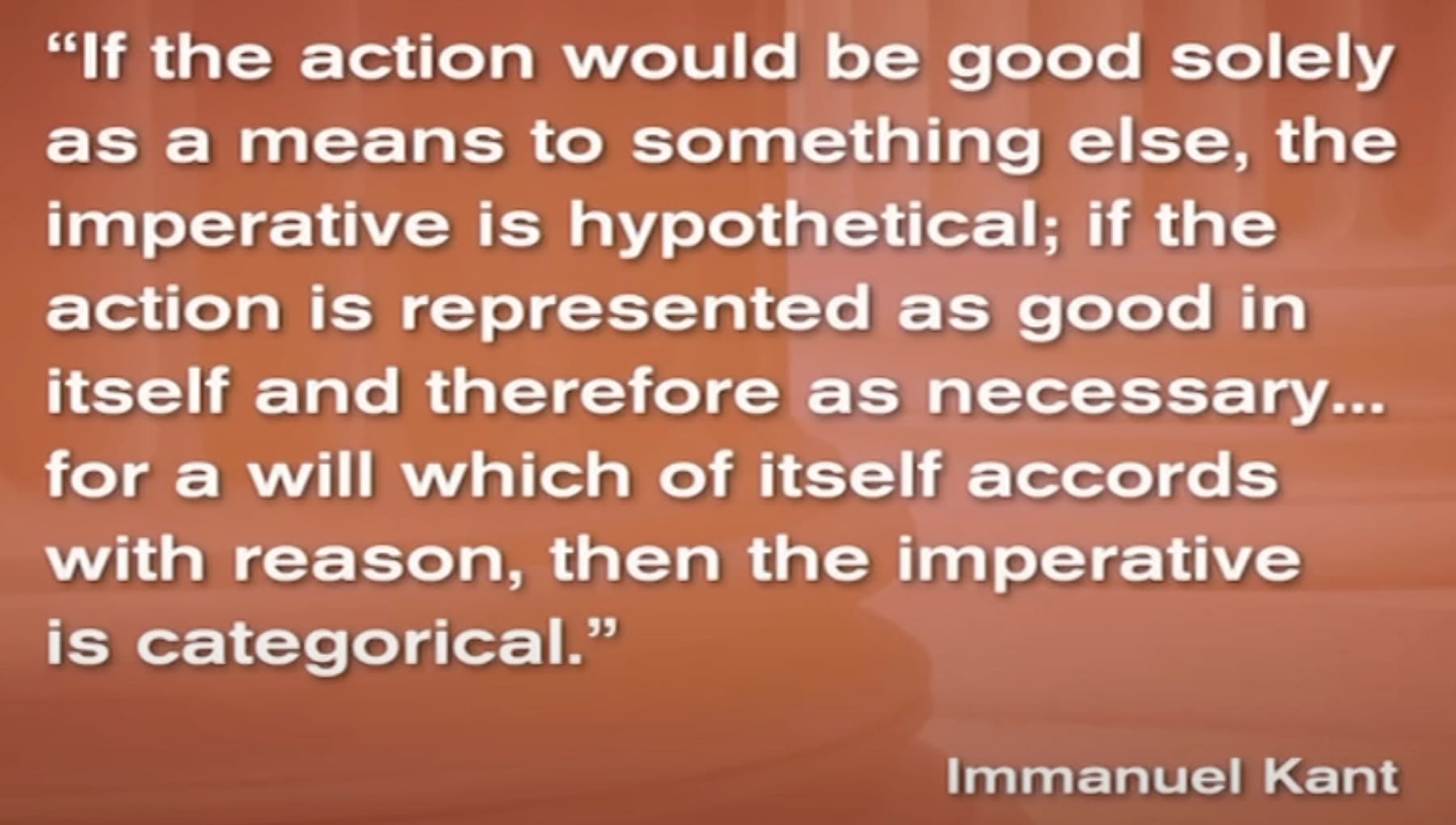
- Its fine to have sentiments and feelings, provided they don’t provide the reason for acting.
Conclusion
- Kant’s demanding account of freedom, autonomy, and moral worth sets a high bar for ethical behavior.
- His emphasis on motives, duty, and universal moral laws challenges us to act not out of self-interest or inclinations, but out of a rational commitment to doing what is right.
Transcript
Duration: 55:13
00:05 Funding for this program provided by additional funding provided by
00:33 Now we turn, to the hardest philosopher that we’re going to read in this course today we turn to Immanuel Kant who offers a different account of why we have a categorical duty to respect the dignity of persons and not to be use people as means merely even for good ends. Kant excelled at the university of Königsberg at the age of sixteen at the age of thirty one he got his first job as an unsalaried lecturer paid on commission based on the number of students who showed up at his lectures this is a sensible system that Harvard would do well to consider luckily for Kant
01:31 he was a popular lecturer and also an industrious one and so he eked out a meager living it wasn’t until he was fifty seven that he published his first major work but it was worth the wait the book was the critique of pure reason perhaps the most important work in all of modern philosophy and a few years later Kant wrote the groundwork for the metaphysics of morals which we read in this course
02:02 I want to acknowledge even before we start that Kant is a difficult thinker but it’s important to try to figure out what he’s saying because what this book is about is well, it’s about what the supreme principle of morality this number one, and
02:25 it’s also it gives us an account one of the most powerful accounts we have of what freedom really is so let me start today. Kant rejects utilitarianism he thinks that the individual
02:49 person all human beings have a certain dignity that commands our respect the reason the individual is sacred or the bearer of rights according to Kant, doesn’t stem from the idea that we own ourselves,
03:12 but instead from the idea that we are all rational beings we’re all rational beings which simply means that we are beings who are capable of reason. we’re also autonomous beings which is to say that we are beings capable of acting and choosing freely
03:45 now, this capacity for reason and freedom isn’t the only capacity we have. we also have the capacity for pain and pleasure for suffering and satisfaction Kant admits the utilitarians were half a right of course we seek to avoid pain and we like pleasure Kant doesn’t deny this what he does deny is Bentham’s claim that pain in pleasure
04:25 are our sovereign masters he thinks that’s wrong. Kant thinks that it’s are national capacity that makes us distinctive, that makes us special that sets us apart from and above mere animal existence.
04:47 it makes us something more than just physical creatures with appetites. Now we often think of freedom as simply consisting in doing what we want or in the absence of obstacles to getting what we want that’s one way of thinking about freedom.
05:13 but this isn’t Kant’s idea of freedom Kant has a more stringent demanding notion of what it means to be free and though stringent and demanding, if you think it through it’s actually pretty persuasive Kant’s reason is as follows when we, like animals seek after pleasure or the satisfaction of our desires of the avoidance pain when we do that we aren’t really acting freely. why not? we’re really acting as the slaves of those appetites and impulses I didn’t choose this particular hunger or that particular appetite,
06:06 and so when I act to satisfy it I’m just acting according to natural necessity and for Kant, freedom is the opposite of necessity there was an advertising slogan for the
06:27 soft drink Sprite a few years ago the slogan was obey your thirst there there’s a Kantian insight buried in that Sprite advertising slogan that in a way is Kant’s point when you go for Sprite, or Pepsi you’re really you might think that you’re choosing freely sprite versus Pepsi
06:56 but you’re actually obeying something, a thirst, or maybe a desire manufactured or massaged by advertising you’re obeying a prompting that you yourself haven’t chosen or created and here it’s worth noticing Kant’s specially demanding idea of freedom what way of acting, how can my will be determined if not by the prompting sub nature or my hunger or my appetite, or my desires? Kant’s answer: to act freely is to act autonomously and to act autonomously is to act according to a law that I give myself not according to the physical laws of nature or to the laws of cause and effect which include my desire, to eat or to drink or to choose this food in a restaurant over that
08:07 now what is the opposite what is the opposite of autonomy for Kant he invest a special term to describe the opposite of autonomy heteronomy is the opposite of autonomy when I act heteronomously I’m acting according to an inclination or a desire that I haven’t chosen for myself
08:42 so freedom is autonomy is this specially stringent idea that Kant insists on. now why is autonomy the opposite of the acting heteronomously or according to the dictates of nature Kant’s point is that nature is governed by laws
09:09 laws of cause and effect for example suppose you drop a billiard ball it falls to the ground we wouldn’t say the billiard ball is acting freely why not? it’s acting according to the law of nature according to the laws of cause and effect the law of gravity and just as he has an unusually demanding and stringent conception of freedom, freedom as autonomy,
09:43 he also has a demanding conception of morality to act freely is not to choose the best means to a given end it’s to choose the end itself for its own sake
10:03 and that’s something that human beings can do and that billiard balls can’t insofar as we act on inclination or pursue pleasure we fact as means to the realization of ends given outside us we are instruments rather than authors of the purposes we pursue that’s the heteronomous determination of the will on the other hand
10:38 insofar as we act autonomously according to law we give ourselves we do something for its own sake as an end in itself when we act autonomously we cease to be instruments to purposes given outside us we become what we can come to think of ourselves as ends in ourselves. this capacity to act freely Kant tells us is what gives human life its special dignity. respecting human dignity
11:14 means regarding persons not just as means but also as ends in them and this is why it’s wrong to use people for the sake of other people’s well being or happiness this is the real reason Kant says that utilitarianism goes wrong
11:37 this is the reason it’s important to respect the dignity of persons and to uphold their rights. so even if there are cases remember John Stuart Mill said well in the long run if we uphold Justice and respect the dignity of persons we will maximize human happiness. What would Kant’s answer be to that? what would his answer be? even if that were true even if the calculus worked out that way even if you shouldn’t throw the Christians to the lions because in the long run fear will spread, the overall utility will decline, the utilitarian
12:17 would be upholding Justice and rights and respect for persons for the wrong reason for a purely contingent reason for an instrumental reason it would still be using people even where the calculus works out for the best in the long run, it would still using people as means rather than respecting them as ends in themselves.
12:50 so that’s Kant’s idea of freedom as autonomy and you can begin to see how it’s connected to his idea of morality but we still have to answer one more question what gives an act it’s moral worth in the first place if it can’t be directed at utility or satisfying wants or desires, what do you think gives an action it’s moral worth? this leads us from Kant’s demanding idea of freedom to his demanding idea of morality. What does Kant say? what makes and action morally worthy consists not in the consequences or in the results that flow from it what makes an action morally worthy has to do with the motive with the quality of the will with the intention for which the act is down what matters is the motive and the motive must be of a certain kind.
14:06 so the moral worth of an action depends on the motive for which it’s done and the important thing is that the person do the right thing for the right reason a goodwill isn’t good because of what it affects or accomplishes, Kant writes, it’s good in itself even if by its utmost effort to goodwill accomplishes nothing it would still shine like a jewel for its own sake
14:35 as something which has its full value in itself and so for any action to be morally good it’s not enough that it should conform to the moral law it must also be done for the sake of the moral law. the idea is that the motive confers the moral worth on an action and the only kind of motive that can confirm moral worth on an action is the motive of duty well what’s the opposite
15:11 of doing something out of a sense of duty because it’s right, well for Kant the opposite would be all of those motives having to do with our inclinations and inclinations refer to all of our desires, all of our contingently given wants preferences impulses and the like only actions done for the sake of the moral law for the sake of duty only these actions have moral worth
15:42 now I want to see what you think about this idea but first let’s consider a few examples Kant begins with an example of a shopkeeper he wants to bring out the intuition and make plausible the idea that what confers moral worth on an action is that it be done because it’s right he says suppose there’s a shopkeeper and an inexperienced customer comes in
16:11 the shopkeeper knows that he could give the customer the wrong change could shortchange the customer and get away with it at least that customer wouldn’t know but the shopkeeper nonetheless says well if I shortchange this customer word may get out my reputation would be damaged and I would lose business
16:35 so I won’t shortchange this customer the shop keeper does nothing wrong he gives a correct change but does this action have moral worth? Kant says no. it doesn’t have moral worth because the shopkeeper only did the right thing for the wrong reason out of self-interest that’s a pretty straightforward case. then he takes another case the case of suicide. he says we have a duty to preserve ourselves
17:18 now, for most people who love life, we have multiple reasons for not taking our own lives so the only way we can really tell the only way we can isolate the operative motive for someone who doesn’t take his or her life is to think
17:41 to imagine someone who’s miserable and who despite having an absolutely miserable life nonetheless recognizes the duty to preserve one’s self
18:02 and so does not commit suicide. the force of the example is to bring out the motive that matters and the motive that matters for morality is doing the right thing for the sake of duty. let me just give you a couple of other examples the better business bureau what’s their slogan, the slogan of the better business bureau? honesty is the best policy
18:36 it’s also the most profitable. this is the better business bureaus full page ad in the new York times honesty it’s as important as any other asset because a business the deals in truth, openness and fair value cannot help but do well come join us and profit from it What would Kant say about the moral worth of the honest dealings that members of the better business bureau. What he says that here’s a perfect example
19:13 that if this is the reason that these companies deal honestly with their customers their action lacks moral worth this is Kant’s point or couple of years ago at the university of Maryland there was a problem with cheating and so they initiated an honor system and they created a program with local merchants that if you signed the honor pledge not to cheat you would get discounts often to twenty five percent of local shops
19:52 now what would you think of someone motivated to uphold an honor code with all the discounts it’s the same as Kant’s shopkeeper the point is what matters is the quality of the will the character of the motive and the relevant motive to morality can only be the motive of duty not the motive of inclination. and when I act out of duty and when I resist as my motive for acting inclinations or self-interest even sympathy and altruism, only then am I acting freely. only then and I acting autonomously, only then is my will not determined or governed by external considerations. that’s the link between Kant’s idea of freedom
20:54 and of morality. now I want to pause here the see if all of this is clear or if you have some questions or puzzles they can be questions of clarification or they can be challenges if you want to challenge this idea that only the motive of duty confers moral worth on the action action what do you think
21:20 I actually have two questions of clarification the first is there seems to be an aspect of this that makes it sort of self-defeating in that once you’re conscious of what morality is you can sort of alter your motive to achieve that end of morality give me an example what do you have in mind the shopkeeper example if he
21:46 decides that he wants to give the person of money is to do the right thing and he decides that’s his motive to do so because he was the moral then isn’t that sort of defeating trying to isn’t that sort of defeating the purity of his action if morality is determined by his motive is his motive is to act morally
22:07 so you’re imagining a case not of the purely selfish calculating shopkeeper but of one who says well he may consider shortchanging the customer but then he says not, while my reputation might suffer if word gets out, but instead he says
22:27 actually I would like to be the kind of honest person who gives the right change to customers simply because it’s the right thing to do or simply because I want to be moral because I want to be moral I want to be a good person and so I’m going to conform all of my actions to what morality requires it’s a subtle point, it’s a good question
22:57 Kant does acknowledge you’re pressing Kant on an important point here, Kant does say there has to be some incentive to obey the moral law it can’t be a self-interested incentive that would defeat it by definition
23:19 so he speaks of a different kind of incentive from an inclination he speaks of reverence for the moral law so if that shopkeeper says I want to develop a reverence for the moral law and so I’m going to act, so I’m going to do the right thing then I think he’s there, he’s there as far as Kant’s concerned because he’s formed his motive his will is conforming to the moral law once he sees the importance of it
23:59 so it would count it would count and secondly very quickly what stops morality from becoming completely objective in this point? what stops morality from becoming completely subjective, yea, like how can if there’s, if morality is completely determined by your morals then how can you apply this or how can it be enforced?
24:24 that’s also a great question, what’s your name? my name’s Ahmady. Ahmady? all right if acting morally means acting according to a moral law out of duty and if it’s also to act freely in the sense of autonomously it must mean that I’m acting according to a law that I give myself that’s what it means to act autonomously Ahmady is right about that
24:54 but that does raise a really interesting question if acting autonomously means acting according to a law I give myself that’s how I escape the chain of cause and effect and the laws of nature what’s to guarantee that the law I give myself when I’m acting out of duty is the same as the law that Ahmady is giving himself and that each of you gives yourselves well here’s the question how many moral laws from Kant’s point of view are there in this room are there a thousands or is there one he thinks there’s one which in a way does go back to this question all right what is the moral law, what does it tell us
25:56 so what guarantees, it sounds like it to act autonomously is to act according to one’s conscience according to a law one gives oneself but what guarantees that we, if we all exercise our reason we will come up with one and the same moral law? that’s what Ahmady wants to know. here’s Kant’s answer,
26:20 the reason that leads us to the law we give ourselves as autonomous beings is a reason it’s a kind of practical reason that we share as human beings it’s not idiosyncratic
26:46 the reason we need to respect the dignity of persons is that we’re all rational beings we all have the capacity for reason and it’s the exercise of that capacity for a reason which exist undifferentiated in all of us that makes us worthy of dignity, all of us and
27:07 since it’s the same capacity for reason unqualified by particular autobiographies and circumstances it’s the same universal capacity for reason that delivers the moral law it turns out that to act autonomously is to act according to a law
27:29 we give ourselves exercising our reason but it’s the reason we share with everyone as rational beings not the particular reason we have given our upbringing, our particular values our particular interests it’s pure practical reason in Kant’s terms which legislates apriori regardless of any particular contingent or empirical ends. Well
28:00 what moral law would that kind of reason deliver? what is its content? to answer that question you have to read the groundwork and we’ll continue with that question next time. For Kant, morally speaking suicide is on a par with murder it’s on a par with murder because what we violate when we take a life
28:39 when we take someone’s life, our’s or somebody else’s, we use that person we use a rational being we use humanity as a means and so we fail to respect humanity as an end
29:03 today we turn back to Kant, but before we do remember this is the week by the end of which all of you will basically get Kant, figure out what he’s up to you’re laughing no, it will happen Kant’s groundwork is about two big questions, first what is the supreme principle of morality second how is freedom possible? two big questions
29:54 now, one way of making your way through this dense philosophical book is to bear in mind a set of opposition or contrasts or dualisms that are related. today I’d like to talk about them today we’re going to answer the question, what according to Kant, is the supreme principle of morality and in answering that question in working our way up to Kant’s answer to that question, it will help to bear in mind three contrasts or dualisms that Kant sets out the first you remember had to do with the motive according to which we act and according to Kant, only one kind of motive is consistent with morality the motive of duty
31:09 doing the right thing for the right reason what other kinds of motives are there Kant sums them up in the category inclination every time the motive for what we do is to satisfy a desire
31:31 or a preference that we may have, to pursue some interest we’re acting out of inclination now let me pause to see if if in thinking about the question of the motive of duty of good will see if any of you has a question about that much of Kant’s claim. or is everybody happy with this distinction what do you think? go ahead. when you make that distinction between duty and inclination is there ever any moral action ever?
32:05 I mean you could always kind of probably find some kind of some selfish motive, can’t you? maybe very often people do have self-interested motives when they act Kant wouldn’t dispute that but what Kant is saying is that in so far as we act
32:27 morally that is in so far as our actions have moral worth what confers moral worth is precisely our capacity to rise above self-interest and prudence and inclination and to act out of duty
32:48 some years ago I read about a spelling bee and there was a young man who was declared the winner of the spelling bee a kid named Andrew, thirteen years old the winning word, the word that he was able to spell was echolalia
33:10 does anyone know what echolalia is? it’s not some type of flower no, it is the tendency to repeat as an echo, to repeat what you’ve heard anyhow, he misspelled it actually
33:31 but the judges misheard him they thought it spelled it correctly and awarded him the championship of the national spelling bee and he went to the judges afterward and said actually I misspelled it I don’t deserve the prize and he was regarded as a moral hero and he was written up in the new York times misspeller is the spelling bee hero there’s Andrew with is proud mother
34:14 and but when he was interviewed afterwards listen to this, when he was interviewed afterwards he said quote the judges said I had a lot of integrity but then he added that part of his motive was quote I didn’t want to feel like a slime all right what would Kant say? I guess it would depend on whether or not
34:44 that was a marginal reason or the predominant reason in whether not and why he decided to confess that he didn’t actually spell the word correctly good and what’s your name. Vasco. that’s very interesting is there anyone else who has a view about this? does this show that Kant’s principle is too stringent too demanding what would Kant say about this? yes
35:14 I think that Kant actually says that it is the pure motivation that comes out of duty that gives the action moral worth, so it’s like for example in this case he might have more than one motive, he might have a motive of not feeling like a slime and he might have to move of doing the right thing in and of itself out of duty and so while there’s more than one motivation going on there does not mean that action is devoid of moral worth just because he has one other motive
35:43 so because the motive which involves duty is what gives it moral worth. goo, and what’s your name? Judith well Judith I think that your account actually is true to Kant it’s fine to have sentiments and feelings that support doing the right thing provided they don’t provide
36:04 the reason for acting so I think Judith has actually a pretty good defense of Kant on this question of the motive of duty, thank you now let’s go back to the three contrasts it’s clear at least what Kant means when he says that for an action to have moral worth it must be done for the sake of duty not out of inclination
36:34 but as we began to see last time there’s a connection between Kant’s stringent notion of morality and especially demanding understanding of freedom and that leads us to the second contrast the link between morality and freedom a second contrast describes two different ways that my will can be determined autonomously and heteronomously according to Kant I’m only free when my will is determined autonomously which means what? according to a law that I give myself we must be capable, if we’re capable of freedom as autonomously, we must be capable of acting accordingly 0:37:26.0laws that’s given or imposed on us
37:28 but according to a law we give ourselves but where could such a law come from? a law that we give ourselves? reason, if reason determines my will then the real becomes to power to choose independent of the dictates of nature or inclination or circumstance
38:00 so connected with Kant’s demanding notions of morality and freedom is especially demanding notion of reason well how can reason determine the will there are two ways and this leads to the third contracts Kant says
38:22 there are two different commands of reason in a command of reason Kant calls an imperative an imperative is simply an ought one kind of imperative, perhaps the most familiar kind, is a hypothetical imperative. hypothetical imperatives
38:45 use instrumental reason if you want x then do y it’s means ends reason. if you want a good business reputation then don’t shortchange your customers word may get out. that’s a hypothetical imperative. if the action would be good
39:13 solely as a means to something else Kant writes, the imperative is hypothetical if the action is represented as good in itself and therefore as necessary for a will which of itself accords with reason then the imperative categorical. that’s the difference between a categorical imperative and a hypothetical one a categorical imperative commands categorically which just means without reference to or dependents on any further purpose
39:51 and so you see the connection among these three parallel contrasts to be free in the sense of autonomous requires that I act not out of a hypothetical imperative but out of the categorical imperative
40:13 so you see by these three contrasts Kant reasons his way brings us up to you he’s derivation of the categorical imperative well this leaves us one big question what is the categorical imperative? what is the supreme principle of morality what does it command of us? Kant gives three versions three formulations of the categorical imperative. I want to mention two and then see what you think of them. the first version the first formula he calls the formula of the universal law act only on that maxim whereby you can at the same time will that it should become a universal law and by maxim what does Kant mean? he means a rule that explains
41:15 the reason for what you’re doing a principle for example promise keeping suppose I need money, I hundred dollars desperately and I know I can’t pay it back anytime soon I come to you
41:36 and make you a promise, a false promise, one I know I can’t keep please give me a hundred dollars today lend me the money I will repay you next week is that consistent with the categorical imperative, that false promise Kant says no and the test the way we can determine that the false promise is at odds with categorical imperative is try to universalize it. universalize the maxim upon which you’re about to act if everybody made false promises when they needed money then nobody would believe those promises there would be no such thing as a promise
42:24 and so there would be a contradiction the maxim universalized would undermine itself that’s the test that’s how we can know that the false promise is wrong well what about the formula of the universal law you find it persuasive? what do you think? I have a question about the difference between categoricalism and a hypothesis that if you’re going to act.. Between categorical in hypothetical imperatives? right. if you’re going to act with a categorical imperative
43:15 so that the maxim doesn’t undermine itself it sounds like I am going to do X because I want y I’m going to not lie in dire need because I want the world to function in such a way that promises kept. I don’t want to liquidate the practice of promises. Right.
43:38 it sounds like justifying a means by an ends it seems like an instance of consequentialist reasoning you’re saying. and what’s your name? Tim. well Tim John Stuart Mill agreed with you he made this criticism of Kant he said if I universalize the maximum and find that the whole practice of promise keeping would be destroyed if universalized I must be appealing
44:14 somehow to consequences if that’s the reason not to tell a false promise so John Stuart Mill agreed with that criticism against Kant but John Stuart Mill was wrong you’re in good company though you’re in good company, Tim Kant is often read as Tim just read him as appealing to consequences the world would be worse off if everybody lied because then nobody could rely on anybody else’s word therefore you shouldn’t lie that’s not what Kant is saying exactly although it’s easy to interpret him as saying that I think what he’s saying is that this is the test this is the test of whether the maxim corresponds with the categorical imperative
45:16 it isn’t exactly the reason it’s not the reason the reason you should universalize to test your maxim is to see whether you are privileging your particular needs and desires over everybody else’s it’s a way of pointing to this feature to this this feature to this demand of the categorical imperative
45:45 that the reasons for your actions shouldn’t depend or their justification on your interests, your needs, your special circumstances being more important than somebody else’s that I think is the moral intuition lying behind the universalization test so let me spell out the second Kant’s second version of the categorical imperative perhaps in a way that’s more intuitively accessible than the formula of universal law it’s the formula of humanity as an end Kant introduces the second version of the categorical imperative with the following line of argument we can’t base the categorical imperative on any particular interests, purposes, or ends because then it would be
46:42 only relative to the person whose ends they were but suppose there was something whose existence has in itself and absolute value an end in itself then in it and in it alone would there be the ground of a possible a categorical imperative well, what is there that we can think of as having it’s end in itself Kant’s answer is this I say that man and in general every rational being exists as an end in himself not nearly as a means for arbitrary use by this or that will and here Kant distinguishes
47:32 between persons on the one hand and things on the other rational beings are persons the don’t just have a relative value for us but if anything has they have an absolute value an intrinsic value that is rational beings have dignity they’re worthy of reverence and respect
47:56 this line of reasoning leads Kant to the second formulation of the categorical imperative which is this act in such a way that you always treated humanity whether in your own person or in the person of any other never simply as a means but always at the same time as an end
48:21 so that’s the formula of humanity as an end the idea that human beings as rational beings are ends in themselves not open to use merely as a means when I make a false promise to you I mean using you as a means to my ends to my desire for the hundred dollars
48:51 and so I’m failing to respect you, I’m failing to respect your dignity I’m manipulating you now consider the example of the duty of against suicide murder and suicide are at odds with the categorical imperative why?
49:17 if I murdered someone I’m taking their life for some purpose. either because I’m a hired killer or I’m in the throws of some great anger or passion well I have some interest or purpose that is particular for the sake of which I’m using them as a means murder violates the categorical imperative for Kant, morally speaking suicide is on a par with murder it’s on a par with murder because what we violate when we take a life
49:57 when we take someone’s life our’s or somebody else’s we use that person we use a rational being we use humanity as a means and so we fail to respect humanity as an end and that capacity for reasons that humanity that commands respect that is to ground of dignity that humanity
50:25 that capacity for a reason resides undifferentiated in all of us and so I violate that dignity in my own person if I commit suicide and in murder if I take somebody else’s life from a moral point of view they’re the same
50:45 and the reason they’re the same has to do with the universal character and ground of the moral law the reason that we have to respect the dignity of other people has not to do with anything in particular about them
51:06 and so respect, Kantian respect is unlike love in this way it’s unlike sympathy it’s unlike solidarity or fellow feeling for altruism because love and those other particular virtues are reasons for caring about other people have to do with who they are in particular
51:28 but respect for Kant respect is respect for humanity which is universal for a rational capacity which is universal and that’s why violating it in my own case is as objectionable as violating it in the case of any other questions or rejections?
51:58 I guess I’m somewhat worried about Kant’s statement that you cannot use a person as a means because every person is an end in and of themselves because it seems that that everyday in order to get something accomplished for that day I must use myself as a means to some end
52:20 and I must use the people around me as a means to some ends as well for instance suppose that I want to do well in a class and I have to write a paper I have to use myself as a means to write the paper suppose I want to buy something, food. I must go to the store, use the person working behind the counters as a means for me to purchase my food. You’re right, that’s true what’s your name? Patrick Patrick you’re not doing anything wrong you’re not violating the categorical imperative when you use other people as a means that’s not objectionable provided when we deal with other people for the sake of advancing our projects and purposes and interests, which we all do, provided we treat them in a way that is consistent with respect for their dignity and what it means to respect them is given by the categorical imperative. are you persuaded? do you think that Kant has given a compelling account a persuasive account of the supreme principle of morality? re-read the groundwork and we’ll try to answer that question next time. don’t miss the chance to interact online with other viewers of Justice join the conversation, take a pop quiz catch up on lectures you’ve missed, and learn a lot more. Visit justiceharvard.org it’s the right thing to do
54:53 funding for this program is provided by additional funding provided by
Episode 7: A Lesson in Lying (Immanuel Kant & John Rawls)
Summary
1. Duty and Autonomy in Kant’s Moral Theory
- Autonomy and Duty: Kant argues that acting autonomously means acting according to a moral law one imposes on oneself, not based on external influences or personal desires.
- Dignity through Self-Legislation: Kant contends that true dignity comes not from merely following laws but from being the author of those laws, thus aligning freedom with duty.
- Universality of Moral Law: Kant insists that a true moral law must be universal, transcending subjective conditions and individual differences, which leads to the concept of the categorical imperative.
- Two Standpoints:
- Sensible World: Governed by the laws of nature and causality.
- Intelligible World: Governed by reason, where true freedom resides.
- Moral Freedom: We can only regard ourselves as free when we act according to laws we autonomously impose upon ourselves, without being merely subject to empirical desires.
2. The Categorical Imperative
- Universal Law Formulation: Moral actions must be guided by principles that can be universally applied without contradiction.
- Intelligible Standpoint and Autonomy: The possibility of categorical imperatives depends on our ability to consider ourselves as part of an intelligible world, where reason governs action.
- Freedom as a Prerequisite for Morality: If humans were purely empirical beings, driven only by sensory experiences, genuine moral freedom would be impossible.
3. The Lying Dilemma and Moral Consistency
- The Case of the Murderer at the Door:
- Kant famously argues that lying is always wrong, even in extreme cases like protecting a friend from a murderer.
- He maintains that introducing consequences into moral decision-making undermines the categorical imperative and leads to consequentialism.
- The debate over misleading truths (e.g., Bill Clinton’s evasive denials) highlights the distinction Kant makes between outright lies and technically true but potentially misleading statements. Kant will say it aligns with a since of duty.
4. Hypothetical Contracts and Justice
- Kant’s Social Contract:
- Kant proposes a form of social contract as an “idea of reason” rather than a literal historical agreement, meant to guide the creation of just laws.
- He contrasts this with actual contracts, which can be tainted by power imbalances and unequal knowledge.
- John Rawls’ Extension:
- Sandel introduces John Rawls’ “veil of ignorance” as a way to extend Kant’s idea, ensuring fairness by abstracting from personal characteristics and interests in the original position.
- Sandel introduces John Rawls’ “veil of ignorance” as a way to extend Kant’s idea, ensuring fairness by abstracting from personal characteristics and interests in the original position.
5. The Limits and Moral Force of Actual Contracts
- Distinction Between Autonomy and Reciprocity:
- Contracts gain moral force through autonomy (self-imposed obligation) and reciprocity (mutual benefit).
- Sandel argues that neither element alone is sufficient for moral obligation, emphasizing the importance of fairness and equality in real-world agreements.
- Case Studies:
- Lobster Harvest Example: Highlights the limits of mutual benefit as a basis for obligation.
- Hume’s House Repair: Demonstrates the potential pitfalls of assuming obligation without explicit consent.
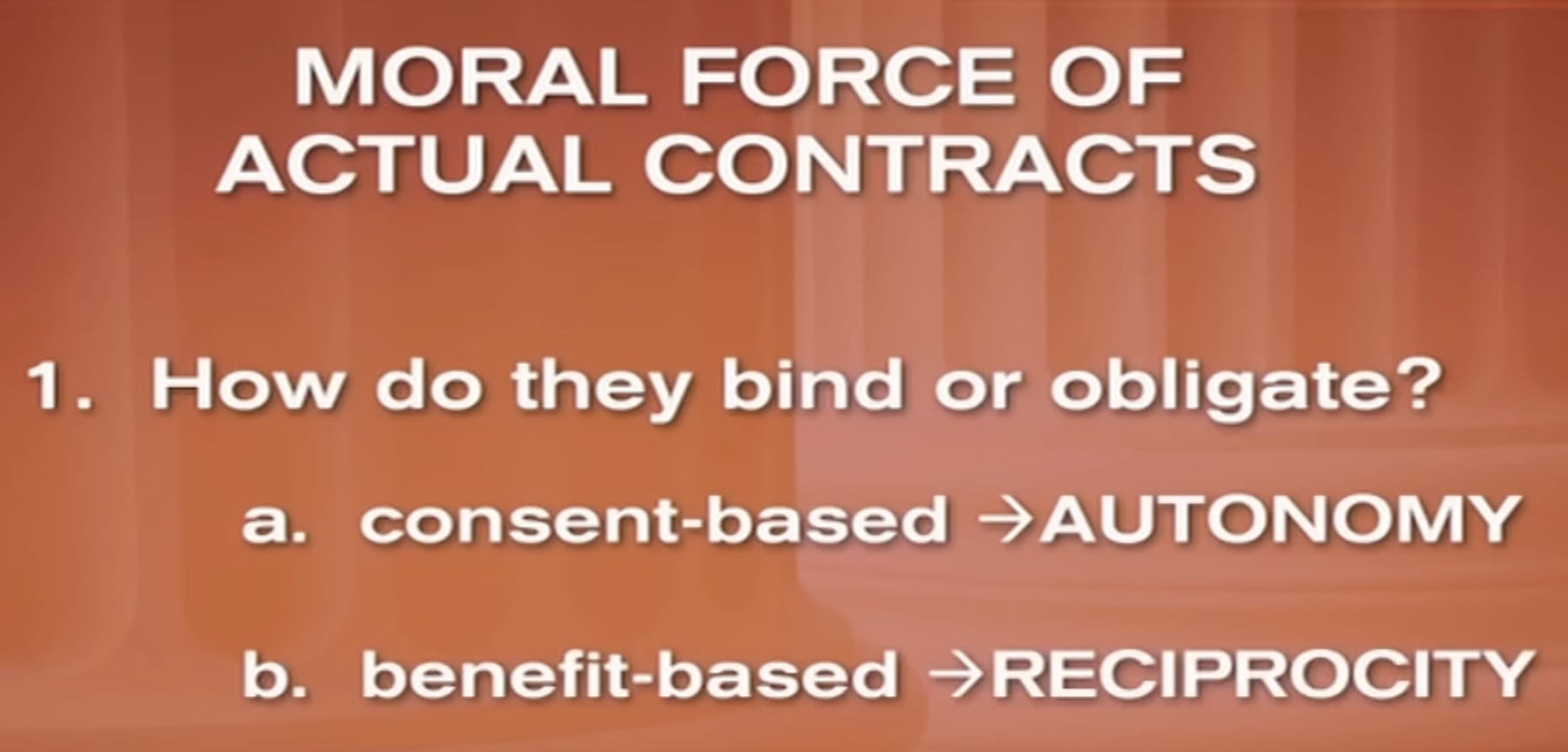
- Contracts don’t need to be fair even if they are agreed to
- An act of consent, a contract, and not only not sufficient but its not even a necessary condition of there being an obligation
- If there is reciprocity, if there is an exchange, then there can be an obligation even without an act of consent
- David Hume
- 18th century philosopher, the Scottish moral philosopher David Hume, when he was young, wrote a book arguing against the idea of an original social contract. Hume heaped scorn on this contractarian idea, calling it a philosophical fiction, “one of the most mysterious and incomprehensible operations that can possibly be imagined.”Many years later, when he was 62 years old, Hume had an experience that put to the test his rejection of consent as the basis of obligation. Hume had a house in Edinburgh, which he rented to his friend James Boswell, who in turn sublet it to a subtenant. The subtenant decided that the house needed some repairs and a paint job. He hired a contractor to do the work. The painter did the work and sent the bill to Hume. Hume refused to pay on the grounds that he hadn’t consented – he hadn’t hired the painter. The case went to court. The contractor said it was true Hume didn’t agree, but the house needed a painting, and he had given it a very good one. Hume thought this was a bad argument:
- “The only argument this painter makes is that the work was necessary to be done. But this is no good answer, because by the same rule this painter may go through every house in Edinburgh and do what he thinks proper to be done without the landlord’s consent and give the same reason – that the work was necessary and that the house was the better for it.”
- Hume didn’t like the theory that there could be obligation to repay a benefit without consent, but the defense failed, and he had to pay.
Consent-based vs Benefit-based Obligations
The distinction between consent-based and benefit-based obligations is a fundamental debate in moral and political philosophy, reflecting different views on what grounds our duty to obey the law or fulfill contractual duties. Here’s a breakdown:
Consent-Based Obligations (Voluntarist Theory)
Core Idea: An obligation arises only if a person has explicitly or implicitly consented to it.
Key Features:
- Explicit or Tacit Consent: Obligations are legitimate only if an individual has agreed to them, either through explicit promises or tacit acceptance (e.g., using public roads as a form of implied consent to obey traffic laws).
- Autonomy and Free Will: Emphasizes the moral importance of individual autonomy and self-determination.
- Moral Binding Force: The act of consenting creates a binding moral duty, which makes the obligation legitimate regardless of the benefits received.
- Limits of Authority: Prevents others from imposing duties without the individual’s consent, protecting against coercion and unjust authority.
Philosophical Proponents: John Locke, Immanuel Kant, and Jean-Jacques Rousseau (through the Social Contract).
Examples:
- Contract law, where a signed agreement is legally binding.
- Democratic legitimacy, where political power is justified by the consent of the governed.
- Hume’s argument against being forced to pay for the painter, as he had not consented to the work.
Benefit-Based Obligations (Beneficence Theory or Natural Duty Theory)
Core Idea: An obligation can arise simply because one has received a benefit, even without explicit consent.
Key Features:
- Non-Voluntary Grounds: Obligations do not always require explicit consent; receiving a benefit can itself impose a moral duty.
- Reciprocity Principle: Focuses on fairness and mutual dependence – if one benefits from a system, one should contribute to its maintenance.
- Moral Interdependence: Recognizes that social cooperation and mutual aid create obligations that transcend individual consent.
- Practical Basis: Emphasizes that societies rely on implicit social contracts and shared benefits to function, making strict consent impractical.
Philosophical Proponents: Plato (through the Crito), H.L.A. Hart (fair play theory), and some interpretations of David Hume.
Examples:
- Paying taxes, as citizens benefit from public goods like roads and defense.
- Repaying someone who helps in an emergency, even if the help was unsolicited.
- Hume’s eventual court loss, where the court found that receiving the benefit of the painted house created an obligation to pay, despite the lack of explicit consent.
Key Distinctions:
| Feature | Consent-Based Obligation | Benefit-Based Obligation |
|---|---|---|
| Source of Duty | Voluntary agreement | Receipt of a benefit |
| Moral Justification | Respect for autonomy | Fairness and reciprocity |
| Scope | Limited to explicit or tacit agreements | Potentially broader, including implicit social ties |
| Criticisms | Too restrictive, ignores practical realities | Can be coercive, risks imposing duties without choice |
| Examples | Contracts, democratic consent | Taxes, social cooperation, rescue duties |
Test relationship between autonomy and reciprocity (Hypothetical Contract)
Here is the summarized passage, organized without removing any of the original content:
The example tests the relationship between the two aspects of the morality of contracts: autonomy and reciprocity.
Imagine a marriage where, after 20 years of faithfulness, one partner discovers that their spouse has been unfaithful every year during their annual cross-country trip. This scenario presents two distinct reasons for moral outrage:
- Violation of Consent: The spouse broke a promise, violating the contract of the marriage. This breach is grounded in the principle of consent – a straightforward betrayal of the agreed terms.
- Violation of Reciprocity: Beyond the broken promise, the faithful partner could feel wronged because they had fulfilled their side of the commitment, expecting fair treatment in return. This resentment arises from the principle of reciprocity – the expectation that effort and loyalty should be met with equivalent dedication.
The distinction becomes clearer if the betrayal occurs not after 20 years, but on the way to the honeymoon, before any substantial history of mutual effort. In this case, the moral force would rest almost entirely on the violation of consent, as there has been no history of reciprocal benefit yet.
Main Idea:
Actual contracts derive their moral force from two fundamental ideals:
- Autonomy: The free and voluntary agreement to a commitment.
- Reciprocity: The expectation of fair exchange based on mutual performance.
However, real-world contracts often fail to fully realize these ideals:
- Autonomy Issues: Differences in bargaining power can undermine true freedom of consent.
- Reciprocity Issues: Disparities in knowledge can prevent genuinely equivalent exchanges.
This leads to the concept of a hypothetical contract – an idealized agreement where both parties have equal power and knowledge, free from the inequalities that can distort real-world contracts. This is the foundation of John Rawls’ approach to justice, where principles are chosen behind a veil of ignorance, ensuring fairness by eliminating biases and unequal bargaining positions.
6. Conclusion and Transition to Rawls
- Veil of Ignorance as Ideal Contract:
- Rawls’ theory builds on Kant by proposing that true justice requires a hypothetical contract created under conditions of perfect equality, free from the contingencies of real-world disparities in power and knowledge.
Transcript
Duration: 55:04
00:03 funding for this program is provided by additional funding provided by last time we began and trying to we began by trying to navigate our way through K moral
00:39 theory now fully to make sense of K moral theory in the groundwork requires that we be able to answer three questions how can Duty and autonomy go together what’s the Great dignity and answering to duty it would seem that these two ideas are opposed Duty and autonomy what’s
01:11 kant’s answer to that need someone here to speak up on kant’s behalf does he have an answer yes go ahead stand up K believes that you only act autonomously when you are when you’re pursuing something only in the name of Duty and not because of your own circumstances such as like
01:34 you’re only doing something good and moral if you’re doing it because of Duty not because something of your own personal gain now why is that acting what’s your name mine is Matt Matt why is that acting out of freedom I I hear what you’re saying you choose to accept those moral laws in yourself and they’re not brought on from outside upon on okay good because acting out of Duty yeah is following a moral law that you impose on yourself that you impose on yourself that’s what makes Duty compatible with
02:04 freedom yeah okay that’s good Matt that is K answer that’s great thank you so K’s answer is it is not in so far as I am subject to the law that I have dignity but rather in so far as with regard to that very same law I’m the author and I’m subordinated to that law on that grounds that I took it as Matt just said
02:33 I took it upon myself I will that law so that’s why for Kant acting according to duty and acting freely in the sense of autonomously are one and the same but that raises the question how many moral laws are there because if dignity consists in being governed by a law that I give myself what’s to guarantee that that my conscience will be the same as your conscience who has count answer to that yes because a moral law trans is not contingent upon subjective conditions it would transcend all particular
03:16 differences between people and so would be a universal law and in this respect there would only be one moral law because it would be Supreme that’s exactly right what’s your name Kelly Kelly so Kelly can’t believes that if we choose freely out of our own consciences the moral law we’re guaranteed to come up with one and the same moral law yes and that’s because when I choose it’s not me Michael sandal choosing it’s not you Kelly choosing for yourself what is it exactly who’s doing the choosing who’s the subject who’s the
03:56 agent who’s doing the choosing reason well reason pure reason pure reason and what you mean by pure reason is what exactly well pure reason is like we were saying before not subject to any external um conditions that may be imposed on it so that’s great so the
04:17 reason that does the Willing the reason that governs my will when I will the moral law is the same reason that operates when you choose the moral law for yourself yes and that’s why it’s possible to act autonomously to choose for myself for each of us to choose for ourselves as autonomous beings and for all of us to wind up willing the same moral law the categorical
04:53 imperative but then there is one big and very difficult question left even if you accept everything that Matt and Kelly have said so far how is a categorical imperative possible how is morality possible to answer that question Kant says we need to make a distinction we need to make a distinction between two standpoints two standpoints from which we can and make sense of our experience let me try to explain what he means by these two standpoints as an object of experience I belong to the sensible World there my actions are determined by the laws of nature and by the regularities of cause and
05:52 effect but as a subject of experience I inhabit an intelligible world he here being independent of the laws of nature I am capable of autonomy capable of acting according to a law I give myself now Kant says that only from this second standpoint can I regard myself as free for to be independent of determination by causes in the sensible world is to be free if I were wholly an empirical being as the utilitarians assume if I were a being holy and only subject to the deliverances of my senses to pain and pleasure and hunger and thirst and appetite if that’s all there were to humanity we wouldn’t be capable of
06:54 Freedom K reasons because in that case every exercise of will would be conditioned by the desire for some object in that case all choice would be heteronomous Choice governed by the pursuit of some external end when we think of ourselves as free count rights we transfer ourselves into the intelligible world as members and recognize the autonomy of the will that’s the idea of the two
07:32 standpoints so how are categorical imperatives Possible only because the idea of freedom makes me a member of an intelligible world now Kant admits we aren’t only rational beings we don’t only inhabit the intelligible world the realm of freedom if we did if we did then all of our actions would invariably Accord with the autonomy of the
08:14 will but precisely because we inhabit simultaneously the two standpoints the two Realms the realm of freedom and the realm of necessity precisely because we inhabit both Realms there is always potentially a gap between what we do and what we ought to do between is and ought another way of putting this point and this is the point with which Kant concludes the groundwork morality is not empirical whatever you see in the world whatever you discover through science can’t decide moral questions morality stands at a certain distance from the world from the empirical world and that’s why no science could deliver moral
09:17 truth now I want to test kant’s moral theory with the hardest possible case a case that he raises the case of the murderer at the door Kant says that lying is wrong we all know that we’ve discussed why lying is at odds with the categorical
09:44 imperative a French philosopher Benjamin Kon wrote an article responding to the groundwork where he said this absolute prohibition on lying is wrong it can’t be right what if a murderer came to your door looking for your friend who was hiding in your house and the murderer asked you point blank is your friend in your house conston says it would be crazy to say that the moral thing to do in that case is to tell the truth kstone says the murderer certainly doesn’t deserve the truth and K Ro a reply and Kant stuck by his principle that lying even to the murderer at the door is
10:48 wrong and the reason it’s wrong he said is once you start taking consequences into account to carat accept I to the categorical imperative you’ve given up the whole moral framework you’ve become a consequentialist or maybe a rule
11:09 utilitarian but most of you and most of K’s readers think there’s something odd and implausible about this answer I would like to try to defend Kant on this point and then I want to see whether you think that my defense is plausible and I would want to defend him within the spirit of his own account of
11:40 morality imagine that someone comes to your door you were asked the question by this murder you’re hiding your friend is there a way that you could avoid telling a lie without selling out your friend does anyone have an idea of how you might be able to do that yes stand up I was just going to say if I were to let my friend in my house to hide in the first place I’d probably make a plan
12:13 with them so I’d be like hey I’ll tell the murderer you’re here but escape and that’s one of the options mentioned so but I’m not sure that’s aan an option H you’re still lying though no because he’s in the house but he won’t be oh I see all right good enough one more try
12:38 if you just say you don’t know where he is because he might not be locked in the closet he might have left the closet you have no clue where he could be so you would say I don’t know which wouldn’t actually be a lie be because you weren’t at that very moment looking in the closet exactly
13:01 so it would be strictly speaking true yes and yet possibly deceiving misleading but still true what’s your name John John all right John has uh now John may be on to
13:22 something John you’re really offering us the option of a clever evasion that is strictly speaking true this raises the question whether there is a moral difference between an outright lie and a misleading truth from K point of
13:46 view there actually is a world of difference between a lie and a misleading truth why is that even though both might have the same consequences but then remember Kant doesn’t base morality on consequences he bases it on formal
14:11 adherence to the moral law now sometimes in ordinary life we make exceptions for the general rule against lying with a white lie what is a white lie it’s it’s a lie to make well to avoid hurting someone feelings for example it’s a lie that we think of as
14:33 justified by the consequences now Kant could not endorse a white lie but perhaps he could endorse a misleading truth suppose someone gives you a tie as a gift and you open the box and it’s just awful what do you say thank you thank
14:54 you you could say thank you but they’re waiting to see what you think of it or they ask you what do you think of it you could tell a white Li and say it’s beautiful but that wouldn’t be permissible from K’s point of view could you say not a white lie but a misleading truth you open the box and you say I’ve never seen a tie like that before thank you you shouldn’t have that’s good can you think of a contemporary political leader who engaged you can what are you thinking of remember the whole carefully worded denials in the Monica Lewinsky Affair of Bill Clinton
16:00 now those denials actually became the subject of very explicit debate and argument during the impeachment hearings take a look at the following excerpts from Bill Clinton is there something do you think morally at stake in the distinction between a lie and a misleading carefully couched truth I want to say one thing to the American people I want you to listen to me I’m going to say this again I did not have sexual relations with that woman Miss Linsky I never told anybody to lie not a single time never these allegations are false did he lie to the American people when he said I never had sex with that
17:01 woman you know he doesn’t believe he did and because of the let me explain may I explain Congressman what he said was to the American people that he did not have sexual relations and I understand you’re not going to like this Congressman because it you will see it as a a hair splitting evasive answer but in his own mind his definition was not okay I understand that argument
17:27 okay all right so there you have the exchange now at the time you may have thought this was just a legalistic hair spitting exchange between a republican who wanted to impeach Clinton and the lawyer who was trying to defend him but now in the light of Kant do you think there is something morally at stake in the distinction between a lie and
17:59 an evasion a true but misleading statement I’d like to hear from Defenders of K people who think there is a distinction are you are you ready to defend Kant well I think when you try to say that lying and misleading truths are the same thing you’re basing it on a consequentialist argument which is that
18:20 they achieve the same thing but the fact of the matter is you told the truth and you intended that people would believe what you were saying which was the truth which means it is not more the same as telling a lie and intending that they believe it is the truth even though it’s not true good what’s your name Diana so Diana says there that KH has a point here and it’s a point that might even come to the aid of Bill Clinton and that
18:47 is well what about that someone over here for C motivation is key so if you give to someone because primarily you want to feel good about yourself com with that has no moral worth well with this the motivation is the same it’s to sort of mislead someone it’s to lie it’s to sort of throw them off the track and the motivation is the same so there should be no difference okay good so here isn’t the motiv motive the same Diana what what do you say to this argument that well the motive is the same in both cases there is the attempt or at least the hope that one’s pursuer will be misled uh well that you could look at it
19:27 that way but I think that the fact is that your immediate motive is that they should believe you the ultimate consequence of that is that they might be deceived and not find out what was going on but your immediate motive is that they should believe you because you’re telling the truth may I help a little sure you and K why don’t you say and what’s your name I’m sorry Wesley why don’t you say to Wesley it’s not exactly the case that the motive in both cases is to mislead they’re hoping they’re hoping
20:03 that the person will be misled by the statement I don’t know where they are or I never had sexual relations you’re hoping that they will be misled but in the case where you’re telling the truth your motive is to mislead while at the same time telling the truth and honoring the moral law and staying within the bounds of the categorical imp N I think K’s answer would be Diana yes
20:33 yes you like that I do okay so I think K’s answer would be unlike a falsehood unlike a lie a misleading truth pays a certain homage to duty and the homage it pays to duty is what justifies that the work of even the work of
20:54 evasion Diana yes you like okay and so there is something some element of respect for the Dignity of the moral law in the careful evasion because Clinton could have told
21:15 an outright lie but he didn’t and so I think kant’s K’s Insight here is in the carefully couched but true evasion there is a kind of homage to the Dignity of the moral law that is not present in the outright lie and that Wesley is part of the motive it’s part of the motive yes I hope he will be misled I hope the murderer will run down the road or go to the mall looking for my friend instead of the closet I hope that will be the effect I can’t control that I can’t control the
21:55 consequences but what I can control is standing by and honoring however I pursue the ends I hope will unfold to do so in a way that is consistent with respect for the moral law Wesley I don’t think is entirely
22:15 persuaded but at least this brings out this discussion brings out some of what’s at stake what’s morally at stake in con notion of the categorical imperative as long as any uh effort is involved I would say that the contract is valid and
22:38 it should take effect but why what was what morally can you point to for example two people agree to be married and one suddenly calls the other in two minutes say I changed my mind does the uh contract have obligation on both sides well I’m tempted to say no fine last time we talked about Khan’s categorical imperative and we considered the way he applied the idea of the categorical imperative to the case of lying I want to turn briefly to one other application of K’s moral theory and that’s his political
23:29 Theory now comp says that just laws arise from a certain kind of social contract but this contract he tells us is of an exceptional nature what makes the contract exceptional is that it’s not an actual contract that happens when people come together and try to figure out what the Constitution should be Kant points out that the contract that generates Justice is what he calls an idea of
24:14 reason it’s not an actual contract among actual men and women gathered in a constitutional convention why not I think K’s reason is that actual men and women gathered in a real con tional convention would have different interests values aims and there would also be differences of bargaining power
24:36 and differences of knowledge among them and so the laws that would result from their deliberations wouldn’t necessarily be just wouldn’t necessarily conform to principles of right but would simply reflect the differences of bargaining power the special interests the fact
24:56 that some might know more than others about law or about politics so Kant says a contract that generates principles of right is merely an idea of reason but it has undoubted practical reality because it can oblige every legislator to frame his laws in such a way that they could have been produced by the United will of the whole
25:27 nation so Kant is a contractarian but he doesn’t trace the origin or the rightness of law to any actual social contract this gives rise to an obvious question what is the moral force of a hypothetical contract a contract that never happened that’s the question we take up
25:56 today but in order to investigate it we need to turn to a modern philosopher John RS who worked out in his book a theory of Justice in great detail an account of a hypothetical agreement as the basis for justice R’s theory of Justice in Broad outline is parallel to K in two important respects like Kant r was a Critic of
26:32 utilitarianism each person possesses an inviability founded on Justice R’s rights that even the welfare of society as a whole cannot override the rights secured by Justice are not subject to political bargaining or to the calculus of social interests the second respect in which rs’s Theory follows cons is on the idea that principles of Justice properly understood can be derived from a
27:11 hypothetical social contract not an actual one and rals works this out in fascinating detail with the device of what he calls the veil of ignorance the way to arrive at the rights the basic rights that we must respect the basic framework of Rights and duties is to imagine that we were gathered together trying to choose the principles to govern our Collective lives without
27:55 knowing certain important particular facts about ourselves that’s the idea of the veil of ignorance now what would happen if we gathered together just as we are here and try to come up with principles of Justice to govern our Collective life there would be a cacaphony of proposals of suggestions reflecting people’s different
28:22 interests some are strong some are weak some are rich some are poor so R says imagine instead that we are gathered in an original position of equality and what assures the equality is the veil of ignorance imagine that we are all behind a veil of ignorance which temporarily abstracts from or brackets hides from us who in particular we are our race our class our place in
29:05 society our strengths our weaknesses whether we’re healthy or unhealthy then and only then R says the principles we would agree to would be principles of Justice that’s how the hypothetical contract Works what is the moral force of this kind of hypothetical agreement is it stronger or weaker than
29:34 a real agreement an actual social contract in order to answer that question we have to look hard at the moral force of actual contract there are really two questions here one one of them is how do actual contracts bind me or obligate me question number one and question number two how do actual real life contracts justify the terms that they produce if you think about it this is in line with walls and K the answer to the second question how do actual contracts justify the terms that they produce the answer is they don’t at least not on their own actual contracts are not self-sufficient moral instruments of any actual contract or agreement it can always be asked is it fair what they agreed to the fact of the agreement never guarantees the fairness of the agreement
30:55 and we know this by looking at our own Constitutional Convention It produced a constitution that permitted slavery to persist it was agreed to it was an actual contract but that doesn’t establish that the laws agreed to all of them were just well then what is the moral force of actual contracts to the extent that they bind us they obligated in two ways suppose maybe here it would help to take an example we make an agreement a commercial agreement I promise to pay you $100 if you will go Harvest and bring to me a 100 lobsters we make a deal you go out and harvest them and bring them to me I eat the lobsters serve them to my friends and then I don’t
32:03 pay and you say but you’re obligated and I say why what do you say well we had a deal and you benefited you ate all those lobsters well that’s a pretty strong argument it’s an argument that depends though on the fact that I benefited from your
32:36 labor so contracts sometimes bind us in so far as they are instruments of mutual benefit I ate the lobsters I owe you the $100 for having gathered them but suppose now take a second case we make this deal I’ll pay you $100 for 100 lobsters and 2 minutes later before you’ve gone to any work I call you back and say I’ve changed my mind
33:09 now there’s no benefit there’s no work on your part so there’s no element of reciprocal exchange what about in that case do I still owe you merely in virtue of the fact that we had an agreement who says those of you who say yes I still owe you
33:33 why okay stand up why do I owe you I call you back after two minutes you haven’t done any work um I think I spent a time and effort in uh drafting this contract with you and also have emotional expectation that I’ll go through the work so you took time to draft the contract but we did it very quickly we just chatted on the phone that wouldn’t be a for form of contract though well I faxed it to you it only took a minute as long as any uh effort is involved I would say that the contract
34:08 is valid and it should take effect but why what was what morally can you point to that obligates me I admit that I agreed but you didn’t go to any work I didn’t enjoy any benefit because one my mentally go through all the work of harvesting the lobsters you mentally went through the work of harvesting the lobsters that’s nothing is it it’s not much is it worth $100 that you were imagining yourself going and collecting
34:43 up it may not worth $100 but it may worth something to some people all right I’ll give you a buck for it for that but what what I so you’re still pointing what’s interesting you’re still pointing to the re reciprocal dimension of contracts you did or imagined that you did or looked forward to doing something
35:03 on my behalf for example two people agree to be married and one suddenly calls the other in two minutes say I changed my mind does the uh contract have obligation on both sides nobody has paid any um work or nobody has benefited yet well I’m tempted to say no fine J all right what’s your name Julian thank you Julian all right that was good
35:41 now is there anyone who has who agrees with Julian that I still owe the money for any other reason now I have go ahead stand up I think if you back out it sort of cheapens the institution of contracts good but why why does it well
36:02 I think this is kind of content but there’s you know almost there’s a certain intrinsic value in being able to make contracts and having you knowing that people will expect that you’ll go through with that good there is some it would cheapen the whole idea of contracts which has to do with taking an obligation on myself is that is that the idea yeah I
36:24 think so what’s your name Adam so Adam points instead not to any reciprocal benefit or Mutual exchange but to the mere fact of the agreement itself we see here there are really two different ways in which actual contracts generate obligations one has to do with the act of consent as a voluntary act and it points Adam said this was a conent idea and I think he’s right because it points to the ideal of autonomy when I make a contract the obligation is one that is self-imposed and that carries a certain moral weight independent of other considerations and then there’s a second element of the moral force of contract arguments which has to do with the sense in which actual contracts are instruments of mutual benefit and this points toward the ideal of reciprocity that obligation can arise I can have an obligation to
37:34 you in so far as you do something for me now we’re investigating the moral force and also the moral limits of actual contracts and here I would like to advance an argument about the moral
37:58 limits of actual contracts now that we know what moral ingredients do the work when people come together and say I will do this if you do that I would like to argue first that the fact that two people agree to some exchange does not mean that the terms of their agreement are fair
38:27 when my two sons were young they collected baseball cards and traded them and one was there was a 2-year age there is a 2-year age difference between them and so I had to Institute a rule about the trades that no trade was complete until I had approved
38:52 it and the reason is obvious the older one knew more about the value of these cards and so would take advantage of the younger one so that’s why I had to review it to make sure that the agreement that the agreements were Fair now you may say well this is paternalism of course it was that’s what paternalism is for that kind of
39:24 thing so what what does this show what does the baseball card example show the fact of an agreement is not sufficient to establish the fairness of the terms I read some years ago of a case in Chicago there was an elderly Widow an 84 year-old Widow named Rose who had a problem in her apartment with a leaky toilet and she signed a contract with an unscrupulous contractor who offered to repair her leaky toilet in exchange for
40:05 $50,000 but she had agreed she was of sound mind maybe terribly naive and unfamiliar with the price of Plumbing she had made this agreement luckily it was discovered she went to the bank and asked to withdraw $25,000 and the teller said what do you need need all of that money for and she said well I have a leaky toilet and the teller called authorities and they discovered this unscrupulous
40:38 contractor now I suspect that even the most Ardent contractarians in the in the room will agree that the fact of This Woman’s agreement is not a sufficient condition of the agreement being fair is there anyone who will dispute that no one am I missing anyone Alex where are you where are
41:17 you so um maybe there’s no dispute then to my first claim that the that an actual agreement is not necessary to their it’s not a efficient condition of there being an obligation I want to now make a a stronger maybe more controversial Claim about the moral limits of actual contracts that a contract or an act of consent is not only not
41:50 sufficient but it’s not even a necessary condition of there being an obligation and the idea here is that if there is reciprocity if there is an exchange then a receipt of benefits there can be an obligation even without an act of consent one great example of this
42:15 involves the 18th century philosopher the Scottish moral philosopher David Hume when he was young Hume wrote a book arguing against loide aidea of an original social contract Hume Heap scorned on this contractarian idea he said it was a philosophical fiction one of the most mysterious and incomprehensible operations that can possibly Be Imagined this idea of the
42:44 social contract many years later when he was 62 years old Hume had an experience that put to the test his rejection of consent as the basis of obligation Hume had a house in Edinburgh he rented it to his friend James Boswell who in turn subl it to a subtenant the subtenant decided that the
43:06 house needed some repairs and a paint job he hired a contractor to do the work the painter did the work and sent the bill to Hume Hume refused to pay on the grounds that he hadn’t consented he hadn’t hired the painter the case went to court the contractor said it’s true Hume
43:27 didn’t agree but the house needed a painting and I gave it a very good one Hume thought this was a bad argument the only argument this painter makes is that the work was necessary to be done but this is no good answer because by the same rule this painter may go through every house in Edinburgh and do what he thinks proper to be done without the landlord’s consent and give the same
43:52 reason that the work was necessary and that the house was the better for it so Hume didn’t like the theory that there could be obligation to repay a benefit without consent but the defense failed and he had to pay let me give you one other example of the distinction between the consent based aspect of obligations and the benefit-based aspect and how they
44:21 sometimes run together this is based on a personal experience some years ago I was driving across the country with some friends and we found ourselves in the middle of nowhere in Hammond Indiana we stopped at a rest stop and got out of the car and when we came back our car wouldn’t start none of us knew much about
44:46 cars we didn’t really know what to do until we noticed that in the parking lot driving up next to us was a van and on the side it said Sam’s mobile repair van and out of the van came a man presumably Sam and he came up to us us and he said can I help you here’s how I work I work by the hour for $50 an hour if I fix your car in five minutes you owe me the $50 and if I work on your car for an hour and can’t fix it you’ll still owe me the
45:23 $50 so I said well what is the likelihood that you’ll be able toix taks the car in he didn’t answer but he did start looking under the poking around under the steering column short time passed he emerged from under the steering column and said there’s nothing wrong with the ignition system but you still have 45 minutes left should I look under the hood I said wait a minute I haven’t hired you we haven’t made any agreement and then he became very angry and he said do you mean to say that if I had fixed your car while I was working under the steering column that you wouldn’t have paid me and I said that’s a different question I didn’t I didn’t go into the distinction between consent-based and benefit-based obligations
46:29 but I think he had the intuition that if he had fixed it while he was poking around that I would have owed him the 50 bucks I shared that intuition I would have but he inferred from that this was the fallacy and the reasoning that I think lay behind his anger he inferred from that fact that therefore implicitly we had an agreement
46:57 but that it seems to me is a mistake it’s a mistake that fails to recognize the distinction between these two different aspects of contract arguments yes I agree I would have owed him $50 if he had repaired my car during that time not because we had made any agreement we hadn’t but simply because if he had fixed my car he would have conferred on me a benefit for which I would have Ed him in the name of reciprocity and
47:25 fairness so here’s another example of the distinction between these two different kinds of arguments these two different aspects of the morality of contract now I want to hear how many think I was in the right in that case that’s reassuring is there anyone who thinks I was in the wrong anyone you do why go ahead isn’t the problem with this is that any benefit is inherently subjectively defined I mean what if you wanted your car broken and he had fixed it I mean no I didn’t want it broken yeah in this case who would who would
48:12 who would I don’t know someone I mean what if what if Hume you know what if the painter had painted his house blue but he hated the color blue I mean you have to sort of Define what your benefit is before the person does it well all right so what would you conclude from that though for the larger issue here would you conclude that therefore consent is a necessary condition of there being an obligation
48:42 absolutely you would what’s your name Nate because otherwise how can we know Nate says whether there has been an exchange of equivalent or Fair benefits unless we have the sub valuation which may vary one person to the next of the situation all right that’s a fair challenge let me put to you one other example in order to test the relation between these two aspects of the morality of contract suppose I get married and suppose I discover that after 20 years of faithfulness on my part every year on our trip across the country my wife has has been seeing another man a man with a van on the Indiana troll Road this part is completely made up by the way wouldn’t I have two different
49:39 reasons for moral outrage one reason could be we had an agreement she broke her promise referring to the fact of her consent but I would also have a second ground for moral outrage having nothing to do with the contract as such but I’ve been so faithful for my part surely I deserve better than this is this what I’m do in
50:05 return and so on so that would point to the element of reciprocity each reason has an independent moral Force that’s the general point and you can see this if you imagine a slight variation on the marriage case suppose we hadn’t been married for 20 years suppose we were just married and that the Betrayal occurred on the way to our honeymoon in Hammond Indiana after the contract has been made
50:37 but before there is any history of performance on my part performance of the contract I mean I would still oh come on come on I would still with with Julian I’d be able to
51:00 say but you promised you promised that would isolate the Pure Element of consent right where where there were no benefit never mind you get the idea here’s the main idea actual contracts have their moral force in virtue of two distinguishable ideals autonomy and
51:36 reciprocity but in real life every actual contract may fall short may fail to realize the ideals that give contracts their moral force in the first place the ideal of autonomy May not be realized because there may be a difference in the bargaining power of the parties the ideal of reciprocity may not be realized because there may be a
52:10 difference of knowledge between the parties and so they may misidentify what really counts as having having equivalent value now suppose you were to imagine imagine a contract where the ideals of autonomy and of reciprocity were not subject to
52:36 contingency but were guaranteed to be realized what kind of contract would that have to be imagine a contract among parties who were equal in power and knowledge rather than unequal who were identically situated rather than differently situated that is the idea behind rs’s claim that the way to think about Justice is from the standpoint of a hypothetical contract behind a veil of ignorance that creates a condition of equality by ruling out or enabling us to forget for the moment the differences in power and
53:21 knowledge that would that could even in principle lead to unfair results this is why for content for RS a hypothetical contract among equals is the only way to think about principles of Justice what will those principles be that’s the question we’ll turn to next time don’t miss the chance to interact online with other viewers of Justice join the conversation take a pop quiz watch lectures you’ve missed and learn a lot more visit justiceharvard.org it’s the right thing to do
54:43 funding for this program is provided by additional funding provided by
Episode 8: What’s A Fair Start? (John Rawls)
Summary
Distributive Justice and the Veil of Ignorance
- Introduction to Distributive Justice
- The lecture introduces the concept of distributive justice, focusing on how income, wealth, power, and opportunities should be distributed in society.
- John Rawls’ theory is examined as a leading framework for addressing this question.
- Rawls’ Hypothetical Contract
- Rawls argues that principles of justice are best derived from a hypothetical contract, carried out in an original position of equality behind a veil of ignorance.
- This veil strips away knowledge of personal attributes like wealth, social status, or natural abilities, ensuring fairness in the selection of just principles.
- Rejection of Utilitarianism
- Behind the veil, individuals would reject utilitarianism, which prioritizes the greatest good for the greatest number, because it risks sacrificing individual rights and liberties for broader social gains.
- Instead, Rawls claims people would prioritize equal basic liberties, including freedom of speech, freedom of assembly, and religious liberty, to avoid being oppressed as a minority.
- Two Principles of Justice
- First Principle: Equal basic liberties for all.
- Second Principle: Social and economic inequalities are permissible only if they benefit the least well-off(the Difference Principle).
- Difference Principle Explained
- Rawls argues that inequalities are only just if they improve the position of the least advantaged.
- This principle accepts that some inequality is inevitable but insists it must work to the advantage of those at the bottom.
- Examples of the Difference Principle
- High earnings, like those of Michael Jordan or Bill Gates, are only justifiable if they benefit the least well-off through a system that fairly distributes the resulting wealth.
- Fair Equality of Opportunity
- Rawls critiques systems like formal equality of opportunity, which, while opening competition to all, still allows advantages based on birth and social background.
- He argues for fair equality of opportunity, which seeks to eliminate these arbitrary advantages.
- Meritocracy vs. Rawlsian Justice
- Even meritocratic systems, which aim to provide equal starting points, are insufficient because they still reward natural abilities, which are themselves morally arbitrary.
- Rawls argues that a just society must go beyond meritocracy to account for these natural inequalities.
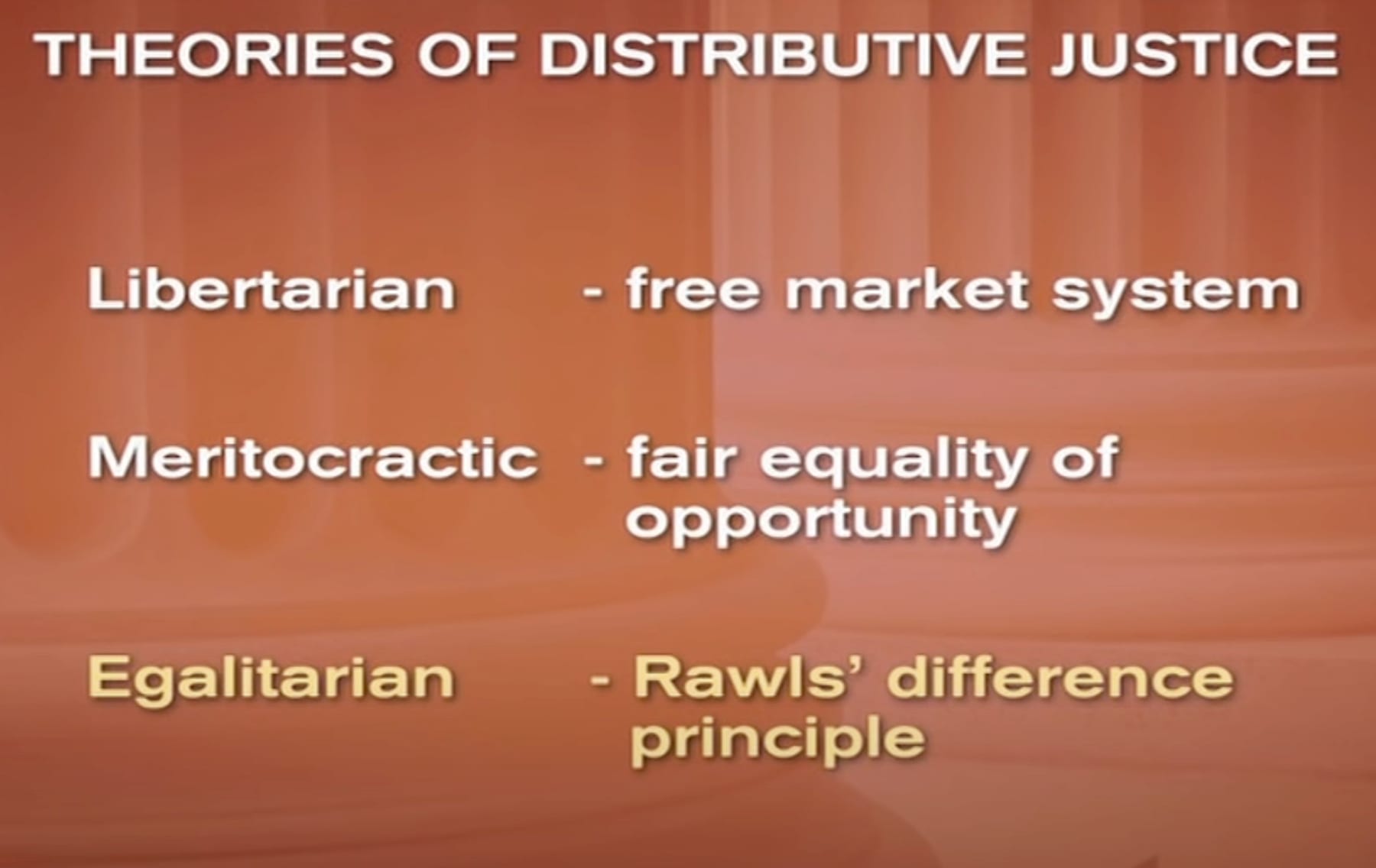
- Average school teacher vs. David Letterman
- Supreme court justice vs. Judge Judy
- Fair if they are taxed to benefit the least in society
- Objections to the Difference Principle
- Incentives: Critics argue that high taxation on the wealthy could reduce motivation for innovation and hard work.
- Effort and Moral Desert: Some contend that those who work harder deserve greater rewards, but Rawls counters that even effort is influenced by unchosen factors like family background and birth order.
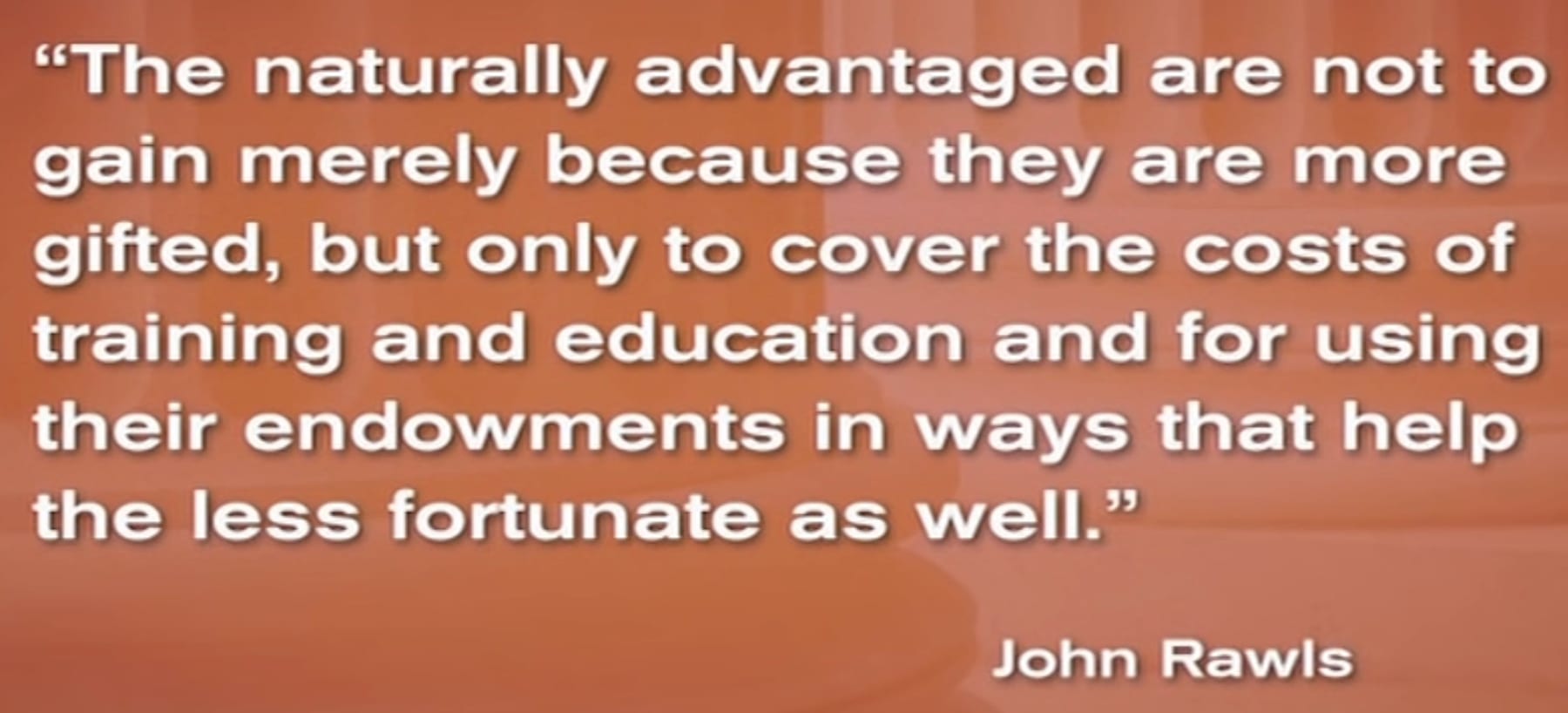
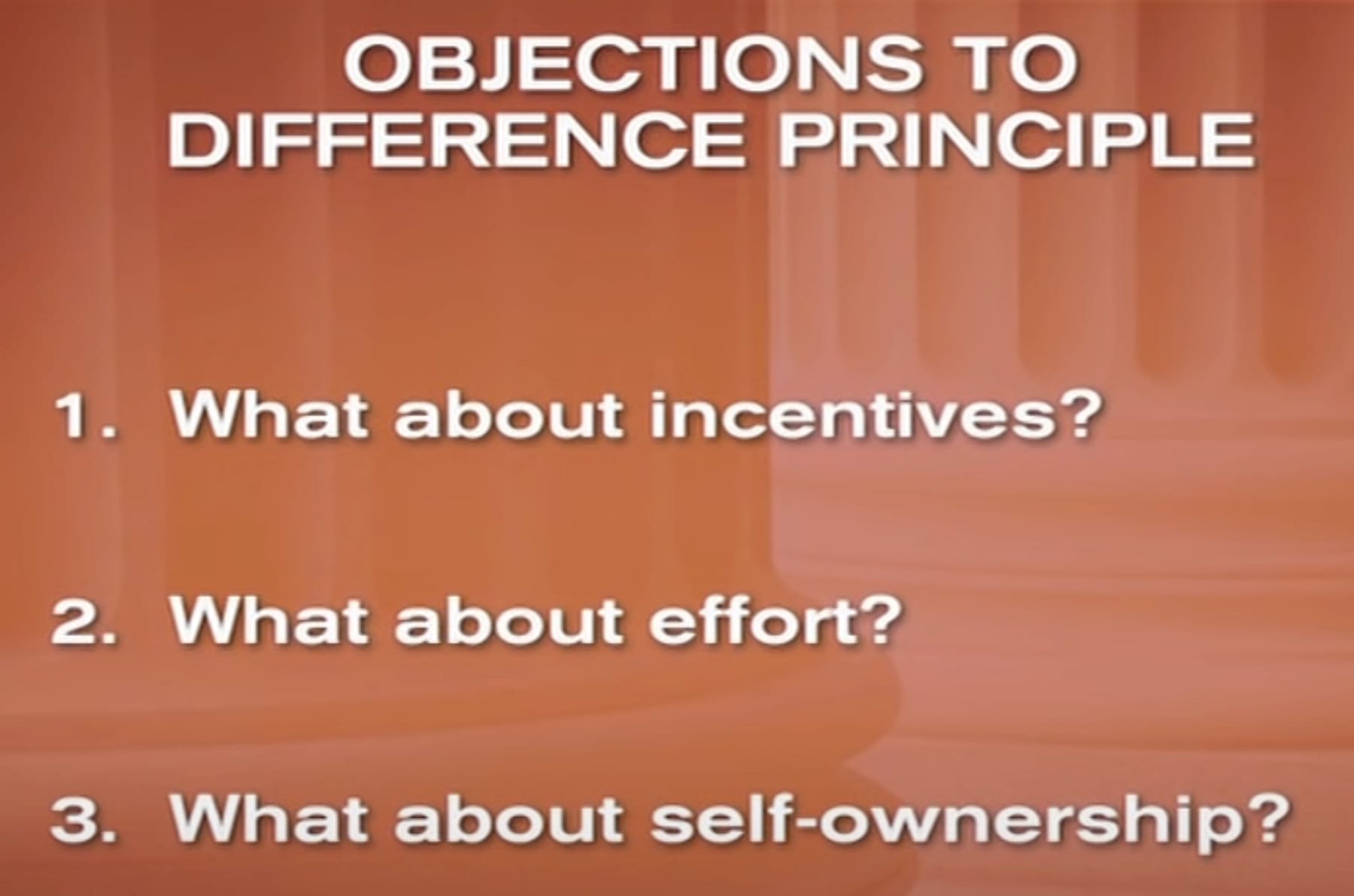
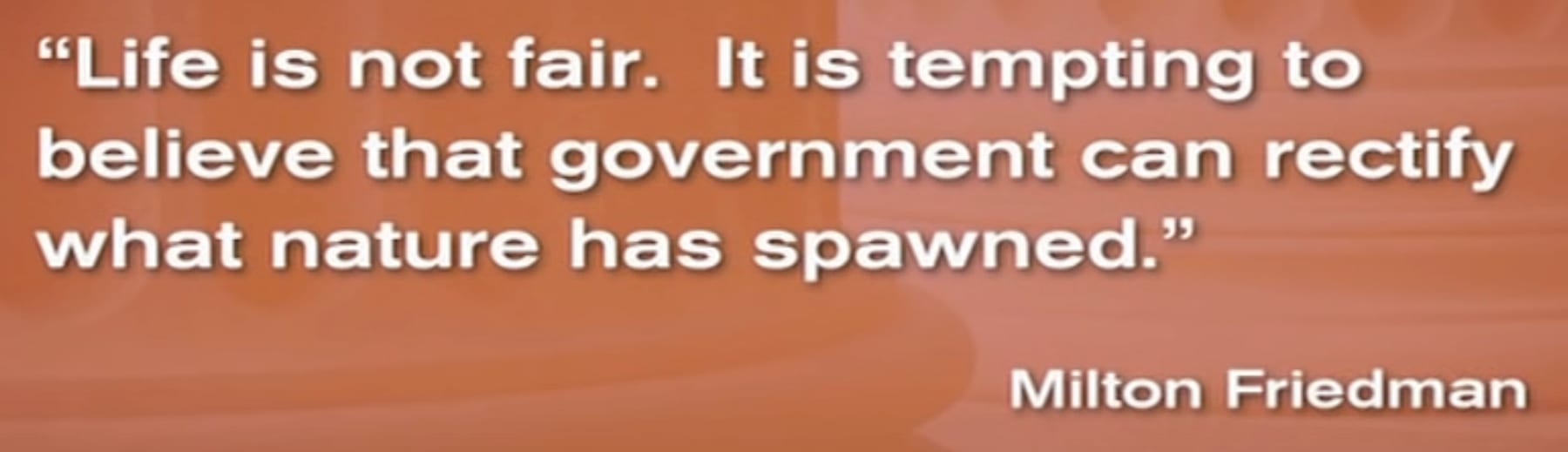
- Most powerful objection to Rawl’s Difference Principle is libertarian self-ownership
- Taxation against their will you coerce them, form of theft. State is doing no better than stealing. Just owning people.
- Rawls counter: You don’t own yourself from the benefits from a market economy.
- Rawl’s counter to effort: It really isn’t effort, but contribution that matters. (You wouldn’t pay a person more if they took longer to do something lacking skill but more effort)
- Legitimate Expectations vs. Moral Desert
- Rawls distinguishes between moral desert and entitlements to legitimate expectations:
- Moral Desert: Implies a person inherently deserves rewards for their talents or efforts.
- Legitimate Expectations: Reflects what individuals are entitled to based on the rules of a fair system, regardless of personal merit.
- Social Context and Contingency
- Rawls highlights the contingency of societal values, noting that what counts as a valuable contribution depends on the specific needs and structures of a society.
- This further undermines the idea that success or wealth is purely deserved.
- The Contingency of Social Value and Moral Desert
- What counts as a valuable contribution in society depends heavily on the specific qualities that a particular society prizes. For instance:
- In a capitalist society, entrepreneurial drive is highly valued.
- In a bureaucratic society, the ability to navigate hierarchical structures is rewarded.
- In a mass democratic society, the ability to perform well on television or in short, impactful sound bites can be crucial.
- In a litigious society, legal skills and the ability to excel on tests like the LSAT are advantageous.
- Contingency of Talents: If those same individuals lived in a different kind of society, like a hunting or warrior society, their current talents might be less valued. Their success would depend on entirely different skills, suggesting that their current advantages are largely contingent on the societal context they happen to inhabit.
- Moral Worth vs. Social Reward: Rawls argues that while these people might earn less in a different society, they would not be any less worthy or virtuous simply because their talents did not align with that society’s needs. The same reasoning applies within our own society to those in less prestigious positions or with less marketable talents.
- Entitlements vs. Moral Desert:
- Rawls emphasizes the difference between being entitled to the benefits that come from exercising one’s talents (as defined by the rules of a particular society) and deserving those benefits in a moral sense.
- It is a mistake to assume that individuals inherently deserve the rewards they receive simply because their talents happen to align with societal demands.
- Educational Opportunities as a Case Study:
- The question of moral desert extends to access to elite colleges and universities.
- Are seats at top institutions a reward for hard work, or are they entitlements to legitimate expectations that should be justified by their broader social benefits, including those to the least advantaged?
- What counts as a valuable contribution in society depends heavily on the specific qualities that a particular society prizes. For instance:
- Conclusion and Next Steps
- The lecture ends by questioning whether seats at elite colleges, like Harvard, represent legitimate rewards for effort or merely reflect deeper inequalities.
- This sets the stage for the next discussion on affirmative action and distributive justice.
Transcript
funding for this program is provided by additional funding provided by today we turn to the question of
00:33 distributive justice how should income and wealth and power and opportunities be distributed according to what principles John Rawls offers a detailed answer to that question and we’re going to examine and assess his answer to that question today we put ourselves in a position to do so last time by trying to make sense of why he thinks that principles of justice our best derived from a hypothetical contract and what matters is that the hypothetical contract be carried out in an original position of equality behind what Rawls calls the veil of ignorance
01:28 so that much is clear all right then let’s turn to the principles that Rawls says would be chosen behind the veil of ignorance first you consider some of the major alternatives what about utilitarianism would the people in the original position choose to govern their collective lives utilitarian principles the greatest good for the greatest number no they wouldn’t all sense and
02:13 the reason is that behind the veil of ignorance everyone knows that once the veil goes up and real life begins we will each want to be respected with dignity even if we turn out to be a member of a minority we don’t want to be oppressed
02:40 and so we would agree to reject utilitarianism and instead to adopt as our first principle equal basic liberties fundamental rights to freedom of speech freedom of assembly religious liberty freedom of conscience and the like we wouldn’t want to take the chance that we would wind up as members of an oppressed or despised minority with the
03:20 majority tyrannize anova us and so it all says utilitarianism would be rejected utilitarianism makes the mistake of all its rights of forgetting or at least not taking seriously the
03:41 distinction between persons and in the original position behind the veil of ignorance we would recognize that and reject utilitarianism we wouldn’t trade off our fundamental rights and liberties for any economic advantages that’s the first principle second principle has to
04:04 do with social and economic inequalities what would we agree to remember we don’t know whether we’re going to wind up being rich or poor healthy or unhealthy we don’t know what kind of family we’re going to come from whether we’re going to inherit millions or whether we will
04:25 come from an impoverished family so we might at first thought say well let’s require an equal distribution of income and wealth just to be on the safe side
04:47 but then we would realize that we could do better than that even if we’re unlucky and wind up at the bottom we could do better if we agree to a qualified principle of equality Rawls calls it the difference principle a
05:09 principle that says only those social and economic inequalities will be permitted that work to the benefit of the least well-off so we wouldn’t reject all inequality of income and wealth we would allow some but the test would be do they work to the benefit of everyone including those or as he specifies the principle especially those at the bottom only those inequalities would be accepted behind the veil of ignorance
05:48 and so Rawls argues only those inequalities that work to the benefit of the least well-off are just we talked about the examples of Michael Jordan making 31 million dollars a year of Bill Gates having a fortune in the tens of billions with those inequalities be permitted under the difference principle only if they were part of a system those
06:19 wage differentials that actually worked to the advantage of the least well-off well what would that system be maybe it turns out that as a practical matter you have to provide incentives to attract the right people to certain jobs and when you do having those people in those
06:44 jobs will actually help those at the bottom strictly speaking Rawls is argument for the difference principle is that it would be chosen behind the veil of ignorance let me hear what you think about Rawls’s claim that these two principles would be chosen behind the veil of ignorance is there anyone who disagrees that they would be chosen all right let’s start up in the balcony if
07:16 that’s all right go ahead okay your argument depends upon us believing that we would argue and set policy or justice from a bottom that for the disadvantaged and I just don’t see from a proof standpoint where where we’ve proven that why not the top right and what’s your name Mike Mike all right good question put yourself behind the veil of ignorance enter into the thought experiment what principles would you choose how would you think it through well I would say things like even Harvard’s existence is an example of preaching toward the top because Harvard takes the top academics
07:54 and I didn’t know when I was born how smart I would be but I worked my life to get to a place of this caliber now if you’d said Harvard’s gonna randomly take 1600 people of absolutely no qualification we’d all be saying well there’s nothing much not much to work for and so what principle would you choose in that situation I would say a merit-based one where one where I don’t
08:16 ously know what I have a brother have a system that rewards me based on my efforts so you but Mike behind the veil of ignorance would choose a merit-based system where people are rewarded according to their efforts alright fair enough what would you say go ahead my question is if the merit-based argument is based on um when everyone is at a level of equality where from that position you be you’re rewarded to where you get or is it regardless of of what advantages you may have when you began your education to get where you are here I think what we do the question you’re asking is
09:01 saying it you know if you want to look at whatever utilitarianism policy is do we want to maximize world wealth and I think of system that rewards merit is the one that we’ve pretty much all established is what is best for all of us this by the fact that some of us may be in the second percentile and some may be in the 98th percentile and the end of the day it lifts that lowest that lowest base level a community that rewards effort as opposed to innate differences I don’t understand how how you’re
09:29 rewarding someone’s efforts who clearly has had not you but maybe myself advantages throughout to get where I am here I mean I can’t say that that somebody else who maybe it worked as hard as I did would have had the same opportunity to come to a school like this alright let’s let’s look at that point what’s your name Kate Kate you suspect that the ability to get into top schools may largely depend on coming from an affluent family having a
10:06 favorable back family background social cultural economic advantages and so on I mean economic but your social cultural all of those advantages for sure someone did a study of the hundred and forty six selective colleges and universities in the United States and they looked at the students in those colleges and universities to try to find out what their background was their economic background what percentage do you think come from the bottom quarter of the
10:41 income scale you know the figure is only three percent of students at the most selective colleges and universities come from poor backgrounds over 70 percent come from affluent families let’s go one step further then and try to address Mike’s challenge
11:07 Rawls actually has two arguments not one in favor of his principles of justice and in particular of the difference principle one argument is the official argument what would be chosen behind the veil of ignorance some people challenge that argument saying maybe people would want to take their chances maybe people would be gamblers behind the veil of ignorance hoping that they would wind up on top that’s one
11:42 challenge that has been put to Rawls but backing up the argument from the original position is a second argument and that is a straightforwardly moral argument and it goes like this it says the distribution of income and wealth and opportunities should not be based on factors for which people can claim no credit it shouldn’t be based on factors that are arbitrary from a moral point of view Rawls illustrates this by considering several rival theories of justice he begins with the theory of justice that most everyone these days would reject a feudal aristocracy what’s wrong with the allocation of life prospects in a feudal aristocracy Rawls says well the thing that’s obviously wrong about it is that people’s life prospects are determined by the accident of birth are you born to a noble family or to the family of peasants and serfs and that’s it you can’t rise it’s not your doing where you wind up or what opportunities you have
13:11 but that’s arbitrary from a moral point of view and so that objection to a feudal aristocracy leads and historically has led people to say careers should be open to talents there should be formal equality of opportunity regardless of the accident of birth
13:34 every person should be free to strive to work to apply for any job in the society and then if you open up jobs and you allow people to apply and if we work as hard as they can then the results are just so it’s more or less the libertarian system that we’ve discussed in earlier weeks what does Rawls think about this he says it’s an improvement it’s an improvement because it doesn’t take as fixed the
14:08 accident of birth but even with formal equality of opportunity the libertarian conception doesn’t extend that doesn’t extend its insight far enough because if you let everybody run the race everybody can enter the race but some people start at different starting points that race isn’t going to be fair intuitively he says the most obvious injustice of this
14:38 system is that it permits distributive shares to be improperly influenced by factors arbitrary from a moral point of view such as whether you’ve got a good education or not whether you grew up in a family that supported you and developed in you a work ethic and gave you the opportunities so that suggests moving to a system of fair equality of opportunity and that’s really the system that mike was advocating earlier on what we might call a merit-based system a meritocratic system in a fair
15:13 meritocracy the Society sets up institutions to bring everyone to the same starting point before the race begins equal educational opportunities Head Start programs for example support for schools in impoverished
15:33 neighborhoods so that everyone regardless of their family background has a genuinely fair opportunity everyone starts from the same starting line well what does Rawls think about the meritocratic system even that he says doesn’t go far enough in remedying or addressing the moral arbitrariness of the natural lottery because if you bring everyone to the same starting point and begin the race who’s going to win the race who would win to use the runners example the
16:26 fastest runners would win but but is it their doing that they happen to be blessed with the athletic prowess to run fast so role says even the principle of meritocracy where you bring everyone to the same starting point may eliminate the
16:50 influence of social contingencies and upbringing but it still permits the distribution of wealth and income to be determined by the natural distribution of abilities and talents and so he thinks that the principle of eliminating morally arbitrary influences in the distribution of income and wealth requires going beyond what mike favours
17:14 the meritocratic system now how do you go beyond if you bring everyone to the same starting point and you’re still bothered by the fact that some are fast runners and some are not fast runners what can you do well some critics of a more egalitarian conception say the only thing you can do is handicap that’s the fast runners make them wear lead shoes
17:42 but who wants to do that that would defeat the whole point of running the race but wall says you don’t have to have a kind of leveling equality if you want to go beyond a meritocratic conception you permit you even encourage those who may
18:05 gifted to exercise their talents but what you do is you change the terms on which people are entitled to the fruits of the exercise of those talents and that really is what the difference principle is you establish a principle that says people may benefit from their good fortune from their luck in the
18:29 genetic lottery but only on terms that work to the advantage of the least well-off and so for example Michael Jordan can make 31 million dollars but only under a system that taxes away a chunk of that to help those who lack the basketball skills that he’s blessed with likewise Bill Gates he could make his
18:58 billions but he can’t think that he somehow morally deserves those billions those who have been favored by nature may gain from their good fortune but only on terms that improve the situation of those who have lost out that’s the difference principle and it’s an argument from moral arbitrariness Rawls claims that if you’re bothered by basing
19:22 distributive shares on factors arbitrary from a moral point of view you don’t just reject a feudal aristocracy for a free market you don’t even rest content with a meritocratic system that brings everyone to the same starting point you set up a system where everyone including those at the bottom benefit from the exercise of the talents held by those who happen to be lucky what do you think is that persuasive was who finds that argument unpersuasive the argument from moral arbitrariness yes I think that in the egalitarian proposition the more talented people I think it’s very optimistic to think that they would would still work really hard even if they knew that part of what they
20:21 made would be given away so I think that the only way for for the more talented people to exercise their talents to the best of their ability is in the meritocracy and in a meritocracy what’s your name Kate Kate does it bother you and Mike does it bother you that in a meritocratic system even with fair equality of opportunity people get ahead people get rewards that they don’t deserve simply because they happen to be naturally gifted what about that um I think that it is arbitrary um and obvious obviously is arbitrary
20:59 but I think that there that correcting for it would be detrimental um and um because it would reduce incentives is that why this incentives yeah Mike what do you say they were all sitting in this room and we have undeserved we are undeserved glory of some sorts that you should not be satisfied with the perfect process of your life because you have not created any of this and I think from a standpoint of not just this room us
21:23 being upset but from a societal standpoint we should have some kind of a gut reaction to that feeling that you know the guy who runs the race he doesn’t he actually harms us as opposed to maybe makes me run that last ten yards faster and that makes the guy behind me run ten yards faster and the guy behind him ten yards faster all right so Mike let me ask you you talked about effort before effort do you think when people work hard to get ahead and succeed that they deserve the rewards that go with effort isn’t that
21:55 the idea behind your defensive you know of course bring Michael Jordan here I’m sure you can get him and have him come and defend himself about why he makes 31 million dollars I think what you’re going to realize is his life was a very very tough one to get to the top and that we are basically being the the majority of pressing the minority in a different light it easy to pick on him their eyes effort you know what all right you’ve got youth this way you I’ve got a futile effort
22:23 you know what Rawls answer to that is even the effort that some people expend conscientious driving the work ethic even effort depends a lot on fortunate family circumstances for which you we can claim no credit
22:43 now let’s hey we’re going to let let’s do the test let’s do a test here never mind economic class those differences are very significant put those aside psychologists say that birth order makes a lot of difference in work ethic striving effort how many here raise your hand those of you here who are first in birth order I am too by the way Mike I noticed you raise your hand if the case for the meritocratic conception is that efforts should be rewarded doesn’t Rawls have a point that even effort striving work ethic is largely shaped even by birth order is it your doing Mike is it your doing that you were first in birth order
23:53 then why Rahl says of course not so why should income and wealth and opportunities in life be based on factors arbitrary from a moral point of view that’s a challenge that he puts to
24:15 market societies but also to those of us at places like this a question to think about for next time a Justice of the United States Supreme Court what do they make it’s it’s just under two hundred thousand dollars there’s another judge who makes a lot
24:49 more than Sandra Day O’Connor you know who it is Judge Judy how did you know that Judge Judy you know how much he makes 25 million dollars now is that just is it fair we ended last time with that remarkable pole you remember the poll about birth order what percentage of people in this room raised their hands was it to say that they were the firstborn 75 80 percent and what was the significance of that if you’re thinking
25:47 about these theories of distributive justice remember we were discussing three different theories of distributive justice three different ways of answering the question how should income and wealth and opportunities and the good things in life be distributed and
26:08 so far we’ve looked at the libertarian answer that says the just system of distribution is a system of free exchange of free market economy against a background of formal equality which simply means that jobs and careers are open to anyone Rawls says this represents an improvement over aristocratic and caste systems because everyone can compete for every job careers opened talents
26:44 and beyond that the just distribution is the one that results from free exchange voluntary transactions no more no less then Wells argues if all you have is formal equality jobs open to everyone the result is not going to be fair it will be biased in favor of those who happen to be born to affluent families who happen to have the benefit of good educational opportunities and that accident of birth is not a just basis
27:27 for distributing life chances and so many people who notice this unfairness Rawls argues I led to embrace a system of fair equality of opportunity that leads to the meritocratic system stay or
27:54 equality of opportunity but Wall says even if you bring everyone to the same starting point in the race what’s going to happen who’s going to win the fastest runners so once you’re troubled by basing distributive shares on morally arbitrary contingencies you should if
28:20 you reason it through be carried all the way to what Rawls calls the Democratic conception of more egalitarian conception of distributive justice that he defines by the difference principle now he doesn’t say that the only way to remedy or to compensate for differences in natural talents and abilities is to have a kind of leveling equality a
28:50 guaranteed equality of outcome but he does say there’s another way to deal with these contingent these people may gain may benefit from their good fortune but only on terms that work to the advantage of the least well-off and so we can test how this
29:14 theory actually works by thinking about some pay differentials that arise in our society what does the average school teacher make in the United States do you suppose roughly it’s a little more 40 40 mm what about David Letterman how much do you think David Letterman makes more than a school teacher 31 million dollars David Letterman is that fair the David Letterman makes that much more than a school teacher well Rawls’s answer would be it depends
29:58 whether the basic structure of society is designed in such a way that Letterman’s 31 million dollars is subject to taxation so that some of those earnings are taken to work for the advantage of the least well-off one other example of a pay differential a Justice of the United States Supreme Court what do they make it’s it’s just under two hundred thousand dollars
30:32 here’s Sandra Day O’Connor for example there she is but there’s another judge who makes a lot more than Sandra Day O’Connor you know who it is Judge Judy how did you know that you watch no but you hurt
30:56 your right Judge Judy you know how much she makes there she is 25 25 million dollars now is that just is it fair well the answer is it depends whether this is against a background system in line with the difference principle where those who come out on top in terms of income and wealth are taxed in a way that benefits the least
31:34 well-off members of society now we’re going to come back to these wage differentials pay differentials between a real judge and a TV judge the one Marcus watches all the time what I want
31:55 to do now is return to these theories and to examine the objections to Rawls’s more egalitarian theory the difference principle there are at least three objections to Rawls’s difference principle one of them came up last time in the discussion and a number of you raised this worry what about incentives isn’t there the risk if taxes reach 70 80 90 percent marginal rate that Michael Jordan won’t play basketball that data David Letterman won’t do late night comedy or
32:50 that CEOs will go into some other line of work now who among those who are defenders of Rawls who has an answer to this objection about the need for incentives yes go ahead stand up Rawls’s idea is that
33:17 there should only be so much difference that it helps the least well-off the most so if there’s too much equality then the least well-off might not be able to watch late-night TV or might not have a job because their CEO doesn’t want to work so you need to find the correct balance where taxation still leaves enough incentive for the least well-off to benefit from the talents good and what’s your name
33:43 Tim Tim all right so Tim is saying in effect that Rawls’s takes account of incentives and could allow for pay differentials and for some adjustment in the tax rate to take account of incentives but Tim points out the standpoint from which the question of incentives needs to be considered is not the effect on the total size of the
34:12 economic pie but instead from the standpoint of the effect of incentives or disincentives on the well-being of those at the bottom right good thank you I think that is what Rawls would say in fact if you look in Section 17 where he describes the difference principle he allows for incentives the naturally advantaged are not to gain merely
34:47 because they are more gifted but only to cover the costs of training and education and for using their endowments in ways that help the less fortunate as well so you can have incentives you can adjust the tax rate if taking too much from David Letterman or from Michael Jordan or from Bill Gates winds up
35:09 actually hurting those at the bottom that’s the test so incentives that’s not a decisive objection against Rawls’s difference principle but there are two weightier more difficult objections one of them comes from defenders of a meritocratic conception the argument that says what about effort what about people working hard having a right to what they earn because they’ve deserved it they’ve worked hard for it that’s the objection from effort and moral desert then there’s a another objection that comes from libertarians and this objection has to do with reasserting the idea of self-ownership doesn’t the difference principle by treating our natural talents and endowments has common assets doesn’t that violate the idea that we own ourselves
36:35 now let me deal first with the objection that comes from the libertarian direction Milton Friedman writes in his book free to choose life is not fair and it’s tempting to believe that government
36:55 can rectify what nature has spawned but his answer is the only way to try to rectify that is to have a leveling equality of outcome everyone finishing the race at the same point and that would be a disaster this is an easy argument to answer and Rawls addresses it in one of the most powerful passages I think of a theory of justice it’s in section 17 the natural
37:37 distribution and here he is talking about the natural distribution of talents and endowment is neither just unjust nor is it unjust that persons are born into society at some particular position these are simply natural facts what is just and unjust is the way that institutions deal with these facts that’s his answer to libertarian Less a fair economists like Milton Friedman who
38:05 say life is unfair but get over it get over it and let’s see if we can at least maximize the benefits that flow from it but the more powerful libertarian objection to Rawls is not libertarian from the libertarian economists like Milton Friedman it’s from the argument about self ownership developed as we saw in Nozick and from that point of view yes it might be a good thing to create headstart
38:41 programs and public schools so that everyone can go to a decent school and start the race at the same starting line that might be good but if you tax people to it to create public schools if you tax people against their will you coerce them it’s a form of theft if you take
39:05 some of Letterman’s 31 million tax it away to support public schools against his will the state is really doing no better than stealing from him it’s coercion and the reason is we have to think of ourselves as owning our talents and endowments because otherwise we’re back to just using people and coercing people that’s the libertarian reply which Rawls answer to that objection he doesn’t address the idea of
39:49 self-ownership directly but the effect the moral weight of this argument for the difference principle is maybe we don’t own ourselves in that thoroughgoing sense after all now he says this doesn’t mean that the state is an owner in me in the sense that it can simply commandeer my life because remember the first principle we would agree to behind the veil of ignorance is the principle of equal basic liberties freedom of speech religious liberty
40:28 freedom of conscience and the like so the only respect in which the idea of self-ownership must give way comes when we’re thinking about whether I own myself in the sense that I have a privileged claim on the benefits that come from the exercise of my talents in a market economy and Rawls says on reflection we don’t we can defend rights we can respect the individual we can uphold human dignity without embracing the idea of self-possession that in effect is his reply to the libertarian I
41:27 want to turn now to his reply to the defender of a meritocratic conception who invokes effort as the basis of moral desert people who work hard to develop their talents deserve the benefits that come from the exercise of their talents well we’ve already seen the beginning of Rawls’s answer to that question and it goes back to that poll we took about birth order his first answer is even the work ethic even the willingness to strive conscientiously depends on all
42:14 sorts of family circumstances and social and cultural contingencies for which we can claim no credit you can’t claim credit for the fact that you most of you most of us happen to be first in birth order and that for some complex psychological and social reasons that seems to be associated with striving with achieving with effort that’s one answer there’s a second answer those of you who invoke effort you don’t really believe that moral desert attaches to effort take two construction workers one is strong and can raise four walls in an hour without even breaking a sweat and another construction worker is small and scrawny and it has to spend three days to do the same amount of work no defender of meritocracy is going to look at the effort of that weak and scrawny construction worker and say therefore he
43:24 deserves to make more so it isn’t really effort this is the second reply to the meritocratic claim it isn’t really effort that the defender of meritocracy believes is the moral basis of distributive shares its contribution how
43:46 much do you contribute but contribution takes us right back to our natural talents and abilities not just effort and it’s not our doing how we came into the possession of those talents in the first place all right suppose you accepted these arguments that effort
44:09 isn’t everything that contribution matters from the standpoint of the meritocratic conception that effort even isn’t our own doing does that mean the objection continues does that mean that according to Rawls moral desert has
44:32 nothing to do with distributive justice well yes distributive justice is not about moral desert now here Rawls introduces an important and a tricky distinction it’s between moral desert on the one hand and entitlements to legitimate expectations on the other what is the difference between moral deserts and entitlements consider two different games a game of chance in a game of skill take a game of pure chance say I play the Massachusetts state lottery and my number comes up I’m
45:22 entitled to my winnings but even though I’m entitled to my winnings there’s no sense in which because it’s just a game of luck no sense in which I morally deserve to win in the first place that’s an entitlement now contrast the lottery with a different kind of game a game of
45:47 skill now imagine the Boston Red Sox winning the World Series when they win they’re entitled to the trophy but it can be always asked of a game of skill did they deserve to win it’s always possible in principle to distinguish
46:17 what someone’s entitled to under the rules and whether they deserve to win in the first place that’s an antecedent standard moral desert now Rahl says distributive justice is not a matter of moral desert though it is a matter of entitlements to legitimate expectations here’s where he explains it a—just scheme answers to what men are entitled to it satisfies their legitimate expectations is founded
46:58 upon social institutions but what they are entitled to is not proportional to nor dependent on their intrinsic worth the principles of justice that regulate the basic structure do not mention moral desert and there is no tendency for distributive shares to correspond to it why does Rawls make this distinction what morally is at stake one thing morally at stake is the whole question of effort that we’ve already discussed
47:34 but there’s a second contingency a second source of moral arbitrariness that goes beyond the question of whether it’s to my credit that I have the talents that enable me to get ahead and that has to do with the contingency that I live in a society that happens to prize my talents the fact that David
48:01 Letterman lives in a society that puts a great premium puts a great value on a certain type of smirky joke that’s not his doing he’s lucky that he happens to live in such a society
48:22 but this is the second contingency this isn’t something that we can claim credit for even if I had sole unproblematic claim to my talents and to my effort it would still be the case that the benefits I get from exercising those talents depend on factors that are arbitrary from a moral point of view what my talents will reap in a market economy what does that depend on what other people happen to one or like in
48:53 this society it depends on the law of supply and demand that’s not my doing certainly not the basis for moral desert what counts as contributing depends on the qualities that this or that society happens to prize most of us are fortunate to possess in large measure
49:17 for whatever reason the qualities that our society happens to prize the qualities they need that enable us to provide what society wants in a capitalist society it helps to have entrepreneurial Drive in a bureaucratic society it helps to get on easily and smoothly with superiors in a mass
49:42 democratic society it helps to look good on television and to speak in short superficial sound bites in a litigious society it helps to go to law school and to have the talents to do well on ell SATs but none of this is our doing suppose that we with our talents
50:05 inhabited not our society technologically advanced highly litigious but a hunting society or a warrior society what would become of our talents then they wouldn’t get us very far no doubt some of us would develop others but would we be less worthy would be be less virtuous would be would we be less meritorious if we live in that kind
50:32 of society rather than in ours Rawls’s answer is no we might make less money and properly so but while we would be entitled to less we would be no less worthy no less deserving than we are now and here’s the point the same could be
50:54 said of those in our society who happen to hold less prestigious positions who happen to have fewer of the talents that our society happens to reward so here’s the moral import of the distinction between moral desert and entitlements to legitimate expectations we are entitled to the benefits that the rules of the game promised for the exercise of our
51:22 talents but it’s a mistake and a conceit to suppose that we deserve in the first place a society that values the qualities we happen to have in abundance now we’ve been talking here about income and wealth what about opportunities and honors what
51:45 about the distribution of access of seats in elite colleges and universities it’s true all of you most of you firstborn worked hard strived developed your talents to get
52:08 here but Rawls asks in effect what is the moral status of your claim to the benefits that attach to the opportunities you have our seats in colleges and universities a matter a kind of reward and honor for those who
52:36 deserve them because they’ve worked so hard or are those seats those opportunities and honors entitlements to legitimate expectations that depend for their justification and those of us who
52:58 enjoy them doing so in a way that works to the benefit of those at the bottom of society that’s the question that Rawls’s difference principle poses it’s a question that can be asked of the earnings of Michael Jordan and David
53:21 Letterman and Judge Judy but it’s also a question that can be asked of opportunities to go to the top colleges and universities and that’s a debate that comes out when we turn to the question of affirmative action next time don’t miss the chance to interact online with other viewers of Justice join the conversation take a pop quiz watch lectures you’ve missed and learn a lot more visit justiceharvard.org it’s the right thing to do
54:45 funding for this program is provided by additional funding provided by
Episode 9: Arguing Affirmative Action (John Rawls & Aristotle)
Summary
- Moral Desert vs. Legitimate Expectations
- The lecture revisits the distinction between moral desert and entitlements to legitimate expectations in distributive justice.
- Rawls argues that distributive justice should not be based on rewarding people according to their moral desert (virtue or effort), but rather on principles that reflect a fair system of entitlements.
- Moral desert suggests that people deserve rewards based on their inherent virtue or effort, while legitimate expectations are based on what is promised within a just social system.
- The Case of Cheryl Hopwood
- The discussion then shifts to the real-world example of Cheryl Hopwood, who applied to the University of Texas Law School.
- Hopwood, a white applicant with strong academic credentials, was denied admission under a policy that included affirmative action preferences for African-American and Mexican-American students.
- Hopwood argued that her race, which she could not control, unfairly disadvantaged her in the admissions process.
- The case raised fundamental questions about whether admissions should reflect merit alone or also consider broader social factors.
- Student Arguments for and Against Affirmative Action
- Against Affirmative Action:
- Some students, like Bri, argued that it is unjust to consider arbitrary factors like race, which are outside an individual’s control.
- This perspective aligns with the principle that admissions should be based on merit alone, reflecting individual effort and achievement.
- Bri emphasized that race is not an earned characteristic, making its use in admissions fundamentally unfair.
- For Affirmative Action:
- Others, like Anisha, countered that racial preferences can be justified as a way of correcting for educational disadvantages, recognizing that many minority students face systemic inequalities that affect their test scores and grades.
- David added that affirmative action can serve as a form of reparation for past injustices like slavery and segregation, addressing long-term structural disparities.
- Hannah introduced the diversity argument, emphasizing that a diverse student body enhances the educational experience for all students, including those from more privileged backgrounds.
- This approach focuses less on correcting past wrongs and more on ensuring a rich educational environment that prepares students for a diverse society.
- Against Affirmative Action:
- Objections to Affirmative Action
- Compensatory Justice:
- Critics, like Kate, challenged the idea that present-day individuals like Hopwood should bear the cost of compensating for past injustices in which they had no part.
- This objection raises questions about collective responsibility and whether it is fair to ask one individual to pay for historical wrongs.
- Merit vs. Arbitrary Advantage:
- Others noted that if the goal is truly to correct for arbitrary advantages, then factors like legacy admissions should also be scrutinized, as they too reflect unearned privilege.
- This argument points out that many advantages, including family background and access to better schools, are just as arbitrary as race.
- It challenges the consistency of affirmative action policies if they do not also address these other forms of unearned advantage.
- Compensatory Justice:
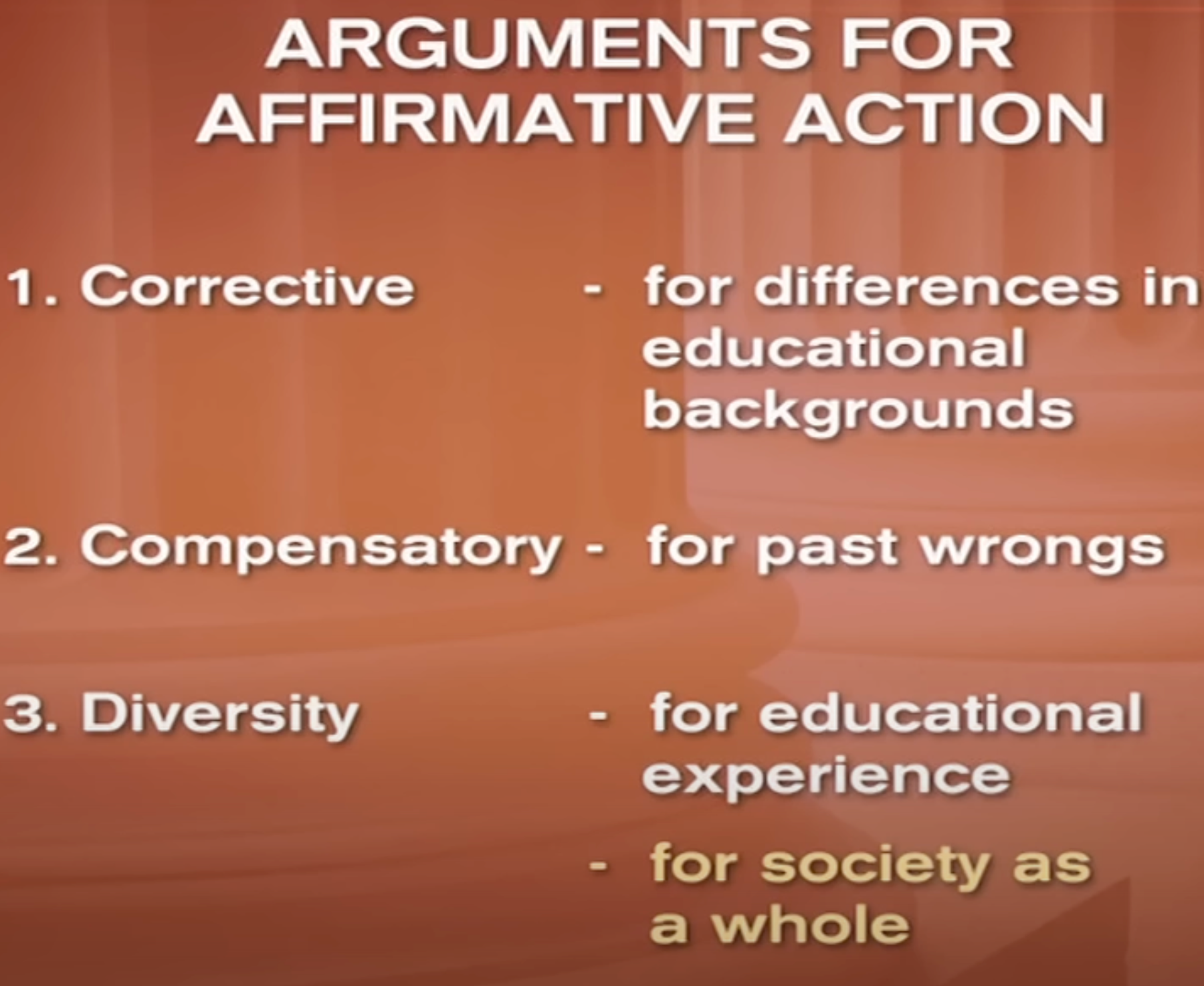
- The Diversity Argument and Institutional Mission
- The diversity defense of affirmative action was also discussed, including the Harvard Brief from the Bakke case, which framed diversity as essential to a university’s social mission.
- The diversity argument has two main strands:
- Educational Benefit: Diverse student bodies enhance the educational experience for all, exposing students to a wide range of perspectives.
- Social Mission: Institutions like the University of Texas argued that diverse classes are necessary to train leaders who reflect the broader society, enhancing the quality of public life.
- However, this argument raises concerns about whether it is just to use individuals as means to a broader social end, potentially violating their rights in the process.
- The Deeper Philosophical Issue: Rights and Moral Desert
- The lecture concluded by returning to the broader question of whether moral desert should play any role in distributive justice.
- Rawls argues that no one inherently deserves to be admitted to an institution like Harvard based solely on their talents, as these too are often the result of unearned advantages.
- This perspective emphasizes that social institutions should be designed to benefit everyone, especially the least advantaged, rather than rewarding arbitrary natural advantages.
- This raises the question of whether it is possible to detach distributive justice from moral desert entirely, a point that will be explored further with a discussion of Aristotle’s contrasting views in the next lecture.
Detaching Justice from Moral Desert
- Central Question: The lecture begins with a critical question in political philosophy: Is it possible and desirable to separate questions of distributive justice from questions of moral desert and virtue? This issue marks a significant divide between modern and ancient political thought. While modern theories often detach justice from moral desert, ancient thinkers like Aristotle explicitly link them.
- Modern Approach to Justice:
- Thinkers like John Rawls (referred to as “RS”) argue for detaching distributive justice from moral desert to promote egalitarianism. This approach emphasizes the “veil of ignorance,” the difference principle, and policies aimed at helping the least well-off without regard to individual virtue.
- However, even rights-oriented theorists who reject egalitarianism, like libertarians, also detach justice from moral desert. This includes figures like Kant, who emphasize respect for persons as free beings, rather than rewarding virtue or merit.
- Why Detach Justice from Moral Desert?:
- The rationale isn’t solely driven by egalitarian aims, as not all theorists who detach justice from desert are egalitarians.
- The broader philosophical reason is that linking justice to moral merit or virtue risks undermining individual freedom and treating people as mere means to a collective end, rather than as free and autonomous beings.
Aristotle’s Teleological Approach to Justice
- Aristotle’s View on Justice:
- In contrast, Aristotle firmly ties justice to moral desert. For him, justice is about giving people what they deserve, aligning individuals with their appropriate social roles based on their virtues.
- Defining Desert:
- Justice, for Aristotle, is about a “proper fit” between individuals and their social roles, determined by the relevant virtues of those individuals.
- The Flute Example:
- Aristotle illustrates this idea using the example of flute distribution:
- The best flutes should go to the best flute players, not based on wealth, birth, beauty, or chance, but based on the ability to best fulfill the purpose of the flute — playing excellent music.
- This reasoning reflects Aristotle’s broader principle that just distribution depends on the telos (purpose) of the thing being distributed.
- Aristotle illustrates this idea using the example of flute distribution:
- The Purpose of Things (Telos):
- Aristotle’s concept of justice is grounded in what he calls “teleological reasoning” — reasoning from the purpose or end (telos) of an activity or thing.
- This is not a utilitarian calculation about maximizing overall happiness but a moral judgment about what is fitting based on the nature and purpose of the activity.
- For example, the best tennis courts at Harvard should go to the best tennis players, not to those with the most influence or wealth, because the purpose of tennis courts is to play tennis well.
Challenges to Teleological Reasoning
- Modern Skepticism:
- Modern science and philosophy generally reject teleological explanations of nature, making it harder for contemporary thinkers to accept Aristotle’s approach.
- The shift away from seeing nature as a meaningful order with inherent purposes has led to a broader rejection of teleological reasoning in ethics and political theory.
- Intuitive Appeal:
- Despite this, Aristotle’s approach remains intuitively compelling in some contexts. For instance, children naturally adopt teleological thinking, as illustrated through the Winnie the Pooh story, where the character assumes that buzzing means bees, and bees make honey for him to eat.
The Continuing Relevance of Aristotle’s Perspective
- Moral and Social Practices:
- Aristotle’s framework invites us to consider whether certain social practices still demand a teleological approach. For example, debates over affirmative action can be framed as disputes over the purpose of higher education — whether it aims to foster merit, achieve social equality, or fulfill some other collective goal.
- Conclusion:
- The lecture concludes by challenging students to reconsider whether modern political philosophy has been too quick to dismiss teleological reasoning. It raises the question of whether justice can truly be understood without reference to the ends or purposes of social practices, echoing Aristotle’s core claim that justice must align with the telos of the thing in question.
Transcript
funding for this program is provided by additional funding provided [Music] by last time we were discussing the distinction that RS draws between two different types of claims claims of moral desert on the one hand and of entitlements to legitimate expectations on the other RS argued that it’s a
00:56 mistake to think that distributive justice is a matter of moral dessert a matter of rewarding people according to their virtue today we’re going to explore that question of moral dessert and its
01:17 relation to distributive justice not in connection with income and wealth but in its connection with opportunities with hiring decisions and admission standards and so we turn to the case of affirmative action you read about the case of Cheryl Hopwood she applied for admission to the University of Texas law school Cheryl hoard had worked her way through high school she didn’t come from an affluent family she put herself through Community College and California State University at Sacramento she achieved a 3.8 grade point average there later moved to Texas became a resident took the law school admissions test did pretty well on that and she applied to the University of Texas law school she was turned down she was turned down at a time when the University of Texas was using an affirmative action admissions policy a policy that took into account race and ethnic background the University of Texas said 40% of the population of Texas is made up of African-Americans and mexican-americans it’s important that we as a law school have a diverse student
02:53 body and so we are going to take into account not only grades and test scores but also Al the demographic makeup of our class including its race and ethnic profile the result and this is what Hopwood complained about the result of that policy is that some applicants to the University of Texas law school with a lower academic index which includes grades and test scores than hers were admitted and she was turned down she said she argued I’m just being turned down because I’m white if I weren’t if I were a member of a minority group with my grades and test scores I would have been admitted and the statistics the admissions statistics that came out in the trial confirmed that African-American and Mexican-American applicants that year who had her grades and test scores were admitted it went to federal
04:03 court now put aside the law let’s consider it from the standpoint of justice and morality is it fair or is it unfair does Cheryl Hopwood have a case a legitimate complaint were her rights violated by the admissions policy of the law school how many say how many would rule for the law school and say that it was just to consider race and ethnicity as a factor in admissions how many would rule for Cheryl Hopwood and say her rights were
04:44 violated so here we have a pretty even split all right now I want to hear from a defender of Cheryl Hopwood yes you’re basing something on that’s an arbitrary Factor you know Cheryl couldn’t control the fact that she was white or not in a minority and therefore you know it’s not as if it was like a test score that she worked hard to try
05:07 and show that she could you know put that out there you know that she had no control over her race good and what’s your name Bri okay Bri stay right there now let’s find someone who’s uh who has an answer for Brie yes there are discrepancies in the educational system and majority of the
05:27 time I know this in New York City the schools that minorities go to are not as well funded are not as well supplied as white schools and so there is going to be a discrepancy naturally between minorities and between whites if they go to better schools and they will not do as well on exams because they haven’t had as much help because of a worse
05:48 school system so let me just interrupt you just to tell me your name Anisha Anisha Anisha you’re pointing out that Minority kids may have gone in some cases MH to schools that didn’t give them the same Educational Opportunity as kids from affluent families yes and so the test scores they
06:11 got may actually not represent their true potential because they didn’t receive the same kind of help that they might have received had they gone to a school with better funding all right Anisha has raised the point that colleges still should choose for the greatest academic scholarly promise but in reading the test scores and grades they should take into account the different meaning those tests and grades have in the light of educational disadvantage in the
06:42 background so that’s one argument in defense of affirmative action inisha argument correcting for the effects of unequal preparation educational disadvantage now there are other arguments suppose just to identify whether there is a is a competing principle here Suppose there are two candidates who did equally well on the tests and grades both of whom went to First Rate schools two cand candidates among those candidates would it be unfair for the college or university for Harvard to say we still want diversity along racial and ethnic Dimensions even where we are not correcting for the effects on tescor of educational disadvantage what about in that case Bri if it’s that one thing that
07:59 puts you know someone over the edge then it’s I guess that would be you know justifiable if everything else about the individual first though everything they consider about that person’s you know talents and where they come from and who they are without these arbitrary factors is the same without these arbitrary factors you call but before you were suggesting bre that race and ethnicity are arbitrary factors outside the control of the applicants true I would agree with that and your general principle is that admissions shouldn’t reward arbitrary factors over which people have no control right all right uh who else who else would like to thank you both who else would like to get into this what do you say well first of all uh I’m for affirmative action
08:43 temporarily but uh what for two reasons first of all you have to look at the University’s purpose it is to educate their students and um I feel that different races people coming from different races have different backgrounds and they contribute differently to you know the education and second of all um when you say they have equal backgrounds they that’s not true when you look at the broader picture and you look at slavery and these are this is kind of a reparation I think uh affirmative action is a
09:12 temporary solution to alleviate um history and uh the wrongs done to African-Americans in particular and what’s your name David David you say that affirmative action is Justified at least for now as a way of compensating for past Injustice the Legacy of slavery and segregation right who wants to take
09:32 on that argument we need now a Critic of affirmative action yes go ahead I think that what happened in the past has no bearing on what happens today and I think that discriminating based on race should always be wrong whether you’re discriminating against one group or another just because our ancestors did something doesn’t mean that that should have any effect on what happens with us today all right good I’m
10:01 sorry your name is Kate Kate all right who has an answer for Kate yes um I just wanted to comment and say that tell us your name uh my name is Monsour because of slavery because of past injustices today we have a higher proportion of African-Americans who are in poverty who face less less
10:25 opportunities than white people and so because of slavery 200 years ago and because of Jim Crow and because of segregation today we have Injustice based on race Kate um I think that there are differences obviously but the way to fix those differences is not by some artificial fixing of the result you need to fix the problem so we need to address differences in education and differences in um in upbringing with with programs like Head Start and giving more funding to lower income schools rather than
10:58 trying to just fix the result so it makes it look like it’s equal when really it isn’t yes well with regard to affirmative action based on race I just want to say that white people have had their own affirmative action in this country for more than 400 years it’s called nepotism and quid proquo so there’s nothing wrong with correcting the Injustice and discrimination that’s been done to black people for 400 years good tell us wait tell us your name Hannah Hannah all right who has an answer for Hannah and just to add to Hannah’s point because we need we need
11:33 now someone to respond Hannah you could have also mentioned legacy admissions exactly I was going to say if you disagree with affirmative action you should disagree with Legacy admission because it’s obvious from looking around here that there are more white legacies than black legacies in the history of Harvard University and explain what legacy admissions are well legacy admissions is giving an advantage to
11:54 someone who has an arbitrary um privilege of their parent having attended the University to which they’re applying all right so a reply for Hannah yes in the balcony go ahead first of all if affirmative action is making up for past injustice how do you explain minorities that were not historically discri discriminated against in the United States who get these advantages in addition You could argue that affirmative action perpetuates divisions between the races rather than achieve the ultimate goal of race being a
12:29 relevant factor in our society and what tell us your name Danielle Hannah I disagree with that because I think that by promoting diversity in an institution like this you further educate all of the students especially the white students who grew up in predominantly white areas it’s certainly a form of Education to be exposed to people from different backgrounds and you put white students at an inherent disadvantage when you surround them only with their own kind why should race necessarily be equated
12:56 with diversity there’s so many other forms why should we assume that race makes people different again that’s perpetuating the idea of racial division within our universities and our society Hannah with regard to um African-American people being given a special Advantage it’s obvious that they bring something special to the table because they have a unique perspective
13:18 just as someone from a different religion or socioeconomic background would as well as you say there are many different types of diversity there’s no reason that racial diversity should be eliminated from that criteria yes go ahead racial discrimination is illegal in this country and I believe that it was African-American leaders themselves when Martin Luther King said he wanted to be judged not on the color
13:41 of his skin but by the content of his character his Merit his achievements and I just think that to do to decide solely based on someone’s race is just inherently unfair I mean if you want to if you want to correct based on disadvantaged backgrounds that’s fine but there are also disadvantaged white people as well it shouldn’t matter white tell us your name Ted Ted yes think of Hopwood it’s unfair to count
14:08 race or I assume you would also say ethnicity or religion yes do you think she has a right to be considered according to her grades and test scores alone there no there’s there is more to with than that you need to universities need to promote diversity and I so you agree with the goal of promoting diversity there’s ways to promote diversity besides discriminating against
14:35 people solely based on a factor that they cannot control all right so what makes it wrong is that she can’t control her race she can’t control the fact that she’s white that’s the that’s the heart of the unfairness to her Bri made a similar point that basing admissions on factors that people can’t control is fundamentally unfair when are you say there’s a lot of things you can’t control and if you’re going to go it through it based on Merit like just based on your test scores a lot of what you can achieve has to do with like the family background that you raised it if both your parents were um scholarly then
15:12 you have more of a chances of actually being more scholarly yourself and getting those grades and you can’t control what kind of family you born into so I me good what tell that’s that’s a great rejoiner what’s your name uh da da Ted are you you against um advantages that come from the family you were born into what about legacy admissions I mean I I I do believe that in terms of like a legacy admission you shouldn’t have a special preference I mean there is a legacy admission You could argue as another part of verse you could say it’s important to have a small percentage of people that have a a several generation family in family attendance at a place like Harvard however that should not be a a f an advantaged Factor like race that should just be another part promoting diversity should it count at all I think that alumni status should it count at all Ted yes it should it should count all right I want to step back for a moment from these arguments thank you all for
16:14 these contributions we’re going to come back to you if you’ve listened carefully I think you will have noticed three different arguments emerg from this discussion in defense of considering race and ethnicity as a factor in admissions one argument has to do with correcting for the effects for the effects of educational disadvantage that was anisha’s argument this is what we might call the the corrective argument correcting for differences in educational background the kind of school people went to the
16:59 opportunities they had and so on that’s one argument what’s worth noticing though is that that argument is consistent in principle with the idea that only academic promise and scholarly potential should count in admissions we just need to go beyond test scores and grades alone to get a true estimate of academic promise and scholarly ability that’s the first argument then we heard a second argument that said affirmative action is Justified even where there may not be the need to correct for educational disadvantage in a in a particular applicant’s case it’s Justified as a way of compensating for past wrongs for historic
17:52 injustices so that’s a compensatory argument compensating for past wrongs then we heard a third a different argument for affirmative action from Hannah and others that argued in the name of
18:17 diversity now the diversity argument is different from the compensatory argument because it makes a certain appeal to the social purpose or the social mission of the college or university there are really two aspects to the diversity argument one says it’s important to have a diverse student body for the sake of the educational experience for everyone Hannah made that point and the other talks about the
18:49 wider Society this was the argument made by the University of Texas in the Hopwood case we need to train lawyers and judges and leaders public officials who will contribute to the strength the Civic strength of the State of Texas and the country as a
19:09 whole so there are two different aspects to the diversity argument but both are arguments in the name of the social purpose or the social Mission or the common good served by the institution well what about the force of these arguments we’ve also heard objections to these arguments the most powerful objection to the compensatory argument is is it fair to ask Cheryl Hopwood today to make the sacrifice to pay the compensation for an injustice that was admittedly committed and was egregious
19:49 in the past but in which she was not implicated is that fair so that’s an important objection to the compensatory argument and in order to meet that objection we would have to investigate whether there is such a thing as group rights or Collective responsibility that reaches over
20:12 time so having identify that issue let’s set it aside to turn to the diversity argument the diversity argument doesn’t have to worry about that question about Collective responsibility for wrongs because it says for reasons Hannah and others pointed out that the common good is served is Advanced if there is a racially and ethnically diverse student body everyone benefits and this indeed was the argument that Harvard made when it filed a friend of the court brief to the Supreme Court in the 1978 case affirmative action case the baky case and the Harvard brief the Harvard rationale was cited by Justice Powell who was the Swing Vote in the case upholding affirmative action he cited that as providing the rationale that he thought was constitutionally acceptable Harvard’s argument in its brief was this we care about diversity scholarly Excellence alone has never been the Criterion of admission
21:36 the sole Criterion of admission to Harvard College 15 years ago diversity meant students from California and New York and Massachusetts city dwellers and farm boys violinists painters and football players biologists historians and classicists the only difference now Harvard argued is that we’re adding raal and ethnic status to this long list of diversity considerations when reviewing the large number of candidates able to do well in our classes Harford wrote race May count as a plus just as coming from Iowa May count or being a good middle linebacker or pianist a farm boy from Idaho can
22:20 bring something to Harvard College that a Bostonian cannot offer similarly a black student can usually bring something a white student cannot offer the quality of the educational experience of all students depends in part on these differences in the background and Outlook that students bring with them
22:42 that was Harvard’s argument now what about the diversity argument is it persuasive if it’s to be persuasive it has to meet one very powerful objection that we’ve heard voiced here by Ted by Bri unless you’re a utilitarian you believe that individual rights can’t be
23:11 violated and so the question is is there an individual right that is violated is Cheryl hopwood’s right violated if she is used so to speak denied admission for the sake of the common good in the social mission that the University of Texas law school has defined for itself does she have a right don’t we deserve to be considered according to our excellences our achievements our accomplishments our hard work isn’t that the right at
23:49 stake now we’ve already heard an answer to that argument no she doesn’t have a right nobody deserves to be admitted notice how this gets us back to the issue of Dessert versus entitlement they’re arguing there is no individual right that Hopwood has she doesn’t deserve to be admitted according to any particular set of criteria that she believes to be important including criteria that have only to do with her efforts and achievements why not I think implicit in this
24:26 argument is some something like rs’s rejection of moral desert as the basis of distributive justice yes once Harvard defines its Mission and Designs its admission policy in the light of its Mission people are entitled who who fit those criteria they are entitled to be
24:51 admitted but according to this argument no one deserves that Harvard College Define its Mission and design its admission criteria in the first place in a way that prizes the qualities they happen to have in abundance whether those qualities are test scores or grades or the ability to play the piano or to be a good middle linebacker or to come from Iowa or to come from a certain minority
25:20 group so you see how this debate about affirmative action especially the diversity argument takes us back to the question of rights which in turn takes us back to the question of whether moral dessert is or is not the basis for distributive justice think about that over the weekend and we’ll continue this discussion next [Music]
25:51 time suppose we’re Distributing flutes who should get the best one what’s Aristotle’s answer anyone his answer is the best flutes should go to the best flute players because that’s what flutes are for when we ended last time we were considering Arguments for and against affirmative action counting RAC is a factor in Admissions and in the course of the discussion three arguments emerged three Arguments for affirmative action one of them was the idea that race and ethnic background should count as a way of correcting for the true meaning of test scores and grades getting a more accurate measure of the academic potential those scores those numbers represent second was what we call the compensatory argument the idea of writing past wrongs past Injustice and the third was the diversity argument and when Sherl Hopwood in the 1990s challenged the University of Texas law school school’s affirmative action program in the federal courts the University of Texas made another version of the diversity argument saying that
27:37 the broader social purpose the social mission of the University of Texas law school is to produce leaders in the legal community in the political Community among judges lawyers legislators and therefore it’s important that we leaders who reflect the background and the experience and the ethnic and the racial composition of the State of Texas it’s important for serving our
28:13 wider social mission that was the University of Texas law school’s argument then we considered an objection to the diversity argument which after all is an argument in the the name of the social Mission the common good we saw that RS does not simply believe that arguments of the common good or the general welfare should Prevail if individual rights must be violated in the course of promoting the common good you remember that was the question the challenge to the diversity rationale that we were considering when we finished last time and we began to discuss the question well what right might be at stake maybe the right to be considered according to factors within one’s control maybe this is the argument that Cheryl Hopwood implicitly was making she can’t help the fact that she’s white why should her chance at getting into law school depend on a factor she can’t control and then Hannah who was advancing an argument last time said Harvard has the right to Define its Mission any way it wants to it’s a private institution and it’s only once Harvard defines its mission that we can identify
29:59 the qualities that count so no rights are being violated now what about that argument what I would like to do is to hear objections to that reply and then see whether others have an answer yes and tell us your name da da right you spoke up last time how do you answer that argument well I think there was two things there one of them was that a private institution could Define its Mission
30:31 however it wants but then that doesn’t make however it defines it right like I could Define my personal mission as I want to collect all the money in the world but does that make it even a good Mission so you can’t like you can’t say that just because a uh college is a private institution it could just Define it whatever it wants we still have to think about whether the way it’s defining it is right and in the case of affirmative action a lot of people have said that since there’s a lot of other factors involved we could why not race
30:59 like if we already know that the system let’s I want to stick with your first point here’s DA’s objection can a college or university Define its social purpose any way it wants to and then Define admissions criteria accordingly what about the University of Texas law school not
31:23 today but in the 1950s then there was another Supreme Court casee against the admissions policy of the University of Texas law school because it was segregated it only admitted whites and when the case went to court back in the 50s the University of Texas law school
31:48 also invoked its Mission our mission as a law school is to educate lawyers for the Texas bar for Texas law firms and no Texas law firm hires African-Americans so to fulfill our mission we only admit whites or consider Harvard in the 1930s when it had anti-jewish quotas president L president of Harvard in the 1930s
32:30 said that he had nothing personally against Jews but he invoked the mission the social purpose of Harvard he said which is not only to train intellectuals part of the mission of Harvard he said is to train stock Brokers for Wall Street presidents and senators and there are very few Jews who go into those
32:55 professions now here’s the challenge is there a principal distinction between the invocation of the social purpose of the college or university today in the diversity rationale and the invocation of the social purpose or mission of the University by Texas in the 1950s or Harvard in the 1930s is there a difference in principle what’s the reply Hannah well I think that the principle
33:32 that’s different here is um basically the distinction between inclusion versus exclusion I think that it’s morally wrong of the university to say we’re going to exclude you on the basis of your religion or your race that’s Denial on the basis of arbitrary factors what Harvard is trying to do today with its diversity initiatives is to include groups that were excluded in the past good let’s see if stay there let see if
33:58 someone would like to reply go ahead as actually this was kind of in support of Hannah um rather than a reply but I was going to say another principal difference can be based on malice being the Jus or the motivation I guess for the historical segregation act so it’s saying that we’re not going to let blacks or Jews in because they’re
34:21 worse as people or as a group good so the element of malice isn’t present and what’s your name Stevie Stevie says that in the uh in the historic segregationist racist anti-semitic quotas or prohibitions there was built into them a certain kind of malice a certain kind of judgment that African-Americans or Jews
34:49 were somehow less worthy than everybody else whereas present day affirmative action programs don’t involve or imply any such judgment what it amounts to saying is so long as a policy just uses people in a way as valuable to
35:15 the social purpose of the institution it’s okay provided it doesn’t judge them maliciously As Stevie might add as intrinsically less Worthy I’d like to raise a question doesn’t that concede that all of us when we compete for positions or for seats in colleges and universities in a way are being used not
35:51 judged but used in a way that has nothing to do with moral desert remember we got into this whole discussion of affirmative action when we were trying to figure out whether distributive justice should be tied to moral desert or not and we were launched on that question by RS and his denial his rejection of the idea the
36:24 distributive justice whether it’s positions or places in the class or income and wealth is a is a matter of moral desert suppose that were the moral basis of Harvard’s admissions policy what letters would they have to write to people they rejected or accepted for that matter wouldn’t they
36:51 have to write something like this dear unsuccessful applicant we regret to inform you that your application for admission has been rejected it’s not your fault that when you came along Society happened not to need the qualities you had to offer those admitted instead of you are not themselves deserving of a place nor worthy of praise for the factors that led to their admission we are in any case only using them and you as
37:20 instruments of a wider social purpose better luck next time what was the letter you actually got when you were admitted perhaps it should have read something like this dear successful applicant we are pleased to inform you that your application for admission has been accepted it turns out lucky for you that
37:47 you have the traits the that Society needs at the moment so we propose to exploit your assets for society’s Advantage you are to be congratulated not in the sense that you deserve credit for having the qualities that led to your admission but only in the sense that the winner of a lottery is to be congratulated and if you choose to accept our offer you will ultimately be entitled to the benefits that attach to being used in this way we look forward to seeing you in the
38:18 fall now there is something a little odd morally odd if it’s true that those letters do reflect the theory the philosophy underlying the policy so here’s the question they POS and it’s a question that takes us back to a big issue in in political
38:46 philosophy is it possible and is it desirable to detach questions of distributive justice from questions of moral desert and questions of virtue in many ways this is an issue that
39:09 separates modern political philosophy from ancient political thought what’s at stake in the question of whether we can put dessert moral desert aside it seemed when we were reading RWS that the incentive the reason he had
39:30 for detaching distributive justice from moral dessert was an egalitarian one that if we set dessert to one side there’s greater scope for the exercise of egalitarian considerations the veil of ignorance the two principles the difference principle helping the least well off redistribution and all
39:52 that but what’s interesting is if you look at a range of thinkers we’ve been considering there does seem to be a reason they want to detach Justice from dessert that goes well beyond any concern for equality libertarian rights oriented theorists of the kind we’ve been studying as well as egalitarian rights oriented theorists including RS and for that
40:23 matter also including Kant all agree despite their disagreements over distributive justice and the welfare state and all of that they all agree that Justice is not a matter of rewarding or honoring virtue or or moral
40:45 desert now why do they all think that it can’t just be for egalitarian reasons not all of them are egalitarians this gets us to the big philosophical question we have to try to sort out somehow they think tying Justice to moral Merit or virtue is going to lead away from
41:10 freedom from respect for persons as free beings well in order to see what they consider to be at stake and in order to assess their shared assumption we need to turn to a thinker to a philosopher who disagrees with them who explicitly ties Justice to honor honoring virtue and Merit and moral desert and that thinker is
41:48 Aristotle now in many ways Aristotle’s idea of justice is intuitively very powerful in some ways it’s strange I want to bring out both its power its plausibility and its strangeness so that we can see what’s at stake in this whole debate about Justice and whether it’s tied to Desert and
42:13 virtue so what is Aristotle’s answered the question about Justice for Aristotle Justice is a matter of giving people what they deserve giving people their due it’s a matter of figuring out the proper fit between persons with their virtues
42:35 and their appropriate social roles well what does this picture of Justice look like and how does it differ from the conception that seems to be shared among libertarian and egalitarian rights oriented theorists alike
42:56 Justice means giving each person his or her due giving people what they deserve but what is a person’s due what are the relevant grounds of Merit or dessert Aristotle says that depends on the sort of things being distributed Justice involves two factors
43:16 things and the persons to whom the things are assigned in general we say Aristotle writes that persons who are equal should have equal things assigned to them but here there arises a hard question equals in what respect Aristotle says that depends on
43:39 the sort of thing we’re Distributing suppose we’re Distributing flutes what is the relevant Merit or basis of dessert for flutes who should get the best ones what’s Aristotle’s answer any one the best the best flute players right those who are best in the relevant sense the best flute players is it just to discriminate in allocating flutes yes all Justice involves discrimination Aristotle says what matters is that the Discrimination be according to the relevant Excellence according to the virtue appropriate to having flutes he says it would be unjust to
44:34 discriminate on some other basis in giving out the flutes say wealth just giving the best flutes to the people who can pay the highest price or nobility of birth just giving flutes to Aristocrats or physical Beauty giving the best flutes to the most
44:54 handsome or chance having a lottery Aristotle says birth and Beauty may be greater Goods than the ability to play the flute and those who possess them may surpass the flute player more in these qualities than he surpasses them in his flute playing but the fact remains that he is
45:17 the person who ought to get the best flute it’s a strange idea this comparison by the way that I mean could you say am I more handsome than she is a good lacrosse player it’s a strange kind of comparison but putting that aside Aristotle says we’re not looking for the best overall whatever that might mean
45:43 we’re looking for the best musician now why this is important to see why should the best flutes go to the best flute players well why do you think anybody what best music they’ll produce the best music well and everybody will enjoy it more that’s not Aristotle’s answer Aristotle is not a utilitarian he’s not just saying that way there will be better music and everyone will enjoy it everyone will be better off his answer is the best best flutes should go to the best flute players because that’s what flutes are for to be played well the purpose of flute playing the purpose is to produce excellent music and those who can best perfect that purpose ought properly to have the best
46:52 ones now it may also be true as a welcome side effect that everyone will enjoy listening to that music so that answer is true enough as far as it goes but it’s important to see that Aristotle’s reason is not a utilitarian reason it’s a reason that looks here’s where you might think it’s a little bit strange it looks to the purpose the point the goal of flute playing another way of describing this looking to the goal to determine what the just allocation the Greek for goal or end was
47:30 tilos so Aristotle says you have to consider the point the end the goal the tilos of the thing in this case of flute playing and that’s how you define a just allocation a just discrimination so this idea of reasoning from the goal from the tilos is called theological
47:58 reasoning theological moral reasoning and that’s Aristotle’s way reasoning from the goal from the end now this may seem as I said a strange idea that we’re supposed to reason from the purpose but it is does have a certain intuitive plausibility consider the allocation let’s say at Harvard of the best tennis courts or squash courts how should they be allocated who should have priority in playing on the on the best courts well you might say those who can best afford them set up a fee system charge money for them Aristotle would say no you might say well Harvard Big Shots the most influential people at Harvard who would they be the senior faculty should have priority in playing on the best tennis courts no Aristotle would reject
49:10 that some scientists may be a greater scientist than some varsity tennis player is a tennis player but still the tennis player is the one who should have priority for the best playing on the best tennis court there is a certain intuitive plausibility to this idea now one of the things that makes it strange is that in Aristotle’s world in
49:35 the ancient world it wasn’t only social practices that were governed in Aristotle’s view by theological reasoning and Theological explanation all of nature was understood to be a meaningful order and and what it meant to understand nature to grasp nature to find our place within nature was to inquire into and read out the purposes or the teoss of Nature and with the Advent of modern science it’s been difficult to think of
50:12 the world that way and so it makes it harder perhaps to think of Justice in a teleological way but there is a certain naturalness to thinking about even the natural world as teleologically ordered as a purpose of whole in fact children have to be educated out of this way of looking at the world I realized this when my kids were very young and I was reading them a book Winnie the Pooh and Winnie the Pooh gives you a great idea of how there is a certain natural childlike way of looking at the world in a theological way you you may remember a story of Winnie the Pooh walking in the forest one day he came to a place in the forest and from the top of a tree there came a loud buzzing noise winie the Pooh sat at the foot of the tree put his head between his paws and began to think here’s what he said to himself that buzzing noise means
51:22 something you don’t get a buzzing noise like that just buzzing in buzzing without it’s meaning something if there’s a buzzing noise somebody’s making a buzzing noise and the only reason for making a buzzing noise that I know of is because you’re a bee then he thought for another long time and said and the only
51:44 reason for being a bee that I know of is making honey and then he got up and he said and the only reason for making honey is so I can eat it so he began to climb the tree this is an example of theological
52:14 reasoning it isn’t it isn’t so implausible after all now we grow up and we’re talked out of this way way of thinking about the world but here’s the question even if theological explanations don’t fit with modern science even if we’ve outgrown them in understanding
52:41 nature isn’t there something still intuitively and morally plausible even powerful about Aristotle’s idea that the only way to think about Justice is to reason from the purpose the goal the tilos of the social practice and isn’t that precisely what we were doing when we were disagreeing about affirmative action you could almost recast that disagreement as as one about what the proper appropriate purpose or end of a university education consists
53:22 in reasoning from the purpose or from the hos or from the end Aristotle says that’s indispensable to thinking about Justice is he right think about that question as you turn to Aristotle’s [Applause] politics don’t miss the chance to interact online with other viewers of Justice join the conversation take a pop quiz watch lectures you’ve missed and learn a lot more visit visit justiceharvard.org it’s the right thing to do [Music] [Music] [Music] [Music] funding for this program is provided by additional funding provided by [Music]
Episode 10: The Good Citizen (Aristotle)
Summary
Aristotle’s Teleological Theory of Justice
1. Justice as Purpose-Driven Allocation
- Aristotle’s approach to justice fundamentally differs from modern theories like those of Kant and Rawls, which detach justice from moral desert and virtue.
- For Aristotle, justice is about giving people what they deserve, but this cannot be determined without understanding the purpose or telos of the social practice in question.
- Justice, therefore, requires reasoning about the “fit” between a person’s virtues and their social role, aligning individuals with positions that match their capabilities and moral excellences.
2. The Flute Example
- Aristotle uses the distribution of flutes as a classic illustration of his approach:
- The best flutes should go to the best flute players, not because of wealth, beauty, or noble birth, but because the telos of a flute is to produce excellent music, which only skilled players can achieve.
- This allocation honors the excellence of flute playing, linking justice to the recognition of individual merit and purpose.
3. Politics and the Good Life
- Aristotle extends this reasoning to politics, arguing that the purpose of a political community (polis) is not merely to ensure security or economic exchange, but to cultivate virtuous citizens and promote the good life.
- In this view, political offices and honors should go to those who contribute most to the moral and civic development of the community.
- Aristotle argues that only through active participation in political life can individuals fully realize their human capacities, particularly the capacity for reason and moral judgment.
4. Virtue Through Practice
- Virtue, for Aristotle, is not acquired through abstract reasoning or rule-following alone, but through practical experience and habituation.
- Like learning to play an instrument or telling a joke, virtue must be practiced to be fully developed.
- This means that moral excellence can only be cultivated through participation in the political life of the community, reinforcing the connection between politics and the good life.
Honor and Recognition in Justice
5. Honor as a Key Element
- Aristotle’s theory emphasizes not just the distribution of resources or power, but also the recognition and honor of excellence.
- Political offices are not just functional roles but honorific distinctions that recognize those who contribute most to the good of the polis.
6. The Casey Martin Example
- This principle is illustrated in the contemporary case of Casey Martin, a disabled golfer who sued for the right to use a golf cart in professional tournaments.
- The debate hinges on whether walking is an essential part of golf and whether accommodating Martin would undermine the honor and nature of the sport as an athletic competition.
- The controversy reveals how debates over rights and accommodations often involve deeper questions about the purpose (telos) of the social practice in question and the virtues it honors.
Scalia’s Dissent in the Casey Martin Case (PGA Tour, Inc. v. Martin, 532 U.S. 661 (2001))
Link:Law
Background of the Case
- Casey Martin, a professional golfer with a rare circulatory condition, sued the PGA Tour for the right to use a golf cart during tournaments, citing the Americans with Disabilities Act (ADA).
- The majority of the Supreme Court ruled in Martin’s favor, holding that walking is not an essential aspect of professional golf, and that denying Martin a cart constituted discrimination under the ADA.
Scalia’s Main Points in Dissent
1. Games as Arbitrary Constructs
- Position: Scalia argued that the nature of a sport or game is defined by its own arbitrary rules, which do not necessarily have any deeper purpose beyond amusement.
- Quote: “It is the very nature of a game to have no object, no point, except amusement. That is what distinguishes games from productive activity.”
- Implication: By this logic, the PGA Tour, as the governing body of golf, has the right to define the rules of its sport without interference from the courts.
2. Rejection of Teleological Reasoning
- Position: Scalia explicitly rejected the Aristotelian approach that ties the definition of justice to the purpose or telos of a social practice.
- Example: He cited Mark Twain’s quip that golf is “a good walk spoiled” to highlight the arbitrary nature of the sport’s rules and the absurdity, in his view, of trying to find an essential purpose in them.
- Contrast with Majority: Scalia’s dissent contrasts sharply with the majority’s willingness to define the essential nature of golf as primarily about striking the ball, not walking the course.
3. Slippery Slope Argument
- Position: Scalia warned that allowing the court to redefine the essential rules of sports sets a dangerous precedent.
- Quote: “If one can ask the courts to alter the rules of a game because one’s particular disability precludes a fundamental aspect of it, then there is no clear limit to what modifications might be demanded.”
- Implication: This reasoning reflects a broader skepticism about the court’s role in interfering with private associations and their rule-making autonomy.
4. Deference to Tradition and Expertise
- Position: Scalia emphasized the importance of respecting the traditional rules and customs of sports, arguing that these are best left to the practitioners and governing bodies themselves.
- Critique of the Majority: He suggested that the majority decision effectively turned the court into a “Supreme Sports Regulatory Commission,” second-guessing the judgment of those who actually play and organize the game.
5. Distinction Between Spectacle and Sport
- Position: Scalia dismissed the notion that golf’s status as a sport (as opposed to a mere game or spectacle) was a matter for the court to decide, arguing that this is inherently subjective and outside the proper role of the judiciary.
- Philosophical Rejection: This stance reflects a deeper philosophical rejection of the idea that sports have inherent purposes that can be judicially defined or enforced.
6. Impact on the Integrity of the Game
- Position: Scalia also warned that altering the fundamental rules of a sport, even for reasons of fairness or inclusivity, could undermine the integrity and competitive nature of the game itself.
- Broader Concern: He framed this as a broader cultural issue, suggesting that the court’s willingness to interfere in such matters reflects a misguided attempt to impose external values on internally coherent practices.
Scalia’s dissent in the Casey Martin case is a strong example of his broader judicial philosophy, emphasizing strict adherence to original intent, respect for institutional autonomy, and skepticism about the court’s role in reshaping established social practices. It also illustrates his broader rejection of teleological reasoning in favor of a more positivist, rule-based approach to law and justice.
Challenges to Aristotle‘s Teleological Justice
7. Freedom and Individual Choice
- A critical challenge to Aristotle’s theory comes from those who argue that tying justice to specific social roles or purposes restricts individual freedom.
- If justice is about assigning roles based on inherent capacities or virtues, it limits the freedom of individuals to choose their own life paths, potentially trapping them in predetermined social positions.
8. The Problem of Slavery
- Aristotle’s defense of slavery illustrates a troubling application of his theory:
- He argues that slavery is justified if it is both necessary for the functioning of the polis and fitting for those enslaved, whom he describes as naturally suited to such a role.
- However, this view is undermined by the recognition that many actual slaves were captured in war or enslaved through misfortune, making their roles inconsistent with his own criterion of fit.
The Ongoing Debate
9. The Right vs. the Good
- This philosophical tension continues in modern political thought, particularly in the debate between proponents of liberal individualism (like Kant and Rawls) and those who, like Aristotle, see justice as inherently tied to specific social purposes and virtues.
- At stake is the question of whether justice should be neutral with respect to conceptions of the good life, allowing individuals to define their own roles, or whether it should reflect deeper, purpose-driven principles about human flourishing.
10. Conclusion and Next Steps
- This sets up the broader question of whether justice should be defined independently of any particular conception of the good, a challenge that will be explored in the next lecture.
Transcript
funding for this program is provided by additional funding provided [Music] by we turn to Aristotle after examining theories modern theories of justice that Tred to detach considerations of justice and rights from questions of moral desert and virtue Aristotle disagrees with Kant and r Aristotle argues that Justice is a matter of giving people what they deserve and the central idea of Aristotle’s theory of
01:14 justice is that in reasoning about Justice and rights we have unavoidably to reason about the purpose or the end or the Kos of social practices and institutions yes Justice requires giving equal things to equal persons but the question immediately arises in any debate about Justice equal in what respect and Aristotle says we need to fill in the answer to that question by looking to the characteristic end or the essential nature or the purpose of the thing we’re
01:55 Distributing and so we discussed Aristotle’s example of flutes who should get the best flutes and Aristotle’s answer was the best flute players the best flute player should get the best flute because that’s a way of honoring the Excellence of flute playing it’s a way of rewarding the virtue of the great flute player what’s interesting though and this is what we’re going to explore
02:34 today is that it’s not quite so easy to dispense with teleological reasoning when we’re thinking about social institutions and political practices in general it’s hard to do without tileology when we’re thinking about ethics Justice and moral argument at least that’s Aristotle’s claim and I would like to bring out the force in Aristotle’s Claim by considering two examples one is an example that Aristotle spends quite a bit of time discussing the case of politics how should political offices and honors how should political rule be
03:21 distributed the second example is a contemporary debate about Gulf and whether the professional golfers association should be required to allow Casey Martin a golfer with a disability to ride in a golf cart both cases bring out a further feature of Aristotle’s chological way of thinking about Justice and that is that when we attend to the Tios or the
04:02 purpose sometimes we disagree and argue about what the purpose of a social practice really consists in and when we have those disagreements part of what’s at stake in those disagreements is not just who will get what not just a Distributive question
04:24 but also an honorific question what qualities what excellences of persons will be honored debates about purpose and tilos are often simultaneously debates about
04:47 honor now let’s see how that works in the case of Aristotle’s account of politics when we discuss distributive justice these days we’re mainly concerned with the distribution of income and wealth and opportunity Aristotle took distributive justice to be mainly not about income
05:11 and wealth but about offices and honors who should have the right to rule who should be a citizen how should political Authority be distributed those were his questions how did he go about answering those questions well in line with his teleological account of Justice Aristotle argues that
05:36 to know how political Authority should be distributed we have first to inquire into the purpose the point the tilos of politics so what is politics about and how does this help us decide who should rule well for Aristotle the answer to that question is politics is a about forming character forming good character it’s about cultivating the virtue of citizens it’s about the good life the end of the state the end of the political Community he tells us in book three of the politics is Not Mere life it’s not economic exchange only it’s not security only it’s realizing the good life that’s what politics is for according to
06:34 Aristotle now you might worry about this you might say well maybe this shows us why those modern theorists of justice and of politics are right because remember for Kant and for RS the point of politics is not to shape the moral character of citizens it’s not to make us good it’s to respect our freedom to choose our Goods our values our ends consistent with a similar Liberty for others Aristotle
07:13 disagrees any polus which is truly so calleded and is not merely one in name must devote itself to the end of encouraging goodness otherwise political Association sinks into a mere Alliance law becomes a mere near Covenant a guarantor of men’s rights against one another instead of being as it should be a way of life such as will make the members of apus good and just that’s Aristotle’s view apus is
07:41 not an association for residents on a common site or for the sake of preventing Mutual Injustice and easing exchange Aristotle writes the end and purpose of aplus is the good life and the institutions of social life are means to that
08:01 end now if that’s the purpose of politics of the polus then Aristotle says we can derive from that the principles of distributive justice the principles that tell us who should have the greatest say who should have the greatest measure of political Authority and what’s his answer to that
08:25 question well those who contribute the most to an assoc iation of this character namely an association that aims at the good should have a greater share in political Rule and in the honors of the pus and the reason is they are in a position to contribute most to what political Community is essentially
08:55 about well so you can see the link that he draws between the principle of distribution for citizenship and political Authority and the purpose of politics but why you’ll quickly ask why does he claim that political life participation in politics is somehow essential to living a good life why isn’t it possible for people to live perfectly good lives decent lives moral lives when without participating in politics well he gives two answers to that question he gives a partial answer a preliminary answer in book one of the politics where he tells us that only by living in a polus and participating in politics do we fully realize our nature as human beings human being things are by Nature meant to live in a polus why it’s only in political life that we can
10:11 actually exercise our distinctly human capacity for language which Aristotle understands has this capacity to deliberate about right and wrong the just and the unjust and so Aristotle writes in book one of the politics that the polist the political Community exists by nature and is prior to the individual not prior
10:36 in time but prior in its purpose human beings are not self-sufficient living by themselves outside of political Community a man who is isolated who’s unable to share in the benefits of political Association or who has no need to share because he’s already self-sufficient
10:59 such a person must be either a beast or a God so we only fully realize our nature we only fully unfold our human capacities when we exercise our faculty of language which means when we deliberate with our fellow citizens about Good and Evil right and wrong just and the unjust
11:30 but why can we only exercise our capacity for language in political Community you might ask Aristotle gives a second part A Fuller part of his answer in the nicomaki ethics an excerpt of which we have among the readings and there he explains that political deliberation living the life of a citizen ruling and being ruled in turn sharing and Rule all of this is necessary to Virtue Aristotle defines happiness not as maximizing the balance of pleasure over
12:25 pain but as an activity an activity of the soul in accordance with virtue and he says that every student of politics must study the soul because shaping the soul is one of the objects of legislation in a good
12:49 city but why is it necessary to live in a good city in order to live a virtuous life why can’t we just learn good moral principles at home or in a philosophy class or from a book live according to those principles those rules those precepts and leave it at that Aristotle says virtue isn’t acquired that way
13:21 virtue is only something we can acquire by practicing by exercising the ver virtues it’s the kind of thing we can only learn by doing it doesn’t come from book learning in this respect it’s like flute playing you couldn’t learn how to play a musical instrument well just by reading a book about it you have to practice and you have to listen to other accomplished flute players there are other practices and skills of this type cooking there are cookbooks
13:59 but no great chef ever learns how to cook by reading a cookbook only it’s the kind of thing you only learn by doing joke telling is probably another example of this kind no great comedian learns to be a comedian just by reading a book on the principles of Comedy it wouldn’t work now why not what do joke telling and cooking and playing a musical instrument have in common such that we can’t learn them just by grasping a precept or a rule that we might learn from a book or a lecture what they have in common is that they are all concerned
14:41 with getting the hang of it but also what is it we get the hang of when we learn how to cook or play a musical instrument or tell jokes well Discerning particulars particular features of a situation and no rule no precept could tell the comedian or the Cook or the great musician how to get in the habit of the practice of Discerning the particular features of a situation Aristotle says virtue is that way
15:20 too now how does this connect to politics the only way we can acquire the virtue vires that constitute the good life is to exercise the virtues to have certain habits inculcated in us and then to engage in the practice of deliberating with citizens about the nature of the good that’s what politics is ultimately about the acquisition of civic virtue of this capacity to deliberate
15:59 among equals that’s something we couldn’t get living a life alone outside of politics and so that’s why in order to realize our nature we have to engage in politics and that’s why those who are greatest in civic virtue like Pericles are the ones who properly have the greatest measure of offices and
16:26 honors so the argument about the distribution of offices and honors has this teleological character but also an honorific Dimension because part of the point of politics is to honor people like Pericles it isn’t just that Pericles should have the dominant say because he has the best judgment and that will lead to the best outcomes to the best consequences for the citizens that’s true and that’s
17:00 important but a further reason people like Pericles should have the greatest measure of offices and honors and political Authority and sway in the polist is that part of the point of politics is to single out and honor those who possess the relevant virtue in this case civic virtue Civic Excellence practical wisdom to the fullest extent that’s the honorific dimension bound up with Aristotle’s account of politics here’s an example that shows the link in a contemporary controversy the link to which Aristotle draws our attention between arguments about Justice and rights on the one hand and figuring out
17:55 the TS or the purpose of a social practice on the other not only that the case of Casey Martin and his golf cart also brings out the link between debates about what the purpose of a social practice or a game is on the one hand and the question of what qualities should be honored on the other the link between thology and honor based
18:30 principles of distributive justice who was Casey Martin well Casey Martin is a very good golfer able to compete at the highest levels of golf but for one thing he has a rare circulatory problem in his leg that makes it very difficult for him to walk
18:52 not only difficult but dangerous and so he asked the PGA which governs the pro tour in golf to be able to use a golf cart when he competed in professional tournaments PGA said no and he sued under the American for Disabilities Act he sued in a case that went all the way to the United States Supreme Court the question the Supreme Court had to answer was does Casey Martin have a right that the PGA provide him allow him to use the golf cart on the tour or not how many here think that from a moral point of view Casey Martin should have a right to use a golf cart and how many think that he should not have a right to a golf cart in the
20:06 tournaments so the majority are sympathetic to Casey Martin’s right though a substantial minority disagree let’s first hear from those of you who would rule against Casey Martin why would you not say that the PGA must give him a golf cart yes since the Inception of golf because
20:34 it’s been part of the sport it’s now intrinsically part of golf walking the course and thus because it’s intrinsic to golf I’d argue that not being able to walk the course it’s just not being able to perform an aspect of the sport which is necessary to performing at a professional level good stay there for a minute what’s your name Tommy are you a
20:56 golfer by the way Tom uh not so much but yeah a little bit are there any are there any golfers here I mean real golfers thank you Professor that was no no I’m just taking your word for it who are there is there someone here on the golf team yes tell us your name and uh tell us what you think uh my name is Michael
21:25 and I usually take a cart so probably the probably the wrong person to ask is that why you’re hand went up slowly when I yes all right um but Tom is saying let’s uh Tom said a minute ago that at least at the professional level walking the course is essential to the game do you agree I would yes you do then why do you take a card and you call yourself a golfer no I’m no no no no I’m kidding I’m kidding what what do you say what do you say to that I I when I have walked of course it it does add tremendously to the to the game makes it a lot harder it really does yeah all right let’s let’s hear Michael and toms stay there let’s hear from people who uh say that he should have a right to a golf cart why who’s prepared to defend that position yes well I think the PGA should definitely be required um to give him a golf cart because they argue in the decision that it’s not just a matter of he’s not not experiencing fatigue for him he’s still walking about a mile the cart can’t go everywhere with him um and in that mile he still experiencing more fatigue and
22:46 pain than a healthy player would so it’s not as if you’re removing the disadvantage what’s your name Reva Reva what do you say to Tom’s point that walking the course is essential to the game would be as if um a disabled player could play in the NBA uh but not have to uh run up and down the court well I think there are two um two responses to that first I don’t think it’s it’s essential to the game um because most golfers who play particularly recreationally don’t play with a Cartal like Michael and uh and on several of the tours um you can play with a cart on the Senior PGA Tour on the Nike tour um in a lot of the colleges events and those events are just as competitive and just as high
23:30 level as the PGA Tour so really it’s just a matter of selective reasoning if you argue that it’s um an important part of the sport but even if it is he still does have to walk he still plays golf standing up it’s not as if he’s playing golf from a wheelchair all right uh who who else go ahead I think the whole point of a competition is that it calls
23:51 out the best you know from the second best or from the third best and when we’re talking about the national level we’re talking about you know the highest of the highest and I think the what they’re um arguing about here is the purpose of competition and I I think in the sake of competition you can’t change the rules so the purpose of the competition includes walking that’s an essential you agree with Tom and what’s your name David the Supreme Court ruled that the PGA did have to accommodate Casey Martin and they did it on grounds that Reva mentioned that walking isn’t really part of an essential part of the game they cited testimony saying that walking the court consumes no more calories than you get eating a Big Mac that’s what walking is in Gulf according to the majority Scalia was in descent Jus as Calia agreed with David he said there is no purpose it’s not and it’s certainly not for to try to figure out the essential purpose of golf golf like any game is strictly for amusement and if there’s a group that wants to have one version of the game they can have that version of the game and the market can decide whether people are amused and like and show up for that and watch the television broadcasts scalia’s descent was an anti-aristotelian descent because notice two things things about the argument first we’re thrust into a discussion about what the essential nature or purpose or tilos of golf really is Does it include walking
25:40 and here’s something I think is rumbling beneath the surface of this debate whether walking partly determines whether golf is really an athletic competition after all the ball sits still you have to put it in a hole it’s is it more like basketall baseball and football Golf and athletic competition or is it more like Billiards the ball sits still there too you can be out of shape and succeed it
26:10 involves skill but not athletic skill could it be that those professional golfers who excel at golf have a stake in golf being honored and recognized as an athletic event not just a game of skill like Billiards and if that’s what’s at stake then we have a debate about the purpose
26:35 theological Dimension and also a debate about honor what virtues really does the game of golf honor and recognize two questions to which Aristotle directs our attention we’ll continue on this case next time [Music] what what’s strange and seem paradoxical to me about Aristotle’s Viewpoint is that if you walk like a pirate and you talk like a pirate you shouldn’t be an investment banker because that’s that’s not what you inherently supposed to do if you have a peg leg and an eye patch
27:20 and a disgruntled disposition you know uh you should be on a pirate ship on the high seas um so he doesn’t his uh some would say some would say the the distinction between the two vocations is not as clear as you [Applause] suggest when we ended last time we were talking about whether Casey Martin has a right to ride in a golf cart in the PGA tournaments and it’s worth remembering how we got into this debate and what’s at stake for an understanding of
27:54 political philosophy remember we were looking at Aristotle’s theory of justice and one way of describing his approach to Justice we’ve called it te logical te logical because he says to allocate rights we first have to figure out the purpose or the end of the social practice in question another way of describing Aristotle’s account of justice is that Justice is for him a matter of fit it’s a matter of fitting
28:30 persons with their virtues and excellences to the appropriate roles now I want to finish our discussion about Casey Martin and his claim for a golf cart and then go back to one more consequential application in Aristotle namely the question of slavery what do you think about Casey Martin’s request should there be an accommodation or not given the nature of the game and of the tournament and its purposes isn’t it discrimination if he’s not provided the golf cart as an
29:11 accommodation say some others reply no if he got a cart it would be unfair to the other golfers because they exert themselves become winded fatigued walking the course that’s where we left it what about the fairness
29:34 argument okay Jenny my question was why doesn’t the PGA just make the option of a cart available to all golfers um from our readings I learned that there are many golf tournaments other than the PGA where using a carts is not prohibited and for something like the seniors tournament it’s even allowed and
29:55 encouraged so why doesn’t the PGA just do that let everybody use a card or give everyone the option of using a card and let them pick so the traditionalist can say well I still choose to walk the course but I do that knowing that I will be more tired at the end than the people who took the cart good all right so what
30:16 about Jenny’s solution for the sake of fairness don’t give Casey Martin an advantage if indeed there is an advantage to riding in a cart let everyone who wants to use a card is everyone happy with that solution does it put to rest this whole dilemma who has an answer for Jenny yes as was brought up last time if you
30:48 do that you you kind of ruin some the spirit of golf as a lot of people like to see it if you let everybody take a cart um even though gives everybody the same playing field now it sort of makes golf less of an athletic game like you pointed out last class it’s just like um if someone decides to go into another Sport and they want an advantage like if
31:11 you have swimming and then you say okay he wants flippers so why don’t we just allow everyone to have flippers during swimming and what would that do to the Olympic swimming competition if people were free to use Jenny and here we better let Jenny reply to this D says it would sort of spoil the spirit of the athletic competition as if in Olympic swimming you let anyone who wanted to swim with flippers all right Jenny what do you say to Da it would spoil the spirit of it
31:43 you’re also ruining the spirit of golf by not letting people who are really passionate about the game and very good at it compete simply because of an aspect of golf which is not the main point of golf is you use this Club to make strokes and hit it into a hole I’m sorry I’m not a golfer but
32:04 that’s basically my the gist of the game from what I see it and I was reading the PJ versus Casey Martin decision and that was one of the um senten that they said is because walking the course is not an inherent part of golf only swinging the club is good so Jenny replies to Da well it isn’t really essential anyhow
32:27 to the course so we’re back to the purpose I mean I’m sure there are like wheelchair basketball there are certain um different competitions that can be made for people who may only be able to use their arms right yes Michael what do you think and you just said that there’s stuff like wheelchair wheelchair basketball where if you can’t play basketball there’s another option I think there’s other options than the PGA
32:52 Tour but the PGA Tour is like the it’s it’s the best it’s the Pinnacle and you have to have certain requirements fulfill to to perform all right Michael you want to say to Casey Martin you go there is a such a thing as the Special Olympics for those who are disabled go play in the golf golfing version of the spectral Olympics that’s what you would say Michael yeah I think that walking is part of the sport of golf and Casey
33:18 Martin you know he can’t if he can’t walk the course I don’t think he should be able to play on the PGA all right good thank you very much for that exchange what comes out of this Exchange that goes back to Aristotle’s theory of Justice well one thing is the question is walking an essential part of golf and the Very fact that deciding whether there is a right for Casey Martin that the PGA must respect seems to depend as Aristotle suggests it must
33:55 on debating and resolving the question is walking essential to the game of golf that’s one moral of the story but there’s a second moral to the story from an Aristotelian point of view what’s at stake here this is the second Aristotelian stake in this debate is honor Casey Martin wants the
34:24 accommodation so that he can compete for for the honor of winning the best tournaments now why is it that the professional golfers the great golfers testified in this case Jack Nicholas Tom Kite in the readings against letting him use a cart and they I suspect would be equally vehement Jenny in opposing your suggestion of letting everyone ride a cart and this goes back in a way to do Point how to put this gently professional golfers are sensitive about whether their sport is really a sport because if everyone rode around in a cart or could then it would become clear or clearer depending on your point of view that golf is not really an athletic
35:30 competition but rather a game a game of skill but not a sport and so not only the question of debating the purpose theological feature but also from the standpoint of viewing debates about the purpose of golf what’s essential to golf those debates Aristotle
35:54 suggests inevitably are also debates about the allocation of Honor because part of the purpose of golf is not just to amuse Spectators scul is wrong about that from Aristotle’s point of view it’s not just to provide entertainment it’s not just to make people happy it’s not an a mere Amusement it’s honoring it’s rewarding it’s recognizing a certain kind of athletic Excellence at least those who have achieved the highest honors have a powerful stake in maintaining that
36:35 view now some of you took the position the Scalia position this is an incredibly difficult and silly question Scalia said what is the essential nature of golf it’s not the kind of thing that the United States Supreme Court is equipped to decide or should decide that Scalia
36:58 but he only says that because he takes a very strong and as it happens anti-aristotelian position on what a game is it is the very nature of a game to have no object no point except Amusement says Scalia that is what distinguishes games he says from productive activity you can just imagine what kind
37:26 of sports fans CIA must be and so he says it’s impossible to say that any of a game’s arbitrary rules is essential and then he quotes Mark Twain’s disparaging remark about golf he says many consider walking to be the central feature of golf hence Mark Twain’s classic criticism of the sport a good walk spoiled
37:58 but Scalia misses an important feature of games and the arguments about rights and fairness that arise from games when he casts Games sports athletic competitions as solely for the sake of
38:22 amusement as solely a utilitarian activity but in arist helan view of sport says no it’s not just about Amusement Real Sports real athletic events are also about appreciation not just amusement and people who follow Sports and care about sports and play sports
38:43 know this which is another way of saying there’s a difference between a sport and a mere spectacle and the difference is that a sport is a practice that calls forth and honors and prizes certain excellences certain virtues and the people who appreciate those virtues are the true fans the informed fans and for them watching the sport is
39:13 Not Mere Amusement but that means that it’s always possible to make sense of a debate about what feature of a sport is essential to it we can make sense of these arguments never mind the question whether the court should decide the PGA in its own internal deliberations can make sense of that debate which is why they cared very much about their view insisting on their view that walking and exertion and fatigue are essential not peripheral parts of sport well this is all to illustrate the theological and the honorific feature of debates about rights which Aristotle says we need to take account of in thinking about
40:10 Justice now I want to begin for us to consider whether Aristotle’s theory of justice is right or wrong whether it’s persuasive or unpersuasive I want to get your thoughts about that but I want to anti anticipate one obvious and important objection if Justice is about fit
40:35 fitting persons to roles matching virtues to the appropriate honors and recognition if that’s what Justice is does it leave room for freedom and this is one of the main objections to Aristotle’s chological account of
40:58 Justice if certain roles social roles are fitting or appropriate to me where does that leave my right to choose my social roles my life purposes for myself what room does tileology leave for freedom and in fact may remember RS rejects teleological accounts of Justice because he says that theological theories of Justice threaten the equal basic rights of
41:45 citizens so let’s let’s begin to examine whether Aristotle is right and in particular whether it’s his theological way of thinking about Justice is at odds with freedom now one
42:06 obvious reason to worry is Aristotle’s defense of slavery he defends slavery which existed as an institution in the Athens of his day well what is his defensive slavery two things two conditions have to be met for slavery to be just first it has to be necessary and Aristotle says at least in
42:43 our society slavery is necessary why is it necessary if there are to be citizens who are freed from manual and IAL and household chores to go to the assembly to deliberate about
43:04 politics there have to be some who look after those menial tasks the mere necessities of life he says unless you could invent in some science fiction a technological fix then there are going to be those who have to do the hard and difficult and menial labor if there are to be citizens deliberating about the good and
43:32 realizing their nature so slavery is necessary for the life of the polus for there to be open to Citizens the life of deliberation of argument of practical wisdom but there’s a further condition that has to be met slavery has not only to be necessary for the community as a whole to function
43:58 but it also has to be the case remember the Criterion of fit it also has to be the case that there are some people for whom being a slave is the just or the fitting or the appropriate condition now Aristotle agrees that by his own standards both of those conditions must be met must be true if slavery is to be just and then in a deplorable passage he
44:27 says well it is true that there are some people who are fit by Nature who are cut out to be slaves these are people who differ from Ordinary People in the same way that the body differs from the soul these are people who are meant to be ruled and for them their nature is best realized if
44:47 they’re slaves they can recognize reason in others but they can’t partake of it they can’t exercise it and somehow we can know this now Aristotle must have known that there was something dodgy something strained about this
45:11 claim because he quickly acknowledges that those who disagree may have a point and what those who disagree point out is that there are a lot of people in Athens who are slaves not not because they were born to be slaves or fit to be slaves but because they were captured they were losers in a
45:35 war and so Aristotle admits that as practiced in ancient Athens slavery didn’t necessarily line up with who actually is fit or Born To Be A Slave because some actual slaves just were slaves by bad luck by being captured in a war and on Aristotle’s own account even if it’s necessary to have slavery for the sake of this of citizenship it’s unjust if people who aren’t properly slaves are cast in that role there is a misfit Aristotle recognizes that slavery for those who aren’t fit for the task is a kind of
46:14 coercion the reason slavery is wrong is not because it’s coerced coercion is an indicator that it’s wrong because it’s not natural if you have to coer someone into a role that’s a pretty good indication that they don’t belong there that that role isn’t fitting for them and Aristotle recognized
46:34 this so all of this is to say the example of slavery Aristotle’s defense of it doesn’t show that there’s anything wrong in principle with te logical argument or with the idea of justice as fit between persons and roles because it’s perfectly possible within Aristotle’s own terms to explain what’s wrong with this application this practical application that he made of his theory I want to turn to the larger challenge to Aristotle in the name of
47:07 freedom but before I do that I want to see what people think of Aristotle’s account of justice as fit his theological way a reasoning about Justice and the honorific dimension of Rights and of distributive justice that emerged in our discussion of flutes and politics and golf questions of clarification about Aristotle or objections to his overall account yes my objection to Aristotle is
47:45 that he wants to match uh a person to a role and you know if if you walk like a pirate and you talk like a pirate you know you should be a pirate and and that is what is right um and so what what’s strange and seem paradoxical to me about Aristotle’s Viewpoint is that if you walk like a pirate and you talk like a pirate you shouldn’t be an investment banker because that’s that’s not what you inherently supposed to do if you have a peg leg and an eye patch and a
48:15 disgruntled disposition you know uh you should be on a pirate ship on the high seas um so he doesn’t his uh some would say some would say the the distin between the two vocations is not as clear as you suggest all right but that’s good I take the point yes go ahead it just seems to
48:38 ignore individual rights so I might be the perfect janitor in the whole world and I can do that job the most efficiently out of anybody that exists right now but I might not want to do that I might want to do any other number of Pursuits and it seems to say that that isn’t really good option for me all right and what’s your name Mary Kate good all right let’s uh let’s take a couple more yes I think that the golf cart
49:09 exchange sort of brought up what I see is my main objection to this theological um mode of reasoning I mean Michael I think that was your name right believes that walking is an inherent part of Gulf myself I believe that walking is not an inherent part of gulf and I feel that no matter how long we debate this particular point of contention we’re never going to reach an accord the theological framework of
49:41 reasoning I believe doesn’t really allow us to come to any sort of agreement all right and what’s your name Patrick Patrick all right let me try to address this set of objections to Aristotle let me start with Patrick’s it’s an important objection we had to debate about whether walking is essential to golf and even in
50:06 so seemingly trivial or at least contained a case as that we couldn’t agree how can we possibly hope to agree when the stakes are higher and when we’re debating the fundamental purposes or ends a political community and so if we can’t agree on what the ends or the goods of our shared public life consist in how can we base Justice and
50:35 rights on some notion of what the end or the purpose or the good consists in that’s an important objection so much so that much modern political Theory takes that worry about disagreement over the good as its starting point and concludes that Justice and rights and constitutions should not be based on any particular conception of the good or the
51:08 purposes of political life but should instead provide a framework of rights that leaves people free to choose their conceptions of the good their own conceptions of the purposes of life now Mary Kate said what if a person is very well suited to having a certain role
51:28 like the role of being a janitor but want something else wants to reach higher wants to choose another way of life so that goes back to this question about Freedom if we take our bearing as persons from roles that are said to fit our nature shouldn’t it at least be up to us to decide what those roles are in fact shouldn’t it be up to us to Define what roles are suitable to us and that’s going to take us back to the confrontation between Aristotle on the one hand and Kant and rs on the other Kant and rs think Patrick has a point they say precisely because people disagree in pluralist
52:16 societies about the nature of the good life we shouldn’t try to base Justice on any particular answer to that question so they reject heliology they reject the idea of tying Justice to some conception of the good what’s at stake in the debate about Tey say Rian and Conan liberals is this if you tie Justice to a particular conception of the good if you see Justice as a matter of fit between a
52:46 person and his or her roles you don’t leave room for freedom and to be free is to be independent of any any particular roles or Traditions or conventions that may be handed down by my parents or my Society so in order to decide as between these two broad Traditions whether Aristotle is right or whether Kant and rs are right we need to investigate whether the right is prior to the good question one and we need to investigate
53:23 what it means to be a free person a free moral agent does freedom require that I stand toward my roles my ends and my purposes as an agent of choice or as someone trying to discover what my nature really is two big questions and we’ll take them up next [Music] time don’t miss the chance to interact online with other viewers of Justice join the conversation take a pop quiz watch lectures you’ve missed and learn a lot more visit Justice harvard.org it’s the right thing to do [Music] [Music] [Music] [Music] funding for this program is provided by additional funding provided by [Music]
Episode 11: The Claims of Community (Aristotle & Immanuel Kant & Alasdair MacIntyre)
Summary
Divergent Views on the Purpose of Law and the State
- Aristotle’s Approach: Aristotle argues that the primary purpose of the state (polis) is to cultivate virtue and shape the moral character of its citizens. Laws and political institutions should promote the good life by fostering civic excellence and encouraging moral development.
- Kant’s Rejection: In contrast, Kant fundamentally rejects this view. He argues that it is a mistake to base constitutions, laws, or principles of justice on any particular conception of the good life.
- Freedom as the Core Principle: For Kant, the purpose of a constitution is to establish a fair framework of rights within which individuals can freely choose and pursue their own conceptions of the good, without state interference in defining what a good life should be.
Competing Conceptions of Freedom
- Aristotelian “Fit”: Aristotle’s idea of freedom is linked to realizing one’s potential and fulfilling the roles that best match one’s nature and capacities. This view emphasizes the importance of aligning individuals with their proper roles in society, reflecting their inherent virtues.
- Kantian Autonomy: Kant, however, defines freedom as the capacity to act according to a law one gives to oneself. This means being free from external coercion and not being bound by roles or duties that one has not chosen.
- Implications for Justice: Kant’s approach frames justice as a matter of creating a political structure that respects individual autonomy, rather than one that seeks to cultivate particular virtues or social roles.
The Independent Self and the Power of Choice
- Self as a Sovereign Agent: Kant’s conception of the self is of a free and independent being, unbound by inherited roles, traditions, or unchosen social identities.
- Rejection of Inherited Obligations: This view rejects the idea that individuals are morally bound by the debts, obligations, or historical legacies of their communities unless they have explicitly chosen to accept them.
- Communitarian Challenge: Critics like Alasdair MacIntyre argue that this liberal view overlooks the deeply embedded and narratively constituted nature of human identity, which includes roles and obligations not chosen but inherited as part of a communal life.
MacIntyre’s Narrative Conception of the Self
- The Encumbered Self: MacIntyre contends that human beings are inherently narrative creatures, whose identities are shaped by the stories and histories of their communities.
- Roles and Obligations: This means that individuals cannot fully understand their moral responsibilities without recognizing their membership in particular communities, traditions, and histories.
- Examples of Embedded Obligations:
- The duty of a child to care for a parent, even without explicit consent.
- The obligation to one’s fellow citizens or compatriots, as seen in examples like the French resistance fighter who refused to bomb his home village.
Communitarian Critique of Kantian Individualism
- Obligations Beyond Consent: MacIntyre and other communitarians argue that some moral obligations arise from roles and relationships that transcend individual choice.
- Critique of Moral Isolation: They challenge the Kantian notion that only voluntary, self-imposed obligations are morally binding, suggesting this view ignores the moral significance of communal life and inherited duties.
Rawls’ Extension of Kantian Principles
-
Justice as Fairness: John Rawls builds on the Kantian framework by emphasizing the need for a “veil of ignorance” to ensure fairness. He argues that principles of justice should be chosen without regard to one’s particular social status, identity, or inherited roles, ensuring that the resulting social contract respects individual autonomy and equality.
-
Autonomy and Justice: Rawls extends the Kantian idea that justice should be grounded in principles that would be chosen by free, rational individuals in an original position of equality, without knowledge of their own particular identities. This approach aims to secure a just society that respects individual autonomy while promoting fairness.
-
Political Obligation: Rawls acknowledges that ordinary citizens may lack a strict political obligation in the absence of explicit consent, emphasizing the importance of free, voluntary association as the basis for political legitimacy. He argues that only those who explicitly choose such obligations (e.g., by running for office or enlisting in the military) bear them in the fullest sense.
-
Limits of Voluntarism: Rawls recognizes that while his framework emphasizes voluntary association, it does not fully account for the complex, non-consensual obligations that arise from deep communal ties and shared histories. However, he maintains that political obligations must be compatible with universal principles of justice and individual autonomy, suggesting that communal ties should not override the basic rights of individuals.
-
Lasting Influence: Rawls’ theory remains a foundational challenge to communitarian views, offering a powerful defense of individual autonomy while recognizing the limits of purely consensual political obligations.
Case Studies in Communitarian Obligations
- Family Obligations: The intuitive sense that one should save one’s own child over a stranger, or care for one’s aging parent, even without explicit consent.
- Patriotic Duties: The Israeli airlift of Ethiopian Jews, or the moral reasoning behind the decisions of figures like Robert E. Lee, highlight the moral weight of particular, non-voluntary communal ties.
Patriotism and Communitarian Obligations
-
Obligations of Membership: Communitarians argue that moral and political obligations often arise from non-voluntary relationships, including those of family, community, and nation. These obligations are seen as deeply embedded in the narrative of one’s life and not simply the result of explicit consent.
-
Patriotic Duties: Examples of such obligations include the Israeli airlift of Ethiopian Jews, where a particular duty was recognized based on shared history and identity, and the moral reasoning behind figures like Robert E. Lee, who chose loyalty to his home state of Virginia over the Union.
-
The Moral Force of Patriotism: Supporters of this view contend that patriotism is not merely a matter of sentimental attachment but reflects a deeper, morally significant form of loyalty that arises from shared histories and communal identities.
-
Conflict with Liberal Individualism: This perspective challenges the liberal, individualist view that obligations must be voluntarily assumed to have moral weight, suggesting that communal ties can impose legitimate moral demands even without explicit consent.
-
Critiques of Patriotism: Critics argue that such loyalties can lead to moral conflicts, as overlapping communal obligations may clash, and that these non-consensual ties risk becoming forms of collective selfishness or prejudice if not carefully scrutinized.
-
Continuing Debate: This tension between individual autonomy and communal loyalty remains a central challenge in contemporary political philosophy, highlighting the ongoing struggle to balance personal freedom with the moral claims of community.
The Challenge of Conflicting Obligations
- Moral Complexity: Critics of communitarianism point out that recognizing these non-voluntary obligations can lead to conflicts when the demands of different communities clash.
- Universality vs. Particularity: This tension is exemplified in the debate over whether universal human obligations should override particular communal loyalties.
Conclusion and Open Questions
- Balancing Freedom and Community: The debate between Kantian individualism and communitarian views raises profound questions about the nature of moral agency, the sources of moral obligation, and the relationship between individual freedom and communal belonging.
- Continuing the Debate: The next step in this philosophical exploration is to consider whether justice can ever be fully detached from particular conceptions of the good, or whether it must always be grounded in some form of communal identity and shared purpose.
Transcript
funding for this program is provided by additional funding provided by today we turn to Kant’s reply to Aristotle Kant thinks that Aristotle just made a mistake it’s one thing Kant says to support a fair framework of Rights within which people can pursue their own conceptions of the good life
00:55 it’s something else and something that runs the risk of coercion to base law or principles of justice on any particular conception of the good life you remember Aristotle says in order to investigate the ideal Constitution we have first to figure out the best way to live Kant would reject that idea he says that constitutions and laws and rights should not embody or affirm or promote any particular way of life that’s at odds with freedom for Aristotle the whole point of law the purpose of the polis is to shape character to cultivate the virtue of citizens to inculcate Civic excellence to make possible a good way of life that’s what he tells us in the politics for Kant on the other hand the purpose of law the point of a constitution is not to inculcate or to promote virtue its to set up a fair framework of Rights within which citizens may be free to pursue their own conceptions of the good for themselves
02:10 so we see the difference in their theories of justice we see the difference in their account of law or the role of a constitution the point of politics and underlying these differences are two different accounts of what it means to be a free person for
02:31 Aristotle we’re free insofar as we have the capacity to realize our potential that leads us to the question of fit fit between persons and the roles that are appropriate to them figuring out what I’m cut out for that’s what it means to lead a free life to live up to my potential Kant rejects that idea and instead substitutes his famously demanding notion of freedom as the capacity to act autonomously freedom means acting according to a law I give myself freedom as autonomy part of the the appeal part of the moral force of the view of content of Rawls
03:25 consists in the conception of the person as a free and independent self capable of choosing his or her own ends the image of the self is free and independent offers up if you think about it a powerful liberating vision because what it says is that as free moral
03:53 persons we are not bound by any ties of history or of tradition or of inherited status that we haven’t chosen for ourselves and so we’re unbound by any moral ties prior to our choosing them and that means that means that we are
04:23 free and independent sovereign selves we’re the authors of the only obligations that constrain us the communitarian critics of Kantian and Rawls in liberalism acknowledge that there is something powerful and inspiring in that account of freedom
04:47 free independent choosing self but they argue it misses something it misses a whole dimension of moral life and even political life it can’t make sense of our moral experience because it can’t account for certain moral and political obligations that we commonly recognize and even prize and these include obligations of membership
05:14 loyalty solidarity and other moral ties that may claim us for reasons that we can’t trace to an act of consent alasdair macintyre gives an account but he calls a narrative conception of the cell it’s a different account of the self human beings are essentially storytelling creatures MacIntyre argues that means I can only answer the question what am i to do if I can answer the prior question of what story or stories do I find myself apart that’s what he means by the narrative conception of the self what does this have to do with the idea of community in belonging MacIntyre says this once you accept this narrative aspect of moral reflection you will notice that we can never seek for the good or exercise the virtues only as individuals we all approach our circumstance as bearers of
06:33 particular social identities I am someone’s son or daughter a citizen of this or that city I belong to this plan that tried this nation hence MacIntyre argues what is good for me has to be the good for someone who inhabits these roles I inherit from the past of my family my city my tribe my nation a variety of debts inheritances expectations and obligations these constitute the given of my life my morale starting point this is in part what gives my life its moral particularity that’s the narrative conception of the self and it’s a conception that sees the self as claimed
07:26 or encumbered at least to some extent by the history the tradition the communities of which it’s a part we can’t make sense of our lives not only is a psychological matter but also as a moral matter in thinking what we ought to do without attending to these
07:48 features about us now MacIntyre recognizes that this narrative account this picture of the encumbered self puts his account at odds with contemporary liberalism and individualism from the standpoint of individualism I am what I myself choose to be
08:14 I’m a biologically be my father’s son but I can’t be held responsible for what he did unless I choose to assume such responsibility I can’t be held responsible for what my country does or has done unless I choose to assume such responsibility but MacIntyre says this reflects a certain kind of moral shallowness even blindness it’s a blindness at odds with the full measure
08:44 of responsibility which sometimes he says involves collective responsibility or responsibilities that may float from historic memories and he gives some examples such individualism it’s expressed by those contemporary Americans who deny any responsibility for the effects of slavery upon black Americans saying I never owned any slaves or the young German who believes that having been born after 1945 means that what Nazis did to Jews has no moral relevance to his relationship to his Jewish contemporaries McIntyre says all of these attitudes of historical amnesia amount to a kind of moral abdication once you see that who
09:38 we are and what it means to sort out our obligations can’t be separated shouldn’t be separated from the life histories that define us the contrast he says when the narrative account is clear for the story of my life is always embedded in the story of those communities from which I derived my identity I am born with the past and to try to cut myself off from that past
10:06 is to deform my present relationships so there you have in McIntyre a strong statement of the idea that the self can’t be detached shouldn’t be detached from its particular ties of membership history story narrative now I want to get your reactions to the communitarian critique of the individualist or the
10:40 voluntarist the unencumbered self but let’s make it concrete so that you can react to more than just the theory of it by looking at the two different accounts of moral and political obligation that arise depending on which of these conceptions of the person one accepts on the liberal conception moral and political obligations arise in one of two ways there are natural duties that we owe human beings as such duties of
11:17 respect for persons Quay persons these obligations are universal then as Rawls points out there are also voluntary obligations obligations that we owe to particular others insofar as we have agreed whether through a promise or a deal or a
11:42 contract now the issue between the liberal and communitarian accounts of the self is there another category of obligation or not the communitarian says there is there is a third category that might be called obligations of
12:03 solidarity or loyalty or membership the communitarian argues that construing all obligations as either natural duties or voluntary obligations fails to capture obligations of membership or solidarity loyalties whose moral force consists partly in the fact that living by them is inseparable from understanding
12:29 ourselves as the particular persons we are what would be some examples and then I want to see how you would react to them examples of obligations of membership that are particular but don’t necessarily flowed from consent but rather from membership narrative community one situation the most common examples are ones to do with the family the relation between parents and
13:05 children for example suppose there were two children drowning you could save only one of them one was your child the other was a stranger’s child would you have an obligation to flip a coin or would there be something morally obtuse if you didn’t rush to save your child
13:32 now you may say well parents have agreed to have their children so take the other case the case of children’s obligation for their parents now we don’t choose our parents we don’t even choose to have parents there is that asymmetry and yet considered two aging parents one of them yours the other strangers doesn’t it make moral sense to think that you have a greater obligation to look after your aged parent then to flip a coin or to
14:07 help the strangers now is this traceable to consent not likely or take a couple of political examples during World War two French Resistance pilots flew bombing raids over occupied France one day one of the pilots received his targets and noticed that the village he was being asked to bomb was his home village he refused not disputing that it was as necessary as the target he bombed yesterday he refused on the ground that he couldn’t bring himself it would be a special moral crime for him to bomb his people even in a cause that he supported
15:01 the cause of liberating France now do we admire that if we do the communitarian argues it’s because we do recognize obligations of solidarity take another example some years ago there was a famine in Ethiopia hundreds of thousands of people were starving the Israeli government organized an airlift to rescue Ethiopian Jews they didn’t have the capacity to rescue everyone in Ethiopia they rescued several hundred
15:39 Ethiopian Jews now what’s your moral assessment is that a kind of morally troubling partiality a kind of prejudice or as the Israeli government thought is there a special obligation of solidarity that this airlift properly responded to well that takes us to the broader question of patriotism what morally speaking is to be said for patriotism there are two towns named Franklin one is Franklin Texas and the other is just across the Rio Grande River Franklin Mexico what is the moral significance of national boundaries why is it or is it the case that we as Americans have a greater responsibility for the health and the education in the welfare and public provision for people who live in Franklin Texas then equally needy people just across the river living in Franklin Mexico according to the communitarian account membership does matter
16:53 and the reason patriotism is at least potentially a virtue is that it is an expression of the obligations of citizenship how many are sympathetic to the idea that there is this third category of obligation the obligation
17:15 obligations of solidarity or membership how many are sympathetic to that idea and how many are critical of that idea how many think all obligations can be accounted for in the first two ways all right let’s hear from the critics of the communitarian idea first yes my biggest concern with the idea of having obligations because you’re a member of
17:48 something or because of solidarity is that it seems that if you accept those obligations as being sort of morally binding then there’s a greater occurrence of overlapping obligations a greater occurrence of good versus good and I don’t know if this sort of framework allows us to choose between them good in much your name
18:12 so you worried that if we recognize obligations of membership or solidarity since we inhabit different communities their claims might conflict and what would we do if we have competing obligations yes
18:35 well one solution is that we could view ourselves as ultimately members of the human community and that then within that we have all these smaller spheres of that you know I am an American or I am a student at Harvard and so the most important community to be to be obligated to is the community of human
19:03 beings and then from there you can sort of evaluate which other ones are most important to you so the most univer and what’s your name Nikola so Nikola you say the most universal community we inhabit the community of humankind always takes precedence yes Patrick are you satisfied No why not um it seems rather arbitrary that we should choose the universal obligation over the more specific
19:34 obligation I might also say that I should be obligated first to the most specific of my obligations for instance take my family as a small unit of solidarity perhaps I should be first obligated to that unit and then perhaps to the unit of my town and then my country and then the human race good thank you let’s I want to hear from another critic of the communitarian view we have the objection well what if Goods collide who objects to the whole idea of it who sees patriotism is just a kind of prejudice that ideally we should overcome yes patriotism reflects a community membership that’s a like a given I think the problem is that
20:24 whereas some memberships are natural narratives the narrative of citizenship is a constructed one and I think a false one because as the river is just a historical accident it makes no sense that because the lottery of birth threw me into the United States as opposed to Mexico that that’s the membership that I should be a part of good and what’s your name Elizabeth Elizabeth who has a reply yes I think in in general uh we have to ask where do our moral obligations arise
21:03 from anyway and I think basically there’d be two places from which they could arise one would be kin another one would be reciprocity and isn’t the closer you are associated to other people there’s a natural reciprocity there in terms of having interactions with those people you interact the neighbors on your street with the other people in your country through economic
21:27 arrangement I don’t know and you don’t know those people in Franklin Texas any more than you know the people in Franklin Mexico do you presumably you’re naturally more connected with the people in your own country in terms of interaction and trade than you are with people in other countries good who else I’ll go ahead yeah I think that a lot of the basis for a patriotism can be compared to like school spirit or even house fear that we see here where
21:55 freshmen are sorted into houses and then within a day they have developed some sort of attachment or a pride associated with that house and so I think that we can probably draw a distinction between a moral obligation for communitarian beliefs and sort of just a sentimental emotional attachment good way to say you stay there what’s your name Rina what about go back to my example about the obligation of the childhood the parent would you say the same thing there it’s just a maybe or may not be a
22:24 sentimental toy but it has no moral weight well I mean I’m not entirely certain that accident in the initial stage is something that will preclude like moral obligations later and so you know just because we were randomly sorted into a house or just because we don’t choose who our parents are what country born into doesn’t necessarily mean that we won’t like
22:48 develop an obligation based on some type of benefit I guess just sort of see your obligation to your parent that’s greater than two agent parents around the world is only because and insofar as you’re repaying a benefit that your parent gave you when you were growing up yeah I mean I would say that if you look at cases of
23:14 adoption where you know you have a biological parent somewhere else that you don’t interact with and then you have a parent you know who adopted you most people would say that if you had to pick between them in the case of you know aging parents that your obligation would lie more with the person who raised you and who had exchanges with you meaningfully may ask you one more question about the parent sure do you
23:38 think that a person with a bad parent owes them less I don’t know because I’ve never had a bad parent I think that’s a good place to end thank you we’ll continue with this next time thank you if I were working on an egg problem set
24:04 for example and I saw that my roommate was cheating that might be a bad thing for hoot for him to do but I wouldn’t turn him in you would not turn him in I wouldn’t turn him in and I think that I would argue that’s the right thing to do because of my obligation um you know you don’t have a duty to tell the truth to report someone who cheated today I’d like to take I’d like to consider the strongest objections to the idea that
24:34 there are obligations of solidarity or membership then I want to see if those objections can be met successfully one objection emerged in the discussion last time Patrick said well if obligations flow from community membership and identity we inhabit multiple communities doesn’t that mean that our obligations
24:58 will sometimes conflict so that’s one possible objection and then Rina said these examples meant to bring out the moral force of solidarity and membership examples about parents and children about the French resistance fighter asked to bomb his own village in drawing back about the airlift by Israel of Ethiopian Jews these examples they may
25:35 be intuitively evocative Rina said but really they’re pointing to matters of emotion matters of sentiment not true moral obligations and then there were a number of objections not necessarily to patriotism as such but to patriotism understood as an obligation of
26:02 solidarity and membership beyond consent this objection allowed that there can be obligations to the communities we inhabit including obligations of patriotism but this objection argued that all of the obligations of patriotism or of
26:26 community or membership are actually based on liberal ideas and perfectly compatible with them consent either implicit or explicit or reciprocity Julia rod how for example on the website said that liberalism can endorse patriotism as a voluntary moral obligation patriotism and familial love both fall under this category because after all Julia points out the content framework allows people free rein to choose to express virtues such as these
27:06 if they want to so you don’t need the idea of a non-voluntary particular moral obligation to capture the moral force of community values where’s Julia okay so did I summarize that that fairly there
27:27 is action Julia actually is in line with what Rawls says about this very topic you weren’t aware of that you came up with it on your own that’s pretty good Rawls says when he’s discussing political obligation he says it’s one thing if someone runs for office or enlist in the military they’re making a
27:51 voluntary choice but Rawls says there is I believe no political obligation strictly speaking for citizens generally because it’s not clear what is the requisite binding action and who has performed it so Rawls acknowledges that for ordinary citizens there is no
28:12 political obligation except insofar as some particular citizen willingly through an act of consent undertakes or chooses such an obligation that’s in line with Julia’s point it’s related to another objection that people have raised which is it’s perfectly possible to recognize particular obligations to one’s family or to ins country provided honoring those obligations doesn’t require you to violate any of the natural duties or requirements of
28:52 Universal respect for persons quite persons so that’s consistent with the idea that we can choose if we want to to express a loyalty to our country or to our people or to our family provided we don’t do any injustice within the framework acknowledging the priority that is of the universal duties the one objection that I didn’t mention is the view of those who say that obligations of membership really are a kind of collective selfishness why should we honor them isn’t it just a kind of
29:27 prejudice so what I’d like to do perhaps if those of you who have agreed who wrote and who have agreed to defect to press these objections perhaps if you could gather down all together will form a team as we did once before and we’ll see if you can respond to those who want to defend patriotism conceived as a
29:52 communal obligation now there were a number of people who argued in defense of patriotism as the communitarian view conceives it so let me go down now and join the critics the critics of communitarianism if there’s a microphone
30:18 that we could use somewhere okay thanks Kate who as the critics of patriotism communal patriotism gather their forces here Patrick if you want to you can join as well arena and others who have spoken or addressed this question are free to join in
30:38 but I would like to hear now from those of you who defend patriotism and defend it as a moral obligation that can’t be translated back into purely consent-based terms can’t be translated into liberal terms where’s Ajay Kumar
31:05 Ajay everybody seems to know you all right let’s hear from Ajay you said I in the same way I feel I owe more to my family than to the general community I owe more to my country than to humanity in general because my country holds a great stake in my identity it is not prejudice for me to love my country unless it is prejudice for me to love my parents more
31:30 than somebody else’s so Ajay what would you say to this group stand up I think that there’s some fundamental moral obligation that comes from a communitarian responsibility to people and groups that form your identity I mean even like I’ll give the example that you know there are a lot of things about our government right now that I’m
31:52 not in favor of but part of my identity is that America value is a free society where we can object to certain things and I think that’s an expression of patriotism as well and I’d go back to the parent example or even in Harvard I think you know I owe more to my roommates because they make up my Tenny than I do to the Harvard community as a whole and I think that applies to our country because there are certain things that growing up here yes we can’t choose if we can’t choose our parents things
32:19 like that but it makes up part of our identity okay who would like to take that on hike yeah both the obligation to others simply by virtue of being in their their um being influenced by them I’m a German citizen and if I had been born 80 years earlier than I would have been a citizen of Nazi Germany and for
32:43 some reason I just don’t think that I would have to feel obligated towards Germany um because I benefited from action of Nazis I mean I guess my response to that would be you have hundreds of thousands of protestors the United States right now who hold up signs that say pieces patriotic and I’m sure there are people in this room who don’t agree
33:03 with that I personally do and I would say that they’re strongly objecting to basically everything the Bush administration is doing right now but they still consider themselves loving their country because they’re furthering the cause of what they see is best for the country and I tend to agree with that as a patriotic movement well but how is that then how do you still favor your country how is that so patriotic I mean isn’t that more sentimental attachment where’s the obligation they’re not to bring this back to John
33:33 Locke but I’d like to bring this back to John Locke so I mean in his conception of um you know when people joined society there’s there’s still some outlet like if you if you’re not satisfied with your society you know you do have a means of exit even though we had a lot of concerns about how you’re born and it’s not very feasible he still provides that option if we want to say that your obligation
33:57 to society is a moral one that means that prior to knowing exactly what that society is going to be like or what your position is going to be in that society that means that you have a binding obligation to like a complete unknown body that that could be you know completely foreign to all of your personal beliefs or you know what you would hope to be do you think that that kind of communal obligation or patriotism means writing the community a
34:21 a blank moral check basically yeah like I think that we can you know I think it’s reasonable to say that as you grow and as you develop within that community that you acquire some type of obligation based on reciprocity but to say that you have a moral obligation I think requires a stronger justification well anyone else like to address that I guess we could say that you you could argue that
34:45 you’re morally obliged to society by the fact that there is this reciprocity I think it’s the idea that you know we participate in society we pay our taxes we vote this is why we could say that we owe something to society but beyond that I don’t think there’s anything inherent in the fact that we are members of the society itself that we owe and anything I think is insofar as we as the society gives something gives us protection safety
35:06 security then we owe the society something but nothing beyond what we give this assign who wants to take that on Rahul I don’t think we I don’t think we give the community a blank moral check in that sense I think we only give it a blank moral check when we abdicate our sense of civic responsibility and when we say that the debate doesn’t matter because patriotism is a vice I think that patriotism is important because it gives us a sense of community a sense of common civic virtue that we can engage in the issues even if you don’t agree with the way the government is acting you can still love your country and hate the way it’s acting and I think because out of that love of country you can debate with other people
35:55 and have respect for their views but still engaging in debate if you just say that you know page 2 is a vice you drop out of that debate and you and you see the ground to people who are more fundamentalist who have a stronger view and who make worse the community it instead we should engage the other members of the community on that same
36:17 moral ground well now this what we hear from a Jain Rahul is a very pluralistic argumentative critically minded patriotism whereas what we hear from ICANN the critics of patriotism here is the worry that to take patriotic obligation in a communal way seriously involves a kind of loyalty that doesn’t let us just pick and choose among the beliefs or actions or or practices of our country what more what’s left of loyalty if all we’re talking about Ajay and Rahul if all we’re talking about is loyalty to principles of justice that may happen to be embodied in our community or not as the case may be in if not then we can can reject its course
37:12 I don’t know I’ve sort of given a reply I got carried away I’m sorry who liked go ahead Julia yeah I think that patriotism you needed to find what that is it sounds like you know you would normally think that we are given a more weak definition here page which is amongst us but it almost sounds like your definition is merely to have some sort of civic involvement in debating
37:33 within your society and I think that that kind of undermines maybe the moral some of the moral worth of patriotism as a virtue as well I think if you can consent to a stronger form of patriotism if you want that’s a stronger I guess more obligation and even what you’re suggesting what we really need to sharpen the issue is an example from the defenders of communitarianism of a case
37:58 where loyalty can actually compete with and possibly outweigh universal principles of justice isn’t that what that’s the test they really need to meet isn’t it all right so that’s the test you need to meet or any any among you who would like to defend obligations of membership or
38:21 solidarity independent of ones that happen to embody just principles who has an example of a kind of loyalty that can and should compete with universal moral claims respect for persons go ahead yeah if I were working on an egg problem set
38:47 for example and I saw that my roommate was cheating that might be a bad thing for her for him to do but I wouldn’t turn him in you would not turn him in I wouldn’t turn him in and I think that I would argue that’s the right thing to do because of my obligation him you know it may be wrong but that’s what I would do and you know I think that’s what most people would do as well right that’s now there’s a fair test he’s not slipping out by saying he’s invoking in the name
39:12 of community some universal principles of justice what’s your name stay there what’s your name it’s dan dan so what do people think about Dan’s case that’s a harder case for the ethic of loyalty isn’t it but a truer test how I agree with Dan so loyalty Dan loyalty has its part a sense it how many disagree with Stan Peggy oh
39:52 well I agree with Dan but I agree that it’s a choice that we make but it’s not necessarily right or wrong I mean I’m agreeing that I’m going to make the wrong choice because I’m gonna choose my roommate but I also recognize that choice isn’t morally right so you’re still translating even Dan’s loyalty you’re saying well that’s a matter of choice but what’s the right thing to do the most people put up their hand saying Dan would be right to stand by his roommate and not turn him in let’s go
40:32 ahead also I think as a roommate you have insider information and that might not be something you want to use that’s might be something unfair to hold against you know you’re spending that much time with the roommate obviously you’re going to learn things about about him and I don’t think it’s fair to reveal that to a greater community but it’s loyalty Wojtek you you agree with Dan that yes oil T is a ethic at stake
40:58 here absolutely you don’t have a duty to tell the truth to report someone who cheated not if you’re if you’ve been advantaged into getting that kind of information before our critics of patriotism leave I want to give you another version a more public example of what will I guess we should call it Dan’s dilemma Dan’s dilemma of loyalty and I want to get the reaction of people to this this came up a few years ago in
41:30 Massachusetts does anyone know who this man is Billy Bulger that’s right who is Billy Bulger he was president the Massachusetts state Senate for many one of the most powerful politicians in Massachusetts and then he became president of the University of Massachusetts now Billy Bulger did you hear the story about him that bears on Dan’s dilemma Billy Bulger has a brother named Whitey Bulger and this is Whitey Bulger his brother whitey is on the FBI’s most wanted list alleged to be a notorious gang leader in Boston responsible for
42:20 many murders and now a fugitive from justice but when when the US Attorney they called Billy Bulger then the president of the University of Massachusetts before the grand jury and wanted information on the whereabouts of his brother this fugitive and he refused to give it us attorney said just to be clear mr. Bulger you feel more loyalty to your brother than to the people of the Commonwealth of Massachusetts and here’s what Billy Bulger said I never
42:58 thought of it that way but I do have a loyalty to my brother I care about him I hope that I’m never helpful to anyone against him I don’t have an obligation to help anyone catch my brother and you would agree how many would agree with the position of Billy Bulger let me give one other example and then we’ll let the critics reply the critics of loyalty as we’ll describe it here’s a an even more fateful example from a figure in
43:36 American history robert e lee now robert e lee on the eve of the civil war was an officer of the Union Army he opposed secession in fact regarded as treason when war loomed Lincoln offered Lee to be the commanding general of the Union Army and Lee refused and he described in a letter to
44:05 his sons why he refused with all my devotion to the Union he wrote I have not been able to make up my mind to raise my hand against my relatives my children my home by which he meant Virginia the Union is dissolved I shall return to my native state and share the miseries of my people save in her defense I will draw my sword no more here’s a real test Dan for your principle of loyalty because here is the cause of the war against not only to
44:45 save the Union but against slavery and Lee is going to fight for Virginia even though he doesn’t share the desire of the southern states to secede now the communitarian would say there is something admirable in that whether or not the decision was ultimately right
45:05 there’s something admirable and the communitarian would say we can’t even make sense rina we can’t make sense of Lee’s dilemma as a moral dilemma and thus we acknowledge that the claim of loyalty arising from his sense of narrative of who he is is immoral not just sentimental emotional tug all right who would like to respond to Dan’s loyalty to Billy Bulger’s loyalty or to robert e lee’s loyalty to virginia what do you
45:40 say it Julia okay well I think that this is these are some classic examples of you know multiple spheres of influence and that you have conflicting communities that your family in your country I think that’s one reason why the idea of choice in your obligation is so important because how else can you resolve this you have if you’re morally obligated and there’s no way out of this need for loyalty to both communities your tract there’s nothing you can do you have to make a choice and I think that being able to choose based on other characteristics than
46:11 merely you know the arbitrary fact that you’re a member of this community is important otherwise it’s left to use randomness well Julia the issue isn’t whether these whether Dan makes a choice or Billy Bulger or robert e lee of course they make a choice the question is on what grounds on what principle should they choose the communitarian doesn’t deny that there’s a choice to be made the question is which choice on what grounds and should loyalty as such
46:39 way Andre now you want to alright go ahead what do you say why one of the things we’ve noticed in the three examples is that the people who’ve all chosen the most immediate community of which they’re part the more local one and I think there’s something to be said for that it’s not just random they’re there I mean there doesn’t seem to be
47:00 conflict because they know which one is more important and it’s their family over the ak10 class their state over their country and their family over the Commonwealth of Massachusetts so I think that’s the answer to which is more important you think that the local the more particular is always the weightier morally Andre well I mean there seems to be a trend in the three cases I would agree with that I think and I think most of us would agree that your family takes precedence over the United States perhaps which is why you go with dan dan loyalty to the roommate over act 10 and the truth yeah exactly I would because I mean I need truth-telling not the truth of act n yes
47:52 all right so we understand yes but on the same example in terms of family you had cases in the civil war where brother was pitted against brother on both sides of the war where they chose country instead of family so I think the exact same more shows that different people have different means of making these choices and that there is no one set of values or one set of morality that communitarians can stick to and
48:17 personally I think that’s the biggest problem with communitarians that we don’t have one set of standard moral obligations and tell me your name Samantha so Samantha you agree with Patrick Patrick’s point the other day that there may be if we allow obligations to be defined by community identification or membership they may conflict there may they may overlap they may compete and there is no clear principled Andre says there’s a clear principle the most particular the other day in Nicola who is sitting over here whereas Nicola said the most universal you’re saying Samantha the scale of the community as such can’t be the decisive
49:03 moral factor so there has to be some other moral judgement all right let’s first let’s let our defence our critics of communal patriotism let’s express our appreciation and thank them for their having stood up and responded to these arguments to find the issue let’s turn to the implications for justice of the positions that we’ve heard discussed here one of the worries underlying these multiple objections to the idea of loyalty or membership as having independent moral weight is that it seems to argue that there is no way of finding principles of justice that are detached from conceptions of the good life as they may be lived in any particular community suppose the communitarian argument is right suppose the priority of the right over the good can’t be sustained suppose instead the justice and rights unavoidably are bound up with conceptions of the good does that mean that justice is simply a creature of convention of the values that happen to prevail in any given community at any given time one of the writings we have among the communitarian critics is by Michael Walzer he draws the implications of justice this way justice is relative
50:59 to social meanings a given society is just if it’s substantive life has lived in a certain way in a way that is faithful to the shared understandings of the members so Walters account seems to bear out the worry that if we can’t find independent principles of justice independent that is from conceptions of the good that prevail in any given community that we’re simply left with justice being a matter of fidelity or faithfulness to the shared understandings or values or conventions
51:42 that prevail in any given society at any given time but is that an adequate way of thinking about justice well let’s take a look at a short clip from the documentary eyes on the prize goes back
52:09 in the 1950s in the south here are some situated American Southerners who believe in the tradition in the shared understandings of segregation listen to the arguments they make about loyalty and tradition and see if they don’t make you uneasy about tying arguments about justice to the shared understandings or traditions that prevail in any given
52:44 society at the moment it’s from eclipse this land is composed of two different cultures of white culture and a colored culture and I live close to them all my life but I’m told now that we’ve mistreated them and that we must change and these changes are coming faster than I expected and I’m required to make decisions on a basis of a new way of thinking and it’s difficult difficult for me it’s difficult for all of them well there you have it narrative selves situated selves invoking tradition doesn’t that show us that justice can’t be tied to the shared understandings of goods that prevail in any given community at any given time or is there a way of rescuing that claim from this example think about that question and we’ll return to it next time don’t miss the chance to interact online with other viewers of justice join the conversation take a pop quiz watch lectures you’ve missed and learn a lot more visit justiceharvard.org it’s the right thing to do
54:49 funding for this program is provided by additional funding provided by
Episode 12: Debating Same-Sex Marriage
Summary
Narrative Conception of the Self and Obligations of Solidarity
-
The lecture revisits the concept of the narrative self, emphasizing that obligations of solidarity and membership do not necessarily arise from explicit consent, contracts, or universal duties. These obligations may claim individuals based on their identities and life histories.
-
The discussion acknowledges the intuitive moral force behind ideas of loyalty, solidarity, and patriotism, but also confronts potential challenges, such as the case of Southern segregationists, who invoked their way of life as a moral justification for their actions.
Voluntarist vs. Narrative Conception of the Person
-
The voluntarist conception (associated with Kant and Rawls) presents the person as a free, rational agent whose moral obligations arise from universal duties and acts of consent.
-
In contrast, the narrative conception emphasizes the embedded, historically situated nature of the self, suggesting that our identities are shaped by communal ties and inherited histories that generate non-consensual obligations.
-
This perspective argues that loyalty and solidarity are essential components of moral life, reflecting a deeper, often unchosen connection to one’s community.
The Problem with Radical Universalism
-
The lecture highlights a potential problem with the extreme universalism of the voluntarist view. It references the Enlightenment philosopher Montesquieu, who argued that a perfectly virtuous person would not have personal friends, only a universal concern for all humanity.
-
This hypothetical world, in which personal attachments are fully dissolved into universal sympathy, is critiqued as unrealistic and even dehumanizing, as it neglects the particular, personal bonds that define human life.
Two Ways of Linking Justice to the Good
-
The lecture distinguishes two approaches to linking justice with the good:
-
Relativist Approach: Justice as fidelity to the shared understandings of a particular community, making it entirely conventional and context-dependent. This approach risks justifying injustices by simply deferring to local customs, as in the case of the Southern segregationists.
-
Non-Relativist Approach: Justice grounded in the intrinsic worth of the human goods it protects, rather than mere cultural conventions. This version attempts to maintain a critical distance from prevailing norms, providing a basis for condemning unjust practices, regardless of cultural context.
-
The Necessity of Reasoning About the Good
-
Despite the appeal of moral neutrality, the lecture argues that reasoning about the good is unavoidable in debates about justice. It critiques the liberal aspiration to avoid moral and religious disputes by emphasizing only consent and autonomy, suggesting this approach cannot fully capture the moral complexity of real-world issues.
-
The lecture uses the example of same-sex marriage to illustrate that even seemingly neutral positions on rights and recognition inevitably involve contested moral judgments about the proper ends of social institutions.
A Gay Marriage Success Story - Los Angeles Times
You Will Be Embarrassed About This in 20 Years | Washington Monthly
Reflective Equilibrium as a Method of Moral Reasoning
-
The lecture concludes by endorsing a dialectical approach to moral reasoning, moving back and forth between specific judgments and broader principles—a method Rawls calls “reflective equilibrium.”
-
This approach rejects both rigid deduction from first principles and unreflective acceptance of intuitions, aiming instead to integrate particular judgments with coherent, general moral theories.
-
It emphasizes that the pursuit of moral clarity often involves revising both our specific judgments and the principles we use to evaluate them.
Final Reflections on the Restlessness of Reason
-
The lecture ends with a reflection on the ongoing, unsettled nature of philosophical inquiry, quoting Kant’s idea that skepticism is a temporary resting place for reason, but not a permanent home.
-
It encourages continued critical reflection, suggesting that the restlessness of reason is essential for personal and political growth, and that philosophy’s purpose is not to provide final answers, but to deepen our understanding and sharpen our moral judgment.
John Rawls > Reflective Equilibrium
Transcript
funding for this program is provided by additional funding provided by [Music] [Music] we ended last time talking about the narrative conception of the self we were testing the narrative conception of the self and the idea of obligations of
00:41 solidarity or membership that did not flow from consent that claimed us for reasons unrelated to a contract or an agreement or a choice we may have made and we were debating among ourselves whether there are any obligations of this kind or whether all apparent obligations of
01:07 solidarity and membership can be translated into consent or reciprocity or a universal Duty that we owe persons quate persons and then there were those who defended the idea of loyalty and of
01:27 patriotism so the idea of loyalty and of solidarity and of membership gathered a certain kind of intuitive moral force in our discussion and then as we concluded we considered what seems to be a pretty powerful counter example to that idea
01:50 namely the film of those Southern segregationists in the 1950s and they talked all about their Traditions their history the way in which their identities were bound up with their life history do you remember that and what flowed from that history from that narrative sense of identity
02:13 for those Southern segregationists they said we have to defend our way of life is this a fatal or a decisive objection to the idea of the narrative conception of the self that’s the question we were left with what I would like to do today is to advance an argument and see what you make of it and let me tell you what that argument is I would like to defend the narrative conception of the
02:46 person as against the voluntarist conception I would like to defend the idea that there are obligations of solidarity or membership then I want to suggest that there being such obligations lends Force to the idea when we turn to justice that arguments about Justice can’t be detached cannot be detached after all from questions of the
03:22 good but I want to distinguish two different ways in which Justice might be tied to the good and argue for one of them now the voluntarist conception of the person of c and rolls we saw was powerful and liberating a further appeal is its Universal
03:45 aspiration the idea of treating persons as persons without prejudice without discrimination and I think that’s what led some among us to argue that okay maybe there are obligations of membership but they are always subordinate they must always be subordinate to the duties that we have to human beings as such the universal
04:14 duties but is that right if our encompassing loyalty should always take precedence over more particular ones then the distinction between friends and strangers should ideally be overcome our special concern for the welfare of friends would be a kind of prejudice a measure of our distance from Universal human
04:41 concern but if you look closely at that idea what kind of a moral Universe what kind of moral imagination would that lead you to the enlightenment philosopher montue gives perhaps the most powerful and I think the ultimately the most honest account of where this Relentless universalizing tendency leads the moral imagination here’s how monu put it he said a truly virtuous man would come to the aid of the most distant stranger as quickly as to his own friend and then he adds listen to this if men were perfectly virtuous they wouldn’t have
05:34 friends but it’s difficult to imagine a world in which persons were so virtuous that they had no friends only a universal disposition to friendliness the problem isn’t simply that such a world would be difficult to bring about that it’s unrealistic the deeper problem is that such a world would be difficult to recognize as a human world the love of humanity is a noble
06:05 sentiment but most of the time we live our lives by smaller solidarities this may reflect certain limits to the bounds of moral sympathy but more important it reflects the fact that we learn to love Humanity not in general but through its particular
06:27 Expressions so these are some considerations they’re not knockdown arguments but moral philosophy can’t offer knockdown arguments but considerations of the kind that we’ve been discussing and arguing about all along well suppose that’s right one way of assessing whether this picture of the
06:52 person and of obligation is right is to see what are its consequences for justice and here’s where it confronts a serious problem and here we go back to our Southern segregationists they felt the weight of History do we admire their character these segregationists who wanted to preserve their way of life are we committed to saying if we accept the idea of
07:20 solidarity membership are we committed to saying that Justice is tied to the good in the sense that Justice means whatever a particular Community or tradition says it means including those Southern segregationists here it’s important to distinguish two different ways in which Justice can be tied to the good one is a relativist way that’s the way that says to think about rights to think about Justice look to the values that happen to Prevail in any given community at any given
08:04 time don’t judge them by some outside standard but instead conceive Justice as a matter of being faithful to the shared understandings of a particular tradition but there’s a problem with this way of tying Justice to The Good the problem is that it makes Justice wholly conventional a product of circumstance and this deprives justice of its critical
08:35 character but there is a second way in which Justice can be tied with or bound up with the good on this second non relativist way of linking Justice with conceptions of the good principles of Justice depend for their justification not on the values that happen to Prevail at any given moment in a certain
08:57 place but instead on the the moral Worth or the intrinsic good of the ends rights serve on this non- relativist view the case for recognizing a right depends on showing that it honors or advances some important human good this second way of tying Justice to the good is not strictly speaking communitarian if by communitarian you mean just giving over to to a particular Community the definition of
09:35 justice now what I would like to suggest that of these two different ways of linking Justice to The Good the first is insufficient because the first leaves Justice the creature of convention it doesn’t give us enough moral resources to respond to those Southern segregationists who invoked their way of life their Traditions their way of doing things
10:05 but if Justice is bound up with the good in a non- relativist way there’s a big challenge a big question to answer how can we reason about the good what about the fact that people hold different conceptions of the good different ideas about the purposes of
10:26 key social institutions different ideas about what social goods and human goods are worthy of honor and recognition we live in a pluralist society people disagree about the good that’s one of the incentive to try to find principles of justice and rights that don’t depend on any particular ends or purposes or
10:50 Goods so is there a way to reason about the good before addressing that question I want to address a slightly easier question is it necessary is it unavoidable when arguing about Justice to argue about the good and my answer to that question is yes it’s unavoidable it’s
11:14 necessary so for the remainder of today I want to take up I want to try to advance that claim that reasoning about the good about purposes and ends is an unavoidable feature of arguing about Justice it’s necessary let me see if I can establish that and for that I’d like for us to begin a discussion of same-sex
11:39 marriage now same-sex marriage draws on implicates deeply contested and controversial ideas morally and religiously and so there’s a powerful incentive to embrace a conception of Justice or of
12:03 rights that doesn’t require the society as a whole to pass judgment one way or another on those hotly contested moral and religious questions about the moral permissibility of homosexuality about the proper ends of marriage as a social institution so clearly if there’s an incentive to
12:25 resolve this question to Define people’s rights in a way that doesn’t require the society as a whole to sort out those moral and religious disputes that would be very attractive so what I would like to do now is to see using the same-sex marriage case whether it’s possible to detach one’s views about the moral permissibility of homosexuality and about the purpose the end of marriage to detach those questions from the question of whether the should recognize same-sex marriage
13:01 or not so let’s begin I would like to begin by hearing the arguments of those who believe that there should be no same-sex marriage but that the state should only recognize marriage between a man and a woman do I have volunteers I had two there were two people I asked people who had voiced their views already on the Justice blog Mark L and Ryan mcaffrey
13:28 where where are you okay uh Mark and where’s Ryan all right let’s go first to Mark I have sort of a theological understanding of um the purpose of Sex and the purpose of marriage and I think that for people like myself who are a
13:49 Christian and also a Catholic the purpose of sex is one for its procreative um usage two for a unifying purpose between a man and a woman within the within the institution of marriage you have a certain conception of the purpose or the tilos yeah of human sexuality which is bound up with procreation right as well as Union yeah and the essence of marriage the purpose
14:21 of marriage as a social institution is to give expression to that tilos and to honor that purpose namely the procreative purpose of marriage is that a fair summary of your view yeah where is Ryan go ahead do you agree more or less with Mark’s reasons yes I agree um uh I think that uh the ideal of marriage is involves procreation and
14:50 it’s fine that you know homosexuals would go off and um and and cohabitate with each other but that the government doesn’t have responsibility to encourage that all right so the government should not encourage homosexual Behavior by conferring the recognition of marriage yeah it would be wrong to Outlaw it but encouraging it is not necessary who has a reply yes Hannah I’d just like to ask a question to Mark um let’s say you got married to a woman you did not have sex with her before marriage and then when you became married it became evident that you were an infertile couple do you think that it should be illegal for you to engage in sex if you if children will not result from that act yeah I I think that it is moral and that’s why I gave
15:46 the the two-fold purpose so like a woman say I think older couples can get married someone a woman who’s Beyond um who’s already had menopause and who can’t have a child because I think that sex has these it has purposes Beyond procreation I hate to be UNC but have you ever engaged in masturbation well all right yeah you don’t you don’t have to answer that you can yeah I think I I I all right just a minute no right make your make your I’d like to respond to that no I think wait look we’ve we’ve done pretty well over a whole
16:32 semester and we’re doing pretty well now dealing with questions that most people think can’t even be discussed in a university setting and Hannah you’ve got you have a powerful Point make that point as a general argument rather than rather than as an interrogative but make the point what’s the what’s the principle that you’re appealing what’s the argument you have in mind all right well biblically put it in the third rather
17:02 rather rather than in the second person make make the argument go ahead okay biblically masturbation or onanism is not permissible because it’s um you know spilling your seed on the earth when it’s not going to result in the birth of a child but what I’m saying is you know you’re saying that sex you know there’s something wrong with sex if it doesn’t produce children or reinforce the
17:26 marriage bond but then how can you say that there’s something wrong that you know masturbation is permissible if masturbation obviously is not going to you know create a child yeah I think marriage is society’s way to create this separate institution where they say this is what we hold as a virtue yes every day we fall short and
17:47 people fall short in so many different other ways but I think that if you personally fall short in some moral sphere as we all do that doesn’t take the right of you to argue you all right I want you you to stay there I want to bring in some other voices and we’ll continue stay there if you would go ahead I think that the response to the masturb tell us my name is Steve Steve all right um the response to the masturbation issue is uh it’s not
18:16 something that’s permissible I don’t think anyone will argue that that homosexual sex is impermissible it’s just that Society has no place in letting you marry yourself if masturbation is something that you do well all right Hannah [Applause] all right Steve has draw all right that’s a good argument Steve has drawn our attention to the fact that there are two issues here one of them is the moral permissibility of various practices the other is the fit between certain practices whatever their moral permissibility with the honor or recognition that the state should Accord
18:57 in allowing marriage so Steve has a pretty good okay counterargument what do you say to Steve um well I think that it’s clear that human sexuality is something that is you know inherent in I believe most people and it’s not something you can avoid and masturbation I mean yeah you can’t marry yourself but I don’t think that takes away from the
19:19 fact that you know homosexuals are people too and I just I can’t I can’t understand why they wouldn’t be able to marry each other if you want to marry yourself I mean I I don’t know if you can legally do that that’s fine but I don’t wait wait wait wait wait now here we’re deciding we here we’re deliberating as if
19:40 legislators what the law should be okay so you said Steve that’s fine does that mean as a legislator you would vote for a law of marriage that would be so broad that it would let people marry themselves well I mean that that’s really Beyond The Pale of like anything
20:02 that would really happen but I don’t think that but in principle yeah in principle yes yeah sure I mean if Steve wants to marry himself I’m not going to stop him I I think and you would confer State recognition on that solo marriage sure and while we’re at it what about consensual polygamous marriages I I
20:25 actually think that if the male and the female are like if the wives and the man and the husband or the husbands and the wife are consenting it should be permissible who else there I know there are a lot of people who yes okay down here stand up and tell us your name uh Victoria Victoria so we’re talking about the theological reasoning here for marriage but I think the problem is that we’re talking about it within the Catholic Viewpoint whereas the theological and the point to marriage
20:53 for another religion or someone who’s an atheist could be completely different and the government does doesn’t have a right to impose the theological reasoning for cathol Catholicism on everyone in the state which is what my problem is with not allowing same-sex marriage because I mean your beliefs are your beliefs and that’s fine but civil union is not marriage within the Catholic church and the state has a right to recognize a civil union between
21:21 whoever it wants but does not have a right to impose the beliefs of a certain minority or majority or whoever it is based on a religion within our state all right Victoria good a question do you think the state should recognize same-sex marriage or just same-sex civil unions as something short of marriage well I think that the state doesn’t have a right to recognize it as marriage within a church because that is not
21:52 their place but whereas civil union I see civil union as essentially the same thing except not under a religion and the state has a right to recognize a civil union all right so Victoria’s argument is that the state should not try to decide the question of what the teos of marriage is that’s only something that religious communities can decide um who else um my point is I don’t see why uh we feel like State should recognize
22:25 marriages at all uh so I’m like one of these 7 people who voted State should not recognize any marriages because I believe it is like it is a union between a male and a female or two males or two females but there’s no reason to like ask state to give permission to me to
22:45 unite myself and some might say that like if State recognizes these marriages it will help children it will have a b binding effect but in reality I don’t think it actually has a binding effect all right tell us your name cesan so Victorian sesan’s comments differ from earlier parts of the conversation they say the state shouldn’t be in the business of honoring or recognizing or affirming any particular tilos or purpose of marriage or of human
23:21 sexuality and ceson is among those who says therefore maybe the state should get out of the business of recognizing marriage at all here’s the question unless you adopt San’s position no State recognition of any kind of marriage is it possible to choose between to decide the question of same-sex marriage without taking a stand on the moral and religious controversy over the propery Los of marriage thank you very much to all of you who have participated we’ll pick this up next time you did a great job
24:03 when we first came together some 13 weeks ago I tried to warn you that once the familiar turns strange once we begin to reflect on our circumstance it’s never quite the same again I hope you have by now experienced at least a little of this unease because this is attension that animates critical reflection and political Improvement and maybe even the moral life as well we have two remaining questions to answer first is it necessary is it unavoidable to take up questions of the good life in thinking about Justice yes and is it possible
24:58 to reason about Justice yes I think so let me try to develop those answers to those two questions now as a way of addressing those questions we began last time to discuss the question of same-sex marriage and we heard from those who argued against same-sex marriage on the ground that the purpose or tilos of marriage is at least in part procreation the bearing and raising of children and then there were those who defended same-sex marriage and they contested that account of the purpose or tilos of marriage arguing we don’t require as a condition of heterosexual marriage that couples be able or willing to procreate we allow infertile couples to marry this is Hannah point in the exchange with
26:17 Mark but then there was another position expressed at the end of our discussion by Victoria who argued we shouldn’t try to decide this question we shouldn’t at least at the level of the state at the level of law try to come to any agreement on those questions about the good because we live in a pluralist
26:47 society where people have different moral and religious convictions and so we should try to make law and the framework of Rights neutral with respect to these competing moral and religious views now it’s interesting that others
27:08 some others who favor the idea of neutrality argued not in favor of restricting marriage to a man and a woman nor in favor of Permitting same-sex marriage they argued in the name of neutrality for a third possibility which is that government get out of the business of recognizing any kind of marriage that was the third possibility
27:40 now Andrea meos had an interesting contribution to this debate she had a rejoiner to people who argue for neutrality where is Andrea all right Andrea would you be willing share with us the view if we can get you a microphone share share with us your view why do you think that it’s a mistake for the state to try to be neutral on moral and even religious questions like same-sex
28:15 marriage I don’t know that it is possible because people’s lives are completely embedded in how they how they view the world and um maybe I just agree with Aristotle that the role of of the government is helping people live in a sort of like having a collective understanding of what what is wrong and what is right is it possible and one could ask the same question of abortion that we’ve been asking of same-sex marriage do you think it’s possible to decide whether abortion should be permitted or prohibited without taking a stand or making a judgment about the moral permissibility of abortion no I don’t think it is and I think that’s why it’s such a controversy
29:01 because people are so deeply committed to like their fundamental beliefs about whether a fetus is a life or if it isn’t so it’s if I believe that like a fetus is a living being and has rights and and has like fundamentally the right to live then it’s very hard for me to say but I can put that aside and let you do what you want because that’s like me saying well despite my beliefs I’m going to let
29:24 you commit what to me is murder so and I mean that’s just that’s just all right and the analog the analogy in the same-sex marriage case is you said you’re a defender of same-sex marriage yes but you only came to that view once you were persuaded on the underlying moral question right well I think particularly
29:47 in the US so many people’s um beliefs are driven by their religious beliefs and um like Mark the other day I’m Christian I’m Catholic and I had to decide for myself like on a lot of thought a lot of prayer a lot of conversations with other people that I disagreed with the Catholic standpoint that homosexuality itself is in a sin and once I came to that sort of conclusion in my personal relationship
30:09 with God like I mean that sounds hokey right that’s like oh religious but a lot of people are religious and that’s where they draw their beliefs and their views from um that’s when I could say yeah I’m I’m down with the state saying go samesex marriage because I’m okay with that and I I think that’s morally okay good thank you now who would like to who would like to reply if you can perhaps hang on there for a moment who would like to reply to Andre’s idea that in order to decide the question of same-sex
30:42 marriage it’s necessary to sort out the question about the moral status of homosexuality and figuring out the purpose the tilos the proper end of marriage who disagrees with Andrea on that
31:02 point yes well uh I think you absolutely can separate your moral opinion and uh what you think the law should be for example I think abortion is unequivocally morally wrong but I do not believe that illegalizing abortion makes it go away I don’t believe illegalizing abortion stops IT and therefore I am pro-choice and I do believe the woman should have the choice as a gives them more safety just as maybe morally I
31:32 don’t want to get married to a man but I’m not going to try to um you know um impede someone else’s freedom to do what they wish to do in terms of uh the law Andrea whether the law makes something legal or illegal is it’s implicitly um approving or disapproving something so if you say like by making
31:54 abortion legal we’re saying it’s okay as a society collectively we’re saying it’s okay with us in our society to abort a fetus if we make it legal um if we make it illegal then we’re saying collectively at a as a society it’s not okay and that’s why Society have tell tell us your name before my name is Daniel Daniel what are you saying are are we saying collectively that it’s
32:16 okay are we saying that collectively we don’t want women who are going to have an abortion anyway to go to clinics on the side alleys and have it you know unsafe conditions all right bring it to the same-sex marriage case why don’t you have to decide that which position you’re in favor of same-sex marriage Daniel being legally permitted I think it absolutely should be legally permitted because it’s not something telling me that I need to have I need to
32:38 marry a man I I absolutely don’t I don’t see if two men are consenting adults and want to get married I don’t see how I could even object to that all right there’s no harm there there’s no harm done either way even if it even if it is morally wrong according to me all right let let me um let me turn to the way the Massachusetts Court who made this Landmark ruling in the same-sex marriage case grappled with the very issue that Andrea and Dan have been uh discussing here thanks to both of you very much what did the court say this was in the Goodridge case which required the state of Massachusetts to extend marriage to same-sex couples the court started out well the court was conflicted if you read that opinion carefully the court was conflicted as between the two positions we’ve just been hearing defended by Andrea and by Dan the court begins and this is Chief Justice Margaret Marshall’s opinion it begins with an attempt at liberal neutrality many people hold deep-seated religious moral and ethical convictions that marriage should be limited to the union of one man and one woman and that homosexual conduct is immoral many hold equally strong religious moral and ethical convictions that same-sex couples are entitled to be married that
34:05 homosexual person should be treated no differently than their heterosexual neighbors this is the court neither view answers the question before us what is at stake is quote respect for individual autonomy and equality under law at stake is an individual freely choosing the
34:26 person with whom to share an exclusive commitment in other words an issue is not the moral worth of the choice but the right of the individual to make it so this is the liberal neutral strand in the court opinion bantra strand the one that emphasizes autonomy Choice
34:51 consent but the court seemed to realize that the liberal case the neutral case for recog izing same-sex marriage doesn’t succeed doesn’t get you all the way to that position because if it were only a matter of respect for individual autonomy if Government were truly neutral on the moral worth of voluntary Intimate Relationships then it should adopt a different policy which is to remove government and the state Al together from according recognition to certain
35:31 associations certain kinds of unions rather than others if Government really must be neutral then the consistent position is what we here have been describing as the third position the one defended in the article by Michael Kinsley who argues for the abolition of marriage at least as a state function perhaps a better better term for this is the disestablishment of religion this is kinsley’s proposal he
36:04 points out that the reason for the opposition to same-sex marriage is that it would go beyond neutral Toleration and give same-sex marriage a government stamp of approval that’s at the heart of the dispute in Aristotle’s terms an issue
36:25 here is the proper distribution of office and honors a matter of social recognition same-sex marriage can’t be justified on the basis of liberal neutrality or non-discrimination or autonomy rights alone because the question at stake in the public debate is whether same-sex unions have moral worth whether they’re worthy of honor and recognition and whether they fit the
36:50 purpose of the social institution of marriage so Kinsley says you want to be neutral then let churches and other religious institutions offer marriage ceremonies let department stores and casinos get into the ACT if they want to this is Kinsley let couples celebrate their Union in any way they choose and consider themselves married whenever they want and if three people want to get
37:21 married or if one person wants to marry himself or herself and someone else wants to conduct a ceremony for them and declare them married let them if you and your government aren’t implicated what do you care this is Kinsley but this is not the position that the Supreme Judicial Court of Massachusetts wanted they didn’t call for the abolition or for the disestablishment of marriage the court did not question government’s role in
37:52 conferring social recognition on some intimate associations rather than others to the contrary the court waxes eloquent about marriage as quote one of our community’s most rewarding and cherished institutions and then it goes on to expand the definition of marriage to include partners of the same
38:13 sex and in doing so it acknowledges that marriage is more than a matter of tolerating choices that individuals make it’s also a matter of social recognition and honor as Justice Marshall wrote in a real sense there are three Partners to every civil marriage two willing spouses and an approving State marriage is at once a deeply
38:43 personal commitment but also a highly public celebration of the ideals of mutuality companionship intimacy Fidelity and family this is the court now this is reaching well beyond liberal neutrality this is celebrating and affirming marriage as an honorific as a form of public recognition and therefore the court found that it couldn’t avoid the debate about the teos of marriage Justice Marshall’s opinion considers and rejects the notion that the primary purpose of marriage is procreation she points out that there’s no requirement that applicants for a marriage licens who are heterosexuals ATT test to their ability or their intention to conceive children fertility is not a condition of marriage people who cannot stir from their deathbed May
39:38 marry so she advances all kinds of arguments along the lines that we began last time about what the proper and the essential nature of the tilos of marriage is and she concludes not procreation but the exclusive and permanent commitment of the partners to one another is the essential point and purpose of marriage
40:04 now nothing I’ve said about this court opinion is an argument for or against same-sex marriage but it is an argument against the claim that you can favor or oppose same-sex marriage while remaining neutral on the underlying moral and religious questions
40:28 so all of this is to suggest that at least in some of the hotly contested debates about Justice and rights that we have in our society the attempt to be neutral the attempt to say it’s just a matter of consent and choice and autonomy we take no stand that doesn’t succeed even the court which wants to be neutral on these moral and Rel ious disputes finds that it can’t what then about our second
41:04 question if reasoning about the good is unavoidable in debates about Justice and rights is it possible if reasoning about the good means that you must have a single principle or rule or Maxim or Criterion for the good life that you simply plug in every time you have a disagreement about morality then the answer is
41:39 no but having a single principle or rule is not the only way not the best way of reasoning either about the good life or about Justice think back think back to to the arguments that we’ve been having here about Justice and about rights and
42:03 sometimes about the good life how have those arguments proceeded they’ve proceeded very much in the way that Aristotle suggests moving back and forth between our judgments about particulars particular cases events stories questions back and forth between our judgments about particular cases and more general principles that make sense
42:33 of our reasons for the positions we take on the particular cases this dialectical way of doing moral reasoning goes back to the Ancients to Plato and Aristotle but it doesn’t stop with them because there is a version of Socratic or dialectical moral reasoning that is defended with great clarity and force by John rolls in giving an account of his method of justifying a theory of Justice you remember it’s not only the veil of ignorance and the
43:14 principles that RS argues for it’s also a method of moral reasoning reasoning about Justice that he calls reflective equilibrium what is the method of reflective equilibrium it’s moving back and forth between our considered judgments about particular cases and the general principles we would articulate to make sense of those judgments and not just stopping there because we might be wrong in our initial
43:46 intuitions not stopping there but then sometimes revising our particular judgments in the light of the principles once we work them out so sometimes we revise the principles sometimes we revise our judgments and intuitions in the particular cases the general point is this and here I quote RS a conception of Justice can’t be deduced from self-evident premises its justification is a matter of the mutual support of many considerations of everything fitting together into one coherent View and later in a theory of Justice he WR moral
44:27 philosophy is Socratic we may want to change our present considered judgments once their regulative principles are brought to light well if RS accepts that idea and advances that notion of reflective equilibrium the question we’re left with is he applies that to questions of Justice not to questions of morality and the good
44:58 life but and that’s why he remains committed to the priority of the right over the good he thinks the method of reflective equilibrium can generate shared judgments about Justice and the right but he doesn’t think they can generate shared judgments about the good life about what he calls comprehensive moral and religious questions and the
45:25 reason he thinks that is that he says that in modern societies there is a fact of reasonable pluralism about the good even conscientious people who reason well will find that they disagree about questions of the good life about morality and religion and rs is likely right about that he’s not talking about the fact of
45:53 disagreement in pluralist societies he’s also suggesting that there may be persisting disagreements about the good life and about moral and religious questions but if that’s true then is he warranted in his further claim that the same can’t be said about
46:20 Justice isn’t it also true not only that we as a matter of fact disagree about Justice in pluralist societies but that at least some of those disagreements are reasonable disagreements in the same way some people favor a Libertarian theory of Justice others a more egalitarian theory of justice and they argue and there is pluralism in our
46:49 society as between free market Les aair libertarian theories of justice and more egalitarian ones is there any difference in principle between the kind of moral reasoning and the kind of disagreements that arise when we debate about Justice and the meaning of free speech and the nature of religious liberty look at the debates we have over appointees to the Supreme Court these are all disagreements about Justice and rights is there any difference between
47:26 the fact of reasonable pluralism in the case of justice and rights and in the case of morality and religion in principle I don’t think that there is in both cases what we do when we disagree is we engage with our interlocutor as we’ve been doing here for an entire semester we consider the arguments that are provoked by particular cases we try to develop the
47:55 reasons that lead us to go one way rather than another and then we listen to the reasons of other people and sometimes we’re persuaded to revise our view other times we’re challenged at least to shore up and strengthen our view but this is how moral argument
48:16 proceeds with Justice and so it seems to me also with questions of the good life now there remains a further worry and it’s a liberal worry what about if we’re going to think of our disagreements about morality and religion as bound up with our disagreements about Justice how are we ever going to find our way to a
48:47 society that Accords respect to fellow citizens with whom we disagree it depends I think on which conception of respect one accepts on the liberal conception to respect our fellow citizens moral and religious
49:13 convictions is so to speak to ignore them for political purposes to rise above or abstract from or to set aside those moral and religious convictions to leave them undisturbed to carry on our political debate without reference to them but that isn’t the only way or perhaps even the most plausible way of understanding the mutual respect on which Democratic life depends there is a different conception of respect According to which we respect our fellow citizens moral and religious
49:53 convictions Not By ignoring but by engaging ing them by attending to them sometimes by challenging and contesting them sometimes by listening and learning from them now there’s no guarantee that a politics of moral and religious attention and engagement will lead in any given case to agreement there’s no guarantee it will lead even to appreciation for the moral and religious convictions of others it’s always possible after all that learning more about a religious or a moral Doctrine will lead us to like it
50:35 less but the respect of deliberation and engagement seems to me a more adequate more suitable ideal for a pluralist society and to the extent that our moral and religious disagreements reflect some ultimate plurality of human Goods a politics of moral engag
50:57 engagement will better enable us so it seems to me to appreciate the distinctive Goods our different lives Express when we first came together some 13 weeks ago I spoke of the exhilaration of political philosophy and also of its
51:19 dangers about how philosophy works and has always worked by arranging us from the familiar by unsettling our settled assumptions and I tried to warn you that once the familiar turns strange once we begin to reflect on our circumstance it’s never quite the same
51:48 again I hope you have by now experienced at least a little of this unease because this is the tension that anim it critical reflection and political Improvement and maybe even the moral life as well and so our argument comes to an end in a sense but in another sense goes on why we asked at the outset why do these arguments keep going even if they raise questions that are impossible ever finally to
52:22 resolve the reason is that we live some answer to these questions all the time in our public life and in our personal lives philosophy is inescapable even if it sometimes seems impossible we began with the thought of Kant that skepticism is a resting place for human
52:47 reason where it can reflect upon its dogmatic wanderings but it is no dwelling place for permanent settlement to allow ourselves simply to acquiesce in skepticism or in complacence K wrote can never suffice to overcome the restlessness of
53:07 reason the aim of this course has been to awaken the restlessness of reason and to see where it might lead and if we have done at least that and if the restlessness continues to afflict you in the days and years to come then we together have achieved no small thing thank you thanks thank you thanks thanks thanks a lot thank you don’t miss the chance to interact online with other viewers of Justice join the conversation take a pop quiz watch lectures you’ve missed and learn a lot more visit justiceharvard.org it’s the right thing to do [Music] [Music] [Music] [Music] funding for this program is provided by additional funding provided by [Music] [Music]