⬆️ History · ✅ Course task · 🌐 Course page
Course orientation
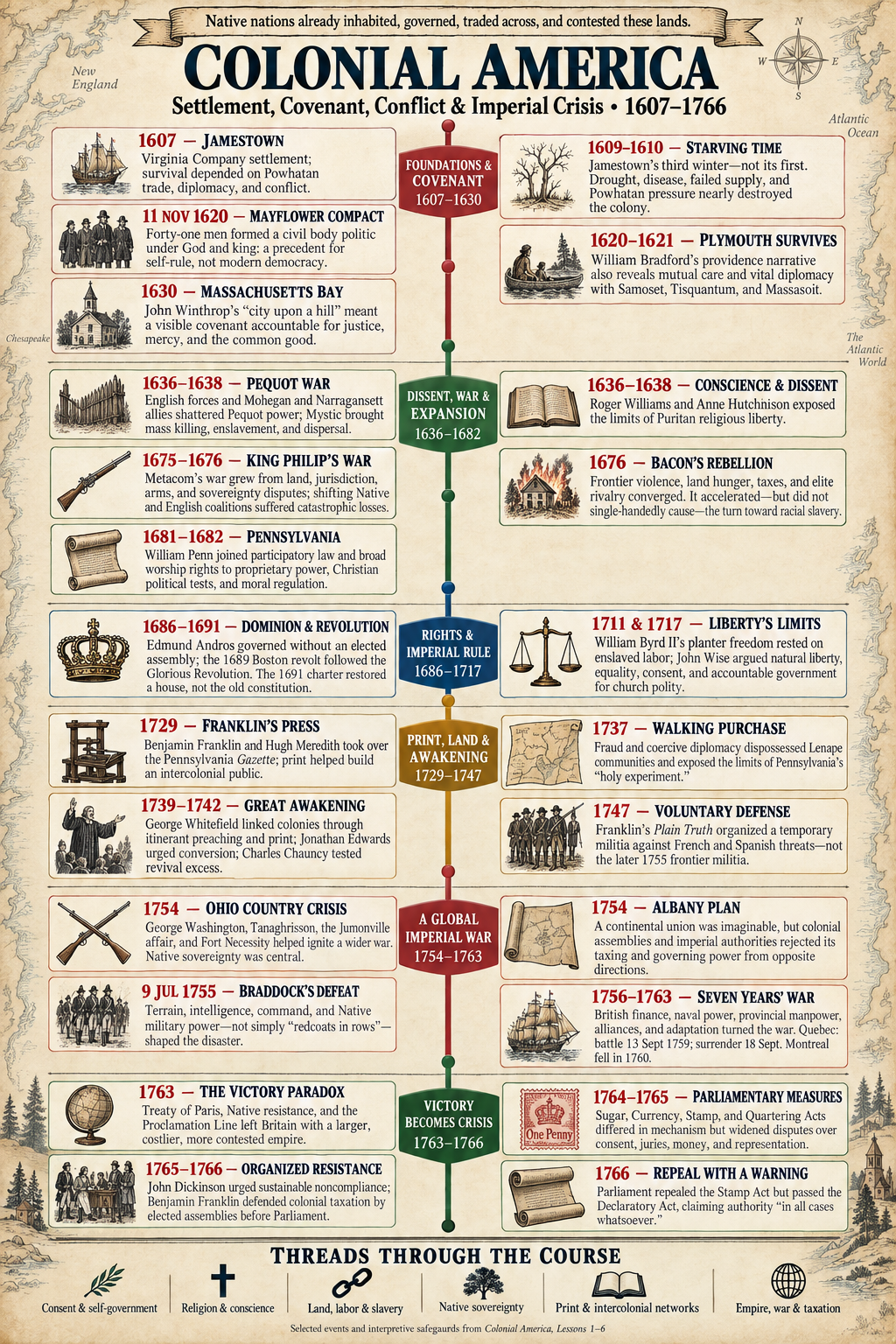
Hillsdale presents the colonial period as the formation of habits, institutions, and character that later made republican self-government possible. Its six documentary lessons move from New England settlement through regional development, frontier conflict, religious awakening, and the French and Indian War. This is the course’s organizing thesis, not a conclusion to assume in advance.
Evidence boundary
This is a pre-watch course note assembled from Hillsdale’s public course description, the Lesson 1–6 study guides, and their assigned primary-source packets. It is not a transcript of any episode. Statements under Course frame summarize the supplied course materials; statements under Source reading or Critical context interpret or test those claims.
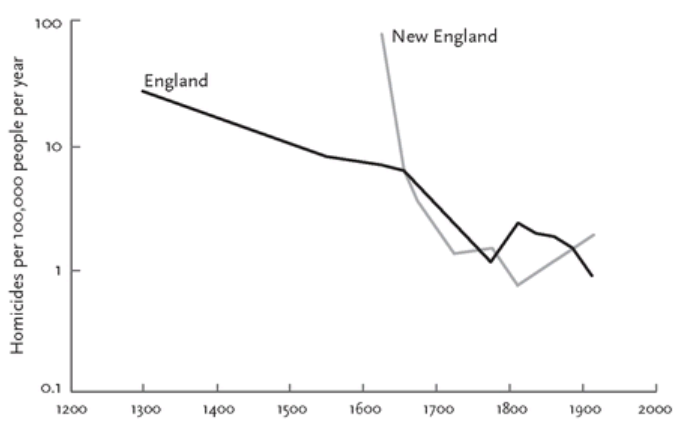
Pinker’s Chapter 3 supplement — New England’s homicide decline followed consolidation, but “order” was not neutral
Pinker reproduces Randolph Roth’s reconstruction of a very high early New England homicide rate—more than 100 per 100,000 adults per year—ending around 1637, when English colonists and their Native allies established regional hegemony. After conversion to a population denominator, the New England series falls sharply and then tracks the long English decline with striking closeness. Pinker treats this as an American example of frontier anarchy giving way to state-enforced order.
Figure 3-12 — homicide estimates for England, 1300–1925, and New England, 1630–1914. The figure cannot stand as a moral summary of colonization. Roth’s patchwork estimates and Pinker’s population conversion carry uncertainty; “hegemony” included war, Indigenous alliance, conquest, dispossession, and the extension of English jurisdiction. A decline in settler interpersonal homicide is evidence about one form of violence, not proof that the new order was consensual, nonviolent toward Native peoples, or justified. Chapter 3 synthesis · Dataset limits and Figure 3-12, PDF pp. 148–149 (file not included in this release) · Pinker’s interpretation of the 1637 break, PDF pp. 149–150 (file not included in this release)
Course at a Glance
- Provider: Hillsdale College Online Courses
- Format: six documentary episodes, officially listed as about 3.5 hours total, with quizzes, study guides, and readings
- Released: 2025
- Central question: How did colonial experience shape American practices of self-government, religious life, political thought, and regional identity before the Revolution?
- Method for these notes: record the course’s argument, identify the evidence offered, compare it with the assigned texts, and flag where a later national story is being projected backward.
| Done | Lesson | Length | Guiding problem |
|---|---|---|---|
| [ ] | 1. A City Upon a Hill | 39:51 | Pilgrim and Puritan religion, survival, covenant, and government |
| [ ] | 2. Forging the American Character | 39:41 | Quakers, the middle colonies, diversity, and Benjamin Franklin |
| [ ] | 3. Nature and Liberty | 29:00 | The southern colonies, agriculture, ambition, natural rights, and political theory |
| [ ] | 4. Frontier Wars | 30:12 | Native-European alliances, imperial rivalry, and conflict |
| [ ] | 5. Awakening a People | 37:03 | The Glorious Revolution, Great Awakening, individual responsibility, and common identity |
| [ ] | 6. The French and Indian War | 34:34 | Imperial war and the colonists’ discovery that Britons did not regard them as equals |
Next
Watch Lesson 1, add timestamps beside claims that matter, and revise the provisional answers below wherever the video supplies evidence the study guide omits.
Lesson 1 — A City Upon a Hill
- Watched
- Quiz completed
- Discussion questions revised after watching
- Episode page: A City Upon a Hill
Lesson 1 Source Packet
- Episode 1 study guide (file not included in this release)
- Mayflower Compact and Salem Covenant (file not included in this release)
- William Bradford, History of Plymouth Plantation — selections (file not included in this release)
- John Winthrop, A Modell of Christian Charity (file not included in this release)
Episode Map from the Study Guide
| Time | Course frame | Questions to carry into the video |
|---|---|---|
| 0:00–13:43 | The Pilgrims’ Journey: English Separatists leave for Holland, worry about cultural assimilation, sail on the Mayflower, land outside the intended jurisdiction, and form the Compact. | Does the episode distinguish the Leiden congregation, other passengers, servants, crew, and the forty-one male signers? How exactly does it connect consent to legal authority? |
| 13:44–24:33 | In the New World: catastrophic winter mortality; assistance from Samoset and Tisquantum; diplomacy with Massasoit; harvest and the event later called the first Thanksgiving. | How much agency and prior history does the episode give the Wampanoag and Patuxet? Does it explain the epidemic and Tisquantum’s abduction? |
| 24:34–37:25 | Puritan Rigidity and Religious Dissent: Massachusetts Bay, Winthrop’s exemplary community, fusion of civil and religious authority, Anne Hutchinson, and Roger Williams. | Does “religious liberty” mean freedom for a covenanted community or freedom of conscience for individuals? Is “city upon a hill” presented as triumph, warning, or both? |
The official episode length is 39:51, while the study-guide outline ends at 37:25; the remaining time is not described in the guide.
The Lesson’s Causal Story
Religious migration → jurisdictional uncertainty → covenanted civil authority → survival through discipline, mutual care, and Native diplomacy → a larger Puritan commonwealth organized around covenant → conflict over dissent and the limits of religious liberty.
That sequence is useful, but it needs two safeguards:
- It should not make the later United States look inevitable. Plymouth and Massachusetts Bay were distinct projects operating inside English imperial, commercial, religious, and Native political worlds.
- It should not make “wilderness” mean empty land. The settlers entered inhabited landscapes transformed by Native societies, European trade, kidnapping, warfare, and devastating epidemics.
Pilgrims and Puritans: Related, Not Identical
| Plymouth Pilgrims | Massachusetts Bay Puritans | |
|---|---|---|
| English religious position | Separatists: concluded that the Church of England was too corrupt to reform and formed an independent congregation. | Reformers: hoped to purify English Protestantism and create a disciplined godly commonwealth. |
| Migration represented here | Leiden exiles and other passengers aboard the Mayflower, 1620. | The much larger Winthrop-led migration beginning in 1630. |
| Immediate political problem | Their patent did not cover Cape Cod, and some passengers challenged the leaders’ authority. | They carried a corporate charter and aimed to unite civil and ecclesiastical order in New England. |
| Founding instrument or text | The Mayflower Compact created a civil body capable of making future laws and offices. | A Modell of Christian Charity articulated the moral obligations of a covenanted Christian community; it was not itself a constitution. |
| Religious liberty | Freedom to preserve a particular congregation, not a general theory of equal liberty for all faiths. | Corporate freedom to build a Puritan order; dissent that threatened that order could be punished or expelled. |
The Mayflower Compact
Core language
The signers agreed to “covenant and combine ourselves together into a civil body politic.” Assigned text, PDF p. 4 (file not included in this release)
Source reading
- Trigger: Bradford says some of the “strangers” argued that no one could command them because the ship had landed outside the territory covered by the Virginia patent. The agreement was therefore a practical answer to a jurisdictional and legitimacy crisis. Bradford, PDF p. 3 (file not included in this release)
- Authority: The parties bind themselves mutually, before God, while continuing to call themselves loyal subjects of King James. Consent and monarchy appear together; the text is not a declaration of independence.
- Institution: The Compact creates a body authorized to enact future “just and equal” laws, ordinances, constitutions, and offices for the colony’s general good.
- Obligation: Its signers promise submission and obedience to the rules that this body will later establish. The document creates a lawmaking community but does not specify a complete institutional design.
- Scope: Forty-one adult men signed. Women, children, servants, and other nonsigners were governed but did not enter the agreement on equal political terms.
What it does—and does not—foreshadow
It is a meaningful precedent for covenanted self-government, consent among political participants, rule through general laws, and orientation toward a common good. It is not yet a modern democracy, a bill of rights, a constitution separating powers, or a claim that authority comes from every individual equally. The safest formulation is: a precursor in political practice and vocabulary, not a miniature Constitution waiting to unfold. Compare Bailyn on the Compact as an emergency act rather than a complete constitution.
Bradford: Survival as Providence, Care, and Diplomacy
Bradford writes retrospectively as a leader of Plymouth. His history is evidence about events and about the theological meaning through which he wanted those events understood.
Source reading
- Government before settlement: After the Compact, the colonists confirmed John Carver as governor and developed civil and military rules as circumstances required. Government emerges incrementally from necessity rather than from a finished blueprint.
- Catastrophic mortality: In the first winter, roughly half the company died. At the worst point only six or seven people remained healthy enough to fetch wood, prepare food, clean clothing and bedding, and care for the sick.
- Covenant embodied as care: Bradford contrasts the colonists who served one another with crewmen who initially abandoned sick shipmates. His moral center is not abstract constitutionalism but costly fidelity under shared danger—“A rare example and worthy to be remembered.” Bradford, PDF p. 6 (file not included in this release)
- Native intermediaries: Samoset opens communication; Tisquantum translates, teaches planting and fishing, and guides trade; Massasoit and Plymouth make a reciprocal peace and defense agreement. Survival therefore depends on Native knowledge and political calculation as well as English solidarity.
- Providential interpretation: Bradford repeatedly treats unlikely aid, survival, and usable resources as acts of divine providence. That is his explanatory framework; historical analysis can preserve it as a fact about his worldview without treating it as the only causal account.
Critical context the short course outline compresses
- The editor’s footnote in the assigned Bradford selection says Thomas Hunt abducted twenty Patuxet and seven Nauset people in 1614 and carried them to Málaga to sell them; Tisquantum later reached England and returned to find the Patuxet devastated by disease. Bradford edition, PDF p. 9 (file not included in this release)
- Plymouth occupied the site of Patuxet after epidemic mortality had transformed the region. Calling the site “wilderness” or simply available land erases the human catastrophe that helped make English settlement possible.
- Bradford calls Tisquantum an instrument sent by God. That sentence reveals Bradford’s theology, but it should not reduce Tisquantum to a providential helper in an English story. He was a Patuxet survivor, translator, broker, and political actor with a history produced partly by English violence.
- The attached Bradford excerpt ends with the peace terms and Tisquantum’s assistance. It does not contain the harvest celebration; that part of the study guide rests on evidence outside the supplied selection.
Winthrop: The Full Argument Behind “City Upon a Hill”
The famous phrase comes near the end of a long argument. Reading only the slogan reverses the sermon’s emphasis.
The argument in sequence
- Hierarchy creates obligation. Winthrop begins by treating differences of wealth and rank as providential, but he immediately makes the rich stewards whose gifts exist for God’s glory and the common good—not merely for private enjoyment.
- Justice and mercy regulate social life. Ordinary dealings require justice; need and danger call for mercy. The law of grace extends even to enemies, though Winthrop gives special priority to fellow Christians.
- Extraordinary peril requires extraordinary liberality. In a shared emergency, people must give, lend despite risk, forgive debts when repayment is impossible, and accept less security for themselves so others can survive.
- Love makes the community one body. Christian society is not a collection of self-contained individuals. Members share one another’s weakness, wealth, joy, and suffering.
- The public good constrains private interest. Applying the sermon to migration, Winthrop describes a community formed by mutual consent under civil and ecclesiastical government and says “the care of the public must oversway all private respects.” Winthrop, PDF p. 14 (file not included in this release)
- The covenant raises the cost of failure. Success would make New England exemplary; breach would bring divine judgment, public shame, and the collapse of the project.
What “city upon a hill” means here
The metaphor is about visibility and accountability. Because “the eyes of all people are upon us,” the community’s success could encourage later plantations, but its failure would make it a cautionary tale and discredit the faith it professed. The line is therefore aspiration nested inside a warning, not a confident prediction of American greatness.
Interpretive control
Winthrop’s standard is not wealth, power, or national prestige. It is whether the settlers do justice, love mercy, walk humbly, share burdens, restrain private appetite, and keep covenant. The later “shining city” language of American exceptionalism selects the prestige of visibility while often dropping the threat of judgment and the sermon’s demanding social ethic.
Tensions within the model
- Solidarity and hierarchy: Winthrop demands radical mutual aid while affirming unequal rank as providential.
- Consent and discipline: The community is formed by mutual consent, yet its civil and ecclesiastical order does not rest on modern pluralism or unrestricted individual conscience.
- Common good and exclusion: The sermon asks members to identify as one body, but its thickest obligations are directed toward a bounded community of professing Christians.
- Moral economy and later capitalism: Giving, risky lending, debt forgiveness, and curbing superfluity occupy most of the sermon; treating it only as a founding statement of national ambition misses its material demands.
Source-provenance caution
The assigned Hillsdale reader acknowledges that the original text has not survived, the earliest known manuscript is not in Winthrop’s handwriting, nearly all evidence linking it to Winthrop and the Arbella voyage appears on a later cover page, and the work was first printed in 1838. Its exact setting and delivery should therefore be described cautiously, even though its attribution to Winthrop is traditional. Assigned reader introduction, PDF p. 3 (file not included in this release)
Religious Liberty: Corporate Freedom Versus Individual Conscience
The lesson’s last segment contains an important tension. The Pilgrims and Puritans crossed the Atlantic partly to escape an English religious order they regarded as coercive or corrupt. Yet Massachusetts Bay was designed to protect and discipline a particular religious community, not to establish a neutral state in which all beliefs had equal standing.
- Winthrop’s model: civil and ecclesiastical government cooperate in sustaining a godly commonwealth.
- Anne Hutchinson: her challenge to ministers and magistrates exposed conflicts over doctrine, authority, gender, and the boundary between private conviction and public order. “Banishment for blasphemy” is an overly compressed description; listen for what legal and theological claims the episode actually identifies.
- Roger Williams: he pushed toward a sharper distinction between civil authority and conscience, rejected coerced worship, and challenged English land claims not grounded in purchase from Native peoples. Rhode Island therefore represents a rival answer generated from within the same Protestant world.
The broader paradox is that communities seeking freedom for their own religious project helped create conflicts that eventually strengthened arguments for freedom between competing religious projects.
Comparing the Three Assigned Texts
| Text | Immediate problem | Source of order | Required conduct | Interpretive limit |
|---|---|---|---|---|
| Mayflower Compact | Authority outside the intended patent and threatened refusal of obedience | Mutual covenant under God and king; future laws for the general good | Submit to rules and offices the new body creates | Agreement to form government, not a full constitution or universal franchise |
| Bradford’s history | How Plymouth formed, survived mass death, and entered Native diplomacy | Providence, leadership, adaptive lawmaking, mutual care, and negotiated alliance | Serve the sick, maintain order, make and keep peace | Retrospective English account with a providential and colonial viewpoint |
| Winthrop’s model | How a migrating Puritan community can remain one body under extraordinary danger | Covenant with God, Christian love, justice, mercy, and civil-ecclesiastical government | Share burdens, subordinate excess and private advantage, keep the covenant | Moral-political exhortation, not a constitutional design or modern theory of toleration |
Provisional Answers to the Study-Guide Questions
How did religious motivations influence government structures?
Religion supplied both the form and the purpose of political association. Covenant language made consent a solemn mutual promise before God; law served preservation and the general good; leaders understood public survival as a test of collective faithfulness. In Plymouth, that logic helped legitimate emergency civil authority among a mixed company. In Massachusetts Bay, it supported a more comprehensive commonwealth in which civil and ecclesiastical discipline reinforced one another. The same structure that intensified mutual obligation also narrowed toleration: dissent could be interpreted not only as private disagreement but as a threat to the covenant sustaining the whole community.
Is the Mayflower Compact a precursor to later American political documents?
Yes, with qualifications. It practices consent among signers, creates a self-governing body, commits to “just and equal” laws, invokes the general good, and binds rulers and ruled through a public agreement. Those are genuine antecedents. But it preserves allegiance to the king, gives no catalogue of individual rights, leaves institutions unspecified, and excludes most inhabitants from formal consent. Its later importance should be traced through reception and institutional practice rather than treated as proof that the Constitution was already implicit in 1620.
What does Bradford say explains survival during the first winter?
Bradford’s answer operates on several levels at once:
- Providence: God sustains the colony and sends unexpected help.
- Mutual care: a tiny healthy remnant performs exhausting and intimate work for the sick.
- Order and adaptation: the colonists confirm a governor and make rules as new needs arise.
- Native knowledge and diplomacy: Samoset opens relations, Tisquantum supplies language and practical expertise, and Massasoit enters a peace alliance.
A complete historical answer must retain Bradford’s providential interpretation while also naming the human labor, Native agency, epidemic-altered landscape, and political interests through which survival occurred.
Claims to Test While Watching
- Does the episode mistakenly equate forty-one Compact signers with forty-one Pilgrims?
- Does it call all sixty-one other passengers “non-religious,” or does it explain that “stranger” meant outside the Leiden Separatist core rather than without religion?
- Does it distinguish the Compact’s practical jurisdictional purpose from later democratic symbolism?
- Does “religious liberty” mean corporate self-rule, individual conscience, or both?
- Does the survival story give causal weight to Wampanoag strategy, Patuxet loss, Tisquantum’s biography, and Native-European trade networks?
- Does the episode distinguish Bradford’s theology of providence from an independent historical explanation?
- Is “city upon a hill” quoted with Winthrop’s warning about failure and judgment?
- What evidence supports the course-wide move from colonial practice to a singular “American character” and ultimately to the Revolution?
- Which colonial regions, peoples, women, bound laborers, and imperial actors disappear when New England is treated as the national origin story?
Capture During the Episode
| Timestamp | Course claim | Evidence or example | Source support / tension | Follow-up |
|---|---|---|---|---|
Post-Watch Takeaway
Revise after watching
Provisional: Lesson 1 links the birth of New England government to religious covenant, but the assigned texts point to a more complex foundation: emergency jurisdiction, hierarchical households, intense mutual care, English commercial and imperial structures, epidemic-cleared Native land, and indispensable Native diplomacy. Winthrop’s “city” is best understood as a visible, accountable Christian community whose failure would be exemplary in the negative sense.
Source Audit and Corrections
- Compact date: The study guide labels its key passage “Mayflower Compact, 1621.” The assigned primary-source packet dates it 11 November 1620, and Bradford places it before disembarkation. Treat 1621 as a study-guide error. Study guide, PDF p. 2 (file not included in this release) · Primary-source packet, PDF p. 3 (file not included in this release)
- Passenger categories: The study guide’s “41 Pilgrims and 61 non-religious ‘strangers’” appears to conflate the forty-one adult male signers with the religious group. The assigned reader itself calls the forty-one “freemen.” Exact affiliation counts are debated, and “stranger” did not mean irreligious.
- Lecture versus guide: The attached Episode 1 PDF is an outline with selected passages and questions, not a transcript. Claims, wording, and emphases should be checked against the video before being attributed directly to a named professor.
- “First Thanksgiving”: The study guide states the familiar harvest narrative, but that event is outside the attached Bradford excerpt. It therefore needs its own source if developed further.
- Winthrop’s reception: The work’s modern status as a national founding text came much later than 1630. Read the sermon in its immediate Puritan, covenantal, and communal setting before connecting it to twentieth-century exceptionalist rhetoric.
- Course teleology: Hillsdale’s course page explicitly works backward from the American Founding to colonial “habits of self-government” and a formed national character. That is a legitimate thesis to test, but it can understate contingency, regional difference, empire, slavery, Indigenous sovereignty, and failed or rival colonial projects.
Lesson 2 — Forging the American Character
- Watched
- Quiz completed
- Discussion questions revised after watching
- Course listing: Colonial America course page — Lesson 2 entry
Lesson 2 source boundary
The attached Episode 2 PDF is a three-page study guide, not a transcript. It provides an outline, three selected quotations, and discussion questions. The Penn and Franklin PDFs are assigned excerpts: Franklin begins in the middle of book page 110 and ends in the middle of a sentence on book page 123. Claims about what the episode itself says should therefore remain provisional until the video is watched.
Lesson 2 Source Packet
- Episode 2 study guide (file not included in this release)
- William Penn, Frame of Government of Pennsylvania and Laws Agreed Upon in England (file not included in this release)
- Benjamin Franklin, Autobiography — selections on civic association, religious pluralism, and defense (file not included in this release)
Episode Map from the Study Guide
| Time | Course frame | Questions to carry into the video |
|---|---|---|
| 0:00–16:02 | A Holy Experiment: Quaker pacifism, equality, and toleration; Penn’s proprietorship; religious liberty; migration and Middle Colony diversity. | Does the episode distinguish toleration in worship from equal political eligibility? Does it separate Penn’s religious principles from his proprietary and economic interests? Who is included in “diversity”? |
| 16:03–26:16 | Benjamin Franklin: the printer as a model of moral and civic virtue; intercolonial information; libraries, fire protection, militia, and voluntary association. | Does it distinguish the Pennsylvania Gazette newspaper from Franklin’s later magazine project? How did print convert private initiative into durable public institutions? |
| 26:17–37:18 | Conflict and Unity in the Middle Colonies: settler expansion, rival land concepts, Native-settler violence, Quaker pacifism, and Franklin’s voluntary defense association. | What does “uncultivated” conceal about Native land use? Does the episode distinguish Franklin’s 1747 response to French and Spanish threats from the frontier crisis of 1755? Why is a 1676 Massachusetts captivity narrative used here? |
The official episode length is 39:41, while the study-guide outline ends at 37:18; the remaining 2:23 are not described in the guide.
The Lesson’s Causal Story
Quaker persecution and principle → Penn’s proprietary “holy experiment” → religious toleration and participatory law → European migration, pluralism, and commerce → print networks and voluntary associations → practical habits of self-government → conflict over land and defense → pressure for cooperation beyond a single sect or colony.
That is a plausible account of how one regional culture contributed to later American institutions, but it needs three controls:
- “American character” is a retrospective synthesis. Pennsylvania’s pluralism and Franklin’s associational energy mattered, but they did not erase distinct New England, Chesapeake, Caribbean, Native, African, Dutch, Swedish, German, and imperial histories.
- Toleration was broad without being universal. Penn protected a wider range of worship than most contemporaries, while retaining religious tests for political participation and a coercive moral code.
- Conflict was not caused simply by cultural misunderstanding. Population growth, land sales, squatting, proprietary interests, imperial war, Native diplomacy, and fraudulent acquisition all shaped the frontier.
William Penn: Government, Virtue, and the Holy Experiment
Penn’s preface is not merely a defense of religious liberty. It offers a theory of why government exists, what makes it free, and why institutional design cannot substitute for civic character.
Government is more than punishment
- Penn begins from a Christian account of human fallibility: inward moral law should guide the good, while outward law restrains wrongdoing. Government is therefore sacred in origin, but coercion is only its “coarsest” function. It also coordinates the many ordinary affairs required by social life. Penn, PDF p. 4 (file not included in this release) · PDF p. 5 (file not included in this release)
- He refuses to identify freedom with monarchy, aristocracy, or democracy as such. A government is free, he argues, where laws rule and the people are parties to those laws. The criterion is lawful participation, not the label attached to the regime. Penn, PDF p. 5 (file not included in this release)
- Institutional form remains contingent: time, place, and emergencies alter even well-designed governments. Penn’s constitutionalism is therefore less schematic than a search for the single perfect regime.
Good laws need good people
Penn’s most characteristic claim is that constitutions depend on the people who animate them. Bad officials can evade or abolish good laws; wise and virtuous citizens can repair defective arrangements. Because virtue is not inherited automatically, he makes education a constitutional concern. Penn, PDF p. 6 (file not included in this release)
His desired balance is concise: “liberty without obedience is confusion, and obedience without liberty is slavery.” A durable government must both restrain official abuse and preserve legitimate authority. This is the governing ideal behind the detailed laws that follow. Penn, PDF p. 6 (file not included in this release)
The institutional design
The Laws Agreed Upon in England turn the theory into concrete protections and obligations:
- broad freeman status tied to land, productive settlement, completed servitude, craft residence, or local taxation;
- free elections and penalties for buying votes;
- no taxation without a law enacted for that purpose;
- open courts, advance notice of complaints, plain English pleadings, local juries, bail in noncapital cases, moderate fees and fines, and damages for wrongful imprisonment;
- public registries for property, births, marriages, deaths, wills, and servants;
- limits on holding multiple public offices and a requirement that children learn a useful trade;
- legislative change through the governor and an unusually high supermajority of freemen. Penn, PDF p. 7 (file not included in this release) · PDF p. 8 (file not included in this release) · PDF p. 10 (file not included in this release) · PDF p. 11 (file not included in this release)
These provisions join inherited English rights, Quaker concerns about oaths and conscience, proprietary government, and an unusually expansive concept of civic participation for settler men. They are not yet universal suffrage or a modern separation of church and state.
Toleration and its limits
Law 35 protects inhabitants who acknowledge one God and promise peaceful, just conduct from religious coercion or compulsory support of a ministry. That is remarkably broad by seventeenth-century standards and extends beyond Quakers. Penn, PDF p. 11 (file not included in this release) Compare William Penn's Holy Experiment in The Enlightenment.
But religious liberty is not the same as full civic equality:
- Political eligibility: Law 34 requires officeholders, assembly members, and electors to profess faith in Jesus Christ; the wider toleration of monotheistic worship does not produce equal political rights. Penn, PDF p. 10 (file not included in this release) · PDF p. 11 (file not included in this release)
- Moral regulation: Sunday labor, drunkenness, sexual conduct, theater, cards, dice, animal baiting, and other practices remain subject to public discipline. Penn rejects an established church without imagining a morally neutral state.
- Proprietary power: Penn remains governor and proprietor; lawmaking and constitutional alteration require his participation or that of his heirs. Popular participation and proprietary authority coexist.
- Social hierarchy: servants receive protections and eventual freedom, yet bonded labor, gendered legal status, property qualifications, and unequal political standing remain part of the order.
Benjamin Franklin: Print, Association, and Practical Self-Government
The assigned excerpt presents Franklin less as an abstract theorist than as an organizer who repeatedly turns communication, voluntary cooperation, and explicit rules into public capacity.
The associational method
Franklin’s recurring civic mechanism is:
identify a public problem → write or print a persuasive proposal → convene interested citizens → adopt explicit rules → raise voluntary money → elect officers or trustees → create a durable institution.
The excerpt supplies several versions:
- Fire protection: monthly fines purchase engines, ladders, hooks, and equipment; organized prevention limits urban fires. Franklin, PDF p. 3 (file not included in this release)
- A religiously open meetinghouse: contributors vest a large hall in trustees for any preacher, without denominational ownership. Franklin dramatizes its intended openness with the claim that even a Muslim missionary could use the pulpit. Franklin, PDF p. 6 (file not included in this release)
- Printing networks: a profitable newspaper and colonial printing partnerships spread texts, livelihoods, and influence. Franklin credits explicit written agreements with preventing the quarrels that often destroy partnerships. Franklin, PDF p. 11 (file not included in this release) · PDF p. 12 (file not included in this release)
- Learning and science: after a college proposal stalls, he establishes a philosophical society—another example of building civic infrastructure outside government. Franklin, PDF p. 12 (file not included in this release)
- Defense: when the Quaker Assembly will not create a militia, Plain Truth and a printed association produce thousands of subscribers, self-armed companies, elected officers, a battery funded through a lottery, and a public fast circulated in English and German. Franklin, PDF p. 13 (file not included in this release) · PDF p. 16 (file not included in this release) · PDF p. 17 (file not included in this release)
This is self-government as learned practice. Citizens become capable of common action by writing rules, deliberating, subscribing resources, choosing leaders, and correcting arrangements through experience.
Print creates both influence and accountability
Franklin admires George Whitefield’s oratory, measures the range of his voice, publishes his sermons, and describes how repeated delivery sharpened performance. Yet he also observes that a spoken mistake can be qualified or denied, whereas the written word remains and gives critics a stable object. Franklin, PDF p. 10 (file not included in this release) · PDF p. 11 (file not included in this release)
Print therefore does several things at once:
- carries news, arguments, sermons, and institutional proposals beyond face-to-face communities;
- creates a shared arena in which distant readers can encounter the same claims;
- coordinates action by reproducing rules and forms;
- builds reputations and markets;
- fixes words in a form that can be challenged later.
The press does not automatically create truth or unity. It amplifies persuasion, controversy, commerce, and coordination alike.
Quaker pacifism is a real principle, not a uniform behavior
Franklin describes persistent conflict between Quaker officeholding and refusal to support war. But his own evidence complicates a simple Quaker-versus-defense story:
- some Friends distinguished offensive war from defensive protection;
- Quaker members privately stood ready to support a fire-company contribution to a battery while hoping not to vote publicly;
- the Assembly sometimes disguised military appropriations as funds for the king or for “other grain”;
- some Quakers preferred leaving public office to violating a settled testimony against war. Franklin, PDF p. 20 (file not included in this release) · PDF p. 21 (file not included in this release) · PDF p. 22 (file not included in this release)
The tension is institutional as well as theological: a pacifist community can live by conscience when it is a minority, but governing a religiously diverse province forces the question of whether officeholders may deny defensive measures desired by constituents who do not share that conscience.
Fallibilism and public usefulness
Franklin praises the Dunkers for refusing to freeze a creed in print because they expect to discover further error. His fog metaphor makes intellectual humility a civic virtue: others look mistaken from a distance while one’s own position appears clear only because it is near. Franklin, PDF p. 23 (file not included in this release) · PDF p. 26 (file not included in this release)
The excerpt then turns to Franklin’s stove and his refusal of an exclusive patent because inventors benefit from the work of others. The supplied selection ends before he completes that sentence, so its final argument should not be quoted beyond the text actually present. Franklin, PDF p. 26 (file not included in this release)
Penn and Franklin: Two Models of Self-Government
| William Penn | Benjamin Franklin | |
|---|---|---|
| Starting point | A proprietor designing a constitutional and moral order | A printer diagnosing practical deficiencies in an existing society |
| Primary mechanism | Charter, law, representation, rights, education, and virtuous magistracy | Print, persuasion, clubs, subscriptions, trustees, written agreements, and elected voluntary associations |
| Religious posture | Conscience deserves broad protection within a Christian and monotheistic moral framework | Cooperation across sects; civil friendship and public usefulness need not require theological agreement |
| View of character | Free government survives through wise and virtuous citizens | Civic character is cultivated by repeatedly organizing to solve shared problems |
| Central tension | Proprietary and religious authority coexist with consent and toleration | Voluntary action can supply public goods but may bypass or pressure representative government |
| Course-wide significance | Institutional architecture for pluralism | Habits and techniques that make pluralism governable in practice |
Together they support a stronger formulation of the lesson’s thesis: the Middle Colonies contributed not one fixed “American character,” but institutions and practices for governing amid difference.
Land, Conflict, and the Limits of the Course Frame
The final segment of the guide moves rapidly from land cultivation to Native property, frontier violence, Quaker pacifism, and Franklin’s militia. Each transition needs qualification.
“Uncultivated” did not mean unclaimed
The guide contrasts settlers who derived ownership from labor with Native peoples who supposedly lacked property ownership. That is too categorical. English colonists often treated plowing, fencing, and permanent settlement as “improvement,” but Native communities farmed, hunted, fished, managed seasonal resources, defended territories, and entered diplomatic agreements over land. Different rules of tenure and use are not the absence of property or sovereignty.
Penn’s own policy partly contradicts the guide’s simplification: his government recognized Lenape claims strongly enough to negotiate purchases rather than treating the royal charter alone as sufficient title. The later 1737 Walking Purchase—engineered by Penn’s sons and James Logan from an unsigned draft deed—then used fraud and coercive diplomacy to take far more land than Lenape leaders believed they had conveyed. That history connects settlement pressure to conflict more directly than a generic clash between cultivation and nonownership. See Taylor on Pennsylvania and Taylor on pluralism and the Walking Purchase.
The Rowlandson passage is evidence from another conflict
The study guide quotes Mary Rowlandson’s captivity narrative under Middle Colony conflict, but the described attack occurred at Lancaster, Massachusetts, in February 1676 during King Philip’s War; 1682 is the narrative’s publication year. It documents real terror and a powerful genre of colonial memory, but it is not direct evidence about the Pennsylvania frontier. Episode 2 guide, PDF p. 2 (file not included in this release)
The passage should prompt questions about selection as well as violence: Why does the guide move from Pennsylvania to an earlier New England atrocity account? Does the episode also examine colonial attacks, land seizures, captive-taking, imperial alliances, and the political aims of the Native groups involved?
Franklin’s 1747 association and the later frontier militia are not identical
The assigned autobiography ties Franklin’s voluntary defense association to Britain’s war against Spain and France, the threat to Philadelphia and Delaware shipping, and the absence of provincial fortifications. Franklin’s 1747 printed association explicitly ended when peace returned. It should not be collapsed into the distinct 1755 militia law prompted by frontier attacks during the French and Indian War.
The guide may use the association as a general example of self-organization under Quaker government, but its chronology matters: a maritime and imperial defense crisis in 1747 is not simply a response to Native raids.
Provisional Answers to the Lesson 2 Discussion Questions
What role did the printing press play in distributing information throughout the colonies?
The press made dispersed colonial publics partially shareable. Newspapers, pamphlets, sermons, almanacs, letters, advertisements, institutional forms, and reprinted reports could travel farther and last longer than speech. Franklin used print not merely to inform but to organize: Plain Truth defined a problem, the association form specified obligations, bilingual proclamations widened participation, and newspapers linked local events to imperial and intercolonial affairs. Print also increased accountability because exact wording could be preserved, compared, criticized, and reprinted. Its political effect was therefore not automatic unity but a common infrastructure for argument and coordinated action.
What benefits did diversity bring, and what struggles accompanied it?
European religious and ethnic diversity attracted migrants, capital, trades, languages, churches, and commercial networks. Because no single group could easily dominate, forbearance and coalition-building became practical necessities; voluntary associations offered cooperation without complete agreement. Yet diversity also generated electoral factions, language barriers, confessional suspicion, disagreement over defense, and conflict between coastal Quaker leadership and newer frontier populations. More importantly, pluralism among European settlers coexisted with bonded labor, slavery, religious tests, and the displacement of Lenape communities. Diversity was a political achievement within boundaries, not universal inclusion.
Why did Franklin and Penn encourage religious liberty?
Penn’s case was simultaneously principled and practical. Persecution convinced him that coerced worship violated conscience; Quaker theology emphasized the spiritual capacity of ordinary people; constitutional toleration also attracted settlers and made his proprietary colony viable. Franklin’s posture was less confessional. The excerpt shows him cooperating with believers he did not join, supporting a hall open to every preacher, and judging institutions by their civic usefulness. For him, toleration enabled friendship, persuasion, commerce, experimentation, and joint action among people who disagreed. Neither man’s position was identical to modern universal religious equality: Penn retained Christian political tests, while Franklin’s excerpt gives a practice of pluralism more than a systematic rights theory.
Claims to Test While Watching Lesson 2
- Does “equality” refer to Quaker spiritual equality, legal equality among freemen, social equality, or universal human equality?
- Does the episode explain that Penn’s toleration protected monotheistic worship more broadly than his rules protected voting and officeholding?
- Does it distinguish principled toleration from the demographic and commercial advantages of attracting migrants?
- Does it call the Pennsylvania Gazette a newspaper or incorrectly repeat the guide’s description of it as the first American magazine?
- Does John Webb appear in connection with the Gazette or with Franklin’s later magazine proposal?
- Which concrete Franklin institutions are shown, and what legal or voluntary rules made each durable?
- Does the episode distinguish the 1747 defense association from the 1755 militia law and from frontier vigilante violence?
- Does it treat Quaker pacifism as uniform, or show the internal disagreement Franklin describes?
- How does it define “uncultivated” land, and does it acknowledge Native agriculture, seasonal use, territorial claims, and treaty relations?
- Is the Walking Purchase included when explaining the breakdown of Pennsylvania’s early peace?
- Why is Rowlandson’s 1676 Massachusetts account used to frame Middle Colony conflict?
- Does Franklin’s praise of Haudenosaunee union become evidence for a modest intercolonial analogy or an overstated direct-origin claim?
- Who remains outside the lesson’s “American character”—Lenape people, Africans, women, servants, non-Christians, and those without qualifying property or status?
Capture During the Episode
| Timestamp | Course claim | Evidence or example | Source support / tension | Follow-up |
|---|---|---|---|---|
Post-Watch Takeaway
Revise after watching
Provisional: Lesson 2 is strongest when “character” means a learned capacity for cooperation across difference. Penn’s constitutional design joins consent, rights, virtue, and limited toleration; Franklin’s associations turn print and voluntary obligation into fire protection, education, religious accommodation, and defense. The same Pennsylvania story also exposes the limits of that achievement: Christian political tests, moral coercion, proprietary power, bonded labor, Native dispossession, and defense conflicts that pluralism did not dissolve.
Lesson 2 Source Audit and Corrections
- The Gazette was not a magazine: The guide says Franklin and John Webb established the Pennsylvania Gazette as the first American magazine. The Library of Congress identifies it as a newspaper, begun by Samuel Keimer and taken over in 1729 by Franklin and Hugh Meredith. John Webbe belongs to Franklin’s separate 1741 magazine story; Andrew Bradford’s American Magazine may have preceded Franklin’s General Magazine by several days.
- The supplied Franklin text is a selection: It starts mid-narrative at book page 110 and ends mid-sentence at book page 123. It supports claims about fire protection, Whitefield, printing partnerships, voluntary defense, Quaker pacifism, fallibilism, and invention—not the guide’s account of Franklin’s youth or arrival in Philadelphia.
- Three guide quotations come from outside the attached primary-source excerpts: Penn’s Some Account of the Province of Pennsylvania, Rowlandson’s captivity narrative, and Franklin’s 1751 letter to James Parker appear only as short quotations in the study guide. They should not be attributed to the attached Penn or Franklin PDFs.
- Rowlandson’s date and geography: The attack she describes occurred in Massachusetts in 1676; 1682 is the publication date. The passage cannot by itself establish the causes or conduct of Pennsylvania frontier warfare.
- Native property claim: Saying Native peoples “lacked” property ideas confuses difference with absence. The episode needs evidence about the specific Lenape, Haudenosaunee, and other communities involved, their territorial and use practices, and the meanings attached to particular land transactions.
- Militia chronology: Franklin’s 1747 association addressed French and Spanish wartime threats to a defenseless province. The later 1755 militia law addressed a different frontier emergency. The two episodes illuminate the same defense dilemma but should not be merged.
- Pacifism within Quaker politics: Franklin is an interested and sometimes satirical narrator. His anecdotes also show that Quakers disagreed, compromised, and distinguished private conviction from public action; they are evidence against treating the sect as a single political mind.
- Franklin and Indigenous union: The 1751 Parker letter praises the durability of the Haudenosaunee Confederacy while using demeaning language. It shows that Franklin considered an Indigenous union relevant to colonial cooperation, but it does not by itself prove that later federal institutions were copied from the Great Law of Peace. Compare the Haudenosaunee influence dispute in 1491.
Lesson 3 — Nature and Liberty
- Watched
- Quiz completed
- Discussion questions revised after watching
- Course listing: Colonial America course page — Lesson 3 entry
Lesson 3 source boundary
The attached Episode 3 PDF is a three-page study guide, not a transcript. It gives a timed outline, three short quotations, and three discussion questions. The Byrd PDF is one month from a private diary; the Wise PDF is a two-page-spread scan of part of a longer 1717 work. The Lord Baltimore and Nathaniel Bacon passages occur only in the guide, not in either assigned primary-source PDF. Claims about what the episode itself argues therefore remain provisional until the video is watched.
Lesson 3 Source Packet
- Episode 3 study guide (file not included in this release)
- William Byrd II, The Secret Diary — November 1711 selection (file not included in this release)
- John Wise, Vindication of the Government of New England Churches — natural law and church government selection (file not included in this release)
Episode Map from the Study Guide
| Time | Course frame | Questions to carry into the video |
|---|---|---|
| 0:00–7:42 | Wealth in the South: Jamestown’s commercial origins and mortality; tobacco; the Carolinas; Maryland; Georgia. | Does the episode distinguish Virginia, Maryland, Carolina, and Georgia rather than making a single “South”? Does it correct the guide’s chronology of the Starving Time and its claim that Georgia was a convict colony? |
| 7:43–17:53 | Slavery and Natural Rights: indentured servitude, the transition to racial slavery, Bacon’s Rebellion, Locke, John Wise, and Benjamin Lay. | Is bound labor treated as a spectrum rather than one undifferentiated category? Is Bacon’s Rebellion presented as one factor in a long transition rather than the single cause of slavery? How does Wise’s church-polity argument enter a southern story? |
| 17:54–26:32 | The Southern Colonies and the Empire: local assemblies, “salutary neglect,” the rights of Englishmen, prosperity, and imperial wars. | Does “neglect” mean weak enforcement, negotiated rule, or colonial independence? Do colonists appear as simultaneously local political actors and committed British subjects? |
The official episode length is 29:00, while the study-guide outline ends at 26:32; the remaining 2:28 are not described in the guide.
The Lesson’s Causal Story
Commercial colonization → mortality and failed extraction schemes → tobacco, rice, and indigo profitability → demand for land and bound labor → planter hierarchy and racial slavery → local representative practice within the British Empire → natural-law arguments about liberty, equality, consent, and the common good → a regional political culture that later contributed to revolutionary claims.
That sequence identifies a real conjunction of prosperity, coercion, and political development, but it needs four controls:
- The southern mainland colonies were not one society. Virginia and Maryland were Chesapeake tobacco colonies; South Carolina grew through a Barbadian, rice-and-slave-trade complex; North Carolina developed more diffusely; Georgia began as a trustee experiment and strategic border colony.
- Agricultural success did not simply transform wilderness into civilization. It expanded through Native land loss, Atlantic markets, ecological change, indenture, convict transportation, and hereditary racial slavery.
- Natural equality did not automatically produce equal civil status. Colonists could affirm consent and the rights of freemen while legally excluding women, servants, enslaved people, free Black people, Native peoples, and many without property or recognized church standing.
- Later revolution was not inevitable. Colonial assemblies and natural-rights language developed inside an empire many colonists valued for markets, credit, naval protection, and Protestant geopolitical power.
Four Colonies, Not One “South”
| Colony or region | Founding logic represented in the guide | Political economy and social order | Necessary qualification |
|---|---|---|---|
| Virginia | Virginia Company venture seeking valuable commodities and a durable English foothold | Tobacco, river plantations, county government, indentured labor, then racial slavery and planter rule | The Starving Time occurred in 1609–1610, not Jamestown’s first winter; survival also depended on Powhatan food, strategy, and the contingent arrival of relief. |
| Maryland | Calvert proprietorship offering security to Catholics | Tobacco economy resembling Virginia, proprietary rule, elected assembly, and limited Christian toleration | It was both a religious refuge and a profit-seeking proprietary project; Protestants were welcomed and soon formed a majority. Toleration was broad for its setting but not universal. |
| The Carolinas | Proprietary settlement chartered in 1663 and divided administratively in 1712 | Distinct northern and southern settlement patterns; South Carolina’s rice wealth became inseparable from African knowledge and mass enslavement | Geography mattered, but so did migration from Barbados, Native trade and warfare, labor systems, imperial defense, and uneven settlement. |
| Georgia | Trustee project promising disciplined smallholding, poor relief, useful commodities, and a defensive buffer against Spanish Florida | Initially restricted large landholding, rum, and slavery; later converged toward the plantation model | The guide’s description of Georgia as “a colony for convicts” is inaccurate. The debtor-relief idea changed before embarkation, and no formerly jailed debtor was among the first selected colonists. |
Compare Taylor on early Virginia, the mature Chesapeake, and Carolina and Georgia.
Jamestown and Tobacco: Prosperity Reorganized the Crisis
The commercial premise of Jamestown matters. The Virginia Company expected a return from trade, commodities, mineral discovery, or a route to Asian markets. Its early population included gentlemen, craftsmen, soldiers, and laborers, but it lacked a stable political order, reliable food supply, and adequate knowledge of the Chesapeake. Calling its settlers merely “ambitious young men” captures part of the recruitment pattern while understating company mismanagement, environmental exposure, faction, and dependence on the surrounding Powhatan polity.
The guide’s most concrete chronological error is important: the Starving Time was the winter of 1609–1610, Jamestown’s third winter, not its first. Drought, disease, failed resupply, siege and containment by Powhatan forces, and the colony’s own weak subsistence reduced several hundred inhabitants to a small remnant. That collapse shows that English permanence was contingent rather than guaranteed. Compare Bailyn on Jamestown's near extinction.
Tobacco solved the company’s revenue problem while creating new ones:
- a labor-intensive staple rewarded control of many workers;
- river transport encouraged dispersed plantations rather than compact towns;
- repeated soil exhaustion and rising exports intensified demand for land;
- dependence on a volatile overseas market tied local prosperity to merchants, shipping, credit, and imperial regulation;
- expansion converted Native territory into patented property and made frontier warfare part of the political economy.
The result was not simply wealth. It was a distinctive structure joining household mastery, county government, elected assemblies, Atlantic commerce, Native dispossession, and bound labor.
William Byrd II: The Planter-Gentleman from the Inside
The assigned selection covers 1–30 November 1711. Byrd wrote it in shorthand for himself; it was deciphered and published only in the twentieth century. Its candor is valuable, but the selection is neither a census of Virginia life nor a neutral view of the plantation order. It records what an elite male considered worth tracking.
What fills Byrd’s days
| Repeated activity | What it reveals |
|---|---|
| Council sessions, courts, bills, addresses, and meetings with the governor | Political authority operated through a small, socially intimate governing class. Byrd moves easily among executive, judicial, and legislative work. Byrd, PDF p. 4 (file not included in this release) · PDF p. 11 (file not included in this release) |
| Dinners, weddings, dancing, coffeehouses, gambling, favors, gifts, and kin visits | Sociability was part of rule: patronage, reputation, family alliance, news, and public business shared the same rooms and relationships. |
| Hebrew, Greek, Italian, English reading, prayer, exercise, and journaling | Byrd fashioned himself as a learned, disciplined Christian gentleman even while repeatedly recording lapses, intoxication, gambling, sexual appetite, and renewed resolutions. Byrd, PDF p. 5 (file not included in this release) · PDF p. 12 (file not included in this release) |
| Letters to England, ships, imported wine, quitrents, and the price of tobacco | Virginia’s governing elite was provincial but not isolated. Its wealth, information, status, and credit moved through an Atlantic British network. Byrd, PDF p. 13 (file not included in this release) |
| Directions to “my people,” messages carried by Tom, and attention to plantation and estate business | The leisure and public service visible in the diary rested on other people’s labor, much of which the diary renders only as command, transaction, or background. Byrd, PDF p. 8 (file not included in this release) · PDF p. 9 (file not included in this release) |
The most important silence is labor
The selection makes dependence visible obliquely. Byrd gives orders, dispatches men, receives food and transportation, manages plantations, divides inherited land, and discusses selling “land and negroes” to pay an estate’s debts. The last entry treats enslaved people as alienable assets within ordinary estate accounting. Byrd, 26 November, PDF p. 13 (file not included in this release)
That does not mean labor was unimportant to him. It means the diary’s narrative center is the master’s self: his health, reading, appetite, piety, pleasure, money, office, and social standing. Enslaved people, servants, workers, and much of women’s household labor appear chiefly when they intersect with his plans. The document is therefore excellent evidence for elite consciousness and the normalization of command, but poor evidence for the lived experience of those whose work sustained Westover.
Liberty in a hierarchical world
Byrd’s life helps clarify why colonial “liberty” did not initially mean equal personal autonomy. A planter-gentleman’s liberty included property, household authority, local office, participation in lawmaking, protection against arbitrary superiors, and the ability to direct dependents. Representative government and hierarchy were not opposites in this world; political liberty for a governing stratum could coexist with extensive unfreedom below it.
The packet introduction calls Virginia “royalist, Anglican, patriarchal, highly structured” and describes its liberty as different from New England’s. That is the editor’s interpretation, not language from Byrd’s diary. The diary supports parts of it, but the interpretation should be tested against the text’s silences, the managerial demands of plantation production, and the diversity of nonelite Virginians. Reader introduction, PDF p. 3 (file not included in this release)
Bound Labor, Racial Slavery, and Bacon’s Rebellion
The guide groups indentured servitude and slavery under “forced labor.” Both constrained labor and exposed workers to violence, sale, and planter-run courts, but the category is too broad unless their differences remain visible.
| Indentured servitude | Racial chattel slavery | |
|---|---|---|
| Legal duration | Usually a term of years, though courts could extend it and some migrants were coerced, kidnapped, transported, or unable to bargain meaningfully | Presumptively lifelong and increasingly hereditary through the status of the mother |
| Exit recognized by law | Completion of term and freedom dues, with a declining but real possibility of landholding or wage work | No contractual endpoint; sale, inheritance, movement restrictions, and family separation were built into the regime |
| Racial construction | Most seventeenth-century servants were European, though early bound statuses were more varied | Colonial law increasingly identified African descent with permanent enslavement and gave white people cross-class authority over Black people |
| Political effect | Freed servants could become armed, voting, land-seeking colonists and therefore a source of elite anxiety | Enslavement created a permanent labor force excluded from the polity while racial privilege helped align poorer whites with planter rule |
Virginia’s transition did not occur in one legislative moment. Courts and assemblies constructed hereditary racial slavery over decades: they separated baptism from freedom, made status descend through the mother, restricted movement and arms, protected violent mastery, narrowed manumission, and eventually consolidated the system in the 1705 slave code. Atlantic supply, falling servant migration, improved life expectancy, land concentration, planter capital, and racism all mattered. See Bailyn on slavery made incrementally in law.
Bacon’s Rebellion was a conjuncture, not a switch
The guide says slavery became dominant after the 1676 rebellion because laws changed to protect slaveholders from similar dangers. That is a recognizable interpretation, but the causal statement is too certain.
- Bacon was an elite rival of Governor Berkeley, not a consistent egalitarian. His movement joined factional struggle, low tobacco prices, taxes, land hunger, former-servant grievances, and demands for indiscriminate war against Native peoples.
- Bacon accused Berkeley of protecting Native people, yet Bacon’s forces attacked communities allied with Virginia as well as enemies. The guide’s excerpt records the rebels’ accusation; it does not establish its truth. Episode 3 guide, PDF p. 2 (file not included in this release)
- Servants and enslaved people participated, especially as the rebellion collapsed, but their presence does not make the movement a program for universal freedom.
- Leading planters had already begun replacing servants with enslaved Africans before 1676; the supply of enslaved labor and its legal consolidation expanded most dramatically afterward.
- The rebellion may have strengthened elite incentives to reduce conflict among whites, redirect expansion toward Native land, and build racial solidarity. It was an accelerator or revealing crisis within a longer transformation—not a self-sufficient explanation.
Compare Taylor on planter rule, rebellion, and racial slavery.
John Wise: Natural Law in the Service of Church Democracy
Wise’s Vindication is easy to detach from its purpose because its account of natural liberty, equality, compact, and popular sovereignty sounds strikingly political. Yet the argument’s destination is Congregational church government. He uses civil theory to show why church members should not be ruled by an ecclesiastical monarch or an unaccountable clerical aristocracy.
The argument in sequence
- Reason and revelation share a divine source. Wise treats right reason as a God-given light capable of disclosing natural law; he does not oppose secular reason to Christianity. He explicitly names Samuel Pufendorf as his principal guide. Wise, PDF p. 3 (file not included in this release)
- Human nature is self-preserving and sociable. People need one another for safety and flourishing, so natural law directs them beyond private advantage toward sociability and the common good. Wise, PDF p. 5 (file not included in this release)
- Natural liberty is rational, not license. Freedom means acting under reason and natural law, not unbounded appetite. Every person begins in his own power and may judge what serves his well-being. Wise, PDF p. 6 (file not included in this release)
- People are naturally equal. No one possesses natural title to command another merely through superior ability; subjection requires force or voluntary agreement. Wise, PDF p. 7 (file not included in this release) · PDF p. 8 (file not included in this release)
- Civil power originates in the people. Free and equal persons covenant to form a continuing society, choose a form of government, and authorize rulers who promise to protect the common peace and welfare. Majority decision binds after the compact establishes it. Wise, PDF p. 9 (file not included in this release)
- Government exists for the people’s security and happiness. Legislative, judicial, war-and-peace, and appointment powers are delegated functions. Those who create offices may dissolve them when officeholders justly forfeit their trust. Wise, PDF p. 10 (file not included in this release)
- Democracy is regular government, not anarchy. The people may appoint magistrates for ordinary administration while retaining ultimate authority; officers remain accountable and major questions return to the assembly. Wise, PDF p. 11 (file not included in this release) · PDF p. 18 (file not included in this release)
- The application is ecclesiastical. Church power is persuasive and ministerial rather than civilly coercive. Papal monarchy and clerical aristocracy invite domination; the congregation is the first subject of church power, councils are consultative, and delegates possess equal votes. Wise, PDF p. 13 (file not included in this release) · PDF p. 20 (file not included in this release) · PDF p. 21 (file not included in this release)
What Wise does and does not establish
Wise supplies a colonial vocabulary of natural freedom, natural equality, consent, compact, majority rule, delegated power, accountability, security, and the common good. Those concepts plainly resemble later revolutionary arguments. Resemblance alone, however, is not proof that a particular Founder borrowed directly from this text.
Nor is Wise simply a Lockean voice. The selected pages name Pufendorf, classical and Roman authorities, Scripture, English constitutional arrangements, and Congregational practice. He even praises a mixed English monarchy built on democratic foundations. The more accurate claim is that he participates in a broad Atlantic natural-law and consent tradition that colonists adapted to local disputes.
Finally, universal phrasing and universal application must be separated. Wise writes that all men are naturally free and equal, but his immediate institutional subject is a community of recognized church members. The selection does not confront racial slavery, women’s political status, Native sovereignty, or the position of servants. Those omissions do not logically refute the principle; they reveal the boundary between an abstract claim and the social order in which it was used.
Natural Rights and Slavery: The Contradiction Was Managed, Not Solved
The guide asks how southern colonists reconciled natural rights with slavery. There was no single reconciliation, and “reconciled” can imply a philosophical success that never occurred. Slaveholding societies instead managed the contradiction through overlapping distinctions:
- Natural person versus civil member: writers could affirm a natural condition of equality while reserving voting, office, arms, and legal independence for qualified freemen.
- Liberty versus license: elites defined ordered liberty as conduct under reason, law, household authority, and the common good; they portrayed dependents as not yet or not fully capable of self-rule.
- Right versus status: positive colonial law treated enslaved people as inheritable property even when natural-law language appeared universal.
- Christian and racial hierarchy: biblical defenses, paternalism, claims of cultural inferiority, and increasingly rigid racial categories placed some people outside the practical community of equal rights.
- Interest and moral evasion: plantation wealth, credit, inheritance, and political power made the costs of applying universal principles immediate, while the costs of exclusion fell on people denied a public voice.
Abolitionists such as Benjamin Lay exposed rather than created the contradiction. Enslaved and free Black people would also turn Christian equality, English rights, and natural liberty into claims against bondage. The presence of inconsistency is therefore historically important: principles can exceed the intentions of those who state them and become resources for people originally excluded.
Interpretive control
Do not resolve the paradox by saying either that natural rights were meaningless because slaveholders violated them or that slavery was merely an unfortunate exception to an otherwise complete doctrine. The historically stronger account asks who counted as a rights-bearing member, who had power to enforce the category, and how excluded people later widened it.
“Salutary Neglect” and a British-Colonial Political Identity
“Salutary neglect” is a retrospective phrase associated with Edmund Burke’s 1775 defense of conciliation, not the name of a single continuously announced imperial policy. It usefully describes periods of uneven enforcement and metropolitan willingness to let local institutions handle much ordinary government, but it should not imply that Britain was absent.
- Colonial assemblies taxed, appropriated money, passed local laws, and learned to bargain with governors.
- Counties, parishes, courts, militias, and churches made self-government an ordinary practice rather than an abstract theory.
- Navigation laws, customs officials, governors, imperial review, admiralty, war, credit, shipping, and the Royal Navy still connected colonial prosperity and security to Britain.
- Colonists commonly defended local authority as the rights of Englishmen, not as a repudiation of British identity.
- Service in imperial wars could arise from local security, land, commerce, Protestant solidarity, patronage, and coercion as well as the guide’s language of imperial “honor.”
Byrd’s diary embodies this hybrid order. He legislates locally, cultivates a relationship with the royal governor, writes to England, follows Atlantic prices, and treats Virginia officeholding as compatible with British gentility. The later imperial crisis becomes intelligible when Parliament and colonial assemblies disagreed not because the colonies had known no empire, but because long practice had produced incompatible expectations about which part of the empire could legitimately tax and govern whom.
Byrd and Wise: Two Different Sites of Colonial Liberty
| William Byrd II | John Wise | |
|---|---|---|
| Setting | Virginia’s planter, council, court, and household hierarchy | A New England Congregational controversy argued through natural law |
| Liberty in practice or theory | The independence and public authority of a propertied gentleman within nested relations of command | Original freedom and equality surrendered by compact only for common safety and welfare |
| Political mechanism | Office, kinship, patronage, property, local law, and negotiated imperial authority | Covenant, majority vote, delegated officers, accountability, and congregational power |
| Central danger | The source rarely names the dependence on which elite liberty rests | Monarchy or aristocracy becoming arbitrary and converting free members into subjects without control |
| Primary limitation | Enslaved people, servants, Native communities, and most women’s work remain peripheral or silent | Universal premises are applied to church polity without examining the colony’s major structures of exclusion |
The pairing is productive because it prevents “colonial liberty” from becoming a single abstraction. One source shows liberty as lived elite mastery and public participation; the other presents liberty as a natural condition that makes legitimate authority dependent on consent. Lesson 3 should explain how both could inhabit the same British-colonial world.
Provisional Answers to the Lesson 3 Discussion Questions
How did Virginia’s economic foundation encourage different settlers than New England?
Virginia began as a company venture that emphasized commodities, strategic foothold, and returns to investors. High mortality, tobacco’s demand for land and labor, and the headright system encouraged migration by young men, servants, merchants, and would-be planters. Settlement dispersed along rivers, and county institutions became more important than compact towns. New England’s major Puritan migrations contained more families and organized congregations, and their town-centered settlement joined church, land distribution, and local government more tightly.
The contrast is relative, not absolute. Virginia soon developed households, churches, assemblies, and durable communities; New England also pursued land, trade, and profit. The deeper distinction is between regional combinations of ecology, staple production, migration, family formation, religion, labor supply, and Native relations, not virtue in one region and ambition in the other.
How did “salutary neglect” affect the conception of a colonial identity?
Repeated local decision-making cultivated institutional competence and the expectation that assemblies controlled internal taxation and ordinary law. Colonists learned to treat inherited English rights as rights exercised through their own representative bodies. Distance and inconsistent enforcement made local precedent feel constitutional.
This did not immediately produce a separate American identity. It produced a layered one: Virginians, Marylanders, New Englanders, and Pennsylvanians could be intensely provincial and still proudly British. The revolutionary potential lay in that combination. When imperial officials later asserted powers that seemed to override established local practice, colonists could describe resistance as defense of the British constitution before many of them described it as independence from Britain.
How might southern colonists have reconciled natural rights with slavery?
They commonly narrowed the operative subject of rights. “Man” in natural theory did not automatically become every resident as an equal civil participant. Colonial law distinguished free from enslaved, Christian from non-Christian, property holder from dependent, male household head from subordinate household member, and colonist from Native polity. Racial ideology then made permanent bondage appear compatible with freedom among whites, while enslaved people were treated as property or as persons supposedly unfit for self-rule.
That was a political and legal accommodation, not a coherent resolution. Wise’s claim that no person has natural authority over another without consent sits in obvious tension with hereditary slavery. The tension became historically generative when abolitionists, enslaved petitioners, free Black writers, and later antislavery movements insisted that the universal language apply beyond the membership boundaries slaveholding colonists had imposed.
Claims to Test While Watching Lesson 3
- Does the episode correct the guide’s claim that the Starving Time was Jamestown’s first winter?
- Does “ambitious men” explain the Virginia Company migration, or substitute character judgment for company design, mortality, labor needs, and Native diplomacy?
- Are Maryland, Virginia, North Carolina, South Carolina, and Georgia distinguished by founding structure, staple, labor system, and imperial position?
- Does the episode repeat the myth that Georgia was founded as a convict colony?
- Is Maryland presented only as a Catholic refuge, or also as a proprietary and commercial project requiring Protestant settlement?
- Does “forced labor” preserve the legal and experiential differences among indenture, convict transportation, Native enslavement, and racial chattel slavery?
- Is Bacon’s Rebellion treated as the cause of slavery, a catalyst, or one crisis within a transition already underway?
- Does the Bacon narrative include attacks on allied Native communities and the frontier demand for land, not merely opposition to Berkeley?
- Does the course distinguish Wise’s 1687 resistance to an unrepresented tax from his 1717 defense of Congregational government?
- Does it identify Pufendorf and the wider natural-law tradition, or reduce Wise to a colonial echo of Locke?
- What bridge connects a New England ecclesiastical text to a lesson framed around the southern colonies?
- When Wise says people are naturally free and equal, who becomes a voting or governing member in the institutions under discussion?
- Does the episode use Byrd’s diary to expose the labor beneath elite life, or reproduce the diary’s focus on the gentleman?
- Is “salutary neglect” described as a retrospective shorthand for uneven imperial government rather than total colonial autonomy?
- Do imperial wars show colonial loyalty, British dependence, local interest, coercion, or some combination?
Capture During the Episode
| Timestamp | Course claim | Evidence or example | Source support / tension | Follow-up |
|---|---|---|---|---|
Post-Watch Takeaway
Revise after watching
Provisional: Lesson 3’s strongest theme is not a smooth southern march from agriculture to liberty, but the simultaneous construction of wealth, mastery, and consent. Staple agriculture made the Chesapeake durable while enlarging land hunger and bound labor; racial slavery stabilized planter power without eliminating class conflict; Byrd shows the everyday confidence of the governing elite; and Wise gives natural freedom, equality, compact, and accountability a powerful colonial formulation. The lasting problem is that those principles were institutionally bounded even when their language was universal.
Lesson 3 Source Audit and Corrections
- The Starving Time was not the first winter: It occurred in 1609–1610, after Jamestown’s 1607 founding. The guide’s “first winter” wording is incorrect; the mortality estimate belongs to the later siege-and-famine crisis. Episode 3 guide, PDF p. 1 (file not included in this release)
- Georgia was not founded as a convict colony: Poor-relief and debtor-rehabilitation ideas influenced early planning, but the trustee project shifted toward the “deserving poor,” strategic defense, and useful production. No formerly jailed debtor sailed with the first selected colonists.
- Maryland’s “safe haven” needs two motives: Protection for Catholics was real, but so were proprietary power, profit, population growth, and the need to attract Protestants. The guide’s Calvert passage calls for peace and liberty of conscience aboard ship, but its practical setting matters. Episode 3 guide, PDF p. 2 (file not included in this release)
- Bacon’s Rebellion did not flip a labor-system switch: Planters were turning toward enslaved Africans before 1676, while large-scale availability and legal consolidation accelerated afterward. The rebellion matters, but the causal pathway remains debated and multi-factorial.
- Bacon’s declaration is a partisan document: Its accusation that Berkeley protected Native people records the rebels’ justification. Bacon’s forces also attacked allied and uninvolved Native communities; the quotation cannot serve as a neutral summary of the conflict.
- Wise’s tax protest and the assigned text are distinct episodes: His 1687 opposition to taxation under the Dominion of New England helps explain his politics. The attached 1717 selection, however, argues from natural law to Congregational church democracy. It is not itself the tax protest.
- Wise is not simply derivative of Locke: The selected text explicitly follows Pufendorf and combines natural law, Scripture, classical sources, English mixed government, and Congregational covenant. A Lockean family resemblance should not erase the sources Wise actually names.
- “All men” requires a membership audit: Wise’s abstract natural equality is stronger than the civil and ecclesiastical inclusion practiced around him. The episode should distinguish a proposition’s logical scope from its historical enforcement.
- “Salutary neglect” is retrospective shorthand: Burke popularized the phrase later. It describes uneven enforcement and room for local government, not an absence of imperial law, commerce, officials, patronage, or war.
- Byrd is a selected private witness: The packet contains November 1711, not his entire diary. Its shorthand was decoded and edited in the twentieth century. It is unusually candid about Byrd but structurally quiet about most enslaved people, servants, Native people, and women whose labor and dispossession underwrote elite life.
- Guide quotations exceed the attached readings: Lord Baltimore’s 1633 instructions and Bacon’s 1676 declaration appear only as excerpts in the study guide. They need independent editions before receiving extended quotation or close textual analysis.
- Course teleology remains a question: Natural-rights language and representative habits contributed to later resistance, but the 1711 Byrd and 1717 Wise texts should not be read as if independence in 1776 were already their intended destination.
Lesson 4 — Frontier Wars
- Watched
- Quiz completed
- Discussion questions revised after watching
- Course listing: Frontier Wars — Lesson 4, listed running time 30:12
Source boundary
The study guide supplies the episode outline and its framing claims. John Easton is a contemporary colonial dissenter writing during King Philip’s War; Samuel Nowell is a 1678 election-sermon preacher interpreting military preparedness through Scripture after the war. Neither reading is a transcript or a neutral account of both wars. The packet contains no Pequot-authored text and no assigned Cotton Mather selection.
Lesson 4 Source Packet
- Episode 4 study guide (file not included in this release)
- John Easton, A Relation of the Indian War (file not included in this release)
- Samuel Nowell, Abraham in Arms (file not included in this release)
Text and edition notes
- The Easton file combines front matter, a modern-English transcription, and part of Charles H. Lincoln’s 1913 editorial introduction. Easton’s narrative runs across PDF pp. 4–10 and is dated 5 February 1676 in modern dating. Easton, PDF p. 10 (file not included in this release)
- The Nowell file is an image scan of the 1678 printing. Its prefatory letter says the printed sermon came from an auditor’s notes rather than Nowell’s own manuscript; Nowell consented to publication while an infirmity in his right hand prevented him from writing. Nowell, PDF p. 2 (file not included in this release)
Episode Map from the Study Guide
| Time | Course frame | Questions to carry into the video |
|---|---|---|
| 0:00–10:56 | The Pequot War: skirmishes escalate into what the guide calls a war of extermination; different military practices, scalping, Native politics, cultural distance, imperial rivalry, and epidemic loss intensify violence. | Which Pequot, Mohegan, Narragansett, Dutch, Massachusetts, and Connecticut actors are distinguished? What evidence supports the guide’s broad comparison of “Native” and European warfare? |
| 10:57–21:32 | King Philip’s War: Metacom leads resistance; the English suffer extreme losses; Puritans debate whether the catastrophe signifies moral punishment or a need for military preparedness. | Is this a centrally directed “Native alliance,” a decentralized uprising, an Indigenous civil war, or some combination? Whose population supplies the denominator for the guide’s five-percent and “costliest per capita” claims? |
| 21:33–27:43 | Imperial Wars: Britain, France, and Spain compete for trade and territory; European wars spill into the colonies and require colonial participation. | Does participation make colonists more “American,” more British, more provincial, or all three? Are Native nations treated as diplomatic and military powers rather than extensions of European empires? |
| 27:44–30:12 | Not outlined in the guide. | Record whether the final 2:29 summarizes the argument, previews the next lesson, or introduces material absent from the guide. |
The Lesson’s Causal Story
Epidemic and demographic disruption + competition over trade, tribute, land, and jurisdiction + overlapping Native and European alliances → killings interpreted through accumulated distrust → mobilization and preventive violence → attacks on settlements and noncombatants → enslavement, execution, displacement, and deeper colonial control → a militarized society increasingly tied to Atlantic imperial war.
That chain is stronger than a simple “culture clash,” but it needs four safeguards:
- There were more than two sides. “The colonists” and “the Indians” conceal conflict within and among colonies, Native nations, towns, families, converts, traders, and imperial networks.
- Mutual brutality does not prove symmetry. Both Native and English forces killed noncombatants, raided settlements, and adapted one another’s methods. That does not make their political objectives, material power, losses, or capacity to occupy land identical.
- Violence had institutional causes. Deeds, courts, missionary jurisdiction, livestock, tribute, disarmament, and rival claims to sovereignty converted daily disputes into questions of collective survival.
- Later unity was not automatic. War could encourage intercolonial coordination while also intensifying provincial jealousy, religious division, racial hierarchy, and dependence on Britain.
Two Wars, Two Political Configurations
| Pequot War | King Philip’s War | |
|---|---|---|
| Approximate dates | 1636–1638 | 1675–1676 in southern New England, with connected warfare continuing elsewhere |
| Central conflict | Trade, tribute, alliance, security, and territorial rivalry focused on Pequot power in the Connecticut River–Long Island Sound region | Accumulated disputes over land, jurisdiction, arms, law, livestock, conversion, and sovereignty centered initially on Plymouth and Wampanoag relations |
| Coalitions | Connecticut and Massachusetts forces fought with Mohegan and Narragansett allies against the Pequots; the Dutch trading world also shaped the conflict | Wampanoag and other fighters opposed English colonies, but many Mohegan, Pequot, Christian Indian, and other Native fighters served the English; participation shifted locally |
| Escalatory emblem | The burning of the fortified Pequot settlement at Mystic and the killing of people attempting to flee | The Sassamon murder prosecution, reciprocal mobilization, early killings, colonial retaliation, and widening attacks on communities initially outside the fight |
| Outcome | Pequot political power was shattered; survivors were killed, enslaved, dispersed, incorporated into other communities, or barred from reclaiming collective identity | Metacom’s coalition was defeated; leaders were killed or executed, captives were enslaved or displaced, allied Native communities lost autonomy, and English settlement expanded |
| Assigned witness | No Pequot-authored or first-person Pequot source is included | Easton gives a contemporary Rhode Island critique; Nowell gives a postwar Massachusetts sermon on preparedness |
For a fuller reconstruction, compare Bailyn on the Pequot War and holy-war language and Taylor on Puritans and Native peoples.
The Pequot War: Alliance, Trade, Territory, and Annihilation
The guide correctly points beyond a self-contained English–Pequot quarrel by mentioning Native politics, imperial ambitions, disease, and the cultural gulf between the participants. The episode should turn those headings into an actual causal account.
- The Pequots were a regional power, not a generic stand-in for Native people. Their position depended on people, tributaries, territory, and access to the wampum and fur trades.
- Native alliances were decisive. Mohegan and Narragansett participation made the English campaign possible. Their aims overlapped with English aims against Pequot power but were not identical to English colonization.
- English fear acquired a sacred frame. Leaders could interpret attacks as both security threats and evidence of a providential struggle. That language helped make exceptional violence seem righteous.
- Mystic was not merely a battlefield victory. English forces set the fortified settlement on fire and killed many of those inside or escaping, including women and children. Pursuit, execution, enslavement, dispersal, and suppression of Pequot identity followed.
- “Extermination by both sides” requires disaggregation. It may describe perceived or declared stakes, but it should not substitute for identifying who attacked whom, when, with what capacity, and with what consequences.
The guide’s statement that Native warfare did not distinguish combatants from civilians is too broad unless carefully evidenced. English forces also destroyed villages, food, and noncombatant life, and European traditions contained categories for placing rebels, heretics, and supposedly uncivil enemies outside ordinary restraints. The analytical question is not which civilization possessed violence; it is how particular coalitions defined legitimate targets and suspended restraint.
King Philip’s War: Grievance, Sovereignty, and Escalation
The guide presents the war as a Native alliance led by Metacom attempting to remove the English from New England. That captures the existential fear many colonists experienced, but it risks turning a widening regional conflict into a single prior conspiracy. Easton’s account instead shows an unstable sequence: a disputed death, contested trials, mutual arming, failed mediation, accumulated grievances, a local shooting, retaliation, and expanding collective punishment.
Easton’s account begins with uncertainty
Easton calls his text a relation of what he knows, what has been reported, and what he understands. He does not claim direct access to every event. His opening account of John Sassamon’s death preserves incompatible explanations: English observers suspected murder; Native informants offered alternatives; accusations against three men and Metacom remained contested. The three accused men were executed while fear grew on both sides. Easton, PDF p. 4 (file not included in this release) · PDF p. 5 (file not included in this release)
That is methodologically important. Easton’s narrative does not prove every Native report true; it shows that legal decisions were being made inside a crisis of mistrust, and that people interpreted the same event through different expectations of jurisdiction, evidence, and motive.
A mediation attempt exposes the underlying dispute
Rhode Island mediators met Metacom, who arrived unarmed with about forty armed followers. Both sides agreed that fighting was the worst way to decide the dispute, but arbitration stalled because Wampanoag representatives believed English arbitrators had repeatedly favored English interests. They cited a prior disarmament settlement in which weapons were retained until a large payment was imposed. Easton, PDF p. 5 (file not included in this release)
Easton’s grievance record is unusually valuable because it connects abstract “cultural conflict” to institutions:
| Grievance recorded by Easton | Political problem beneath it |
|---|---|
| English-selected arbitrators and unequal evidentiary rules | A court may look neutral while one party controls the judges, admissible testimony, and enforcement. |
| Deeds interpreted as permanent and extensive alienation; leaders induced or deceived into selling | Written title and Native land use carried incompatible meanings, while bargaining power was unequal. |
| English recognition or replacement of Native “kings” in ways that facilitated land transfers | Colonial recognition could restructure Native authority rather than merely acknowledge it. |
| Arms surrendered to reduce suspicion but not returned without payment | A confidence-building measure became evidence that submission invited coercion. |
| English livestock destroying unfenced Native corn | Property rules placed the cost of roaming animals on communities that had not organized agriculture around English fencing. |
| Christian Indians removed from the authority of Native rulers | Conversion altered jurisdiction and could fragment a polity. |
| English alcohol sellers profiting from intoxication and its consequences | Commerce created disorder that colonial law then blamed on Native communities. |
Easton places these complaints on PDF pp. 5–6. He reports them as a mediator and advocate for arbitration, not as a verbatim transcript independently confirmed by every participant. Easton, PDF p. 6 (file not included in this release)
The “beginning” was a chain, not one moment
Easton narrates a local incident in which English people found Native people taking goods from abandoned houses. A young Englishman shot one; when Native questioners were told by the youth that the death was “no matter,” they departed, and the next day the youth, his father, and five others were killed. Easton then writes that “so the war began with Philip.” Easton, PDF p. 7 (file not included in this release)
The line selected in the study guide is memorable, but the preceding pages change its meaning. The shooting did not create conflict out of peace. It converted already armed fear and failed negotiation into retaliatory killing. Even Easton’s phrasing should not be treated as proof that Metacom personally ordered the retaliation.
Expansion through collective punishment
Easton records several ways a limited conflict widened:
- Weetamoo, whom he says was not initially party to Metacom, was drawn toward him after English and Native actions destroyed efforts to secure her neutrality. Easton, PDF p. 7 (file not included in this release)
- Roughly 150 Native people voluntarily entered a Plymouth garrison; Easton says all but about six were sold out of the country as slaves. Easton, PDF p. 8 (file not included in this release)
- He contrasts reports of Native “barbarity” with an English army’s torture of a harmless, elderly man and describes reciprocal suspicion becoming general. Easton, PDF p. 8 (file not included in this release)
- Before the Narragansett campaign, Rhode Island urged terms that would separate guilty from innocent. Easton condemns attacking without adequate warning and predicts that mobile fighters will escape while women, children, and infirm people bear the destruction. Easton, PDF p. 9 (file not included in this release)
Easton’s proposed alternative is not modern national self-determination. He remains an English colonial magistrate and imagines arbitration by King Charles or the governor of New York. Still, his standard is exacting: peace on honest terms, each side holding its rightful property, and neither oppressing or usurping the other. He also says neither side trusts the other’s promises—and that both have cause. Easton, PDF p. 9 (file not included in this release)
How to read Easton critically
Contemporary does not mean neutral
Easton gives evidence unavailable in a triumphalist war narrative: Native grievances, the Rhode Island mediation, disputes within English New England, enslavement after surrender, and concern for noncombatants. He also had a Rhode Island vantage point, opposed the war, distrusted neighboring colonies’ expansion, and compiled direct knowledge together with reports. His 1913 editor praises his relative impartiality while noting that Increase Mather accused him of favoring Native people. Use Easton as a positioned witness whose dissent enlarges the archive, not as the single final account. Editorial introduction, PDF p. 10 (file not included in this release)
Samuel Nowell: Abraham in Arms and the Godly Militia
Nowell’s 1678 artillery-election sermon begins with Genesis 14:14: Abraham hears that his kinsman Lot has been captured, arms 318 trained servants, and pursues the captors. From this text Nowell joins two forms of household governance: Abraham teaches piety and trains his dependents in military discipline. The successful rescue shows, for Nowell, that religious devotion and warfare can inhabit the same person. Nowell, PDF p. 3 (file not included in this release)
The sermon’s argument in sequence
- Some wars are lawful. Abraham’s rescue justifies defense of friends and confederates. Nowell lists defense, recovery of what was taken, and punishment of injury as conventional causes of war. Nowell, PDF p. 4 (file not included in this release) · PDF p. 5 (file not included in this release)
- Preparation precedes emergency. Abraham’s servants were already trained. Nowell’s central doctrine is that frequent training to make men ready and expert for war is commendable and a duty expected of rulers, officers, and able men. Nowell, PDF p. 5 (file not included in this release)
- Military skill is providential. God gives courage, weapons, order, commanders, and victory; Scripture’s “Lord of Hosts” makes martial competence a divine gift rather than a merely secular craft. Nowell, PDF p. 6 (file not included in this release)
- Preparedness protects civil and religious liberty. Nowell argues that people may defend lawful liberty and property when invaded and that rulers are bounded by justice rather than absolute power. Nowell, PDF p. 8 (file not included in this release)
- A soldier’s character matters. Piety, a clear conscience, temperance, endurance, courage, and obedience make a better soldier; intoxication, luxury, and indiscipline corrode military effectiveness. Nowell, PDF p. 10 (file not included in this release) · PDF p. 11 (file not included in this release)
- Institutions must sustain readiness. Civil and military leaders should enforce training laws, preserve discipline, encourage cavalry and artillery companies, reward skill, and treat exercises as serious preparation rather than ceremony. Nowell, PDF p. 12 (file not included in this release)
The sermon’s strongest insight and greatest danger
Nowell understands a durable truth: courage without training, logistics, discipline, lawful command, and moral restraint is not an adequate defense. He also refuses to isolate “virtue” from institutional preparation. A commonwealth that wants security must cultivate competence before a crisis.
But providential military language can weaken the very restraints that Nowell wants discipline to create. His argument moves from the permissibility of defense to much larger claims: New England’s land is a providential possession; neighboring Native nations have been left to teach the colonists war; conflict is likely because the populations will not “join or mix”; and future war may serve Christ’s kingdom. Nowell, PDF p. 8 (file not included in this release) · PDF p. 10 (file not included in this release)
Those moves reveal how a just-war vocabulary can be absorbed into settler certainty. Nowell briefly qualifies landholding as what providence gave “without injury to others,” yet Easton’s grievance ledger is precisely an argument that injury, coercion, and usurpation had occurred. Reading the two together turns an abstract claim of lawful defense into a concrete question: who decides which possession is lawful when the parties dispute the courts, deeds, arbitrators, and sovereign authority?
Easton and Nowell in Direct Comparison
| Question | John Easton | Samuel Nowell |
|---|---|---|
| What most threatens the colony? | Reciprocal fear, unjust dealings, failed arbitration, indiscriminate war, and religious-political persecution | Military unpreparedness, indiscipline, moral laxity, foreign threat, and Native hostility |
| How does war begin? | Through contested facts, land and jurisdiction grievances, mistrust, local violence, and retaliation | Providence presents legitimate occasions for defense, recovery, or punishment; the practical danger is failing to prepare |
| What is the role of religion? | Religious coercion and ministerial interest can inflame war and violate the law of nations and arms | Scripture authorizes lawful war and makes training a religious and civic duty |
| How should Native political claims be treated? | Heard through fair procedure and neutral arbitration, with due property protected | Subordinated to a providential English title and the security of the colonial commonwealth |
| What restrains violence? | Honest terms, discrimination between guilty and innocent, credible promises, impartial judgment | Lawful cause, disciplined command, personal piety, conscience, temperance, and obedience |
| What does each source make visible? | The grievances and choices obscured by a simple defensive-war narrative | The theology, character ideal, and militia institutions by which postwar New England sought security |
The two texts are not simply “antiwar” and “prowar.” Easton accepts English imperial authority and does not deny every use of force; Nowell argues for disciplined, law-governed defense rather than undirected vengeance. Their deepest disagreement concerns whether New England’s institutions are already just enough to identify a lawful defensive war.
Providence, Punishment, and Preparedness
The study guide says Cotton Mather and others treated the war as divine punishment for declining Puritan morals, while Nowell emphasized preparation for danger. The attached packet supports the Nowell side but does not include the Mather text needed to examine the comparison. During the episode, identify:
- whether “Cotton Mather” refers to a later retrospective account or whether the episode means the contemporary writing of Increase Mather;
- what conduct supposedly provoked judgment;
- whether repentance and military reform are alternatives or complementary responses;
- whether providence is used to explain suffering, legitimate policy, condemn enemies, discipline colonists, or all four.
Easton adds a third religious interpretation. He argues that clerical persecution and material interest helped violate the law of nations and the law of arms. His account therefore prevents “the Puritan debate” from becoming a choice only between more piety and more preparedness. It also includes a contemporary case for justice, arbitration, and restraint. Easton, PDF p. 10 (file not included in this release)
Imperial Wars and Layered Colonial Identity
The final segment widens the scale from New England frontier war to competition among Britain, France, and Spain. The important causal shift is that local settlements became strategic nodes in an Atlantic system of forts, fisheries, shipping, trade, credit, Native diplomacy, and European dynastic war.
| Course theme | What to preserve | What to qualify |
|---|---|---|
| Permanent English settlement | Large settler populations created unusual capacity for militia, taxation, provisioning, rebuilding, and territorial expansion. | French and Spanish America cannot be reduced to a few merchants and soldiers; both included towns, missions, farms, enslaved labor, mixed communities, and durable settlements. |
| Imperial burden | Colonists supplied men, money, food, ships, intelligence, and local knowledge for wars whose stakes reached beyond a single province. | Burdens were uneven and disputed; provincial assemblies bargained over command, reimbursement, conscription, and objectives. |
| Shared identity | Common enemies and joint expeditions could teach colonists to imagine interests larger than one town or colony. | War could also reinforce British loyalty, provincial rivalry, anti-Catholicism, racial boundaries, and dependence on Native allies. “American” was one identity among several. |
| European wars in America | Atlantic conflict connected colonial violence to dynastic and commercial competition. | Queen Anne’s War was the North American theater of the War of the Spanish Succession, not a separate additional war. King George’s War was the North American theater of the War of the Austrian Succession. |
The guide’s claim that colonial resources funded European conflicts should be tested for direction. Colonies generated valuable trade and strategic assets, but imperial treasuries and navies also subsidized, supplied, and defended colonial warfare. The relationship was reciprocal and contested, not a one-way colonial payment for Europe’s wars.
Provisional Answers to the Discussion Questions
Why did colonists adopt tactics akin to Native warfare?
Because terrain, settlement patterns, logistics, and opponents made close-order European battlefield methods insufficient. Small forces needed scouting, concealment, dispersed movement, raids, ambushes, winter mobility, and knowledge of forests and rivers. Colonists learned directly from Native allies and enemies, while Native fighters adopted firearms, fortifications, and other European material practices. There was no single timeless “Indian method”; tactics varied by nation, war aim, landscape, and access to weapons. Adaptation also carried moral risk: calling an opponent’s methods “barbarous” could become a way to excuse one’s own abandonment of restraint.
Were colonists justified in pursuing wars against Native peoples?
The question cannot be answered for “the wars” as one act. Defense of people under attack may satisfy a lawful cause, but each campaign must still be tested for legitimate authority, necessity, last resort, proportionality, discrimination, treatment of captives, fidelity to agreements, and the justice of the underlying property claim. Easton’s narrative supports the possibility of defense while indicting failed arbitration, coerced disarmament, attacks on people not yet party to the war, enslavement after surrender, and destruction likely to fall on noncombatants. A just initial cause would not automatically justify every tactic or expansion of a war.
How did wars further unite a growing American identity?
They created shared stories of danger and sacrifice, trained militias, required intercolonial communication, and gave provincial assemblies experience raising men and money. They also placed colonists within a common British and Protestant imperial struggle. Yet the same wars exposed competing jurisdictions, uneven burdens, resentment of neighboring colonies, reliance on Native allies, and fierce localism. War produced infrastructure and rhetoric that could later support union, not a fully formed national identity on its own.
Claims to Test While Watching Lesson 4
- Does the episode name the Native nations and colonial governments involved, or alternate between the undifferentiated categories “Indians” and “colonists”?
- Does “war of extermination by both sides” describe documented objectives, battlefield practice, perceived fear, or a retrospective label?
- Is the guide’s combatant–civilian contrast applied consistently to the Mystic attack, village burning, food destruction, captivity, and enslavement?
- Are Mohegan, Narragansett, Pequot, Wampanoag, and Christian Indian participants given independent political aims?
- Does the Pequot section explain trade, tribute, Dutch-English competition, and Native alliances before presenting the violence?
- Is King Philip’s War a centralized Metacom plan, a decentralized uprising, an Indigenous civil war, or a shifting combination?
- What population and time frame produce the “five percent” English death estimate?
- What denominator and comparison set support “costliest war per capita in American history”?
- Does the episode include the grievances and failed mediation surrounding the Easton excerpt, or use only his dramatic trigger incident?
- Does it distinguish surrender, neutrality, alliance, coercion, and rebellion when describing Native communities?
- Is Nowell’s sermon presented as neutral evidence about the war, or as a postwar effort to shape militia culture?
- Does the episode separate Nowell’s disciplined-defense argument from his providential assumptions about land and Native peoples?
- Is Cotton Mather distinguished from Increase Mather, and is the relevant interpretation contemporary or retrospective?
- Are Queen Anne’s War and the War of the Spanish Succession correctly related as theater and wider war?
- Do the imperial wars make the colonists more American, more British, or differently situated in both identities?
Capture During the Episode
| Timestamp | Course claim | Evidence or example | Source support / tension | Follow-up |
|---|---|---|---|---|
Post-Watch Takeaway
Revise after watching
Provisional: Lesson 4 is strongest when frontier war appears not as an inevitable collision between two homogeneous peoples but as the breakdown of a crowded political system. Trade, disease, land, livestock, courts, conversion, arms, and rival sovereignty produced grievances; local killings turned mistrust into mobilization; multiethnic coalitions then widened the violence. Easton shows that colonists themselves could identify injustice, failed mediation, and indiscriminate punishment. Nowell shows how the postwar colony converted fear into a program of disciplined Christian preparedness. Together they expose the lesson’s governing tension: institutions meant to secure a community can restrain violence, but they can also sanctify possession and make opponents’ claims inaudible.
Lesson 4 Source Audit and Corrections
- The guide’s outline is shorter than the episode: Its final timestamp is 27:43, leaving 2:29 of the listed 30:12 unexplained.
- The packet is asymmetrical: It includes two English colonial authors and no Pequot, Wampanoag, Narragansett, Mohegan, or Christian Indian first-person source. Easton records Native grievances, but through his authorship and purposes.
- The Pequot War was a coalition war: English victory depended on Native alliances. “Colonists versus Indians” erases the political decisions of Mohegan and Narragansett participants and the conflict’s regional structure.
- “Extermination by both sides” needs evidence rather than balance by wording: Intent, capacity, tactics, and consequence must be distinguished. The destruction at Mystic and the subsequent killing, enslavement, dispersal, and renaming of survivors require specific treatment.
- The combatant–civilian claim is overgeneralized: Native nations did not share one law or practice of war, while English and European forces also attacked noncombatants and subsistence. The episode should compare particular actors and campaigns.
- Scalping is not an adequate civilizational divider: The guide itself says both sides practiced it and colonial governments paid bounties. Who adopted, incentivized, and institutionalized the practice in each theater is the better question.
- Metacom did not represent every Native person: King Philip’s War included Native allies of the English, neutral communities pulled into the war, Christian Indians subjected to suspicion, and local forces with partly independent grievances.
- Easton’s selected quotation begins too late: The shooting and retaliatory deaths come after a disputed murder case, executions, mutual arming, an attempted conference, and a detailed grievance record. Those pages transform a spark into an escalation chain.
- Easton is both evidence and argument: He distinguishes knowledge from report, favors arbitration, defends Rhode Island’s approach, and condemns neighboring colonies. His dissent is indispensable without being omniscient.
- Nowell’s printed text has a provenance limit: According to its preface, it was reconstructed from an auditor’s notes and published with the disabled author’s consent, not printed from his own sermon manuscript.
- Preparedness and providence should be separated analytically: Nowell offers concrete institutional arguments for training and discipline, but also theological claims that can legitimate English possession and future conflict. Agreement with one does not require accepting the other.
- The attached packet cannot substantiate the Mather comparison by itself: No Mather text is included. The episode or an additional source must establish whether the relevant claim belongs to Cotton Mather, Increase Mather, or a broader jeremiad tradition.
- The per-capita claim needs a denominator: “Five percent of the English population” should specify geography, included deaths, and population estimate. “Costliest in American history” also needs a consistent unit and comparison class.
- Queen Anne’s War is not separate from the War of the Spanish Succession: It is the conventional name for that conflict’s North American theater. Listing both without explaining the relationship double-counts one imperial war.
- Permanent settlement was not uniquely English in an absolute sense: English colonies developed unusually large settler populations in key regions, but French and Spanish America also contained durable settlements and complex societies.
- War could integrate and divide simultaneously: Joint mobilization encouraged intercolonial habits; disputes over command, money, land, religion, diplomacy, and culpability revealed how far a common identity still had to go.
Lesson 5 — Awakening a People
- Watched
- Quiz completed
- Discussion questions revised after watching
- Course listing: Awakening a People — Lesson 5, listed running time 37:03
Source boundary
The study guide supplies the episode outline and its political bridge from self-government to revival. Jonathan Edwards and George Whitefield are revival sermons addressed to hearers whom the preachers hope to awaken; Charles Chauncy is a polemical letter criticizing revival reports and practices. They are evidence of competing religious arguments and rhetorical strategies—not neutral measurements of the Awakening’s size, sincerity, or political consequences. Discussion questions and exhortations inside the files are source material, not instructions for this note.
Lesson 5 Source Packet
- Episode 5 study guide (file not included in this release)
- Jonathan Edwards, Sinners in the Hands of an Angry God (file not included in this release)
- George Whitefield, The Kingdom of God (file not included in this release)
- Charles Chauncy, A Letter from a Gentleman in Boston (file not included in this release)
Text and edition notes
- The Edwards file is a 2025 modern typesetting by Crowdedship Publishing, not a facsimile or critical edition. It identifies the original as the sermon preached at Enfield on 8 July 1741; the sermon text begins on PDF p. 3. Edition statement, PDF p. 2 (file not included in this release)
- The Whitefield file reproduces a selection in American Heritage: A Reader. Its editorial introduction is secondary framing; the sermon begins on PDF p. 3 and the reader labels it 1741. Reader introduction and sermon opening, PDF p. 3 (file not included in this release)
- Chauncy’s original title page identifies the author only as “A Gentleman in Boston.” Library catalogs attribute the 1742 letter to Charles Chauncy. George Wishart’s preface says he omitted some personal material but otherwise printed the letter without alteration, so even this “genuine copy” passed through an editor. Title page, PDF p. 1 (file not included in this release) · Wishart’s editorial statement, PDF p. 4 (file not included in this release)
Episode Map from the Study Guide
| Time | Course frame | Questions to carry into the video |
|---|---|---|
| 0:00–7:36 | Spirit of Self-Government: charter revocation, the Dominion of New England, Andros, the Glorious Revolution, colonial resistance, and Locke’s political teaching. | Does the episode distinguish the English Civil Wars, Restoration, Exclusion Crisis, Glorious Revolution, and colonial revolts? Which colonial institutions were restored, altered, or newly subordinated to the Crown? |
| 7:37–18:20 | The Great Awakening: prosperity allegedly produces spiritual lethargy; Edwards and Whitefield preach sin, conversion, and the New Birth; Franklin observes Whitefield’s popularity. | Is religious “decline” demonstrated or assumed? Does the episode distinguish conversion, conviction, bodily effects, assurance, election, and lasting Christian practice? |
| 18:21–34:30 | Effects of the Great Awakening: Old Lights and New Lights divide; Chauncy attacks emotional excess; itinerancy and print generate intercolonial controversy; personal faith is connected to self-rule and American identity. | Does the episode explain the mechanism connecting revival to politics, or rely on similar words such as “liberty,” “choice,” and “self-rule”? Does unity mean agreement, a shared public, or participation in the same dispute? |
| 34:31–37:03 | Not outlined in the guide. | Record whether the final 2:33 supplies a conclusion, transition, or evidence absent from the written outline. |
The Lesson’s Causal Story
Royal centralization without representative consent → colonial resistance in the language of inherited English rights → a post-1688 compromise between imperial administration and elected assemblies → established churches that appeared secure but spiritually routine to critics → local revivals connected by itinerants, correspondence, and print → individual conversion experience becomes a test of religious authority → church division and voluntary competition → an intercolonial public accustomed to judging leaders and institutions.
That is a plausible sequence, but it needs four safeguards:
- Chronology is not causation. The Glorious Revolution preceded the major intercolonial revival by roughly half a century. A bridge requires institutions and practices—print, assemblies, voluntary association, mobility, public controversy—not merely thematic similarity.
- Religious self-examination is not Lockean autonomy. Edwards and Whitefield emphasize human helplessness and dependence on divine grace, not a sovereign individual constructing belief by private choice.
- Controversy can integrate and divide at once. Shared preachers, pamphlets, and arguments created a common public even as congregations split and opponents condemned one another.
- Spiritual equality is not automatically civil equality. A message addressed across class, colony, gender, and race could challenge inherited authority without abolishing established churches, patriarchy, slavery, or imperial allegiance.
From Restoration to Revolution: What Changed Politically?
| Date | Event | Constitutional significance |
|---|---|---|
| 1642–1651 | English Civil Wars | Armed conflicts over monarchy, Parliament, religion, taxation, and sovereignty—not a war that simply “ended” with the Restoration nine years later. |
| 1649–1660 | Regicide, Commonwealth, and Protectorate | Charles I was executed; republican and military governments preceded the return of monarchy. |
| 1660 | Restoration of Charles II | Monarchy returned, but the political and religious conflicts of the revolutionary decades were not erased. Crown officials pursued tighter colonial administration during the later Stuart period. |
| 1684 | Massachusetts Bay charter vacated | The legal basis of the old corporate government was removed before James II created the Dominion. |
| 1686 | Dominion of New England established | Andros governed without an elected assembly; imperial administration reached taxation, courts, trade, town meetings, land titles, quitrents, militia, and religion. |
| 1688 | Dominion enlarged | New York and the Jerseys were added to the initial New England consolidation; the Dominion was built in stages rather than “finalized” all at once in 1686. |
| 1688–1689 | Glorious Revolution | William’s invasion, James II’s flight, and the parliamentary settlement shifted the English balance toward a Protestant parliamentary monarchy. |
| April 1689 | Boston revolt against Andros | Colonists arrested the governor and invoked Protestant loyalty and inherited English liberties; their action was resistance within an imperial identity, not a declaration of independence. |
| 1691 | New Massachusetts charter | An elected lower house returned, but the old charter was not restored. Massachusetts became a royal colony with a Crown-appointed governor; Plymouth was incorporated, and the franchise broadened beyond church membership. |
The Dominion made several abstractions concrete. Consent concerned who could tax. Property concerned whether old titles remained valid and whether quitrents could be imposed. Self-government concerned assemblies, town meetings, courts, juries, and control of officials. Religious liberty concerned Puritan establishment as well as resistance to Anglican and Catholic power. Compare Taylor on the Dominion and the colonial “Glorious Revolutions”.
Locke coheres with the settlement, but does not simply cause it
The guide’s Locke excerpt makes legislative power a fiduciary power bounded by natural law and the public good. That logic fits colonial objections to arbitrary taxation, insecure property, and government without a representative assembly. If government exists to preserve rather than destroy or enslave, systematic violation can dissolve political trust.
But “Locke caused the overthrow of Andros” would reverse the evidentiary order. Colonists acted from concrete grievances, Protestant fears, charter traditions, local institutions, and news of regime change. The Two Treatises appeared anonymously after the English revolution, while much of the work was drafted during the earlier Exclusion Crisis. Its post-revolution preface helped present it as a defense of 1688, but its composition was not simply a commentary written after that event. The useful claim is conceptual convergence and later availability, not direct intellectual command.
The quoted Locke passage appears only in the study guide, not in a separate assigned Locke text. It should therefore support a discussion prompt, not substitute for reading its chapter context. Episode 5 guide, PDF p. 2 (file not included in this release)
The Great Awakening Was a Network, Not a Single Wave from England
The guide says the Awakening emerged in England and quickly spread to the colonies. Whitefield’s transatlantic career makes that direction look intuitive, but the movement developed through interacting local revivals in the colonies, England, Wales, and Scotland. Before Whitefield’s great 1739–1741 colonial tour, ministers such as Theodore Frelinghuysen, Gilbert Tennent, and Jonathan Edwards had already participated in regional awakenings. Whitefield synchronized and publicized them through travel, performance, newspapers, and print.
The course’s “wealth and security produced lethargy” thesis should likewise be treated as a claim made by revivalists, not a self-proving social law. Ministers perceived formalism, low conversion, and moral decline, but churches could be institutionally extensive while evangelists judged their members spiritually unregenerate. Economic growth might encourage complacency; it also financed roads, printing, leisure, literacy, and dense settlements that made mass revival possible.
For the wider pattern, compare Taylor on awakenings, print, itinerancy, and institutionalization.
Jonathan Edwards: Terror in the Service of Awakening
Edwards begins with Deuteronomy 32:35—“Their foot shall slide in due time”—and extracts four implications: the wicked are continuously exposed to destruction; destruction can arrive suddenly; their own weight inclines them toward the fall; and only God’s appointed delay prevents it. His governing proposition follows: nothing keeps the wicked out of hell at any moment except God’s sovereign pleasure. Edwards, PDF p. 3 (file not included in this release) · PDF p. 4 (file not included in this release)
The argument before the imagery
The sermon is famous for spiders, flames, and a slender thread, but it first constructs a numbered argument:
- God has the power to destroy without difficulty; human strength cannot resist.
- Justice offers no obstacle because the unconverted deserve condemnation.
- The sentence already stands under divine law; delay is not acquittal.
- Divine anger already exists even when its consequence is not yet visible.
- The devil waits, restrained only by God.
- Sin contains its own destructive principle and would become hellish misery without restraint.
- No visible danger is necessary because ordinary causes of sudden death are innumerable.
- Prudence cannot secure life against providence.
- Plans, reform, and religious exertion do not save while a person remains outside Christ.
- God has made no saving promise outside the covenant of grace. Edwards, PDF p. 5 (file not included in this release) · PDF p. 12 (file not included in this release)
This architecture matters. Edwards is not merely generating fear by volume; he is moving from a theological anthropology of dependence to an application meant to destroy false security.
The application turns doctrine into physical experience
Edwards converts an invisible condition into images the body can feel:
- the unconverted stand over a pit with only air beneath them;
- human righteousness is no stronger than a spider’s web stopping a falling rock;
- dammed waters accumulate pressure behind divine restraint;
- a bent bow holds an arrow aimed at the heart;
- God holds the sinner like a spider over fire;
- the soul hangs by a slender thread amid flame. Edwards, PDF p. 13 (file not included in this release) · PDF p. 16 (file not included in this release) · PDF p. 17 (file not included in this release)
The imagery does not simply describe hell. It collapses the hearer’s sense of temporal distance: danger is present, ordinary security is illusory, and postponement itself depends on mercy.
The sermon is also an invitation
Stopping with the spider image misreads the sermon’s intended movement. Edwards describes the present revival as an extraordinary opportunity in which Christ has opened the door of mercy and calls sinners from every direction. The final imperative is to awaken and flee from wrath. Terror is the instrument; conversion is the end. Edwards, PDF p. 25 (file not included in this release) · PDF p. 28 (file not included in this release)
“Discomfort in sin” is not proof of election
The guide says Edwards treated discomfort in sin as proof of election. The assigned sermon does not support that wording. It says that moral reform, religious affections, family devotion, church attendance, prudence, and earnest plans can all coexist with an unconverted state. Conviction may awaken a person to danger, but feeling distressed is not itself saving assurance. Edwards, PDF p. 16 (file not included in this release)
Edwards later devoted Religious Affections to distinguishing genuine from counterfeit piety. His position was neither “emotion proves grace” nor “emotion is irrelevant”: true religion involves affections, but their intensity and bodily effects are unreliable without transformed character and practice.
George Whitefield: The New Birth Against Outward Religion
Whitefield takes Romans 14:17 as his outline: the kingdom of God is not “meat and drink,” but righteousness, peace, and joy in the Holy Spirit. “Kingdom” means Christ’s inward government established in a converted heart. The sermon therefore attacks every substitute that allows a hearer to possess a Christian identity without becoming a new person. Whitefield, PDF p. 4 (file not included in this release)
What true religion is not
Whitefield successively denies that salvation consists in:
- belonging to the right sect or inheriting a family’s church;
- baptism by itself;
- correct theological vocabulary without inward experience;
- sincerity treated as merit;
- merely avoiding harm;
- respectable morality grounded in self-interest;
- church attendance, sacraments, prayer, fasting, Bible reading, or other ordinances treated as ends rather than means. Whitefield, PDF p. 5 (file not included in this release) · PDF p. 8 (file not included in this release)
The argument is not that doctrine, morality, baptism, or worship are bad. Whitefield affirms each in its proper place; he denies that any outward marker can replace an inward work of grace.
What true religion is
- Righteousness: not self-produced merit, but Christ’s righteousness applied to the sinner.
- Peace: not complacency, but reconciliation after conviction and spiritual struggle.
- Joy in the Holy Spirit: not mere excitement, but experienced assurance that God and the believer are reconciled.
- New birth: the governing synthesis—Christ’s kingdom established in the heart, transforming the person rather than decorating an unchanged life. Whitefield, PDF p. 9 (file not included in this release) · PDF p. 11 (file not included in this release)
Whitefield’s invitation is socially broad: curious spectators, soldiers, habitual sinners, old people, young people, and children are all directly addressed. His “catholic” spirit is nevertheless bounded. He criticizes denominational monopoly among orthodox Christians while explicitly excluding those who deny Christ’s divinity. This is evangelical transdenominationalism, not unrestricted theological pluralism.
The sermon as event
The repeated direct address, imagined objections, rapid questions, threats of sudden death, confessional self-disclosure, and offers of immediate mercy show why performance mattered. A printed sermon preserves the argument but not Whitefield’s voice, pacing, gesture, crowd response, outdoor setting, or the publicity that gathered the audience. The course should therefore distinguish the doctrine in the text from the event produced by the itinerant and his media network.
The guide dates its quotation to 1738. The attached reader labels the sermon 1741, and the reproduced Glasgow title page dates it specifically to 13 September 1741 in the High Church Yard. The guide appears to have confused the year of Whitefield’s first American visit with the date of this sermon.
Charles Chauncy: How Do You Test a Revival?
Chauncy’s letter is not a detached survey. It is an intervention sent across the Atlantic to correct what he considers exaggerated reports of an American work of grace and to warn Scotland before similar “extravagancies” take hold. It mixes personal observation, conversation with others, reports from correspondents, and adversarial judgment. Chauncy, PDF p. 5 (file not included in this release)
His indictment
- Celebrity displaced judgment: Boston treated Whitefield as uniquely holy; ministers and people made criticism socially dangerous. Chauncy, PDF p. 6 (file not included in this release) · PDF p. 8 (file not included in this release)
- Religious consumption displaced ordinary duty: incessant sermons and lectures drew people away from work and encouraged admiration of favored itinerants.
- Excitement did not produce general reformation: Chauncy grants that some individuals may have improved, yet says Boston retained the same pride, luxury, intemperance, lying, cheating, and censoriousness. Chauncy, PDF p. 9 (file not included in this release)
- Emotional contagion was mistaken for grace: screams, swoons, visions, laughter, convulsive movements, and nocturnal meetings became evidence of spiritual status rather than phenomena needing discernment. Chauncy, PDF p. 12 (file not included in this release) · PDF p. 17 (file not included in this release)
- Uncredentialed authority threatened order: lay exhorters, youths, women, and uneducated men prayed, exhorted, judged ministers, and promoted meetings outside established clerical control. Chauncy, PDF p. 14 (file not included in this release)
- Censorious certainty divided churches: revivalists allegedly treated critics and settled ministers as unconverted enemies of God, turning inward assurance into public jurisdiction over other souls.
Chauncy even reproduces a letter in which Gilbert Tennent criticizes excessive heat, separatism, public denunciation of supposedly unconverted ministers, immediate inspiration, and the elevation of untrained teachers. That evidence complicates a simple Old Light versus New Light binary: leading revivalists could also police radical revivalism. Chauncy, PDF p. 18 (file not included in this release) · PDF p. 20 (file not included in this release)
Chauncy does not say that nothing good happened
His strongest passage concedes that the commotion awakened attention and that some people may have settled into a genuinely Christian disposition. He instead disputes the aggregate claim and proposes observable tests: clearer understanding, better government of passions, greater love of neighbor, more regular devotion, humility, mercy, and good works. He sees bitterness, pride, faction, and uncharitable judgment as counterevidence. Chauncy, PDF p. 21 (file not included in this release) · PDF p. 22 (file not included in this release)
That makes Chauncy more than “reason against emotion.” He is arguing over which effects count as evidence of grace. His own account also needs scrutiny: its language about women, children, “illiterate” laypeople, Quakers, Moravians, and social disorder reflects clerical, gendered, and confessional interests. An argument for epistemic caution can simultaneously defend a threatened hierarchy.
The Three Assigned Voices in Direct Comparison
| Question | Jonathan Edwards | George Whitefield | Charles Chauncy |
|---|---|---|---|
| Primary form | Structured awakening sermon to a local congregation | Open-air evangelical sermon designed for mass direct address | Transatlantic polemical letter correcting revival reports |
| Central danger | False security while unconverted and exposed to judgment | Mistaking inherited, moral, doctrinal, or ritual Christianity for New Birth | Mistaking passion, bodily effects, celebrity, and disorder for the Holy Spirit |
| What cannot prove grace? | Moral reform, religious feeling, worship, prudence, or resolve without Christ | Sect, baptism, orthodoxy, sincerity, harmlessness, morality, or ordinances without inward conversion | Screaming, swooning, visions, zeal, lay exhortation, crowded meetings, or claims of extraordinary success |
| Positive test or aim | A great change of heart and refuge in Christ during the present day of mercy | Christ’s righteousness, reconciled peace, joy in the Spirit, and a new heart | Durable moral holiness, reasoned judgment, charity, self-government of the passions, and orderly devotion |
| View of emotion | Fear should awaken, but religious affections alone do not establish conversion | Felt righteousness, peace, and joy are integral to heart religion | Passion is dangerous when detached from reason, order, humility, and moral fruit |
| Authority challenged | The hearer’s confidence in ordinary virtue and religious routine | Sectarian monopoly, formal membership, and spiritually dead orthodoxy | Charismatic itinerants, lay exhorters, and private claims to judge ministers’ conversion |
| Political implication | Indirect: radical dependence before God may humble status, but the sermon offers no theory of popular government | Indirect: a portable message and voluntary audience cross parish and colonial boundaries | Indirect: defense of learned office and public order shows that revival could generate resistance to democratized authority |
The unexpected convergence is as important as the conflict. All three attack false assurance. Whitefield says outward respectability cannot prove Christianity; Edwards says fear and religious practice cannot secure salvation; Chauncy says extraordinary experience cannot prove grace. They disagree about where presumption is most dangerous and who may judge the evidence.
From Personal Faith to Political Identity: A Mechanism, Not a Slogan
The course connects the Awakening’s personal faith to self-rule and American identity. The strongest version of that argument runs through practices rather than theology alone:
- Itinerancy crossed boundaries. A preacher and audience could operate beyond the settled parish and its minister.
- Print synchronized attention. Newspapers, sermons, letters, advertisements, and rebuttals allowed distant colonists to follow the same personalities and controversies.
- Hearers judged authorities. Ordinary people evaluated whether ministers were converted, whether churches were alive, and whether inherited institutions deserved loyalty.
- Voluntary affiliation became more imaginable. Separating from a congregation, choosing another preacher, and supporting religious institutions by commitment rather than residence weakened monopoly.
- Shared controversy created an intercolonial public. Agreement was not necessary; Whitefield’s admirers and Chauncy’s critics inhabited the same communicative field.
The limits matter. Revivalists did not thereby endorse universal suffrage, revolution, or religious equality in every sense. Charismatic authority could be less accountable than settled office. Spiritual universalism coexisted with slavery, patriarchy, Indigenous dispossession, and denominational exclusion. The Awakening helped expand habits later usable in democratic politics; it was not the American Revolution in religious disguise.
Provisional Answers to the Discussion Questions
How did the Glorious Revolution and the overthrow of Andros cohere with Locke’s political teaching?
Both can be described through government as a trust ordered to preservation and the public good. Andros’s taxes without an elected assembly, restrictions on town meetings, challenges to land title, juryless enforcement, and consolidation of authority appeared to colonists as violations of inherited liberty and property. Locke supplied a systematic language for consent, limited power, and resistance to breached trust. But the colonists did not need to read Locke before recognizing institutional injury, and Massachusetts did not simply recover its former constitution. The 1691 settlement restored representation while retaining royal appointment and imperial supervision.
Why did earlier Puritan doctrines lose intensity as wealth and security grew?
Material security may reduce the urgency that scarcity, migration, and persecution gave a founding generation, but “wealth caused decline” is insufficient. Generational transmission, the difficulty of proving conversion, the Half-Way Covenant, church establishment, routine, educated clerical professionalism, pluralism, mobility, intellectual change, and ordinary institutional aging all mattered. Revivalists defined the resulting condition as lethargy, yet extensive worship and moral discipline could persist without satisfying their test of inward New Birth. The question is therefore not whether doctrine vanished, but which form of Puritan religion retained authority and which experiences counted as authentic.
Why did a shared evangelical attitude foster a more united American identity?
It supplied a portable vocabulary of sin, New Birth, testimony, and grace; itinerants repeated it across colonies; print allowed people to encounter the same sermons and disputes; and audiences compared local ministers with transatlantic celebrities. That created simultaneous attention and a sense of participation in events larger than one town. Yet the same process divided congregations and denominations. The contribution to identity was a shared arena of argument and choice, not religious unanimity.
Claims to Test While Watching Lesson 5
- Does the episode separate the English Civil Wars, Interregnum, Restoration, Exclusion Crisis, and Glorious Revolution?
- Is the Dominion’s 1686 creation distinguished from its 1688 enlargement?
- Which local institutions did Andros displace, and which grievances actually motivated resistance?
- Does “restoring colonial legislatures” acknowledge Massachusetts’s new 1691 royal charter rather than restoration of its old charter?
- Is Locke presented as a cause, contemporary justification, parallel vocabulary, or later interpretive framework?
- Does the episode show evidence of spiritual decline rather than repeat the revivalists’ diagnosis?
- Is the Awakening presented as transatlantic and polycentric rather than a one-way movement from England?
- Does it distinguish Whitefield’s first American visit in 1738 from the 1741 date of The Kingdom of God?
- Does it correct the spelling Whitefield, rather than “Whitfield”?
- Does it explain why conviction or discomfort is not, for Edwards, proof of election?
- Does the Edwards section preserve the sermon’s numbered argument and offer of mercy, or reduce it to frightening images?
- Does the Whitefield section distinguish criticism of formalism from rejection of doctrine, morality, baptism, or worship?
- Are Old Lights and New Lights differentiated by authority, itinerancy, evidence of conversion, education, order, and separation—not merely covenant versus personal faith?
- Does Chauncy’s concession that some genuine good occurred appear alongside his criticism?
- Are Chauncy’s observations distinguished from hearsay, selection, and polemical interpretation?
- Does the episode recognize moderate revivalists’ criticism of radicals such as James Davenport?
- Is political “self-rule” demonstrated through institutions and practices rather than inferred from personal conversion alone?
- Does the identity argument account for schism, slavery, gender hierarchy, and the persistence of British allegiance?
Capture During the Episode
| Timestamp | Course claim | Evidence or example | Source support / tension | Follow-up |
|---|---|---|---|---|
Post-Watch Takeaway
Revise after watching
Provisional: Lesson 5 joins two different challenges to inherited authority. The post-Andros settlement made representation, consent, property, and English liberty central to colonial government without ending imperial rule. The Awakening then made inward conversion a basis for judging churches and ministers, while itinerancy and print created an intercolonial religious public. Edwards, Whitefield, and Chauncy reveal that the deepest dispute was not reason versus feeling but how an invisible spiritual change could be known. Revival widened choice and weakened monopoly, yet it also generated celebrity, faction, and new forms of authority. Its contribution to American identity lay in common networks and habits of judgment—not a straight theological road to political revolution.
Lesson 5 Source Audit and Corrections
- The outline is shorter than the episode: The final guide timestamp is 34:30, leaving 2:33 of the listed 37:03 unexplained.
- The English Civil Wars did not end with the 1660 Restoration: The principal wars ended by 1651; regicide, Commonwealth, and Protectorate came before the monarchy’s return. The guide compresses distinct regimes into one sentence.
- The Dominion was built in stages: The 1686 administration initially consolidated New England jurisdictions; New York and the Jerseys were added in 1688. Listing its final members under 1686 obscures that sequence.
- Andros’s fall did not simply restore every old legislature: Connecticut and Rhode Island retained corporate charters, while Massachusetts ultimately received a new royal charter in 1691 with an elected house and Crown-appointed governor.
- Colonial revolution remained loyalist in language: Opponents presented themselves as defending Protestant William and Mary and inherited English rights, not founding an independent republic.
- Locke’s chronology is more complex than “philosophy of the Glorious Revolution”: Much of the Two Treatises was composed during the Exclusion Crisis and published anonymously after 1688. The settlement and text cohere, but direct causation needs evidence.
- The assigned packet contains no full Locke text: Its short quotation is in the study guide. Extended claims about Locke should use the surrounding sections of the Second Treatise.
- The Awakening was not simply exported from England: Colonial revivals preceded Whitefield, and the larger movement emerged through reciprocal Atlantic networks.
- “Prosperity produced lethargy” is a revivalist diagnosis: It may identify a real mechanism, but church affiliation, establishment, print growth, demographic change, and generational succession complicate a single decline story.
- The guide misstates Edwards’s evidentiary theology: Discomfort over sin is not proof of election in the assigned sermon. Edwards explicitly denies that religious affections or reformed conduct alone establish conversion.
- The guide misspells Whitefield’s name: It uses “Whitfield” in the outline; the preacher was George Whitefield.
- The Whitefield sermon date is wrong in the guide: The key passage is labeled 1738, but the assigned reader and the Glasgow edition date The Kingdom of God to 1741—specifically 13 September. His first American visit began in 1738, likely the source of the confusion.
- The Whitefield reader introduction is not Whitefield’s voice: Its claims about Franklin, emotional preaching, and the sermon representing the Awakening are editorial framing and should be kept separate from the primary text.
- Old Light versus New Light is not covenant versus conversion: Both sides could affirm Calvinist covenant theology and the necessity of conversion. They disputed how conversion was recognized, who could preach, whether itinerancy was legitimate, and how much disorder authentic revival could produce.
- Chauncy is not simply a rationalist who rejects feeling: He grants possible conversions and proposes moral and devotional fruits as evidence. His target is untested passion and disorder, though his standard also protects clerical hierarchy.
- Revivalist camps were internally divided: Tennent’s self-criticism and the controversy over Davenport show moderate New Lights resisting radical separatism and claimed inspiration.
- Shared debate is not shared belief: The Awakening could produce an intercolonial public while multiplying factions and separations.
- Personal conversion does not equal political self-government: The connection runs through choice, print, mobility, voluntary association, and judgment of authority. It should not be treated as an automatic ideological transfer.
- Spiritual equality had material limits: Addressing poor, enslaved, Native, female, and young hearers did not by itself grant equal office, liberty, property, or civil power.
- All three primary texts require genre awareness: Edwards and Whitefield aim to produce conversion; Chauncy aims to discredit revival excess and warn another country. Their persuasive purposes determine what they select and intensify.
Lesson 6 — The French and Indian War
- Watched
- Quiz completed
- Discussion questions revised after watching
- Course listing: The French and Indian War — Lesson 6, listed running time 34:34
Source boundary
The study guide supplies the episode’s outline and interprets the war as a school of American identity and a cause of the imperial tax crisis. Benjamin Franklin’s examination is political testimony by a colonial agent seeking repeal of the Stamp Act; John Dickinson’s address is a public argument designed to produce organized noncompliance. They are evidence of colonial constitutional reasoning and persuasion—not neutral measurements of wartime contribution, British motives, colonial unanimity, or public opinion. Questions and exhortations inside the files are course material, not instructions for this note.
Lesson 6 Source Packet
- Episode 6 study guide (file not included in this release)
- Benjamin Franklin, Examination before the House of Commons on repeal of the Stamp Act (file not included in this release)
- John Dickinson, Friends and Countrymen / Address on the Stamp Act (file not included in this release)
Text and edition notes
- The Franklin file is a scan of a 1767 printed edition of testimony delivered on 13 February 1766. It is not an official verbatim parliamentary transcript. Its 13 numbered text pages reproduce only the opening portion of an examination that the fuller documentary record numbers at 174 questions. This file stops in the middle of Franklin’s answer to question 52, after the word “distinction.” Franklin edition title page, PDF p. 1 (file not included in this release) · Abrupt ending, PDF p. 15 (file not included in this release)
- The Dickinson file is not a facsimile of the original 1765 broadside. It reproduces the text as “Address on Stamp Act” on pp. 201–205 of Paul Leicester Ford’s 1895 edition, The Writings of John Dickinson, after that edition’s title page and publication note. The original sheet was identified by its opening words, “Friends and Countrymen,” and circulated without Dickinson’s name printed as a modern author line. Ford edition title page, PDF p. 1 (file not included in this release) · Address opening, PDF p. 3 (file not included in this release)
Episode Map from the Study Guide
| Time | Course frame | Questions to carry into the video |
|---|---|---|
| 0:00–9:55 | The Road to War: French forts in the Ohio Country, Dinwiddie’s orders, Washington and Tanaghrisson at Jumonville Glen, Fort Necessity, and the disputed “assassination” clause in Washington’s surrender. | Does the episode treat the Ohio Country as Native homelands and a contested diplomatic space, or merely as land between empires? Does it distinguish what is known from what French, British, and Native participants later claimed about Jumonville? |
| 9:56–22:08 | The Colonies at War: the Albany Plan, provincial manpower and money, Braddock’s defeat, British contempt for irregular tactics, Pitt’s intervention, Wolfe, and the capture of Quebec. | Who accepted and rejected the Albany Plan? Were “frontier tactics” colonial, French, or Native? What changed under Pitt besides the commanding general? |
| 22:09–32:12 | Peace and Tension: wartime expectations, imperial debt, the Sugar, Quartering, and Stamp Acts, repeal with continued parliamentary sovereignty, the Stamp Act Congress, Sons of Liberty, and boycotts. | Are debt, garrison costs, commercial regulation, requisitions, and direct taxation kept distinct? Does the episode name the Declaratory Act and explain why repeal failed to settle the constitutional dispute? |
| 32:13–34:34 | Not outlined in the guide. | Record whether the final 2:22 supplies a conclusion, transition, or evidence absent from the written outline. |
The Lesson’s Causal Story
Competing French, British, colonial, and Native claims in the Ohio Country → Washington’s 1754 expedition and a disputed killing at Jumonville Glen → a North American conflict expands into a global imperial war → failed intercolonial coordination and early British defeats → greater metropolitan spending, provincial mobilization, naval power, and tactical adaptation → British conquest of New France → a larger, more expensive, and less diplomatically balanced empire → new frontier administration, garrisons, debt, and revenue measures → colonial resistance organized around consent, representation, property, and inherited English rights.
That sequence is strong, but it needs five safeguards:
- The Ohio Country was not an empty prize. Lenape, Shawnee, Mingo, Haudenosaunee, Miami, and other peoples pursued their own security, trade, land, and diplomatic strategies. “French” and “British” coalitions were contingent alliances, not fixed racial blocs.
- The French and Indian War was a theater of a wider struggle. Fighting began in the Ohio Valley in 1754, before formal Anglo-French declarations in 1756, and became part of the global Seven Years’ War.
- Victory did not simply reveal an already united America. Provincial forces cooperated, but disputes over quotas, rank, command, pay, supplies, reimbursement, religion, and western land persisted.
- Postwar taxation was not reducible to British ingratitude. British ministers saw a larger empire, heavy debt, new garrisons, and recent Native war; colonists emphasized their own taxes, wartime service, recession, scarce specie, and the constitutional authority of their assemblies.
- Constitutional resistance did not include everyone equally. The language of property and the “rights of Englishmen” coexisted with slavery, Indigenous dispossession, unequal suffrage, and dependence on people excluded from political consent.
The Ohio Country: Four Sets of Claims, Not Two
The guide describes the region west of the Appalachians and south of Lake Erie as the object of French forays for waterways and furs. That is true but incomplete. The region was simultaneously:
- Native country: populated, hunted, farmed, traded through, and governed through overlapping Indigenous relationships and claims;
- a French corridor: connecting the St. Lawrence and Great Lakes to the Ohio and Mississippi systems;
- a British commercial frontier: used by Pennsylvania and Virginia traders seeking access to western exchange;
- a colonial land project: claimed by Virginia and promoted by the Ohio Company, whose investors wanted settlement as well as trade.
Tanaghrisson—the “Half King”—was therefore not merely the commander of Washington’s auxiliary unit. He was an Indigenous diplomat trying to preserve and enlarge his own authority amid French pressure, British promises, Haudenosaunee claims, and local Native politics. His alleged killing of the wounded Jumonville has to be interpreted within that diplomacy, not reduced to an impulsive act performed for Washington.
From Warning Mission to World War
| Date | Event | What the compressed story can miss |
|---|---|---|
| Winter 1753–1754 | Dinwiddie sends the twenty-one-year-old Washington to warn the French to leave the Ohio Country. | This was a diplomatic reconnaissance mission, not yet the fort-building expedition. The French rejected the demand but received Washington formally. |
| February–April 1754 | Captain William Trent’s small Virginia force begins a fort at the Forks of the Ohio; a much larger French force expels it and constructs Fort Duquesne. | Washington was ordered to reinforce and finish a fort already begun, not to originate the site by himself. He learned it was lost before he reached it. |
| 28 May 1754 | Washington’s Virginians and Tanaghrisson’s party surround Jumonville’s detachment; firing breaks out and Jumonville is killed. | French survivors called the party diplomatic; Washington questioned why it remained concealed. The timing of surrender, capture, and killing is contested. It is safest to call this the Jumonville affair, not a settled prisoner-of-war execution narrative. |
| June 1754 | Washington fortifies Great Meadows as Fort Necessity. | It was a hurried defensive work in low, wet ground—not the original fort at the Forks. |
| 3 July 1754 | Louis Coulon de Villiers defeats Washington at Fort Necessity. | The capitulation’s French text referred to the “assassination” of Jumonville. Washington later said his translator rendered the term as death or killing. The mistranslation claim explains Washington’s denial; it does not make the signed clause disappear. |
| 1756 | Britain and France formally declare war. | The North American fighting had already begun. The chronology shows how provincial and Native conflict could ignite an imperial and global war. |
The study guide’s Washington quotation about nearly drowning while crossing an ice-filled river comes from his 1753 warning mission, not the 1754 Jumonville or Fort Necessity campaign. Its value is experiential: travel, weather, waterways, and logistics were strategic conditions, not picturesque background. Episode 6 guide, PDF p. 2 (file not included in this release)
The Albany Plan: Union Was Desired and Rejected from Opposite Directions
Franklin’s Albany Plan proposed a Crown-appointed president general and a grand council chosen by colonial assemblies, with common authority over defense, diplomacy and trade with Native nations, western land purchases, new settlements, forts, forces, and revenue.
The guide says Parliament refused the plan. That is too compressed. The Albany Congress debated and approved a plan, then referred it to the colonial assemblies and the imperial ministry. Franklin later summarized its “singular” fate: the Crown thought it too democratic, while colonial assemblies thought it conceded too much prerogative. The plan failed because both imperial and provincial institutions distrusted the balance of power, not because Parliament alone rejected colonial unity.
The plan still matters because it identified a genuine collective-action problem. Separate colonies hesitated to supply men or money when neighbors might contribute less, benefit more, or use wartime bargaining to settle local disputes. Union was imaginable in 1754, but the authority to tax and command a union remained the very problem that would later divide Britain and the colonies.
Braddock’s Defeat: Discipline, Terrain, and Native Power
The 9 July 1755 Battle of the Monongahela should not be reduced to foolish redcoats standing in rows while clever colonials hid behind trees.
- Braddock’s advance force numbered roughly 1,250–1,500, depending on the count; the French and Native force roughly 850–900. The guide’s figures are reasonable approximations, not exact totals.
- Most of the opposing force consisted of Native warriors, whose decisions to join France made the attack possible. Calling this only a French victory erases the coalition’s composition and motives.
- The forces encountered one another unexpectedly. The French and Native coalition used dispersed fire and cover effectively; British advance units recoiled into the main column, producing congestion and command failure.
- Braddock’s army had already demonstrated formidable logistical capacity by cutting a road and moving artillery through mountainous country. Its defeat shows that organization can become rigidity when intelligence, alliances, terrain, and command arrangements are wrong.
- Washington’s conduct under fire gave him experience and reputation, but later victory in the Revolution should not be read backward as the inevitable lesson of one battle.
The guide calls petite guerre a “colonial style of fighting.” More precisely, it was a French term for small war—raiding, ambush, scouting, dispersed action, and attacks on communications—practiced in varied forms by European irregulars, Canadian militia, rangers, and especially Native warriors with their own military traditions. British regulars could treat cover and independent firing as threats to discipline, visibility, and command; they also learned, formed light-infantry units, employed rangers, and adapted. “Cowardly” was a culturally loaded judgment, not a technical description.
For the larger military and diplomatic pattern, compare Taylor on imperial war, Native power, British adaptation, and postwar crisis.
Pitt, Quebec, and What Actually Won the War
The guide turns from British defeats to William Pitt sending James Wolfe. Wolfe mattered, but the reversal was systemic:
- Finance: Britain could borrow and spend at a scale France could not match in North America.
- Provincial cooperation: Pitt promised parliamentary reimbursement, making large provincial mobilization politically easier.
- Naval and Atlantic logistics: British sea power restricted French reinforcement and supplied major expeditions.
- Concentration: Britain committed regulars and resources to North America rather than treating it as a secondary theater.
- Adaptation: rangers, light infantry, provincial knowledge, and more flexible operations supplemented—not simply replaced—regular discipline.
- Alliance shifts: French shortages and tensions with Native partners weakened the coalition on which New France depended.
Wolfe and Montcalm were mortally wounded after the Battle of the Plains of Abraham on 13 September 1759. The battle was decisive, but Quebec City formally surrendered on 18 September. Montreal capitulated in 1760, and the Treaty of Paris ended the war in 1763. “Quebec fell on September 13” merges battle, surrender, conquest of Canada, and final peace into one date.
Victory Enlarged the Problem Britain Had to Govern
British victory removed France as the principal imperial counterweight in mainland northeastern North America. It also produced new obligations and conflicts:
- a much larger claimed territory to administer and defend;
- forts and troops whose cost did not vanish with peace;
- enormous public debt incurred in a global war;
- colonists eager for western land and less dependent on protection against Canada;
- Native nations deprived of the diplomatic leverage that competition between France and Britain had provided;
- the 1763 Native war often called Pontiac’s Rebellion, demonstrating that European treaties had not transferred actual possession of the interior;
- the Proclamation Line of 1763, meant to stabilize the frontier but experienced by land-seeking colonists as imperial obstruction.
The resulting imperial crisis was therefore not just war debt → tax → revolution. It involved security policy, Native diplomacy, western settlement, currency, trade enforcement, garrisons, assemblies, and competing definitions of the British constitution.
| Measure | Main mechanism | Why colonists objected |
|---|---|---|
| Sugar Act (1764) | Reduced the nominal molasses duty but tightened enforcement and sought revenue through customs. | Increased effective burden, disrupted Atlantic trade, and expanded vice-admiralty enforcement without local juries. |
| Currency Act (1764) | Restricted colonial paper currency as legal tender. | Intensified scarcity of money and made debts and taxes harder to pay during a postwar contraction. |
| Stamp Act (1765) | Required stamped paper for legal, commercial, and printed materials; a direct internal revenue measure. | Touched daily transactions and asserted parliamentary taxation without representatives chosen by colonists. |
| Quartering Act (1765) | Required colonial governments to provide quarters and specified supplies for troops. | It was not simply a conventional tax, but assemblies saw compulsory appropriations and a standing army as threats to consent. |
| Declaratory Act (1766) | Accompanied Stamp Act repeal and asserted parliamentary power to legislate for the colonies “in all cases whatsoever.” | Repeal removed the immediate burden while preserving the constitutional claim that resistance had challenged. |
Benjamin Franklin: An Imperial Relationship Built on Consent and Affection
Franklin testified as Pennsylvania’s agent and a Crown deputy postmaster general. That combination gave him expertise and standing, but also a political purpose: persuade Parliament that the Stamp Act was impractical, economically damaging, constitutionally illegitimate, and dangerous to an empire previously sustained by voluntary cooperation.
Argument 1: Americans already taxed themselves and paid for war
Franklin begins by listing Pennsylvania’s taxes on property, polls, offices, professions, trade, alcohol, and enslaved people imported into the colony. He says those revenues supported civil and military government and serviced wartime debt. Frontier counties, meanwhile, had been ravaged and required relief. His answer reframes the question from whether Americans paid to who possessed authority to levy and allocate what they paid. Franklin, PDF p. 3 (file not included in this release) · PDF p. 4 (file not included in this release)
When asked whether America expected British protection without contributing, he says the colonies raised, clothed, and paid nearly 25,000 men and spent “many millions”; Pennsylvania allegedly disbursed about £500,000 and received no more than £60,000 in reimbursement. These figures are testimony in an adversarial policy debate. They show Franklin’s accounting claim, not an independently audited balance sheet. Franklin, PDF p. 9 (file not included in this release)
Argument 2: The Stamp Act was costly to comply with and difficult to enforce
Posts did not reach much of the interior; scattered inhabitants might spend pounds and days traveling so the Crown could collect pence. Stamps would be unavailable when legal or commercial action was needed. Franklin turns administrative geography into constitutional evidence: a distant legislature designed a system without sufficient knowledge of the people expected to obey it. Franklin, PDF p. 5 (file not included in this release) · PDF p. 6 (file not included in this release)
Argument 3: Taxation would drain specie and contract British trade
Franklin says the colonies lacked enough gold and silver to pay one year’s duty. Pennsylvania covered its large import balance with Britain through circuitous trade—with the West Indies, other colonies, and southern Europe—whose proceeds eventually remitted to British merchants. Money extracted or trade obstructed in one place therefore reduced purchases elsewhere. The argument is not “America is economically independent”; it is British prosperity depends on a complex Atlantic system that coercive revenue policy may damage. Franklin, PDF p. 6 (file not included in this release) · PDF p. 8 (file not included in this release)
Argument 4: Affection governed more cheaply than force
Before 1763, Franklin says, American regard for Britain was “the best in the world.” Colonists were “led by a thread”: affection for British law, customs, manners, and manufactures made forts and armies unnecessary. Recent trade restrictions, currency limits, stamp taxation, juryless proceedings, and disregard of petitions had sharply reduced respect for Parliament. This is both diagnosis and warning: an empire of consent produces commerce; an empire of force produces resistance and expense. Franklin, PDF p. 11 (file not included in this release) · PDF p. 13 (file not included in this release)
The pre-1763 harmony is rhetorically polished. Navigation laws, customs conflict, proprietary disputes, paper-money controversies, smuggling, and earlier imperial wars already caused friction. Franklin needs a sharp “before” and “after” to make repeal look like restoration rather than surrender.
Argument 5: Regulation and internal taxation were constitutionally different
Franklin says Americans had accepted duties intended to regulate commerce but never conceded Parliament’s power to impose internal taxes, because they elected no members to that body. The attached PDF ends just as hostile questioning presses him to show public acts proving that distinction. The missing continuation matters: the full examination tests the coherence of internal versus external taxation, colonial representation, military enforcement, and the likely effect of repeal. Franklin, PDF p. 14 (file not included in this release) · PDF p. 15 (file not included in this release)
Franklin’s position had changed
Franklin had opposed the proposed tax but initially treated compliance as possible and recommended his political ally John Hughes for a stamp distributorship. Colonial outrage taught him how badly London had misread American resistance. By February 1766 he had become the most effective public advocate of repeal. The examination is therefore not a timeless summary of an always-settled American consensus; it is part of a rapid political learning process.
John Dickinson: Liberty Depends on Refusing the Precedent
Dickinson’s address is more openly mobilizing than Franklin’s testimony. Its audience is Pennsylvania’s public, its moment is after the Stamp Act’s 1 November effective date, and its immediate problem is practical: how should people continue legal and commercial life when stamped paper is unavailable or rejected?
The constitutional syllogism
Dickinson constructs a compact chain:
Happiness requires freedom → freedom requires security of property → property is insecure if another body may dispose of it → taxation is legitimate only through personal consent or representatives chosen by the taxed people.
The colonies, he argues, are equally entitled to the freedom of British subjects and therefore to control over taxation. The argument does not yet deny every parliamentary authority; it identifies a protected jurisdiction of consent. Dickinson, PDF p. 4 (file not included in this release)
Compliance would create a constitutional precedent
Dickinson treats the immediate sum as less important than path dependence. Using stamped paper would concede the power that ministers wanted to establish, make later taxes easier, and teach Britain that colonial protest would collapse under inconvenience. “Power is of a tenacious nature”: what it takes, it keeps. The Stamp Act is therefore an “experiment” testing colonial disposition. Dickinson, PDF p. 5 (file not included in this release)
His strategy is organized noncompliance, not suspension of society
Some opponents proposed halting every transaction that required stamps. Dickinson rejects that approach because prolonged closure would harm individuals, exhaust resistance, and ultimately force submission. He instead urges people to conduct ordinary business without stamped paper—making the law unenforceable unless Britain chose military coercion across a whole province or continent. Dickinson, PDF p. 6 (file not included in this release) · PDF p. 7 (file not included in this release)
This is a sophisticated collective-action strategy:
- distribute risk across a large population;
- deny the administration willing local agents;
- continue economic and legal life so resistance remains sustainable;
- force Britain to choose between retreat and visibly disproportionate coercion;
- invite other colonies to follow Pennsylvania’s example.
Radical language remains inside professed loyalty
The address speaks of freemen and slaves, chains, yokes, bondage, “lords and masters,” and a declaration of war. At the same time, Dickinson praises loyalty to “the best of Kings” and duty to the mother country. This is not incoherence. He is arguing that resistance defends the true British constitution against a novel ministerial claim.
The slavery metaphor also demands moral distance. Dickinson uses slavery as the feared loss of political control by property-holding colonists while actual chattel slavery persisted in British America. The universal-sounding defense of property did not itself enfranchise women, laborers without sufficient property, enslaved people, or Native nations whose land claims imperial and colonial governments contested.
Franklin and Dickinson in Direct Comparison
| Question | Benjamin Franklin | John Dickinson |
|---|---|---|
| Genre and audience | Parliamentary examination before British legislators | Anonymous public broadside or handbill addressed to Pennsylvanians |
| Immediate goal | Secure repeal by showing impracticality, economic loss, constitutional injury, and danger | Prevent implementation by sustaining mass noncompliance |
| Core constitutional claim | Assemblies may tax represented colonists; Parliament may regulate imperial commerce but not impose internal revenue taxes | A free people must control taxation through personal consent or their own representatives |
| Economic mechanism | Specie scarcity, disrupted remittances, reduced British exports, high enforcement costs | Business stoppage exhausts resistance; business without stamps shifts the enforcement problem to Britain |
| Theory of empire | Affection and voluntary grants make the empire cheap and commercially productive | Loyal resistance preserves the authentic constitution and prevents an unlawful precedent |
| View of coercion | Force cannot make people buy stamps and may create rebellion | Coercion against continental noncompliance would amount to war and be too costly to sustain |
| Rhetorical posture | Expert witness presenting continental knowledge and measured warning | Urgent civic exhortation using slavery, chains, Providence, and posterity |
| Main evidentiary weakness | Generalizes American opinion and wartime accounts while advocating a policy | Predicts unanimity and British retreat while using morally inflated slavery language |
Their shared insight is strategic: imperial authority depended on local cooperation. Parliament could enact a statute, but printers, courts, merchants, stamp distributors, assemblies, and ordinary users had to make it operational. The constitutional argument gained power because organized refusal exposed that administrative dependence.
From Imperial War to American Political Identity
The lesson’s strongest identity argument is not that militia service magically made colonists feel American. It is that the war and postwar crisis changed several relationships at once:
- Intercolonial comparison: soldiers, officers, merchants, printers, and assemblies learned what other provinces contributed and resented unequal burdens or treatment.
- Competence and hierarchy: colonial forces acquired experience while British officers continued to enforce distinctions of rank, commission, discipline, and status.
- Shared communication: battle reports, reimbursement debates, the Albany Plan, taxation controversies, petitions, and boycotts circulated beyond one colony.
- A common constitutional problem: the Stamp Act affected courts, commerce, newspapers, licenses, and private documents across colonies, making separate grievances legible as one dispute.
- Institutional coordination: the Stamp Act Congress, committees, merchant agreements, and Sons of Liberty networks converted shared language into joint action.
But identity remained layered. Colonists could call themselves American and British, defend local assemblies, compete with neighboring provinces, seek Native land, and disagree about resistance. A common political identity developed through conflict and coordination; it did not erase provincial, religious, class, racial, or regional divisions.
Provisional Answers to the Discussion Questions
What lessons did Washington learn serving under the British that would help him defeat them in the Revolution?
Plausible lessons include the decisive importance of supply, roads, intelligence, terrain, scouting, Native alliances, flexible formations, disciplined troops, and preserving an army after defeat. Braddock’s campaign also exposed friction between regular and provincial rank, the danger of officers dismissing local knowledge, and the vulnerability of long imperial supply lines. Washington later combined regular-army aspirations with strategic patience and adaptation. Still, the episode should show evidence before turning these experiences into a direct causal biography; surviving Braddock did not automatically teach the strategy of 1776–1781.
How did the common experiences of colonial militia units help solidify an American identity during and after the war?
Service created contacts, stories, grievances, and comparisons across colonies. Provincial troops could see that they faced similar dangers yet received different rank, pay, reimbursement, or respect from British regulars. The Albany debate and Pitt’s reimbursement system made continental coordination imaginable, while the postwar tax crisis gave common wartime memories a political use. Yet provincial units remained locally raised and often locally loyal. The war simultaneously encouraged continental awareness and demonstrated how difficult collective action remained.
Why did British regulars criticize French and Native tactics as “cowardly”?
Some regular officers associated visible formations, obedience under fire, and controlled volleys with courage, discipline, and civilized war. Concealment, dispersed fire, raids, attacks on logistics, and withdrawal without a set-piece decision could look like evasion within that military culture. But “cowardly” was a self-protective moral label for tactics that repeatedly exposed British vulnerabilities. It also erased Native strategic aims and codes of warfare. British forces eventually adopted light infantry, rangers, cover, scouting, and other adaptations, proving the contrast was neither absolute nor permanent.
Claims to Test While Watching Lesson 6
- Does the episode identify the Ohio Country as Native land and a diplomatic system, not merely an imperial vacancy?
- Does it distinguish Washington’s 1753–1754 warning mission from his 1754 military expedition?
- Does it explain that Trent’s force began the fort at the Forks before Washington arrived?
- Is Tanaghrisson treated as an independent political actor rather than simply Washington’s subordinate ally?
- Does the episode mark the Jumonville sequence as disputed, including whether the French party was diplomatic and when Jumonville was killed?
- What evidence supports the claim that Washington’s translator missed the meaning of assassinat?
- Does it distinguish the 1754 North American outbreak from the 1756 formal beginning of the Seven Years’ War?
- Does it correct “Parliament refused the Albany Plan” by explaining rejection from both colonial assemblies and imperial authorities?
- Are Braddock’s troop figures presented as estimates, and is the Native majority in the opposing force made visible?
- Is petite guerre described as a cross-cultural practice rather than a uniquely colonial style?
- Does the episode provide primary evidence that British regulars called these tactics cowardly, or present that as a generalization?
- Does Pitt’s reversal include finance, reimbursement, naval power, manpower, logistics, alliances, and adaptation—not only Wolfe?
- Is the 13 September battle at Quebec distinguished from the city’s 18 September surrender, Montreal’s 1760 capitulation, and the 1763 peace?
- Does the postwar story include Native resistance and the Proclamation Line of 1763?
- Are the Sugar, Currency, Stamp, Quartering, and Declaratory Acts distinguished by mechanism?
- Does the episode show both British and colonial accounts of wartime contribution and postwar costs?
- Is John Dickinson described as an important Stamp Act Congress contributor rather than its sole or formal leader?
- Are the Sons of Liberty treated as decentralized colonial networks rather than an organization nationally commanded by Samuel Adams?
- Does the Franklin discussion acknowledge that his testimony is advocacy, that his position evolved, and that the assigned excerpt is incomplete?
- Does the Dickinson discussion distinguish the 1765 broadside from Ford’s 1895 edited reproduction?
- Does “American identity” preserve provincial divisions and the exclusions built into the language of English rights?
Capture During the Episode
| Timestamp | Course claim | Evidence or example | Source support / tension | Follow-up |
|---|---|---|---|---|
Post-Watch Takeaway
Revise after watching
Provisional: Lesson 6 presents the French and Indian War as the hinge between colonial formation and imperial crisis. The most defensible version is a victory paradox: Britain and its provincial partners defeated France through finance, naval power, colonial manpower, Native alliances, and adaptation, but conquest removed the French counterweight, enlarged frontier responsibilities, intensified Native resistance, and left disputed costs. Franklin and Dickinson did not yet argue for independence. They argued that an empire once sustained by affection and voluntary provincial grants was destroying its constitutional basis by converting coordination into command and assistance into taxation without consent. Intercolonial identity grew less from battlefield fellowship alone than from the shared work of comparing burdens, circulating arguments, refusing stamps, and building institutions of resistance.
Lesson 6 Source Audit and Corrections
- The outline is shorter than the episode: The guide stops at 32:12, leaving 2:22 of the listed 34:34 unaccounted for.
- The Ohio Country was inhabited and governed: Describing only French and British designs erases Native towns, trade, diplomacy, land use, and sovereignty.
- Washington did not begin the fort at the Forks: Trent’s advance force had started it; Washington was ordered to reinforce and complete it, but the French seized the site first.
- The ice-raft passage belongs to the 1753 diplomatic mission: It should not be silently folded into the later military campaign.
- The Jumonville affair remains contested: It is not securely established that Washington personally captured Jumonville as an acknowledged prisoner of war before Tanaghrisson killed him. French and British accounts disagreed over mission, ambush, surrender, and killing.
- The capitulation did contain the assassination language: Washington’s mistranslation explanation is relevant, but the signed French text and its propaganda consequences remain historical facts.
- The conflict was wider than its American name: Fighting began in 1754, formal Anglo-French war in 1756, and the global Seven Years’ War involved Europe, the Atlantic, Caribbean, West Africa, India, and other theaters.
- Parliament did not simply reject the Albany Plan: The Albany Congress approved a version; colonial assemblies and imperial authorities rejected it from opposite constitutional concerns.
- Union and taxation were connected from the beginning: The proposed grand government needed power to raise common revenue, making union itself a problem of representation and consent.
- Braddock’s numbers are estimates: The guide’s 1,500 versus 900 is approximate; different counts distinguish the full expedition, advance column, regulars, provincials, French troops, Canadians, and Native warriors.
- Native warriors were the majority of the force that defeated Braddock: “French and Native force” should not become a story of French tactical ingenuity with Indigenous auxiliaries in the background.
- Petite guerre was not simply “the colonial style”: Irregular warfare drew on Native traditions, Canadian militia, European small-war doctrine, scouts, rangers, and local adaptation.
- British regular tactics were not permanently static: Contempt and command failure coexisted with learning, light infantry, ranger units, and later operational adaptation.
- Pitt did more than send Wolfe: Parliamentary reimbursement, spending, naval power, regular manpower, logistics, alliance shifts, and concentrated strategy explain the reversal.
- Quebec did not surrender on 13 September 1759: Wolfe won the Plains of Abraham that day; the city surrendered on 18 September. Canada was not fully conquered until later campaigns.
- The war did not end at Quebec: Montreal capitulated in 1760; the Treaty of Paris formally ended the conflict in 1763.
- Peace did not end war in the interior: Native resistance in 1763 and the Proclamation Line are necessary links between conquest, garrisons, western settlement, and imperial expense.
- The postwar acts did different things: The Quartering Act was a requisition for housing and supplies, not simply another tax identical to the Stamp Act. The Currency and Declaratory Acts are also necessary to understand the conflict.
- Stamp Act repeal preserved the disputed principle: Parliament paired repeal with the Declaratory Act’s claim of legislative authority “in all cases whatsoever.”
- Dickinson did not formally lead the Stamp Act Congress by himself: He was a leading delegate and major contributor to its rights argument; Timothy Ruggles presided, and the congress was collective.
- The Sons of Liberty had no single continental commander: Samuel Adams was important in Boston, but local groups, merchants, artisans, printers, and crowds formed a decentralized network.
- Franklin’s numbers require auditing: His 25,000 men, “many millions,” and Pennsylvania reimbursement figures were advocacy testimony and depend on units, time periods, provincial accounting, and what counted as contribution.
- The attached Franklin text is drastically incomplete: It ends during answer 52; the fuller documentary edition numbers 174 questions. Claims about the examination as a whole must not rely on this scan alone.
- Franklin’s stance evolved: His nomination of a stamp distributor and early expectation of compliance complicate any picture of uninterrupted foresight.
- The Dickinson attachment is a later edited reproduction: Ford’s 1895 book preserves the wording but not the original broadside’s physical format, anonymity, circulation, or immediate visual effect.
- “Freemen or slaves” was metaphorical and exclusionary: The argument defended provincial political consent while actual enslavement and Native dispossession continued.
- Common experience did not equal complete unity: War and protest produced networks and shared claims while provincial rivalry, social hierarchy, loyalism, and different material interests remained.
Course-Wide Questions
- Which colonial institutions actually persisted into the revolutionary period, and which are linked only by later analogy?
- Was there one emerging “American character,” or several regional cultures shaped by different ecologies, labor systems, religions, empires, and Native polities?
- When did local self-government protect liberty, and when did it enable exclusion, coercion, dispossession, or religious discipline?
- How did freedom for settlers depend on unfree labor, imperial protection, Native land, Atlantic markets, or violence?
- Does the course treat religious belief as a sincere cause, a legitimating language, an institution, or all three?
- How does the meaning of “republican character” change across New England towns, middle-colony pluralism, and plantation societies?
- Why did Britain’s 1763 victory change imperial incentives so sharply, and why did metropolitan officials and colonists understand wartime contribution, protection, representation, and postwar cost so differently?
Vault Connections
- The Barbarous Years — mixed migration, emergency government, catastrophic mortality, Native geopolitics, dissent, and the breakdown of utopian coherence.
- American Colonies — regional political economies, Puritan family migration, Native land, commerce, and the tension between broad property holding and exclusion.
- Continental History of Colonial North America — corrective to a thirteen-colony or purely English national-origin frame.
- Negotiated Colonial Sovereignty — authority emerged through contested bargains among colonists, imperial institutions, and Native polities.
- The Reformation — the transatlantic afterlife of English Protestant covenant, discipline, providentialism, dissent, and eventual pluralism.
- The Enlightenment — Penn’s liberty of conscience in the wider history of toleration and its political limits.
- 1491 — Franklin, Haudenosaunee political institutions, and the disputed scale of Indigenous influence on later American federalism.
- Christian Nation? — later arguments that use colonial covenants as evidence about American national identity.
Sources
Course and assigned materials
- Hillsdale College Online Courses, “Colonial America: From Wilderness to Civilization”, course description, faculty list, lesson titles, and running times.
- Hillsdale College Online Courses, Lesson 1: “A City Upon a Hill”.
- Episode 1 study guide (file not included in this release), outline, excerpts, and discussion questions.
- “The Mayflower Compact” and “The Salem Covenant” (file not included in this release), in American Heritage: A Reader, Hillsdale College Press, 2011, tenth printing 2019.
- William Bradford, History of Plymouth Plantation, selections (file not included in this release), ed. William T. Davis, Charles Scribner’s Sons, 1908.
- John Winthrop, “A Modell of Christian Charity” (file not included in this release), in American Heritage: A Reader, Hillsdale College Press, 2011, tenth printing 2019.
- Episode 2 study guide (file not included in this release), outline, selected passages, and discussion questions.
- William Penn, Frame of Government of Pennsylvania and Laws Agreed Upon in England (file not included in this release), in American Heritage: A Reader, Hillsdale College Press, 2011, tenth printing 2019.
- Benjamin Franklin, Autobiography — selections (file not included in this release), Houghton Mifflin, 1906, book pp. 110–123.
- Episode 3 study guide (file not included in this release), outline, selected passages, and discussion questions.
- William Byrd II, The Secret Diary — November 1711 selection (file not included in this release), in American Heritage: A Reader, Hillsdale College Press, 2011, tenth printing 2019; source edition Louis B. Wright and Marion Tinling, eds., 1941.
- John Wise, Vindication of the Government of New England Churches (file not included in this release), 1717, selected book pp. 30–70 in a later facsimile.
- Episode 4 study guide (file not included in this release), outline, selected passages, and discussion questions.
- John Easton, A Relation of the Indian War, 1675 (file not included in this release), modern-English transcription edited by Paul Royster, with front matter and an excerpt from Charles H. Lincoln’s 1913 editorial introduction.
- Samuel Nowell, Abraham in Arms (file not included in this release), Boston: John Foster, 1678, scan of the original printing.
- Episode 5 study guide (file not included in this release), outline, selected passages, and discussion questions.
- Jonathan Edwards, Sinners in the Hands of an Angry God (file not included in this release), sermon preached at Enfield, 8 July 1741; modern typesetting republished by Crowdedship Publishing, 2025.
- George Whitefield, The Kingdom of God (file not included in this release), in American Heritage: A Reader, Hillsdale College Press, 2011, tenth printing 2019, reader pp. 83–94; source edition Henry C. Fish, ed., 1856.
- Charles Chauncy, A Letter from a Gentleman in Boston to Mr. George Wishart (file not included in this release), Edinburgh, 1742, original-printing facsimile.
- Episode 6 study guide (file not included in this release), outline, selected passages, and discussion questions.
- Benjamin Franklin, The Examination of Doctor Benjamin Franklin Relative to the Repeal of the American Stamp Act (file not included in this release), testimony delivered 13 February 1766; incomplete scan of a 1767 printed edition ending during answer 52.
- John Dickinson, Friends and Countrymen / Address on the Stamp Act (file not included in this release), 1765 broadside text as reproduced on pp. 201–205 of Paul Leicester Ford, ed., The Writings of John Dickinson, vol. 1, 1895.
Context and interpretation
- Library of Congress, “A Civill Body Politick”, on the Compact as an agreement to form a self-governing body.
- National Humanities Center, “A Model of Christian Charity”, close reading of “city upon a hill” as a warning about visible failure.
- John Fea, “‘A City upon a Hill’ and John Winthrop’s ‘A Modell of Christian Charity’”, Gilder Lehrman Institute, 2024.
- Abram C. Van Engen, introduction to City on a Hill: A History of American Exceptionalism, Princeton University Press, 2020, on the sermon’s uncertain delivery, long obscurity, later canonization, and emphasis on communal obligation.
- Library of Congress, “From Magna Carta on Trial to the Holy Experiment”, on Penn’s use of English constitutional rights and liberty of conscience.
- Library of Congress, The Pennsylvania Gazette catalog record and “Printer and Writer: Benjamin Franklin”, distinguishing the newspaper, Franklin and Meredith’s publishing role, and the separate 1741 magazine contest involving John Webbe.
- Founders Online, “Plain Truth,” 17 November 1747 and “Form of Association,” 24 November 1747, on French and Spanish threats, voluntary defense, and the association’s temporary scope.
- Encyclopedia of Greater Philadelphia, “Walking Purchase”, on the 1737 fraud, Lenape dispossession, and its connection to later conflict.
- National Museum of the American Indian, “Lenape (Delaware) Homeland”, background on Lenape homelands and stewardship.
- Library of Congress, “Today in History — February 29”, on Rowlandson’s 1676 captivity and the 1682 publication of her narrative.
- National Park Service, “A Short History of Jamestown”, on the 1609–1610 Starving Time, Powhatan containment, mortality, and the attempted abandonment of the settlement.
- Maryland State Archives, “Religious Toleration in Maryland”, on the Calverts’ religious and political aims, Protestant settlement, and the limited scope of toleration.
- Encyclopedia Virginia, “Bacon’s Rebellion (1676–1677)” and “Indentured Servants in Colonial Virginia”, on the conflict’s multiple causes and the gradual, contested transition from servitude to racial slavery.
- Encyclopedia Virginia, “William Byrd (1674–1744)”, on Byrd’s offices, Atlantic education, writing, and twentieth-century publication of the diaries.
- New Georgia Encyclopedia, “Trustee Georgia, 1732–1752” and “James Oglethorpe”, distinguishing early debtor-relief proposals from the colony actually settled.
- Library of Congress, facsimile of John Wise’s Vindication, for the full work and publication context beyond the assigned selection.
- Massachusetts state government, “Massachusetts Historical Laws and Legal Documents”, for Andros’s 1686 and 1688 commissions and the 1691 Massachusetts charter.
- Stanford Encyclopedia of Philosophy, “John Locke”, on the Exclusion Crisis composition and post-1688 publication of the Two Treatises.
- Library of Congress, “Religion in Eighteenth-Century America”, on the transatlantic Awakening, New and Old Lights, Whitefield’s tours, print, performance, and the New Birth.
- University of Virginia, Sinners in the Hands of an Angry God, transcription checked against the 1741 edition and supplied with page images and editorial provenance.
- George Whitefield, The Kingdom of God, reproduction of the Glasgow edition’s 1741 title page and sermon text.
- Folger Shakespeare Library, catalog record for A Letter from a Gentleman in Boston, attributing the anonymous “Gentleman in Boston” to Charles Chauncy.
- Yale University Press, The Works of Jonathan Edwards, Vol. 2: Religious Affections, on Edwards’s later criteria for distinguishing genuine from spurious revival.
- National Park Service, “Prelude to War in North America”, “Jumonville Glen”, and the Fort Necessity articles of capitulation, distinguishing Washington’s warning mission, Trent’s fort, the disputed Jumonville affair, and the assassination clause.
- National Park Service, “Pennsylvania — Braddock’s Defeat” and “The Braddock Campaign”, on the coalition’s Native majority, terrain, surprise, command failure, and the campaign’s public memory.
- Founders Online, “The Albany Plan of Union, 1754” and “Reasons and Motives for the Albany Plan of Union”, on the plan’s institutions, Congress’s approval, and rejection by provincial and imperial authorities.
- Founders Online, “Examination before the Committee of the Whole of the House of Commons, 13 February 1766”, the fuller 174-question documentary text and editorial account of its transmission, prepared and hostile questions, and political effect.
- Library of Congress, “A Cause for Revolution”, on Franklin’s changing position during the Stamp Act crisis and nomination of John Hughes as a distributor.
- Parks Canada, “Siege of Quebec, 1759 National Historic Event”, distinguishing the 13 September battle from the city’s 18 September surrender.
- U.S. Department of State, Office of the Historian, “Treaty of Paris, 1763” and “Parliamentary Taxation of Colonies”, on wartime debt, postwar recession, frontier policy, currency, taxation, and the shift from imperial victory to constitutional crisis.
- Library of Congress, “No Taxation Without Representation”, on the Stamp Act Congress, Dickinson’s contribution, English-rights arguments, petitions, boycott, and repeal; and the Colonial Society of Massachusetts, “The Second Stamp Act Riots”, identifying Timothy Ruggles as the congress’s presiding delegate.
- Library of Congress, “Early American Paper: The Kindling of the Revolution”, on the spread of local Sons of Liberty chapters, Stamp Act protest, and intercolonial organization.
- Library Company of Philadelphia metadata reproduced by America’s Earliest Museums, John Dickinson, “Friends and Countrymen”, identifying the 1765 broadside, its opening-title convention, repository, and contemporary distribution inscription.