Back to People, Groups & Places (MOC) · Timeline & History (MOC) · Related: Iran & the Axis of Resistance · Hassan Nasrallah · Lebanon (country hub) · 1968-2023
The argument of this note
For a century, Lebanon has been a weak, sectarian state bordering a strong one, and almost every Lebanese-Israeli war has really been a war between Israel and an armed non-state actor operating on Lebanese soil: first the PLO (1969-1982), then Hezbollah (1982-present). Each Israeli attempt to solve that problem by force reshaped the problem rather than ending it. Expelling the PLO in 1982 helped create the conditions for Hezbollah; occupying the south until 2000 gave Hezbollah its founding cause; the 2006 war entrenched it; the 2024 and 2026 wars broke much of its military power but have not yet produced a Lebanese state with a monopoly on arms. Inside Lebanon, the same story runs in reverse: a state built on confessional bargains was repeatedly unable to say no to armed factions, and Hezbollah grew into the strongest actor in a country it never formally ran.
At a glance
| Period | Lebanon’s internal order | Main armed actor in the south | Relationship with Israel |
|---|---|---|---|
| 1920-1943 | French Mandate creates Greater Lebanon | None | Mandate border fixed (1923); Maronite-Zionist contacts |
| 1943-1967 | National Pact, Christian-led confessional republic | None | 1948 war, 1949 armistice, “the quiet border” |
| 1968-1982 | Cairo Agreement, then civil war (1975) | PLO (“Fatahland”) | Raids, reprisals, Operation Litani (1978), Israeli-Maronite alliance |
| 1982-1985 | State collapse, foreign armies | PLO expelled; Shia militancy rises | Full invasion, siege of Beirut, Sabra and Shatila, May 17 Agreement |
| 1985-2000 | Taif Agreement (1989), Syrian tutelage | Hezbollah vs. Israel and the SLA | Israeli “security zone”; withdrawal in May 2000 |
| 2000-2006 | Hariri assassination, Syrian withdrawal | Hezbollah | Shebaa Farms, abductions, the 2006 war |
| 2006-2023 | Hezbollah’s veto power, state collapse (2019-) | Hezbollah (rebuilt, Syria-tested) | Deterrence; maritime border deal (2022) |
| 2023-2024 | Presidential vacuum | Hezbollah | The northern front, pagers, Nasrallah killed, invasion, ceasefire |
| 2025-2026 | Aoun-Salam government seeks a monopoly on arms | Hezbollah (weakened) and the LAF | Five Israeli positions, 2026 war, first direct political talks in decades |
Part I: The making of Lebanon (1920-1948)
Greater Lebanon and the confessional bargain
Modern Lebanon was created on 1 September 1920, when the French general Henri Gouraud proclaimed “Greater Lebanon” (Grand Liban). France took the old Ottoman autonomous district of Mount Lebanon, a Maronite Christian and Druze heartland that had suffered terribly in the Great Famine of 1915-1918, and attached to it the coastal cities (Beirut, Tripoli, Sidon, Tyre) and the Bekaa Valley and Jabal Amil in the south. The additions were largely Sunni and Shia Muslim. The result was a state with a narrow Christian plurality whose new Muslim citizens had, in many cases, wanted to belong to Syria instead. That founding ambiguity, a country some of its citizens did not choose, sits underneath everything that follows.
The only official census, in 1932, recorded a slight Christian majority. It has never been repeated, because the political system depends on the numbers it produced. The National Pact of 1943, an unwritten agreement between the Maronite Bishara al-Khoury and the Sunni Riad al-Solh, set the rules at independence (22 November 1943):
- The president would be a Maronite, the prime minister a Sunni, and the speaker of parliament a Shia.
- Parliamentary seats would be divided 6:5 between Christians and Muslims.
- Christians would not seek Western protection; Muslims would not seek union with Syria or the wider Arab world. Lebanon would have an “Arab face” but remain independent.
The Shia of the south, poor, rural, and under-represented, got the least out of this bargain. Their later political awakening is the soil Hezbollah grew from.
Maps for Greater Lebanon and the confessional bargain
These are Izady’s geographic reconstructions and estimates, not a uniform census series or maps of political allegiance. Dates and classifications belong to each image; religious affiliation does not establish support for a government or armed group.
Greater Lebanon’s communities, 1935
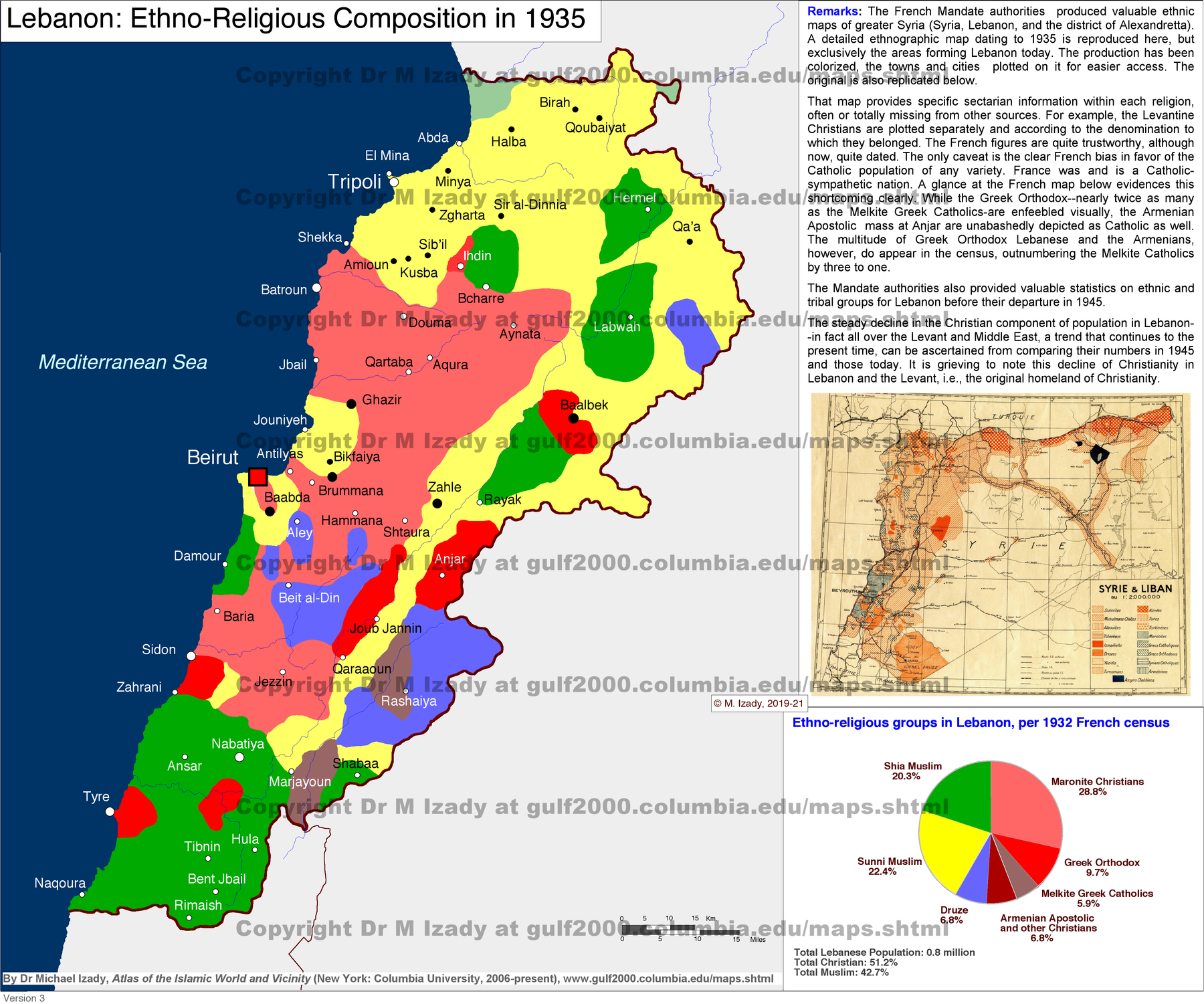
Place the 1935 settlement pattern beside the account of the creation of Greater Lebanon and the later confessional bargain. A historical distribution does not determine how individuals voted or which faction controlled an area.
Map source: Dr. Michael Izady, Gulf/2000, Columbia University. Original map · Collection. Personal reference use; copyright remains with the author.

Source and interpretation: Gulf2000 map collection.
The southern border
The boundary between French Lebanon and British Palestine was settled by the Paulet-Newcombe Agreement (1923). It placed a group of Shia villages (often called “the Seven Villages”) on the Palestinian side. Those villages were depopulated in 1948, and Hezbollah and some Lebanese nationalists still invoke them as Lebanese land, alongside the better-known Shebaa Farms dispute (see Part VII). For the mandate background on the Palestinian side, see Situation in the Beginning of British Mandate 19th-Early 20th Century and 1900-1948.
The Maronite-Zionist connection
Some Maronite leaders saw the Zionist movement as a natural partner: another non-Muslim minority seeking a homeland in an Arab-majority region. Contacts between the Jewish Agency and Maronite figures ran through the 1930s and 1940s, and the Maronite Archbishop of Beirut, Ignatius Mubarak, publicly endorsed a Jewish homeland in 1947 (an act that cost him politically). Laura Zittrain Eisenberg’s My Enemy’s Enemy is the standard study. The idea of an alliance of minorities never became Lebanese state policy, but it resurfaced in Israeli strategy in the 1950s and was attempted in earnest in 1982.
Part II: The quiet border (1948-1967)
The 1948 war
Lebanon joined the Arab war against the new state of Israel in May 1948, but its small army played a limited role. Lebanese forces and the Arab Liberation Army briefly took the border village of al-Malkiyya in June 1948. In Operation Hiram (late October 1948), the IDF cleared the Galilee and pushed into southern Lebanon, occupying roughly fourteen Lebanese villages up to the Litani approaches. In one of them, Hula, Israeli soldiers killed several dozen captured men (estimates commonly range from about 35 to 58); the company commander was later convicted, then pardoned. See Massacres & War Crimes for how the vault handles 1948 atrocity claims on all sides.
The Israel-Lebanon General Armistice Agreement was signed at Ras al-Naqoura on 23 March 1949. Israel withdrew from the Lebanese villages, and the armistice line followed the 1923 international border, making Lebanon the only front where the armistice line and the mandate border coincided.
Refugees
Somewhere around 100,000 to 130,000 Palestinian Arabs fled or were expelled into Lebanon in 1948 (see Nakba). Lebanon treated them very differently from Jordan, which gave citizenship. To protect the sectarian balance, Lebanon naturalized relatively few (disproportionately Christians), barred most from owning property and from dozens of professions, and confined much of the population to camps. Today UNRWA registers several hundred thousand Palestine refugees in Lebanon, while a 2017 Lebanese-Palestinian census counted about 174,000 actually living in camps and gatherings. This permanent, disenfranchised, armed-by-the-1970s population is one of the central causes of the civil war. It also bears directly on the Right of Return debate: Lebanon is the clearest case of an Arab host state that kept refugees as refugees on purpose.
The Jews of Lebanon
Lebanon is a genuine exception in the story of Jewish flight from Arab countries. It did not expel its Jews in 1948; its Jewish community actually grew afterward, swelled by Jews leaving Syria and Iraq, to roughly 9,000-10,000, centered on Beirut’s Wadi Abu Jamil quarter. Security was fragile (a synagogue was bombed in the early 1950s), and most Jews left after the 1967 war and during the civil war. In 1984-1985, a Shia group called the Organization of the Oppressed on Earth, widely believed to be linked to Hezbollah, kidnapped prominent members of the remaining community, including its leader Isaac Sasson and the physician Elie Hallak; several were murdered. Only a few dozen registered Jews remain.
Talking-point correction
The script in 60.1 Israel-Palestine TP lists Lebanon among countries that expelled Jews “where they have lived for thousands of years.” Lebanon is the weak link in that list. The accurate claim is narrower and still damning: Lebanese Jews were not expelled in 1948, but the community was hollowed out by insecurity after 1967 and the civil war, and its last leaders were kidnapped and murdered by a Hezbollah-linked group in the 1980s.
Israel and the “Maronite option”
In the mid-1950s, David Ben-Gurion and Moshe Dayan floated plans to split Lebanon by encouraging a Christian officer to seize power and create a Christian state allied with Israel. Prime Minister Moshe Sharett opposed it as reckless, and his diaries are the main record of the discussions. Nothing came of it then, but the instinct, that Israel’s security in the north could be bought by alliance with Lebanon’s Christians, would shape 1976-1982.
1958 and 1967
The 1958 crisis, a short civil conflict between supporters of President Camille Chamoun (pro-Western) and pan-Arab Nasserists, ended with US Marines landing in Beirut (July 1958) and a compromise presidency under General Fuad Chehab. It previewed the later war: Lebanese factions looked to outside patrons whenever the internal balance shifted.
In June 1967, Lebanon stayed out of the fighting in practice. Its army was small, its leaders were cautious, and the border remained quiet. That was about to change, not because of anything Lebanon did to Israel, but because the Palestinian armed movement moved in. See 1949-1967.
Part III: The PLO’s state within a state (1968-1982)
From Athens to Beirut airport
After 1967, Palestinian fedayeen organizations began operating from Lebanese territory. On 26 December 1968, the Popular Front for the Liberation of Palestine, operating from Beirut, attacked an El Al airliner in Athens, killing an Israeli passenger. Two days later, on 28 December, Israeli commandos raided Beirut International Airport and destroyed thirteen civilian aircraft, most belonging to Lebanon’s Middle East Airlines. No one was killed, but the UN Security Council unanimously condemned Israel (Resolution 262). The raid established a pattern that would last decades: Israel held the Lebanese state responsible for attacks it could not, or would not, stop.
The Cairo Agreement (1969)
Under pressure from Arab states and Palestinian sympathy at home, Lebanon signed the Cairo Agreement on 3 November 1969, brokered by Nasser between the Lebanese army commander Emile Bustani and Yasser Arafat. It recognized the PLO’s right to armed presence in the camps and in a strip of the southern border region. Israelis and Lebanese alike soon called the Arqoub area “Fatahland.” The Lebanese state had formally signed away part of its sovereignty to a non-state army, the first version of the problem it is still trying to solve with Hezbollah.
Black September and the move to Lebanon
When King Hussein crushed the PLO in Jordan in September 1970 (Black September), the fighters and leadership relocated to Lebanon (1971). Beirut became the PLO’s capital. Lebanon was now the base for cross-border raids and for some of the worst attacks on Israeli civilians:
- Kiryat Shmona (11 April 1974): 18 killed in an apartment building.
- Ma’alot (15 May 1974): Democratic Front gunmen who crossed from Lebanon took a school hostage; 25 killed, 22 of them children.
- Coastal Road massacre (11 March 1978): Fatah gunmen landed by sea from Lebanon, hijacked a bus, and killed 38 civilians, including 13 children.
Israel answered with raids, air strikes, and assassinations, including Operation Spring of Youth (9-10 April 1973), in which commandos led by Ehud Barak (dressed as a woman) killed three senior PLO leaders in their Beirut apartments. See Ehud Barak and Rise and Kill First - The Secret History of Israel's Targeted Assassinations.
The civil war (1975-1990)
The Lebanese Civil War began on 13 April 1975, when Phalangist gunmen attacked a bus carrying Palestinians in Ain el-Remmaneh after an attack on a church. Its causes were layered, and it is worth keeping them separate:
- A frozen confessional system that over-represented Christians as Muslims, especially Shia, grew in number.
- A left-right and pan-Arab vs. Lebanese-nationalist split, with the Lebanese National Movement (Kamal Jumblatt) against the Maronite-led Lebanese Front.
- The armed PLO presence, which tilted the balance toward the Muslim-leftist camp and provoked Christian militias to arm.
- Foreign patrons: Syria, Israel, Iraq, Libya, Iran, the US, France, and others, each backing clients.
The war produced massacres on every side: Christian militias at Karantina (January 1976) and Tel al-Zaatar (siege ending August 1976), and Palestinian and leftist forces at Damour (January 1976), among many others. Roughly 150,000 people were killed over fifteen years.
Debate calibration
The talking-points list of “Palestinians starting coups in other countries” (60.1 Israel-Palestine TP > Palestinians) includes the Lebanese civil war. That is defensible as a claim about contribution, not sole cause. The PLO’s armed state-within-a-state was a major accelerant, and PLO and allied forces committed atrocities, but the war also grew from Lebanon’s own sectarian structure, and Lebanese Christian militias committed massacres against Palestinians before and after 1982. Stating it as “the Palestinians caused the Lebanese civil war” invites an easy rebuttal.
Syria enters, Israel picks partners
Syria intervened in June 1976, initially to prevent a PLO-leftist victory and to protect the Christians, a reminder that Damascus cared more about controlling Lebanon than about any side. Israel tacitly accepted a Syrian presence north of an understood “red line” and began open support for the Maronite militias and for Christian enclaves along the border (“the Good Fence” policy, 1976). Major Saad Haddad’s militia in the south, later the South Lebanon Army (SLA) under Antoine Lahad, became Israel’s local proxy.
Operation Litani and UNIFIL (1978)
After the Coastal Road massacre, Israel launched Operation Litani (14-21 March 1978) and occupied the south up to the Litani River. Hundreds to more than a thousand Lebanese and Palestinians were killed, and tens of thousands fled. The Security Council passed Resolution 425 (19 March 1978) calling for Israeli withdrawal and creating the UN Interim Force in Lebanon (UNIFIL), which is still there. Israel withdrew in June 1978 but handed its border strip to Haddad rather than to UNIFIL. Resolution 425 would become the benchmark for “full withdrawal” in 2000.
The 1981 rocket war
In July 1981, PLO artillery and rockets shelled northern Israel for days, and Israel bombed PLO offices in West Beirut, killing a large number of civilians. US envoy Philip Habib brokered a ceasefire on 24 July 1981 that largely held on the border. Defense Minister Ariel Sharon and Prime Minister Menachem Begin concluded that the PLO’s growing conventional arsenal in Lebanon was intolerable and began planning something much larger.
Part IV: The 1982 war
Aims
The official aim of Operation Peace for Galilee was to push the PLO 40 kilometers from the border. Sharon’s real aims, as the Israeli journalists Ze’ev Schiff and Ehud Ya’ari documented in Israel’s Lebanon War, were far broader: destroy the PLO as a military and political force, install the Phalangist leader Bashir Gemayel as president, sign a peace treaty with a Christian-led Lebanon, and push Syria out. (See also 1968-2023 > 1982 June: Lebanon War.)
The war
- 3 June 1982: Gunmen of the Abu Nidal Organization, a group hostile to Arafat and sponsored by Iraq, shot Israel’s ambassador in London, Shlomo Argov. Israeli intelligence knew it was not the PLO; the cabinet used it as the trigger anyway.
- 6 June: The IDF invaded. Within days it was past the 40 km line, fighting the Syrian army in the Bekaa and destroying Syria’s air-defense network and much of its air force.
- July-August: The IDF besieged West Beirut for some ten weeks, with heavy bombardment of a city full of civilians. Lebanese government and press counts at the time put the war’s dead at roughly 17,000-19,000, a contested figure that mixes combatants and civilians.
- 21 August-1 September: Under a US-brokered deal and the protection of a Multinational Force, more than 10,000 PLO fighters and the leadership left Beirut, mostly for Tunis.
- 23 August: Bashir Gemayel was elected president.
Sabra and Shatila
On 14 September 1982, Bashir Gemayel was assassinated by a bomb planted by Habib Shartouni of the Syrian Social Nationalist Party. The IDF moved into West Beirut, and on 16-18 September it allowed Phalangist militiamen into the Sabra and Shatila refugee camps, ostensibly to clear out remaining fighters. They massacred civilians for some 40 hours while the IDF lit the area with flares. Estimates of the dead range from several hundred (Israeli intelligence and the Kahan Commission’s sources suggested 700-800) to several thousand. (1968-2023 > 1982 September: Sabra and Shatila massacre)
Israel’s own Kahan Commission (report published February 1983) found that Israel bore indirect responsibility and that Sharon bore “personal responsibility” for ignoring the danger of a massacre. Sharon was forced out of the defense ministry. Some 400,000 Israelis protested in Tel Aviv. Bergman’s account of the decision-making is summarized at Rise and Kill First, ch. 16.
How to use Sabra and Shatila honestly
Both sides of the debate misuse this event. The direct perpetrators were Lebanese Christian militiamen, not Israeli soldiers, which matters against claims that the IDF itself carried out the massacre. But Israel controlled the area, let the militia in, and failed to stop it once warned, which is why an Israeli state commission found Israeli officials responsible. The strongest pro-Israel point is not “Israel was blameless” but “Israel investigated itself and removed its defense minister, something no other party to the Lebanese war ever did.”
Failure of the grand design
- Bashir’s brother Amin Gemayel became president and signed the 17 May 1983 Agreement with Israel, a near-peace treaty negotiated with American help. Syria and its Lebanese allies opposed it, Lebanon never implemented it, and it was formally abrogated on 5 March 1984.
- The US Marines and French paratroopers of the Multinational Force were drawn into the civil war. On 18 April 1983, a suicide truck bomb destroyed the US Embassy in Beirut (63 killed, including much of the CIA’s Middle East leadership). On 23 October 1983, near-simultaneous truck bombs killed 241 US servicemen and 58 French paratroopers. A group calling itself “Islamic Jihad” claimed them; US courts later found Iran responsible and Hezbollah’s founding networks the perpetrators (see Targeted Beirut - Jack Carr James M Scott). The Multinational Force withdrew in early 1984.
- Two suicide bombings destroyed Israeli headquarters in Tyre (November 1982 and November 1983), killing scores of Israeli personnel and Lebanese detainees.
- Israel pulled back in stages and in June 1985 withdrew to a “security zone” of roughly 10% of Lebanon’s territory, held with the SLA. Around 650 Israeli soldiers had been killed between 1982 and the 1985 pullback.
The deepest unintended consequence: when the IDF entered the south in June 1982, many Shia villagers, exhausted by PLO rule, greeted it with rice and flowers. Within two years, occupation, detentions, and the influence of revolutionary Iran had turned much of that population against Israel.
Part V: The birth of Hezbollah (1978-1990)
The Shia awakening
Three developments prepared the ground:
- Musa al-Sadr, an Iranian-born Lebanese cleric, mobilized the Shia from the 1960s, founding the Movement of the Deprived (1974) and its militia Amal (1975). He disappeared during a visit to Libya on 31 August 1978, almost certainly murdered by Gaddafi’s regime, becoming a martyr-figure for Lebanese Shia.
- The Iranian Revolution (1979) gave Shia Islamism a state sponsor with an exportable doctrine, velayat-e faqih (guardianship of the jurist). See Iran's Ayatollahs (Khomeini & Khamenei).
- The 1982 invasion. In the summer of 1982, Iran sent roughly 1,000-1,500 Revolutionary Guards to the Bekaa Valley, with Syrian permission. They trained and organized radical clerics and Amal defectors (notably “Islamic Amal”) into what became Hezbollah, the “Party of God.”
Terror, hostages, and the Open Letter
Before it had a public name, the network carried out the 1983 bombings, the hijacking of TWA Flight 847 (June 1985, in which US Navy diver Robert Stethem was murdered), and the Western hostage crisis (roughly 1982-1992), in which dozens of Americans, French, British, and others were held, some for years. CIA station chief William Buckley died in captivity. The hostages were bargaining chips in Iran’s dealings with the West, including the Iran-Contra affair.
Hezbollah publicly announced itself on 16 February 1985 with its Open Letter to “the downtrodden in Lebanon and the world.” Two passages define its founding identity:
Hezbollah, Open Letter (16 February 1985)
“We obey the orders of one leader, wise and just, that of our tutor and faqih (jurist) who fulfills all the necessary conditions: Ruhollah Musawi Khomeini.”
“Our primary assumption in our fight against Israel states that the Zionist entity is aggressive from its inception, and built on lands wrested from their owners, at the expense of the rights of the Muslim people. Therefore our struggle will end only when this entity is obliterated. We recognize no treaty with it, no cease fire, and no peace agreements, whether separate or consolidated.”
— English translation in The Jerusalem Quarterly (1988), as reproduced by the International Institute for Counter-Terrorism
These two sentences settle two debates that recur in the vault. First, Hezbollah’s founding hostility to Israel was existential, not territorial; it was not a demand for Israeli withdrawal from the south but for Israel’s destruction. Second, Hezbollah was doctrinally subordinate to Iran’s Supreme Leader from day one. Both points carry the same caveat as the Hamas charter: organizations evolve, and the 2009 manifesto (Part VIII) softened the language on Lebanon’s political system while keeping the rejection of Israel.
Shia against Shia, Shia against Palestinians
The late 1980s were not simply “Lebanon vs. Israel.” Amal, backed by Syria, fought the Palestinian camps in the War of the Camps (1985-1988), and then fought Hezbollah for control of the Shia community (1988-1990). Iran and Syria eventually brokered a settlement that left Hezbollah dominant in the south’s “resistance” and Amal dominant in state patronage. That division of labor, Nabih Berri’s Amal inside the state and Hezbollah’s arms outside it, lasted for three decades.
Part VI: Taif, Syrian tutelage, and the security zone war (1989-2000)
The Taif Agreement
The Taif Agreement (negotiated in Saudi Arabia, 22 October 1989) ended the civil war on these terms:
- Parliament split 50:50 between Christians and Muslims; executive power moved from the Maronite president to the Council of Ministers, strengthening the Sunni prime minister.
- All militias were to disband and hand over weapons.
- Syria would help restore state authority and later redeploy, which in practice became a Syrian military and intelligence presence lasting until 2005.
When General Michel Aoun’s holdout government was crushed by Syrian forces in October 1990, the war ended. In 1991, the militias were disarmed, except Hezbollah, which the Syrian-supervised state classified as a “resistance” against Israeli occupation rather than a militia. That exemption is the legal and political root of Lebanon’s arms problem today.
”Lebanonization”
Hezbollah adapted. In 1992 it ran in parliamentary elections for the first time, winning eight seats, and built a vast social-service network (schools, hospitals, the reconstruction arm Jihad al-Bina, the al-Qard al-Hassan finance association). The source collection in Nasrallah Speeches and Interviews (1986–2006) tracks this shift, and Hassan Nasrallah > Ideological and Political Evolution summarizes it.
On 16 February 1992, Israeli helicopters killed Hezbollah’s secretary-general Abbas al-Musawi, his wife, and his young son. He was succeeded by the 32-year-old Hassan Nasrallah, who proved far more capable. Within weeks came the bombing of the Israeli embassy in Buenos Aires (17 March 1992, 29 killed), followed by the AMIA Jewish community center bombing (18 July 1994, 85 killed). Argentine investigators and courts attribute both to Iran and Hezbollah. Bergman treats this as a case study in assassination producing a more dangerous successor and global retaliation: Rise and Kill First, ch. 23.
Accountability, Grapes of Wrath, Qana
The 1990s security zone war followed a cycle of Hezbollah attacks on Israeli and SLA forces, rockets on northern Israel when Israel struck Lebanese civilians, and large Israeli operations meant to pressure the Lebanese state by displacing the south’s population:
- Operation Accountability (25-31 July 1993) displaced hundreds of thousands of southern Lebanese.
- Operation Grapes of Wrath (11-27 April 1996). On 18 April 1996, Israeli artillery hit the UNIFIL compound at Qana, where civilians were sheltering, killing 106. A UN military adviser’s report found it unlikely that the shelling was the result of technical or procedural errors; Israel said it was an error in response to Hezbollah fire from nearby.
- The resulting April Understanding (26 April 1996) committed both sides not to attack civilians and not to fire from populated areas, monitored by a US-French-Syrian-Lebanese-Israeli group. It tacitly accepted Hezbollah’s attacks on Israeli forces inside Lebanon as legitimate, which Hezbollah treated as international recognition of “resistance.”
The cost to Israel and the withdrawal
The security zone became Israel’s slow-bleeding war. The 1997 helicopter disaster (73 soldiers killed in a collision en route to Lebanon) and the Ansariya ambush (12 naval commandos killed, September 1997) fed the Four Mothers protest movement. Ehud Barak campaigned on leaving Lebanon and did so on 24 May 2000, faster than planned; the SLA collapsed, and many of its members fled to Israel.
The UN Secretary-General certified Israel’s compliance with Resolution 425, and the Security Council endorsed the Blue Line in June 2000. Two days after the withdrawal, Nasrallah gave his victory speech in Bint Jbeil, mocking Israel as “weaker than a spider’s web.” For much of the Arab world, the withdrawal was the first proof that “resistance” could force Israel out without a peace treaty. Hamas drew exactly that lesson for the Second Intifada (see 1968-2023 and Hamas).
Part VII: From withdrawal to war (2000-2006)
Shebaa Farms and the search for a new reason
With Israel gone, Hezbollah’s justification for keeping its weapons needed a new basis. It found one in the Shebaa Farms, a small strip on the slopes of Mount Hermon captured by Israel from Syria in 1967. The UN treats the area as Syrian territory under occupation, to be resolved under Resolution 242 between Israel and Syria, but Lebanon (with Syrian encouragement and no formal Syrian cession) claims it as Lebanese. The dispute let Hezbollah argue that the occupation, and therefore the resistance, continued.
Strongest pro-Israel argument on Lebanon
In 2000, Israel withdrew from every meter of Lebanese territory as certified by the United Nations. The armed attacks that followed were justified by a claim to land the UN considers Syrian, and by a founding charter that called for Israel’s obliteration rather than its withdrawal. This is the clearest case in the region where “end the occupation and the violence will stop” was tested, and failed.
On 7 October 2000, Hezbollah abducted three Israeli soldiers in the Shebaa Farms area (all later declared dead) and lured an Israeli businessman, Elhanan Tannenbaum, to Beirut. In a German-mediated exchange in January 2004, Israel released more than 400 prisoners for Tannenbaum and the soldiers’ bodies. Hezbollah learned that abductions worked.
Resolution 1559 and the Hariri assassination
On 2 September 2004, Security Council Resolution 1559 called for the withdrawal of all foreign forces from Lebanon (meaning Syria) and the disbanding and disarmament of all Lebanese and non-Lebanese militias (meaning Hezbollah and the Palestinian factions).
On 14 February 2005, a massive truck bomb in Beirut killed former prime minister Rafik Hariri and 21 others. The country split into two blocs named after rival rallies:
- March 8: Hezbollah, Amal, and allies, rallying to thank Syria.
- March 14: a Sunni-Christian-Druze coalition led by Saad Hariri, demanding Syria’s departure, in a demonstration of perhaps a million people (the “Cedar Revolution”).
Syria withdrew its troops by 26 April 2005. The UN-backed Special Tribunal for Lebanon later convicted in absentia a Hezbollah member, Salim Ayyash, for the bombing (18 August 2020), and on appeal two more Hezbollah members (2022). The tribunal did not find evidence directly implicating Hezbollah’s leadership or the Syrian government. Hezbollah refused to hand anyone over. A wave of assassinations of anti-Syrian journalists and politicians followed between 2005 and 2013.
The 2006 war
On 12 July 2006, Hezbollah fighters crossed the border, killed three Israeli soldiers, and abducted two, Ehud Goldwasser and Eldad Regev (both dead; their bodies were returned in 2008). Five more soldiers were killed in the pursuit. Israel responded with a massive air campaign and later a ground offensive. The war lasted 34 days:
- Hezbollah fired roughly 4,000 rockets into northern Israel; around 121 Israeli soldiers and 44 civilians were killed and hundreds of thousands of Israelis were displaced.
- Roughly 1,100-1,200 Lebanese were killed (Human Rights Watch counted at least 1,109, the large majority civilians), about a million were displaced, and Beirut’s southern suburb (the Dahiyeh), bridges, and infrastructure were heavily destroyed. In the last days of the war Israel fired large numbers of cluster munitions, leaving the south littered with unexploded bomblets.
- Human Rights Watch found that Hezbollah’s rocket attacks on Israeli cities were deliberate or indiscriminate attacks on civilians, and that Israel’s strikes caused many civilian deaths in cases where it found no Hezbollah military presence nearby (see the vault's calibration of the HRW findings, Laws of War (IHL), Human Shields - UN and Human Rights Findings).
Security Council Resolution 1701 (11 August 2006) ended the war on 14 August. It called for the Lebanese army and an enlarged UNIFIL to deploy in the south, for no armed personnel or weapons other than the Lebanese state’s and UNIFIL’s between the Blue Line and the Litani River, and for implementation of Resolution 1559. It is the framework every later arrangement refers back to, and it was never fully implemented.
Two weeks after the ceasefire, Nasrallah made an admission rarely quoted by his admirers:
Hassan Nasrallah, interview with Lebanon’s New TV (27 August 2006)
“We did not think, even one per cent, that the capture would lead to a war at this time and of this magnitude. You ask me, if I had known on July 11 … that the operation would lead to such a war, would I do it? I say no, absolutely not.”
— as reported by Al Jazeera, 27 August 2006
In Israel, the Winograd Commission judged the war a “serious missed opportunity” marked by failures of leadership and preparation. In 2008, the then head of Northern Command, Gadi Eisenkot, described what became known as the Dahiya doctrine:
Gadi Eisenkot, Yedioth Ahronoth (October 2008)
“What happened in the Dahieh quarter of Beirut in 2006 will happen in every village from which shots will be fired in the direction of Israel. … We will wield disproportionate power and cause immense damage and destruction.”
— as quoted in the Dahiya doctrine literature; see also Gabi Siboni, “Disproportionate Force,” INSS Insight No. 74 (2 October 2008)
Critics cite this as an admission of a policy of disproportionate force against civilian areas; defenders argue it describes deterrence against an enemy that deliberately embeds its arsenal in villages. Both readings need to engage the text itself, which explicitly calls the villages military bases.
Part VIII: Hezbollah’s state within the state (2006-2019)
The gun turns inward: May 2008
After the war, Hezbollah’s arms increasingly shaped domestic politics. When the March 14-led government moved on 6 May 2008 to dismantle Hezbollah’s private telecommunications network and remove the airport security chief, Hezbollah and its allies seized West Beirut and fought in the mountains. Human Rights Watch reported at least 65 killed. The Doha Agreement (21 May 2008) gave the opposition a “blocking third” in cabinet, a formal veto over government decisions. The principle that Hezbollah’s weapons would not be used inside Lebanon, which Nasrallah had repeatedly promised, was broken.
In February 2008, Hezbollah’s military chief Imad Mughniyeh, the man behind the 1983 bombings and the hostage era, was killed by a car bomb in Damascus, in a joint CIA-Mossad operation according to later reporting. In July 2008, Israel exchanged the Lebanese prisoner Samir Kuntar, who had murdered a father and his four-year-old daughter in Nahariya in 1979, for the bodies of Goldwasser and Regev.
The 2009 manifesto
Hezbollah’s 2009 political document dropped the 1985 call for an Islamic order in Lebanon and accepted the confessional system pending its reform, while continuing to reject Israel’s legitimacy and to insist on “resistance.” It is the best evidence for the “Lebanonization” thesis, and its limits are the best evidence against it.
Syria, designations, and regional reach
- In January 2011, Hezbollah and its allies resigned from the cabinet and brought down Saad Hariri’s government over the Special Tribunal.
- From 2012-2013, Hezbollah intervened openly in Syria to save Bashar al-Assad, most visibly at Qusayr (2013). It gained battle experience and lost many fighters, and its image as a pan-Arab resistance movement suffered badly among Sunnis.
- The Burgas bus bombing in Bulgaria (18 July 2012) killed five Israeli tourists and their Bulgarian driver; Bulgaria attributed it to Hezbollah. The EU designated Hezbollah’s “military wing” in 2013, and the Gulf Cooperation Council and Arab League designated the organization as terrorist in 2016.
- Hezbollah’s arsenal grew, by common Israeli and Western estimates, to well over 100,000 rockets and missiles, with an Iranian-backed program to add precision guidance.
Alliance politics
Hezbollah’s 2006 memorandum with Michel Aoun’s Free Patriotic Movement gave it a large Christian partner. With Hezbollah’s backing, Michel Aoun was elected president on 31 October 2016 after a two-and-a-half-year vacancy. In November 2017, Prime Minister Saad Hariri announced his resignation from Riyadh, under Saudi pressure over Hezbollah’s role, before rescinding it on return. In December 2018, Israel’s Operation Northern Shield exposed cross-border attack tunnels dug from Lebanon, which UNIFIL confirmed violated Resolution 1701.
Part IX: Collapse (2019-2023)
Revolution and financial ruin
On 17 October 2019, a proposed tax on WhatsApp calls set off cross-sectarian mass protests against the whole political class (“all of them means all of them”). Hezbollah, which had presented itself as an anti-corruption outsider, sided with the system; its supporters attacked protest camps. The banking system, which had financed the state through a Ponzi-like structure at the central bank, collapsed. Lebanon defaulted on its Eurobonds in March 2020, the lira lost the overwhelming majority of its value, and the World Bank called the crisis likely to be among the top ten, possibly the top three, most severe economic collapses globally since the mid-nineteenth century.
The port explosion
On 4 August 2020, roughly 2,750 tonnes of ammonium nitrate, stored unsafely at Beirut port for years, exploded, killing more than 200 people and devastating much of the city. The investigation led by Judge Tarek Bitar was repeatedly blocked by politicians, and Hezbollah led the campaign against him. A protest against the judge on 14 October 2021 turned into deadly gun battles in Tayouneh. No senior official has been held accountable.
The maritime deal
On 27 October 2022, Israel and Lebanon, which remain formally at war and do not recognize each other, concluded a US-mediated maritime boundary agreement (negotiated by Amos Hochstein), dividing offshore gas areas including the Karish and Qana fields. Hezbollah had threatened Karish with drones during the talks and then accepted the outcome. It showed that Lebanese and Israeli state interests could be reconciled when the Lebanese state, with Hezbollah’s tacit consent, chose to.
Political paralysis
In the May 2022 elections, Hezbollah and its allies lost their parliamentary majority, though Hezbollah and Amal held all Shia seats. When Aoun’s term ended on 31 October 2022, parliament failed to elect a successor for more than two years.
Part X: The northern front and the 2024 war (October 2023-November 2024)
“Support front”
On 8 October 2023, the day after Hamas’s massacre in southern Israel (2023-2024 October 7th Massacre + War), Hezbollah opened fire on Israeli positions “in solidarity” with Hamas. It framed this as a limited “support front,” not full war. For eleven months the two sides fought a war of attrition along the border. Israel evacuated around 60,000-68,000 residents from northern communities, and tens of thousands of Lebanese fled the south. Israel killed Hamas deputy leader Saleh al-Arouri in Beirut’s Dahiyeh (2 January 2024). On 27 July 2024, a rocket struck a football field in the Druze town of Majdal Shams in the Golan Heights, killing 12 children; Israel and the US attributed it to Hezbollah, which denied it. Israel killed Hezbollah’s senior commander Fuad Shukr in Beirut three days later.
September 2024: the decapitation
- 17-18 September: thousands of Hezbollah pagers and then walkie-talkies, booby-trapped by Israeli intelligence, exploded across Lebanon and Syria, killing around 40 people (including children) and wounding thousands, many of them Hezbollah operatives.
- 20 September: a strike in Beirut killed Ibrahim Aqil and much of the Radwan Force command.
- 23 September: Israel’s massive air campaign (“Northern Arrows”) killed several hundred people in a single day, the deadliest day in Lebanon since the civil war.
- 27 September: Israeli bunker-busting bombs on a Dahiyeh headquarters killed Hassan Nasrallah, Hezbollah’s leader for 32 years. His likely successor, Hashem Safieddine, was killed days later.
- 1 October: Israeli ground forces entered southern Lebanon. Iran fired a large ballistic-missile barrage at Israel the same night.
- 29 October: Naim Qassem became secretary-general.
The ceasefire
The US-French-brokered cessation of hostilities took effect on 27 November 2024. Its terms and early implementation are analyzed in Iran & the Axis of Resistance > November 2024 cessation of hostilities and Iran & the Axis of Resistance > What happened after the agreement. In summary: Lebanon was to prevent attacks and dismantle unauthorized infrastructure, starting south of the Litani, and to move toward disarmament of all non-state groups; Israel was to stop offensive operations and withdraw as the Lebanese army deployed.
The toll of the 2023-2024 war: Lebanon’s health minister reported 4,047 killed and more than 16,000 wounded (Lebanese figures do not separate combatants from civilians); Hezbollah’s own leadership reportedly put its dead fighters in the thousands. On the Israeli side, the Alma Center tallied 45 civilians and 83 soldiers killed on the northern front. More than a million Lebanese had been displaced at the peak.
Eleven days after the ceasefire, on 8 December 2024, the Assad regime fell in Syria, severing Hezbollah’s land bridge to Iran. In two months, Hezbollah had lost its leader, its senior command, much of its arsenal, and its supply route.
Part XI: A state tries to take back its guns (2025)
New leadership
On 9 January 2025, parliament elected the army commander Joseph Aoun president, ending the vacancy. Former International Court of Justice president Nawaf Salam became prime minister, forming a government on 8 February. Both pledged that the state would hold a monopoly on arms. This was a political shift Hezbollah could slow but no longer block: its Shia partners still held the finance ministry and the speakership, but its veto had weakened along with its arsenal.
The five points and the disarmament decision
Israel withdrew from most of southern Lebanon by the extended deadline of 18 February 2025 but kept five hilltop positions inside Lebanon and continued near-daily strikes on what it identified as Hezbollah personnel and infrastructure. Lebanon and the UN called these violations of sovereignty; Israel called them enforcement of an agreement Lebanon was not enforcing.
On 5 and 7 August 2025, the cabinet tasked the Lebanese Armed Forces with drawing up a plan to bring all weapons under state control by the end of 2025 and endorsed the objectives of a US-backed paper. The Shia ministers walked out. Hezbollah called the decision a “grave sin” and said it would treat it “as if it does not exist.” Qassem warned that forcing disarmament could lead to civil strife. On 5 September 2025, the cabinet “welcomed” a phased army plan, starting south of the Litani, without fixed deadlines.
On 23 November 2025, an Israeli strike in Beirut killed Hezbollah’s military chief Haytham Ali Tabatabai. On 8 January 2026, the army announced that it had completed the first phase south of the Litani; Prime Minister Netanyahu called the progress “far from sufficient.”
Part XII: The 2026 war and direct talks
Fast-moving and contested
This section covers events after mid-2026 that are still unfolding. Figures come from the Lebanese Health Ministry, which does not distinguish combatants from civilians, and from news reports and Israeli statements that sometimes conflict with one another on dates. Treat specific numbers as provisional and re-check before using them in debate.
Hezbollah enters the Iran war
On 28 February 2026, the United States and Israel launched strikes on Iran in which Supreme Leader Ali Khamenei was killed. On 2 March, Hezbollah fired rockets and drones at Israel, its first major attack since the 2024 ceasefire. The Lebanese government’s response was unprecedented. On the same day, Prime Minister Salam declared:
Nawaf Salam, 2 March 2026
“The Lebanese state declares its absolute and unequivocal rejection of any military or security actions launched from Lebanese territory outside the framework of its legitimate institutions.”
— the cabinet ordered “the immediate prohibition of all of Hezbollah’s security and military activities, considering them to be outside the law, and obliging it to hand over its weapons” (Naharnet)
For the first time, the Lebanese state formally outlawed Hezbollah’s military activity. On 24 March it declared Iran’s ambassador persona non grata. These decisions did not stop the war, but they reversed the 1991 logic that had treated Hezbollah’s arms as legitimate “resistance.”
The Israeli offensive
Israel began ground operations in mid-March and, over the following months, pushed deeper than in 2024: destroying Litani bridges, fighting in Khiam and Bint Jbeil, crossing the Litani in May, and taking the high ground around Beaufort Castle. Defense Minister Israel Katz stated: “Where there is terror and missiles, there are no homes and no residents, and the IDF will control the security zone up to the Litani River.” Israeli strikes on 8 April killed more than 300 people in a matter of minutes, the deadliest single day of the war. By early August, the Lebanese Health Ministry reported more than 4,300 killed since 2 March and over a million displaced; Israeli military deaths numbered in the dozens.
Direct negotiations
On 14 April 2026, Israeli and Lebanese representatives met in Washington, hosted by US Secretary of State Marco Rubio, in the first direct political-level negotiations between the two states since the Madrid-era bilateral talks of the early 1990s. Netanyahu said Israel wanted “the dismantling of Hezbollah’s weapons” and “a real peace agreement.” A ten-day truce announced on 16 April was repeatedly extended amid continued strikes and attacks. Further rounds in Washington (with Lebanon’s delegation led by the former ambassador Simon Karam) produced a framework agreement in late June 2026: phased Israeli withdrawal from “pilot zones” as the Lebanese army takes over, with Hezbollah’s disarmament under international oversight. Qassem called it a “surrender” and declared it “null and void.”
Talks moved to Rome in July and August (the seventh round ended on 5 August) without resolving the core sequencing problem: Israel will not withdraw until Hezbollah is disarmed, Hezbollah will not disarm while Israel occupies Lebanese land, and the Lebanese army will not fight Hezbollah. Hezbollah reportedly offered to withdraw south of the Litani but not to disarm north of it. As of late September 2026, clashes and Israeli strikes continued, and Israel’s defense minister said Israel would not withdraw from at least some captured areas.
Patterns across the century
- The non-state army problem. Lebanon’s wars with Israel have nearly always been wars between Israel and an armed movement the Lebanese state could not control: the PLO under the Cairo Agreement, then Hezbollah under the Taif exemption. The 2026 cabinet ban is the first time the state has formally declared such a force illegal.
- Israeli force reshapes rather than removes. 1982 expelled the PLO and helped birth Hezbollah. The security zone (1985-2000) gave Hezbollah its cause. Decapitation in 1992 produced Nasrallah. The 2024-2026 campaigns have done more damage to Hezbollah than any before, but whether they produce a disarmed Hezbollah or a new form of insurgency is the open question.
- Buffer zones recur. Haddad’s enclave (1978), the security zone (1985-2000), the five points (2025), and the zone up to the Litani (2026) are versions of the same idea. Each was justified as temporary.
- Outside patrons. Syria, Iran, Israel, Saudi Arabia, France, and the US have all treated Lebanon as an arena. The fall of Assad and the 2026 war with Iran are the first time in forty years that Hezbollah’s patron network has been broken from both ends at once.
- Confessional politics. The National Pact, Taif, the blocking third, and Shia control of key ministries have repeatedly given armed factions a veto. Lebanon’s internal sectarian bargain and its external security problem are the same problem.
Contested interpretations
“Hezbollah is a Lebanese resistance movement created by Israeli occupation.” Its best case: Hezbollah emerged during the 1982 invasion and the long occupation of the south; it has a real Shia constituency, wins elections, runs social services, and forced Israel out in 2000 when diplomacy had not. Many Lebanese, not only Shia, credited it with deterring Israel after 2006. Rola El Husseini’s paper (Hezbollah and the Axis of Refusal Hamas, Iran and Syria) argues for treating it as a legitimate political actor.
“Hezbollah is an Iranian army that hijacked the Lebanese state.” Its best case: the Open Letter pledged obedience to Iran’s Supreme Leader; Iran’s Revolutionary Guards built and funded it; it kept fighting after the UN-certified withdrawal of 2000; it fought for Assad in Syria, used its guns against Lebanese in 2008, was tied by a UN tribunal to the killing of Lebanon’s prime minister, obstructed the port investigation, and twice (2006, 2023) dragged Lebanon into war without the state’s consent, most recently on behalf of Iran in 2026.
The defensible synthesis (consistent with Iran & the Axis of Resistance > Hezbollah — independent agency, Iranian support, and Lebanese costs): Hezbollah is genuinely Lebanese in personnel, constituency, and institutions, and genuinely Iranian in doctrine, funding, arms, and strategic direction. Its own decisions, not only Israel’s, explain most of Lebanon’s wars since 2000. Israel’s conduct in Lebanon, from Qana to the Dahiya doctrine to strikes after ceasefires, raises serious and separate legal questions under Laws of War (IHL), and acknowledging them strengthens rather than weakens the core argument.
Key figures
| Figure | Role |
|---|---|
| Bishara al-Khoury and Riad al-Solh | Authors of the 1943 National Pact |
| Camille Chamoun | President during the 1958 crisis; later Lebanese Front leader |
| Yasser Arafat | PLO leader based in Beirut, 1970-1982 |
| Musa al-Sadr | Founder of Shia political mobilization and Amal; disappeared 1978 |
| Bashir Gemayel | Phalangist leader, Israel’s ally, president-elect assassinated 1982 |
| Menachem Begin and Ariel Sharon | Prime minister and defense minister behind the 1982 invasion |
| Nabih Berri | Amal leader, speaker of parliament since 1992 |
| Abbas al-Musawi | Hezbollah secretary-general, killed 1992 |
| Imad Mughniyeh | Hezbollah military chief behind 1980s terror; killed 2008 |
| Hassan Nasrallah | Hezbollah secretary-general 1992-2024 |
| Rafik Hariri | Prime minister and reconstruction leader; assassinated 2005 |
| Ehud Barak | Led the 1973 Beirut raid; ordered the 2000 withdrawal |
| Michel Aoun | General in 1989-1990; Hezbollah-allied president 2016-2022 |
| Naim Qassem | Hezbollah secretary-general since October 2024 |
| Joseph Aoun and Nawaf Salam | President and prime minister since 2025; pursuing the state arms monopoly |
| Benjamin Netanyahu | Israeli prime minister during the 2024 and 2026 wars |
Open questions
- Can the Lebanese army disarm Hezbollah north of the Litani without a civil war, and will Hezbollah’s Shia base accept it after two devastating wars?
- Does Israel’s retention of territory in the south revive the occupation logic that built Hezbollah in the 1980s and 1990s?
- With Iran’s leadership and the Syrian corridor gone, can Hezbollah be rearmed at all, or will it become primarily a political party with residual militias?
- Could the 2026 framework become the first Lebanese-Israeli peace treaty since the failed 17 May 1983 Agreement, and what would Lebanon’s confessional politics require to ratify it?
- How should the death tolls of 2024 and 2026 be split between combatants and civilians? No independent breakdown yet exists.
Sources
Primary documents and official records:
- Hezbollah, Open Letter (16 February 1985), English translation in The Jerusalem Quarterly (1988): https://www.ict.org.il/UserFiles/The%20Hizballah%20Program%20-%20An%20Open%20Letter.pdf
- UN Security Council Resolutions 262 (1968), 425 (1978), 1559 (2004), 1701 (2006)
- Israel-Lebanon General Armistice Agreement (23 March 1949); Cairo Agreement (3 November 1969); 17 May 1983 Agreement; Taif Agreement (22 October 1989)
- Report of the Commission of Inquiry into the Events at the Refugee Camps in Beirut (Kahan Commission), February 1983
- Special Tribunal for Lebanon, Prosecutor v. Ayyash et al., Judgment (18 August 2020)
- Cessation of hostilities arrangement, UN document S/2024/870: https://digitallibrary.un.org/record/4068549?ln=en
- UN Secretary-General report on Resolution 1701, S/2025/254: https://digitallibrary.un.org/record/4082001/files/S_2025_254-EN.pdf
Human rights and research reports:
- Human Rights Watch, Why They Died: Civilian Casualties in Lebanon during the 2006 War (2007): https://www.hrw.org/report/2008/07/14/why-they-died/civilian-casualties-lebanon-during-2006-war
- Human Rights Watch, Civilians under Assault: Hezbollah’s Rocket Attacks on Israel in the 2006 War (2007): https://www.hrw.org/report/2007/08/28/civilians-under-assault/hezbollahs-rocket-attacks-israel-2006-war
- Gabi Siboni, “Disproportionate Force: Israel’s Concept of Response in Light of the Second Lebanon War,” INSS Insight No. 74 (2 October 2008)
- World Bank, Lebanon Economic Monitor: Lebanon Sinking (To the Top 3) (Spring 2021)
- Alma Research and Education Center, “Summary of War Data - Israel Northern Arena (2023-2024)”: https://israel-alma.org/summary-of-war-data-israel-northern-arena-2023-2024/
- House of Commons Library, “Israel-Hezbollah conflict 2023/24” (CBP-10108): https://commonslibrary.parliament.uk/research-briefings/cbp-10108/
- House of Commons Library, “Lebanon 2025: Plans to disarm Hezbollah” (CBP-10347): https://commonslibrary.parliament.uk/research-briefings/cbp-10347/
News reporting used for specific quotes and figures:
- Al Jazeera, “Nasrallah says he did not want war” (27 August 2006): https://www.aljazeera.com/news/2006/8/27/nasrallah-says-he-did-not-want-war
- Times of Israel, “Lebanon health minister says 4,047 killed in Hezbollah-Israel fighting” (December 2024): https://www.timesofisrael.com/liveblog_entry/lebanon-health-minister-says-4047-killed-in-hezbollah-israel-fighting/
- Al Jazeera, “Hezbollah weapons deadline: What’s next for Lebanon amid Israeli strikes?” (31 December 2025): https://www.aljazeera.com/news/2025/12/31/hezbollah-weapons-deadline-whats-next-for-lebanon-amid-israeli-strikes
- Naharnet, “Cabinet bans Hezbollah military activities, demands group to hand over arms” (2 March 2026): https://www.naharnet.com/stories/en/318707-cabinet-bans-hezbollah-military-activities-demands-group-to-hand-over-arms
- Time, “Israel’s War Against Lebanon, Explained” (10 April 2026): https://time.com/article/2026/04/10/israels-hezbollah-lebanon-war-explained/
- Al Jazeera, “Lebanon and Israel still split over disarming Hezbollah at Rome talks” (5 August 2026): https://www.aljazeera.com/news/2026/8/5/lebanon-and-israel-still-split-over-disarming-hezbollah-at-rome-talks
Tertiary overviews (for orientation, not for citation in debate):
- Wikipedia, “2026 Lebanon war”: https://en.wikipedia.org/wiki/2026_Lebanon_war
- Wikipedia, “2026 Israel-Lebanon peace talks”: https://en.wikipedia.org/wiki/2026_Israel%E2%80%93Lebanon_peace_talks
- Wikipedia, “History of the Jews in Lebanon”: https://en.wikipedia.org/wiki/History_of_the_Jews_in_Lebanon
- Wikipedia, “Dahiya doctrine”: https://en.wikipedia.org/wiki/Dahiya_doctrine
Further reading (books):
- Kamal Salibi, A House of Many Mansions: The History of Lebanon Reconsidered (1988)
- Fawwaz Traboulsi, A History of Modern Lebanon (2nd ed., 2012)
- Laura Zittrain Eisenberg, My Enemy’s Enemy: Lebanon in the Early Zionist Imagination, 1900-1948 (1994)
- Ze’ev Schiff and Ehud Ya’ari, Israel’s Lebanon War (1984)
- Thomas Friedman, From Beirut to Jerusalem (1989)
- Robert Fisk, Pity the Nation: Lebanon at War (1990)
- Augustus Richard Norton, Hezbollah: A Short History (2007; later updated editions)
- Matthew Levitt, Hezbollah: The Global Footprint of Lebanon’s Party of God (2013)
- Ronen Bergman, Rise and Kill First (2018) → vault notes: Rise and Kill First - The Secret History of Israel's Targeted Assassinations · ch. 21 on Hezbollah's rise
See also
- Hezbollah and Iran → Iran & the Axis of Resistance · Hassan Nasrallah · Nasrallah Speeches and Interviews (1986–2006) · Velayat-e Faqih - Governance of the Jurist · Iran's Ayatollahs (Khomeini & Khamenei) · Iran - Regime, Society and Historical Timeline · Treacherous Alliance by Trita Parsi
- Timeline → 1900-1948 · 1949-1967 · 1968-2023 · 2023-2024 October 7th Massacre + War
- Palestinians in Lebanon → Nakba · Right of Return · UNRWA · Massacres & War Crimes
- Law and conduct of war → Laws of War (IHL) · Human Shields - UN and Human Rights Findings · International Law & Aid Organizations
- Cross-vault → Lebanon (country hub) · Middle East · Iran · Targeted Beirut - Jack Carr James M Scott (1983 bombings) · Christians in and around Israel · Israel - United States Relations · Hezbollah and the Axis of Refusal Hamas, Iran and Syria · Hezbollah (clippings stub)