⬅️ Back to Home · Cross: Communication · Rhetoric & Persuasion (MOC) · Database: Influence base (file not included in this release) · NotebookLM
Two sides of one coin: using influence — rapport, negotiation, persuasion, storytelling — and defending against it — manipulation, propaganda, subversion, and psyops. The full mind map lives at the bottom.
The core moves
Mirror → Label → aim for “That’s right” (never “you’re right”) → calibrated how/what questions → accusation audit. → Never Split the Difference · Key Points of Influence & Rapport
Rapport & Connection
- Key Points of Influence & Rapport — the pillar note: rapport, core principles, practical techniques, psychological tactics
- Books: The Like Switch · How to Win Friends & Influence People · Mirroring People - The New Science of How We Connect with Others · How to Talk to Anyone About Anything - James W Williams (the FORM framework)
- Network-building → Friend of a Friend · Superconnector
- Cross-vault → Harvard’s Behaviour Expert The Psychology Of Why People Don't Like You! · Reading People - How to Understand People and Predict Their Behavior · Communication hub
Negotiation
- Books: Never Split the Difference — tactical empathy, mirroring, labels, calibrated questions
- The Harvard line: Getting to Yes - Negotiating Agreement Without Giving In · Getting Past No · Beyond Reason - Using Emotions as You Negotiate · Difficult Conversations - How to Discuss what Matters Most
- MasterClass - The Art of a Negotiation · Powerful Phrases for Dealing with Difficult People - Renee Evenson
- Tools (from the mind map below): Seven Elements · Negotiation One Sheet · Accusation Audit · full list
Influence & Persuasion
- Books: Influence - The Psychology of Persuasion — Cialdini’s six principles
- The Art of Seduction — influence through persona, fantasy, uncertainty, setting, and mass media; read with explicit consent and evidence boundaries · 100-story audit
- Words That Change Minds - Mastering the Language of Influence · Pitch Anything · The 48 Laws of Power — power tactics, status, coalitions, reputation, and strategic adaptation; read with explicit evidence and ethics boundaries · 123-story audit · Cracking the Code - How to Win Hearts, Change Minds, and Restore America's Original Vision
- Consumer Networks as Ideological Institutions — how production, selection, distribution, endorsement, consumption, and feedback can form a movement without centralized command.
- Gender, Conformity, and Affiliation Under Social Pressure — public versus private conformity, normative and informational influence, gendered sanctions, social proof, and ethical marketing applications.
- Cross-vault → Persuasion · Rhetoric & Persuasion (MOC) · Argumentation quotes · Psychology quotes
Presentation & Storytelling
- Effective Presentation Skills · Talk Your Way to the Top
- Storytellers · The Leader's Guide to Storytelling - Mastering the Art and Discipline of Business Narrative
- Cross-vault → The Lost Art of the Great Speech - How to Write One--How to Deliver It · The Story Factor · Speaking · Articulation · Storytelling MOC
Deception & Detection
- Spy the Lie - Mike Floyd Philip Houston Susan Carnicero — CIA officers on spotting lies
- How Real Is Real · I'll Make You an Offer You Can't Refuse by Michael Franzese · Surrounded by Narcissist
- Tactics — tradecraft link library (limited hangout, HUMINT, propaganda techniques)
- Cross-vault → The Official CIA Manual of Trickery and Deception · The Art of Deception · Pragmatics of Human Communication - A Study of Interactional Patterns, Pathologies, and Paradoxes · Sizing People Up
Manipulation — recognizing & defending
- Common Manipulation Tactics · Emotional Manipulation — tactics + boundary enforcement
- Insinuation — the seduction-era mechanics and the defense
- The 18 Tactics Tucker and Candace Use to Manipulate You - Jeremy Boreing — media manipulation, case study
- Semantic overload - Wikipedia — language as fog
- Cross-vault → Distorted Automatic Thoughts · Fallacies & Bad Faith (MOC)
Propaganda, Subversion & PsyOps
- Demoralization — history, science, media, and responses (the deep-research note)
- subversion — tactics, psychology, history, countermeasures
- Reflexive Control — the Russian doctrine of shaping an adversary’s decisions
- KGB Defector Yuri Bezmenov 1985 Interview. Explains KGB Manipulation of US Public Opinion — the 4 stages
- Psychological Inoculation Theory — prebunking: the research labs, games, and interventions
- Shut up about Cultural Marxism by LazerPig — the skeptical counter-case
- PDFs: RAND — the Russian “Firehose of Falsehood” (file not included in this release) · USASOC Unconventional Warfare Pocket Guide (file not included in this release)
- Cross-vault → Subversion & Demoralization (Politics) · “Flood the zone with shit” How misinformation overwhelmed our democracy · Psychology of Belief (MOC) · Ideology & Foundations
Across the vault
- Skills stack: Communication (the operating system) · Persuasion · Leadership · Debate Playbook (MOC)
- The reading curriculum: Reading Track - Argumentation & Influence — nine phases from epistemic habits through rhetoric, storytelling, and deception · hub: Reading Lists
- Character & frame: Stoicism (People's Reactions · Ego) · Social quotes
- Attraction: Attractiveness · The Art of Mackin'
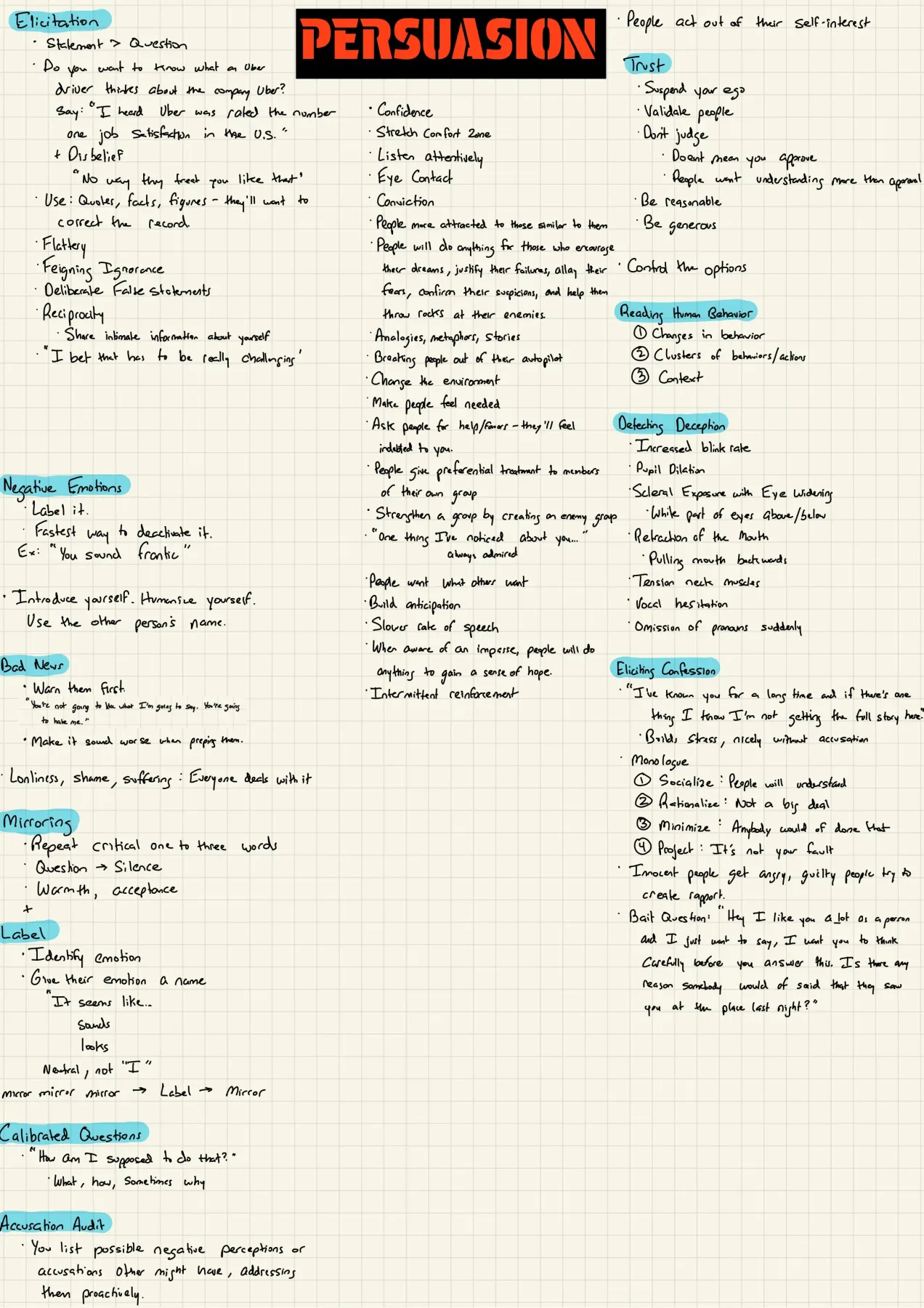
Mind Map — Understanding and Influencing Others
- Understanding and Influencing Others (Core Goal Across Sources)
- Building Rapport and Connection (Foundation for Influence)
- What it is: Bond, trust, being in sync, feeling valued/heard
- Why it’s important: People listen when they feel cared for, facilitates success, generates voluntary compliance, helps manage differences.
- Key Techniques:
- Focus on the Other Person
- See things from their point of view (Empathy)
- Make them feel important
- Let them talk
- Validate and appreciate their thoughts/feelings
- Communication Skills
- Listening (Active, Deep) - an “unnatural act” that requires artistry.
- Asking Questions (Calibrated, Open-ended) - digs deep, transforms conflict.
- Labeling Emotions - “Don’t feel their pain, label it”.
- Paraphrasing and Summarizing
- Aim for “That’s Right” - signifies understanding. Avoid “You’re right”.
- Using Simple, Clear Language
- Using Metaphors - provides a visual/visceral sense of purpose.
- Nonverbal Communication (How you “are”)
- Presence - paying attention, makes others feel listened to/respected/valued.
- Body Language / Demeanor - telegraphs internal state. Congruence is key.
- Smiling
- Mirroring / Isopraxism - subtly copying activates trust. “Be a Mirror”.
- Eye Contact - degree and tension impact perception.
- Removing Barriers
- Psychological Principles
- Reciprocity - giving creates a need to reciprocate.
- Similarity - people are drawn to similarity.
- Respect Autonomy - expand yours and don’t impinge on theirs.
- Focus on the Other Person
- Understanding Human Behavior & Decision Making
- Emotions and Rationality - emotions can infect ideas/decisions, narrow the mind. Calm spirit allows for wider options.
- Cognitive Biases and Blunders - people are not always rational maximizers. Examples: Anchoring, Loss Aversion, Status Quo Bias, Planning Fallacy.
- Dual Process Theories (System 1/2) - fast, intuitive thinking vs. slow, deliberative thinking.
- The Power of the Unconscious - suggestions can be accepted without examination.
- The Role of Imagination - mind affects body, imagination impacts body language/charisma. Brain has trouble distinguishing imagination from reality.
- Self-Perception and Self-Opinion - confirming self-opinion has a loosening-up effect. People crave acceptance.
- Negativity Bias - brain reacts strongly to negative information. Neutralizing negative emotions is important.
- Need for Control/Autonomy - obstacles can limit our own autonomy and impinge on others’. Empower others with choices.
- Negotiation and Influence Tactics (Applying Understanding)
- Preparation - Prepare on Process, Substance, and Emotion. Use the Seven Elements of Negotiation. Prepare a Negotiation One Sheet outlining goal, summary (“That’s right”), labels/accusation audit.
- Generating Options - invent options before deciding. Conduct joint brainstorming. Present options skillfully (Art of Mediation).
- Asking for What You Want - Frame in terms of what they gain or lose.
- Managing Difficult Emotions - They happen, be ready. Joint brainstorming can help in emotionally heated conflicts like divorce. Labeling helps absorb tension.
- Dealing with Resistance - Anticipate resistance and stubbornness.
- Leveraging Psychological Principles:
- Generating Reasons - Consider ease of generating reasons. Asking for many reasons for a rival can help you.
- Using “Because” - strengthens persuasion attempts.
- Commitment and Consistency - Active vs. Passive commitment.
- Internal State and Self-Management
- Knowing Thyself - understanding your own emotions and motivations.
- Creating Optimal Mental States - Crucial for charisma. Visualization helps create the right state and body language.
- Practicing Gratitude, Goodwill, Compassion - Increases warmth and confidence.
- Managing Anxiety - Create a ladder of descending goals, break tasks into microgoals.
- Handling Negative Emotions - Question their origin, they lose hold.
- Focusing Your Mind - Mental filtering based on priorities and long-term goals. Avoid getting lost in details.
- Skepticism and Curiosity - Maintain a balance; question evidence but remain open to wild ideas.
- Self-Compassion
- Decision Making Environments (Choice Architecture / Nudging)
- Design choices to help people make better decisions.
- Key Principles: Defaults, Mapping, Feedback, Incentives, Structuring Complex Choices, Reminders, Intelligent Assignment.
- Awareness of Influence - Minimize distractions when stakes are high to make accurate evaluations and resist deceptive tactics. People are more inclined to believe others’ claims when low on cognitive resources.
- Specific Tools & Concepts Mentioned
- Seven Elements of Negotiation
- Negotiation One Sheet
- Accusation Audit
- Calibrated Questions
- Labels
- “That’s Right”
- Mirroring
- Isopraxism
- Empathic Statements
- The Platinum Rule (Give others what they want) - Mentioned in bibliography, relates to seeing things from their perspective.
- Recap (Record, Evaluate, Compare Alternative Prices) - Tool for transparency.
- Road Map Metaphor
- Building Rapport and Connection (Foundation for Influence)
This structure attempts to consolidate the various concepts from the sources into related branches, highlighting the core ideas and their supporting techniques and principles.
Connected Book Sections
- Meta-programs for rapport and flexible communication
- Narcissistic manipulation and countermeasures
- Facial expression, masked emotion, and context limits
- Undue influence and restoring independent judgment
Auto-index
Base index
Influence Negotiation.base (file not included in this release)
- 60.17.1 Books
- Beyond Reason - Using Emotions as You Negotiate
- Cracking the Code - How to Win Hearts, Change Minds, and Restore America's Original Vision
- Difficult Conversations - How to Discuss what Matters Most
- Effective Presentation Skills
- Friend of a Friend
- Getting Past No
- Getting to Yes - Negotiating Agreement Without Giving In
- How Real Is Real
- How to Talk to Anyone About Anything - James W Williams
- How to Win Friends & Influence People
- I'll Make You an Offer You Can't Refuse by Michael Franzese
- Influence - The Psychology of Persuasion
- MasterClass - The Art of a Negotiation
- Mirroring People - The New Science of How We Connect with Others
- Never Eat Alone - Keith Ferrazzi Tahl Raz
- Never Split the Difference
- Pitch Anything
- Powerful Phrases for Dealing with Difficult People - Renee Evenson
- Spy the Lie - Mike Floyd Philip Houston Susan Carnicero
- Storytellers
- Superconnector - Scott Gerber Ryan Paugh
- Surrounded by Narcissist
- Talk Your Way to the Top
- The 48 Laws of Power
- The Art of Seduction - Robert Greene
- The Leader's Guide to Storytelling - Mastering the Art and Discipline of Business Narrative
- The Like Switch
- Words That Change Minds - Mastering the Language of Influence
- Common Manipulation Tactics
- Consumer Networks as Ideological Institutions
- Demoralization
- Emotional Manipulation
- Insinuation
- Key Points of Influence & Rapport
- KGB Defector Yuri Bezmenov 1985 Interview. Explains KGB Manipulation of US Public Opinion
- Psychological Inoculation Theory
- Reflexive Control
- Semantic overload - Wikipedia
- Shut up about Cultural Marxism by LazerPig
- subversion
- Tactics
- The 18 Tactics Tucker and Candace Use to Manipulate You - Jeremy Boreing